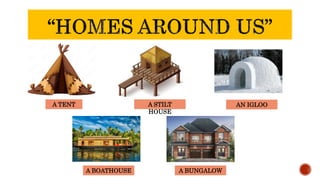
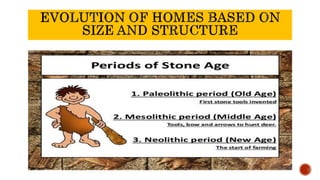
A TENT A STILT
HOUSE
AN IGLOO
A BOATHOUSE A BUNGALOW
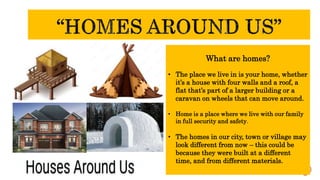
What are homes?
• The place we live in is your home, whether
it’s a house with four walls and a roof, a
flat that’s part of a larger building or a
caravan on wheels that can move around.
• Home is a place where we live with our family
in full security and safety.
• The homes in our city, town or village may
look different from now – this could be
because they were built at a different
time, and from different materials.
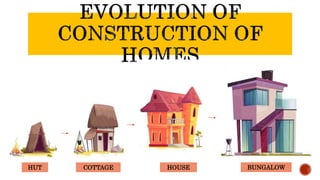
HUT COTTAGE HOUSE BUNGALOW
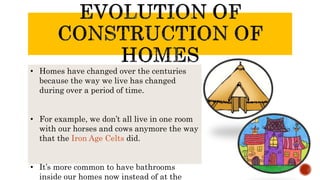
• Homes have changed over the centuries
because the way we live has changed
during over a period of time.
• For example, we don’t all live in one room
with our horses and cows anymore the way
that the Iron Age Celts did.
• It’s more common to have bathrooms
inside our homes now instead of at the
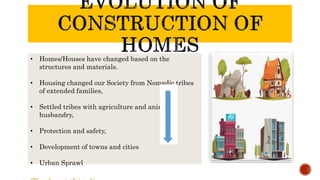
• Homes/Houses have changed based on the
structures and materials.
• Housing changed our Society from Nomadic tribes
of extended families,
• Settled tribes with agriculture and animal
husbandry,
• Protection and safety,
• Development of towns and cities
• Urban Sprawl
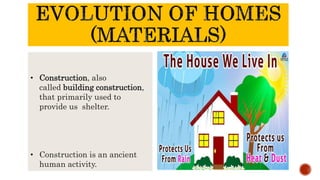
• Construction, also
called building construction,
that primarily used to
provide us shelter.
• Construction is an ancient
human activity.
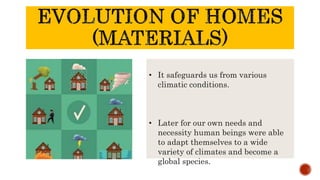
• It safeguards us from various
climatic conditions.
• Later for our own needs and
necessity human beings were able
to adapt themselves to a wide
variety of climates and become a
global species.
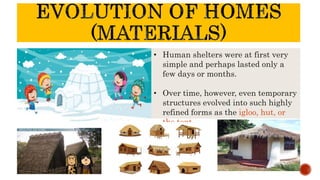
• Human shelters were at first very
simple and perhaps lasted only a
few days or months.
• Over time, however, even temporary
structures evolved into such highly
refined forms as the igloo, hut, or
the tent.
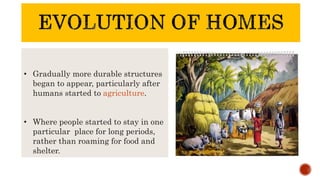
• Gradually more durable structures
began to appear, particularly after
humans started to agriculture.
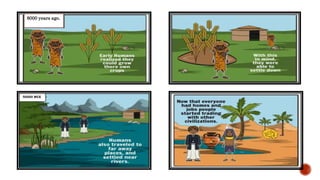
• Where people started to stay in one
particular place for long periods,
rather than roaming for food and
shelter.
8000 years ago.
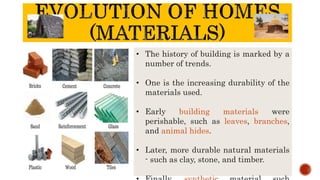
• The history of building is marked by a
number of trends.
• One is the increasing durability of the
materials used.
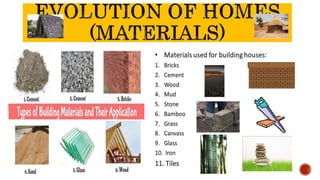
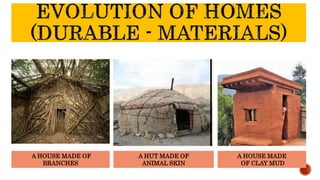
• Early building materials were
perishable, such as leaves, branches,
and animal hides.
• Later, more durable natural materials
- such as clay, stone, and timber.
A HUT MADE OF
ANIMAL SKIN
A HOUSE MADE OF
BRANCHES
A HOUSE MADE
OF CLAY MUD
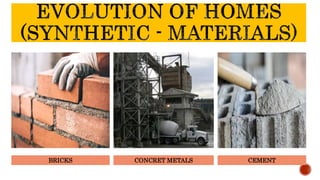
CONCRET METALS
BRICKS CEMENT
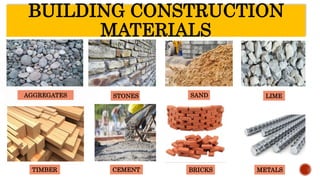
BUILDING CONSTRUCTION
MATERIALS
AGGREGATES STONES
METALS
SAND LIME
CEMENT BRICKS
TIMBER
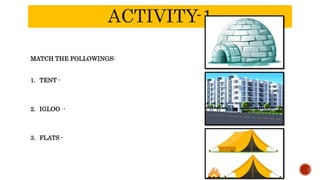
MATCH THE FOLLOWINGS:
1. TENT -
2. IGLOO -
3. FLATS -
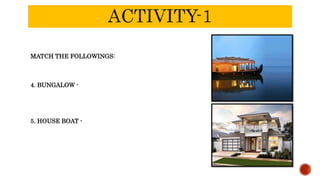
MATCH THE FOLLOWINGS:
4. BUNGALOW -
5. HOUSE BOAT -
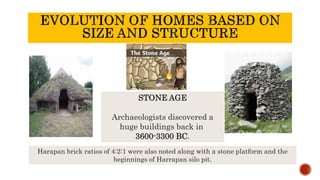
STONE AGE
Archaeologists discovered a
huge buildings back in
3600-3300 BC.
Harapan brick ratios of 4:2:1 were also noted along with a stone platform and the
beginnings of Harrapan silo pit.
STONE AGE
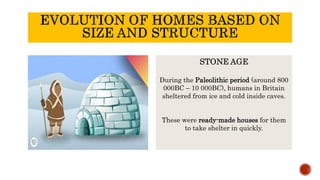
During the Paleolithic period (around 800
000BC – 10 000BC), humans in Britain
sheltered from ice and cold inside caves.
These were ready-made houses for them
to take shelter in quickly.
STONE AGE
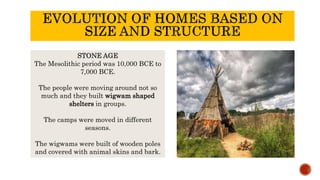
The Mesolithic period was 10,000 BCE to
7,000 BCE.
The people were moving around not so
much and they built wigwam shaped
shelters in groups.
The camps were moved in different
seasons.
The wigwams were built of wooden poles
and covered with animal skins and bark.
STONE AGE
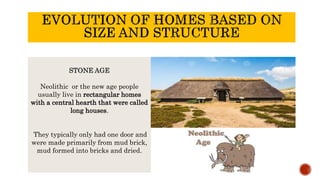
Neolithic or the new age people
usually live in rectangular homes
with a central hearth that were called
long houses.
They typically only had one door and
were made primarily from mud brick,
mud formed into bricks and dried.
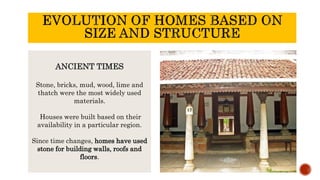
ANCIENT TIMES
Stone, bricks, mud, wood, lime and
thatch were the most widely used
materials.
Houses were built based on their
availability in a particular region.
Since time changes, homes have used
stone for building walls, roofs and
floors.
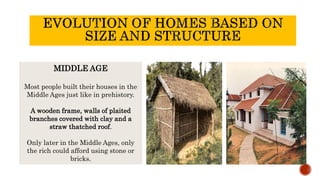
MIDDLE AGE
Most people built their houses in the
Middle Ages just like in prehistory.
A wooden frame, walls of plaited
branches covered with clay and a
straw thatched roof.
Only later in the Middle Ages, only
the rich could afford using stone or
bricks.
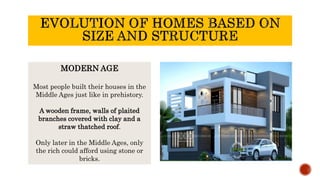
MODERN AGE
Most people built their houses in the
Middle Ages just like in prehistory.
A wooden frame, walls of plaited
branches covered with clay and a
straw thatched roof.
Only later in the Middle Ages, only
the rich could afford using stone or
bricks.
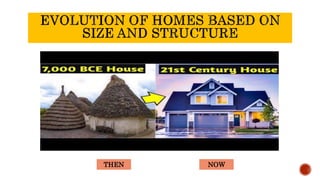
THEN NOW
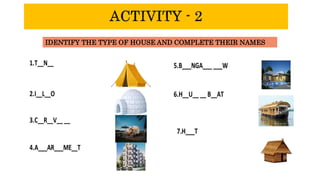
IDENTIFY THE TYPE OF HOUSE AND COMPLETE THEIR NAMES
 https://www.dreamstime.com/illustration/housing-evolution.html
 https://www.canstockphoto.com/architectural-housing-evolution-set-
93522257.html
 https://www.britannica.com/technology/construction/Roman-
achievements
 https://www.re-thinkingthefuture.com/rtf-fresh-perspectives/a1537-
evolution-of-housing-in-
india/#5e364bfc67f770dc39d4d8c5b9c4ca8f4f7ec81c#143921
 https://www.topperlearning.com/doubts-solutions/what-are-huts-
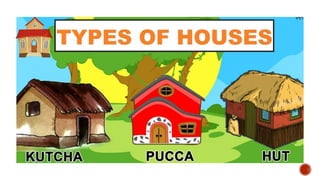
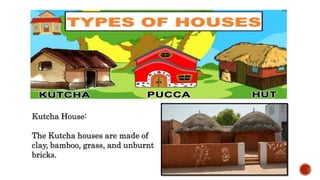
Kutcha House:
The Kutcha houses are made of
clay, bamboo, grass, and unburnt
bricks.
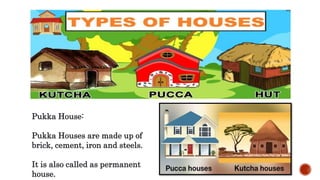
Pukka House:
Pukka Houses are made up of
brick, cement, iron and steels.
It is also called as permanent
house.
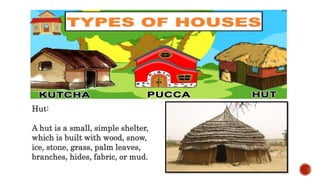
Hut:
A hut is a small, simple shelter,
which is built with wood, snow,
ice, stone, grass, palm leaves,
branches, hides, fabric, or mud.
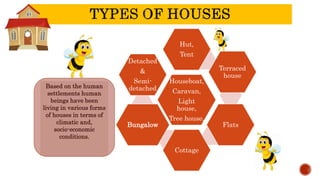
Based on the human
settlements human
beings have been
living in various forms
of houses in terms of
climatic and,
socio-economic
conditions.
Houseboat,
Caravan,
Light
house,
Tree house,
Hut,
Tent
Terraced
house
Flats
Cottage
Bungalow
Detached
&
Semi-
detached
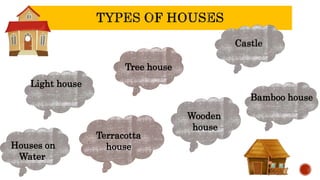
Houses on
Water
Castle
Light house
Tree house
Wooden
house
Bamboo house
Terracotta
house
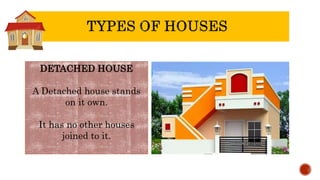
DETACHED HOUSE
A Detached house stands
on it own.
It has no other houses
joined to it.
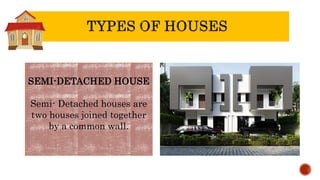
SEMI-DETACHED HOUSE
Semi- Detached houses are
two houses joined together
by a common wall.
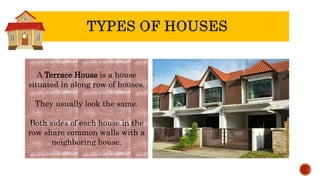
A Terrace House is a house
situated in along row of houses.
They usually look the same.
Both sides of each house in the
row share common walls with a
neighboring house.
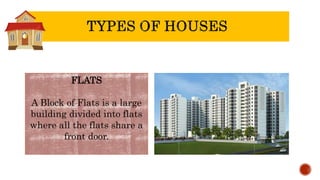
FLATS
A Block of Flats is a large
building divided into flats
where all the flats share a
front door.
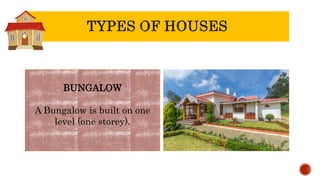
BUNGALOW
A Bungalow is built on one
level (one storey).
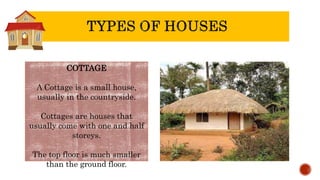
COTTAGE
A Cottage is a small house,
usually in the countryside.
Cottages are houses that
usually come with one and half
storeys.
The top floor is much smaller
than the ground floor.
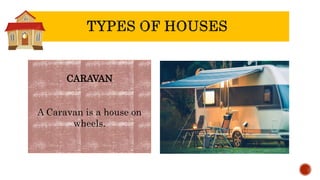
CARAVAN
A Caravan is a house on
wheels.
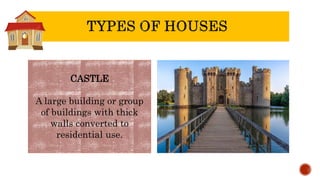
CASTLE
A large building or group
of buildings with thick
walls converted to
residential use.
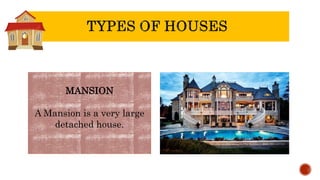
MANSION
A Mansion is a very large
detached house.
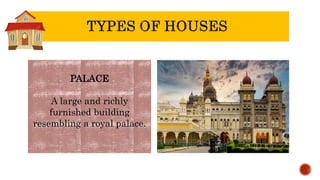
PALACE
A large and richly
furnished building
resembling a royal palace.
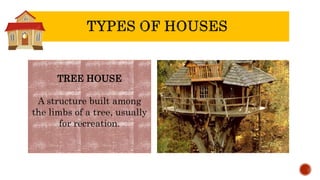
TREE HOUSE
A structure built among
the limbs of a tree, usually
for recreation.
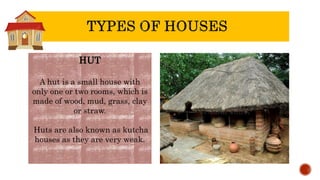
HUT
A hut is a small house with
only one or two rooms, which is
made of wood, mud, grass, clay
or straw.
Huts are also known as kutcha
houses as they are very weak.
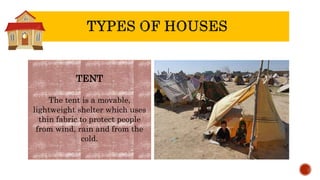
TENT
The tent is a movable,
lightweight shelter which uses
thin fabric to protect people
from wind, rain and from the
cold.
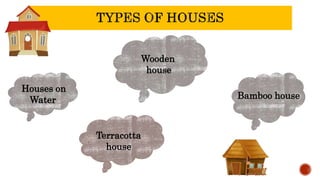
Houses on
Water
Wooden
house
Bamboo house
Terracotta
house
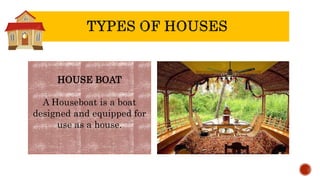
HOUSE BOAT
A Houseboat is a boat
designed and equipped for
use as a house.
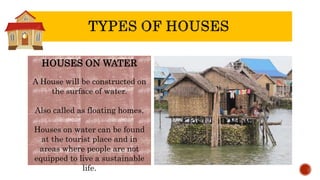
HOUSES ON WATER
A House will be constructed on
the surface of water.
Also called as floating homes.
Houses on water can be found
at the tourist place and in
areas where people are not
equipped to live a sustainable
life.
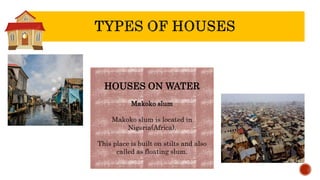
HOUSES ON WATER
Makoko slum
Makoko slum is located in
Nigeria(Africa).
This place is built on stilts and also
called as floating slum.
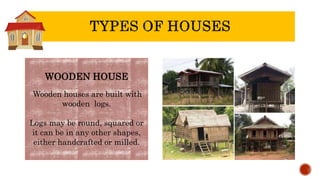
WOODEN HOUSE
Wooden houses are built with
wooden logs.
Logs may be round, squared or
it can be in any other shapes,
either handcrafted or milled.
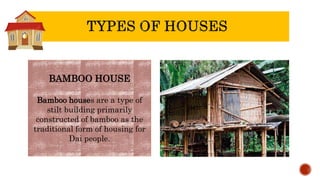
BAMBOO HOUSE
Bamboo houses are a type of
stilt building primarily
constructed of bamboo as the
traditional form of housing for
Dai people.
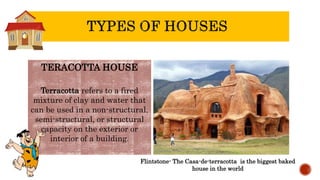
TERACOTTA HOUSE
Terracotta refers to a fired
mixture of clay and water that
can be used in a non-structural,
semi-structural, or structural
capacity on the exterior or
interior of a building.
Flintstone- The Casa-de-terracotta is the biggest baked
house in the world
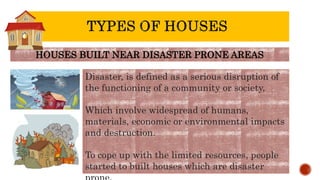
HOUSES BUILT NEAR DISASTER PRONE AREAS
Disaster, is defined as a serious disruption of
the functioning of a community or society,
Which involve widespread of humans,
materials, economic or environmental impacts
and destruction.
To cope up with the limited resources, people
started to built houses which are disaster
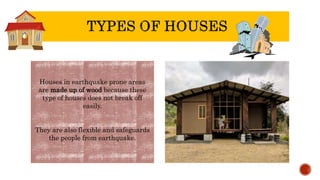
Houses in earthquake prone areas
are made up of wood because these
type of houses does not break off
easily.
They are also flexible and safeguards
the people from earthquake.
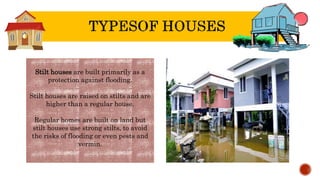
Stilt houses are built primarily as a
protection against flooding.
Stilt houses are raised on stilts and are
higher than a regular house.
Regular homes are built on land but
stilt houses use strong stilts, to avoid
the risks of flooding or even pests and
vermin.
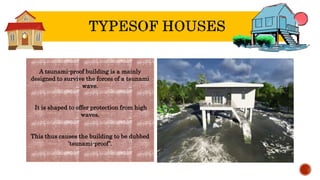
A tsunami-proof building is a mainly
designed to survive the forces of a tsunami
wave.
It is shaped to offer protection from high
waves.
This thus causes the building to be dubbed
'tsunami-proof’.
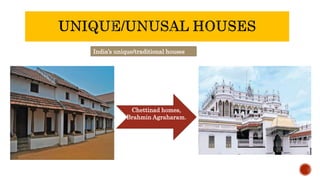
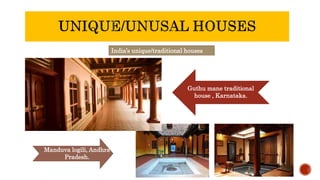
India’s unique/traditional houses
Chettinad homes,
Brahmin Agraharam.
.
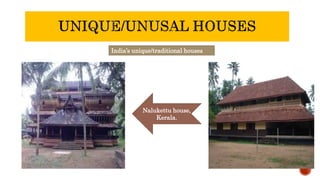
India’s unique/traditional houses
.
Nalukettu house,
Kerala.
India’s unique/traditional houses
Guthu mane traditional
house , Karnataka.
Manduva logili, Andhra
Pradesh.
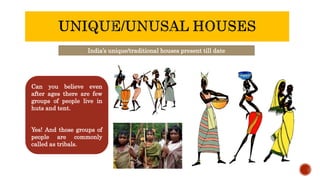
India’s unique/traditional houses present till date
Can you believe even
after ages there are few
groups of people live in
huts and tent.
Yes! And those groups of
people are commonly
called as tribals.
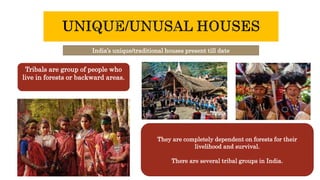
India’s unique/traditional houses present till date
Tribals are group of people who
live in forests or backward areas.
They are completely dependent on forests for their
livelihood and survival.
There are several tribal groups in India.
India’s unique/traditional houses present till date
• The most commonly known tribes of India are Gonds,
Bhils, Santhal, Munda, Khasi, Garo, Angami, Bhutia,
Chenchu, Kodaba, and the Great Andamanese Tribes.
• As they keep moving from one place to the another, for
living these tribals groups do not have a permanent place.
• Their main occupation is cattle rearing for which they
need availability of water and pastures for grazing their
animals.
• When the pastures get depleted, they move to another
place with their animals, looking for pasture and water.
India’s unique/traditional houses present till date
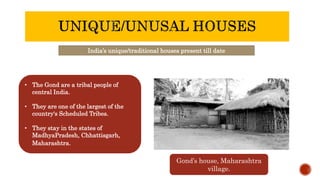
• The Gond are a tribal people of
central India.
• They are one of the largest of the
country's Scheduled Tribes.
• They stay in the states of
MadhyaPradesh, Chhattisgarh,
Maharashtra.
Gond’s house, Maharashtra
village.
India’s unique/traditional houses present till date
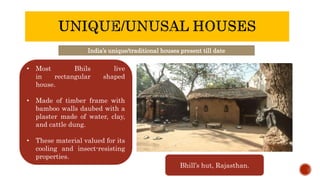
• Most Bhils live
in rectangular shaped
house.
• Made of timber frame with
bamboo walls daubed with a
plaster made of water, clay,
and cattle dung.
• These material valued for its
cooling and insect-resisting
properties.
Bhill’s hut, Rajasthan.
India’s unique/traditional houses present till date
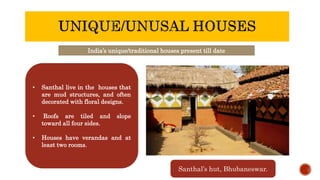
• Santhal live in the houses that
are mud structures, and often
decorated with floral designs.
• Roofs are tiled and slope
toward all four sides.
• Houses have verandas and at
least two rooms.
Santhal’s hut, Bhubaneswar.
India’s unique/traditional houses present till date
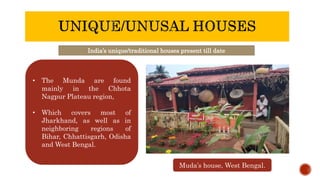
• The Munda are found
mainly in the Chhota
Nagpur Plateau region,
• Which covers most of
Jharkhand, as well as in
neighboring regions of
Bihar, Chhattisgarh, Odisha
and West Bengal.
Muda’s house, West Bengal.
India’s unique/traditional houses present till date
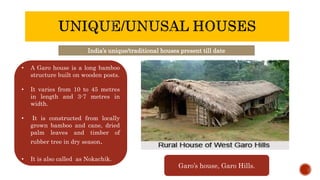
• A Garo house is a long bamboo
structure built on wooden posts.
• It varies from 10 to 45 metres
in length and 3-7 metres in
width.
• It is constructed from locally
grown bamboo and cane, dried
palm leaves and timber of
rubber tree in dry season.
• It is also called as Nokachik.
Garo’s house, Garo Hills.
India’s unique/traditional houses present till date
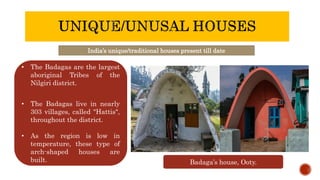
• The Badagas are the largest
aboriginal Tribes of the
Nilgiri district.
• The Badagas live in nearly
303 villages, called "Hattis",
throughout the district.
• As the region is low in
temperature, these type of
arch-shaped houses are
built. Badaga’s house, Ooty.
India’s unique/traditional houses present till date
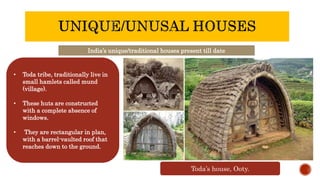
• Toda tribe, traditionally live in
small hamlets called mund
(village).
• These huts are constructed
with a complete absence of
windows.
• They are rectangular in plan,
with a barrel-vaulted roof that
reaches down to the ground.
Toda’s house, Ooty.
India’s unique/traditional houses present till date
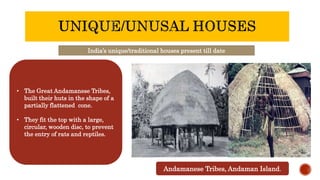
• The Great Andamanese Tribes,
built their huts in the shape of a
partially flattened cone.
• They fit the top with a large,
circular, wooden disc, to prevent
the entry of rats and reptiles.
Andamanese Tribes, Andaman Island.
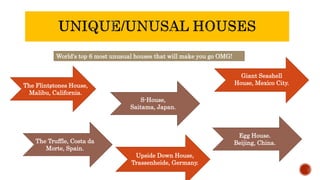
World's top 6 most unusual houses that will make you go OMG!
The Flintstones House,
Malibu, California.
Giant Seashell
House, Mexico City.
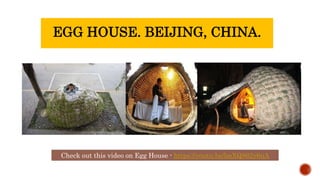
Egg House.
Beijing, China.
.
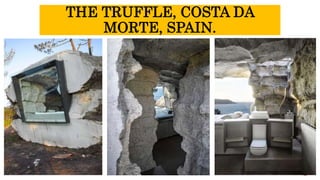
The Truffle, Costa da
Morte, Spain.
S-House,
Saitama, Japan.
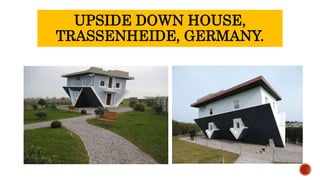
Upside Down House,
Trassenheide, Germany.
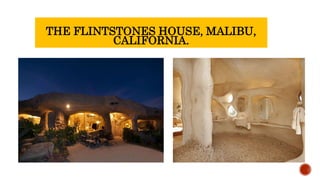
THE FLINTSTONES HOUSE, MALIBU,
CALIFORNIA.
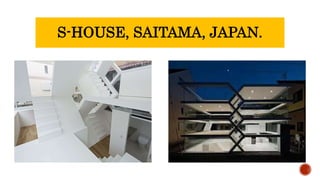
S-HOUSE, SAITAMA, JAPAN.
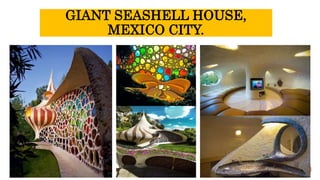
GIANT SEASHELL HOUSE,
MEXICO CITY.
THE TRUFFLE, COSTA DA
MORTE, SPAIN.
UPSIDE DOWN HOUSE,
TRASSENHEIDE, GERMANY.
EGG HOUSE. BEIJING, CHINA.
Check out this video on Egg House - https://youtu.be/lmXQ862y6uA
• https://wonderfulengineering.com/flintstone-looking-casa-terracota-is-the-biggest-baked-
house-in-the-world/
• https://www.indiatvnews.com/buzz/news-world-s-top-6-most-unusual-houses-that-will-
make-you-go-omg-443185
• https://k-render.com/top-10-best-south-indian-traditional-houses/
• https://www.badugaa.com/2015/01/badugar-history.html
• https://www.wallswithstories.com/ancient/toda-tribe.html
• Check out - https://youtu.be/Bb5sy2pgQAo
• Types of House Video - https://youtu.be/udwdInzAe88
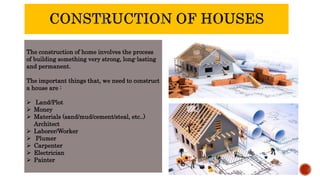
The construction of home involves the process
of building something very strong, long-lasting
and permanent.
The important things that, we need to construct
a house are :
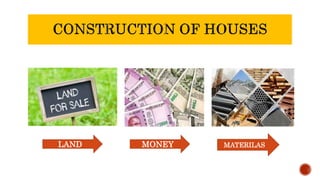
 Land/Plot
 Money
 Materials (sand/mud/cement/steal, etc..)
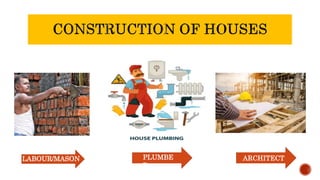
Architect
 Laborer/Worker
 Plumer
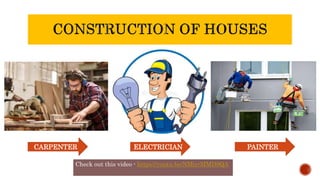
 Carpenter
 Electrician
 Painter
LAND MONEY MATERILAS
LABOUR/MASON ARCHITECT
PLUMBE
R
Check out this video - https://youtu.be/NMirrMMD9QA
CARPENTER ELECTRICIAN PAINTER
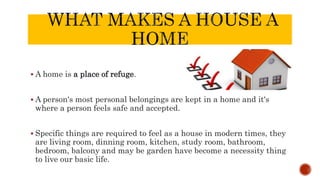
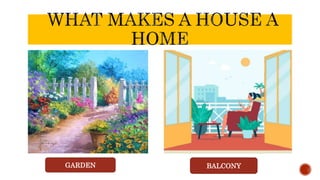
 A home is a place of refuge.
 A person's most personal belongings are kept in a home and it's
where a person feels safe and accepted.
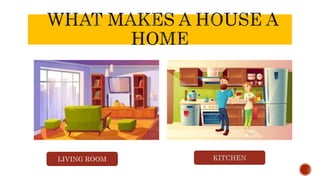
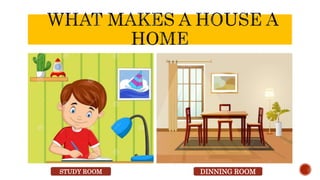
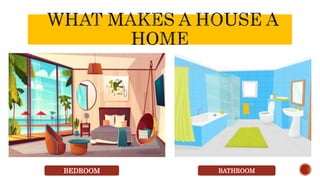
 Specific things are required to feel as a house in modern times, they
are living room, dinning room, kitchen, study room, bathroom,
bedroom, balcony and may be garden have become a necessity thing
to live our basic life.
STUDY ROOM DINNING ROOM
BEDROOM BATHROOM
GARDEN BALCONY
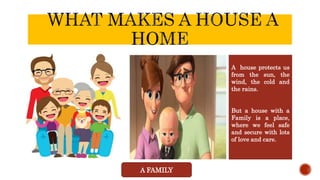
A FAMILY
A house protects us
from the sun, the
wind, the cold and
the rains.
But a house with a
Family is a place,
where we feel safe
and secure with lots
of love and care.
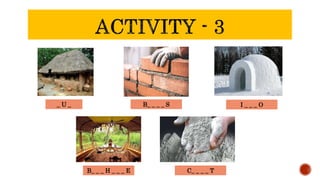
_ U _ B_ _ _ _ S I _ _ _ O
B_ _ _ H _ _ _ E C_ _ _ _ T
By
R PAVITHRA

Social Science - Homes Around Us.pptx

  • 2.
    A TENT ASTILT HOUSE AN IGLOO A BOATHOUSE A BUNGALOW
  • 3.
    What are homes? •The place we live in is your home, whether it’s a house with four walls and a roof, a flat that’s part of a larger building or a caravan on wheels that can move around. • Home is a place where we live with our family in full security and safety. • The homes in our city, town or village may look different from now – this could be because they were built at a different time, and from different materials.
  • 4.
  • 5.
    • Homes havechanged over the centuries because the way we live has changed during over a period of time. • For example, we don’t all live in one room with our horses and cows anymore the way that the Iron Age Celts did. • It’s more common to have bathrooms inside our homes now instead of at the
  • 6.
    • Homes/Houses havechanged based on the structures and materials. • Housing changed our Society from Nomadic tribes of extended families, • Settled tribes with agriculture and animal husbandry, • Protection and safety, • Development of towns and cities • Urban Sprawl
  • 7.
    • Construction, also calledbuilding construction, that primarily used to provide us shelter. • Construction is an ancient human activity.
  • 8.
    • It safeguardsus from various climatic conditions. • Later for our own needs and necessity human beings were able to adapt themselves to a wide variety of climates and become a global species.
  • 9.
    • Human shelterswere at first very simple and perhaps lasted only a few days or months. • Over time, however, even temporary structures evolved into such highly refined forms as the igloo, hut, or the tent.
  • 10.
    • Gradually moredurable structures began to appear, particularly after humans started to agriculture. • Where people started to stay in one particular place for long periods, rather than roaming for food and shelter.
  • 11.
  • 13.
    • The historyof building is marked by a number of trends. • One is the increasing durability of the materials used. • Early building materials were perishable, such as leaves, branches, and animal hides. • Later, more durable natural materials - such as clay, stone, and timber.
  • 14.
    A HUT MADEOF ANIMAL SKIN A HOUSE MADE OF BRANCHES A HOUSE MADE OF CLAY MUD
  • 15.
  • 16.
  • 17.
    MATCH THE FOLLOWINGS: 1.TENT - 2. IGLOO - 3. FLATS -
  • 18.
    MATCH THE FOLLOWINGS: 4.BUNGALOW - 5. HOUSE BOAT -
  • 20.
    STONE AGE Archaeologists discovereda huge buildings back in 3600-3300 BC. Harapan brick ratios of 4:2:1 were also noted along with a stone platform and the beginnings of Harrapan silo pit.
  • 22.
    STONE AGE During thePaleolithic period (around 800 000BC – 10 000BC), humans in Britain sheltered from ice and cold inside caves. These were ready-made houses for them to take shelter in quickly.
  • 23.
    STONE AGE The Mesolithicperiod was 10,000 BCE to 7,000 BCE. The people were moving around not so much and they built wigwam shaped shelters in groups. The camps were moved in different seasons. The wigwams were built of wooden poles and covered with animal skins and bark.
  • 24.
    STONE AGE Neolithic orthe new age people usually live in rectangular homes with a central hearth that were called long houses. They typically only had one door and were made primarily from mud brick, mud formed into bricks and dried.
  • 25.
    ANCIENT TIMES Stone, bricks,mud, wood, lime and thatch were the most widely used materials. Houses were built based on their availability in a particular region. Since time changes, homes have used stone for building walls, roofs and floors.
  • 26.
    MIDDLE AGE Most peoplebuilt their houses in the Middle Ages just like in prehistory. A wooden frame, walls of plaited branches covered with clay and a straw thatched roof. Only later in the Middle Ages, only the rich could afford using stone or bricks.
  • 27.
    MODERN AGE Most peoplebuilt their houses in the Middle Ages just like in prehistory. A wooden frame, walls of plaited branches covered with clay and a straw thatched roof. Only later in the Middle Ages, only the rich could afford using stone or bricks.
  • 28.
  • 29.
    IDENTIFY THE TYPEOF HOUSE AND COMPLETE THEIR NAMES
  • 30.
     https://www.dreamstime.com/illustration/housing-evolution.html  https://www.canstockphoto.com/architectural-housing-evolution-set- 93522257.html https://www.britannica.com/technology/construction/Roman- achievements  https://www.re-thinkingthefuture.com/rtf-fresh-perspectives/a1537- evolution-of-housing-in- india/#5e364bfc67f770dc39d4d8c5b9c4ca8f4f7ec81c#143921  https://www.topperlearning.com/doubts-solutions/what-are-huts-
  • 32.
    Kutcha House: The Kutchahouses are made of clay, bamboo, grass, and unburnt bricks.
  • 33.
    Pukka House: Pukka Housesare made up of brick, cement, iron and steels. It is also called as permanent house.
  • 34.
    Hut: A hut isa small, simple shelter, which is built with wood, snow, ice, stone, grass, palm leaves, branches, hides, fabric, or mud.
  • 35.
    Based on thehuman settlements human beings have been living in various forms of houses in terms of climatic and, socio-economic conditions. Houseboat, Caravan, Light house, Tree house, Hut, Tent Terraced house Flats Cottage Bungalow Detached & Semi- detached
  • 36.
    Houses on Water Castle Light house Treehouse Wooden house Bamboo house Terracotta house
  • 37.
    DETACHED HOUSE A Detachedhouse stands on it own. It has no other houses joined to it.
  • 38.
    SEMI-DETACHED HOUSE Semi- Detachedhouses are two houses joined together by a common wall.
  • 39.
    A Terrace Houseis a house situated in along row of houses. They usually look the same. Both sides of each house in the row share common walls with a neighboring house.
  • 40.
    FLATS A Block ofFlats is a large building divided into flats where all the flats share a front door.
  • 41.
    BUNGALOW A Bungalow isbuilt on one level (one storey).
  • 42.
    COTTAGE A Cottage isa small house, usually in the countryside. Cottages are houses that usually come with one and half storeys. The top floor is much smaller than the ground floor.
  • 43.
    CARAVAN A Caravan isa house on wheels.
  • 44.
    CASTLE A large buildingor group of buildings with thick walls converted to residential use.
  • 45.
    MANSION A Mansion isa very large detached house.
  • 46.
    PALACE A large andrichly furnished building resembling a royal palace.
  • 47.
    TREE HOUSE A structurebuilt among the limbs of a tree, usually for recreation.
  • 48.
    HUT A hut isa small house with only one or two rooms, which is made of wood, mud, grass, clay or straw. Huts are also known as kutcha houses as they are very weak.
  • 49.
    TENT The tent isa movable, lightweight shelter which uses thin fabric to protect people from wind, rain and from the cold.
  • 50.
  • 51.
    HOUSE BOAT A Houseboatis a boat designed and equipped for use as a house.
  • 52.
    HOUSES ON WATER AHouse will be constructed on the surface of water. Also called as floating homes. Houses on water can be found at the tourist place and in areas where people are not equipped to live a sustainable life.
  • 53.
    HOUSES ON WATER Makokoslum Makoko slum is located in Nigeria(Africa). This place is built on stilts and also called as floating slum.
  • 54.
    WOODEN HOUSE Wooden housesare built with wooden logs. Logs may be round, squared or it can be in any other shapes, either handcrafted or milled.
  • 55.
    BAMBOO HOUSE Bamboo housesare a type of stilt building primarily constructed of bamboo as the traditional form of housing for Dai people.
  • 56.
    TERACOTTA HOUSE Terracotta refersto a fired mixture of clay and water that can be used in a non-structural, semi-structural, or structural capacity on the exterior or interior of a building. Flintstone- The Casa-de-terracotta is the biggest baked house in the world
  • 57.
    HOUSES BUILT NEARDISASTER PRONE AREAS Disaster, is defined as a serious disruption of the functioning of a community or society, Which involve widespread of humans, materials, economic or environmental impacts and destruction. To cope up with the limited resources, people started to built houses which are disaster
  • 58.
    Houses in earthquakeprone areas are made up of wood because these type of houses does not break off easily. They are also flexible and safeguards the people from earthquake.
  • 59.
    Stilt houses arebuilt primarily as a protection against flooding. Stilt houses are raised on stilts and are higher than a regular house. Regular homes are built on land but stilt houses use strong stilts, to avoid the risks of flooding or even pests and vermin.
  • 60.
    A tsunami-proof buildingis a mainly designed to survive the forces of a tsunami wave. It is shaped to offer protection from high waves. This thus causes the building to be dubbed 'tsunami-proof’.
  • 61.
  • 62.
  • 63.
    India’s unique/traditional houses Guthumane traditional house , Karnataka. Manduva logili, Andhra Pradesh.
  • 64.
    India’s unique/traditional housespresent till date Can you believe even after ages there are few groups of people live in huts and tent. Yes! And those groups of people are commonly called as tribals.
  • 65.
    India’s unique/traditional housespresent till date Tribals are group of people who live in forests or backward areas. They are completely dependent on forests for their livelihood and survival. There are several tribal groups in India.
  • 66.
    India’s unique/traditional housespresent till date • The most commonly known tribes of India are Gonds, Bhils, Santhal, Munda, Khasi, Garo, Angami, Bhutia, Chenchu, Kodaba, and the Great Andamanese Tribes. • As they keep moving from one place to the another, for living these tribals groups do not have a permanent place. • Their main occupation is cattle rearing for which they need availability of water and pastures for grazing their animals. • When the pastures get depleted, they move to another place with their animals, looking for pasture and water.
  • 67.
    India’s unique/traditional housespresent till date • The Gond are a tribal people of central India. • They are one of the largest of the country's Scheduled Tribes. • They stay in the states of MadhyaPradesh, Chhattisgarh, Maharashtra. Gond’s house, Maharashtra village.
  • 68.
    India’s unique/traditional housespresent till date • Most Bhils live in rectangular shaped house. • Made of timber frame with bamboo walls daubed with a plaster made of water, clay, and cattle dung. • These material valued for its cooling and insect-resisting properties. Bhill’s hut, Rajasthan.
  • 69.
    India’s unique/traditional housespresent till date • Santhal live in the houses that are mud structures, and often decorated with floral designs. • Roofs are tiled and slope toward all four sides. • Houses have verandas and at least two rooms. Santhal’s hut, Bhubaneswar.
  • 70.
    India’s unique/traditional housespresent till date • The Munda are found mainly in the Chhota Nagpur Plateau region, • Which covers most of Jharkhand, as well as in neighboring regions of Bihar, Chhattisgarh, Odisha and West Bengal. Muda’s house, West Bengal.
  • 71.
    India’s unique/traditional housespresent till date • A Garo house is a long bamboo structure built on wooden posts. • It varies from 10 to 45 metres in length and 3-7 metres in width. • It is constructed from locally grown bamboo and cane, dried palm leaves and timber of rubber tree in dry season. • It is also called as Nokachik. Garo’s house, Garo Hills.
  • 72.
    India’s unique/traditional housespresent till date • The Badagas are the largest aboriginal Tribes of the Nilgiri district. • The Badagas live in nearly 303 villages, called "Hattis", throughout the district. • As the region is low in temperature, these type of arch-shaped houses are built. Badaga’s house, Ooty.
  • 73.
    India’s unique/traditional housespresent till date • Toda tribe, traditionally live in small hamlets called mund (village). • These huts are constructed with a complete absence of windows. • They are rectangular in plan, with a barrel-vaulted roof that reaches down to the ground. Toda’s house, Ooty.
  • 74.
    India’s unique/traditional housespresent till date • The Great Andamanese Tribes, built their huts in the shape of a partially flattened cone. • They fit the top with a large, circular, wooden disc, to prevent the entry of rats and reptiles. Andamanese Tribes, Andaman Island.
  • 75.
    World's top 6most unusual houses that will make you go OMG! The Flintstones House, Malibu, California. Giant Seashell House, Mexico City. Egg House. Beijing, China. . The Truffle, Costa da Morte, Spain. S-House, Saitama, Japan. Upside Down House, Trassenheide, Germany.
  • 76.
    THE FLINTSTONES HOUSE,MALIBU, CALIFORNIA.
  • 77.
  • 78.
  • 79.
    THE TRUFFLE, COSTADA MORTE, SPAIN.
  • 80.
  • 81.
    EGG HOUSE. BEIJING,CHINA. Check out this video on Egg House - https://youtu.be/lmXQ862y6uA
  • 82.
    • https://wonderfulengineering.com/flintstone-looking-casa-terracota-is-the-biggest-baked- house-in-the-world/ • https://www.indiatvnews.com/buzz/news-world-s-top-6-most-unusual-houses-that-will- make-you-go-omg-443185 •https://k-render.com/top-10-best-south-indian-traditional-houses/ • https://www.badugaa.com/2015/01/badugar-history.html • https://www.wallswithstories.com/ancient/toda-tribe.html • Check out - https://youtu.be/Bb5sy2pgQAo • Types of House Video - https://youtu.be/udwdInzAe88
  • 83.
    The construction ofhome involves the process of building something very strong, long-lasting and permanent. The important things that, we need to construct a house are :  Land/Plot  Money  Materials (sand/mud/cement/steal, etc..) Architect  Laborer/Worker  Plumer  Carpenter  Electrician  Painter
  • 84.
  • 85.
  • 86.
    Check out thisvideo - https://youtu.be/NMirrMMD9QA CARPENTER ELECTRICIAN PAINTER
  • 87.
     A homeis a place of refuge.  A person's most personal belongings are kept in a home and it's where a person feels safe and accepted.  Specific things are required to feel as a house in modern times, they are living room, dinning room, kitchen, study room, bathroom, bedroom, balcony and may be garden have become a necessity thing to live our basic life.
  • 89.
  • 90.
  • 91.
  • 92.
    A FAMILY A houseprotects us from the sun, the wind, the cold and the rains. But a house with a Family is a place, where we feel safe and secure with lots of love and care.
  • 93.
    _ U _B_ _ _ _ S I _ _ _ O B_ _ _ H _ _ _ E C_ _ _ _ T
  • 94.