Housekeeping
Importance of Housekeeping Department Cleanliness of hotel
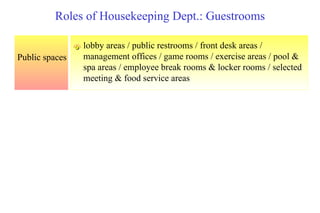
Roles of Housekeeping Dept.: Guestrooms Public spaces lobby areas / public restrooms / front desk areas / management offices / game rooms / exercise areas / pool & spa areas / employee break rooms & locker rooms / selected meeting & food service areas
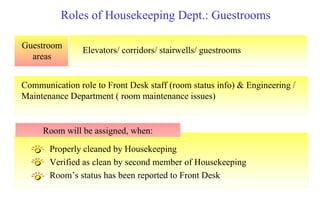
Roles of Housekeeping Dept.: Guestrooms Room will be assigned, when: Guestroom areas Properly cleaned by Housekeeping Verified as clean by second member of Housekeeping Room’s status has been reported to Front Desk Elevators/ corridors/ stairwells/ guestrooms Communication role to Front Desk staff (room status info) & Engineering / Maintenance Department ( room maintenance issues)
Roles of Housekeeping Dept.: Guestrooms (continued…) Room status terminology Clean & Vacant  Room vacant, has been cleaned and can be assigned to guest Occupied Room registered to a current guest On-Change Room vacant but not yet cleaned Do not disturb Room is occupied but not yet cleaned, due to guest request not to be disturbed Sleep-out Room reported as occupied, but room was not used, and guest may have left Stay-over Guest will stay in room at least one more night
Roles of Housekeeping Dept.: Guestrooms (continued…) Room status terminology (continued…) Due-out Guest has indicated that is last day he/she will use room Check-out Guest has departed Out-of-order Room is not rentable, thus not assignable  Lock-out Guest’s items still in room, but guest will be denied access until management approval of re-entry Late check-out Guest has requested and has been allowed an extension of regular check out time
Roles of Housekeeping Dept: Laundry  Housekeeping Dept. & Executive Housekeeper’s role Laundry areas laundry preparation areas/ laundry supply closets/ guest linen, terry and supplies storage areas Managing “On Premise Laundry (OPL)” and  its effective operation Laundry often represents one of the hotel’s largest expenses.
Organization Chart for a Housekeeping Department, Large Hotel with In-house Laundry Executive  Housekeeper Assistant Supervisor Floor Supervisor Room Attendant – AM Shift Laundry Supervisor Laundry Attendant – AM Shift Room Attendant – PM Shift Laundry Attendant – PM Shift Public Area Attendant
Staffing the Department Executive Housekeeper should: Room Inspector’s major responsibilities: Assess quality of room cleanliness Point out deficiencies to room attendants, get those deficiencies corrected, & report revision of room status to Executive Housekeeper or Front Desk  have management skills (planning, organizing, directing and controlling departmental activities).  have commitment to cleanliness and impeccable cleaning standard. create an appropriate inspection checklist and revise it as necessary. know about personal administration, budgeting, laundry sanitation, fabrics & uniforms, room cleaning chemicals and routines. be guest oriented.
Staffing the Department (Continued…) Approaches to build highly motivated, dedicated Room Attendants: Treat them at all times with respect Ensure they are supervised by excellent supervisors Have room cleaning assignment policies perceived by them as fair  Provide excellent, ongoing training Provide a realistic career ladder for room attendants Enforce Housekeeping Department policies consistently and without favoritism Ensure room attendant safety through training and appropriate hotel policies Provide benefit packages that are competitive for the area Pay fair wages
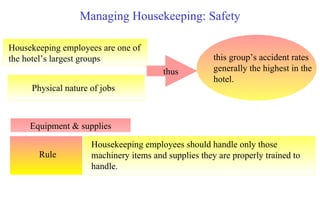
Managing Housekeeping: Safety Equipment & supplies Housekeeping employees are one of the hotel’s largest groups Physical nature of jobs this group’s accident rates generally the highest in the hotel. thus Rule Housekeeping employees should handle only those machinery items and supplies they are properly trained to handle.
Managing Housekeeping: Safety Areas of training concern Chemical handling Cleaning procedures Correct lifting techniques Properly entering guestrooms Contending with guestrooms containing: firearms/ uncaged animals/ individuals perceived as threatening/ ill or unconscious guests/ drugs and drug paraphernalia / blood and potential bloodborne pathogens Guest service Guestroom security Lost & Found procedures
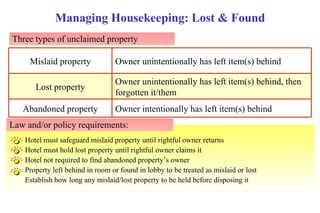
Managing Housekeeping: Lost & Found Three types of unclaimed property Law and/or policy requirements: Hotel must safeguard mislaid property until rightful owner returns Hotel must hold lost property until rightful owner claims it Hotel not required to find abandoned property’s owner Property left behind in room or found in lobby to be treated as mislaid or lost Establish how long any mislaid/lost property to be held before disposing it Mislaid property Owner unintentionally has left item(s) behind Lost property Owner unintentionally has left item(s) behind, then forgotten it/them Abandoned property Owner intentionally has left item(s) behind
Managing Housekeeping: Lost & Found (continued…) Written report  When returned to rightful owner, or disposed of Date item is returned Owner’s name/ address/ phone Housekeeping Manager returning item Method of return Date property is declared as abandoned Name of hotel employee receiving abandoned property  Date item is found Description of item Location where item is found (room #, if applicable) Name of finder Supervisor who receives item When item is found
Facility Care & Cleansing Public space cleaning Guestroom cleaning Effective guestroom cleaning is heart of Housekeeping Department Determines long-term success or failure of property Sleeping area: the first part seen by guest when entering room Bathroom area: closely inspected by guests for cleanliness Forms basis for a guest’s initial impression of property
Facility Care & Cleansing (continued…) G.M.s’ roles in facility care and cleaning G.M.s should know what to look for when inspecting the hotel G.M.s must inspect public space, guestroom and laundry  operation areas regularly G.M.s should not evaluate effectiveness of their  housekeeping departments based only on lower costs per  occupied room or fewer minutes per room cleaning (these factors are not always better!)
Operating an effective “on-premises laundry” is a multi-step process Laundry Collecting Delivering Sorting Watching Drying Finishing / Folding
Laundry: Operating an Effective OPL (continued…) Collecting Dirty linen and terry should never be used as guestroom cleaning rags. Bloodstained linen or terry must be placed separately in a biohazard waste bag (pre-sort in guestroom). Biohazard waste bag should be on every housekeeping cart. Sorting Once in OPL, laundry is sorted both in terms of fabric type  & degree of staining. Washing This step is the most complex part. Monitor a: washing times,  b: wash temperatures, c:  chemicals, d: agitation length and strength
Laundry: Operating an Effective OPL (continued…) Drying Drying is simply a process of moving hot air (140-145 degrees F.) through fabrics to vaporize & remove moisture. Fabrics that are dried must have cool-down period in the dryer before they are removed from it Finishing/ Folding Space for finishing laundry must be adequate Storing Many fabrics must “rest” after washing & drying  24-hr rest time for cleaned laundry Housekeeping Dept. should maintain laundry par levels of three times normal usage Delivering Storage areas containing these items should be locked

Housekeeping Week 2011

  • 1.
  • 2.
    Importance of HousekeepingDepartment Cleanliness of hotel
  • 3.
    Roles of HousekeepingDept.: Guestrooms Public spaces lobby areas / public restrooms / front desk areas / management offices / game rooms / exercise areas / pool & spa areas / employee break rooms & locker rooms / selected meeting & food service areas
  • 4.
    Roles of HousekeepingDept.: Guestrooms Room will be assigned, when: Guestroom areas Properly cleaned by Housekeeping Verified as clean by second member of Housekeeping Room’s status has been reported to Front Desk Elevators/ corridors/ stairwells/ guestrooms Communication role to Front Desk staff (room status info) & Engineering / Maintenance Department ( room maintenance issues)
  • 5.
    Roles of HousekeepingDept.: Guestrooms (continued…) Room status terminology Clean & Vacant Room vacant, has been cleaned and can be assigned to guest Occupied Room registered to a current guest On-Change Room vacant but not yet cleaned Do not disturb Room is occupied but not yet cleaned, due to guest request not to be disturbed Sleep-out Room reported as occupied, but room was not used, and guest may have left Stay-over Guest will stay in room at least one more night
  • 6.
    Roles of HousekeepingDept.: Guestrooms (continued…) Room status terminology (continued…) Due-out Guest has indicated that is last day he/she will use room Check-out Guest has departed Out-of-order Room is not rentable, thus not assignable Lock-out Guest’s items still in room, but guest will be denied access until management approval of re-entry Late check-out Guest has requested and has been allowed an extension of regular check out time
  • 7.
    Roles of HousekeepingDept: Laundry Housekeeping Dept. & Executive Housekeeper’s role Laundry areas laundry preparation areas/ laundry supply closets/ guest linen, terry and supplies storage areas Managing “On Premise Laundry (OPL)” and its effective operation Laundry often represents one of the hotel’s largest expenses.
  • 8.
    Organization Chart fora Housekeeping Department, Large Hotel with In-house Laundry Executive Housekeeper Assistant Supervisor Floor Supervisor Room Attendant – AM Shift Laundry Supervisor Laundry Attendant – AM Shift Room Attendant – PM Shift Laundry Attendant – PM Shift Public Area Attendant
  • 9.
    Staffing the DepartmentExecutive Housekeeper should: Room Inspector’s major responsibilities: Assess quality of room cleanliness Point out deficiencies to room attendants, get those deficiencies corrected, & report revision of room status to Executive Housekeeper or Front Desk have management skills (planning, organizing, directing and controlling departmental activities). have commitment to cleanliness and impeccable cleaning standard. create an appropriate inspection checklist and revise it as necessary. know about personal administration, budgeting, laundry sanitation, fabrics & uniforms, room cleaning chemicals and routines. be guest oriented.
  • 10.
    Staffing the Department(Continued…) Approaches to build highly motivated, dedicated Room Attendants: Treat them at all times with respect Ensure they are supervised by excellent supervisors Have room cleaning assignment policies perceived by them as fair Provide excellent, ongoing training Provide a realistic career ladder for room attendants Enforce Housekeeping Department policies consistently and without favoritism Ensure room attendant safety through training and appropriate hotel policies Provide benefit packages that are competitive for the area Pay fair wages
  • 11.
    Managing Housekeeping: SafetyEquipment & supplies Housekeeping employees are one of the hotel’s largest groups Physical nature of jobs this group’s accident rates generally the highest in the hotel. thus Rule Housekeeping employees should handle only those machinery items and supplies they are properly trained to handle.
  • 12.
    Managing Housekeeping: SafetyAreas of training concern Chemical handling Cleaning procedures Correct lifting techniques Properly entering guestrooms Contending with guestrooms containing: firearms/ uncaged animals/ individuals perceived as threatening/ ill or unconscious guests/ drugs and drug paraphernalia / blood and potential bloodborne pathogens Guest service Guestroom security Lost & Found procedures
  • 13.
    Managing Housekeeping: Lost& Found Three types of unclaimed property Law and/or policy requirements: Hotel must safeguard mislaid property until rightful owner returns Hotel must hold lost property until rightful owner claims it Hotel not required to find abandoned property’s owner Property left behind in room or found in lobby to be treated as mislaid or lost Establish how long any mislaid/lost property to be held before disposing it Mislaid property Owner unintentionally has left item(s) behind Lost property Owner unintentionally has left item(s) behind, then forgotten it/them Abandoned property Owner intentionally has left item(s) behind
  • 14.
    Managing Housekeeping: Lost& Found (continued…) Written report When returned to rightful owner, or disposed of Date item is returned Owner’s name/ address/ phone Housekeeping Manager returning item Method of return Date property is declared as abandoned Name of hotel employee receiving abandoned property Date item is found Description of item Location where item is found (room #, if applicable) Name of finder Supervisor who receives item When item is found
  • 15.
    Facility Care &Cleansing Public space cleaning Guestroom cleaning Effective guestroom cleaning is heart of Housekeeping Department Determines long-term success or failure of property Sleeping area: the first part seen by guest when entering room Bathroom area: closely inspected by guests for cleanliness Forms basis for a guest’s initial impression of property
  • 16.
    Facility Care &Cleansing (continued…) G.M.s’ roles in facility care and cleaning G.M.s should know what to look for when inspecting the hotel G.M.s must inspect public space, guestroom and laundry operation areas regularly G.M.s should not evaluate effectiveness of their housekeeping departments based only on lower costs per occupied room or fewer minutes per room cleaning (these factors are not always better!)
  • 17.
    Operating an effective“on-premises laundry” is a multi-step process Laundry Collecting Delivering Sorting Watching Drying Finishing / Folding
  • 18.
    Laundry: Operating anEffective OPL (continued…) Collecting Dirty linen and terry should never be used as guestroom cleaning rags. Bloodstained linen or terry must be placed separately in a biohazard waste bag (pre-sort in guestroom). Biohazard waste bag should be on every housekeeping cart. Sorting Once in OPL, laundry is sorted both in terms of fabric type & degree of staining. Washing This step is the most complex part. Monitor a: washing times, b: wash temperatures, c: chemicals, d: agitation length and strength
  • 19.
    Laundry: Operating anEffective OPL (continued…) Drying Drying is simply a process of moving hot air (140-145 degrees F.) through fabrics to vaporize & remove moisture. Fabrics that are dried must have cool-down period in the dryer before they are removed from it Finishing/ Folding Space for finishing laundry must be adequate Storing Many fabrics must “rest” after washing & drying 24-hr rest time for cleaned laundry Housekeeping Dept. should maintain laundry par levels of three times normal usage Delivering Storage areas containing these items should be locked

Editor's Notes

  • #4 The text addresses management judgments regarding areas of cleaning responsibility specific to each department, and notes that many hotels have implemented color-coded maps of their properties to facilitate this; the first case study provides the scenario of possible conflicts - in responsibilities for cleaning areas - between Housekeeping Department and other departments (e.g. Food & Beverage / Maintenance Department). Decisions about the required number of room attendants is a major responsibility of the Executive Housekeeper. In the section “Employee Scheduling” later, the text discusses differences in how the inexperienced and the experienced Executive Housekeepers establish Room Attendants’ schedules in terms of numbers.
  • #8 Linen is a generic term for guestroom sheets, pillowcases, tablecloths and napkins washed and dried in the laundry area. Terry is a generic term for bath towels, hand towels and wash cloths washed and dried in the laundry area.
  • #10 Note that principle of management is also applied to run an effective Housekeeping Department. Thus, the Executive Housekeeper needs to understand management process such as planning, organizing, directing & controlling) specific to the Housekeeping Department. Revisit Chapter 2 (The Hotel General Manager) and Chapter 3 (Management Skills for the G.M.) to review how each management process step works and what specific things should be done, in detail. Inspector (inspectress) is the individual responsible for physically checking guestroom status, as well as other tasks assigned by the Executive Housekeeper.
  • #11 The text discusses that recruiting and retaining quality room attendants is a challenge, and that the G.M. in conjunction with the Executive Housekeeper needs to develop / design strategies to attract and retain the best room attendants; what specific activities / strategies can be applied so that room attendants regard the G.M., and the property, as the employer of choice.
  • #13 Bloodborne pathogen is any microorganism or virus, carried by blood, which can cause a disease. The text emphasizes that the G.M. particularly needs to pay attention to the matter of blood pathogens. Similarly, attention is necessary to lost and found training; in the section “Lost and Found” later, three types of unclaimed property are discussed in detail, in terms of law and policy requirements.
  • #15 The text emphasizes that Housekeeping Department must have specific, written “Lost and Found” procedures in place; it is one of the Executive Housekeeper’s important jobs to have pre-printed forms, namely, written lost and found procedures, in place to protect guest property until it is declared abandoned.
  • #16 Review Figure 7.3 (Sample Public Space Inspection Sheet), 7.4 (Sample Guestroom Sleeping Area Inspection Sheet), and 7.5 (Sample Guestroom Bath Area Inspection Sheet) in the text. The text discusses the usefulness of inspection sheets to identify areas to be evaluated during routine inspections of public spaces, guest bathroom and sleeping room areas, and laundry.
  • #17 “ cost per occupied room” is total cost incurred for items or area, divided by the number of rooms occupied in the hotel for the time period examined.
  • #19 Emphasize that use of the biohazard waste bag is necessary to avoid needless exposure to bloodborne pathogens, when room attendant notices linen or terry is bloodstained. Agitation is movement of the washing machine resulting in friction as fabrics rub against each other. Executive Housekeeper must teach laundry workers to monitor washing times, washing temperatures, chemicals and agitation during the washing process.
  • #20 Laundry par level is the amount of laundry in use, in process and in storage.