C. BYREGOWDAINSTITUTEOF TECHNOLOGY
An ISO 9001 2015 Certified Institute
Department of ComputerScience and Engineering
Srinivaspura Road, Kolar – 563101
2023-2024
VisvesvarayaTechnological University
“Jnana Sangama,” Belagavi-590 018
DBMS Mini Project Report on
“ HOTEL MANAGEMENT SYSTEM"
Submitted in partial fulfilment of requirement for the IV semester
Bachelor of Engineeringin Computer Science and Engineering Submitted
By
ABHILASH.N-1CK22CS001
ARAVINDA.HN -1CK22CS013
AVINASH-1CK22CS018
Under the guidance of
Prof. VANITHA L B
Asst Professor, Dept of CSE, CBIT-KOLAR
CERTIFICATE
This is Certified that the mini project report entitled with “HOTEL MANAGEMENT
SYSTEM” is a Bonafide work carried out by ABHILASH.N & ARAVINDA.HN,
AVINASH bearing the university seat number 1CK22CS001 & 1CK22CS013,
1CK22CS018 partial fulfilment for the award of Bachelor of Engineering in
Computer Science &Engineering of the Visvesvaraya Technological University,
Belagavi during the year 2023-2024.It is certified that all corrections/suggestions indicated
for the internal assessment have been incorporated in the mini project report. The mini
project report has been approved as it satisfies the academic requirements prescribed for
the IV semester Bachelor of Engineering Degree.
C. BYREGOWDAINSTITUTEOF TECHNOLOGY
An ISO 9001 2015 Certified Institute
Department of Computer Scienceand Engineering
(Srinivaspura Road,Kolar (T&D)Kolar – 563101)
Name of Examiners Signature of Examinar
Signature of Guide
Prof. VANITHA L B
Asst.Professor
Dept. of CSE,CBITKolar
Signature of the HOD
Dr.VASUDEVA R
Assoc.Professor & HOD
Dept. of CSE,CBIT Kolar
ABSTRACT
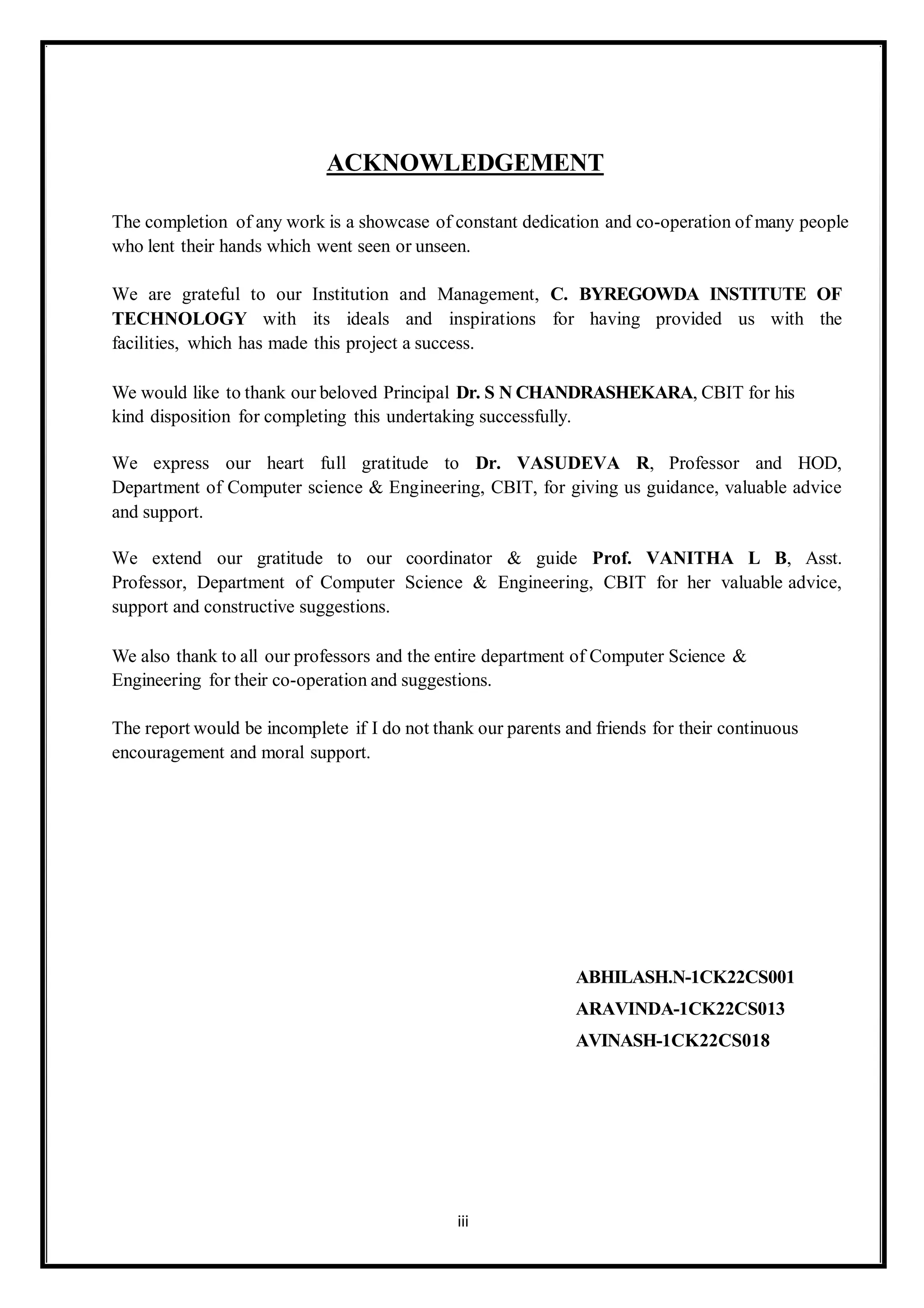
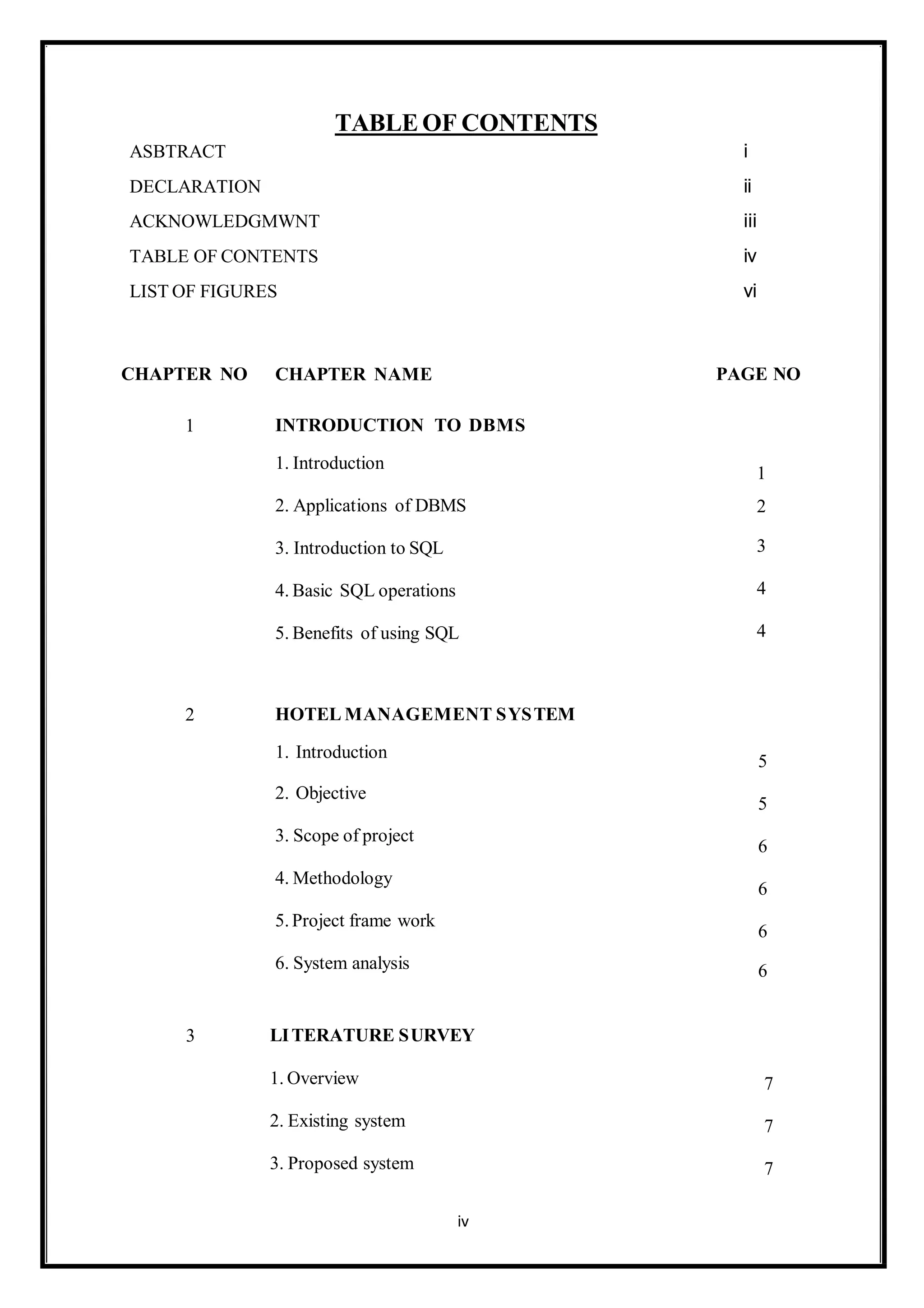
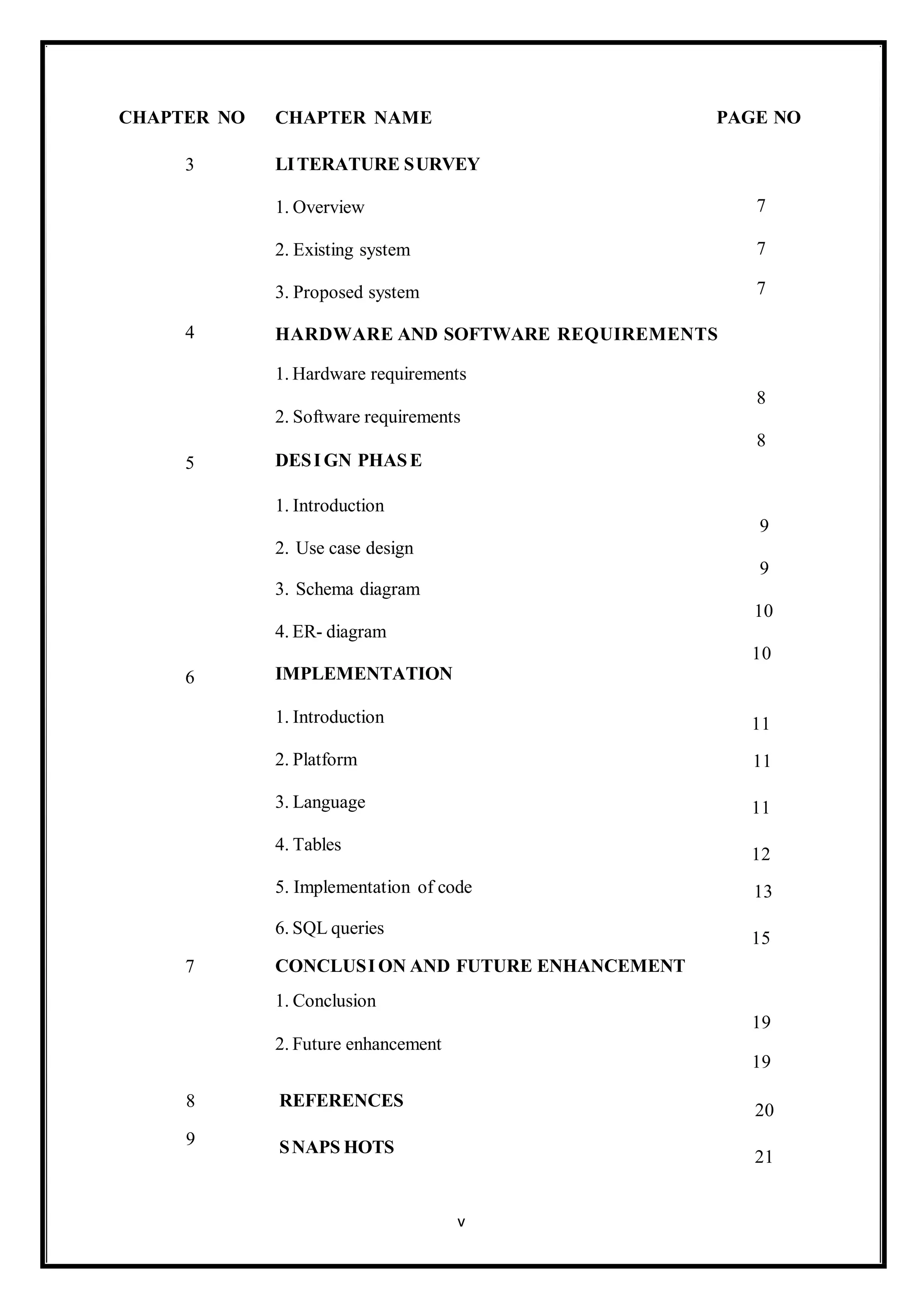
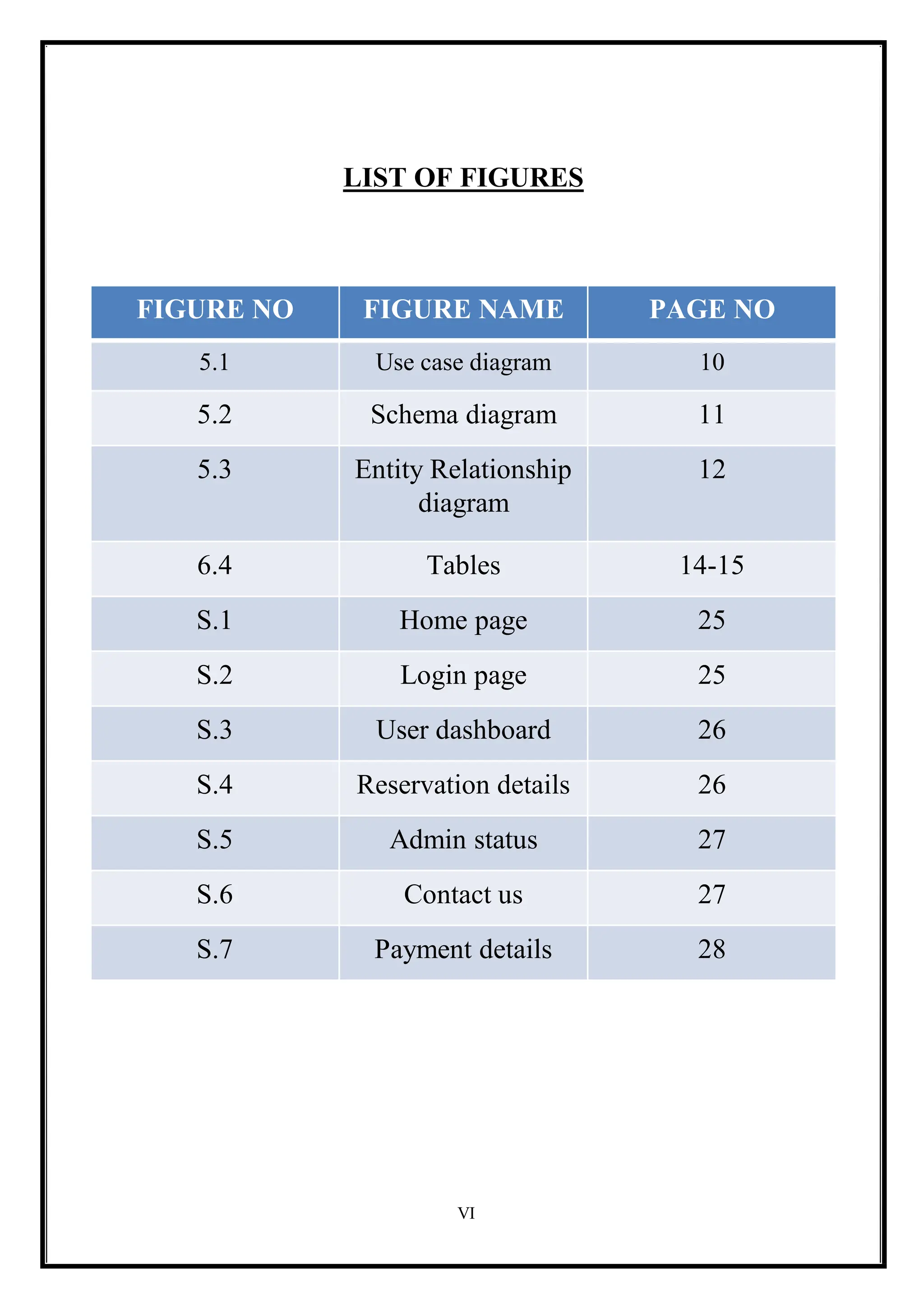
This project aims at creating on Hotel Management System which can be used by Admin
and Customers. The admin to advise/publish the availability of rooms in different hotels
and customers are checking the availability of room in required hotel. Customers should
be able to know the availability of the rooms on a particular date to reserve in hotel. They
should be able to reserve the available rooms according to their need in advance to make
their stay comfortable. The Admin hands the booking information of customers. The
users can register and log into the system.
The administrator will know the details of reservation and daily income. The hotel
department maintain the seat availability and booking details in certain database.This
project provides high security to Admin and user information.
i
DECLARATION
ABHILASH.N-1CK22CS001
ARAVINDA.H.N-1CK22CS013
AVINASH-1CK22CS018
We ABHILASH.N & ARAVINDA.H.N, AVINASH bearing USN 1CK22CS001 &
1CK22CS013, 1CK22CS018 student of 4th semester B.E, Computer Science and
Engineering of VTU, declare that this report entitled “HOTEL MANAGEMENT”,
embodies the report of the mini project carried out under the guidance of Prof.
VANITHA L B Dept. of CSE, CBIT as partial fulfilment of the requirement of the award of the
degree in Bachelor of Engineering, ComputerScience and Engineering, affiliated to
Visvesvaraya Technological University, Belagavi during the academic year 2023-2024. Further
the content embodies in the mini project report has not been submitted previously by anybody
for the award of any other degree.
ii
ACKNOWLEDGEMENT
The completion of any work is a showcase of constant dedication and co-operation of many people
who lent their hands which went seen or unseen.
We are grateful to our Institution and Management, C. BYREGOWDA INSTITUTE OF
TECHNOLOGY with its ideals and inspirations for having provided us with the
facilities, which has made this project a success.
We would like to thank our beloved Principal Dr. S N CHANDRASHEKARA, CBIT for his
kind disposition for completing this undertaking successfully.
We express our heart full gratitude to Dr. VASUDEVA R, Professor and HOD,
Department of Computer science & Engineering, CBIT, for giving us guidance, valuable advice
and support.
We extend our gratitude to our coordinator & guide Prof. VANITHA L B, Asst.
Professor, Department of Computer Science & Engineering, CBIT for her valuable advice,
support and constructive suggestions.
We also thank to all our professors and the entire department of Computer Science &
Engineering for their co-operation and suggestions.
The report would be incomplete if I do not thank our parents and friends for their continuous
encouragement and moral support.
ABHILASH.N-1CK22CS001
ARAVINDA-1CK22CS013
AVINASH-1CK22CS018
iii
TABLE OF CONTENTS
1
2
CHAPTER NO
ASBTRACT
DECLARATION
ACKNOWLEDGMWNT
TABLE OF CONTENTS
LIST OF FIGURES
CHAPTER NAME
INTRODUCTION TO DBMS
1. Introduction
2. Applications of DBMS
3. Introduction to SQL
4. Basic SQL operations
5. Benefits of using SQL
HOTEL MANAGEMENT SYSTEM
1. Introduction
2. Objective
3. Scope of project
4. Methodology
5. Project frame work
6. System analysis
1
2
3
4
4
5
5
6
6
6
6
PAGE NO
i
ii
iii
iv
vi
3 LITERATURE SURVEY
1. Overview
2. Existing system
3. Proposed system
7
7
7
iv
3
4
5
6
7
CHAPTER NO CHAPTER NAME
LITERATURE SURVEY
1. Overview
2. Existing system
3. Proposed system
HARDWARE AND SOFTWARE REQUIREMENTS
1. Hardware requirements
2. Software requirements
DESI GN PHASE
1. Introduction
2. Use case design
3. Schema diagram
4. ER- diagram
IMPLEMENTATION
1. Introduction
2. Platform
3. Language
4. Tables
5. Implementation of code
6. SQL queries
CONCLUSI ON AND FUTURE ENHANCEMENT
1. Conclusion
2. Future enhancement
7
7
7
8
8
11
11
11
12
13
15
9
9
10
10
19
19
PAGE NO
REFERENCES
20
8
9 SNAPS HOTS
21
v
FIGURE NO FIGURE NAME PAGE NO
5.1 Use case diagram 10
5.2 Schema diagram 11
5.3 Entity Relationship
diagram
12
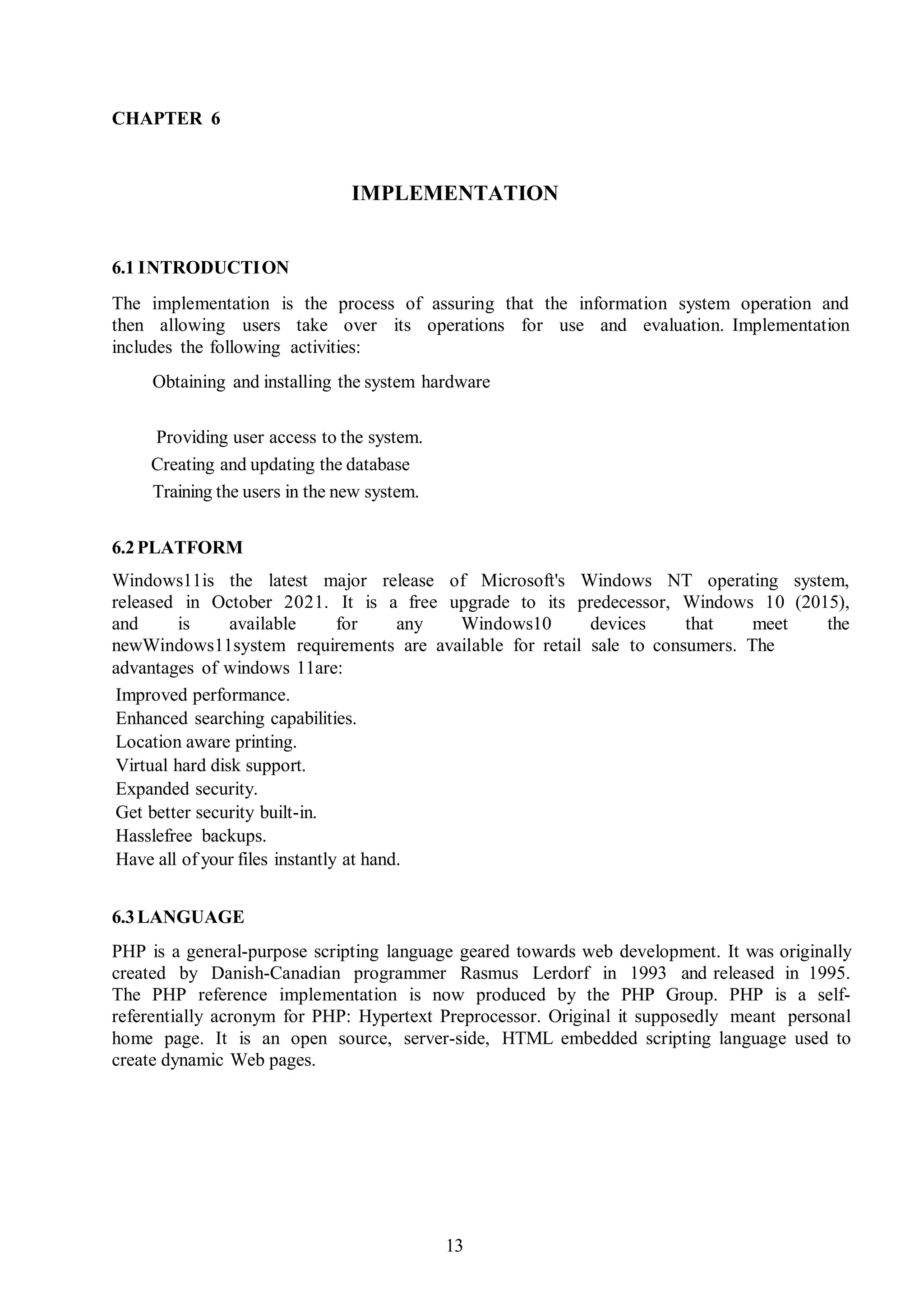
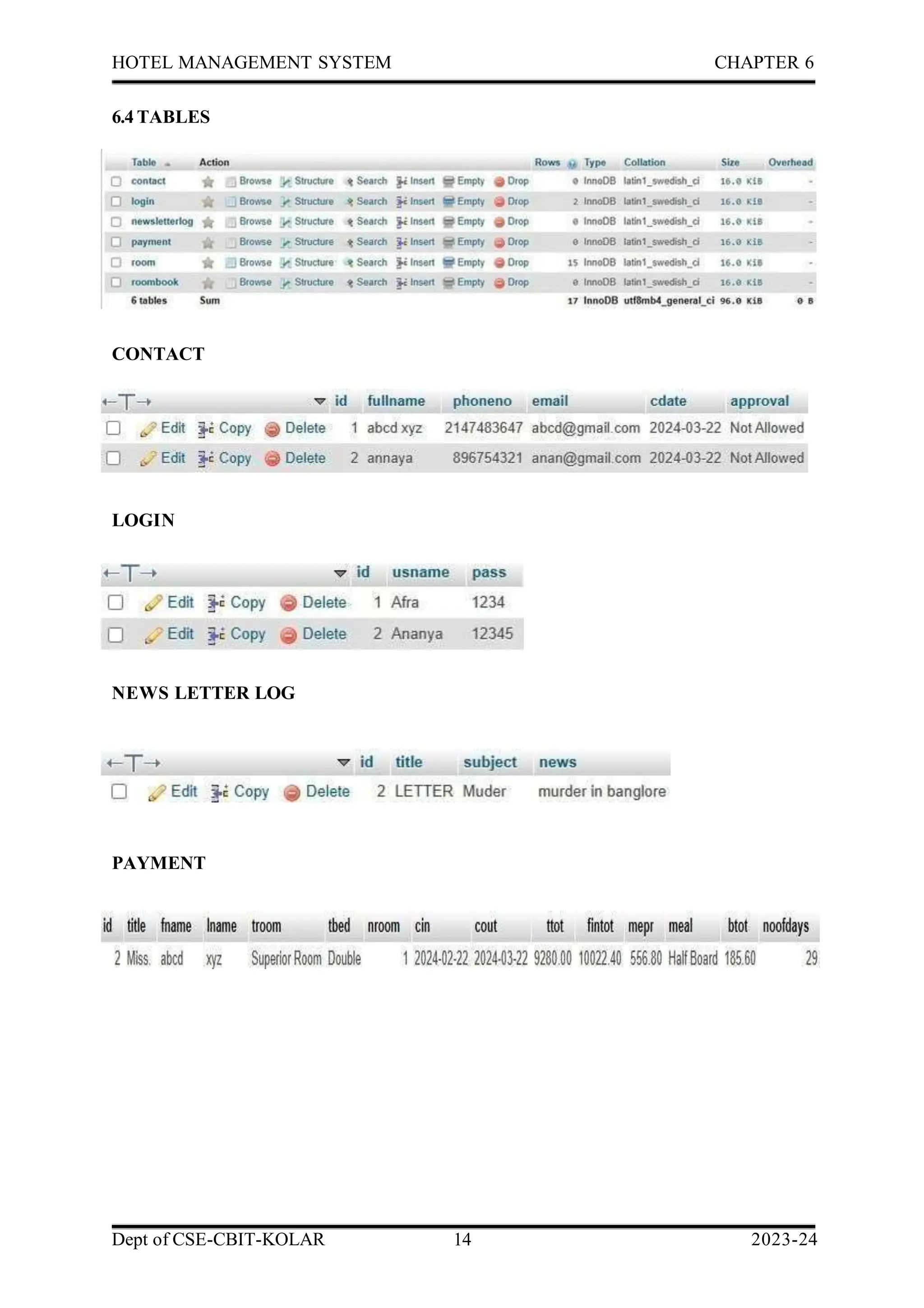
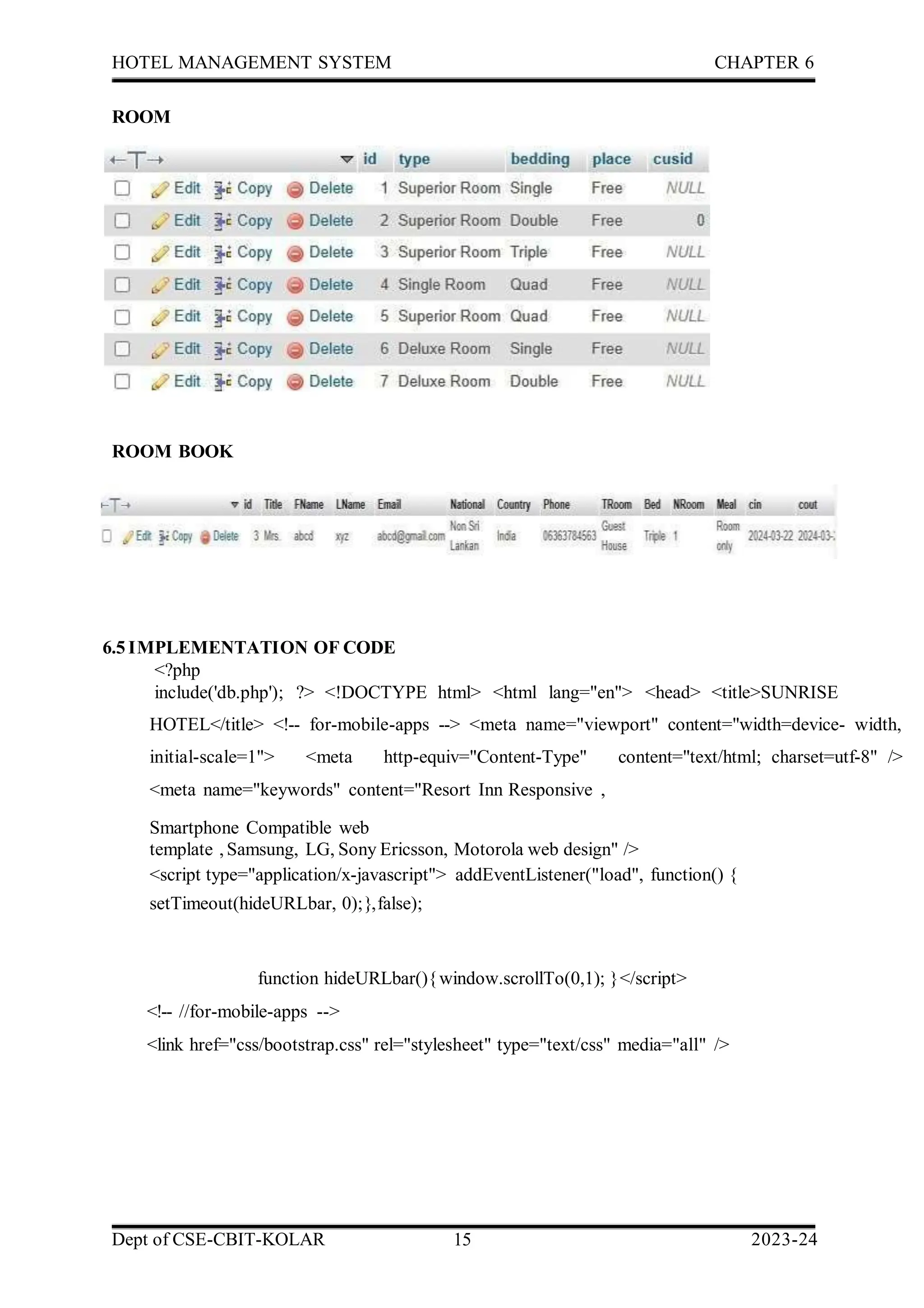
6.4 Tables 14-15
S.1 Home page 25
S.2 Login page 25
S.3 User dashboard 26
S.4 Reservation details 26
S.5 Admin status 27
S.6 Contact us 27
S.7 Payment details 28
VI
LIST OF FIGURES
CHAPTER1
INTRODUCTIONTODBMS
1.1INTRODUCTION
A Database Management System (DBMS) is a software suite designed to facilitate the
creation, organization, retrieval, and manipulation of data in a structured format. It serves
as an intermediary between users and databases, providing an interface for users to interact
with the data while ensuring its integrity and security. DBMS are crucial components of
modern information systems, utilized across various industries and applications, including
banking, healthcare, education, e-commerce, and more. They offer several key functionalities:
1. DataOrganization:DBMSs enable the efficient organization of data into logical
structures such as tables, rows, and columns. This organization allows for easy storage and
retrieval of information based on predefined relationships and data models.
2. DataRetrievalandManipulation:Users can query DBMSs to retrieve specific information
from the database using structured query languages (SQL)or other interfaces. DBMSs also support
data manipulation operations, including insertion, deletion, and modification of records.
3. Concurrency Control: DBMS manage concurrent access to the database by multiple users or
applications, ensuring data consistency and integrity. Through mechanisms such as locking
and transaction management, DBMSs prevent conflicts and maintain the accuracy of data during
simultaneous operations.
4. Data Security and Integrity: DBMS implement security measures to protect sensitive
data from unauthorized access, ensuring compliance with privacy regulations and organizational
policies. They also enforce data integrity constraints to maintain the accuracy and consistency of
information stored in the database.
5. Scalability and Performance: DBMSs are designed to scale with growing data volumes
and user demands, providing efficient storage and retrieval mechanisms. They optimize query
processing and resource utilization to deliver high performance even under heavy workloads.
Database scalability is the ability to expand or contract the capacity of system resources in
order to support the changing usage of your application. This can refer both to increasing and
decreasing usage of the application.
1
1.2APPLI CATIONS OF DBMS
Database Management Systems (DBMS) find application across various domains due to their
ability to efficiently manage, organize, and retrieve large volumes of data. Here are some common
applications of DBMS:
1. Enterprise Resource Planning (ERP) Systems: ERP systems integrate various
business processes and departments within an organization, such as finance, human resources,
inventory management, and customer relationship management (CRM). DBMSs store and
manage data related to these processes, enabling seamless coordination and information
sharing across the enterprise.
2. Customer Relationship Management (CRM) Systems: CRM systems help businesses manage
interactions with current and potential customers. DBMSs store customer information, including contact
details, purchase history, preferences, and feedback, allowing organizations
to personalize marketing strategies, improve customer service, and enhance customer retention.
3.E-commerce Platforms: E-commerce platforms rely on DBMSs to store product catalogues,
customer orders, payment transactions, and inventory data. By efficiently managing this
information, DBMSs enable smooth online shopping experiences, secure payment processing,
and real-time inventory management for e-commerce businesses.
4. Healthcare Information Systems: Healthcare institutions utilize DBMSs to manage patient records,
medical histories, diagnostic reports, treatment plans, and billing information. DBMSs
ensure the confidentiality, integrity, and accessibility of sensitive healthcare data, facilitating
efficient patient care, medical research, and regulatory compliance.
5. Banking and Financial Systems: Banks and financial institutions rely on DBMSs to store and
manage customer accounts, transactions, loan portfolios, credit histories, and regulatory
compliance data. DBMSs support secure and reliable banking operations, including online
banking, ATM transactions, fraud detection, and risk management.
6. Telecommunications Systems: Telecommunications companies use DBMSs to store
subscriber information, call records, network configurations, billing details, and service
provisioning data. DBMSs enable efficient management of telecommunications
infrastructure, network optimization, and billing accuracy for telecom providers.
7. Supply Chain Management (SCM) Systems: SCM systems track the flow of goods,
materials, and information across supply chains, from raw material sourcing to product delivery.
DBMSs store data related to inventory levels, supplier relationships, order fulfilment,
logistics, and distribution networks, facilitating efficient supply chain operations and
collaboration among stakeholders.
2
HOTEL MANAGEMENT SYSTEM CHAPTER 1
Dept of CSE-CBIT-KOLAR 2023-24
3
8. Educational Institutions: Educational institutions leverage DBMSs to manage student records,
course schedules, academic performance, faculty information, library resources, and administrative
operations. DBMSs support student enrolment, grading, course planning, and institutional research
efforts, enhancing educational quality and administrative efficiency.
1.3 INTRODUCTION TOSQL
SQL, which stands for Structured Query Language, is a powerful and standardized programming
language used for managing and manipulating relational databases. It provides a comprehensive set of
commands and syntax for performing various operations on data stored in a relational database
management system (RDBMS).
Key Components of SQL:
1. Data Definition Language (DDL):
DDL statements are used to define, modify, and delete database objects such as tables, indexes,
and views.
Common DDL commands include CREATE, ALTER, DROP, and TRUNCATE.
2. Data Manipulation Language (DML):
DML statements are used to retrieve, insert, update, and delete data in database tables.
Common DML commands include SELECT, INSERT,UPDATE, and DELETE.
3. Data Control Language (DCL):
DCL statements are used to control access permissions and privileges on database objects.
Common DCL commands include GRANT and REVOKE.
4. Transaction Control Language (TCL):
TCL statements are used to manage transactions within a database. Common
TCL commands include COMMIT, ROLLBACK, and SAVEPOINT.
1.4 BASIC SQLOPERATIONS:
1. Creating Tables:
CREATE TABLE table_name (
column1 datatype,
column2 datatype, …
);
2. Inserting Data:
INSERT INTO table_name (column1, column2, ...)
VALUES (value1, value2, ...);
HOTEL MANAGEMENT SYSTEM CHAPTER 1
Dept of CSE-CBIT-KOLAR 2023-24
3. Querying Data:
SELECT column1, column2,
...FROM table_name WHERE
condition;
4. Updating Data:
UPDATE table_name
SET column1 =value1, column2 =value2, ...
WHERE condition;
5. Deleting Data:
DELETE FROM table_name
WHERE condition;
1.5 BENEFITS OF USING SQL
Faster Processing Speed Minimal
Requirement of Coding
Easier Data Manipulation
Better Data Mining
Restricted Access
Reliable for Complicated Queries
4
HOTEL MANAGEMENT SYSTEM CHAPTER 1
Dept of CSE-CBIT-KOLAR 2023-24
CHAPTER2
HOTELMANAGEMENTSYSTEM
INTRODUCTION
Hotel Management System is a hotel reservation site script where site users will be able to
search rooms availability with an online booking reservations system.Site
users can also browse hotels,view room inventory,check availability,and book reservations in
real-time.Site users enter check in date and check out date then search for availability and
rates.After choosing the right room in the wanted hotel-all booking and reservation process is
done on the site and an SMS is sent to confirm the booking.
Administer Panel
Administrator-Administrator can manage administrator accounts and confirm the rooms.
Room Types-Administrator can define the type of rooms in the hotels,room’sprices and
upload
an image for each room.
Bookings-All booking and reservations made on the site are displayed with all booking
details:
arrival date, departuredate, hotel name, room type, number of passengers,price.
2.2OBJECTIVE
The main objective of hotel organization could be improved by integrating service-oriented operations
service-oriented operations with project management principles.Such integration
would in still innovation,proactive attitudes and regulated risk-taking needed to pursue on going
improvement and proactive response to change.By managing each change as project embedded
in smoothly running operations,hotels would extend their life span by continuously reinventing
themselves.Due to which the customers can easily book the hotels rooms.
Needs of Hotel Management System
This system will help administration to work easily. Because of its easy access and less time
consuming administration can get the information of the Users, Rooms, Payments,
etc. They do not have to searchin the paper file for the log time. Members an easily handle
the system.
5
HOTEL MANAGEMENT SYSTEM CHAPTER 2
1. SCOPE OF PROJECT
This activity is also known as the feasibility study.
Perform and evaluate feasibility studies like cost-benefit analysis, technical feasibility, time
feasibility and operational feasibility for the project. Project Scheduling should be made using chats.
Feasibility study is carried out to decide whether the proposed system is feasible for the company. It
begins with a request from the user for a new system. It involves the following:
Identify the responsible user for a new system Clarify the user request
Identify deficiencies in the current system
Establish goals and objectives for the new system Determine the feasibility for the new system
Prepare a project charter that will be used to guide the remainder of the Project
2. METHODOLOGY/PROCEDURE
For the development of the project the designing is done on PHPMYADMIN, backend was
coded in basis of php and same front end we use the same php codes. Software methodologies
are connected with the process of creating software -not so much the technical side but
organization aspects. Several software development approaches since have used the origin of
information technology.
3. PROJECT FRAME WORK:
A frame work is a standardized set of concepts, practices, and criteria for dealing with a
common type of problem, which can be used as a reference to help us approach and
resolve new problems of similar nature. The aim of framework is to provide a common
structure so that developers don’t have to redo it from scratch and can reuse the code
provided. In this way, frame works allows us to cut out much of the work and save a lot of
time.
4. SYSTEM ANALYSI S
System Analysis is a detailed study of the various operations performed by a system and their
relationships within and outside of the system. Here the key question is why all problems exist
in the present system? What must be done to solve the problem? Analysis begins when a user
or manager begins a study of the program using existing system. The commonly used tools
in the system are Data Flow Diagrammatic. Training, experience a common sense are
required for collection of relevant information needed to develop the system. The
success of the system depends largely on how clearly the problem is defined, thoroughly
investigated and properly carried out through the choice of solution. A good analysis model
should provide not only the mechanisms of problem understanding but also the frame
work of the solution.
Dept of CSE-CBIT-KOLAR 6 2023-2024
CHAPTER3
LITERATURE SURVEY
3.1OVERVIEW
Hotel Management project provides room booking, meals, and other necessary hotel
management features. The system allows the manager to post available rooms in the system.
Customers can view and book room online. Admin has the power of either approving or
disapproving the customers’s booking request.
3.2EXISTINGSYSTEM
Existing System means the current system on which all calculations are done
manually.The existing system uses paperwork and direct human language
communication by mouth to manage the hotel.This delays information transmission in the
hotel. Booking is done through phone calls or through visit to the hotel booking office.The
guest’s personal details such as Name, Age, Nationality and Duration of stay, are input during
booking in. The booking office orders for preparation of the guest’s room before his/her check
in date. Some of the limitations of the existing system can be concluded as follows:
In the existing system, all the data is maintained in different files and registers.That often
leads to data duplication and redundancy in the stored data, thus ending to wastages of
storage of space.
In the existing system, data of customers are entered into various long registered that is
customers register etc. which result into slow access to the desired information.
In the existing system, since everything is record and stored in the register.It is quite difficult
and time consuming.The major problem is modification that must be reflected in all the entire
and summaries also needed to be update.
3.3PROPOSEDSYSTEM
Implementing an automated system for managing reservations can streamline the booking
process for guest’s and reduce manual errors. Developing a user friendly online booking portal
can enhance cutomer experience and attract more guest by allowing them to book rooms
and services convenintely.Implementing a centralized database system can facilitate efficient
management of guest information, reservations, billing and other operations.Recorded
maintainance is easy because all records are stored in specific file. Data can easily
secured,security restrictions can easily be applied. Error detection is easy.
7
CHAPTER 4
HARDWARE AND SOFTWARE REQUIREMENTS
4.1 HARDWARE REQUIREMENTS
Operating System: Windows7or later
Processor: IntelPentium4 or later
Memory: 4GB minimum, 8 GB recommended
Screenresolution:1280*1024 or larger
Application Window Size: 1024*680or larger
Internet Connection: Not required
CacheMemory:512KB
MicrosoftCompatible101ormoreKey Board
4.2 SOFTWARE REQUIREMENTS
Client: Operating System (Windows)
Web Server:Apache Web Server
Language:PHP
Front-End: HTML, CSS, JAVASCRIPT, BOOTSTRAP
Back-end: MySQL
8
CHAPTER 5
DESI GN PHASE
Design is the creation of a plan or convention for the construction of an object or a system (as in
architectural blueprints, engineering drawings, business processes, circuit diagrams and sewing
patterns). Design has different connotations in different fields (see design disciplines below). In some
cases, the direct construction of an object (as in pottery, engineering, management, coding and graphic
design) is also considered to be design. A specification of an
object, manifested by an agent, intended to accomplish goals, in a particular environment, using a set of
primitive components, satisfying a set of requirements, subject to constraints. Another definition for design
is a roadmap or a strategic approach for someone to achievea unique expectation. It defines the
specifications, plans, parameters, costs, activities, processesand how and what to do within legal, political,
social, environmental, safety and economic constraints in achieving that objective. Designing often
necessitates considering the aesthetic, functional, economic and socio-political dimensions of both the
design object and design process. It may involve considerable research, thought, modelling, interactive
adjustment, and re-design.
Meanwhile, diverse kinds of objects may be designed, including clothing, graphical user
interfaces, skyscrapers, corporate identities, business processes and even methods of designing.
9
HOTEL MANAGEMENT SYSTEM
10 2023-2024
Dept of CSE-CBIT-KOLAR
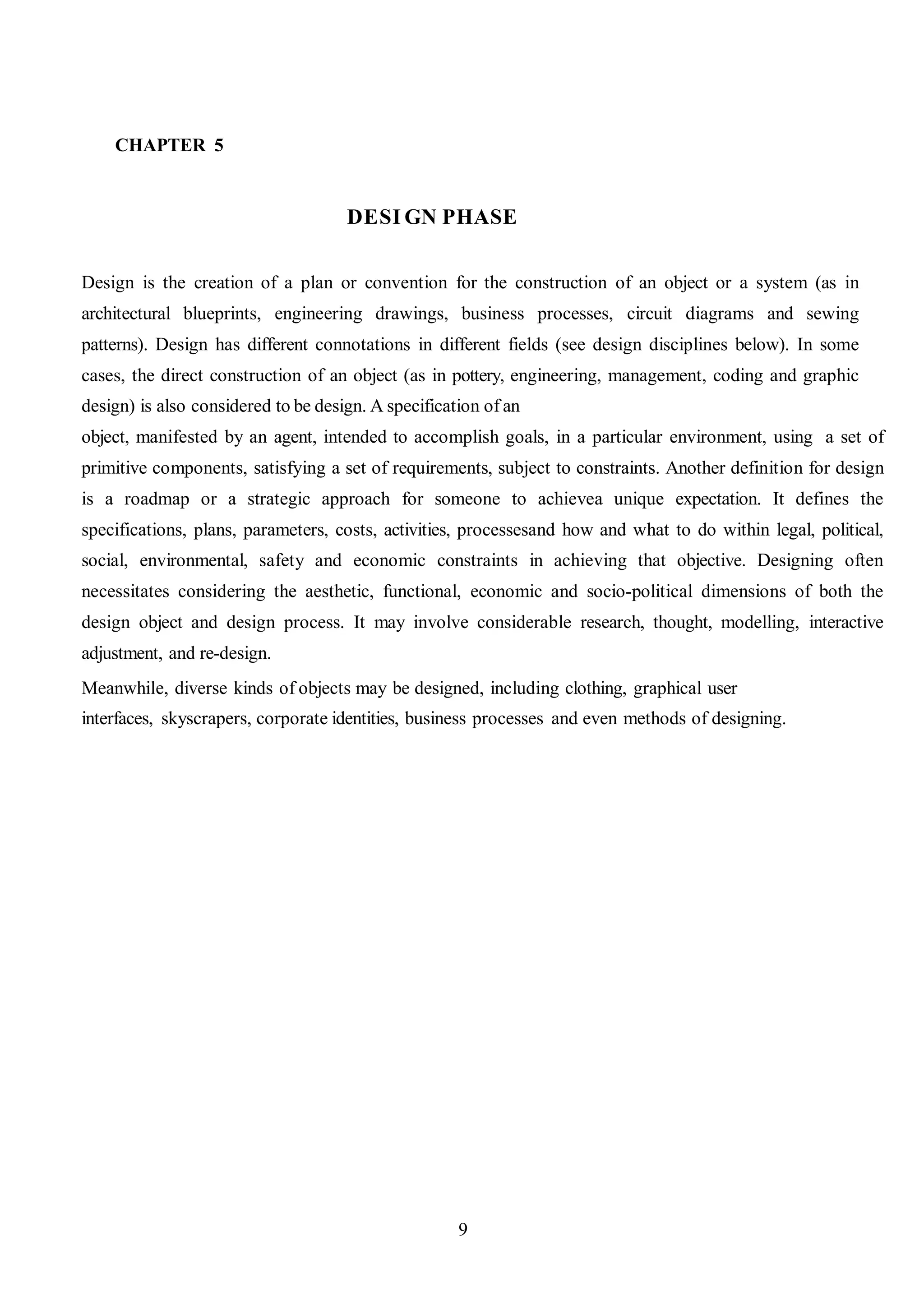
USE CASE DIAGRAM
Use case diagrams model behavior with in a system and helps the developers understand of what
the user require. The stick man represents what’s called an actor. Use case diagramcan be useful
for getting an overall view of the system and clarifying who can do and more importantly what they
can’t do. Use case diagram consists of use cases and actors and shows the interaction between the
use case and actors. The purpose is to show the interactions betweenthe use case and actor. To
represent the system requirements from user’s perspective. An actor could be the end-user of the
system or an external system.
CHAPTER 5
FIG :5.1 USE CASE DIAGRAM
HOTEL MANAGEMENT SYSTEM
Dept of CSE-CBIT-KOLAR 2023-2024
11
CHAPTER 5
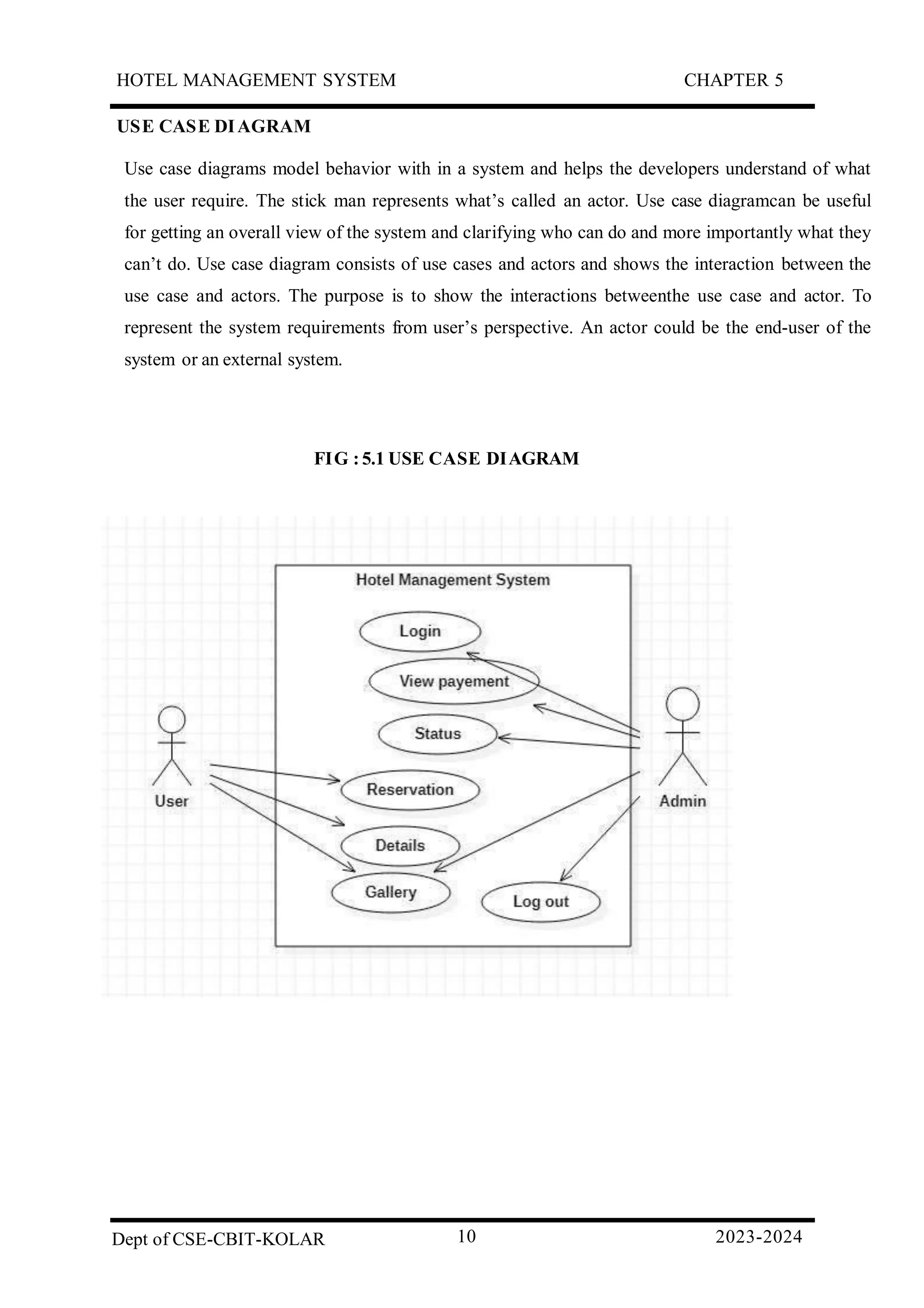
5.2 SCHEMA DIAGRAM
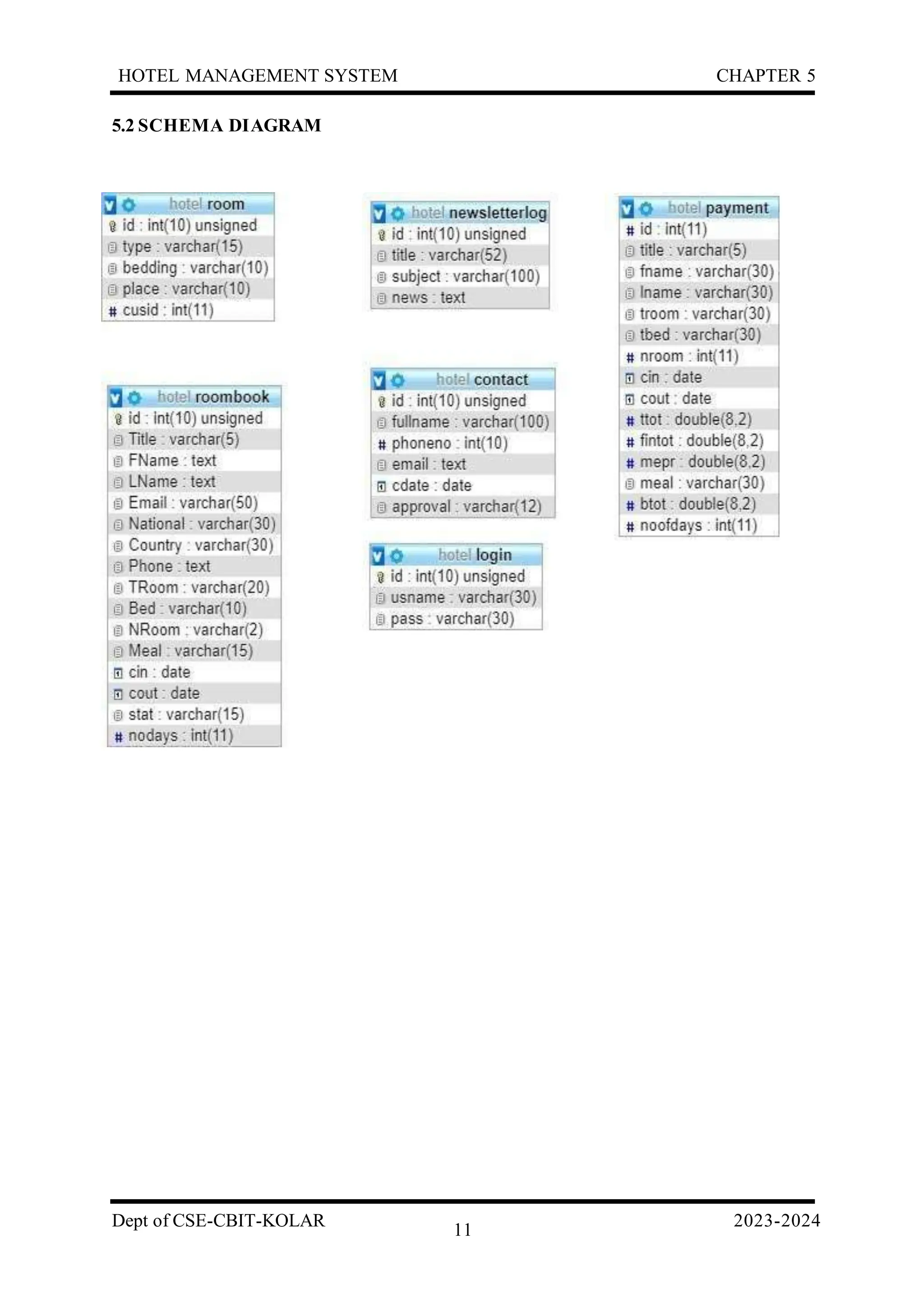
5.3 ENTITY RELATIONSHIP DIAGRAM
ER-DI AGRAM DEFI NITION
An Entity relationship describes inter-related things of interest in a specific domain of knowledge.An
ER model is composed of entity types and specifies relationships that canexist between instances of
those entity types. In software engineering an ER model is commonly formed to represent things that a
business needs to remember in order to perform business processes. Consequently, the ER model
becomes an abstract data model that definesa data or information structure that can be implemented in a
database, typically a relation database.
FIG:5.2 ENTITY RELATIONSHIP DIAGRAM
HOTEL MANAGEMENT SYSTEM
Dept of CSE-CBIT-KOLAR 12 2023-2024
CHAPTER 5
6.3LANGUAGE
PHP is a general-purpose scripting language geared towards web development. It was originally
created by Danish-Canadian programmer Rasmus Lerdorf in 1993 and released in 1995.
The PHP reference implementation is now produced by the PHP Group. PHP is a self-
referentially acronym for PHP: Hypertext Preprocessor. Original it supposedly meant personal
home page. It is an open source, server-side, HTML embedded scripting language used to
create dynamic Web pages.
CHAPTER 6
IMPLEMENTATION
6.1 INTRODUCTION
The implementation is the process of assuring that the information system operation and
then allowing users take over its operations for use and evaluation. Implementation
includes the following activities:
Obtaining and installing the system hardware
Providing user access to the system.
Creating and updating the database
Training the users in the new system.
advantages of windows 11are:
Improved performance.
Enhanced searching capabilities.
Location aware printing.
Virtual hard disk support.
Expanded security.
Get better security built-in.
Hasslefree backups.
Have all of your files instantly at hand.
6.2PLATFORM
Windows11is the latest major release of Microsoft's Windows NT operating system,
released in October 2021. It is a free upgrade to its predecessor, Windows 10 (2015),
and is available for any Windows10 devices that meet the
newWindows11system requirements are available for retail sale to consumers. The
13
HOTEL MANAGEMENT SYSTEM
Dept of CSE-CBIT-KOLAR 2023-24
14
CHAPTER 6
LOGIN
CONTACT
PAYMENT
6.4 TABLES
NEWS LETTER LOG
HOTEL MANAGEMENT SYSTEM
Dept of CSE-CBIT-KOLAR 2023-24
15
CHAPTER 6
6.5 IMPLEMENTATION OF CODE
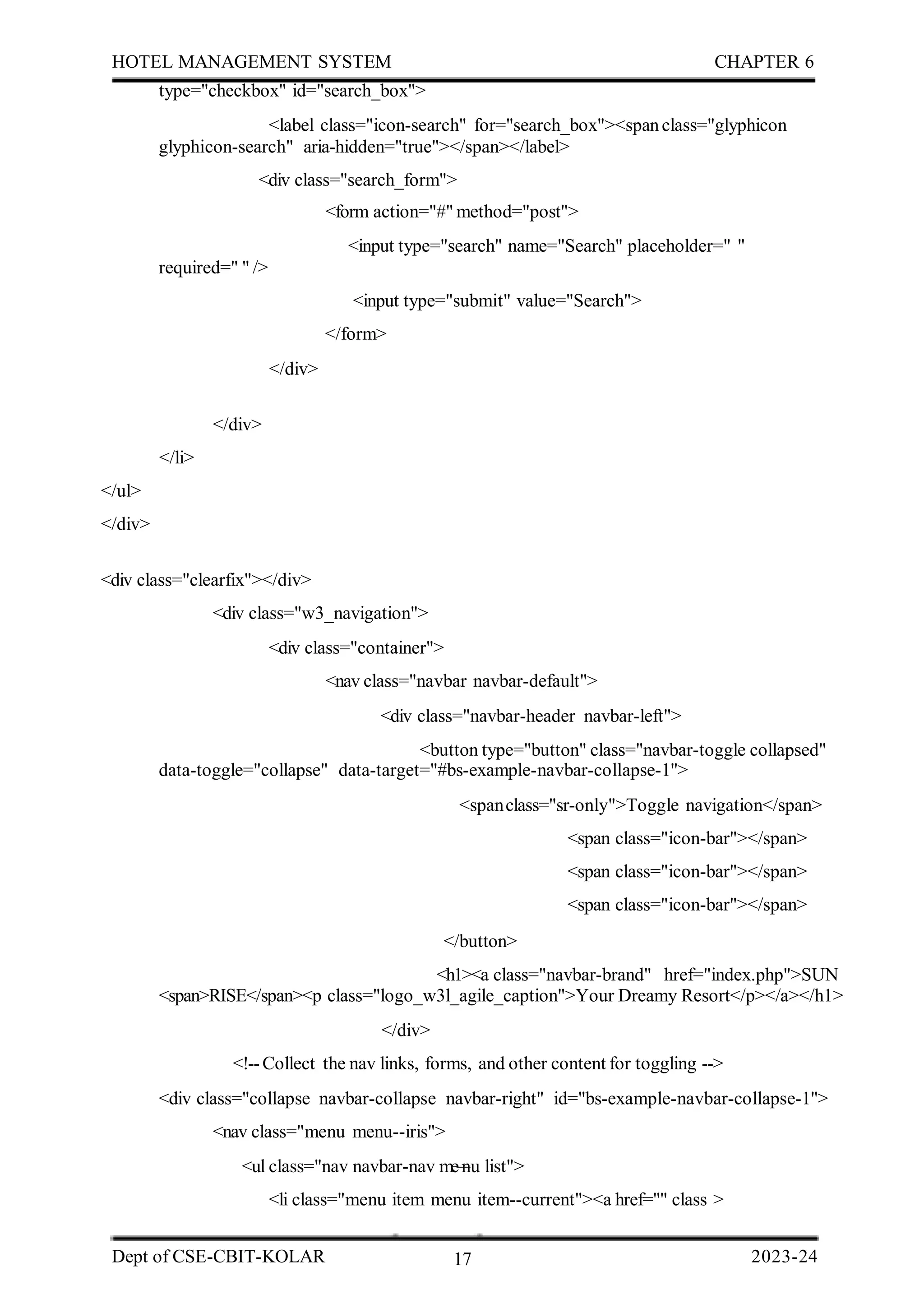
<?php
include('db.php'); ?> <!DOCTYPE html> <html lang="en"> <head> <title>SUNRISE
HOTEL</title> <!-- for-mobile-apps --> <meta name="viewport" content="width=device- width,
initial-scale=1"> <meta http-equiv="Content-Type" content="text/html; charset=utf-8" />
<meta name="keywords" content="Resort Inn Responsive ,
Smartphone Compatible web
template , Samsung, LG, Sony Ericsson, Motorola web design" />
<script type="application/x-javascript"> addEventListener("load", function() {
setTimeout(hideURLbar, 0);},false);
function hideURLbar(){window.scrollTo(0,1); }</script>
<!-- //for-mobile-apps -->
<link href="css/bootstrap.css" rel="stylesheet" type="text/css" media="all" />
ROOM
ROOM BOOK
HOTEL MANAGEMENT SYSTEM CHAPTER 6
<link href="css/font-awesome.css" rel="stylesheet">
<link rel="stylesheet" href="css/chocolat.css" type="text/css" media="screen">
<link href="css/easy-responsive-tabs.css" rel='stylesheet' type='text/css'/>
<link rel="stylesheet" href="css/flexslider.css" type="text/css" media="screen"
property="" />
<link rel="stylesheet" href="css/jquery-ui.css" />
<link href="css/style.css" rel="stylesheet" type="text/css" media="all" />
<script type="text/javascript" src="js/modernizr-2.6.2.min.js"></script>
<!--fonts-->
<link href="//fonts.googleapis.com/css?family=Oswald:300,400,700" rel="stylesheet">
<link href="//fonts.googleapis.com/css?family=Federo" rel="stylesheet">
<link href="//fonts.googleapis.com/css?family=Lato:300,400,700,900" rel="stylesheet">
<!--//fonts-->
</head>
<body>
<!-- header -->
<div class="banner-top">
<div class="social-bnr-agileits">
<ul class="social-icons3">
<li><a href="https://www.facebook.com/" class="fa fa-facebook icon-
border facebook"></a>
<li><a href="https://twitter.com/" class="fa fa-twitter icon-border
twitter"> </a></li>
<li><a href="https://plus.google.com/u/0/" class="fa fa-google-plus icon-
border googleplus"> </a></li>
</ul>
</div>
<div class="contact-bnr-w3-agile">
<ul>
<li><i class="fa fa-envelope" aria-hidden="true"></i><a
href="mailto:info@example.com">INFO@SUNRISE.COM</a></li>
<li><i class="fa fa-phone" aria-hidden="true"></i>+94 (65)222-4455</li>
<li class="s-bar">
<div class="search">
<input class="search_box"
Dept of CSE-CBIT-KOLAR 2023-24
16
HOTEL MANAGEMENT SYSTEM
type="checkbox" id="search_box">
Dept of CSE-CBIT-KOLAR 2023-24
17
CHAPTER 6
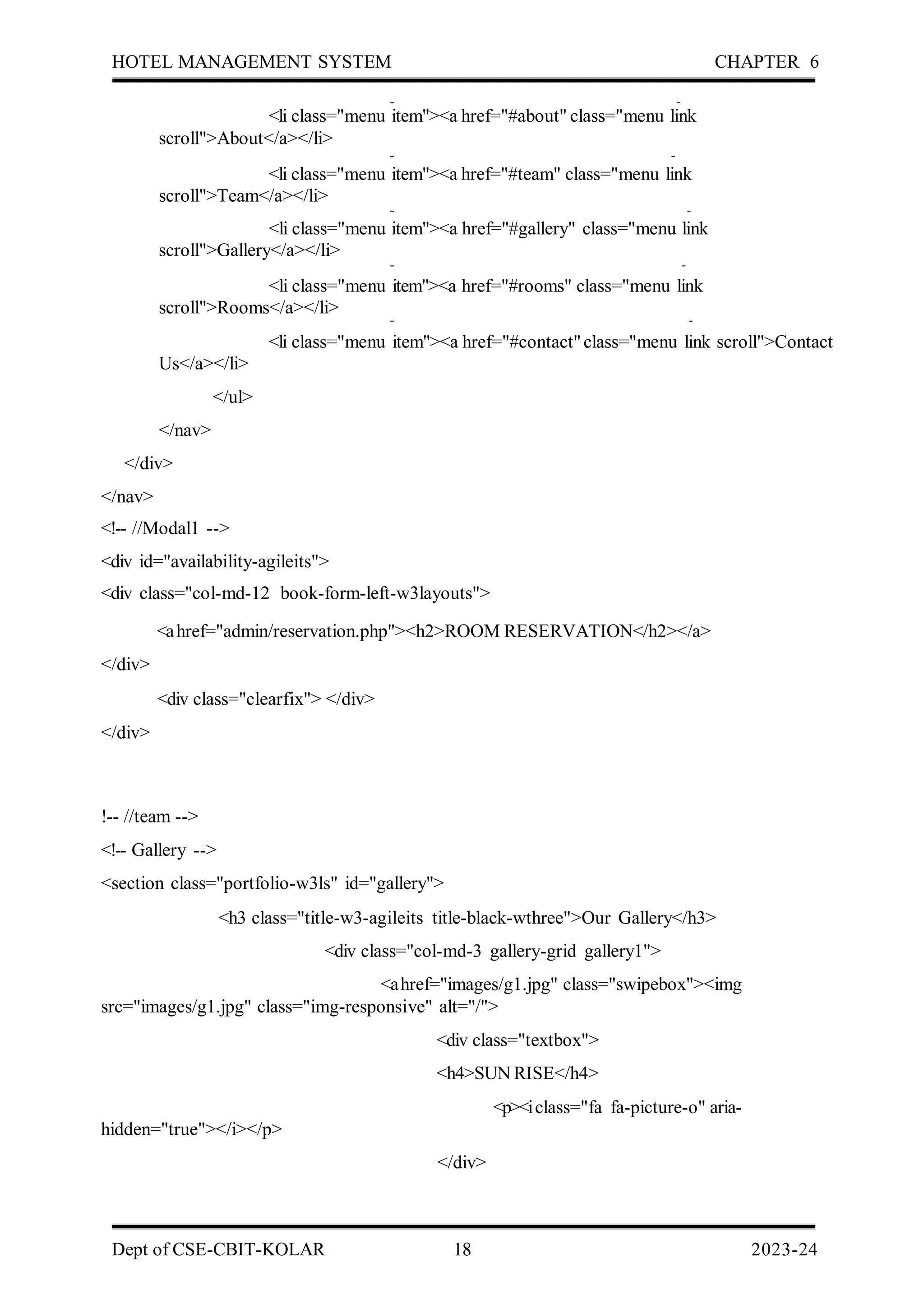
<label class="icon-search" for="search_box"><spanclass="glyphicon
glyphicon-search" aria-hidden="true"></span></label>
<div class="search_form">
<form action="#" method="post">
<input type="search" name="Search" placeholder=" "
required=" " />
<input type="submit" value="Search">
</form>
</div>
</div>
</li>
</ul>
</div>
<div class="clearfix"></div>
<div class="w3_navigation">
<div class="container">
<nav class="navbar navbar-default">
<div class="navbar-header navbar-left">
<button type="button" class="navbar-toggle collapsed"
data-toggle="collapse" data-target="#bs-example-navbar-collapse-1">
<spanclass="sr-only">Toggle navigation</span>
<span class="icon-bar"></span>
</button>
<h1><a class="navbar-brand" href="index.php">SUN
<span>RISE</span><p class="logo_w3l_agile_caption">Your Dreamy Resort</p></a></h1>
</div>
<!--Collect the nav links, forms, and other content for toggling -->
<div class="collapse navbar-collapse navbar-right" id="bs-example-navbar-collapse-1">
<nav class="menu menu--iris">
<ul class="nav navbar-nav menu list">
<li class="menu item menu item--current"><a href="" class >
HOTEL MANAGEMENT SYSTEM CHAPTER 6
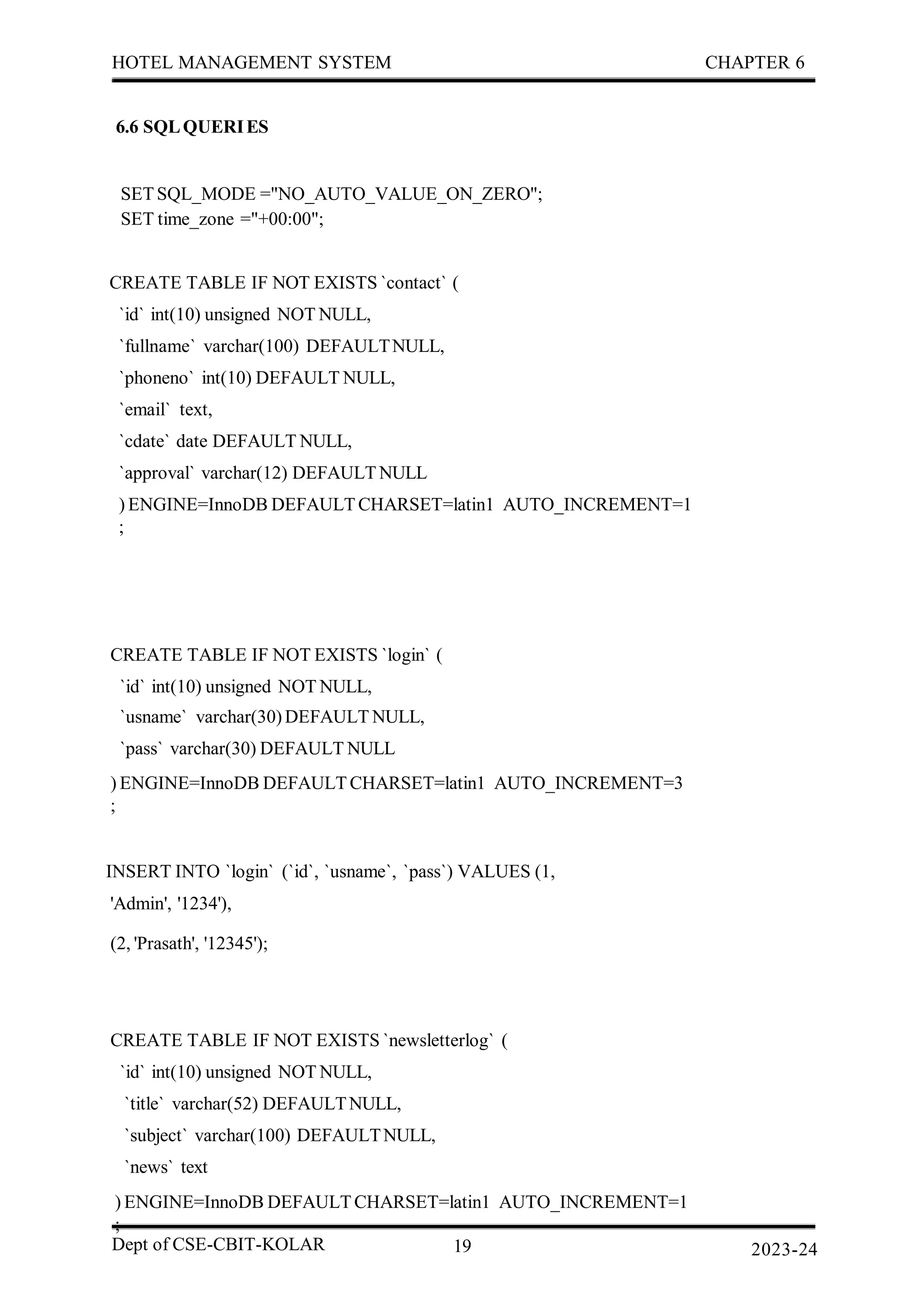
<li class="menu item"><a href="#about" class="menu link
scroll">About</a></li>
<li class="menu item"><a href="#team" class="menu link
scroll">Team</a></li>
<li class="menu item"><a href="#gallery" class="menu link
scroll">Gallery</a></li>
<li class="menu item"><a href="#rooms" class="menu link
scroll">Rooms</a></li>
<li class="menu item"><a href="#contact"class="menu link scroll">Contact
Us</a></li>
</ul>
</nav>
</div>
</nav>
<!-- //Modal1 -->
<div id="availability-agileits">
<div class="col-md-12 book-form-left-w3layouts">
<ahref="admin/reservation.php"><h2>ROOM RESERVATION</h2></a>
</div>
<div class="clearfix"> </div>
</div>
!-- //team -->
<!-- Gallery -->
<section class="portfolio-w3ls" id="gallery">
<h3 class="title-w3-agileits title-black-wthree">Our Gallery</h3>
<div class="col-md-3 gallery-grid gallery1">
<ahref="images/g1.jpg" class="swipebox"><img
src="images/g1.jpg" class="img-responsive" alt="/">
<div class="textbox">
<h4>SUN RISE</h4>
<p><iclass="fa fa-picture-o" aria-
hidden="true"></i></p>
</div>
Dept of CSE-CBIT-KOLAR 18 2023-24
HOTEL MANAGEMENT SYSTEM
Dept of CSE-CBIT-KOLAR 19 2023-24
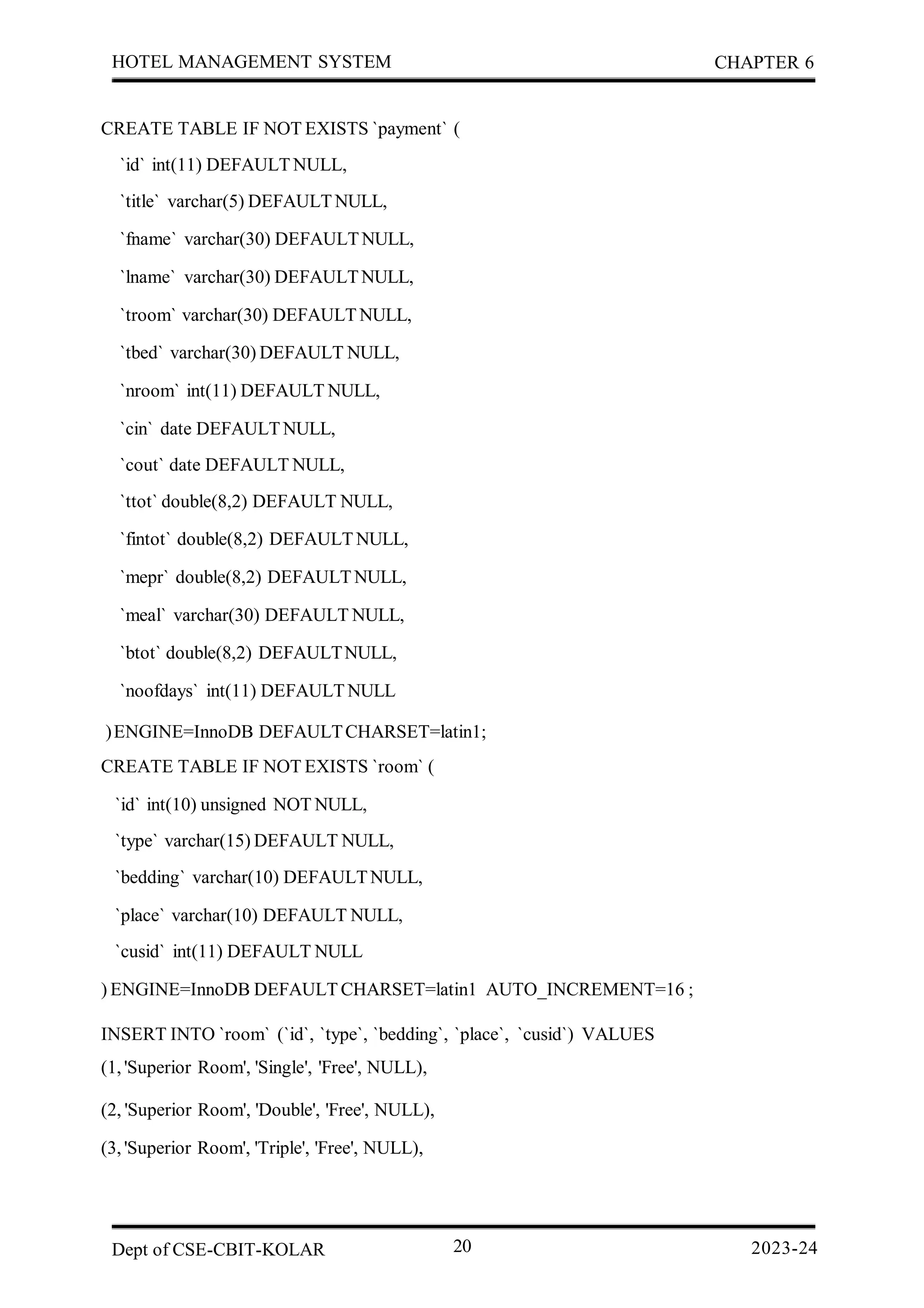
INSERT INTO `login` (`id`, `usname`, `pass`) VALUES (1,
'Admin', '1234'),
(2, 'Prasath', '12345');
CREATE TABLE IF NOT EXISTS `login` (
`id` int(10) unsigned NOT NULL,
`usname` varchar(30)DEFAULT NULL,
`pass` varchar(30) DEFAULT NULL
) ENGINE=InnoDB DEFAULT CHARSET=latin1 AUTO_INCREMENT=3
;
6.6 SQLQUERIES
SETSQL_MODE ="NO_AUTO_VALUE_ON_ZERO";
SET time_zone ="+00:00";
CREATE TABLE IF NOT EXISTS `contact` (
`id` int(10) unsigned NOT NULL,
`fullname` varchar(100) DEFAULTNULL,
`phoneno` int(10) DEFAULT NULL,
`email` text,
`cdate` date DEFAULT NULL,
`approval` varchar(12) DEFAULT NULL
) ENGINE=InnoDB DEFAULT CHARSET=latin1 AUTO_INCREMENT=1
;
CREATE TABLE IF NOT EXISTS `newsletterlog` (
`id` int(10) unsigned NOT NULL,
`title` varchar(52) DEFAULTNULL,
`subject` varchar(100) DEFAULTNULL,
`news` text
) ENGINE=InnoDB DEFAULT CHARSET=latin1 AUTO_INCREMENT=1
;
CHAPTER 6
HOTEL MANAGEMENT SYSTEM
CREATE TABLE IF NOT EXISTS `payment` (
`id` int(11) DEFAULT NULL,
`title` varchar(5) DEFAULT NULL,
`fname` varchar(30) DEFAULTNULL,
`lname` varchar(30) DEFAULTNULL,
`troom` varchar(30) DEFAULT NULL,
`tbed` varchar(30) DEFAULT NULL,
`nroom` int(11) DEFAULT NULL,
`cin` date DEFAULT NULL,
`cout` date DEFAULT NULL,
`ttot` double(8,2) DEFAULT NULL,
`fintot` double(8,2) DEFAULT NULL,
`mepr` double(8,2) DEFAULT NULL,
`meal` varchar(30) DEFAULT NULL,
`btot` double(8,2) DEFAULTNULL,
`noofdays` int(11) DEFAULT NULL
)ENGINE=InnoDB DEFAULTCHARSET=latin1;
Dept of CSE-CBIT-KOLAR 20 2023-24
CREATE TABLE IF NOT EXISTS `room` (
`id` int(10) unsigned NOT NULL,
`type` varchar(15) DEFAULT NULL,
`bedding` varchar(10) DEFAULTNULL,
`place` varchar(10) DEFAULT NULL,
`cusid` int(11) DEFAULT NULL
) ENGINE=InnoDB DEFAULT CHARSET=latin1 AUTO_INCREMENT=16 ;
INSERT INTO `room` (`id`, `type`, `bedding`, `place`, `cusid`) VALUES
(1, 'Superior Room', 'Single', 'Free', NULL),
(2, 'Superior Room', 'Double', 'Free', NULL),
(3, 'Superior Room', 'Triple', 'Free', NULL),
CHAPTER 6
HOTEL MANAGEMENT SYSTEM
Dept of CSE-CBIT-KOLAR 21 2023-24
(4, 'Single Room', 'Quad', 'Free', NULL),
(5, 'Superior Room', 'Quad', 'Free', NULL),
(6,'Deluxe Room', 'Single', 'Free', NULL),
(7, 'Deluxe Room', 'Double', 'Free', NULL),
(8,'Deluxe Room', 'Triple', 'Free', NULL),
(9,'Deluxe Room', 'Quad', 'Free', NULL),
(10, 'Guest House', 'Single', 'Free', NULL),
(11, 'Guest House', 'Double', 'Free', NULL),
(12, 'Guest House', 'Quad', 'Free', NULL),
(13, 'Single Room', 'Single', 'Free', NULL),
(14, 'Single Room', 'Double', 'Free', NULL),
(15, 'Single Room', 'Triple', 'Free', NULL);
CREATE TABLE IF NOT EXISTS `roombook` (
`id` int(10) unsigned NOT NULL,
`Title` varchar(5) DEFAULT NULL,
`FName` text,
`LName` text,
`Email` varchar(50) DEFAULT NULL,
`National` varchar(30) DEFAULTNULL,
`Country` varchar(30) DEFAULTNULL,
`Phone` text,
`TRoom` varchar(20) DEFAULTNULL,
`Bed` varchar(10) DEFAULTNULL,
`NRoom` varchar(2) DEFAULT NULL,
`Meal` varchar(15) DEFAULT NULL,
`cin` date DEFAULTNULL,
`cout` date DEFAULT NULL,
`stat` varchar(15) DEFAULTNULL,
CHAPTER 6
`nodays` int(11) DEFAULT NULL
) ENGINE=InnoDB DEFAULTCHARSET=latin1 AUTO_INCREMENT=2
;
ALTER TABLE `contact`
ADD PRIMARY KEY (`id`);
Dept of CSE-CBIT-KOLAR 22 2023-24
ALTER TABLE `login`
ADD PRIMARY KEY (`id`);
ALTERTABLE `newsletterlog`
ADD PRIMARY KEY (`id`);
ALTER TABLE `room`
ADD PRIMARY KEY (`id`);
ALTER TABLE `roombook`
ADD PRIMARY KEY (`id`);
ALTER TABLE `contact`
MODIFY `id` int(10) unsigned NOT NULL AUTO_INCREMENT;
ALTERTABLE `newsletterlog`
MODIFY `id` int(10) unsigned NOT NULL AUTO_INCREMENT;
HOTEL MANAGEMENT SYSTEM
ALTER TABLE `login`
MODIFY `id` int(10) unsigned NOT NULL AUTO_INCREMENT,AUTO_INCREMENT=3;
ALTER TABLE `room`
MODIFY `id` int(10) unsigned NOT NULL AUTO_INCREMENT,AUTO_INCREMENT=16;
CHAPTER 6
CHAPTER 7
CONCLUSION AND FUTURE ENHANCEMENT
1. CONCLUSION
By centralizing crime-related data into a single database, the system eliminates data
silos and enables seamless access to information across different departments and units
within law enforcement agencies.
The system allows for the efficient storage and organization of various types of crime
data, including incident reports, suspect information, witness statements, and case
details, thereby facilitating effective data management practices.
Through user-friendly interfaces and intuitive query mechanisms, authorized personnel
can easily access relevant crime data based on their specific needs, thereby enabling
timely decision-making and investigative processes.
The system supports advanced data analysis techniques, such as data mining and statistical
analysis, to identify patterns, trends, and correlations within the crime data.
Robust security measures are implemented to safeguard sensitive crime data and ensure
compliance with privacy regulations and policies.
Access controls and encryption techniques are employed to prevent unauthorized access
and maintain data integrity.
2. FUTURE ENHANCEMENT
Integration of Artificial Intelligence (AI)and Machine Learning (ML)
Real-time Data Analysis and Alerts
Mobile Application Support
Geospatial Analysis and Mapping
DataSharing and Interoperability
Enhanced Security Measures
User Training and Suppor
23
REFERENCES
FORXAMPP:
https://www.apachefriends.org/download.html [2]Wangkhem.K & Joshi.K IOT FOR
HEALTH CARE AND ITS CHALLENGES
International Educational Journal of Science and Engineering (IEJSE) –Volume,1.
[3]Kaur, J. S. Ganjoo, P.Vaqur, M.,& Joshi. K. A Review: Image Fusion using DCT and
DWT.
7In0t7e.r n[4a]tional Journal of Scientific & Engineering Research (IJSER)-Volume, 10, 702- Joshi,
K., Kashyap, D.,Bisht. B, & Bagwari.A. GPS based Location Tracker: A
Review.
EInntgeirnneaetrioinnga l Journal of Advanced Research in Computer and Communication
(IJARCCE)- Volume, 8.
[5]Joshi.K.N, Diwakar.M. Image Fusion using Cross Bilateral Filter and Wavelet
Transform
Domain. International Journal of Engineering and Advanced Technology (IJEAT)-
Volume, 8,
110-115. [6] Kumar, R., Singh, G., Joshi, K. Emotion Recognition System using Local
Binary
Pattern. International Journal of Inventive Engineering and Sciences (IJIES)-
AWBEBB RREEFVEIRAETNICOESN: S
1. https://www.wikipedia.org
ER: Entity Relationship
2. https://studocu.com.
SR:Software Requirements
3. www.sourcecodeandproject.
SQL:Structured Query Language
DBMS: Database Management System
PHP: Hypertext Pre-processor
CSS:Cascading style sheets
HOTEL MANAGEMENT SYSTEM
Dept of CSE-CBIT-KOLAR 24 2023-24
CHAPTER 7
SNAPSHOTS
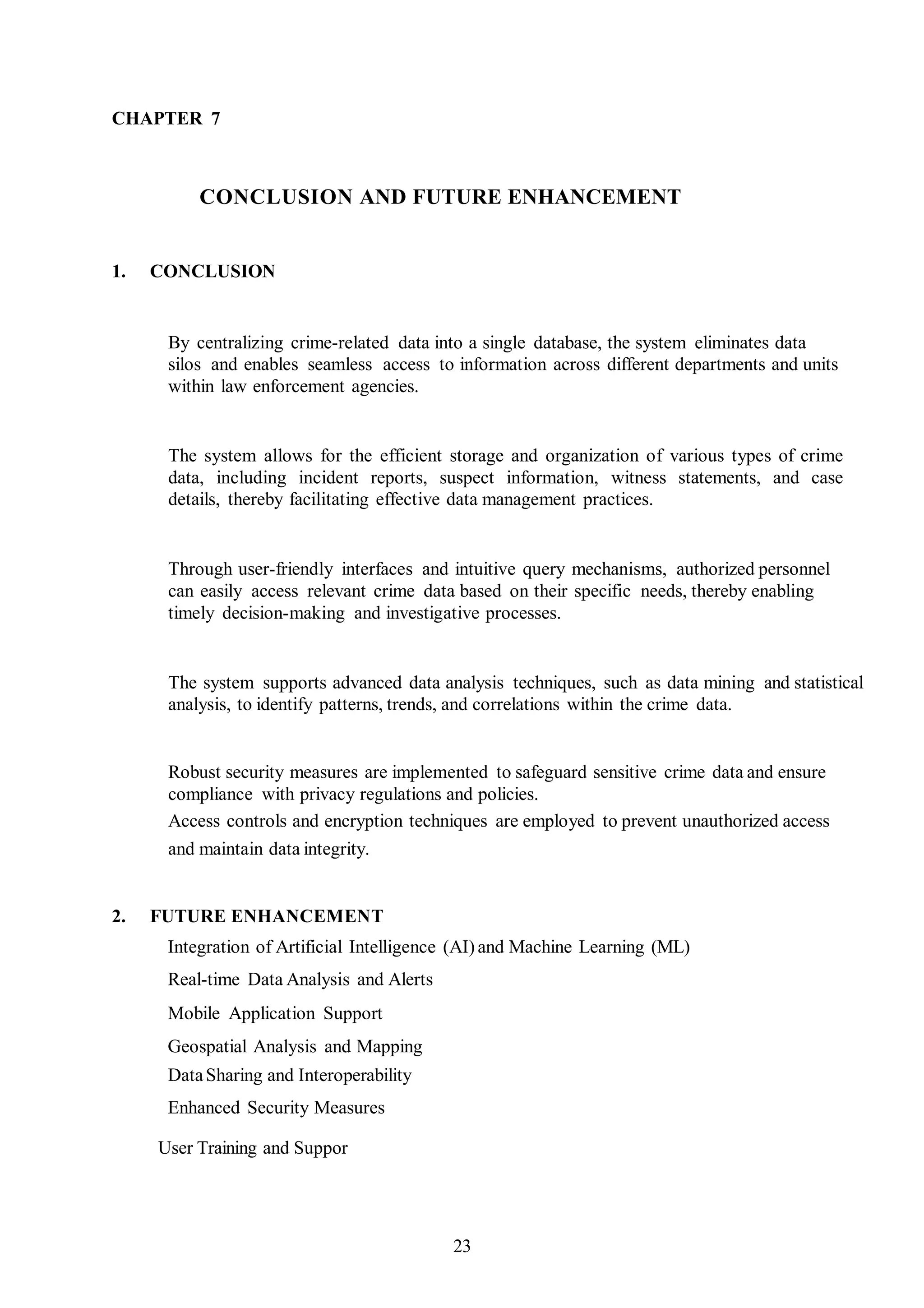
S.1HOMEPAGE
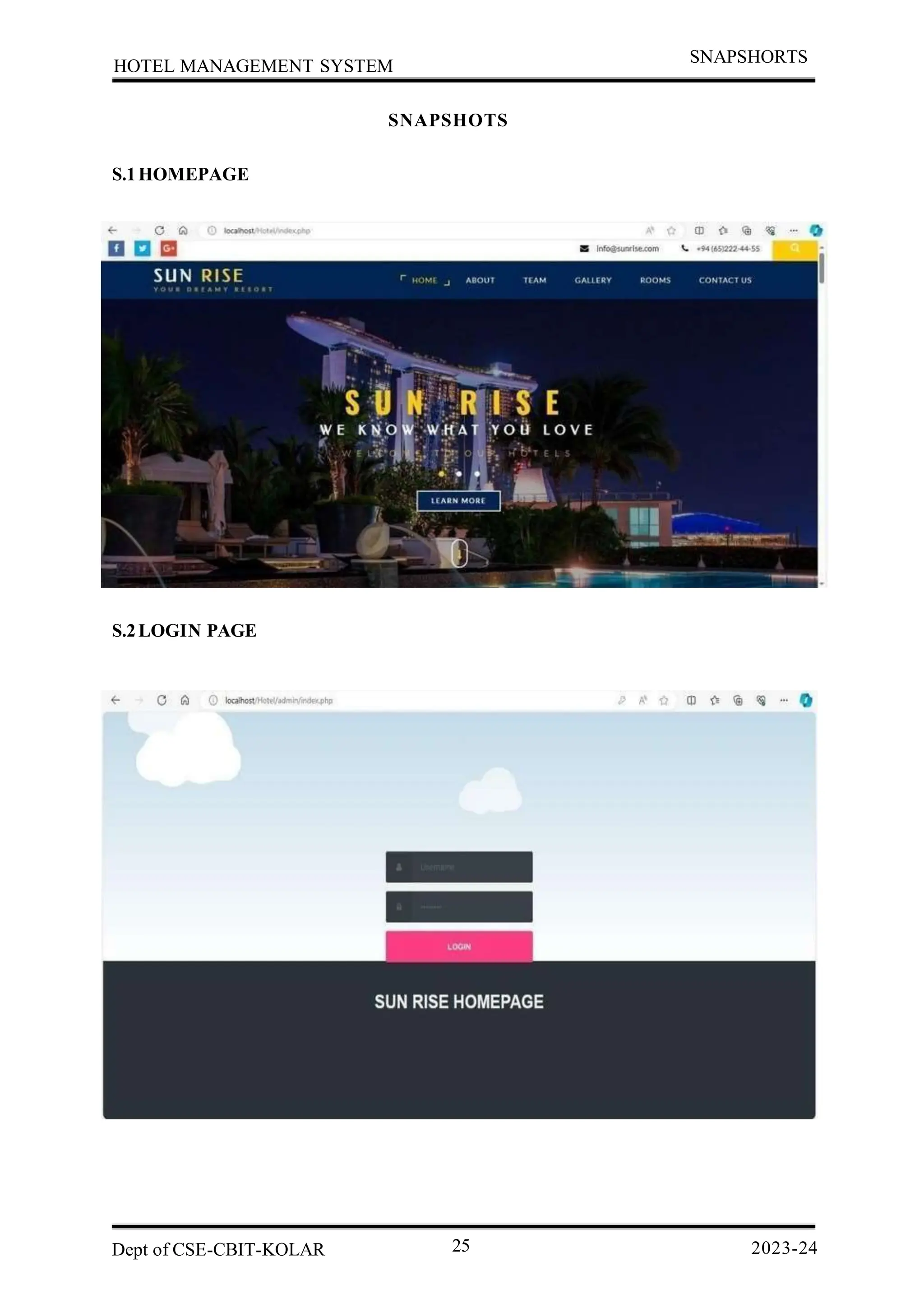
S.2LOGIN PAGE
HOTEL MANAGEMENT SYSTEM
Dept of CSE-CBIT-KOLAR 25 2023-24
SNAPSHORTS
HOTEL MANAGEMENT SYSTEM
Dept of CSE-CBIT-KOLAR 26 2023-24
SNAPSHOTS
S.3 USER DASHBOARD
S.4 RESERVATION DETAILS
HOTEL MANAGEMENT SYSTEM
Dept of CSE-CBIT-KOLAR 27 2023-24
SNAPSHOTS
S.6CONTACTUS
S.5ADMIN STATUS
HOTEL MANAGEMENT SYSTEM
Dept of CSE-CBIT-KOLAR 28 2023-24
SNAPSHOTS
S.7 PAYMENT DETAILS

Hotel management system in a DBMS project

  • 1.
    C. BYREGOWDAINSTITUTEOF TECHNOLOGY AnISO 9001 2015 Certified Institute Department of ComputerScience and Engineering Srinivaspura Road, Kolar – 563101 2023-2024 VisvesvarayaTechnological University “Jnana Sangama,” Belagavi-590 018 DBMS Mini Project Report on “ HOTEL MANAGEMENT SYSTEM" Submitted in partial fulfilment of requirement for the IV semester Bachelor of Engineeringin Computer Science and Engineering Submitted By ABHILASH.N-1CK22CS001 ARAVINDA.HN -1CK22CS013 AVINASH-1CK22CS018 Under the guidance of Prof. VANITHA L B Asst Professor, Dept of CSE, CBIT-KOLAR
  • 2.
    CERTIFICATE This is Certifiedthat the mini project report entitled with “HOTEL MANAGEMENT SYSTEM” is a Bonafide work carried out by ABHILASH.N & ARAVINDA.HN, AVINASH bearing the university seat number 1CK22CS001 & 1CK22CS013, 1CK22CS018 partial fulfilment for the award of Bachelor of Engineering in Computer Science &Engineering of the Visvesvaraya Technological University, Belagavi during the year 2023-2024.It is certified that all corrections/suggestions indicated for the internal assessment have been incorporated in the mini project report. The mini project report has been approved as it satisfies the academic requirements prescribed for the IV semester Bachelor of Engineering Degree. C. BYREGOWDAINSTITUTEOF TECHNOLOGY An ISO 9001 2015 Certified Institute Department of Computer Scienceand Engineering (Srinivaspura Road,Kolar (T&D)Kolar – 563101) Name of Examiners Signature of Examinar Signature of Guide Prof. VANITHA L B Asst.Professor Dept. of CSE,CBITKolar Signature of the HOD Dr.VASUDEVA R Assoc.Professor & HOD Dept. of CSE,CBIT Kolar
  • 3.
    ABSTRACT This project aimsat creating on Hotel Management System which can be used by Admin and Customers. The admin to advise/publish the availability of rooms in different hotels and customers are checking the availability of room in required hotel. Customers should be able to know the availability of the rooms on a particular date to reserve in hotel. They should be able to reserve the available rooms according to their need in advance to make their stay comfortable. The Admin hands the booking information of customers. The users can register and log into the system. The administrator will know the details of reservation and daily income. The hotel department maintain the seat availability and booking details in certain database.This project provides high security to Admin and user information. i
  • 4.
    DECLARATION ABHILASH.N-1CK22CS001 ARAVINDA.H.N-1CK22CS013 AVINASH-1CK22CS018 We ABHILASH.N &ARAVINDA.H.N, AVINASH bearing USN 1CK22CS001 & 1CK22CS013, 1CK22CS018 student of 4th semester B.E, Computer Science and Engineering of VTU, declare that this report entitled “HOTEL MANAGEMENT”, embodies the report of the mini project carried out under the guidance of Prof. VANITHA L B Dept. of CSE, CBIT as partial fulfilment of the requirement of the award of the degree in Bachelor of Engineering, ComputerScience and Engineering, affiliated to Visvesvaraya Technological University, Belagavi during the academic year 2023-2024. Further the content embodies in the mini project report has not been submitted previously by anybody for the award of any other degree. ii
  • 5.
    ACKNOWLEDGEMENT The completion ofany work is a showcase of constant dedication and co-operation of many people who lent their hands which went seen or unseen. We are grateful to our Institution and Management, C. BYREGOWDA INSTITUTE OF TECHNOLOGY with its ideals and inspirations for having provided us with the facilities, which has made this project a success. We would like to thank our beloved Principal Dr. S N CHANDRASHEKARA, CBIT for his kind disposition for completing this undertaking successfully. We express our heart full gratitude to Dr. VASUDEVA R, Professor and HOD, Department of Computer science & Engineering, CBIT, for giving us guidance, valuable advice and support. We extend our gratitude to our coordinator & guide Prof. VANITHA L B, Asst. Professor, Department of Computer Science & Engineering, CBIT for her valuable advice, support and constructive suggestions. We also thank to all our professors and the entire department of Computer Science & Engineering for their co-operation and suggestions. The report would be incomplete if I do not thank our parents and friends for their continuous encouragement and moral support. ABHILASH.N-1CK22CS001 ARAVINDA-1CK22CS013 AVINASH-1CK22CS018 iii
  • 6.
    TABLE OF CONTENTS 1 2 CHAPTERNO ASBTRACT DECLARATION ACKNOWLEDGMWNT TABLE OF CONTENTS LIST OF FIGURES CHAPTER NAME INTRODUCTION TO DBMS 1. Introduction 2. Applications of DBMS 3. Introduction to SQL 4. Basic SQL operations 5. Benefits of using SQL HOTEL MANAGEMENT SYSTEM 1. Introduction 2. Objective 3. Scope of project 4. Methodology 5. Project frame work 6. System analysis 1 2 3 4 4 5 5 6 6 6 6 PAGE NO i ii iii iv vi 3 LITERATURE SURVEY 1. Overview 2. Existing system 3. Proposed system 7 7 7 iv
  • 7.
    3 4 5 6 7 CHAPTER NO CHAPTERNAME LITERATURE SURVEY 1. Overview 2. Existing system 3. Proposed system HARDWARE AND SOFTWARE REQUIREMENTS 1. Hardware requirements 2. Software requirements DESI GN PHASE 1. Introduction 2. Use case design 3. Schema diagram 4. ER- diagram IMPLEMENTATION 1. Introduction 2. Platform 3. Language 4. Tables 5. Implementation of code 6. SQL queries CONCLUSI ON AND FUTURE ENHANCEMENT 1. Conclusion 2. Future enhancement 7 7 7 8 8 11 11 11 12 13 15 9 9 10 10 19 19 PAGE NO REFERENCES 20 8 9 SNAPS HOTS 21 v
  • 8.
    FIGURE NO FIGURENAME PAGE NO 5.1 Use case diagram 10 5.2 Schema diagram 11 5.3 Entity Relationship diagram 12 6.4 Tables 14-15 S.1 Home page 25 S.2 Login page 25 S.3 User dashboard 26 S.4 Reservation details 26 S.5 Admin status 27 S.6 Contact us 27 S.7 Payment details 28 VI LIST OF FIGURES
  • 9.
    CHAPTER1 INTRODUCTIONTODBMS 1.1INTRODUCTION A Database ManagementSystem (DBMS) is a software suite designed to facilitate the creation, organization, retrieval, and manipulation of data in a structured format. It serves as an intermediary between users and databases, providing an interface for users to interact with the data while ensuring its integrity and security. DBMS are crucial components of modern information systems, utilized across various industries and applications, including banking, healthcare, education, e-commerce, and more. They offer several key functionalities: 1. DataOrganization:DBMSs enable the efficient organization of data into logical structures such as tables, rows, and columns. This organization allows for easy storage and retrieval of information based on predefined relationships and data models. 2. DataRetrievalandManipulation:Users can query DBMSs to retrieve specific information from the database using structured query languages (SQL)or other interfaces. DBMSs also support data manipulation operations, including insertion, deletion, and modification of records. 3. Concurrency Control: DBMS manage concurrent access to the database by multiple users or applications, ensuring data consistency and integrity. Through mechanisms such as locking and transaction management, DBMSs prevent conflicts and maintain the accuracy of data during simultaneous operations. 4. Data Security and Integrity: DBMS implement security measures to protect sensitive data from unauthorized access, ensuring compliance with privacy regulations and organizational policies. They also enforce data integrity constraints to maintain the accuracy and consistency of information stored in the database. 5. Scalability and Performance: DBMSs are designed to scale with growing data volumes and user demands, providing efficient storage and retrieval mechanisms. They optimize query processing and resource utilization to deliver high performance even under heavy workloads. Database scalability is the ability to expand or contract the capacity of system resources in order to support the changing usage of your application. This can refer both to increasing and decreasing usage of the application. 1
  • 10.
    1.2APPLI CATIONS OFDBMS Database Management Systems (DBMS) find application across various domains due to their ability to efficiently manage, organize, and retrieve large volumes of data. Here are some common applications of DBMS: 1. Enterprise Resource Planning (ERP) Systems: ERP systems integrate various business processes and departments within an organization, such as finance, human resources, inventory management, and customer relationship management (CRM). DBMSs store and manage data related to these processes, enabling seamless coordination and information sharing across the enterprise. 2. Customer Relationship Management (CRM) Systems: CRM systems help businesses manage interactions with current and potential customers. DBMSs store customer information, including contact details, purchase history, preferences, and feedback, allowing organizations to personalize marketing strategies, improve customer service, and enhance customer retention. 3.E-commerce Platforms: E-commerce platforms rely on DBMSs to store product catalogues, customer orders, payment transactions, and inventory data. By efficiently managing this information, DBMSs enable smooth online shopping experiences, secure payment processing, and real-time inventory management for e-commerce businesses. 4. Healthcare Information Systems: Healthcare institutions utilize DBMSs to manage patient records, medical histories, diagnostic reports, treatment plans, and billing information. DBMSs ensure the confidentiality, integrity, and accessibility of sensitive healthcare data, facilitating efficient patient care, medical research, and regulatory compliance. 5. Banking and Financial Systems: Banks and financial institutions rely on DBMSs to store and manage customer accounts, transactions, loan portfolios, credit histories, and regulatory compliance data. DBMSs support secure and reliable banking operations, including online banking, ATM transactions, fraud detection, and risk management. 6. Telecommunications Systems: Telecommunications companies use DBMSs to store subscriber information, call records, network configurations, billing details, and service provisioning data. DBMSs enable efficient management of telecommunications infrastructure, network optimization, and billing accuracy for telecom providers. 7. Supply Chain Management (SCM) Systems: SCM systems track the flow of goods, materials, and information across supply chains, from raw material sourcing to product delivery. DBMSs store data related to inventory levels, supplier relationships, order fulfilment, logistics, and distribution networks, facilitating efficient supply chain operations and collaboration among stakeholders. 2 HOTEL MANAGEMENT SYSTEM CHAPTER 1 Dept of CSE-CBIT-KOLAR 2023-24
  • 11.
    3 8. Educational Institutions:Educational institutions leverage DBMSs to manage student records, course schedules, academic performance, faculty information, library resources, and administrative operations. DBMSs support student enrolment, grading, course planning, and institutional research efforts, enhancing educational quality and administrative efficiency. 1.3 INTRODUCTION TOSQL SQL, which stands for Structured Query Language, is a powerful and standardized programming language used for managing and manipulating relational databases. It provides a comprehensive set of commands and syntax for performing various operations on data stored in a relational database management system (RDBMS). Key Components of SQL: 1. Data Definition Language (DDL): DDL statements are used to define, modify, and delete database objects such as tables, indexes, and views. Common DDL commands include CREATE, ALTER, DROP, and TRUNCATE. 2. Data Manipulation Language (DML): DML statements are used to retrieve, insert, update, and delete data in database tables. Common DML commands include SELECT, INSERT,UPDATE, and DELETE. 3. Data Control Language (DCL): DCL statements are used to control access permissions and privileges on database objects. Common DCL commands include GRANT and REVOKE. 4. Transaction Control Language (TCL): TCL statements are used to manage transactions within a database. Common TCL commands include COMMIT, ROLLBACK, and SAVEPOINT. 1.4 BASIC SQLOPERATIONS: 1. Creating Tables: CREATE TABLE table_name ( column1 datatype, column2 datatype, … ); 2. Inserting Data: INSERT INTO table_name (column1, column2, ...) VALUES (value1, value2, ...); HOTEL MANAGEMENT SYSTEM CHAPTER 1 Dept of CSE-CBIT-KOLAR 2023-24
  • 12.
    3. Querying Data: SELECTcolumn1, column2, ...FROM table_name WHERE condition; 4. Updating Data: UPDATE table_name SET column1 =value1, column2 =value2, ... WHERE condition; 5. Deleting Data: DELETE FROM table_name WHERE condition; 1.5 BENEFITS OF USING SQL Faster Processing Speed Minimal Requirement of Coding Easier Data Manipulation Better Data Mining Restricted Access Reliable for Complicated Queries 4 HOTEL MANAGEMENT SYSTEM CHAPTER 1 Dept of CSE-CBIT-KOLAR 2023-24
  • 13.
    CHAPTER2 HOTELMANAGEMENTSYSTEM INTRODUCTION Hotel Management Systemis a hotel reservation site script where site users will be able to search rooms availability with an online booking reservations system.Site users can also browse hotels,view room inventory,check availability,and book reservations in real-time.Site users enter check in date and check out date then search for availability and rates.After choosing the right room in the wanted hotel-all booking and reservation process is done on the site and an SMS is sent to confirm the booking. Administer Panel Administrator-Administrator can manage administrator accounts and confirm the rooms. Room Types-Administrator can define the type of rooms in the hotels,room’sprices and upload an image for each room. Bookings-All booking and reservations made on the site are displayed with all booking details: arrival date, departuredate, hotel name, room type, number of passengers,price. 2.2OBJECTIVE The main objective of hotel organization could be improved by integrating service-oriented operations service-oriented operations with project management principles.Such integration would in still innovation,proactive attitudes and regulated risk-taking needed to pursue on going improvement and proactive response to change.By managing each change as project embedded in smoothly running operations,hotels would extend their life span by continuously reinventing themselves.Due to which the customers can easily book the hotels rooms. Needs of Hotel Management System This system will help administration to work easily. Because of its easy access and less time consuming administration can get the information of the Users, Rooms, Payments, etc. They do not have to searchin the paper file for the log time. Members an easily handle the system. 5
  • 14.
    HOTEL MANAGEMENT SYSTEMCHAPTER 2 1. SCOPE OF PROJECT This activity is also known as the feasibility study. Perform and evaluate feasibility studies like cost-benefit analysis, technical feasibility, time feasibility and operational feasibility for the project. Project Scheduling should be made using chats. Feasibility study is carried out to decide whether the proposed system is feasible for the company. It begins with a request from the user for a new system. It involves the following: Identify the responsible user for a new system Clarify the user request Identify deficiencies in the current system Establish goals and objectives for the new system Determine the feasibility for the new system Prepare a project charter that will be used to guide the remainder of the Project 2. METHODOLOGY/PROCEDURE For the development of the project the designing is done on PHPMYADMIN, backend was coded in basis of php and same front end we use the same php codes. Software methodologies are connected with the process of creating software -not so much the technical side but organization aspects. Several software development approaches since have used the origin of information technology. 3. PROJECT FRAME WORK: A frame work is a standardized set of concepts, practices, and criteria for dealing with a common type of problem, which can be used as a reference to help us approach and resolve new problems of similar nature. The aim of framework is to provide a common structure so that developers don’t have to redo it from scratch and can reuse the code provided. In this way, frame works allows us to cut out much of the work and save a lot of time. 4. SYSTEM ANALYSI S System Analysis is a detailed study of the various operations performed by a system and their relationships within and outside of the system. Here the key question is why all problems exist in the present system? What must be done to solve the problem? Analysis begins when a user or manager begins a study of the program using existing system. The commonly used tools in the system are Data Flow Diagrammatic. Training, experience a common sense are required for collection of relevant information needed to develop the system. The success of the system depends largely on how clearly the problem is defined, thoroughly investigated and properly carried out through the choice of solution. A good analysis model should provide not only the mechanisms of problem understanding but also the frame work of the solution. Dept of CSE-CBIT-KOLAR 6 2023-2024
  • 15.
    CHAPTER3 LITERATURE SURVEY 3.1OVERVIEW Hotel Managementproject provides room booking, meals, and other necessary hotel management features. The system allows the manager to post available rooms in the system. Customers can view and book room online. Admin has the power of either approving or disapproving the customers’s booking request. 3.2EXISTINGSYSTEM Existing System means the current system on which all calculations are done manually.The existing system uses paperwork and direct human language communication by mouth to manage the hotel.This delays information transmission in the hotel. Booking is done through phone calls or through visit to the hotel booking office.The guest’s personal details such as Name, Age, Nationality and Duration of stay, are input during booking in. The booking office orders for preparation of the guest’s room before his/her check in date. Some of the limitations of the existing system can be concluded as follows: In the existing system, all the data is maintained in different files and registers.That often leads to data duplication and redundancy in the stored data, thus ending to wastages of storage of space. In the existing system, data of customers are entered into various long registered that is customers register etc. which result into slow access to the desired information. In the existing system, since everything is record and stored in the register.It is quite difficult and time consuming.The major problem is modification that must be reflected in all the entire and summaries also needed to be update. 3.3PROPOSEDSYSTEM Implementing an automated system for managing reservations can streamline the booking process for guest’s and reduce manual errors. Developing a user friendly online booking portal can enhance cutomer experience and attract more guest by allowing them to book rooms and services convenintely.Implementing a centralized database system can facilitate efficient management of guest information, reservations, billing and other operations.Recorded maintainance is easy because all records are stored in specific file. Data can easily secured,security restrictions can easily be applied. Error detection is easy. 7
  • 16.
    CHAPTER 4 HARDWARE ANDSOFTWARE REQUIREMENTS 4.1 HARDWARE REQUIREMENTS Operating System: Windows7or later Processor: IntelPentium4 or later Memory: 4GB minimum, 8 GB recommended Screenresolution:1280*1024 or larger Application Window Size: 1024*680or larger Internet Connection: Not required CacheMemory:512KB MicrosoftCompatible101ormoreKey Board 4.2 SOFTWARE REQUIREMENTS Client: Operating System (Windows) Web Server:Apache Web Server Language:PHP Front-End: HTML, CSS, JAVASCRIPT, BOOTSTRAP Back-end: MySQL 8
  • 17.
    CHAPTER 5 DESI GNPHASE Design is the creation of a plan or convention for the construction of an object or a system (as in architectural blueprints, engineering drawings, business processes, circuit diagrams and sewing patterns). Design has different connotations in different fields (see design disciplines below). In some cases, the direct construction of an object (as in pottery, engineering, management, coding and graphic design) is also considered to be design. A specification of an object, manifested by an agent, intended to accomplish goals, in a particular environment, using a set of primitive components, satisfying a set of requirements, subject to constraints. Another definition for design is a roadmap or a strategic approach for someone to achievea unique expectation. It defines the specifications, plans, parameters, costs, activities, processesand how and what to do within legal, political, social, environmental, safety and economic constraints in achieving that objective. Designing often necessitates considering the aesthetic, functional, economic and socio-political dimensions of both the design object and design process. It may involve considerable research, thought, modelling, interactive adjustment, and re-design. Meanwhile, diverse kinds of objects may be designed, including clothing, graphical user interfaces, skyscrapers, corporate identities, business processes and even methods of designing. 9
  • 18.
    HOTEL MANAGEMENT SYSTEM 102023-2024 Dept of CSE-CBIT-KOLAR USE CASE DIAGRAM Use case diagrams model behavior with in a system and helps the developers understand of what the user require. The stick man represents what’s called an actor. Use case diagramcan be useful for getting an overall view of the system and clarifying who can do and more importantly what they can’t do. Use case diagram consists of use cases and actors and shows the interaction between the use case and actors. The purpose is to show the interactions betweenthe use case and actor. To represent the system requirements from user’s perspective. An actor could be the end-user of the system or an external system. CHAPTER 5 FIG :5.1 USE CASE DIAGRAM
  • 19.
    HOTEL MANAGEMENT SYSTEM Deptof CSE-CBIT-KOLAR 2023-2024 11 CHAPTER 5 5.2 SCHEMA DIAGRAM
  • 20.
    5.3 ENTITY RELATIONSHIPDIAGRAM ER-DI AGRAM DEFI NITION An Entity relationship describes inter-related things of interest in a specific domain of knowledge.An ER model is composed of entity types and specifies relationships that canexist between instances of those entity types. In software engineering an ER model is commonly formed to represent things that a business needs to remember in order to perform business processes. Consequently, the ER model becomes an abstract data model that definesa data or information structure that can be implemented in a database, typically a relation database. FIG:5.2 ENTITY RELATIONSHIP DIAGRAM HOTEL MANAGEMENT SYSTEM Dept of CSE-CBIT-KOLAR 12 2023-2024 CHAPTER 5
  • 21.
    6.3LANGUAGE PHP is ageneral-purpose scripting language geared towards web development. It was originally created by Danish-Canadian programmer Rasmus Lerdorf in 1993 and released in 1995. The PHP reference implementation is now produced by the PHP Group. PHP is a self- referentially acronym for PHP: Hypertext Preprocessor. Original it supposedly meant personal home page. It is an open source, server-side, HTML embedded scripting language used to create dynamic Web pages. CHAPTER 6 IMPLEMENTATION 6.1 INTRODUCTION The implementation is the process of assuring that the information system operation and then allowing users take over its operations for use and evaluation. Implementation includes the following activities: Obtaining and installing the system hardware Providing user access to the system. Creating and updating the database Training the users in the new system. advantages of windows 11are: Improved performance. Enhanced searching capabilities. Location aware printing. Virtual hard disk support. Expanded security. Get better security built-in. Hasslefree backups. Have all of your files instantly at hand. 6.2PLATFORM Windows11is the latest major release of Microsoft's Windows NT operating system, released in October 2021. It is a free upgrade to its predecessor, Windows 10 (2015), and is available for any Windows10 devices that meet the newWindows11system requirements are available for retail sale to consumers. The 13
  • 22.
    HOTEL MANAGEMENT SYSTEM Deptof CSE-CBIT-KOLAR 2023-24 14 CHAPTER 6 LOGIN CONTACT PAYMENT 6.4 TABLES NEWS LETTER LOG
  • 23.
    HOTEL MANAGEMENT SYSTEM Deptof CSE-CBIT-KOLAR 2023-24 15 CHAPTER 6 6.5 IMPLEMENTATION OF CODE <?php include('db.php'); ?> <!DOCTYPE html> <html lang="en"> <head> <title>SUNRISE HOTEL</title> <!-- for-mobile-apps --> <meta name="viewport" content="width=device- width, initial-scale=1"> <meta http-equiv="Content-Type" content="text/html; charset=utf-8" /> <meta name="keywords" content="Resort Inn Responsive , Smartphone Compatible web template , Samsung, LG, Sony Ericsson, Motorola web design" /> <script type="application/x-javascript"> addEventListener("load", function() { setTimeout(hideURLbar, 0);},false); function hideURLbar(){window.scrollTo(0,1); }</script> <!-- //for-mobile-apps --> <link href="css/bootstrap.css" rel="stylesheet" type="text/css" media="all" /> ROOM ROOM BOOK
  • 24.
    HOTEL MANAGEMENT SYSTEMCHAPTER 6 <link href="css/font-awesome.css" rel="stylesheet"> <link rel="stylesheet" href="css/chocolat.css" type="text/css" media="screen"> <link href="css/easy-responsive-tabs.css" rel='stylesheet' type='text/css'/> <link rel="stylesheet" href="css/flexslider.css" type="text/css" media="screen" property="" /> <link rel="stylesheet" href="css/jquery-ui.css" /> <link href="css/style.css" rel="stylesheet" type="text/css" media="all" /> <script type="text/javascript" src="js/modernizr-2.6.2.min.js"></script> <!--fonts--> <link href="//fonts.googleapis.com/css?family=Oswald:300,400,700" rel="stylesheet"> <link href="//fonts.googleapis.com/css?family=Federo" rel="stylesheet"> <link href="//fonts.googleapis.com/css?family=Lato:300,400,700,900" rel="stylesheet"> <!--//fonts--> </head> <body> <!-- header --> <div class="banner-top"> <div class="social-bnr-agileits"> <ul class="social-icons3"> <li><a href="https://www.facebook.com/" class="fa fa-facebook icon- border facebook"></a> <li><a href="https://twitter.com/" class="fa fa-twitter icon-border twitter"> </a></li> <li><a href="https://plus.google.com/u/0/" class="fa fa-google-plus icon- border googleplus"> </a></li> </ul> </div> <div class="contact-bnr-w3-agile"> <ul> <li><i class="fa fa-envelope" aria-hidden="true"></i><a href="mailto:info@example.com">INFO@SUNRISE.COM</a></li> <li><i class="fa fa-phone" aria-hidden="true"></i>+94 (65)222-4455</li> <li class="s-bar"> <div class="search"> <input class="search_box" Dept of CSE-CBIT-KOLAR 2023-24 16
  • 25.
    HOTEL MANAGEMENT SYSTEM type="checkbox"id="search_box"> Dept of CSE-CBIT-KOLAR 2023-24 17 CHAPTER 6 <label class="icon-search" for="search_box"><spanclass="glyphicon glyphicon-search" aria-hidden="true"></span></label> <div class="search_form"> <form action="#" method="post"> <input type="search" name="Search" placeholder=" " required=" " /> <input type="submit" value="Search"> </form> </div> </div> </li> </ul> </div> <div class="clearfix"></div> <div class="w3_navigation"> <div class="container"> <nav class="navbar navbar-default"> <div class="navbar-header navbar-left"> <button type="button" class="navbar-toggle collapsed" data-toggle="collapse" data-target="#bs-example-navbar-collapse-1"> <spanclass="sr-only">Toggle navigation</span> <span class="icon-bar"></span> <span class="icon-bar"></span> <span class="icon-bar"></span> </button> <h1><a class="navbar-brand" href="index.php">SUN <span>RISE</span><p class="logo_w3l_agile_caption">Your Dreamy Resort</p></a></h1> </div> <!--Collect the nav links, forms, and other content for toggling --> <div class="collapse navbar-collapse navbar-right" id="bs-example-navbar-collapse-1"> <nav class="menu menu--iris"> <ul class="nav navbar-nav menu list"> <li class="menu item menu item--current"><a href="" class >
  • 26.
    HOTEL MANAGEMENT SYSTEMCHAPTER 6 <li class="menu item"><a href="#about" class="menu link scroll">About</a></li> <li class="menu item"><a href="#team" class="menu link scroll">Team</a></li> <li class="menu item"><a href="#gallery" class="menu link scroll">Gallery</a></li> <li class="menu item"><a href="#rooms" class="menu link scroll">Rooms</a></li> <li class="menu item"><a href="#contact"class="menu link scroll">Contact Us</a></li> </ul> </nav> </div> </nav> <!-- //Modal1 --> <div id="availability-agileits"> <div class="col-md-12 book-form-left-w3layouts"> <ahref="admin/reservation.php"><h2>ROOM RESERVATION</h2></a> </div> <div class="clearfix"> </div> </div> !-- //team --> <!-- Gallery --> <section class="portfolio-w3ls" id="gallery"> <h3 class="title-w3-agileits title-black-wthree">Our Gallery</h3> <div class="col-md-3 gallery-grid gallery1"> <ahref="images/g1.jpg" class="swipebox"><img src="images/g1.jpg" class="img-responsive" alt="/"> <div class="textbox"> <h4>SUN RISE</h4> <p><iclass="fa fa-picture-o" aria- hidden="true"></i></p> </div> Dept of CSE-CBIT-KOLAR 18 2023-24
  • 27.
    HOTEL MANAGEMENT SYSTEM Deptof CSE-CBIT-KOLAR 19 2023-24 INSERT INTO `login` (`id`, `usname`, `pass`) VALUES (1, 'Admin', '1234'), (2, 'Prasath', '12345'); CREATE TABLE IF NOT EXISTS `login` ( `id` int(10) unsigned NOT NULL, `usname` varchar(30)DEFAULT NULL, `pass` varchar(30) DEFAULT NULL ) ENGINE=InnoDB DEFAULT CHARSET=latin1 AUTO_INCREMENT=3 ; 6.6 SQLQUERIES SETSQL_MODE ="NO_AUTO_VALUE_ON_ZERO"; SET time_zone ="+00:00"; CREATE TABLE IF NOT EXISTS `contact` ( `id` int(10) unsigned NOT NULL, `fullname` varchar(100) DEFAULTNULL, `phoneno` int(10) DEFAULT NULL, `email` text, `cdate` date DEFAULT NULL, `approval` varchar(12) DEFAULT NULL ) ENGINE=InnoDB DEFAULT CHARSET=latin1 AUTO_INCREMENT=1 ; CREATE TABLE IF NOT EXISTS `newsletterlog` ( `id` int(10) unsigned NOT NULL, `title` varchar(52) DEFAULTNULL, `subject` varchar(100) DEFAULTNULL, `news` text ) ENGINE=InnoDB DEFAULT CHARSET=latin1 AUTO_INCREMENT=1 ; CHAPTER 6
  • 28.
    HOTEL MANAGEMENT SYSTEM CREATETABLE IF NOT EXISTS `payment` ( `id` int(11) DEFAULT NULL, `title` varchar(5) DEFAULT NULL, `fname` varchar(30) DEFAULTNULL, `lname` varchar(30) DEFAULTNULL, `troom` varchar(30) DEFAULT NULL, `tbed` varchar(30) DEFAULT NULL, `nroom` int(11) DEFAULT NULL, `cin` date DEFAULT NULL, `cout` date DEFAULT NULL, `ttot` double(8,2) DEFAULT NULL, `fintot` double(8,2) DEFAULT NULL, `mepr` double(8,2) DEFAULT NULL, `meal` varchar(30) DEFAULT NULL, `btot` double(8,2) DEFAULTNULL, `noofdays` int(11) DEFAULT NULL )ENGINE=InnoDB DEFAULTCHARSET=latin1; Dept of CSE-CBIT-KOLAR 20 2023-24 CREATE TABLE IF NOT EXISTS `room` ( `id` int(10) unsigned NOT NULL, `type` varchar(15) DEFAULT NULL, `bedding` varchar(10) DEFAULTNULL, `place` varchar(10) DEFAULT NULL, `cusid` int(11) DEFAULT NULL ) ENGINE=InnoDB DEFAULT CHARSET=latin1 AUTO_INCREMENT=16 ; INSERT INTO `room` (`id`, `type`, `bedding`, `place`, `cusid`) VALUES (1, 'Superior Room', 'Single', 'Free', NULL), (2, 'Superior Room', 'Double', 'Free', NULL), (3, 'Superior Room', 'Triple', 'Free', NULL), CHAPTER 6
  • 29.
    HOTEL MANAGEMENT SYSTEM Deptof CSE-CBIT-KOLAR 21 2023-24 (4, 'Single Room', 'Quad', 'Free', NULL), (5, 'Superior Room', 'Quad', 'Free', NULL), (6,'Deluxe Room', 'Single', 'Free', NULL), (7, 'Deluxe Room', 'Double', 'Free', NULL), (8,'Deluxe Room', 'Triple', 'Free', NULL), (9,'Deluxe Room', 'Quad', 'Free', NULL), (10, 'Guest House', 'Single', 'Free', NULL), (11, 'Guest House', 'Double', 'Free', NULL), (12, 'Guest House', 'Quad', 'Free', NULL), (13, 'Single Room', 'Single', 'Free', NULL), (14, 'Single Room', 'Double', 'Free', NULL), (15, 'Single Room', 'Triple', 'Free', NULL); CREATE TABLE IF NOT EXISTS `roombook` ( `id` int(10) unsigned NOT NULL, `Title` varchar(5) DEFAULT NULL, `FName` text, `LName` text, `Email` varchar(50) DEFAULT NULL, `National` varchar(30) DEFAULTNULL, `Country` varchar(30) DEFAULTNULL, `Phone` text, `TRoom` varchar(20) DEFAULTNULL, `Bed` varchar(10) DEFAULTNULL, `NRoom` varchar(2) DEFAULT NULL, `Meal` varchar(15) DEFAULT NULL, `cin` date DEFAULTNULL, `cout` date DEFAULT NULL, `stat` varchar(15) DEFAULTNULL, CHAPTER 6
  • 30.
    `nodays` int(11) DEFAULTNULL ) ENGINE=InnoDB DEFAULTCHARSET=latin1 AUTO_INCREMENT=2 ; ALTER TABLE `contact` ADD PRIMARY KEY (`id`); Dept of CSE-CBIT-KOLAR 22 2023-24 ALTER TABLE `login` ADD PRIMARY KEY (`id`); ALTERTABLE `newsletterlog` ADD PRIMARY KEY (`id`); ALTER TABLE `room` ADD PRIMARY KEY (`id`); ALTER TABLE `roombook` ADD PRIMARY KEY (`id`); ALTER TABLE `contact` MODIFY `id` int(10) unsigned NOT NULL AUTO_INCREMENT; ALTERTABLE `newsletterlog` MODIFY `id` int(10) unsigned NOT NULL AUTO_INCREMENT; HOTEL MANAGEMENT SYSTEM ALTER TABLE `login` MODIFY `id` int(10) unsigned NOT NULL AUTO_INCREMENT,AUTO_INCREMENT=3; ALTER TABLE `room` MODIFY `id` int(10) unsigned NOT NULL AUTO_INCREMENT,AUTO_INCREMENT=16; CHAPTER 6
  • 31.
    CHAPTER 7 CONCLUSION ANDFUTURE ENHANCEMENT 1. CONCLUSION By centralizing crime-related data into a single database, the system eliminates data silos and enables seamless access to information across different departments and units within law enforcement agencies. The system allows for the efficient storage and organization of various types of crime data, including incident reports, suspect information, witness statements, and case details, thereby facilitating effective data management practices. Through user-friendly interfaces and intuitive query mechanisms, authorized personnel can easily access relevant crime data based on their specific needs, thereby enabling timely decision-making and investigative processes. The system supports advanced data analysis techniques, such as data mining and statistical analysis, to identify patterns, trends, and correlations within the crime data. Robust security measures are implemented to safeguard sensitive crime data and ensure compliance with privacy regulations and policies. Access controls and encryption techniques are employed to prevent unauthorized access and maintain data integrity. 2. FUTURE ENHANCEMENT Integration of Artificial Intelligence (AI)and Machine Learning (ML) Real-time Data Analysis and Alerts Mobile Application Support Geospatial Analysis and Mapping DataSharing and Interoperability Enhanced Security Measures User Training and Suppor 23
  • 32.
    REFERENCES FORXAMPP: https://www.apachefriends.org/download.html [2]Wangkhem.K &Joshi.K IOT FOR HEALTH CARE AND ITS CHALLENGES International Educational Journal of Science and Engineering (IEJSE) –Volume,1. [3]Kaur, J. S. Ganjoo, P.Vaqur, M.,& Joshi. K. A Review: Image Fusion using DCT and DWT. 7In0t7e.r n[4a]tional Journal of Scientific & Engineering Research (IJSER)-Volume, 10, 702- Joshi, K., Kashyap, D.,Bisht. B, & Bagwari.A. GPS based Location Tracker: A Review. EInntgeirnneaetrioinnga l Journal of Advanced Research in Computer and Communication (IJARCCE)- Volume, 8. [5]Joshi.K.N, Diwakar.M. Image Fusion using Cross Bilateral Filter and Wavelet Transform Domain. International Journal of Engineering and Advanced Technology (IJEAT)- Volume, 8, 110-115. [6] Kumar, R., Singh, G., Joshi, K. Emotion Recognition System using Local Binary Pattern. International Journal of Inventive Engineering and Sciences (IJIES)- AWBEBB RREEFVEIRAETNICOESN: S 1. https://www.wikipedia.org ER: Entity Relationship 2. https://studocu.com. SR:Software Requirements 3. www.sourcecodeandproject. SQL:Structured Query Language DBMS: Database Management System PHP: Hypertext Pre-processor CSS:Cascading style sheets HOTEL MANAGEMENT SYSTEM Dept of CSE-CBIT-KOLAR 24 2023-24 CHAPTER 7
  • 33.
    SNAPSHOTS S.1HOMEPAGE S.2LOGIN PAGE HOTEL MANAGEMENTSYSTEM Dept of CSE-CBIT-KOLAR 25 2023-24 SNAPSHORTS
  • 34.
    HOTEL MANAGEMENT SYSTEM Deptof CSE-CBIT-KOLAR 26 2023-24 SNAPSHOTS S.3 USER DASHBOARD S.4 RESERVATION DETAILS
  • 35.
    HOTEL MANAGEMENT SYSTEM Deptof CSE-CBIT-KOLAR 27 2023-24 SNAPSHOTS S.6CONTACTUS S.5ADMIN STATUS
  • 36.
    HOTEL MANAGEMENT SYSTEM Deptof CSE-CBIT-KOLAR 28 2023-24 SNAPSHOTS S.7 PAYMENT DETAILS