DATABASE AND
DATABASE USERS
Submitted by
T.priyadharsini
 Traditional database application:
Information that is stored and accessed either
text or numeric
 Multimedia database:
A multimedia database in a Relational Database
Management System (RDBMS) refers to a
system designed to handle various types of
multimedia data—such as images, audio, video,
and other non-textual content—within the
structured framework of a relational database.
 Geographic information:
The physical location and characteristics of objects or
phenomena on the Earth's surface. This type of data is
often managed in Geographic Information Systems
(GIS).
 Warehouse online analytical processing:
This technology that enables complex querying and
analysis of large volumes of data, typically in a data
warehouse environment. OLAP systems are designed
to help with decision-making by providing quick access
to analytical and historical data from various sources.
 Real time and active database technology:
Used to control industrial and manufacturing
process
 Search technique:
To applied search the world wide web(WWW)
search information needed by users browse the
internet.
Introduction:
 Database and database technology have a
major impact on the growing use of computer
 Computer are used
business,electronics,commerce,engineering,me
dicine,law,education and library
 Database can by any size
 A database represent some aspects of the real
world sometime called Mini world (or) the
Universe of Discourse (UoD)
 We stored bytes or gigabytes
 Huge amount of information must be
organized and managed so that users can
search for retrieve update the data as needed
Example:
 Large commercial database is Amazon.Com. It
contains data of over 20 million books, CDs,
Video, Dgames and electronic VD, items.
 The database occupies over 2 terabytes and it
is stored on 200 different computers .About 15
million visitors access Amazon.com each day
and use the database to make purchases. The
database is continually updated as new books
and other items are added to the inventory
stock quantities are updated as purchases are
transacted. About 100 people are responsible
for keeping the Amazon database up-to-date.
 A Database management system (DBMS) is a
Collection of programs that enables users to create and
maintain a database.
 DBMS general purpose software system that facilities
the process of
 Defining data types, structures and constraints are
stored data in the database
 Constructing form of database catalog or dictionary
mini-data constructing
 Manipulating retrieve specifying data, update the data
 Sharing data multiple users and programs to access the
database
CHARACTERISED OF DATABASE:
 In traditional file processing, each user defines and
implements the files needed for specific software
application as part of programming the application.
 Self describing the nature of a database system
 Insulation between programs and data, and data
abstraction
 Support of multiple views of the data
 Sharing of data and multiuser transaction
processing
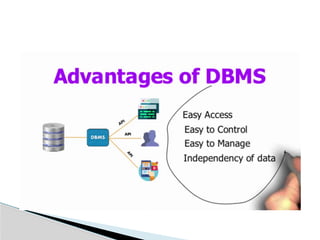
ADVANTAGE OF DBMS APPROACH:
 Controlling redundancy :
 In traditional software development utilizing the file
processing, every user group maintains it s own files.
 All the database stored in only one place of database
 Restricted unauthorized access
 when multiple users share a large database , the type of
access operation must be controlled
 DBMS must provide security and authorization subsystem
 Its creates accounts and specifies account restrictions
 Parameters users allowed to access database only
through canned transactions.
 Providing storage of program objects:
 In file system what happens is that , the data
structures, program objects are discarded once
the program is closed
 Providing storage of structures and search
techniques for efficient query processing:
 Capabilities foe efficiently executing queries and
updates
 The process of choosing the most efficient query
execution plan from among many alternatives.
 Providing backup and recovery:
 The backup and recovery subsystem is responsible for the
recovery of the database incase of software or hardware
failure
 For example: suppose the system crashes in middle of a
transaction , the DBMS should make sure to restore the
database to the state in still where the transaction had
completed and resume from there or at-least restore to the
point before the transaction begin.
 Providing multiple users and interfaces:
 Manages sequences of operations that are executed as a
single unit, ensuring atomicity, consistency, isolation, and
durability (ACID properties).
 Representing complex relationship among data:
 A database may have variety of data to interrelated in
many ways
 DBMS must capable of: Representing complex
relationships among data
 Retrieve and update related data easily and efficiently.
 Enforcing integrity constraint:
 Simplest type of integrity constraint to specifying data
type for each data item
 Another type of constraint to uniqueness of data item
values.

Relational database management system and their application

  • 1.
  • 2.
     Traditional databaseapplication: Information that is stored and accessed either text or numeric  Multimedia database: A multimedia database in a Relational Database Management System (RDBMS) refers to a system designed to handle various types of multimedia data—such as images, audio, video, and other non-textual content—within the structured framework of a relational database.
  • 3.
     Geographic information: Thephysical location and characteristics of objects or phenomena on the Earth's surface. This type of data is often managed in Geographic Information Systems (GIS).  Warehouse online analytical processing: This technology that enables complex querying and analysis of large volumes of data, typically in a data warehouse environment. OLAP systems are designed to help with decision-making by providing quick access to analytical and historical data from various sources.
  • 4.
     Real timeand active database technology: Used to control industrial and manufacturing process  Search technique: To applied search the world wide web(WWW) search information needed by users browse the internet.
  • 5.
    Introduction:  Database anddatabase technology have a major impact on the growing use of computer  Computer are used business,electronics,commerce,engineering,me dicine,law,education and library  Database can by any size  A database represent some aspects of the real world sometime called Mini world (or) the Universe of Discourse (UoD)
  • 6.
     We storedbytes or gigabytes  Huge amount of information must be organized and managed so that users can search for retrieve update the data as needed Example:  Large commercial database is Amazon.Com. It contains data of over 20 million books, CDs, Video, Dgames and electronic VD, items.
  • 7.
     The databaseoccupies over 2 terabytes and it is stored on 200 different computers .About 15 million visitors access Amazon.com each day and use the database to make purchases. The database is continually updated as new books and other items are added to the inventory stock quantities are updated as purchases are transacted. About 100 people are responsible for keeping the Amazon database up-to-date.
  • 8.
     A Databasemanagement system (DBMS) is a Collection of programs that enables users to create and maintain a database.  DBMS general purpose software system that facilities the process of  Defining data types, structures and constraints are stored data in the database  Constructing form of database catalog or dictionary mini-data constructing  Manipulating retrieve specifying data, update the data  Sharing data multiple users and programs to access the database
  • 9.
    CHARACTERISED OF DATABASE: In traditional file processing, each user defines and implements the files needed for specific software application as part of programming the application.  Self describing the nature of a database system  Insulation between programs and data, and data abstraction  Support of multiple views of the data  Sharing of data and multiuser transaction processing
  • 10.
    ADVANTAGE OF DBMSAPPROACH:  Controlling redundancy :  In traditional software development utilizing the file processing, every user group maintains it s own files.  All the database stored in only one place of database  Restricted unauthorized access  when multiple users share a large database , the type of access operation must be controlled  DBMS must provide security and authorization subsystem  Its creates accounts and specifies account restrictions  Parameters users allowed to access database only through canned transactions.
  • 11.
     Providing storageof program objects:  In file system what happens is that , the data structures, program objects are discarded once the program is closed  Providing storage of structures and search techniques for efficient query processing:  Capabilities foe efficiently executing queries and updates  The process of choosing the most efficient query execution plan from among many alternatives.
  • 13.
     Providing backupand recovery:  The backup and recovery subsystem is responsible for the recovery of the database incase of software or hardware failure  For example: suppose the system crashes in middle of a transaction , the DBMS should make sure to restore the database to the state in still where the transaction had completed and resume from there or at-least restore to the point before the transaction begin.  Providing multiple users and interfaces:  Manages sequences of operations that are executed as a single unit, ensuring atomicity, consistency, isolation, and durability (ACID properties).
  • 14.
     Representing complexrelationship among data:  A database may have variety of data to interrelated in many ways  DBMS must capable of: Representing complex relationships among data  Retrieve and update related data easily and efficiently.  Enforcing integrity constraint:  Simplest type of integrity constraint to specifying data type for each data item  Another type of constraint to uniqueness of data item values.