Host parasite
relationship/
Pathogenesis of
infectious Diseases
Competency Covered: MI 1.1
Learning objectives
At the end of the session, the students will be able to understand:
▰ Mechanism of microbial pathogenicity
▰ Differences between endotoxins and exotoxins
MECHANISM OF MICROBIAL
PATHOGENICITY
▰Pathogenicity - refer to the ability of a microbial species to produce disease.
▰Virulence - Degree of pathogenesis (tissue damage), which depends on the
strains of the organism
▰Primary pathogen :microbe or virus that causes disease in otherwise healthy
individual -• Diseases such as plague, malaria, measles, influenza, diphtheria,
tetanus, tuberculosis, etc.
▰• Opportunistic pathogen causes disease only when body’s innate or adaptive
defenses are compromised or when introduced into unusual location
▰• Can be members of normal microbiota or common in environment (e.g.,
Pseudomonas)
▰ Virulence factors are traits which determine the degree to which the pathogen
can cause damage invasion and infectivity
Principles of infectious diseases
• Incubation period: time between infection and onset
• Varies considerably: few days for common cold to
even years for Hansen’s disease (leprosy)
• Depends on growth rate, host’s condition,
infectious dose
• Illness: signs and symptoms of disease
• May be preceded by prodromal phase (vague
symptoms)
• Convalescence: recuperation, recovery from disease
• Carriers may harbor and spread infectious agent for
long periods of time in absence of signs or symptoms
Can be subclinical: no or mild symptoms
•• Initial infection is primary infection – Damage can
predispose individual to developing a secondary
infection (e.g., respiratory illness impairing mucociliary
escalator)
Principles of infectious diseases
• Acute infections: symptoms develop quickly,
last a short time (e.g., strep throat)
• Chronic infections: develop slowly, last for
months or years (e.g., tuberculosis)
• Latent infections: never completely
eliminated; microbe exists in host tissues
without causing symptoms
• Decrease in immunity may allow reactivation
• Chicken pox (acute illness) results from
varicella-zoster virus; immune response stops,
but virus takes refuge in sensory nerves, can
later produce viral particles resulting in shingles
• Tuberculosis, cold sores, genital herpes also
examples
Determinants of Virulence
(i) Adhesion
(ii) Invasiveness
(iii) Antiphagocytic factors
(iv) Survival within the phagocyte
(v) Bacterial toxins
(vi) Enzymes
Some bacteria produce enzymes which
directly damage host tissue.
(vii) Genetic factors
(viii) Infecting dose -Adequate number of
bacteria is required for successful infection.
Ix) susceptibility of the host
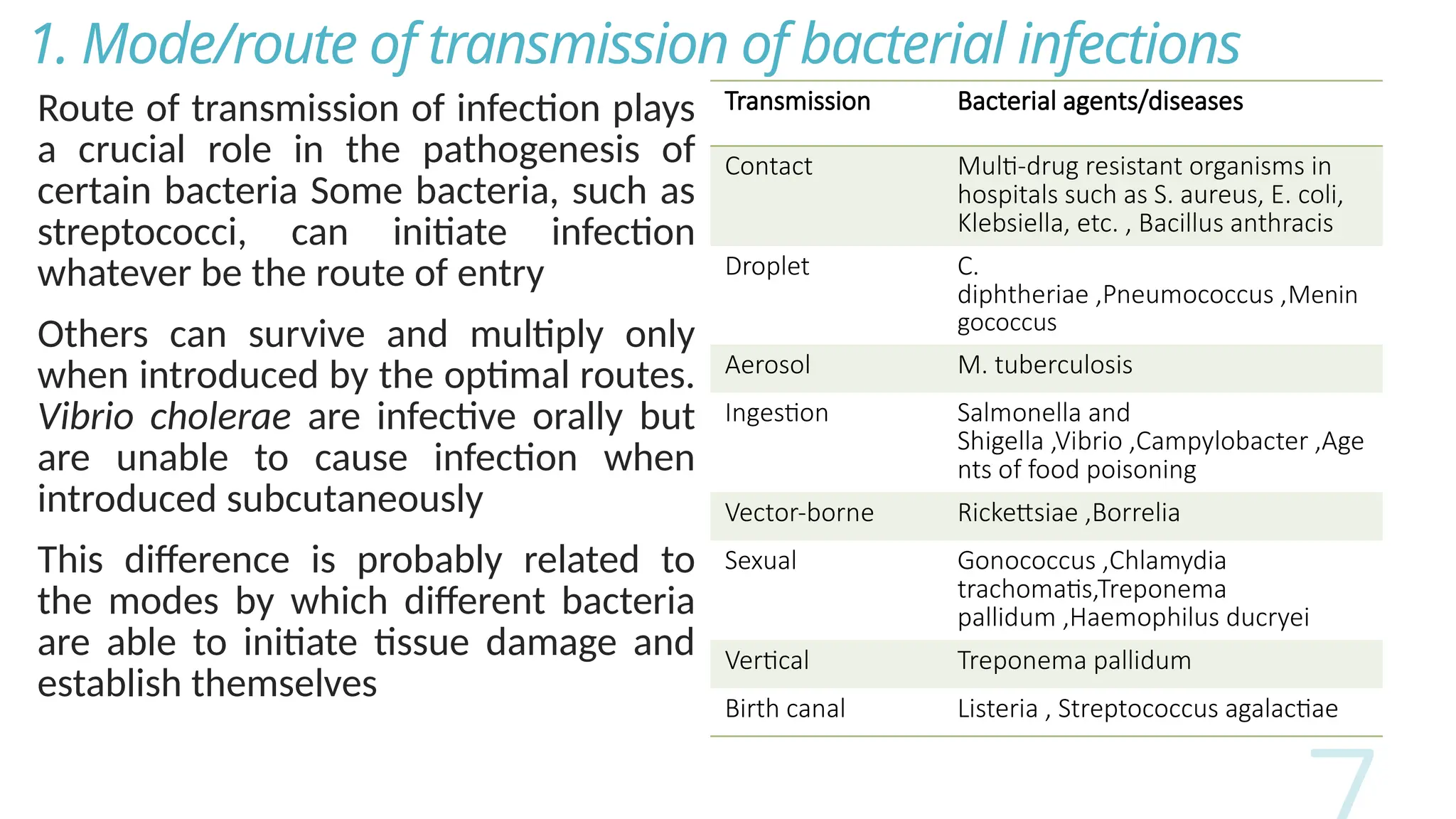
1. Mode/route of transmission of bacterial infections
Route of transmission of infection plays
a crucial role in the pathogenesis of
certain bacteria Some bacteria, such as
streptococci, can initiate infection
whatever be the route of entry
Others can survive and multiply only
when introduced by the optimal routes.
Vibrio cholerae are infective orally but
are unable to cause infection when
introduced subcutaneously
This difference is probably related to
the modes by which different bacteria
are able to initiate tissue damage and
establish themselves
Transmission Bacterial agents/diseases
Contact Multi-drug resistant organisms in
hospitals such as S. aureus, E. coli,
Klebsiella, etc. , Bacillus anthracis
Droplet C.
diphtheriae ,Pneumococcus ,Menin
gococcus
Aerosol M. tuberculosis
Ingestion Salmonella and
Shigella ,Vibrio ,Campylobacter ,Age
nts of food poisoning
Vector-borne Rickettsiae ,Borrelia
Sexual Gonococcus ,Chlamydia
trachomatis,Treponema
pallidum ,Haemophilus ducryei
Vertical Treponema pallidum
Birth canal Listeria , Streptococcus agalactiae
2. Infective Dose
▰ Minimum inoculum size or number of microbes necessary to
establish infection .
▰ ID50 is number of cells that infects 50% of population
Low infective dose:
▰ Shigella: Very low (as low as 10 bacilli)
▰ Escherichia coli O157: H7 (<10 bacilli)
▰ Campylobacter jejuni (500 bacilli).
▰ Large infective dose: In contrast, bacteria with high
▰ infective dose can initiate the infection only when theinoculum size
exceeds a particular critical size
▰ Difference partially reflects ability to survive stomach acid
3.Adhesion
▰Adhesion of the bacteria to body surfaces-
initial event in the pathogenesis of the
disease.
oMediated by specialized molecules-
adhesins- bind to specific host cell
receptors.
oAdherence prevents the bacteria from
being flushed away in secretions and also
facilitates bacterial invasion into the host
cells.
▰located at tips of pili/fimbriae)
▰• Can be component of capsules or
various cell wall proteins
▰• Binding highly specific; exploits host cell
receptor
▰Biofilm formation
Adherence and colonization
First step- entrance and attachment
Portal of entry- skin respiratory Gastrointestinal
urogenital systems conjunctivae of eye
Vector borne sexual contact blood transfusion or
organ transplant
Colonization
Site of microbial reproduction on or within host
Does not necessarily result in tissue invasion or
damage
Growth in biofilms
Avoidance of secretory IgA
Antigenic variations, IgA proteases
Compete with normal microbiota, tolerate toxins
Invasiveness-colonization
Invasiveness – ability to spread to adjacent tissues
Penetration- active or passive
Active- lytic substances
Attack extracellular matrix and basement membranes of skin
and intestinal linings
Degrade carbohydrate –protein complexes between cells
Disrupt host cell surface
Passive skin lesions insect bites wounds- deeper tissues
Establishing infection
▰ Delivering Effector Proteins to Host Cells
▰ Secretion systems in Gram-negatives -Several types
discovered; some can inject molecules other than
proteins
▰ Type III secretion system (injectisome)
▰ – Effector proteins induce changes (e.g., altering of cell’s
cytoskeleton structure)
invasion
• once in the circulatory system or into a wound-
Localized infection: limited to small area (boil caused by Staphylococcus aureus)
Systemic infection: agent disseminated throughout body (e.g., measles)
• Bacteremia: bacteria circulating in blood – Not always disease state (e.g., can occur
transiently following vigorous tooth brushing
• Toxemia: toxins circulating in bloodstream
• Viremia: viruses circulating in bloodstream
• Septicemia or sepsis: acute, life-threatening illness caused by infectious agents or
products in bloodstream- with severe signs and symptoms
Varies among pathogens
1. clostridium tetani- produces number of virulence factors - non-invasive
2. bacillus anthracis- and Yersinia pestis produce many virulence factors- highly invasive
Streptococcus sp. span the spectrum of virulence factors and invasiveness
Important virulence factors
▰Virulence marker antigen or invasion plasmid
antigens in Shigella
▰Produces proteases that degrade host proteins
▰enhanced by many enzymes such as:
hyaluronidase, collagenase, streptokinase, IgA
proteases.
Antiphagocytic Factors: Bacteria are rapidly killed
once they are ingested by phagocytes. Some
pathogens develop strategies to evade
phagocytosis by several antiphagocytic factors, the
most important ones being –
▰Capsule
▰Cell wall proteins
▰Cytotoxins
Intracellular Survival
Pathogenic microorganisms with
mechanisms to survive in vertebrate cells
are termed intracellular pathogens
• Avoiding Recognition and Attachment
• Capsules: interfere with opsonization–
Streptococcus pneumoniae
• Fc receptors:– E.g., Staphylococcus
aureus, Streptococcus pyogenes
• Surviving Within Phagocytes
• Escape from phagosome: prior to lysis
with lysosomes – Listeria monocytogenes
Shigella species lyse phagosome
• Prevent phagosome-lysosome fusion:
avoid destruction – Salmonella
Mechanism of
intracellular survival
Organism
Inhibition of
phagolysosome fusion
Legionella species
Mycobacterium
tuberculosis
Chlamydia species
Resistance to lysosomal
enzymes
Salmonella
Typhimurium
Coxiella species
Mycobacterium leprae
Adaptation to
cytoplasmic replication
Listeria, Rickettsia
Francisella tularensis
Survival within
phagolysosome
Coxiella burnetti
Mimick host
molecules
Streptococcus
pyogenes
Intracellular Survival (Cont..)
Facultative intracellular bacteria
can survive and replicate inside
host cells, but they can also
proliferate outside host cells.
A second group of intracellular
bacteria depends critically on the
host cell milieu and hence are
obligately intracellular bacteria.
They cannot survive and replicate
outside their host cells
Facultative intracellular
bacteria
Obligate intracellular
Salmonella Typhi, Brucella
Shigella
Mycobacterium leprae
Legionella pneumophila ,
Listeria monocytogenes,
Nocardia Francisella
tularensis
Rickettsia Orientia
Ehrlichia Anaplasma
Chlamydia , Coxiella
burnetii
Neisseria meningitidis
Yersinia
Mycobacterium
tuberculosis M avium
intracellulare complex
Leishmania Toxoplasma
gondii Plasmodia reside in
host cells
Toxins- Endotoxins
Effects of
bacterial
the lipid A portion of lipopolysaccharide as an
integral part of the cell wall of Gram negative
bacteria.
▰released from the bacterial surface by natural lysis
of the bacteria
▰ responsible for various biological effects in the
host.
▰Macrophage activation
▰Complement activation
▰Endothelial activation
▰Coagulation pathways activation
▰Platelet activation
▰Mast cell activation
▰In Gram negative septicemia
Toxins-Exotoxins
▰Heat labile proteins; secreted by
certain species of both gram-
positive and gram-negative
bacteria and diffuse readily into
the surrounding medium.
▰High potency: Can act locally or
systemically
▰Used for vaccine : critical
▻ toxoids are inactivated toxin
▻ Antitoxin is suspension of
neutralizing antibodies to treat
▰Specific action
▰Travels from site of infection to
other tissues where they exert
their effects
Organisms Toxins (Exotoxins) Mechanism
Staphylococc
us aureus
Enterotoxin, Toxic
shock syndrome
toxin
Act as super antigen;
stimulate T cell non-
specifically, to release of
large amounts of cytokines.
Streptococcu
s pyogenes
Streptococcal
pyrogenic exotoxin
Corynebacter
ium
diphtheriae
Diphtheria toxin
(DT)
Inhibits protein synthesis (by
inhibiting elongation factor-
2)
Bacillus
anthracis
Anthrax toxin ↑cAMP in target cell,
edema
Clostridium
perfringens
α toxin and other
major and minor
toxins
Lecithinase and
phospholipase activity →
causes myonecrosis
Clostridium
tetani
Tetanus toxin
(tetanospasmin)
Decrease in
neurotransmitter (GABA and
glycine) release from the
inhibitory neurons → spastic
paralysis
mechanism of action
Types of exotoxins
AB exotoxins
Of two subunits
A subunit –responsible for toxic effect
B subunit- binds to specific target cells
Specific host site exotoxin effects
Membrane disrupting exotoxins
superantigens
Examples
Pertussis toxin
Shiga toxin/ Shiga like toxin
Cholera toxin
Bacterial exotoxins
and their mechanism
of action
Foodborne intoxication results from
consumption
Destroyed by heating; heat-sensitive •
• Proteins, so immune system can
generate antibodies
• Many fatal before immune response
mounted
• Neurotoxins damage nervous system
• Enterotoxins cause intestinal
disturbance
• Cytotoxins damage variety of cell types
Organisms Toxins
(Exotoxins)
Mechanism
Clostridium
botulinum
Botulinum
toxin
Decrease in neurotransmitter
(acetyl choline) release from
neurons → flaccid paralysis
Escherichia
coli
(diarrheageni
c)
Heat labile
toxin (LT)
Activation of adenylate cyclase →
↑cAMP in target cell →
secretory diarrhea
Heat stable
toxin (ST)
↑cGMP in target cell →
secretory diarrhea
Verocytotoxin Inhibit protein synthesis (by
inhibiting ribosome)
Shigella
dysenteriae
type-1
Shiga toxin
Vibrio
cholerae
Cholera toxin
(CT)
Activation of adenylate cyclase →
↑cAMP in target cell →
secretory diarrhea
Pseudomona
s
Exotoxin-A Inhibit protein synthesis (by
inhibiting elongation factor-2)
Differences between bacterial endotoxins and exotoxins
Feature Endotoxins Exotoxins
Nature Lipopolysaccharides
No enzyme action
Proteins (polypeptides) MW 10,000 to 900 000
Enzymatic action
Source Integral Part of cell wall of Gram negative
bacteria-released only on lysis of cell
Secreted both by Gram positive & negative
bacteria; diffuse into surrounding medium
Antigenicit
y
Weakly antigenic antitoxin not formed
but against polysaccharide- antibodies
formed
Cannot be toxoided
highly antigenic –stimulates formation of
antitoxin which neutralises toxin
Conveterd into toxoid by formaldehyde
Heat stability Highly stable Heat labile destroyed at 60o
C
Mode of
action
↑IL-1 and TNF Mostly enzyme like action
Potency Low potency
Only large doses are fatal
Very high potency
More potent, even smaller doses- fatal
Pyrogenic Usually produces fever Does not produce fever
Specificity Non specific in action Highly specific for particular tissue-
Genetic factors-Pathogenicity islands
Major virulence factors on large
segments on chromosomal or plasmid
DNA
Increase bacterial virulence
Absent in nonpathogenic members
Common sequence characteristics
Insertion like sequences for mobility
G+C content different from bacterial
genome
Several open reading frames
Can be spread through horizontal
transfer of virulence genes to bacteria
Biofilm
development
Biofilm growth is
physiologically different from
planktonic growth
May cause chronic infection
Increases virulence
Becomes less sensitive to
antibiotics
Makes cells in biofilm more
resistant to host defense
host parasite-Pathogenesis of microbial infections.pptx

host parasite-Pathogenesis of microbial infections.pptx

  • 1.
    Host parasite relationship/ Pathogenesis of infectiousDiseases Competency Covered: MI 1.1
  • 2.
    Learning objectives At theend of the session, the students will be able to understand: ▰ Mechanism of microbial pathogenicity ▰ Differences between endotoxins and exotoxins
  • 3.
    MECHANISM OF MICROBIAL PATHOGENICITY ▰Pathogenicity- refer to the ability of a microbial species to produce disease. ▰Virulence - Degree of pathogenesis (tissue damage), which depends on the strains of the organism ▰Primary pathogen :microbe or virus that causes disease in otherwise healthy individual -• Diseases such as plague, malaria, measles, influenza, diphtheria, tetanus, tuberculosis, etc. ▰• Opportunistic pathogen causes disease only when body’s innate or adaptive defenses are compromised or when introduced into unusual location ▰• Can be members of normal microbiota or common in environment (e.g., Pseudomonas) ▰ Virulence factors are traits which determine the degree to which the pathogen can cause damage invasion and infectivity
  • 4.
    Principles of infectiousdiseases • Incubation period: time between infection and onset • Varies considerably: few days for common cold to even years for Hansen’s disease (leprosy) • Depends on growth rate, host’s condition, infectious dose • Illness: signs and symptoms of disease • May be preceded by prodromal phase (vague symptoms) • Convalescence: recuperation, recovery from disease • Carriers may harbor and spread infectious agent for long periods of time in absence of signs or symptoms Can be subclinical: no or mild symptoms •• Initial infection is primary infection – Damage can predispose individual to developing a secondary infection (e.g., respiratory illness impairing mucociliary escalator)
  • 5.
    Principles of infectiousdiseases • Acute infections: symptoms develop quickly, last a short time (e.g., strep throat) • Chronic infections: develop slowly, last for months or years (e.g., tuberculosis) • Latent infections: never completely eliminated; microbe exists in host tissues without causing symptoms • Decrease in immunity may allow reactivation • Chicken pox (acute illness) results from varicella-zoster virus; immune response stops, but virus takes refuge in sensory nerves, can later produce viral particles resulting in shingles • Tuberculosis, cold sores, genital herpes also examples
  • 6.
    Determinants of Virulence (i)Adhesion (ii) Invasiveness (iii) Antiphagocytic factors (iv) Survival within the phagocyte (v) Bacterial toxins (vi) Enzymes Some bacteria produce enzymes which directly damage host tissue. (vii) Genetic factors (viii) Infecting dose -Adequate number of bacteria is required for successful infection. Ix) susceptibility of the host
  • 7.
    1. Mode/route oftransmission of bacterial infections Route of transmission of infection plays a crucial role in the pathogenesis of certain bacteria Some bacteria, such as streptococci, can initiate infection whatever be the route of entry Others can survive and multiply only when introduced by the optimal routes. Vibrio cholerae are infective orally but are unable to cause infection when introduced subcutaneously This difference is probably related to the modes by which different bacteria are able to initiate tissue damage and establish themselves Transmission Bacterial agents/diseases Contact Multi-drug resistant organisms in hospitals such as S. aureus, E. coli, Klebsiella, etc. , Bacillus anthracis Droplet C. diphtheriae ,Pneumococcus ,Menin gococcus Aerosol M. tuberculosis Ingestion Salmonella and Shigella ,Vibrio ,Campylobacter ,Age nts of food poisoning Vector-borne Rickettsiae ,Borrelia Sexual Gonococcus ,Chlamydia trachomatis,Treponema pallidum ,Haemophilus ducryei Vertical Treponema pallidum Birth canal Listeria , Streptococcus agalactiae
  • 9.
    2. Infective Dose ▰Minimum inoculum size or number of microbes necessary to establish infection . ▰ ID50 is number of cells that infects 50% of population Low infective dose: ▰ Shigella: Very low (as low as 10 bacilli) ▰ Escherichia coli O157: H7 (<10 bacilli) ▰ Campylobacter jejuni (500 bacilli). ▰ Large infective dose: In contrast, bacteria with high ▰ infective dose can initiate the infection only when theinoculum size exceeds a particular critical size ▰ Difference partially reflects ability to survive stomach acid
  • 10.
    3.Adhesion ▰Adhesion of thebacteria to body surfaces- initial event in the pathogenesis of the disease. oMediated by specialized molecules- adhesins- bind to specific host cell receptors. oAdherence prevents the bacteria from being flushed away in secretions and also facilitates bacterial invasion into the host cells. ▰located at tips of pili/fimbriae) ▰• Can be component of capsules or various cell wall proteins ▰• Binding highly specific; exploits host cell receptor ▰Biofilm formation
  • 11.
    Adherence and colonization Firststep- entrance and attachment Portal of entry- skin respiratory Gastrointestinal urogenital systems conjunctivae of eye Vector borne sexual contact blood transfusion or organ transplant Colonization Site of microbial reproduction on or within host Does not necessarily result in tissue invasion or damage Growth in biofilms Avoidance of secretory IgA Antigenic variations, IgA proteases Compete with normal microbiota, tolerate toxins
  • 12.
    Invasiveness-colonization Invasiveness – abilityto spread to adjacent tissues Penetration- active or passive Active- lytic substances Attack extracellular matrix and basement membranes of skin and intestinal linings Degrade carbohydrate –protein complexes between cells Disrupt host cell surface Passive skin lesions insect bites wounds- deeper tissues Establishing infection ▰ Delivering Effector Proteins to Host Cells ▰ Secretion systems in Gram-negatives -Several types discovered; some can inject molecules other than proteins ▰ Type III secretion system (injectisome) ▰ – Effector proteins induce changes (e.g., altering of cell’s cytoskeleton structure)
  • 14.
    invasion • once inthe circulatory system or into a wound- Localized infection: limited to small area (boil caused by Staphylococcus aureus) Systemic infection: agent disseminated throughout body (e.g., measles) • Bacteremia: bacteria circulating in blood – Not always disease state (e.g., can occur transiently following vigorous tooth brushing • Toxemia: toxins circulating in bloodstream • Viremia: viruses circulating in bloodstream • Septicemia or sepsis: acute, life-threatening illness caused by infectious agents or products in bloodstream- with severe signs and symptoms Varies among pathogens 1. clostridium tetani- produces number of virulence factors - non-invasive 2. bacillus anthracis- and Yersinia pestis produce many virulence factors- highly invasive Streptococcus sp. span the spectrum of virulence factors and invasiveness
  • 15.
    Important virulence factors ▰Virulencemarker antigen or invasion plasmid antigens in Shigella ▰Produces proteases that degrade host proteins ▰enhanced by many enzymes such as: hyaluronidase, collagenase, streptokinase, IgA proteases. Antiphagocytic Factors: Bacteria are rapidly killed once they are ingested by phagocytes. Some pathogens develop strategies to evade phagocytosis by several antiphagocytic factors, the most important ones being – ▰Capsule ▰Cell wall proteins ▰Cytotoxins
  • 16.
    Intracellular Survival Pathogenic microorganismswith mechanisms to survive in vertebrate cells are termed intracellular pathogens • Avoiding Recognition and Attachment • Capsules: interfere with opsonization– Streptococcus pneumoniae • Fc receptors:– E.g., Staphylococcus aureus, Streptococcus pyogenes • Surviving Within Phagocytes • Escape from phagosome: prior to lysis with lysosomes – Listeria monocytogenes Shigella species lyse phagosome • Prevent phagosome-lysosome fusion: avoid destruction – Salmonella Mechanism of intracellular survival Organism Inhibition of phagolysosome fusion Legionella species Mycobacterium tuberculosis Chlamydia species Resistance to lysosomal enzymes Salmonella Typhimurium Coxiella species Mycobacterium leprae Adaptation to cytoplasmic replication Listeria, Rickettsia Francisella tularensis Survival within phagolysosome Coxiella burnetti Mimick host molecules Streptococcus pyogenes
  • 17.
    Intracellular Survival (Cont..) Facultativeintracellular bacteria can survive and replicate inside host cells, but they can also proliferate outside host cells. A second group of intracellular bacteria depends critically on the host cell milieu and hence are obligately intracellular bacteria. They cannot survive and replicate outside their host cells Facultative intracellular bacteria Obligate intracellular Salmonella Typhi, Brucella Shigella Mycobacterium leprae Legionella pneumophila , Listeria monocytogenes, Nocardia Francisella tularensis Rickettsia Orientia Ehrlichia Anaplasma Chlamydia , Coxiella burnetii Neisseria meningitidis Yersinia Mycobacterium tuberculosis M avium intracellulare complex Leishmania Toxoplasma gondii Plasmodia reside in host cells
  • 18.
    Toxins- Endotoxins Effects of bacterial thelipid A portion of lipopolysaccharide as an integral part of the cell wall of Gram negative bacteria. ▰released from the bacterial surface by natural lysis of the bacteria ▰ responsible for various biological effects in the host. ▰Macrophage activation ▰Complement activation ▰Endothelial activation ▰Coagulation pathways activation ▰Platelet activation ▰Mast cell activation ▰In Gram negative septicemia
  • 19.
    Toxins-Exotoxins ▰Heat labile proteins;secreted by certain species of both gram- positive and gram-negative bacteria and diffuse readily into the surrounding medium. ▰High potency: Can act locally or systemically ▰Used for vaccine : critical ▻ toxoids are inactivated toxin ▻ Antitoxin is suspension of neutralizing antibodies to treat ▰Specific action ▰Travels from site of infection to other tissues where they exert their effects Organisms Toxins (Exotoxins) Mechanism Staphylococc us aureus Enterotoxin, Toxic shock syndrome toxin Act as super antigen; stimulate T cell non- specifically, to release of large amounts of cytokines. Streptococcu s pyogenes Streptococcal pyrogenic exotoxin Corynebacter ium diphtheriae Diphtheria toxin (DT) Inhibits protein synthesis (by inhibiting elongation factor- 2) Bacillus anthracis Anthrax toxin ↑cAMP in target cell, edema Clostridium perfringens α toxin and other major and minor toxins Lecithinase and phospholipase activity → causes myonecrosis Clostridium tetani Tetanus toxin (tetanospasmin) Decrease in neurotransmitter (GABA and glycine) release from the inhibitory neurons → spastic paralysis mechanism of action
  • 20.
    Types of exotoxins ABexotoxins Of two subunits A subunit –responsible for toxic effect B subunit- binds to specific target cells Specific host site exotoxin effects Membrane disrupting exotoxins superantigens Examples Pertussis toxin Shiga toxin/ Shiga like toxin Cholera toxin
  • 21.
    Bacterial exotoxins and theirmechanism of action Foodborne intoxication results from consumption Destroyed by heating; heat-sensitive • • Proteins, so immune system can generate antibodies • Many fatal before immune response mounted • Neurotoxins damage nervous system • Enterotoxins cause intestinal disturbance • Cytotoxins damage variety of cell types Organisms Toxins (Exotoxins) Mechanism Clostridium botulinum Botulinum toxin Decrease in neurotransmitter (acetyl choline) release from neurons → flaccid paralysis Escherichia coli (diarrheageni c) Heat labile toxin (LT) Activation of adenylate cyclase → ↑cAMP in target cell → secretory diarrhea Heat stable toxin (ST) ↑cGMP in target cell → secretory diarrhea Verocytotoxin Inhibit protein synthesis (by inhibiting ribosome) Shigella dysenteriae type-1 Shiga toxin Vibrio cholerae Cholera toxin (CT) Activation of adenylate cyclase → ↑cAMP in target cell → secretory diarrhea Pseudomona s Exotoxin-A Inhibit protein synthesis (by inhibiting elongation factor-2)
  • 22.
    Differences between bacterialendotoxins and exotoxins Feature Endotoxins Exotoxins Nature Lipopolysaccharides No enzyme action Proteins (polypeptides) MW 10,000 to 900 000 Enzymatic action Source Integral Part of cell wall of Gram negative bacteria-released only on lysis of cell Secreted both by Gram positive & negative bacteria; diffuse into surrounding medium Antigenicit y Weakly antigenic antitoxin not formed but against polysaccharide- antibodies formed Cannot be toxoided highly antigenic –stimulates formation of antitoxin which neutralises toxin Conveterd into toxoid by formaldehyde Heat stability Highly stable Heat labile destroyed at 60o C Mode of action ↑IL-1 and TNF Mostly enzyme like action Potency Low potency Only large doses are fatal Very high potency More potent, even smaller doses- fatal Pyrogenic Usually produces fever Does not produce fever Specificity Non specific in action Highly specific for particular tissue-
  • 23.
    Genetic factors-Pathogenicity islands Majorvirulence factors on large segments on chromosomal or plasmid DNA Increase bacterial virulence Absent in nonpathogenic members Common sequence characteristics Insertion like sequences for mobility G+C content different from bacterial genome Several open reading frames Can be spread through horizontal transfer of virulence genes to bacteria
  • 24.
    Biofilm development Biofilm growth is physiologicallydifferent from planktonic growth May cause chronic infection Increases virulence Becomes less sensitive to antibiotics Makes cells in biofilm more resistant to host defense