PATHOGENESIS OF
MICROORGANISM
1
Microbial Pathogenesis:
Microbial pathogenesis is the ability of
microbes, or their components, to cause infection in a host after
developing a complex mode of interactions from both
hosts and pathogens.
Pathogens:
A pathogen is an infectious agent (“germ”) that causes
disease or illness in a host.
Infection:
An infection is the invasion of an organism's body tissues by
disease-causing agents, their multiplication, and the reaction of host
tissues to the infectious agents and the toxins they produce.
2
3
How Microorganism Enter A Host
Portals Of Entry
Mucus Membranes
Skin
The Parenteral Route
The Preferred Portal of Entry
Numbers of Invading Microbes
Adherence
4
Mucus membranes:
The most common route for most pathogens.
Entry through mucus membranes of:
1. respiratory tract (most common)
2. gastrointestinal tract
3. urinary/genital tracts
4. conjunctive
Skin:
1.Some pathogens infect hair follicles and sweat
glands
2.Few can colonize surface.
Portals of Entry:
5
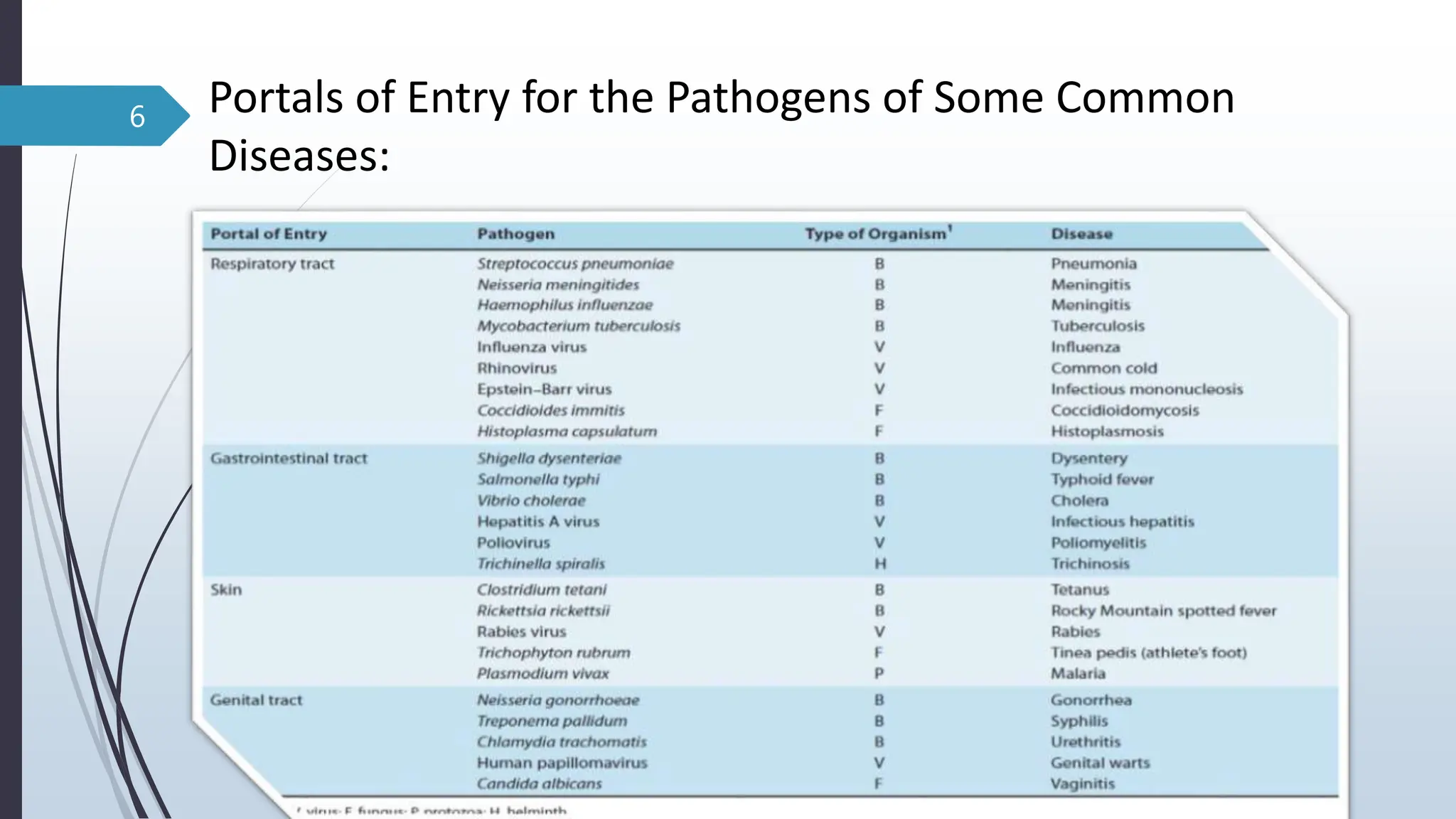
Portals of Entry for the Pathogens of Some Common
Diseases:
6
Numbers of Invading Microbes:
Likelihood of disease increases as the
number of invading pathogens increases.
Adherence:
Adherence attachment to the host by the microbe at portalof
entry.
Blocking adhesion can prevent diseasepathogen has
surface molecules called adhesions orligands that bind specifically to
the host surface receptors.
Most microbial adhesions are glycoproteins or lipoproteins
located on the glycocalyx, capsule, capsid, pili, fimbriae orHost
cellsurfaceflagella .
Most host receptors are typically proteins (for virus) or
carbohydrates (for bacteria) in the wall or membrane of host cell.
7
Adherence:
8
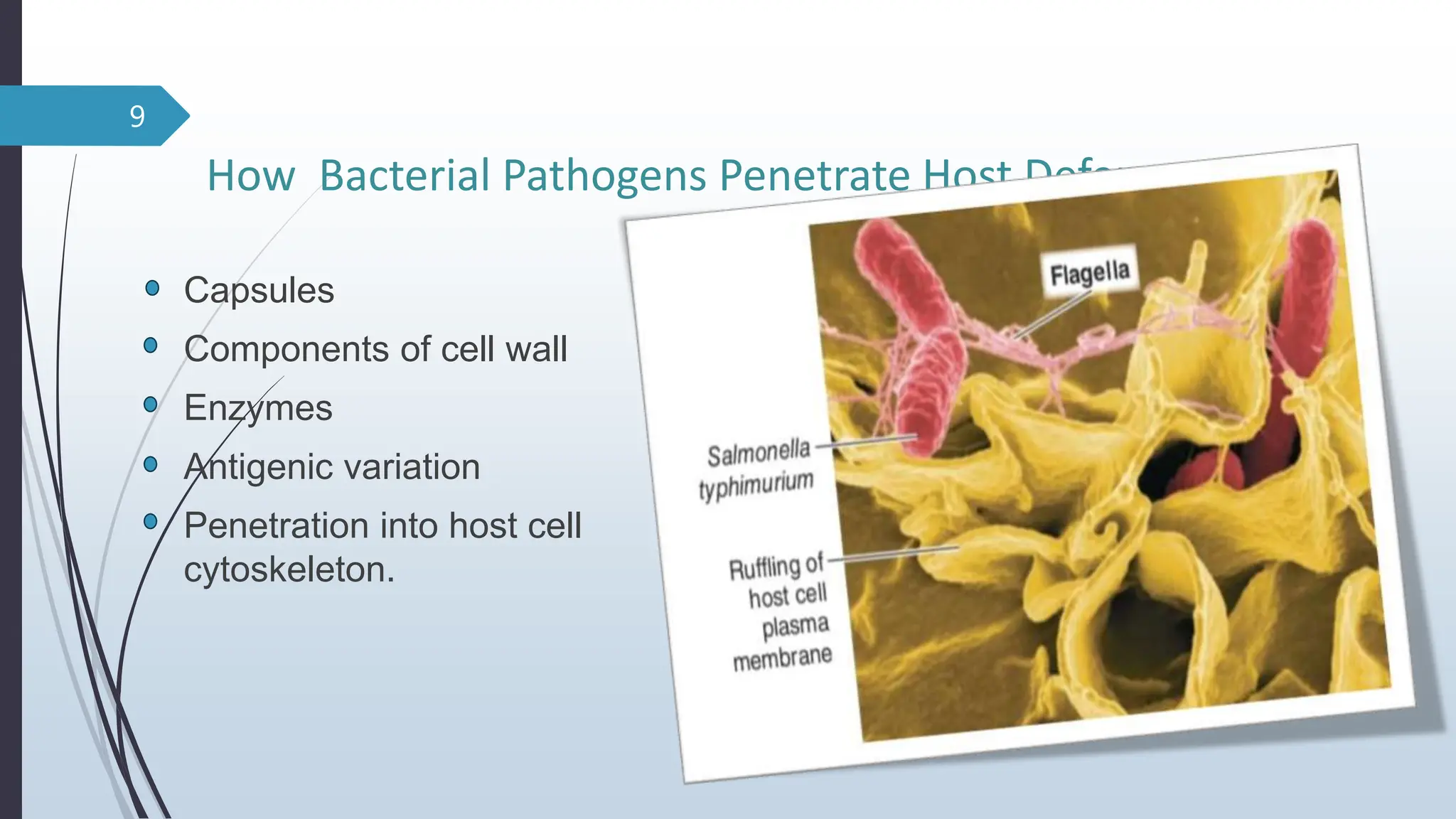
How Bacterial Pathogens Penetrate Host Defenses
Capsules
Components of cell wall
Enzymes
Antigenic variation
Penetration into host cell
cytoskeleton.
9
Capsules:
Capsules-organized glycocalyx layer (carbohydrates)
outside cell wall.
Impairs phagocytosis: prevents engulfment and
destruction byleukocytes.
If present, is usually required for virulence.
Components of Cell Wall:
M protein of Streptococcus pyogenes:
Heat and acid resistant
Mediates attachment of bacterium to
epithelial cells resists. phagocytosis by leukocytes.
10
Fimbriae + Opa (membrane protein):
Used by Neisseria gonorrhoeae: -promote
attachment and uptake by host epithelial cells and leukocytes.
Neisseria then grows inside these cells.
Mycolic acid (waxy) of Mycobacterium tuberculosis:
Resist digestion by phagocytes -
Mycobacterium then grows inside phagocyte.
11
Enzymes:
Also known as Exoenzymes.
Coagulases:
Clot fibrin in blood to create protective barrier against host
defenses.
Kinases:
Dissolve clots (fibrinolysis) to allow escape fromisolated
woundse.g. Streptokinase (Streptococcus pyogenes) Staphylokinase
(Staphylococcus aureus).
Hyaluronidase:
Hydrolyzes hyaluronic acid ("glue' that holds together
connective tissues and epithelium barriers) allowing deeper invasion.
e.g. Clostridium species:allows them to cause gangrene
(tissue necrosis).
12
Collagenase:
Breaks down collagen (fibrous part of connective tissue) for
invasion into muscles and organs e.g. Clostridium species.
IgA proteases:
Destroy host IgA antibodies found in mucous secretions to
allow adherence and passage at mucus membranes e.g. Neisseria
species that infect CNS.
Antigenic Variation:
Pathogen alters its surface antigens to escape attack by antibodies
andimmune cells. e.g. Neisseria gonorrhoeae has many versions of the Opa
gene, it canalter which one is being expressed.
13
How Bacterial Pathogens Damage Host Cells
14
If pathogen overcome host defense
then microorganism can damage host
cells by:
Using host cells nutrients.
Causing direct damage.
Inducing hypersensitivity reactions
Producing toxins .
Using hosts nutrients: (e.g. iron)
Required for all cells (electron transport chain:
cytochromes) both host and pathogen.
Host usually does not have free iron available (free iron
leads to easy colonizationby pathogens).
Humans bind unused iron to transport proteins:
transferrin.
Pathogens can produce siderophores (iron carrier):
secreted by bacteria to competeiron from host proteins, siderophore iron
complex then absorbed by bacteria.
15
Direct damage to colonized area:
Growth and replication in host cells: results in host
cell lysis.
Penetration through host cells (mucosa, organs)
causes damage.
Lysis of host cells to obtain nutrients.
Producing toxin:
Toxins are of two genereal types , based on their
position relative to the microbial cell: Exotoxins & Endotoxins.
16
Exotoxins:
Produced inside the bacteria and either secreted or released
following microbelysis.
Function to destroy certain host cell parts or inhibit particular
metabolic functions.
Damage from toxin results in the particular signs or symptoms
of a disease.
Can be named for the disease, type of cell attacked or
organism that produces it e.g. tetanus toxin: causes tetanus
(contraction) of muscle.
17
Endotoxins:
Part of the outer membrane portion of the cell wall of gram
negative bacteria: Lipopolysaccharide (LPS)
Released when dead cells lyse
In blood, causes macrophages to release high levels of
cytokines resulting in chills, fever, weakness, aches, small blood
clots, tissue necrosis, shock and death.
Sterile solutions can contain LPS: bacteria dies in
sterilization but LPS is unaltered.
Due to serious consequences at very low levels of LPS, it is
essential totest medical devices and solutions for endotoxin.
18
19
20
Pathogenic Properties & Stages of Viruses
21
Viral pathogenesis comprises of several
stages including-
(1) transmission and entry of the
virus into the host.
(2) spread in the host.
(3) tropism.
(4) virulence and
cytopathogenicity.
(5) patterns of viral infection and
disease.
(6) host factors.
(7) host defense.
(8) virus-induced
immunopathology.
Pathogenic Properties of Fungi, Protozoa, Helminths,
Algae.
Fungi:
(1)Fungal waste products may cause symptoms.
(2)Chronic infections provoke alargic response .
Protozoa:
(1) Amoebic dysentery.
(2) Balantidiasis.
(3)malaria, cryptosporidium.
22
Helmenthis:
(1)Use host tissue.
(2) Presence of parasite interferes with host
function.
(3) Parasite metabolic waste can
causes symptoms.
Algae:
(1) Neurotoxins produced by dinoflagellates-
SaxitoxinParalytic shellfish poisoning.
23
24
25
Immunopathogenesis
In certain diseases, the symptoms are caused not by the organism
itself, but due to immune response to the presence of organisms. For
example, immune complexes deposited in the glomerulus of the
kidney cause poststreptococcal glo-merulo nephritis. Antibodies that
are produced against the M proteins of S. pyogenes cross-react with
joint, heart, and brain tissues producing disease manifestations of
rheumatic fever. Similarly, the host immune response is an important
cause of disease symptoms in patients suffering from syphilis caused
by T. pallidum, Lyme disease caused by Borrelia, and other diseases.
26
27
28
Questions
Depertment of Pharmacy ,Northern University Bangladesh
29

Pathogens of microorganisms on microbiology.pptx

  • 1.
  • 2.
    Microbial Pathogenesis: Microbial pathogenesisis the ability of microbes, or their components, to cause infection in a host after developing a complex mode of interactions from both hosts and pathogens. Pathogens: A pathogen is an infectious agent (“germ”) that causes disease or illness in a host. Infection: An infection is the invasion of an organism's body tissues by disease-causing agents, their multiplication, and the reaction of host tissues to the infectious agents and the toxins they produce. 2
  • 3.
  • 4.
    How Microorganism EnterA Host Portals Of Entry Mucus Membranes Skin The Parenteral Route The Preferred Portal of Entry Numbers of Invading Microbes Adherence 4
  • 5.
    Mucus membranes: The mostcommon route for most pathogens. Entry through mucus membranes of: 1. respiratory tract (most common) 2. gastrointestinal tract 3. urinary/genital tracts 4. conjunctive Skin: 1.Some pathogens infect hair follicles and sweat glands 2.Few can colonize surface. Portals of Entry: 5
  • 6.
    Portals of Entryfor the Pathogens of Some Common Diseases: 6
  • 7.
    Numbers of InvadingMicrobes: Likelihood of disease increases as the number of invading pathogens increases. Adherence: Adherence attachment to the host by the microbe at portalof entry. Blocking adhesion can prevent diseasepathogen has surface molecules called adhesions orligands that bind specifically to the host surface receptors. Most microbial adhesions are glycoproteins or lipoproteins located on the glycocalyx, capsule, capsid, pili, fimbriae orHost cellsurfaceflagella . Most host receptors are typically proteins (for virus) or carbohydrates (for bacteria) in the wall or membrane of host cell. 7
  • 8.
  • 9.
    How Bacterial PathogensPenetrate Host Defenses Capsules Components of cell wall Enzymes Antigenic variation Penetration into host cell cytoskeleton. 9
  • 10.
    Capsules: Capsules-organized glycocalyx layer(carbohydrates) outside cell wall. Impairs phagocytosis: prevents engulfment and destruction byleukocytes. If present, is usually required for virulence. Components of Cell Wall: M protein of Streptococcus pyogenes: Heat and acid resistant Mediates attachment of bacterium to epithelial cells resists. phagocytosis by leukocytes. 10
  • 11.
    Fimbriae + Opa(membrane protein): Used by Neisseria gonorrhoeae: -promote attachment and uptake by host epithelial cells and leukocytes. Neisseria then grows inside these cells. Mycolic acid (waxy) of Mycobacterium tuberculosis: Resist digestion by phagocytes - Mycobacterium then grows inside phagocyte. 11
  • 12.
    Enzymes: Also known asExoenzymes. Coagulases: Clot fibrin in blood to create protective barrier against host defenses. Kinases: Dissolve clots (fibrinolysis) to allow escape fromisolated woundse.g. Streptokinase (Streptococcus pyogenes) Staphylokinase (Staphylococcus aureus). Hyaluronidase: Hydrolyzes hyaluronic acid ("glue' that holds together connective tissues and epithelium barriers) allowing deeper invasion. e.g. Clostridium species:allows them to cause gangrene (tissue necrosis). 12
  • 13.
    Collagenase: Breaks down collagen(fibrous part of connective tissue) for invasion into muscles and organs e.g. Clostridium species. IgA proteases: Destroy host IgA antibodies found in mucous secretions to allow adherence and passage at mucus membranes e.g. Neisseria species that infect CNS. Antigenic Variation: Pathogen alters its surface antigens to escape attack by antibodies andimmune cells. e.g. Neisseria gonorrhoeae has many versions of the Opa gene, it canalter which one is being expressed. 13
  • 14.
    How Bacterial PathogensDamage Host Cells 14 If pathogen overcome host defense then microorganism can damage host cells by: Using host cells nutrients. Causing direct damage. Inducing hypersensitivity reactions Producing toxins .
  • 15.
    Using hosts nutrients:(e.g. iron) Required for all cells (electron transport chain: cytochromes) both host and pathogen. Host usually does not have free iron available (free iron leads to easy colonizationby pathogens). Humans bind unused iron to transport proteins: transferrin. Pathogens can produce siderophores (iron carrier): secreted by bacteria to competeiron from host proteins, siderophore iron complex then absorbed by bacteria. 15
  • 16.
    Direct damage tocolonized area: Growth and replication in host cells: results in host cell lysis. Penetration through host cells (mucosa, organs) causes damage. Lysis of host cells to obtain nutrients. Producing toxin: Toxins are of two genereal types , based on their position relative to the microbial cell: Exotoxins & Endotoxins. 16
  • 17.
    Exotoxins: Produced inside thebacteria and either secreted or released following microbelysis. Function to destroy certain host cell parts or inhibit particular metabolic functions. Damage from toxin results in the particular signs or symptoms of a disease. Can be named for the disease, type of cell attacked or organism that produces it e.g. tetanus toxin: causes tetanus (contraction) of muscle. 17
  • 18.
    Endotoxins: Part of theouter membrane portion of the cell wall of gram negative bacteria: Lipopolysaccharide (LPS) Released when dead cells lyse In blood, causes macrophages to release high levels of cytokines resulting in chills, fever, weakness, aches, small blood clots, tissue necrosis, shock and death. Sterile solutions can contain LPS: bacteria dies in sterilization but LPS is unaltered. Due to serious consequences at very low levels of LPS, it is essential totest medical devices and solutions for endotoxin. 18
  • 19.
  • 20.
  • 21.
    Pathogenic Properties &Stages of Viruses 21 Viral pathogenesis comprises of several stages including- (1) transmission and entry of the virus into the host. (2) spread in the host. (3) tropism. (4) virulence and cytopathogenicity. (5) patterns of viral infection and disease. (6) host factors. (7) host defense. (8) virus-induced immunopathology.
  • 22.
    Pathogenic Properties ofFungi, Protozoa, Helminths, Algae. Fungi: (1)Fungal waste products may cause symptoms. (2)Chronic infections provoke alargic response . Protozoa: (1) Amoebic dysentery. (2) Balantidiasis. (3)malaria, cryptosporidium. 22
  • 23.
    Helmenthis: (1)Use host tissue. (2)Presence of parasite interferes with host function. (3) Parasite metabolic waste can causes symptoms. Algae: (1) Neurotoxins produced by dinoflagellates- SaxitoxinParalytic shellfish poisoning. 23
  • 24.
  • 25.
  • 26.
    Immunopathogenesis In certain diseases,the symptoms are caused not by the organism itself, but due to immune response to the presence of organisms. For example, immune complexes deposited in the glomerulus of the kidney cause poststreptococcal glo-merulo nephritis. Antibodies that are produced against the M proteins of S. pyogenes cross-react with joint, heart, and brain tissues producing disease manifestations of rheumatic fever. Similarly, the host immune response is an important cause of disease symptoms in patients suffering from syphilis caused by T. pallidum, Lyme disease caused by Borrelia, and other diseases. 26
  • 27.
  • 28.
  • 29.
    Depertment of Pharmacy,Northern University Bangladesh 29