

M.S.RAMAIAH INSTITUTE OF TECHNOLOGY
Hospital Management Presentation
MLOE03
Nishank Kukreja-1MS12ME096
Abhinav Banga-1MS12ME209
Raman Kumar-1MS12ME124
Mudit Parasar-1MS12ME088
• To meet up requirements of the organisation: To do work in the organisation, every
organisation needs personnel of desired skill, knowledge and experience. This human resources
requirement of organisation can be effectively fulfilled through proper human resource
planning. It helps in defining the number of personnel as well as kind of personnel required to
satisfy its needs. It ensures the reservoir of desired human resources as and when required.
• Counterbalance insecurity and change: There must be proper utilisation of human and non-
human resources in the organisation. Sometimes the organisation may have adequate non-
human resources e.g. machines, materials and money but inadequate human resources as a
result, manufacturing process/production cannot be started. Human resource planning helps to
offset uncertainties and changes as far as possible and enables to ensure availability of human
resources of the right kind, at right time and at right place.
• It helps in checking labour imbalance: Human resource planning helps to anticipate shortages
and/or surpluses of manpower in the organisation. The shortage of manpower as well as
surplus of manpower is not good for the organisation. It proves very expensive for the
organisation. In case of shortage of human resources, physical resources of the organisation
cannot be properly utilized. In case of surplus of human resources, this resource may remain
under-utilized It helps in counter balancing the problem of shortage and surplus employees
very comfortably. Human resource planning helps in correcting this imbalance before it become
unmanageable and expensive.
Benefits of Manpower Planning
• Right-sizing the human resource requirements of the organisation: In an existing organisation,
there is a constant need for right-sizing the organisation. In the organisation, some posts may fall
vacant as a result of retirement, accidents, resignations, promotions or death of employees.
Consequently, there is constant need of replacing people. Human resource planning estimates
future requirements of the organisation and helps to ensure that human resources of right kind,
right number, in right time and right place.
• To meet expansion and diversification needs of the organisation: It helps to execute future
plans of the organisation regarding expansion, diversification and modernization. Through
human resource planning it is ensured that employees in right number and of right kind are
available when required to meet these needs of the organisation. It ensures that people of
desired skills and knowledge are available to handle the challenging job requirements.
• Training and Development of Employees: There is constant need of training and development
of employees as a result of changing requirements of the organisation. It provides scope for
advancement and development of employees through training and development etc. Thus, it
helps in meeting the future needs of the organisation of highly skilled employees.
• Fulfill Individual Needs of the Employees: It helps to satisfy the individual needs of the
employees for promotions, transfer, salary encashment, better benefits etc.
• Helps Formulation of Budgets: It helps in anticipating the cost of human resources e.g. salary
and other benefits etc. It facilitates the formulation of human resource budget for various
departments/divisions of the organisation. So, it may also help in, the formulation of suitable
budgets in an organisation.
• To Check Joblessness: In the exercise of right-sizing of employees by the organisation, some of
the employees may become surplus. It means their services are no more required in the
organisation. It tries to foresee the need for redundancy. It plans to check job loss or to provide
for alternative employment in consultation with various concerned parties and authorities.
•
Objectives of Manpower Planning
• To recruit and maintain the HR of requisite quantity and quality.
• To predict the employee turnover and make the arrangements for
minimizing turnover and filing up of consequent vacancies.
• To meet the requirements of the programmes of expansion,
diversification etc.
• To anticipate the impact of technology on work, existing employees
and future human resource requirements.
• To progress the knowledge, skill, standards, ability and discipline etc.
• To appraise the surplus or shortage of human resources and take
actions accordingly.
• To maintain pleasant industrial relations by maintaining optimum level
and structure of human resource.
• To minimize imbalances caused due to non-availability of human
resources of right kind, right number in right time and right place.
• To make the best use of its human resources; and
• To estimate the cost of human resources
• Making assessment human resource requirements for future and
making plans for recruitment and selection.
• Assessing skill needs in future.
• Determining training and development needs of the enterprise.
• To assess the surplus or shortage of human resources and
avoiding unnecessary dismissals.
• To minimise imbalances caused due to non-availability of human
resources of right kind, right number in right time and at the
right place.
• Ensuring optimum use of existing human resources in the
enterprise.
• Keeping the enterprise ready to meet with the technological
development and modernisation.
• Controlling wage and salary costs.
• Ensuring higher labour productivity.
• Ensuring career planning of every employee of the enterprise
and making succession programmes.
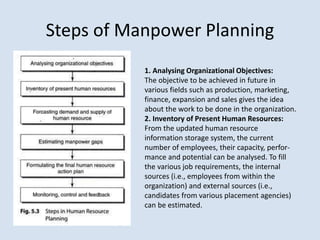
Steps of Manpower Planning
1. Analysing Organizational Objectives:
The objective to be achieved in future in
various fields such as production, marketing,
finance, expansion and sales gives the idea
about the work to be done in the organization.
2. Inventory of Present Human Resources:
From the updated human resource
information storage system, the current
number of employees, their capacity, perfor-
mance and potential can be analysed. To fill
the various job requirements, the internal
sources (i.e., employees from within the
organization) and external sources (i.e.,
candidates from various placement agencies)
can be estimated.
• Forecasting Demand and Supply of Human Resource:
The human resources required at different positions according to their job profile are to be
estimated. The available internal and external sources to fulfill those requirements are also
measured. There should be proper matching of job description and job specification of one
particular work, and the profile of the person should be suitable to it.
• Estimating Manpower Gaps:
Comparison of human resource demand and human resource supply will provide with the
surplus or deficit of human resource. Deficit represents the number of people to be employed,
whereas surplus represents termination. Extensive use of proper training and development
programme can be done to upgrade the skills of employees.
• Formulating the Human Resource Action Plan:
The human resource plan depends on whether there is deficit or surplus in the organization.
Accordingly, the plan may be finalized either for new recruitment, training, interdepartmental
transfer in case of deficit of termination, or voluntary retirement schemes and redeployment
in case of surplus.
• Monitoring, Control and Feedback:
It mainly involves implementation of the human resource action plan. Human resources are
allocated according to the requirements, and inventories are updated over a period. The plan
is monitored strictly to identify the deficiencies and remove it. Comparison between the
human resource plan and its actual implementation is done to ensure the appropriate action
and the availability of the required number of employees for various jobs.
Work Load Ratio
• Work-load Analysis is a suitable technique when the estimated work-load is easily
measureable. Workload Analysis is series of processes to calculate the workload of a
position, sub position, and also needs the number of people to fill the position and sub
position. Workload Analysis is very important to calculate exactly how many
employees needed to complete all of tasks in a section or department. This method
estimates total production and activities for a specific period of time in future. This
information is then translated into number of man-hours required to produce per unit
taking into consideration the capability of the workforces. Past-experience of the
management can help in this direction in translating the work-loads into number of
man-hours required. Thus, demand for human resources is forecasted on the basis of
estimated total production taking into consideration of contribution of each employee
in producing each unit of items. Both quantitative and qualitative techniques are
utilized for accurate results. The example of this technique is given below.
• For example if the estimated production of an organisation is 1, 50,000 units. The
standard man-hours required to produce each unit are 2 hours and the work ability of
each employee as calculated by the past experience is 1500 man hours per annum.
The work-load and demand of human resources can be calculated as follows:
• Estimated total annual production = 1, 50,000 units
• Standard man-hours needed to produce each unit = 2 hrs
• Estimated man-hours needed to meet estimated annual production (i x ii) = 300000 hrs
• Work ability/contribution per employee in terms of man-hour = 1500 units
• Estimated no. of workers needed (iii / iv) = 3,00,000/1500 = 200
• The above example clearly shows that 200 workers are needed for the
year in order to produce 1, 50,000 units. Further, absenteeism rate, rate of
labour turnover, resignations, deaths, machine break-down, strikes, pause,
break and power-failure etc. are given due consideration while estimating
future demand of human resources by Workload Analysis method.
• Work-Force Analysis
• Workforce Analysis is the foundation of workforce plan and determines
the rate of influx and outflow of employees. Workforce Analysis provides
sufficient margin for absenteeism, labour turnover and idle time for the
completion of the total job at hand undertaken by an organization on the
basis of past experiences. The organization needs to make reasonable
prediction of labour turnover or absenteeism. However, if the actual
labour turnover or absenteeism exceeds the predicted value, then it puts
the business under loss. Therefore the Workforce Analysis has to be done
with a lot of caution by experienced persons with validation of past
periods data. Any seasonal variations and special events that are likely to
occur need to be incorporated for the predicted period in order to ensure
a realistic demand forecasts. Moreover, a reasonable degree of buffer
must be built in while doing workforce analysis in order to sustain any
deviations.
Thank You !!!

Hospital ppt

  • 1.
    M.S.RAMAIAH INSTITUTE OFTECHNOLOGY Hospital Management Presentation MLOE03 Nishank Kukreja-1MS12ME096 Abhinav Banga-1MS12ME209 Raman Kumar-1MS12ME124 Mudit Parasar-1MS12ME088
  • 2.
    • To meetup requirements of the organisation: To do work in the organisation, every organisation needs personnel of desired skill, knowledge and experience. This human resources requirement of organisation can be effectively fulfilled through proper human resource planning. It helps in defining the number of personnel as well as kind of personnel required to satisfy its needs. It ensures the reservoir of desired human resources as and when required. • Counterbalance insecurity and change: There must be proper utilisation of human and non- human resources in the organisation. Sometimes the organisation may have adequate non- human resources e.g. machines, materials and money but inadequate human resources as a result, manufacturing process/production cannot be started. Human resource planning helps to offset uncertainties and changes as far as possible and enables to ensure availability of human resources of the right kind, at right time and at right place. • It helps in checking labour imbalance: Human resource planning helps to anticipate shortages and/or surpluses of manpower in the organisation. The shortage of manpower as well as surplus of manpower is not good for the organisation. It proves very expensive for the organisation. In case of shortage of human resources, physical resources of the organisation cannot be properly utilized. In case of surplus of human resources, this resource may remain under-utilized It helps in counter balancing the problem of shortage and surplus employees very comfortably. Human resource planning helps in correcting this imbalance before it become unmanageable and expensive. Benefits of Manpower Planning
  • 3.
    • Right-sizing thehuman resource requirements of the organisation: In an existing organisation, there is a constant need for right-sizing the organisation. In the organisation, some posts may fall vacant as a result of retirement, accidents, resignations, promotions or death of employees. Consequently, there is constant need of replacing people. Human resource planning estimates future requirements of the organisation and helps to ensure that human resources of right kind, right number, in right time and right place. • To meet expansion and diversification needs of the organisation: It helps to execute future plans of the organisation regarding expansion, diversification and modernization. Through human resource planning it is ensured that employees in right number and of right kind are available when required to meet these needs of the organisation. It ensures that people of desired skills and knowledge are available to handle the challenging job requirements. • Training and Development of Employees: There is constant need of training and development of employees as a result of changing requirements of the organisation. It provides scope for advancement and development of employees through training and development etc. Thus, it helps in meeting the future needs of the organisation of highly skilled employees. • Fulfill Individual Needs of the Employees: It helps to satisfy the individual needs of the employees for promotions, transfer, salary encashment, better benefits etc. • Helps Formulation of Budgets: It helps in anticipating the cost of human resources e.g. salary and other benefits etc. It facilitates the formulation of human resource budget for various departments/divisions of the organisation. So, it may also help in, the formulation of suitable budgets in an organisation. • To Check Joblessness: In the exercise of right-sizing of employees by the organisation, some of the employees may become surplus. It means their services are no more required in the organisation. It tries to foresee the need for redundancy. It plans to check job loss or to provide for alternative employment in consultation with various concerned parties and authorities. •
  • 4.
    Objectives of ManpowerPlanning • To recruit and maintain the HR of requisite quantity and quality. • To predict the employee turnover and make the arrangements for minimizing turnover and filing up of consequent vacancies. • To meet the requirements of the programmes of expansion, diversification etc. • To anticipate the impact of technology on work, existing employees and future human resource requirements. • To progress the knowledge, skill, standards, ability and discipline etc. • To appraise the surplus or shortage of human resources and take actions accordingly. • To maintain pleasant industrial relations by maintaining optimum level and structure of human resource. • To minimize imbalances caused due to non-availability of human resources of right kind, right number in right time and right place. • To make the best use of its human resources; and • To estimate the cost of human resources
  • 5.
    • Making assessmenthuman resource requirements for future and making plans for recruitment and selection. • Assessing skill needs in future. • Determining training and development needs of the enterprise. • To assess the surplus or shortage of human resources and avoiding unnecessary dismissals. • To minimise imbalances caused due to non-availability of human resources of right kind, right number in right time and at the right place. • Ensuring optimum use of existing human resources in the enterprise. • Keeping the enterprise ready to meet with the technological development and modernisation. • Controlling wage and salary costs. • Ensuring higher labour productivity. • Ensuring career planning of every employee of the enterprise and making succession programmes.
  • 6.
    Steps of ManpowerPlanning 1. Analysing Organizational Objectives: The objective to be achieved in future in various fields such as production, marketing, finance, expansion and sales gives the idea about the work to be done in the organization. 2. Inventory of Present Human Resources: From the updated human resource information storage system, the current number of employees, their capacity, perfor- mance and potential can be analysed. To fill the various job requirements, the internal sources (i.e., employees from within the organization) and external sources (i.e., candidates from various placement agencies) can be estimated.
  • 7.
    • Forecasting Demandand Supply of Human Resource: The human resources required at different positions according to their job profile are to be estimated. The available internal and external sources to fulfill those requirements are also measured. There should be proper matching of job description and job specification of one particular work, and the profile of the person should be suitable to it. • Estimating Manpower Gaps: Comparison of human resource demand and human resource supply will provide with the surplus or deficit of human resource. Deficit represents the number of people to be employed, whereas surplus represents termination. Extensive use of proper training and development programme can be done to upgrade the skills of employees. • Formulating the Human Resource Action Plan: The human resource plan depends on whether there is deficit or surplus in the organization. Accordingly, the plan may be finalized either for new recruitment, training, interdepartmental transfer in case of deficit of termination, or voluntary retirement schemes and redeployment in case of surplus. • Monitoring, Control and Feedback: It mainly involves implementation of the human resource action plan. Human resources are allocated according to the requirements, and inventories are updated over a period. The plan is monitored strictly to identify the deficiencies and remove it. Comparison between the human resource plan and its actual implementation is done to ensure the appropriate action and the availability of the required number of employees for various jobs.
  • 8.
    Work Load Ratio •Work-load Analysis is a suitable technique when the estimated work-load is easily measureable. Workload Analysis is series of processes to calculate the workload of a position, sub position, and also needs the number of people to fill the position and sub position. Workload Analysis is very important to calculate exactly how many employees needed to complete all of tasks in a section or department. This method estimates total production and activities for a specific period of time in future. This information is then translated into number of man-hours required to produce per unit taking into consideration the capability of the workforces. Past-experience of the management can help in this direction in translating the work-loads into number of man-hours required. Thus, demand for human resources is forecasted on the basis of estimated total production taking into consideration of contribution of each employee in producing each unit of items. Both quantitative and qualitative techniques are utilized for accurate results. The example of this technique is given below. • For example if the estimated production of an organisation is 1, 50,000 units. The standard man-hours required to produce each unit are 2 hours and the work ability of each employee as calculated by the past experience is 1500 man hours per annum. The work-load and demand of human resources can be calculated as follows: • Estimated total annual production = 1, 50,000 units • Standard man-hours needed to produce each unit = 2 hrs • Estimated man-hours needed to meet estimated annual production (i x ii) = 300000 hrs • Work ability/contribution per employee in terms of man-hour = 1500 units • Estimated no. of workers needed (iii / iv) = 3,00,000/1500 = 200
  • 9.
    • The aboveexample clearly shows that 200 workers are needed for the year in order to produce 1, 50,000 units. Further, absenteeism rate, rate of labour turnover, resignations, deaths, machine break-down, strikes, pause, break and power-failure etc. are given due consideration while estimating future demand of human resources by Workload Analysis method. • Work-Force Analysis • Workforce Analysis is the foundation of workforce plan and determines the rate of influx and outflow of employees. Workforce Analysis provides sufficient margin for absenteeism, labour turnover and idle time for the completion of the total job at hand undertaken by an organization on the basis of past experiences. The organization needs to make reasonable prediction of labour turnover or absenteeism. However, if the actual labour turnover or absenteeism exceeds the predicted value, then it puts the business under loss. Therefore the Workforce Analysis has to be done with a lot of caution by experienced persons with validation of past periods data. Any seasonal variations and special events that are likely to occur need to be incorporated for the predicted period in order to ensure a realistic demand forecasts. Moreover, a reasonable degree of buffer must be built in while doing workforce analysis in order to sustain any deviations.
  • 10.