HORROR GENRE CHART
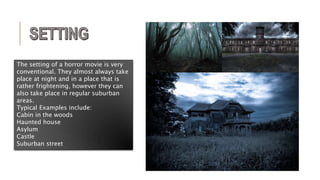
The setting of a horror movie is very
conventional. They almost always take
place at night and in a place that is
rather frightening, however they can
also take place in regular suburban
areas.
Typical Examples include:
Cabin in the woods
Haunted house
Asylum
Castle
Suburban street
Lighting – Horror films are often lit rather lowly since darkness is a
convention of horror.
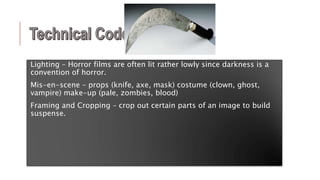
Mis-en-scene – props (knife, axe, mask) costume (clown, ghost,
vampire) make-up (pale, zombies, blood)
Framing and Cropping – crop out certain parts of an image to build
suspense.
Common themes in horror include binary oppositions such as natural
vs supernatural, known vs unknown and innocence vs evil.
Other themes such as what comes after death, the evil inside a
person, science becoming out of control and the Freudian theory are
all frequently included within the horror genre.
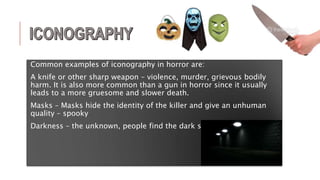
Common examples of iconography in horror are:
A knife or other sharp weapon – violence, murder, grievous bodily
harm. It is also more common than a gun in horror since it usually
leads to a more gruesome and slower death.
Masks – Masks hide the identity of the killer and give an unhuman
quality – spooky
Darkness – the unknown, people find the dark spooky
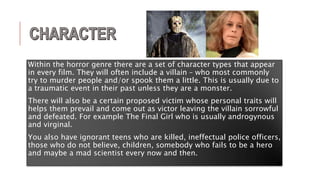
Within the horror genre there are a set of character types that appear
in every film. They will often include a villain – who most commonly
try to murder people and/or spook them a little. This is usually due to
a traumatic event in their past unless they are a monster.
There will also be a certain proposed victim whose personal traits will
helps them prevail and come out as victor leaving the villain sorrowful
and defeated. For example The Final Girl who is usually androgynous
and virginal.
You also have ignorant teens who are killed, ineffectual police officers,
those who do not believe, children, somebody who fails to be a hero
and maybe a mad scientist every now and then.
Horror often follows the classic Hollywood narrative yet it does not always
offer a resolution. This is usually to set up a sequel or make a point of the
mythical side of monsters if the movie includes one.
The clear hero of the Hollywood narrative is also not always used in horror.
For example the common use of a “final girl” in slasher movies is a
victim/hero which is slightly more complicated.
Narrative structure in horror can become quite formulaic. In the Slasher sub
genre films often revolve around a killer returning to the location of a
traumatic event on a particular date and killing a group of teens before they
are defeated by the “final girl”
Barthes’s and Levi Strauss’s narrative structure analysis is relevant to the
horror genre in regards to the binary opposition of innocence and evil.

Horror genre chart

  • 1.
  • 2.
    The setting ofa horror movie is very conventional. They almost always take place at night and in a place that is rather frightening, however they can also take place in regular suburban areas. Typical Examples include: Cabin in the woods Haunted house Asylum Castle Suburban street
  • 3.
    Lighting – Horrorfilms are often lit rather lowly since darkness is a convention of horror. Mis-en-scene – props (knife, axe, mask) costume (clown, ghost, vampire) make-up (pale, zombies, blood) Framing and Cropping – crop out certain parts of an image to build suspense.
  • 4.
    Common themes inhorror include binary oppositions such as natural vs supernatural, known vs unknown and innocence vs evil. Other themes such as what comes after death, the evil inside a person, science becoming out of control and the Freudian theory are all frequently included within the horror genre.
  • 5.
    Common examples oficonography in horror are: A knife or other sharp weapon – violence, murder, grievous bodily harm. It is also more common than a gun in horror since it usually leads to a more gruesome and slower death. Masks – Masks hide the identity of the killer and give an unhuman quality – spooky Darkness – the unknown, people find the dark spooky
  • 6.
    Within the horrorgenre there are a set of character types that appear in every film. They will often include a villain – who most commonly try to murder people and/or spook them a little. This is usually due to a traumatic event in their past unless they are a monster. There will also be a certain proposed victim whose personal traits will helps them prevail and come out as victor leaving the villain sorrowful and defeated. For example The Final Girl who is usually androgynous and virginal. You also have ignorant teens who are killed, ineffectual police officers, those who do not believe, children, somebody who fails to be a hero and maybe a mad scientist every now and then.
  • 7.
    Horror often followsthe classic Hollywood narrative yet it does not always offer a resolution. This is usually to set up a sequel or make a point of the mythical side of monsters if the movie includes one. The clear hero of the Hollywood narrative is also not always used in horror. For example the common use of a “final girl” in slasher movies is a victim/hero which is slightly more complicated. Narrative structure in horror can become quite formulaic. In the Slasher sub genre films often revolve around a killer returning to the location of a traumatic event on a particular date and killing a group of teens before they are defeated by the “final girl” Barthes’s and Levi Strauss’s narrative structure analysis is relevant to the horror genre in regards to the binary opposition of innocence and evil.