Horror Genre Slasher Movies
Critical thinking…. "at the bottom of the horror heap" (Clover)   "the most disreputable form of the horror film" (Pinedo)   "unartistic and reactionary generic manifestations" (Williams)
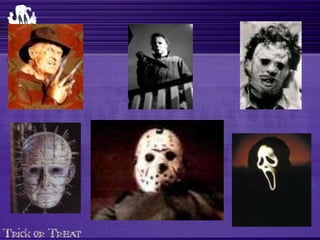
Yet…. Yet the legacy of the three major horror characters to emerge during the 1980s, Freddy Krueger of A Nightmare on Elm Street, Jason Voorhees of the Friday the 13th series, and Pinhead of Hellraiser, lives on as the virtual definition of film horror today.  Because of their immense and enduring popularity with adolescents, and because their messages differ from mainstream cinema
 
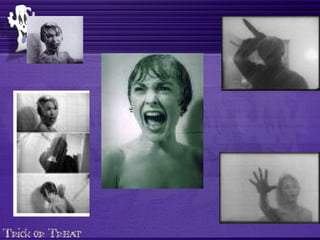
Origins Many date the birth of the Slasher genre, or certainly its defining moment, to the shower scene in Psycho. Characteristics being  the vulnerable female who is sexualised (she is naked) The masked killer The weapon (knife)
 
Examples Halloween  Scream  I know what you did last summer Prom Night  Nightmare on Elm St. Friday 13 th   and all the associated sequels
Conventions These films are defined by repeating cycles - sequels. There is a strong sense of voyeurism in these films and a high amount of POV shots. Replicating the act of the audience Voyeurism: Act of looking
Women In the Slasher Genre The primary rationale for the slasher film's status as low culture within academia is its consistent depiction of targeted female victims:   "explicitly about the destruction of women" (Sharrett).   Women are repeatedly killed, apparently in conformance to the monster's attempt at repressing the dangerous sexuality they exhibit (during the obligatory nude scene)
Final Girl The most consistent element in slasher sequels is the Final Girl   The Texas Chainsaw Massacre (she eludes Leatherface until she is ultimately rescued by a passing truck driver)   Laurie from Halloween, who, in the last sequence of the film, ceases to run and retaliates against Michael Myers, matching him in violence.   The Final Girls are masculine projections Final Girls are usually desexualized, either unavailable for relationships or reluctant while in them
Youth Another consistent theme in these slashers is the depiction of youth subjugated to an adult community that produces monsters.   "unaware or ineffectual adult community" (Heba)   If the families are present, they are either unsupportive, or disbelieving.  Institutions of Police and Psychiatry are ineffective
The ‘monstrous other’ The killers are the rejected, marginalized underbelly of society, those that suburban America represses and denies. Their threat  "lies there, quite close, but it cannot be assimilated" (Kristeva) The films express a "world where safety in every sense of the term is a fiction" (Pinedo)
Ideologies Horror movies (esp. the slasher sub-genre) are ideological texts. They contain values and messages which the audience are free to interpret as they wish Audience readings consist of Dominant Negotiated Oppositional
Ideologies In slasher films the characters that are interested in sex / sin are killed. There always remains the ‘final  girl’ who is typically a saintly virgin. Sins Include? Final Girls?
Ideologies Not only are the films voyeuristic, they are also very misogynistic. The death sequences of the females are almost always much more elaborate / detailed / torturous than the male characters. Misogyny: a hatred or dislike of women
Narrative Pattern Essentially these films follow a very formulaic narrative pattern. This may in some way account for their success It also allows for the numerous sequels which are inevitable Two time zones are often present in Slashers,  past  and  present .
Narrative Pattern Past Event person / community is guilty of wrong doing killer sees this killer suffers loss  killer kills Typically Halloween and I Know What You Did Last Summer
Narrative Pattern Present Event Event commemorates past action Killer’s impulses are reactivated Killer stalks community and kills Heroine sees murders and murderers Heroine subdues murderer Heroine survives but is not freed
Iconography As with many genres, there is a strong sense of iconic images and motifs associated with the slasher genre Knives Suburban communities Teenagers Masks Etc. etc.
A Changing Genre Successful genres follow a changing pattern Establishment (defining the main characteristics) Change (adapting in order to remain successful) Reflection (They understand themselves and become a parody / pastiche – they are post-modern)
Post-Modern Slasher Movies Movies such as  Scream Wes Craven’s A New Nightmare Scary Movie Are all post-modern versions of the slasher genre. They are reflecting upon themselves / their rules and are essentially films  about  slasher movies
In the late 1990s, the slasher series in some senses made the leap from  low culture  to  high culture   ‘ Monster’ has returned to the Halloween mode of having a ‘real’ killer rather than a supernatural one. Nearly every conversation or discussion in these films becomes an analysis of the other characters' possible guilt.  Suspects become those who are even slightly different from the well-adjusted group.   Post-Modern Slasher Movies
Finally "before Thelma and Louise there were Nancy and Stephanie and about a hundred other young women who fought back in the excoriated slasher film" (Pinedo)

Slasher Movie

  • 1.
  • 2.
    Critical thinking…. "atthe bottom of the horror heap" (Clover) "the most disreputable form of the horror film" (Pinedo) "unartistic and reactionary generic manifestations" (Williams)
  • 3.
    Yet…. Yet thelegacy of the three major horror characters to emerge during the 1980s, Freddy Krueger of A Nightmare on Elm Street, Jason Voorhees of the Friday the 13th series, and Pinhead of Hellraiser, lives on as the virtual definition of film horror today. Because of their immense and enduring popularity with adolescents, and because their messages differ from mainstream cinema
  • 4.
  • 5.
    Origins Many datethe birth of the Slasher genre, or certainly its defining moment, to the shower scene in Psycho. Characteristics being the vulnerable female who is sexualised (she is naked) The masked killer The weapon (knife)
  • 6.
  • 7.
    Examples Halloween Scream I know what you did last summer Prom Night Nightmare on Elm St. Friday 13 th and all the associated sequels
  • 8.
    Conventions These filmsare defined by repeating cycles - sequels. There is a strong sense of voyeurism in these films and a high amount of POV shots. Replicating the act of the audience Voyeurism: Act of looking
  • 9.
    Women In theSlasher Genre The primary rationale for the slasher film's status as low culture within academia is its consistent depiction of targeted female victims: "explicitly about the destruction of women" (Sharrett). Women are repeatedly killed, apparently in conformance to the monster's attempt at repressing the dangerous sexuality they exhibit (during the obligatory nude scene)
  • 10.
    Final Girl Themost consistent element in slasher sequels is the Final Girl The Texas Chainsaw Massacre (she eludes Leatherface until she is ultimately rescued by a passing truck driver) Laurie from Halloween, who, in the last sequence of the film, ceases to run and retaliates against Michael Myers, matching him in violence. The Final Girls are masculine projections Final Girls are usually desexualized, either unavailable for relationships or reluctant while in them
  • 11.
    Youth Another consistenttheme in these slashers is the depiction of youth subjugated to an adult community that produces monsters. "unaware or ineffectual adult community" (Heba) If the families are present, they are either unsupportive, or disbelieving. Institutions of Police and Psychiatry are ineffective
  • 12.
    The ‘monstrous other’The killers are the rejected, marginalized underbelly of society, those that suburban America represses and denies. Their threat "lies there, quite close, but it cannot be assimilated" (Kristeva) The films express a "world where safety in every sense of the term is a fiction" (Pinedo)
  • 13.
    Ideologies Horror movies(esp. the slasher sub-genre) are ideological texts. They contain values and messages which the audience are free to interpret as they wish Audience readings consist of Dominant Negotiated Oppositional
  • 14.
    Ideologies In slasherfilms the characters that are interested in sex / sin are killed. There always remains the ‘final girl’ who is typically a saintly virgin. Sins Include? Final Girls?
  • 15.
    Ideologies Not onlyare the films voyeuristic, they are also very misogynistic. The death sequences of the females are almost always much more elaborate / detailed / torturous than the male characters. Misogyny: a hatred or dislike of women
  • 16.
    Narrative Pattern Essentiallythese films follow a very formulaic narrative pattern. This may in some way account for their success It also allows for the numerous sequels which are inevitable Two time zones are often present in Slashers, past and present .
  • 17.
    Narrative Pattern PastEvent person / community is guilty of wrong doing killer sees this killer suffers loss killer kills Typically Halloween and I Know What You Did Last Summer
  • 18.
    Narrative Pattern PresentEvent Event commemorates past action Killer’s impulses are reactivated Killer stalks community and kills Heroine sees murders and murderers Heroine subdues murderer Heroine survives but is not freed
  • 19.
    Iconography As withmany genres, there is a strong sense of iconic images and motifs associated with the slasher genre Knives Suburban communities Teenagers Masks Etc. etc.
  • 20.
    A Changing GenreSuccessful genres follow a changing pattern Establishment (defining the main characteristics) Change (adapting in order to remain successful) Reflection (They understand themselves and become a parody / pastiche – they are post-modern)
  • 21.
    Post-Modern Slasher MoviesMovies such as Scream Wes Craven’s A New Nightmare Scary Movie Are all post-modern versions of the slasher genre. They are reflecting upon themselves / their rules and are essentially films about slasher movies
  • 22.
    In the late1990s, the slasher series in some senses made the leap from low culture to high culture ‘ Monster’ has returned to the Halloween mode of having a ‘real’ killer rather than a supernatural one. Nearly every conversation or discussion in these films becomes an analysis of the other characters' possible guilt. Suspects become those who are even slightly different from the well-adjusted group. Post-Modern Slasher Movies
  • 23.
    Finally "before Thelmaand Louise there were Nancy and Stephanie and about a hundred other young women who fought back in the excoriated slasher film" (Pinedo)