UNDERSTANDING ORGANIZATIONAL MATURITY (Learning Level) FOR BETTER CHANGE
                      MANAGEMENT OUTCOMES.


      Research & Author: - Dr. Myles Sweeney BA (Psych), Dip. (Mgt.), MBS (Fin.), Ph.D. (Psychol.)
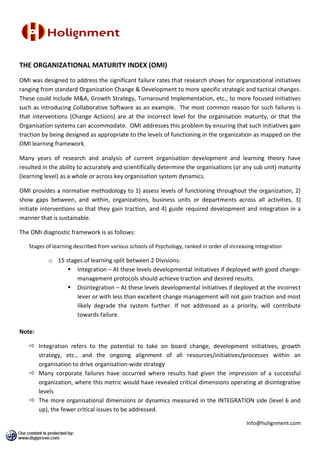
THE ORGANIZATIONAL MATURITY INDEX (OMI)
OMI was designed to address the significant failure rates that research shows for organizational initiatives
ranging from standard Organization Change & Development to more specific strategic and tactical changes.
These could include M&A, Growth Strategy, Turnaround Implementation, etc., to more focused initiatives
such as introducing Collaborative Software as an example. The most common reason for such failures is
that interventions (Change Actions) are at the incorrect level for the organisation maturity, or that the
Organisation systems can accommodate. OMI addresses this problem by ensuring that such initiatives gain
traction by being designed as appropriate to the levels of functioning in the organization as mapped on the
OMI learning framework.

Many years of research and analysis of current organisation development and learning theory have
resulted in the ability to accurately and scientifically determine the organisations (or any sub unit) maturity
(learning level) as a whole or across key organisation system dynamics.

OMI provides a normative methodology to 1) assess levels of functioning throughout the organization, 2)
show gaps between, and within, organizations, business units or departments across all activities, 3)
initiate interventions so that they gain traction, and 4) guide required development and integration in a
manner that is sustainable.

The OMI diagnostic framework is as follows:

   Stages of learning described from various schools of Psychology, ranked in order of increasing integration

           o 15 stages of learning split between 2 Divisions:
                  Integration – At these levels developmental initiatives if deployed with good change-
                    management protocols should achieve traction and desired results.
                  Disintegration – At these levels developmental initiatives if deployed at the incorrect
                    lever or with less than excellent change management will not gain traction and most
                    likely degrade the system further. If not addressed as a priority, will contribute
                    towards failure.

Note:

    Integration refers to the potential to take on board change, development initiatives, growth
     strategy, etc., and the ongoing alignment of all resources/initiatives/processes within an
     organisation to drive organisation-wide strategy
    Many corporate failures have occurred where results had given the impression of a successful
     organization, where this metric would have revealed critical dimensions operating at disintegrative
     levels
    The more organisational dimensions or dynamics measured in the INTEGRATION side (level 6 and
     up), the fewer critical issues to be addressed.

                                                                                              Info@holignment.com
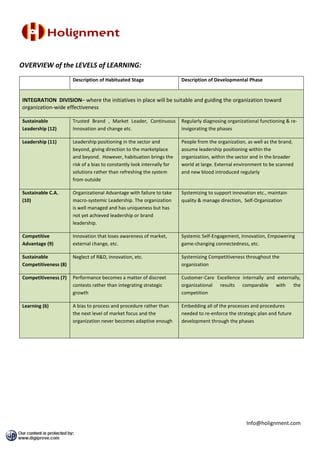
OVERVIEW of the LEVELS of LEARNING:
                      Description of Habituated Stage                    Description of Developmental Phase


INTEGRATION DIVISION– where the initiatives in place will be suitable and guiding the organization toward
organization-wide effectiveness

Sustainable           Trusted Brand , Market Leader, Continuous          Regularly diagnosing organizational functioning & re-
Leadership (12)       Innovation and change etc.                         invigorating the phases

Leadership (11)       Leadership positioning in the sector and           People from the organization, as well as the brand,
                      beyond, giving direction to the marketplace        assume leadership positioning within the
                      and beyond. However, habituation brings the        organization, within the sector and in the broader
                      risk of a bias to constantly look internally for   world at large. External environment to be scanned
                      solutions rather than refreshing the system        and new blood introduced regularly
                      from outside

Sustainable C.A.      Organizational Advantage with failure to take      Systemizing to support innovation etc., maintain
(10)                  macro-systemic Leadership. The organization        quality & manage direction, Self-Organization
                      is well managed and has uniqueness but has
                      not yet achieved leadership or brand
                      leadership.

Competitive           Innovation that loses awareness of market,         Systemic Self-Engagement, Innovation, Empowering
Advantage (9)         external change, etc.                              game-changing connectedness, etc.

Sustainable           Neglect of R&D, innovation, etc.                   Systemizing Competitiveness throughout the
Competitiveness (8)                                                      organization

Competitiveness (7)   Performance becomes a matter of discreet           Customer-Care Excellence internally and externally,
                      contests rather than integrating strategic         organizational results comparable with the
                      growth                                             competition

Learning (6)          A bias to process and procedure rather than        Embedding all of the processes and procedures
                      the next level of market focus and the             needed to re-enforce the strategic plan and future
                      organization never becomes adaptive enough         development through the phases


                                                                                                      Info@holignment.com
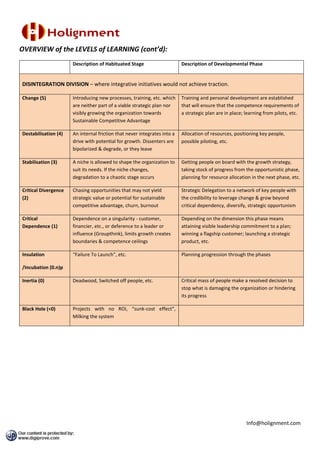
OVERVIEW of the LEVELS of LEARNING (cont’d):
                      Description of Habituated Stage                     Description of Developmental Phase


DISINTEGRATION DIVISION – where integrative initiatives would not achieve traction.

Change (5)            Introducing new processes, training, etc. which     Training and personal development are established
                      are neither part of a viable strategic plan nor     that will ensure that the competence requirements of
                      visibly growing the organization towards            a strategic plan are in place; learning from pilots, etc.
                      Sustainable Competitive Advantage

Destabilisation (4)   An internal friction that never integrates into a   Allocation of resources, positioning key people,
                      drive with potential for growth. Dissenters are     possible piloting, etc.
                      bipolarized & degrade, or they leave

Stabilisation (3)     A niche is allowed to shape the organization to     Getting people on board with the growth strategy,
                      suit its needs. If the niche changes,               taking stock of progress from the opportunistic phase,
                      degradation to a chaotic stage occurs               planning for resource allocation in the next phase, etc.

Critical Divergence   Chasing opportunities that may not yield            Strategic Delegation to a network of key people with
(2)                   strategic value or potential for sustainable        the credibility to leverage change & grow beyond
                      competitive advantage, churn, burnout               critical dependency, diversify, strategic opportunism

Critical              Dependence on a singularity - customer,             Depending on the dimension this phase means
Dependence (1)        financier, etc., or deference to a leader or        attaining visible leadership commitment to a plan;
                      influence (Groupthink), limits growth creates       winning a flagship customer; launching a strategic
                      boundaries & competence ceilings                    product, etc.

Insulation            “Failure To Launch”, etc.                           Planning progression through the phases

/Incubation (0.n)p

Inertia (0)           Deadwood, Switched off people, etc.                 Critical mass of people make a resolved decision to
                                                                          stop what is damaging the organization or hindering
                                                                          its progress

Black Hole (<0)       Projects with no ROI, “sunk-cost effect”,
                      Milking the system


                                                                                                         Info@holignment.com
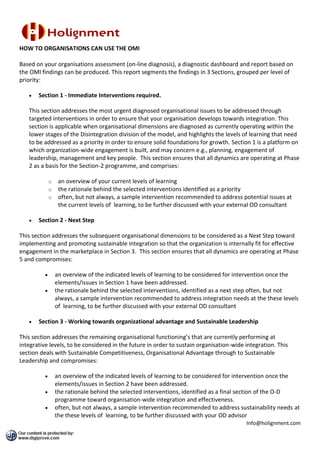
HOW TO ORGANISATIONS CAN USE THE OMI

Based on your organisations assessment (on-line diagnosis), a diagnostic dashboard and report based on
the OMI findings can be produced. This report segments the findings in 3 Sections, grouped per level of
priority:

      Section 1 - Immediate Interventions required.

   This section addresses the most urgent diagnosed organisational issues to be addressed through
   targeted interventions in order to ensure that your organisation develops towards integration. This
   section is applicable when organisational dimensions are diagnosed as currently operating within the
   lower stages of the Disintegration division of the model, and highlights the levels of learning that need
   to be addressed as a priority in order to ensure solid foundations for growth. Section 1 is a platform on
   which organization-wide engagement is built, and may concern e.g., planning, engagement of
   leadership, management and key people. This section ensures that all dynamics are operating at Phase
   2 as a basis for the Section-2 programme, and comprises:

              o    an overview of your current levels of learning
              o    the rationale behind the selected interventions identified as a priority
              o    often, but not always, a sample intervention recommended to address potential issues at
                   the current levels of learning, to be further discussed with your external OD consultant

      Section 2 - Next Step

This section addresses the subsequent organisational dimensions to be considered as a Next Step toward
implementing and promoting sustainable integration so that the organization is internally fit for effective
engagement in the marketplace in Section 3. This section ensures that all dynamics are operating at Phase
5 and compromises:

                 an overview of the indicated levels of learning to be considered for intervention once the
                  elements/issues in Section 1 have been addressed.
                 the rationale behind the selected interventions, identified as a next step often, but not
                  always, a sample intervention recommended to address integration needs at the these levels
                  of learning, to be further discussed with your external OD consultant

      Section 3 - Working towards organizational advantage and Sustainable Leadership

This section addresses the remaining organisational functioning’s that are currently performing at
integrative levels, to be considered in the future in order to sustain organisation-wide integration. This
section deals with Sustainable Competitiveness, Organisational Advantage through to Sustainable
Leadership and compromises:

                 an overview of the indicated levels of learning to be considered for intervention once the
                  elements/issues in Section 2 have been addressed.
                 the rationale behind the selected interventions, identified as a final section of the O-D
                  programme toward organisation-wide integration and effectiveness.
                 often, but not always, a sample intervention recommended to address sustainability needs at
                  the these levels of learning, to be further discussed with your OD advisor
                                                                                         Info@holignment.com

Org learning levels

  • 1.
    UNDERSTANDING ORGANIZATIONAL MATURITY(Learning Level) FOR BETTER CHANGE MANAGEMENT OUTCOMES. Research & Author: - Dr. Myles Sweeney BA (Psych), Dip. (Mgt.), MBS (Fin.), Ph.D. (Psychol.)
  • 2.
    THE ORGANIZATIONAL MATURITYINDEX (OMI) OMI was designed to address the significant failure rates that research shows for organizational initiatives ranging from standard Organization Change & Development to more specific strategic and tactical changes. These could include M&A, Growth Strategy, Turnaround Implementation, etc., to more focused initiatives such as introducing Collaborative Software as an example. The most common reason for such failures is that interventions (Change Actions) are at the incorrect level for the organisation maturity, or that the Organisation systems can accommodate. OMI addresses this problem by ensuring that such initiatives gain traction by being designed as appropriate to the levels of functioning in the organization as mapped on the OMI learning framework. Many years of research and analysis of current organisation development and learning theory have resulted in the ability to accurately and scientifically determine the organisations (or any sub unit) maturity (learning level) as a whole or across key organisation system dynamics. OMI provides a normative methodology to 1) assess levels of functioning throughout the organization, 2) show gaps between, and within, organizations, business units or departments across all activities, 3) initiate interventions so that they gain traction, and 4) guide required development and integration in a manner that is sustainable. The OMI diagnostic framework is as follows: Stages of learning described from various schools of Psychology, ranked in order of increasing integration o 15 stages of learning split between 2 Divisions:  Integration – At these levels developmental initiatives if deployed with good change- management protocols should achieve traction and desired results.  Disintegration – At these levels developmental initiatives if deployed at the incorrect lever or with less than excellent change management will not gain traction and most likely degrade the system further. If not addressed as a priority, will contribute towards failure. Note:  Integration refers to the potential to take on board change, development initiatives, growth strategy, etc., and the ongoing alignment of all resources/initiatives/processes within an organisation to drive organisation-wide strategy  Many corporate failures have occurred where results had given the impression of a successful organization, where this metric would have revealed critical dimensions operating at disintegrative levels  The more organisational dimensions or dynamics measured in the INTEGRATION side (level 6 and up), the fewer critical issues to be addressed. Info@holignment.com
  • 3.
    OVERVIEW of theLEVELS of LEARNING: Description of Habituated Stage Description of Developmental Phase INTEGRATION DIVISION– where the initiatives in place will be suitable and guiding the organization toward organization-wide effectiveness Sustainable Trusted Brand , Market Leader, Continuous Regularly diagnosing organizational functioning & re- Leadership (12) Innovation and change etc. invigorating the phases Leadership (11) Leadership positioning in the sector and People from the organization, as well as the brand, beyond, giving direction to the marketplace assume leadership positioning within the and beyond. However, habituation brings the organization, within the sector and in the broader risk of a bias to constantly look internally for world at large. External environment to be scanned solutions rather than refreshing the system and new blood introduced regularly from outside Sustainable C.A. Organizational Advantage with failure to take Systemizing to support innovation etc., maintain (10) macro-systemic Leadership. The organization quality & manage direction, Self-Organization is well managed and has uniqueness but has not yet achieved leadership or brand leadership. Competitive Innovation that loses awareness of market, Systemic Self-Engagement, Innovation, Empowering Advantage (9) external change, etc. game-changing connectedness, etc. Sustainable Neglect of R&D, innovation, etc. Systemizing Competitiveness throughout the Competitiveness (8) organization Competitiveness (7) Performance becomes a matter of discreet Customer-Care Excellence internally and externally, contests rather than integrating strategic organizational results comparable with the growth competition Learning (6) A bias to process and procedure rather than Embedding all of the processes and procedures the next level of market focus and the needed to re-enforce the strategic plan and future organization never becomes adaptive enough development through the phases Info@holignment.com
  • 4.
    OVERVIEW of theLEVELS of LEARNING (cont’d): Description of Habituated Stage Description of Developmental Phase DISINTEGRATION DIVISION – where integrative initiatives would not achieve traction. Change (5) Introducing new processes, training, etc. which Training and personal development are established are neither part of a viable strategic plan nor that will ensure that the competence requirements of visibly growing the organization towards a strategic plan are in place; learning from pilots, etc. Sustainable Competitive Advantage Destabilisation (4) An internal friction that never integrates into a Allocation of resources, positioning key people, drive with potential for growth. Dissenters are possible piloting, etc. bipolarized & degrade, or they leave Stabilisation (3) A niche is allowed to shape the organization to Getting people on board with the growth strategy, suit its needs. If the niche changes, taking stock of progress from the opportunistic phase, degradation to a chaotic stage occurs planning for resource allocation in the next phase, etc. Critical Divergence Chasing opportunities that may not yield Strategic Delegation to a network of key people with (2) strategic value or potential for sustainable the credibility to leverage change & grow beyond competitive advantage, churn, burnout critical dependency, diversify, strategic opportunism Critical Dependence on a singularity - customer, Depending on the dimension this phase means Dependence (1) financier, etc., or deference to a leader or attaining visible leadership commitment to a plan; influence (Groupthink), limits growth creates winning a flagship customer; launching a strategic boundaries & competence ceilings product, etc. Insulation “Failure To Launch”, etc. Planning progression through the phases /Incubation (0.n)p Inertia (0) Deadwood, Switched off people, etc. Critical mass of people make a resolved decision to stop what is damaging the organization or hindering its progress Black Hole (<0) Projects with no ROI, “sunk-cost effect”, Milking the system Info@holignment.com
  • 5.
    HOW TO ORGANISATIONSCAN USE THE OMI Based on your organisations assessment (on-line diagnosis), a diagnostic dashboard and report based on the OMI findings can be produced. This report segments the findings in 3 Sections, grouped per level of priority:  Section 1 - Immediate Interventions required. This section addresses the most urgent diagnosed organisational issues to be addressed through targeted interventions in order to ensure that your organisation develops towards integration. This section is applicable when organisational dimensions are diagnosed as currently operating within the lower stages of the Disintegration division of the model, and highlights the levels of learning that need to be addressed as a priority in order to ensure solid foundations for growth. Section 1 is a platform on which organization-wide engagement is built, and may concern e.g., planning, engagement of leadership, management and key people. This section ensures that all dynamics are operating at Phase 2 as a basis for the Section-2 programme, and comprises: o an overview of your current levels of learning o the rationale behind the selected interventions identified as a priority o often, but not always, a sample intervention recommended to address potential issues at the current levels of learning, to be further discussed with your external OD consultant  Section 2 - Next Step This section addresses the subsequent organisational dimensions to be considered as a Next Step toward implementing and promoting sustainable integration so that the organization is internally fit for effective engagement in the marketplace in Section 3. This section ensures that all dynamics are operating at Phase 5 and compromises:  an overview of the indicated levels of learning to be considered for intervention once the elements/issues in Section 1 have been addressed.  the rationale behind the selected interventions, identified as a next step often, but not always, a sample intervention recommended to address integration needs at the these levels of learning, to be further discussed with your external OD consultant  Section 3 - Working towards organizational advantage and Sustainable Leadership This section addresses the remaining organisational functioning’s that are currently performing at integrative levels, to be considered in the future in order to sustain organisation-wide integration. This section deals with Sustainable Competitiveness, Organisational Advantage through to Sustainable Leadership and compromises:  an overview of the indicated levels of learning to be considered for intervention once the elements/issues in Section 2 have been addressed.  the rationale behind the selected interventions, identified as a final section of the O-D programme toward organisation-wide integration and effectiveness.  often, but not always, a sample intervention recommended to address sustainability needs at the these levels of learning, to be further discussed with your OD advisor Info@holignment.com