NUJ 
Responsibilities & Obligations of Writers.
Who We Are 
• We are the National Union of Journalists. An 
independent Union with it’s own separate rules on 
how we believe Journalists should act, in regard to 
there responsibilities & Obligations of a writer. 
• In this presentation, we will be training you what 
we do here at NUJ, what we look at in particular 
for our members to follow & examples of wrong 
doings in past journalism.
Introduction 
It is very important for journalists to be socially & culturally aware. One of the main reasons why journalists 
need to be responsible in the area is because they are often writing about people that there readers do not 
experience them in there own lives, so there opinions will be purely based upon how they are reported. 
For this reason, the journalist should not use bias in his work as this can be very damaging to the group/person 
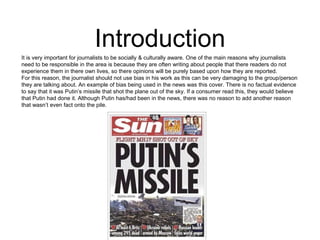
they are talking about. An example of bias being used in the news was this cover. There is no factual evidence 
to say that it was Putin’s missile that shot the plane out of the sky. If a consumer read this, they would believe 
that Putin had done it. Although Putin has/had been in the news, there was no reason to add another reason 
that wasn’t even fact onto the pile.
How People Are Being 
Represented 
People are represented in different ways in the media. A responsible journalist should never put a negative 
spin on what they are writing. The representation of someone in journalism is important as it may only be the 
only opinion they hear on the subject matter. It is also important to represent people with facts, not opinions in 
responsible journalism. You are journalist and the people need to know the facts, not your opinion.There have 
been problems with this in the past as opinion can often cloud a human’s judgement about facts, this then 
conveys your opinion & not the fact. There are specific words that represent certain groups in negative ways 
(more on this in the next slide). This article on BBC News http://www.bbc.co.uk/news/uk-26230410 really 
highlights the negative representation of Young People & Teenagers in the media. In the article, the company 
‘Demos’ found that the words that are commonly used to describe this demo as ‘yobs’. The article highlights 
that 4/5th’s of young people that asked feel like there job opportunities are hindered because of the way they 
are represented in the media, particularly in newspapers & magazines.
How connotation can influence the 
response to a piece of writing: 
Words have there initial meanings (denotations) & then the have there connotations, which means what 
people think about when they hear/read/see something. It is important that when writing responsible 
journalism that the words used in the work do not have negative connotations that can represent a 
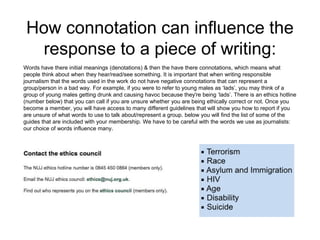
group/person in a bad way. For example, if you were to refer to young males as ‘lads’, you may think of a 
group of young males getting drunk and causing havoc because they're being ‘lads’. There is an ethics hotline 
(number below) that you can call if you are unsure whether you are being ethically correct or not. Once you 
become a member, you will have access to many different guidelines that will show you how to report if you 
are unsure of what words to use to talk about/represent a group. below you will find the list of some of the 
guides that are included with your membership. We have to be careful with the words we use as journalists: 
our choice of words influence many.
How Different Groups Can Have Alternative 
Readings of a Piece of Writing: 
If you are not initially part of a group, you will gain an alternative reading than others. For example, if we read 
something negative about immigrants entering the UK, we will have a negative reading. Whereas if you have 
a friend/family member who is an immigrant or you are one yourself, you will have a different reading. for 
example, if you were reading an article and it said ‘over 1million immigrants are in the UK’. (I have just made 
that fact up), you would have different readings. Some people would find this positive and some would find 
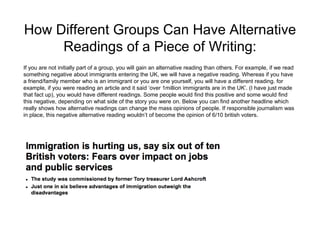
this negative, depending on what side of the story you were on. Below you can find another headline which 
really shows how alternative readings can change the mass opinions of people. If responsible journalism was 
in place, this negative alternative reading wouldn’t of become the opinion of 6/10 british voters.
Objective: 
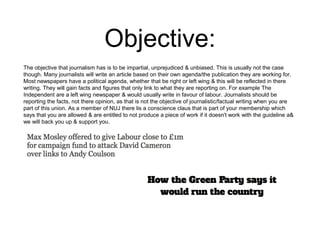
The objective that journalism has is to be impartial, unprejudiced & unbiased. This is usually not the case 
though. Many journalists will write an article based on their own agenda/the publication they are working for. 
Most newspapers have a political agenda, whether that be right or left wing & this will be reflected in there 
writing. They will gain facts and figures that only link to what they are reporting on. For example The 
Independent are a left wing newspaper & would usually write in favour of labour. Journalists should be 
reporting the facts, not there opinion, as that is not the objective of journalistic/factual writing when you are 
part of this union. As a member of NUJ there lis a conscience claus that is part of your membership which 
says that you are allowed & are entitled to not produce a piece of work if it doesn't work with the guideline a& 
we will back you up & support you.
Accurate: 
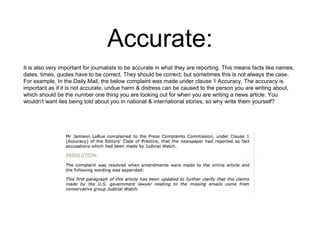
It is also very important for journalists to be accurate in what they are reporting. This means facts like names, 
dates, times, quotes have to be correct. They should be correct, but sometimes this is not always the case. 
For example, In the Daily Mail, the below complaint was made under clause 1 Accuracy. The accuracy is 
important as if it is not accurate, undue harm & distress can be caused to the person you are writing about, 
which should be the number one thing you are looking out for when you are writing a news article. You 
wouldn't want lies being told about you in national & international stories, so why write them yourself?
Truthful: 
The key to being truthful in your journalism is to be truthful throughout your work. Being clear about where you 
got/gathered the information & facts in your work is the main way for your work to be seen as truthful. If you 
are telling a lie in your journalism, it’s more than likely that you will be found out & the truth will come out 
eventually. A lie can damage a persons life, as the lie will be written in a way that will make it seem like fact. 
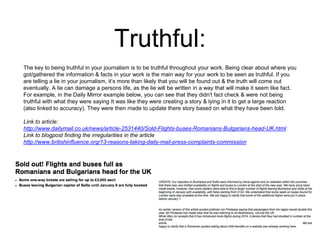
For example, in the Daily Mirror example below, you can see that they didn't fact check & were not being 
truthful with what they were saying It was like they were creating a story & lying in it to get a large reaction 
(also linked to accuracy). They were then made to update there story based on what they have been told. 
Link to article: 
http://www.dailymail.co.uk/news/article-2531440/Sold-Flights-buses-Romanians-Bulgarians-head-UK.html 
Link to blogpost finding the irregularities in the article 
http://www.britishinfluence.org/13-reasons-taking-daily-mail-press-complaints-commission
Fair & Balanced: 
When you are a journalist, it is very important to be fair & balanced. This is another key way to be on your way 
to being a responsible journalist. All articles that you write must be written open-minded & unbiased towards a 
certain viewpoint. A clear argument between both sides is needed for a fair & balanced argument which allows 
the audience to decide on there own who they want to side with. Being fair & balanced when writing for a 
newspaper can have complications as a lot of these newspapers are either right or left wing. This will effect the 
way you write stories on politics & immigration mostly. The issue of fair & balanced journalism work comes into 
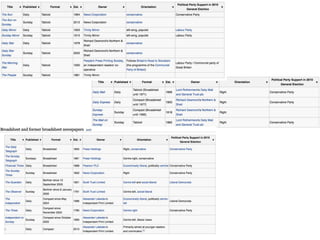
practice when referring to left & right wing journalism quite prominently.On the next slide, you can see see lists 
of the orientation these newspapers swing towards.
Defamation 
Defamation is to important stay clear of in this profession. When writing, you should stay clear of writing false 
stories that include misrepresentation, false accusation, offensive & milieus writing that could possibly be 
based on someones actions/words. 
Defamation could lead to a libel case against you, which would then lead to possible court costs. Anyone can 
make defamation cases against you, including celebrities, politicians & members of the public. 
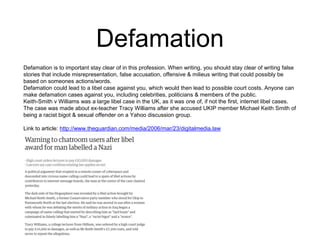
Keith-Smith v Williams was a large libel case in the UK, as it was one of, if not the first, internet libel cases. 
The case was made about ex-teacher Tracy Williams after she accused UKIP member Michael Keith Smith of 
being a racist bigot & sexual offender on a Yahoo discussion group. 
Link to article: http://www.theguardian.com/media/2006/mar/23/digitalmedia.law
Copyright 
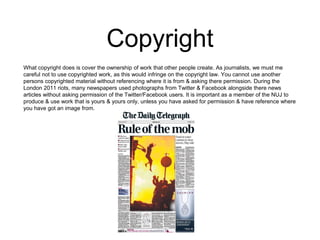
What copyright does is cover the ownership of work that other people create. As journalists, we must me 
careful not to use copyrighted work, as this would infringe on the copyright law. You cannot use another 
persons copyrighted material without referencing where it is from & asking there permission. During the 
London 2011 riots, many newspapers used photographs from Twitter & Facebook alongside there news 
articles without asking permission of the Twitter/Facebook users. It is important as a member of the NUJ to 
produce & use work that is yours & yours only, unless you have asked for permission & have reference where 
you have got an image from.
Children & Young Persons 
When you are dealing with young people & children in your writing, you must be very careful with what you 
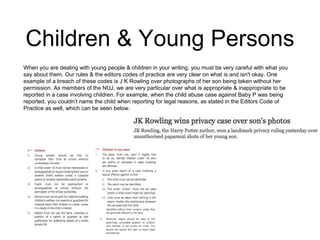
say about them. Our rules & the editors codes of practice are very clear on what is and isn't okay. One 
example of a breach of these codes is J K Rowling over photographs of her son being taken without her 
permission. As members of the NUJ, we are very particular over what is appropriate & inappropriate to be 
reported in a case involving children. For example, when the child abuse case against Baby P was being 
reported, you couldn’t name the child when reporting for legal reasons, as stated in the Editors Code of 
Practice as well, which can be seen below.
Confidentially 
Sometimes, as journalists, we have to talk to people that are breaking the law or a large part of events that 
are illegal. You are protected to not tell the police what you have learnt about. There is a moral obligation for 
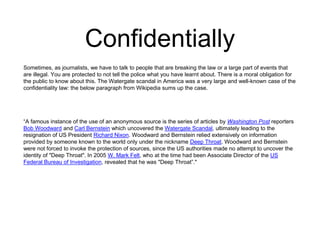
the public to know about this. The Watergate scandal in America was a very large and well-known case of the 
confidentiality law: the below paragraph from Wikipedia sums up the case. 
“A famous instance of the use of an anonymous source is the series of articles by Washington Post reporters 
Bob Woodward and Carl Bernstein which uncovered the Watergate Scandal, ultimately leading to the 
resignation of US President Richard Nixon. Woodward and Bernstein relied extensively on information 
provided by someone known to the world only under the nickname Deep Throat. Woodward and Bernstein 
were not forced to invoke the protection of sources, since the US authorities made no attempt to uncover the 
identity of "Deep Throat". In 2005 W. Mark Felt, who at the time had been Associate Director of the US 
Federal Bureau of Investigation, revealed that he was "Deep Throat”."
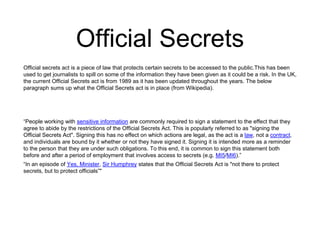
Official Secrets 
Official secrets act is a piece of law that protects certain secrets to be accessed to the public.This has been 
used to get journalists to spill on some of the information they have been given as it could be a risk. In the UK, 
the current Official Secrets act is from 1989 as it has been updated throughout the years. The below 
paragraph sums up what the Official Secrets act is in place (from Wikipedia). 
“People working with sensitive information are commonly required to sign a statement to the effect that they 
agree to abide by the restrictions of the Official Secrets Act. This is popularly referred to as "signing the 
Official Secrets Act". Signing this has no effect on which actions are legal, as the act is a law, not a contract, 
and individuals are bound by it whether or not they have signed it. Signing it is intended more as a reminder 
to the person that they are under such obligations. To this end, it is common to sign this statement both 
before and after a period of employment that involves access to secrets (e.g. MI5/MI6).” 
“In an episode of Yes, Minister, Sir Humphrey states that the Official Secrets Act is "not there to protect 
secrets, but to protect officials”"
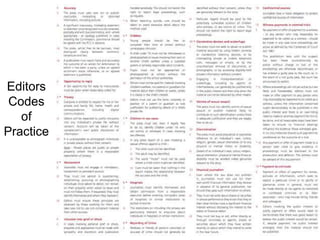
Editors 
Codes 
of 
Practice
Privacy 
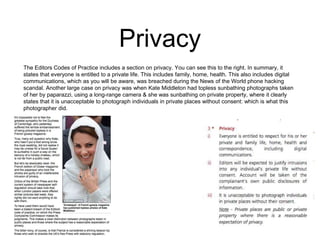
The Editors Codes of Practice includes a section on privacy. You can see this to the right. In summary, it 
states that everyone is entitled to a private life. This includes family, home, health. This also includes digital 
communications, which as you will be aware, was breached during the News of the World phone hacking 
scandal. Another large case on privacy was when Kate Middleton had topless sunbathing photographs taken 
of her by paparazzi, using a long-range camera & she was sunbathing on private property, where it clearly 
states that it is unacceptable to photograph individuals in private places without consent: which is what this 
photographer did.
Intrusion 
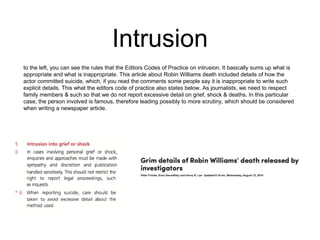
to the left, you can see the rules that the Editors Codes of Practice on intrusion. It basically sums up what is 
appropriate and what is inappropriate. This article about Robin Williams death included details of how the 
actor committed suicide, which, if you read the comments some people say it is inappropriate to write such 
explicit details. This what the editors code of practice also states below. As journalists, we need to respect 
family members & such so that we do not report excessive detail on grief, shock & deaths. In this particular 
case, the person involved is famous, therefore leading possibly to more scrutiny, which should be considered 
when writing a newspaper article.
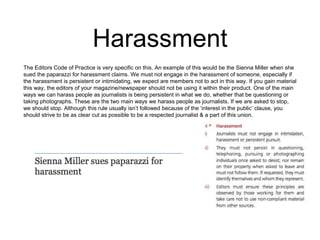
Harassment 
The Editors Code of Practice is very specific on this. An example of this would be the Sienna Miller when she 
sued the paparazzi for harassment claims. We must not engage in the harassment of someone, especially if 
the harassment is persistent or intimidating, we expect are members not to act in this way. If you gain material 
this way, the editors of your magazine/newspaper should not be using it within their product. One of the main 
ways we can harass people as journalists is being persistent in what we do, whether that be questioning or 
taking photographs. These are the two main ways we harass people as journalists. If we are asked to stop, 
we should stop. Although this rule usually isn’t followed because of the ‘interest in the public’ clause, you 
should strive to be as clear cut as possible to be a respected journalist & a part of this union.

Homework presentation 2

  • 1.
    NUJ Responsibilities &Obligations of Writers.
  • 2.
    Who We Are • We are the National Union of Journalists. An independent Union with it’s own separate rules on how we believe Journalists should act, in regard to there responsibilities & Obligations of a writer. • In this presentation, we will be training you what we do here at NUJ, what we look at in particular for our members to follow & examples of wrong doings in past journalism.
  • 3.
    Introduction It isvery important for journalists to be socially & culturally aware. One of the main reasons why journalists need to be responsible in the area is because they are often writing about people that there readers do not experience them in there own lives, so there opinions will be purely based upon how they are reported. For this reason, the journalist should not use bias in his work as this can be very damaging to the group/person they are talking about. An example of bias being used in the news was this cover. There is no factual evidence to say that it was Putin’s missile that shot the plane out of the sky. If a consumer read this, they would believe that Putin had done it. Although Putin has/had been in the news, there was no reason to add another reason that wasn’t even fact onto the pile.
  • 4.
    How People AreBeing Represented People are represented in different ways in the media. A responsible journalist should never put a negative spin on what they are writing. The representation of someone in journalism is important as it may only be the only opinion they hear on the subject matter. It is also important to represent people with facts, not opinions in responsible journalism. You are journalist and the people need to know the facts, not your opinion.There have been problems with this in the past as opinion can often cloud a human’s judgement about facts, this then conveys your opinion & not the fact. There are specific words that represent certain groups in negative ways (more on this in the next slide). This article on BBC News http://www.bbc.co.uk/news/uk-26230410 really highlights the negative representation of Young People & Teenagers in the media. In the article, the company ‘Demos’ found that the words that are commonly used to describe this demo as ‘yobs’. The article highlights that 4/5th’s of young people that asked feel like there job opportunities are hindered because of the way they are represented in the media, particularly in newspapers & magazines.
  • 5.
    How connotation caninfluence the response to a piece of writing: Words have there initial meanings (denotations) & then the have there connotations, which means what people think about when they hear/read/see something. It is important that when writing responsible journalism that the words used in the work do not have negative connotations that can represent a group/person in a bad way. For example, if you were to refer to young males as ‘lads’, you may think of a group of young males getting drunk and causing havoc because they're being ‘lads’. There is an ethics hotline (number below) that you can call if you are unsure whether you are being ethically correct or not. Once you become a member, you will have access to many different guidelines that will show you how to report if you are unsure of what words to use to talk about/represent a group. below you will find the list of some of the guides that are included with your membership. We have to be careful with the words we use as journalists: our choice of words influence many.
  • 6.
    How Different GroupsCan Have Alternative Readings of a Piece of Writing: If you are not initially part of a group, you will gain an alternative reading than others. For example, if we read something negative about immigrants entering the UK, we will have a negative reading. Whereas if you have a friend/family member who is an immigrant or you are one yourself, you will have a different reading. for example, if you were reading an article and it said ‘over 1million immigrants are in the UK’. (I have just made that fact up), you would have different readings. Some people would find this positive and some would find this negative, depending on what side of the story you were on. Below you can find another headline which really shows how alternative readings can change the mass opinions of people. If responsible journalism was in place, this negative alternative reading wouldn’t of become the opinion of 6/10 british voters.
  • 7.
    Objective: The objectivethat journalism has is to be impartial, unprejudiced & unbiased. This is usually not the case though. Many journalists will write an article based on their own agenda/the publication they are working for. Most newspapers have a political agenda, whether that be right or left wing & this will be reflected in there writing. They will gain facts and figures that only link to what they are reporting on. For example The Independent are a left wing newspaper & would usually write in favour of labour. Journalists should be reporting the facts, not there opinion, as that is not the objective of journalistic/factual writing when you are part of this union. As a member of NUJ there lis a conscience claus that is part of your membership which says that you are allowed & are entitled to not produce a piece of work if it doesn't work with the guideline a& we will back you up & support you.
  • 8.
    Accurate: It isalso very important for journalists to be accurate in what they are reporting. This means facts like names, dates, times, quotes have to be correct. They should be correct, but sometimes this is not always the case. For example, In the Daily Mail, the below complaint was made under clause 1 Accuracy. The accuracy is important as if it is not accurate, undue harm & distress can be caused to the person you are writing about, which should be the number one thing you are looking out for when you are writing a news article. You wouldn't want lies being told about you in national & international stories, so why write them yourself?
  • 9.
    Truthful: The keyto being truthful in your journalism is to be truthful throughout your work. Being clear about where you got/gathered the information & facts in your work is the main way for your work to be seen as truthful. If you are telling a lie in your journalism, it’s more than likely that you will be found out & the truth will come out eventually. A lie can damage a persons life, as the lie will be written in a way that will make it seem like fact. For example, in the Daily Mirror example below, you can see that they didn't fact check & were not being truthful with what they were saying It was like they were creating a story & lying in it to get a large reaction (also linked to accuracy). They were then made to update there story based on what they have been told. Link to article: http://www.dailymail.co.uk/news/article-2531440/Sold-Flights-buses-Romanians-Bulgarians-head-UK.html Link to blogpost finding the irregularities in the article http://www.britishinfluence.org/13-reasons-taking-daily-mail-press-complaints-commission
  • 10.
    Fair & Balanced: When you are a journalist, it is very important to be fair & balanced. This is another key way to be on your way to being a responsible journalist. All articles that you write must be written open-minded & unbiased towards a certain viewpoint. A clear argument between both sides is needed for a fair & balanced argument which allows the audience to decide on there own who they want to side with. Being fair & balanced when writing for a newspaper can have complications as a lot of these newspapers are either right or left wing. This will effect the way you write stories on politics & immigration mostly. The issue of fair & balanced journalism work comes into practice when referring to left & right wing journalism quite prominently.On the next slide, you can see see lists of the orientation these newspapers swing towards.
  • 12.
    Defamation Defamation isto important stay clear of in this profession. When writing, you should stay clear of writing false stories that include misrepresentation, false accusation, offensive & milieus writing that could possibly be based on someones actions/words. Defamation could lead to a libel case against you, which would then lead to possible court costs. Anyone can make defamation cases against you, including celebrities, politicians & members of the public. Keith-Smith v Williams was a large libel case in the UK, as it was one of, if not the first, internet libel cases. The case was made about ex-teacher Tracy Williams after she accused UKIP member Michael Keith Smith of being a racist bigot & sexual offender on a Yahoo discussion group. Link to article: http://www.theguardian.com/media/2006/mar/23/digitalmedia.law
  • 13.
    Copyright What copyrightdoes is cover the ownership of work that other people create. As journalists, we must me careful not to use copyrighted work, as this would infringe on the copyright law. You cannot use another persons copyrighted material without referencing where it is from & asking there permission. During the London 2011 riots, many newspapers used photographs from Twitter & Facebook alongside there news articles without asking permission of the Twitter/Facebook users. It is important as a member of the NUJ to produce & use work that is yours & yours only, unless you have asked for permission & have reference where you have got an image from.
  • 14.
    Children & YoungPersons When you are dealing with young people & children in your writing, you must be very careful with what you say about them. Our rules & the editors codes of practice are very clear on what is and isn't okay. One example of a breach of these codes is J K Rowling over photographs of her son being taken without her permission. As members of the NUJ, we are very particular over what is appropriate & inappropriate to be reported in a case involving children. For example, when the child abuse case against Baby P was being reported, you couldn’t name the child when reporting for legal reasons, as stated in the Editors Code of Practice as well, which can be seen below.
  • 15.
    Confidentially Sometimes, asjournalists, we have to talk to people that are breaking the law or a large part of events that are illegal. You are protected to not tell the police what you have learnt about. There is a moral obligation for the public to know about this. The Watergate scandal in America was a very large and well-known case of the confidentiality law: the below paragraph from Wikipedia sums up the case. “A famous instance of the use of an anonymous source is the series of articles by Washington Post reporters Bob Woodward and Carl Bernstein which uncovered the Watergate Scandal, ultimately leading to the resignation of US President Richard Nixon. Woodward and Bernstein relied extensively on information provided by someone known to the world only under the nickname Deep Throat. Woodward and Bernstein were not forced to invoke the protection of sources, since the US authorities made no attempt to uncover the identity of "Deep Throat". In 2005 W. Mark Felt, who at the time had been Associate Director of the US Federal Bureau of Investigation, revealed that he was "Deep Throat”."
  • 16.
    Official Secrets Officialsecrets act is a piece of law that protects certain secrets to be accessed to the public.This has been used to get journalists to spill on some of the information they have been given as it could be a risk. In the UK, the current Official Secrets act is from 1989 as it has been updated throughout the years. The below paragraph sums up what the Official Secrets act is in place (from Wikipedia). “People working with sensitive information are commonly required to sign a statement to the effect that they agree to abide by the restrictions of the Official Secrets Act. This is popularly referred to as "signing the Official Secrets Act". Signing this has no effect on which actions are legal, as the act is a law, not a contract, and individuals are bound by it whether or not they have signed it. Signing it is intended more as a reminder to the person that they are under such obligations. To this end, it is common to sign this statement both before and after a period of employment that involves access to secrets (e.g. MI5/MI6).” “In an episode of Yes, Minister, Sir Humphrey states that the Official Secrets Act is "not there to protect secrets, but to protect officials”"
  • 17.
  • 18.
    Privacy The EditorsCodes of Practice includes a section on privacy. You can see this to the right. In summary, it states that everyone is entitled to a private life. This includes family, home, health. This also includes digital communications, which as you will be aware, was breached during the News of the World phone hacking scandal. Another large case on privacy was when Kate Middleton had topless sunbathing photographs taken of her by paparazzi, using a long-range camera & she was sunbathing on private property, where it clearly states that it is unacceptable to photograph individuals in private places without consent: which is what this photographer did.
  • 19.
    Intrusion to theleft, you can see the rules that the Editors Codes of Practice on intrusion. It basically sums up what is appropriate and what is inappropriate. This article about Robin Williams death included details of how the actor committed suicide, which, if you read the comments some people say it is inappropriate to write such explicit details. This what the editors code of practice also states below. As journalists, we need to respect family members & such so that we do not report excessive detail on grief, shock & deaths. In this particular case, the person involved is famous, therefore leading possibly to more scrutiny, which should be considered when writing a newspaper article.
  • 20.
    Harassment The EditorsCode of Practice is very specific on this. An example of this would be the Sienna Miller when she sued the paparazzi for harassment claims. We must not engage in the harassment of someone, especially if the harassment is persistent or intimidating, we expect are members not to act in this way. If you gain material this way, the editors of your magazine/newspaper should not be using it within their product. One of the main ways we can harass people as journalists is being persistent in what we do, whether that be questioning or taking photographs. These are the two main ways we harass people as journalists. If we are asked to stop, we should stop. Although this rule usually isn’t followed because of the ‘interest in the public’ clause, you should strive to be as clear cut as possible to be a respected journalist & a part of this union.