Homework Practical, Research Based Guidelines  for Developing Meaningful, Manageable Homework Jennifer Walsh-Rurak
On the Lighter Side… http://www.youtube.com/watch?v=Mn1BreaZ6rM Free powerpoint template: www.brainybetty.com
… But Seriously "We assign homework in an attempt to develop students' skills and to extend learning time.  At the same time, we are left frustrated when the students who need more time to learn seem the least likely to complete homework." "Students with inadequate home environments for completing homework or with parents intellectually unable to help them are less likely to complete homework (Vatterott, 2007)" From  Rethinking Homework  by Cathy Vatterott Free powerpoint template: www.brainybetty.com
Give the right amount of homework. Research suggests students should get about 10 minutes of homework each night for each grade (i.e. 40 minutes for 4 th  grade, 50 minutes for 5 th  grade, etc.)  Consider making parents aware of how long homework should take so they can alert you if their child is struggling to complete the work within that time frame.  Free powerpoint template: www.brainybetty.com
More frequent but shorter assignments are better than fewer but longer assignments. This strategy makes practice more frequent, helps prevent learning fatigue, and assists students with establishing  a regular routine for studying at home.  Free powerpoint template: www.brainybetty.com
Distribute Material Across  Multiple Assignments Learning is greatly facilitated when assignments include review of material covered in past lessons and an introduction to new topics, rather than just sticking to topics taught that day.  Free powerpoint template: www.brainybetty.com
Distribute easy and harder material  throughout an assignment . Research shows this kind of alteration of easy and harder material helps to keep students engaged and interested. Free powerpoint template: www.brainybetty.com
Consider giving students homework choices. Choice can be important for enhancing students’ interest in material and helping to establish a sense of autonomy.  When possible, consider giving students options about content and/or format .  Free powerpoint template: www.brainybetty.com
Be careful about parent involvement. Consider the time and resources of parents when considering their involvement.  Involve parents when it makes sense, but do so with careful planning and an understanding that families function very differently when it comes to homework. Free powerpoint template: www.brainybetty.com
Focus on study skills.  Provide materials that helps students learn to manage time and stay organized.  Talk to students about a variety of study strategies and techniques.  Free powerpoint template: www.brainybetty.com
Do not grade or comment  on every homework assignment.   Periodic commenting or grading can be just as effective as providing feedback on every assignment.  However, it is important to let students and parents know your grading policy up front.  Adapted from Homework Tips for Teachers from The Battle Over Homework  by Harris Cooper Free powerpoint template: www.brainybetty.com
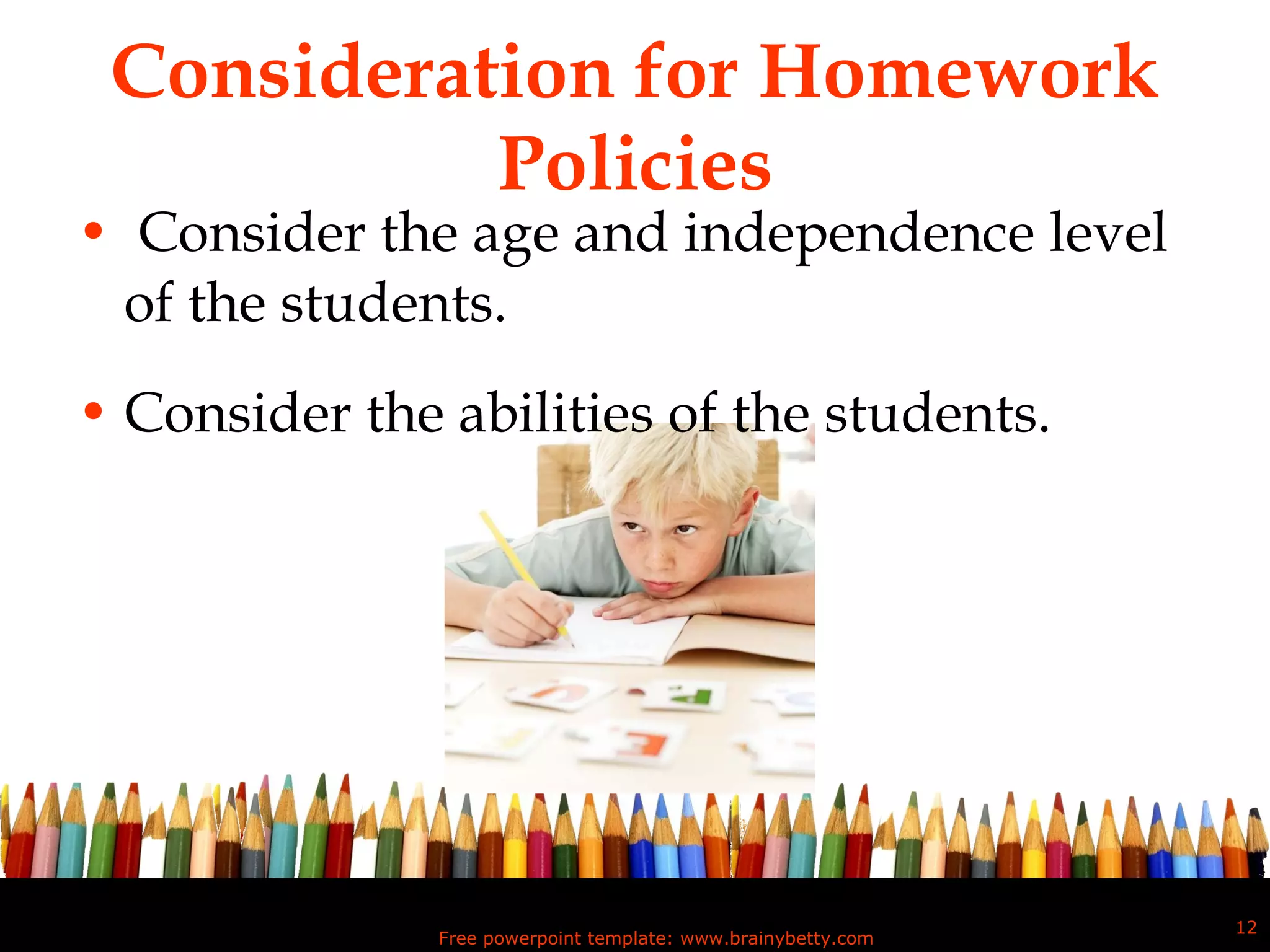
Consideration for Homework Policies Consider the age and independence level of the students. Consider the abilities of the students.  Free powerpoint template: www.brainybetty.com
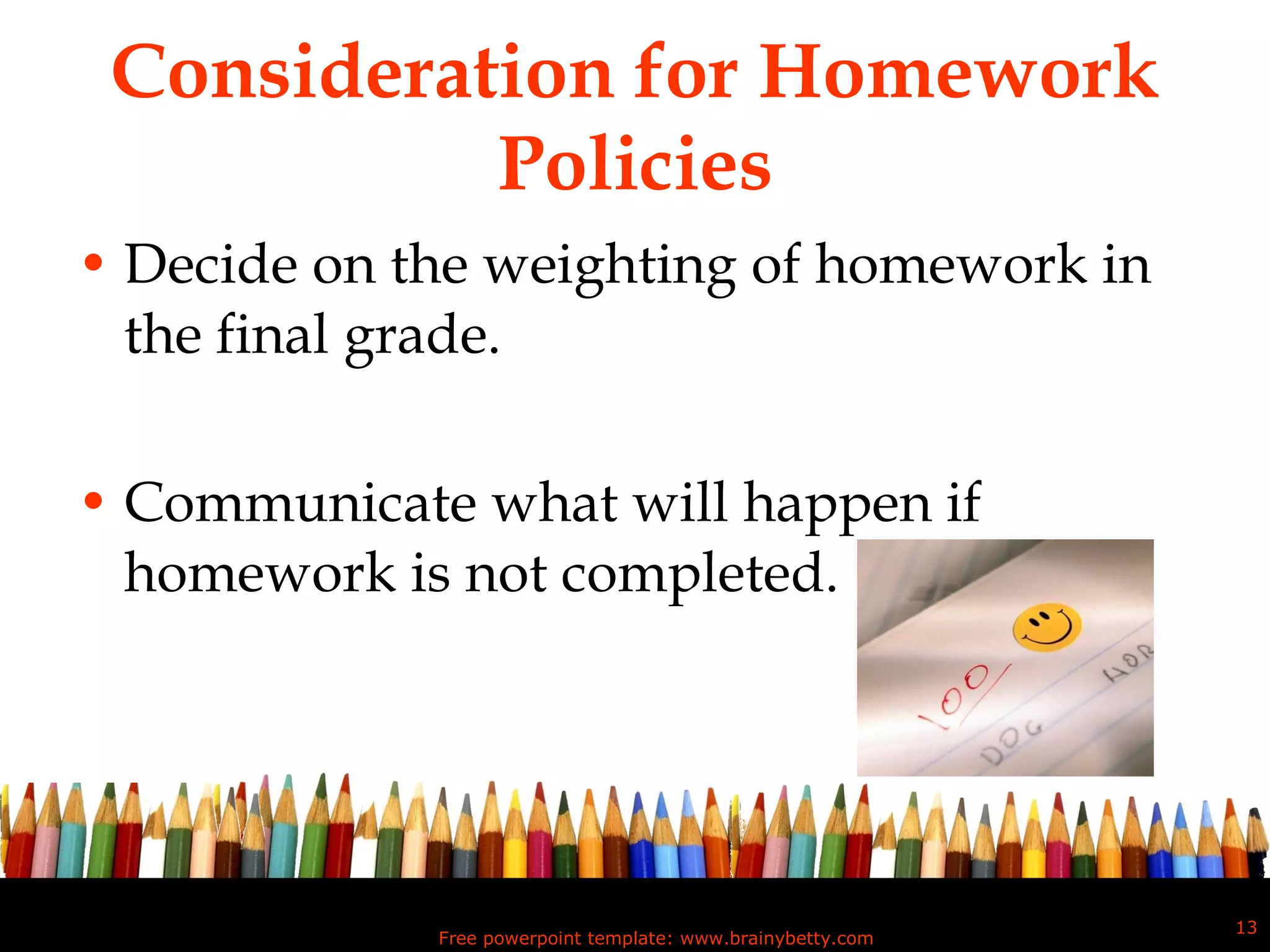
Consideration for Homework Policies Decide on the weighting of homework in the final grade. Communicate what will happen if homework is not completed. Free powerpoint template: www.brainybetty.com
Consideration for Homework Policies Give your students two copies of your policies on the first day of school and ask the parent to sign the paper as well as the student. Ask the students to return one copy and keep the other at home to refer to throughout the year. Free powerpoint template: www.brainybetty.com
Consideration for Homework Policies Be flexible in your policies and consider extenuating circumstances.  Allow options  for students who are absent due to sickness or have other situations that prevent homework completion.  Free powerpoint template: www.brainybetty.com
For Further Investigation The Battle Over Homework  by Harris Cooper (Office copies available)  Rethinking Homework  by Cathy Vatterott  (One Office Copy Available)  A Repair Kit for Grading: 15 Fixes for Broken Grades  by Ken O'Connor (Office copies on backorder, expected late September) Free powerpoint template: www.brainybetty.com

Homework: Practical, Research Based Guidelines for Developing Meaningful, Manageable Homework by Jennifer Walsh-Rurak

  • 1.
    Homework Practical, ResearchBased Guidelines for Developing Meaningful, Manageable Homework Jennifer Walsh-Rurak
  • 2.
    On the LighterSide… http://www.youtube.com/watch?v=Mn1BreaZ6rM Free powerpoint template: www.brainybetty.com
  • 3.
    … But Seriously"We assign homework in an attempt to develop students' skills and to extend learning time. At the same time, we are left frustrated when the students who need more time to learn seem the least likely to complete homework." "Students with inadequate home environments for completing homework or with parents intellectually unable to help them are less likely to complete homework (Vatterott, 2007)" From Rethinking Homework by Cathy Vatterott Free powerpoint template: www.brainybetty.com
  • 4.
    Give the rightamount of homework. Research suggests students should get about 10 minutes of homework each night for each grade (i.e. 40 minutes for 4 th grade, 50 minutes for 5 th grade, etc.) Consider making parents aware of how long homework should take so they can alert you if their child is struggling to complete the work within that time frame. Free powerpoint template: www.brainybetty.com
  • 5.
    More frequent butshorter assignments are better than fewer but longer assignments. This strategy makes practice more frequent, helps prevent learning fatigue, and assists students with establishing a regular routine for studying at home. Free powerpoint template: www.brainybetty.com
  • 6.
    Distribute Material Across Multiple Assignments Learning is greatly facilitated when assignments include review of material covered in past lessons and an introduction to new topics, rather than just sticking to topics taught that day. Free powerpoint template: www.brainybetty.com
  • 7.
    Distribute easy andharder material throughout an assignment . Research shows this kind of alteration of easy and harder material helps to keep students engaged and interested. Free powerpoint template: www.brainybetty.com
  • 8.
    Consider giving studentshomework choices. Choice can be important for enhancing students’ interest in material and helping to establish a sense of autonomy. When possible, consider giving students options about content and/or format . Free powerpoint template: www.brainybetty.com
  • 9.
    Be careful aboutparent involvement. Consider the time and resources of parents when considering their involvement. Involve parents when it makes sense, but do so with careful planning and an understanding that families function very differently when it comes to homework. Free powerpoint template: www.brainybetty.com
  • 10.
    Focus on studyskills. Provide materials that helps students learn to manage time and stay organized. Talk to students about a variety of study strategies and techniques. Free powerpoint template: www.brainybetty.com
  • 11.
    Do not gradeor comment on every homework assignment. Periodic commenting or grading can be just as effective as providing feedback on every assignment. However, it is important to let students and parents know your grading policy up front. Adapted from Homework Tips for Teachers from The Battle Over Homework by Harris Cooper Free powerpoint template: www.brainybetty.com
  • 12.
    Consideration for HomeworkPolicies Consider the age and independence level of the students. Consider the abilities of the students. Free powerpoint template: www.brainybetty.com
  • 13.
    Consideration for HomeworkPolicies Decide on the weighting of homework in the final grade. Communicate what will happen if homework is not completed. Free powerpoint template: www.brainybetty.com
  • 14.
    Consideration for HomeworkPolicies Give your students two copies of your policies on the first day of school and ask the parent to sign the paper as well as the student. Ask the students to return one copy and keep the other at home to refer to throughout the year. Free powerpoint template: www.brainybetty.com
  • 15.
    Consideration for HomeworkPolicies Be flexible in your policies and consider extenuating circumstances. Allow options for students who are absent due to sickness or have other situations that prevent homework completion. Free powerpoint template: www.brainybetty.com
  • 16.
    For Further InvestigationThe Battle Over Homework by Harris Cooper (Office copies available) Rethinking Homework by Cathy Vatterott (One Office Copy Available) A Repair Kit for Grading: 15 Fixes for Broken Grades by Ken O'Connor (Office copies on backorder, expected late September) Free powerpoint template: www.brainybetty.com