The Holocaust
Symbolism Jewish and Nazi Symbols
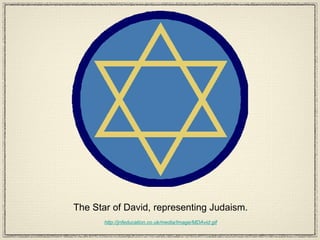
The Star of David, representing Judaism. http://jnfeducation.co.uk/media/Image/MDAvid.gif
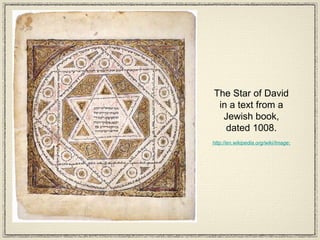
The Star of David in a text from a Jewish book, dated 1008. http://en.wikipedia.org/wiki/Image:Leningrad_Codex_Carpet_page_e.jpg
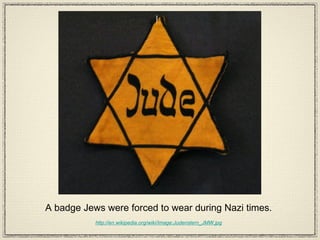
A badge Jews were forced to wear during Nazi times. http://en.wikipedia.org/wiki/Image:Judenstern_JMW.jpg
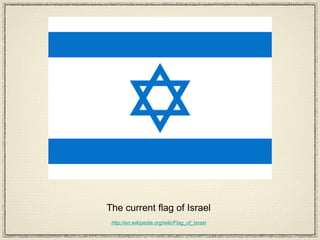
The current flag of Israel http://en.wikipedia.org/wiki/Flag_of_Israel
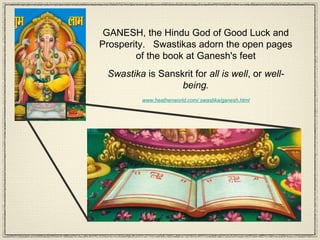
GANESH, the Hindu God of Good Luck and Prosperity.  Swastikas adorn the open pages of the book at Ganesh's feet Swastika  is Sanskrit for  all is well , or  well-being. www.heathenworld.com/ swastika/ganesh.html
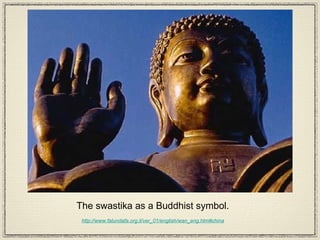
The swastika as a Buddhist symbol. http://www.falundafa.org.il/ver_01/english/wan_eng.htm#china
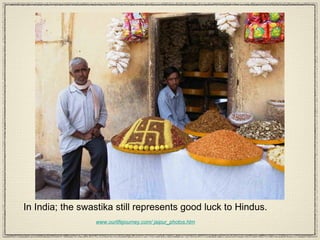
In India; the swastika still represents good luck to Hindus. www.ourlifejourney.com/ jaipur_photos.htm
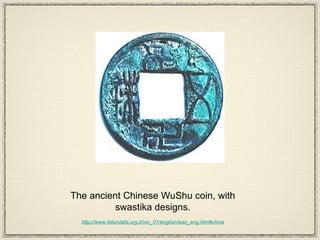
The ancient Chinese WuShu coin, with swastika designs. http://www.falundafa.org.il/ver_01/english/wan_eng.htm#china
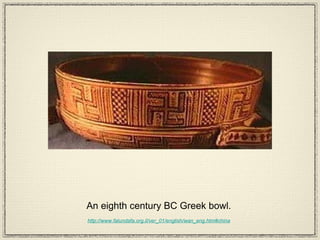
An eighth century BC Greek bowl. http://www.falundafa.org.il/ver_01/english/wan_eng.htm#china
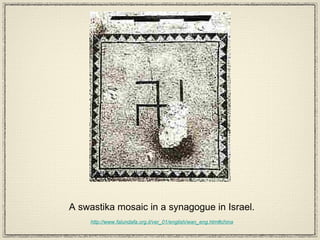
A swastika mosaic in a synagogue in Israel. http://www.falundafa.org.il/ver_01/english/wan_eng.htm#china
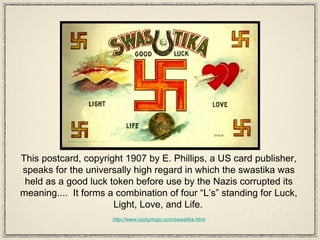
This postcard, copyright 1907 by E. Phillips, a US card publisher, speaks for the universally high regard in which the swastika was held as a good luck token before use by the Nazis corrupted its meaning....  It forms a combination of four “L’s” standing for Luck, Light, Love, and Life.   http://www.luckymojo.com/swastika.html
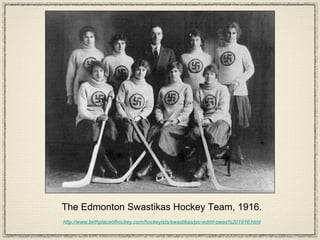
The Edmonton Swastikas Hockey Team, 1916. http://www.birthplaceofhockey.com/hockeyists/swastikas/pic-edmt-swas%201916.html
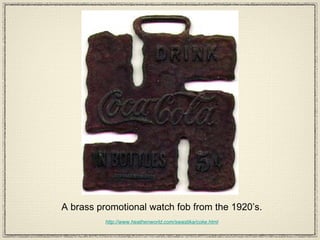
A brass promotional watch fob from the 1920’s. http://www.heathenworld.com/swastika/coke.html
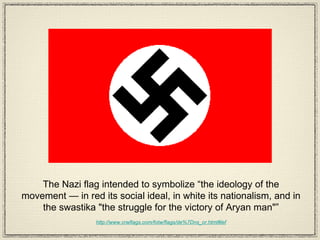
The Nazi flag intended to symbolize “the ideology of the movement — in red its social ideal, in white its nationalism, and in the swastika "the struggle for the victory of Aryan man"” http://www.crwflags.com/fotw/flags/de%7Dns_or.html#lef
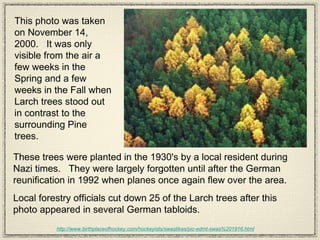
These trees were planted in the 1930's by a local resident during Nazi times.  They were largely forgotten until after the German reunification in 1992 when planes once again flew over the area. Local forestry officials cut down 25 of the Larch trees after this photo appeared in several German tabloids. http://www.birthplaceofhockey.com/hockeyists/swastikas/pic-edmt-swas%201916.html   This photo was taken on November 14, 2000.  It was only visible from the air a few weeks in the Spring and a few weeks in the Fall when Larch trees stood out in contrast to the surrounding Pine trees.
 
The History of the Jews


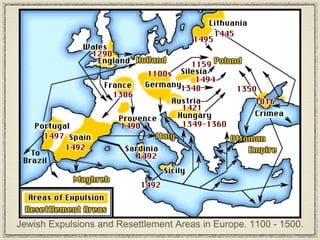
Jewish Expulsions and Resettlement Areas in Europe. 1100 - 1500.
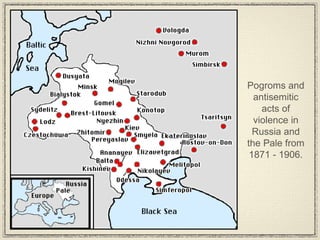
Pogroms and antisemitic acts of violence in Russia and the Pale from 1871 - 1906.
 
The Rise of the Nazi Party Nazi Party 1918 - 1933
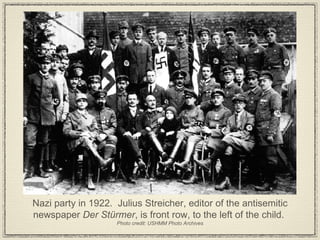
Nazi party in 1922.  Julius Streicher, editor of the antisemitic newspaper  Der Stürmer , is front row, to the left of the child.  Photo credit: USHMM Photo Archives
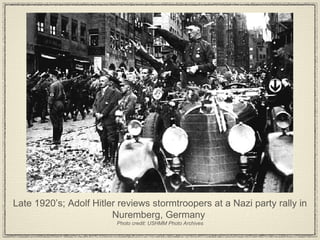
Late 1920’s; Adolf Hitler reviews stormtroopers at a Nazi party rally in Nuremberg, Germany  Photo credit: USHMM Photo Archives
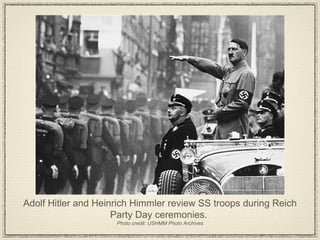
Adolf Hitler and Heinrich Himmler review SS troops during Reich Party Day ceremonies.  Photo credit: USHMM Photo Archives
 
The Nazification of Germany of Germany 1933 - 1939
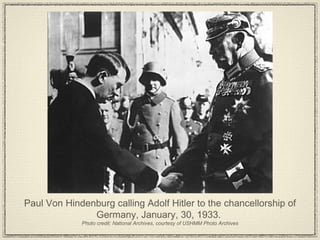
Paul Von Hindenburg calling Adolf Hitler to the chancellorship of Germany, January, 30, 1933.  Photo credit: National Archives, courtesy of USHMM Photo Archives
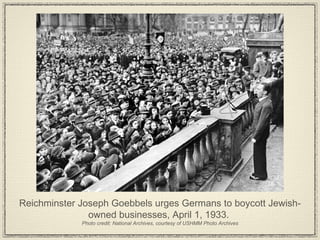
Reichminster Joseph Goebbels urges Germans to boycott Jewish-owned businesses, April 1, 1933.  Photo credit: National Archives, courtesy of USHMM Photo Archives
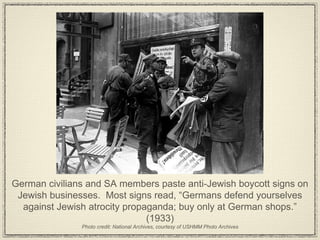
German civilians and SA members paste anti-Jewish boycott signs on Jewish businesses.  Most signs read, “Germans defend yourselves against Jewish atrocity propaganda; buy only at German shops.” (1933) Photo credit: National Archives, courtesy of USHMM Photo Archives
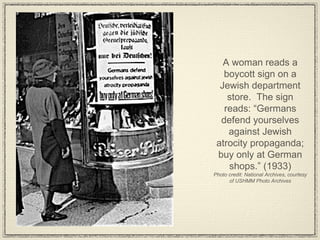
A woman reads a boycott sign on a Jewish department store.  The sign reads: “Germans defend yourselves against Jewish atrocity propaganda; buy only at German shops.” (1933) Photo credit: National Archives, courtesy of USHMM Photo Archives
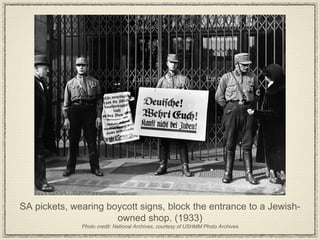
SA pickets, wearing boycott signs, block the entrance to a Jewish-owned shop. (1933) Photo credit: National Archives, courtesy of USHMM Photo Archives
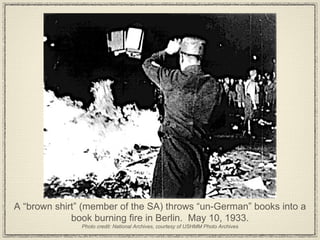
A “brown shirt” (member of the SA) throws “un-German” books into a book burning fire in Berlin.  May 10, 1933. Photo credit: National Archives, courtesy of USHMM Photo Archives
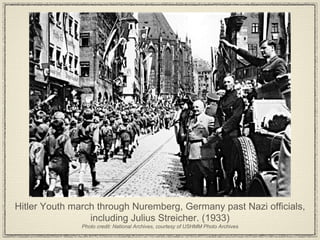
Hitler Youth march through Nuremberg, Germany past Nazi officials, including Julius Streicher. (1933) Photo credit: National Archives, courtesy of USHMM Photo Archives
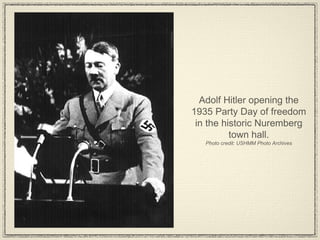
Adolf Hitler opening the 1935 Party Day of freedom in the historic Nuremberg town hall. Photo credit: USHMM Photo Archives
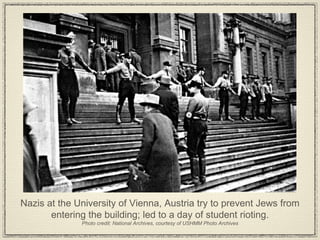
Nazis at the University of Vienna, Austria try to prevent Jews from entering the building; led to a day of student rioting. Photo credit: National Archives, courtesy of USHMM Photo Archives
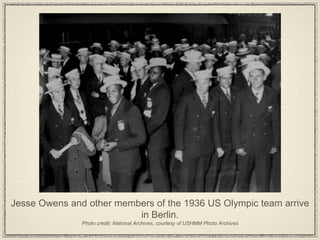
Jesse Owens and other members of the 1936 US Olympic team arrive in Berlin. Photo credit: National Archives, courtesy of USHMM Photo Archives
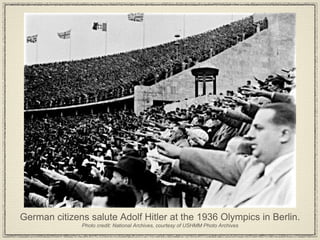
German citizens salute Adolf Hitler at the 1936 Olympics in Berlin. Photo credit: National Archives, courtesy of USHMM Photo Archives
Regards: Measures against Jews tonight. a) Only such measures may be taken which do not jeopardize German life or property (for instance, burning of synagogues only if there is no danger of fires for the neighbourhoods). b) Business establishments and homes of Jews may be destroyed but not looted. The police have been instructed to supervise the execution of these directives and to arrest looters. c) In Business streets special care is to be taken that non-Jewish establishments will be safeguarded at all cost against damage. As soon as the events of this night permit the use of the designated officers, as many Jews, particularly wealthy ones, as the local jails will hold, are to be arrested in all districts. Initially only healthy male Jews, not too old, are to be arrested. After the arrests have been carried out the appropriate concentration camp is to be contacted immediately with a view to a quick transfer of the Jews to the camps.... Orders about  Kristallnacht : Nov. 10, 1938
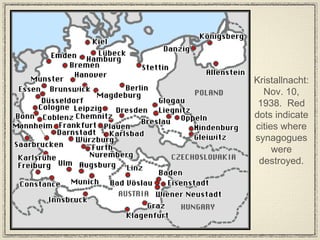
Kristallnacht: Nov. 10, 1938.  Red dots indicate cities where synagogues were destroyed.
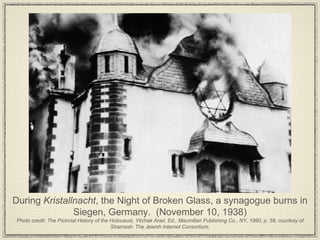
During  Kristallnacht , the Night of Broken Glass, a synagogue burns in Siegen, Germany.  (November 10, 1938) Photo credit: The Pictorial History of the Holocaust, Yitzhak Arad, Ed., Macmillan Publishing Co., NY, 1990, p. 58, courtesy of Shamash: The Jewish Internet Consortium.
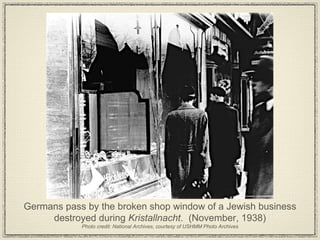
Germans pass by the broken shop window of a Jewish business destroyed during  Kristallnacht .  (November, 1938) Photo credit: National Archives, courtesy of USHMM Photo Archives
 
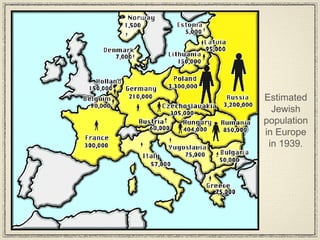
Estimated Jewish population in Europe in 1939.
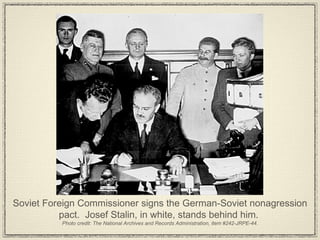
Soviet Foreign Commissioner signs the German-Soviet nonagression pact.  Josef Stalin, in white, stands behind him.  Photo credit: The National Archives and Records Administration, item #242-JRPE-44.
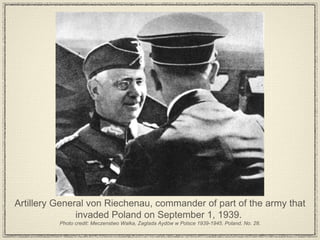
Artillery General von Riechenau, commander of part of the army that invaded Poland on September 1, 1939.  Photo credit: Meczenstwo Walka, Zaglada Aydów w Polsce 1939-1945. Poland. No. 28.
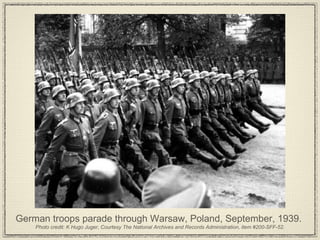
German troops parade through Warsaw, Poland, September, 1939.  Photo credit: K Hugo Juger, Courtesy The National Archives and Records Administration, item #200-SFF-52.
 
The Ghettos 1939 - 1941
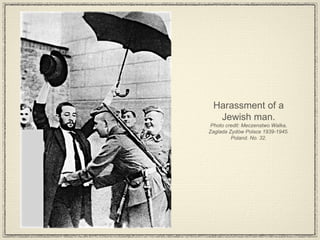
Harassment of a Jewish man. Photo credit: Meczenstwo Walka, Zaglada Zydów Polsce 1939-1945. Poland. No. 32.
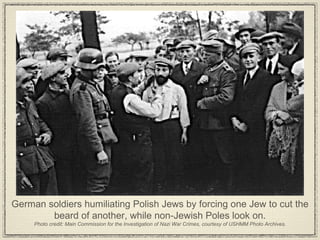
German soldiers humiliating Polish Jews by forcing one Jew to cut the beard of another, while non-Jewish Poles look on. Photo credit: Main Commission for the Investigation of Nazi War Crimes, courtesy of USHMM Photo Archives.
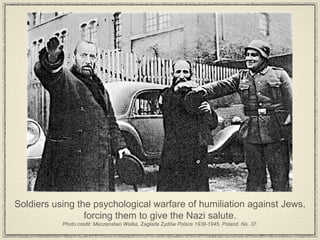
Soldiers using the psychological warfare of humiliation against Jews, forcing them to give the Nazi salute. Photo credit: Meczenstwo Walka, Zaglada Zydów Polsce 1939-1945. Poland. No. 37.
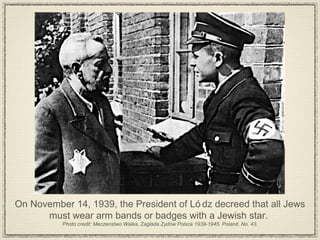
On November 14, 1939, the President of Lódz decreed that all Jews must wear arm bands or badges with a Jewish star.  Photo credit: Meczenstwo Walka, Zaglada Zydów Polsce 1939-1945. Poland. No. 43.
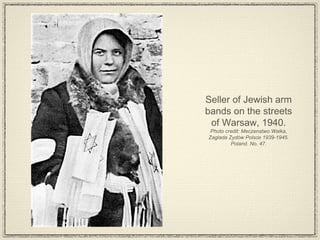
Seller of Jewish arm bands on the streets of Warsaw, 1940. Photo credit: Meczenstwo Walka, Zaglada Zydów Polsce 1939-1945. Poland. No. 47.
 
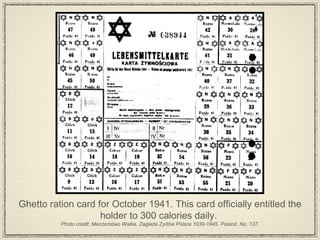
Ghetto ration card for October 1941. This card officially entitled the holder to 300 calories daily.  Photo credit: Meczenstwo Walka, Zaglada Zydów Polsce 1939-1945. Poland. No. 137.
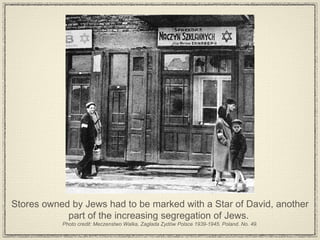
Stores owned by Jews had to be marked with a Star of David, another part of the increasing segregation of Jews.  Photo credit: Meczenstwo Walka, Zaglada Zydów Polsce 1939-1945. Poland. No. 49.
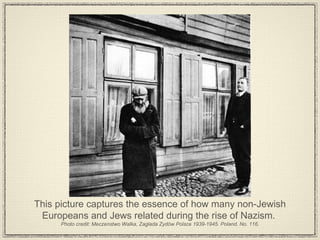
This picture captures the essence of how many non-Jewish Europeans and Jews related during the rise of Nazism.  Photo credit: Meczenstwo Walka, Zaglada Zydów Polsce 1939-1945. Poland. No. 116.
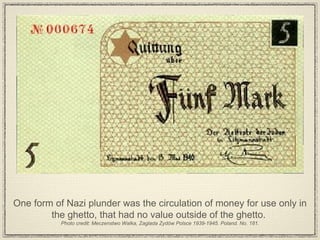
One form of Nazi plunder was the circulation of money for use only in the ghetto, that had no value outside of the ghetto.  Photo credit: Meczenstwo Walka, Zaglada Zydów Polsce 1939-1945. Poland. No. 181.
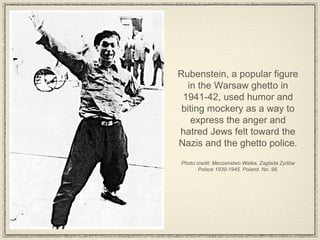
Rubenstein, a popular figure in the Warsaw ghetto in 1941-42, used humor and biting mockery as a way to express the anger and hatred Jews felt toward the Nazis and the ghetto police.  Photo credit: Meczenstwo Walka, Zaglada Zydów Polsce 1939-1945. Poland. No. 98.
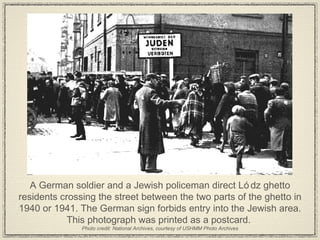
A German soldier and a Jewish policeman direct Lódz ghetto residents crossing the street between the two parts of the ghetto in 1940 or 1941. The German sign forbids entry into the Jewish area. This photograph was printed as a postcard.  Photo credit: National Archives, courtesy of USHMM Photo Archives
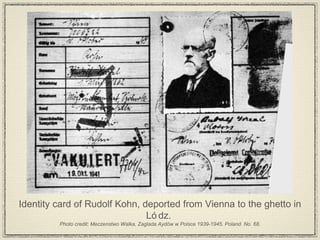
Identity card of Rudolf Kohn, deported from Vienna to the ghetto in Lódz.  Photo credit: Meczenstwo Walka, Zaglada Aydów w Polsce 1939-1945. Poland. No. 68.
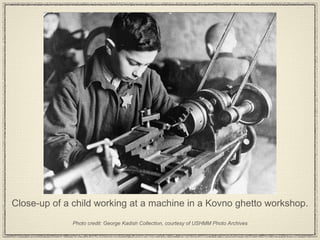
Close-up of a child working at a machine in a Kovno ghetto workshop.  Photo credit: George Kadish Collection, courtesy of USHMM Photo Archives
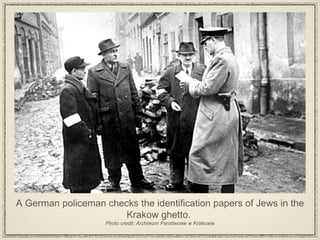
A German policeman checks the identification papers of Jews in the Krakow ghetto.  Photo credit: Archiwum Panstwowe w Krakowie
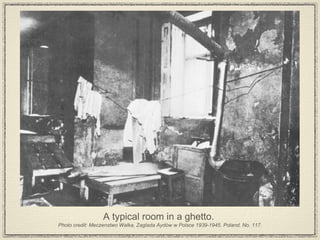
A typical room in a ghetto.  Photo credit: Meczenstwo Walka, Zaglada Aydów w Polsce 1939-1945. Poland. No. 117.
 
The Camps 1941 - 1942
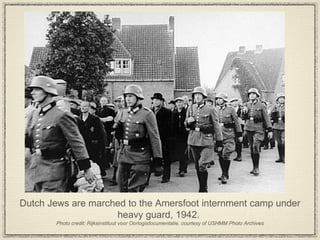
Dutch Jews are marched to the Amersfoot internment camp under heavy guard, 1942.  Photo credit: Rijksinstituut voor Oorlogsdocumentatie, courtesy of USHMM Photo Archives
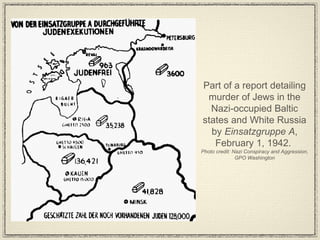
Part of a report detailing murder of Jews in the Nazi-occupied Baltic states and White Russia by  Einsatzgruppe A , February 1, 1942.  Photo credit: Nazi Conspiracy and Aggression, GPO Washington
 
 
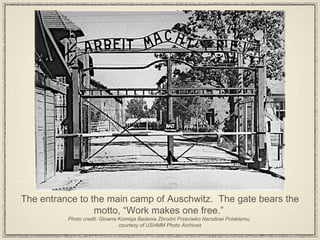
The entrance to the main camp of Auschwitz.  The gate bears the motto, “Work makes one free.”  Photo credit: Glowna Komisja Badania Zbrodni Przeciwko Narodowi Polskiemu,  courtesy of USHMM Photo Archives
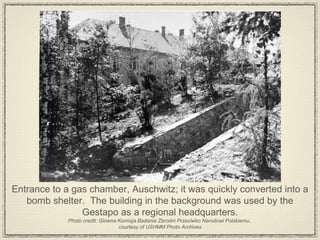
Entrance to a gas chamber, Auschwitz; it was quickly converted into a bomb shelter.  The building in the background was used by the Gestapo as a regional headquarters. Photo credit: Glowna Komisja Badania Zbrodni Przeciwko Narodowi Polskiemu,  courtesy of USHMM Photo Archives
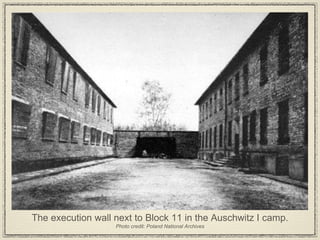
The execution wall next to Block 11 in the Auschwitz I camp. Photo credit: Poland National Archives
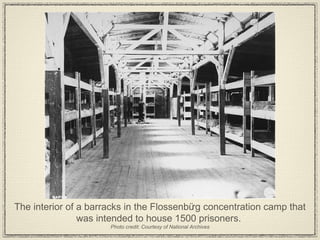
The interior of a barracks in the Flossenbürg concentration camp that was intended to house 1500 prisoners.  Photo credit: Courtesy of National Archives
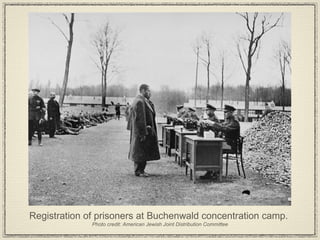
Registration of prisoners at Buchenwald concentration camp.  Photo credit: American Jewish Joint Distribution Committee
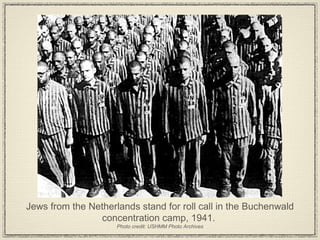
Jews from the Netherlands stand for roll call in the Buchenwald concentration camp, 1941.  Photo credit: USHMM Photo Archives
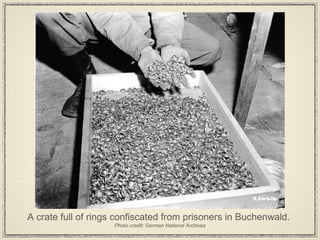
A crate full of rings confiscated from prisoners in Buchenwald.  Photo credit: German National Archives
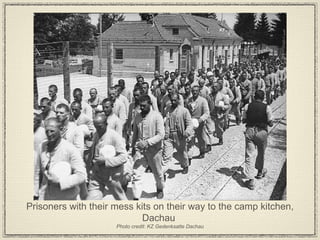
Prisoners with their mess kits on their way to the camp kitchen, Dachau  Photo credit: KZ Gedenksatte Dachau
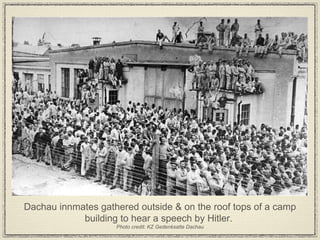
Dachau innmates gathered outside & on the roof tops of a camp building to hear a speech by Hitler.  Photo credit: KZ Gedenksatte Dachau
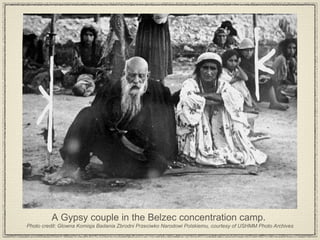
A Gypsy couple in the Belzec concentration camp.  Photo credit: Glowna Komisja Badania Zbrodni Przeciwko Narodowi Polskiemu, courtesy of USHMM Photo Archives
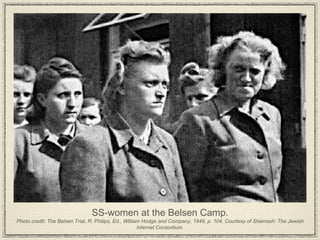
SS-women at the Belsen Camp. Photo credit: The Belsen Trial, R. Philips, Ed., William Hodge and Company, 1949, p. 104, Courtesy of Shamash: The Jewish Internet Consortium.
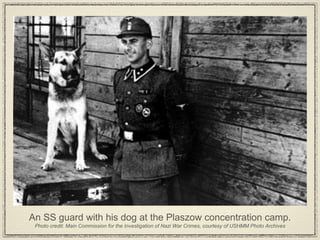
An SS guard with his dog at the Plaszow concentration camp. Photo credit: Main Commission for the Investigation of Nazi War Crimes, courtesy of USHMM Photo Archives
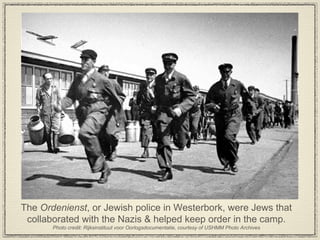
The  Ordenienst , or Jewish police in Westerbork, were Jews that collaborated with the Nazis & helped keep order in the camp. Photo credit: Rijksinstituut voor Oorlogsdocumentatie, courtesy of USHMM Photo Archives
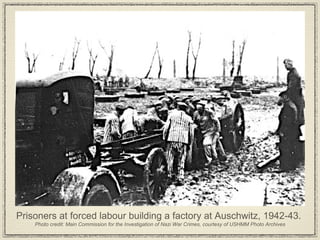
Prisoners at forced labour building a factory at Auschwitz, 1942-43.  Photo credit: Main Commission for the Investigation of Nazi War Crimes, courtesy of USHMM Photo Archives
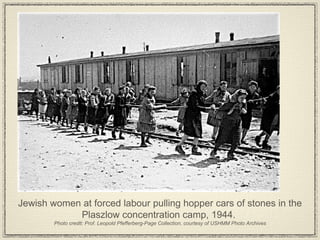
Jewish women at forced labour pulling hopper cars of stones in the Plaszlow concentration camp, 1944.  Photo credit: Prof. Leopold Pfefferberg-Page Collection, courtesy of USHMM Photo Archives
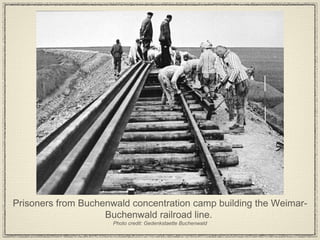
Prisoners from Buchenwald concentration camp building the Weimar-Buchenwald railroad line.  Photo credit: Gedenkstaette Buchenwald
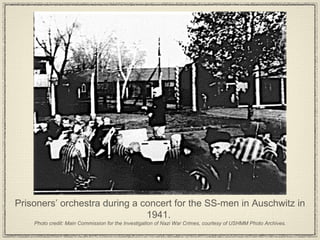
Prisoners’ orchestra during a concert for the SS-men in Auschwitz in 1941.  Photo credit: Main Commission for the Investigation of Nazi War Crimes, courtesy of USHMM Photo Archives.
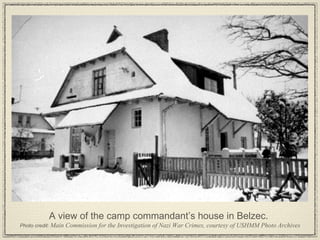
A view of the camp commandant’s house in Belzec.  Photo credit:  Main Commission for the Investigation of Nazi War Crimes, courtesy of USHMM Photo Archives
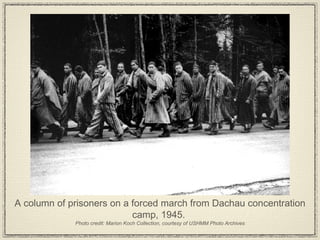
A column of prisoners on a forced march from Dachau concentration camp, 1945.  Photo credit: Marion Koch Collection, courtesy of USHMM Photo Archives
 
Resistance 1942 - 1944
 
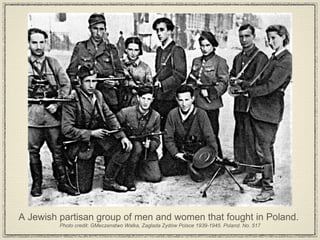
A Jewish partisan group of men and women that fought in Poland.  Photo credit: GMeczenstwo Walka, Zaglada Zydów Polsce 1939-1945. Poland. No. 517
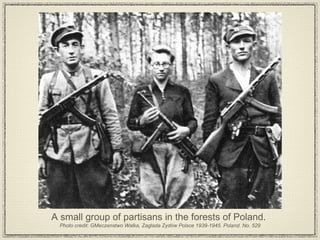
A small group of partisans in the forests of Poland.  Photo credit: GMeczenstwo Walka, Zaglada Zydów Polsce 1939-1945. Poland. No. 529
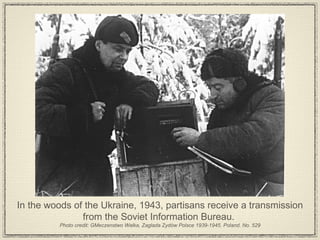
In the woods of the Ukraine, 1943, partisans receive a transmission from the Soviet Information Bureau.  Photo credit: GMeczenstwo Walka, Zaglada Zydów Polsce 1939-1945. Poland. No. 529
 
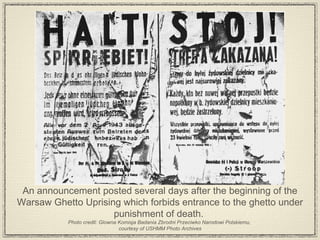
An announcement posted several days after the beginning of the Warsaw Ghetto Uprising which forbids entrance to the ghetto under punishment of death.  Photo credit: Glowna Komisja Badania Zbrodni Przeciwko Narodowi Polskiemu,  courtesy of USHMM Photo Archives
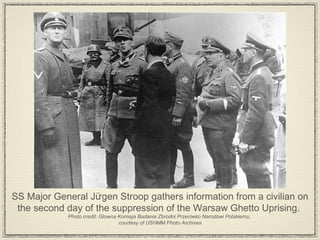
SS Major General Jürgen Stroop gathers information from a civilian on the second day of the suppression of the Warsaw Ghetto Uprising.  Photo credit: Glowna Komisja Badania Zbrodni Przeciwko Narodowi Polskiemu,  courtesy of USHMM Photo Archives
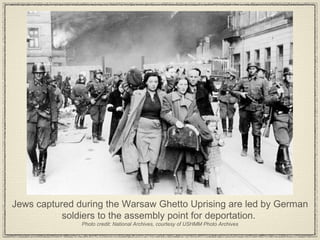
Jews captured during the Warsaw Ghetto Uprising are led by German soldiers to the assembly point for deportation.  Photo credit: National Archives, courtesy of USHMM Photo Archives
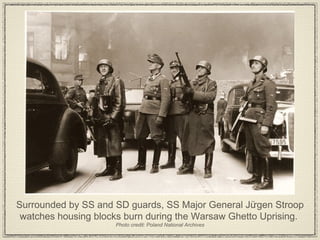
Surrounded by SS and SD guards, SS Major General Jürgen Stroop watches housing blocks burn during the Warsaw Ghetto Uprising.  Photo credit: Poland National Archives
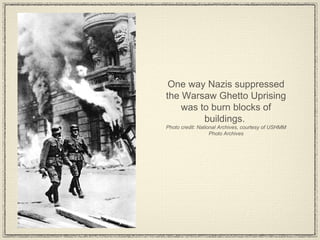
One way Nazis suppressed the Warsaw Ghetto Uprising was to burn blocks of buildings.  Photo credit: National Archives, courtesy of USHMM Photo Archives
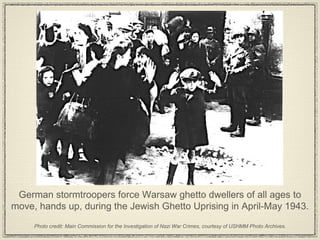
German stormtroopers force Warsaw ghetto dwellers of all ages to move, hands up, during the Jewish Ghetto Uprising in April-May 1943.  Photo credit: Main Commission for the Investigation of Nazi War Crimes, courtesy of USHMM Photo Archives.
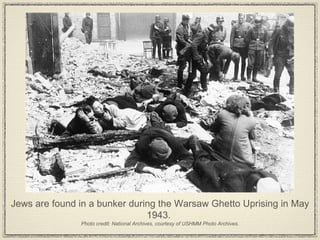
Jews are found in a bunker during the Warsaw Ghetto Uprising in May 1943.  Photo credit: National Archives, courtesy of USHMM Photo Archives.
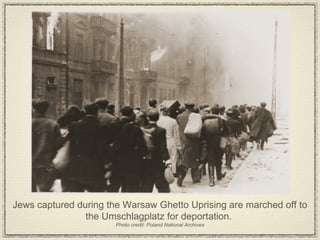
Jews captured during the Warsaw Ghetto Uprising are marched off to the Umschlagplatz for deportation.  Photo credit: Poland National Archives
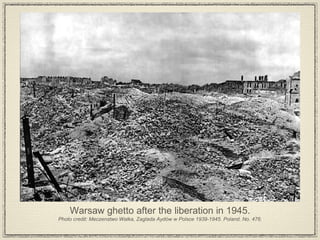
Warsaw ghetto after the liberation in 1945. Photo credit: Meczenstwo Walka, Zaglada Aydów w Polsce 1939-1945. Poland. No. 476.
 
 
Rescue & Liberation 1944 - 1945
 
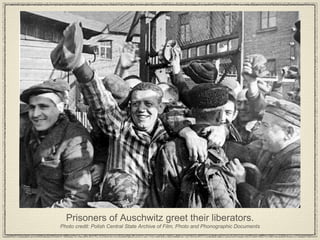
Prisoners of Auschwitz greet their liberators. Photo credit: Polish Central State Archive of Film, Photo and Phonographic Documents
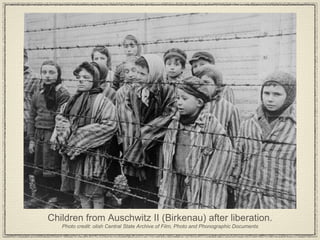
Children from Auschwitz II (Birkenau) after liberation. Photo credit: olish Central State Archive of Film, Photo and Phonographic Documents
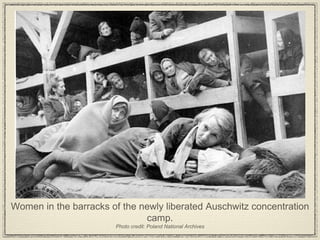
Women in the barracks of the newly liberated Auschwitz concentration camp. Photo credit: Poland National Archives
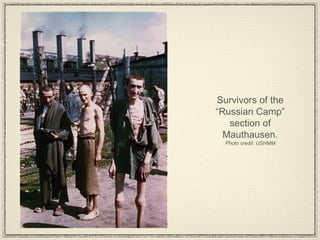
Survivors of the “Russian Camp” section of Mauthausen. Photo credit: USHMM
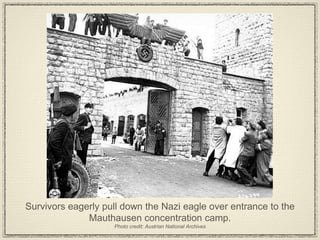
Survivors eagerly pull down the Nazi eagle over entrance to the Mauthausen concentration camp. Photo credit: Austrian National Archives
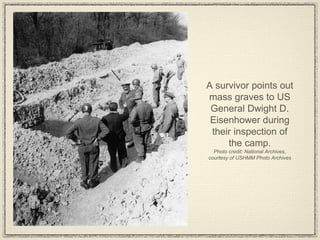
A survivor points out mass graves to US General Dwight D. Eisenhower during their inspection of the camp. Photo credit: National Archives, courtesy of USHMM Photo Archives
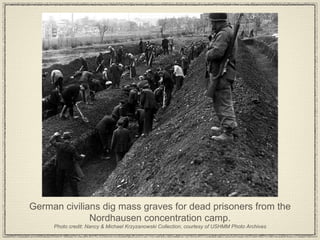
German civilians dig mass graves for dead prisoners from the Nordhausen concentration camp. Photo credit: Nancy & Michael Krzyzanowski Collection, courtesy of USHMM Photo Archives
 
Aftermath 1945 - Present
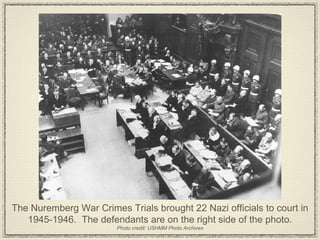
The Nuremberg War Crimes Trials brought 22 Nazi officials to court in 1945-1946.  The defendants are on the right side of the photo. Photo credit: USHMM Photo Archives
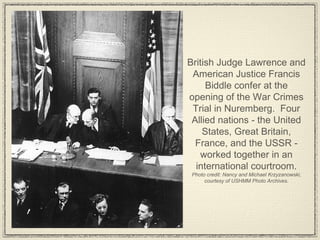
British Judge Lawrence and American Justice Francis Biddle confer at the opening of the War Crimes Trial in Nuremberg.  Four Allied nations - the United States, Great Britain, France, and the USSR - worked together in an international courtroom. Photo credit: Nancy and Michael Krzyzanowski, courtesy of USHMM Photo Archives.
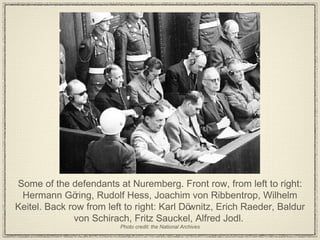
Some of the defendants at Nuremberg. Front row, from left to right: Hermann Göring, Rudolf Hess, Joachim von Ribbentrop, Wilhelm Keitel. Back row from left to right: Karl Döwnitz, Erich Raeder, Baldur von Schirach, Fritz Sauckel, Alfred Jodl.  Photo credit: the National Archives
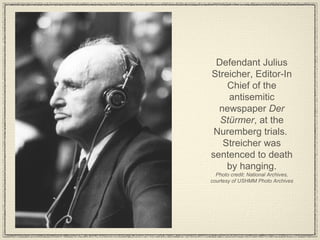
Defendant Julius Streicher, Editor-In Chief of the antisemitic newspaper  Der Stürmer , at the Nuremberg trials.  Streicher was sentenced to death by hanging. Photo credit: National Archives, courtesy of USHMM Photo Archives
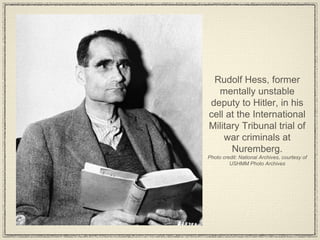
Rudolf Hess, former mentally unstable deputy to Hitler, in his cell at the International Military Tribunal trial of war criminals at Nuremberg. Photo credit: National Archives, courtesy of USHMM Photo Archives
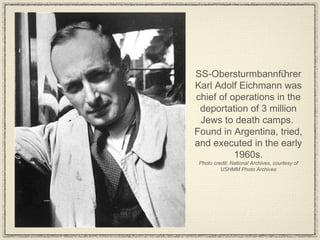
SS-Obersturmbannführer Karl Adolf Eichmann was chief of operations in the deportation of 3 million Jews to death camps.  Found in Argentina, tried, and executed in the early 1960s. Photo credit: National Archives, courtesy of USHMM Photo Archives
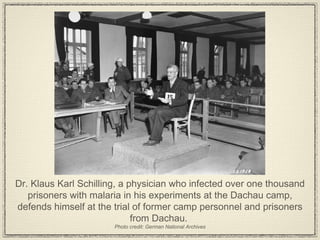
Dr. Klaus Karl Schilling, a physician who infected over one thousand prisoners with malaria in his experiments at the Dachau camp, defends himself at the trial of former camp personnel and prisoners from Dachau.  Photo credit: German National Archives
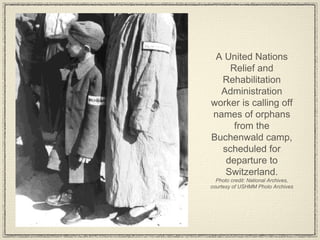
A United Nations Relief and Rehabilitation Administration worker is calling off names of orphans from the Buchenwald camp, scheduled for departure to Switzerland. Photo credit: National Archives, courtesy of USHMM Photo Archives
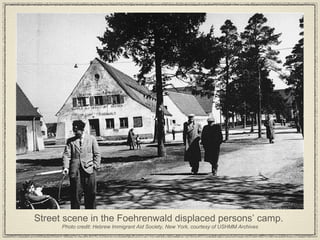
Street scene in the Foehrenwald displaced persons’ camp.  Photo credit: Hebrew Immigrant Aid Society, New York, courtesy of USHMM Archives
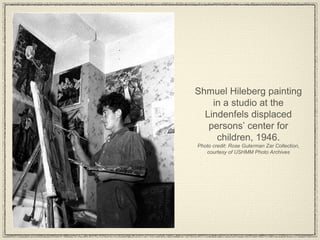
Shmuel Hileberg painting in a studio at the Lindenfels displaced persons’ center for children, 1946. Photo credit: Rose Guterman Zar Collection, courtesy of USHMM Photo Archives
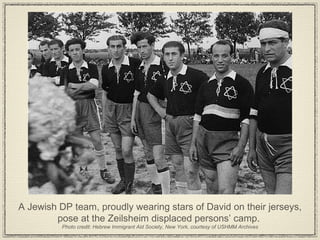
A Jewish DP team, proudly wearing stars of David on their jerseys, pose at the Zeilsheim displaced persons’ camp.  Photo credit: Hebrew Immigrant Aid Society, New York, courtesy of USHMM Archives
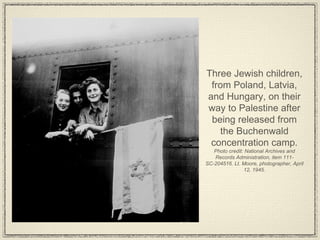
Three Jewish children, from Poland, Latvia, and Hungary, on their way to Palestine after being released from the Buchenwald concentration camp. Photo credit: National Archives and Records Administration, item 111-SC-204516. Lt. Moore, photographer, April 12, 1945.
 

Holocaust

  • 1.
  • 2.
  • 3.
    The Star ofDavid, representing Judaism. http://jnfeducation.co.uk/media/Image/MDAvid.gif
  • 4.
    The Star ofDavid in a text from a Jewish book, dated 1008. http://en.wikipedia.org/wiki/Image:Leningrad_Codex_Carpet_page_e.jpg
  • 5.
    A badge Jewswere forced to wear during Nazi times. http://en.wikipedia.org/wiki/Image:Judenstern_JMW.jpg
  • 6.
    The current flagof Israel http://en.wikipedia.org/wiki/Flag_of_Israel
  • 7.
    GANESH, the HinduGod of Good Luck and Prosperity.  Swastikas adorn the open pages of the book at Ganesh's feet Swastika is Sanskrit for all is well , or well-being. www.heathenworld.com/ swastika/ganesh.html
  • 8.
    The swastika asa Buddhist symbol. http://www.falundafa.org.il/ver_01/english/wan_eng.htm#china
  • 9.
    In India; theswastika still represents good luck to Hindus. www.ourlifejourney.com/ jaipur_photos.htm
  • 10.
    The ancient ChineseWuShu coin, with swastika designs. http://www.falundafa.org.il/ver_01/english/wan_eng.htm#china
  • 11.
    An eighth centuryBC Greek bowl. http://www.falundafa.org.il/ver_01/english/wan_eng.htm#china
  • 12.
    A swastika mosaicin a synagogue in Israel. http://www.falundafa.org.il/ver_01/english/wan_eng.htm#china
  • 13.
    This postcard, copyright1907 by E. Phillips, a US card publisher, speaks for the universally high regard in which the swastika was held as a good luck token before use by the Nazis corrupted its meaning.... It forms a combination of four “L’s” standing for Luck, Light, Love, and Life. http://www.luckymojo.com/swastika.html
  • 14.
    The Edmonton SwastikasHockey Team, 1916. http://www.birthplaceofhockey.com/hockeyists/swastikas/pic-edmt-swas%201916.html
  • 15.
    A brass promotionalwatch fob from the 1920’s. http://www.heathenworld.com/swastika/coke.html
  • 16.
    The Nazi flagintended to symbolize “the ideology of the movement — in red its social ideal, in white its nationalism, and in the swastika "the struggle for the victory of Aryan man"” http://www.crwflags.com/fotw/flags/de%7Dns_or.html#lef
  • 17.
    These trees wereplanted in the 1930's by a local resident during Nazi times.  They were largely forgotten until after the German reunification in 1992 when planes once again flew over the area. Local forestry officials cut down 25 of the Larch trees after this photo appeared in several German tabloids. http://www.birthplaceofhockey.com/hockeyists/swastikas/pic-edmt-swas%201916.html   This photo was taken on November 14, 2000.  It was only visible from the air a few weeks in the Spring and a few weeks in the Fall when Larch trees stood out in contrast to the surrounding Pine trees.
  • 18.
  • 19.
  • 20.
  • 21.
  • 22.
  • 23.
    Jewish Expulsions andResettlement Areas in Europe. 1100 - 1500.
  • 24.
    Pogroms and antisemiticacts of violence in Russia and the Pale from 1871 - 1906.
  • 25.
  • 26.
    The Rise ofthe Nazi Party Nazi Party 1918 - 1933
  • 27.
    Nazi party in1922. Julius Streicher, editor of the antisemitic newspaper Der Stürmer , is front row, to the left of the child. Photo credit: USHMM Photo Archives
  • 28.
    Late 1920’s; AdolfHitler reviews stormtroopers at a Nazi party rally in Nuremberg, Germany Photo credit: USHMM Photo Archives
  • 29.
    Adolf Hitler andHeinrich Himmler review SS troops during Reich Party Day ceremonies. Photo credit: USHMM Photo Archives
  • 30.
  • 31.
    The Nazification ofGermany of Germany 1933 - 1939
  • 32.
    Paul Von Hindenburgcalling Adolf Hitler to the chancellorship of Germany, January, 30, 1933. Photo credit: National Archives, courtesy of USHMM Photo Archives
  • 33.
    Reichminster Joseph Goebbelsurges Germans to boycott Jewish-owned businesses, April 1, 1933. Photo credit: National Archives, courtesy of USHMM Photo Archives
  • 34.
    German civilians andSA members paste anti-Jewish boycott signs on Jewish businesses. Most signs read, “Germans defend yourselves against Jewish atrocity propaganda; buy only at German shops.” (1933) Photo credit: National Archives, courtesy of USHMM Photo Archives
  • 35.
    A woman readsa boycott sign on a Jewish department store. The sign reads: “Germans defend yourselves against Jewish atrocity propaganda; buy only at German shops.” (1933) Photo credit: National Archives, courtesy of USHMM Photo Archives
  • 36.
    SA pickets, wearingboycott signs, block the entrance to a Jewish-owned shop. (1933) Photo credit: National Archives, courtesy of USHMM Photo Archives
  • 37.
    A “brown shirt”(member of the SA) throws “un-German” books into a book burning fire in Berlin. May 10, 1933. Photo credit: National Archives, courtesy of USHMM Photo Archives
  • 38.
    Hitler Youth marchthrough Nuremberg, Germany past Nazi officials, including Julius Streicher. (1933) Photo credit: National Archives, courtesy of USHMM Photo Archives
  • 39.
    Adolf Hitler openingthe 1935 Party Day of freedom in the historic Nuremberg town hall. Photo credit: USHMM Photo Archives
  • 40.
    Nazis at theUniversity of Vienna, Austria try to prevent Jews from entering the building; led to a day of student rioting. Photo credit: National Archives, courtesy of USHMM Photo Archives
  • 41.
    Jesse Owens andother members of the 1936 US Olympic team arrive in Berlin. Photo credit: National Archives, courtesy of USHMM Photo Archives
  • 42.
    German citizens saluteAdolf Hitler at the 1936 Olympics in Berlin. Photo credit: National Archives, courtesy of USHMM Photo Archives
  • 43.
    Regards: Measures againstJews tonight. a) Only such measures may be taken which do not jeopardize German life or property (for instance, burning of synagogues only if there is no danger of fires for the neighbourhoods). b) Business establishments and homes of Jews may be destroyed but not looted. The police have been instructed to supervise the execution of these directives and to arrest looters. c) In Business streets special care is to be taken that non-Jewish establishments will be safeguarded at all cost against damage. As soon as the events of this night permit the use of the designated officers, as many Jews, particularly wealthy ones, as the local jails will hold, are to be arrested in all districts. Initially only healthy male Jews, not too old, are to be arrested. After the arrests have been carried out the appropriate concentration camp is to be contacted immediately with a view to a quick transfer of the Jews to the camps.... Orders about Kristallnacht : Nov. 10, 1938
  • 44.
    Kristallnacht: Nov. 10,1938. Red dots indicate cities where synagogues were destroyed.
  • 45.
    During Kristallnacht, the Night of Broken Glass, a synagogue burns in Siegen, Germany. (November 10, 1938) Photo credit: The Pictorial History of the Holocaust, Yitzhak Arad, Ed., Macmillan Publishing Co., NY, 1990, p. 58, courtesy of Shamash: The Jewish Internet Consortium.
  • 46.
    Germans pass bythe broken shop window of a Jewish business destroyed during Kristallnacht . (November, 1938) Photo credit: National Archives, courtesy of USHMM Photo Archives
  • 47.
  • 48.
    Estimated Jewish populationin Europe in 1939.
  • 49.
    Soviet Foreign Commissionersigns the German-Soviet nonagression pact. Josef Stalin, in white, stands behind him. Photo credit: The National Archives and Records Administration, item #242-JRPE-44.
  • 50.
    Artillery General vonRiechenau, commander of part of the army that invaded Poland on September 1, 1939. Photo credit: Meczenstwo Walka, Zaglada Aydów w Polsce 1939-1945. Poland. No. 28.
  • 51.
    German troops paradethrough Warsaw, Poland, September, 1939. Photo credit: K Hugo Juger, Courtesy The National Archives and Records Administration, item #200-SFF-52.
  • 52.
  • 53.
  • 54.
    Harassment of aJewish man. Photo credit: Meczenstwo Walka, Zaglada Zydów Polsce 1939-1945. Poland. No. 32.
  • 55.
    German soldiers humiliatingPolish Jews by forcing one Jew to cut the beard of another, while non-Jewish Poles look on. Photo credit: Main Commission for the Investigation of Nazi War Crimes, courtesy of USHMM Photo Archives.
  • 56.
    Soldiers using thepsychological warfare of humiliation against Jews, forcing them to give the Nazi salute. Photo credit: Meczenstwo Walka, Zaglada Zydów Polsce 1939-1945. Poland. No. 37.
  • 57.
    On November 14,1939, the President of Lódz decreed that all Jews must wear arm bands or badges with a Jewish star. Photo credit: Meczenstwo Walka, Zaglada Zydów Polsce 1939-1945. Poland. No. 43.
  • 58.
    Seller of Jewisharm bands on the streets of Warsaw, 1940. Photo credit: Meczenstwo Walka, Zaglada Zydów Polsce 1939-1945. Poland. No. 47.
  • 59.
  • 60.
    Ghetto ration cardfor October 1941. This card officially entitled the holder to 300 calories daily. Photo credit: Meczenstwo Walka, Zaglada Zydów Polsce 1939-1945. Poland. No. 137.
  • 61.
    Stores owned byJews had to be marked with a Star of David, another part of the increasing segregation of Jews. Photo credit: Meczenstwo Walka, Zaglada Zydów Polsce 1939-1945. Poland. No. 49.
  • 62.
    This picture capturesthe essence of how many non-Jewish Europeans and Jews related during the rise of Nazism. Photo credit: Meczenstwo Walka, Zaglada Zydów Polsce 1939-1945. Poland. No. 116.
  • 63.
    One form ofNazi plunder was the circulation of money for use only in the ghetto, that had no value outside of the ghetto. Photo credit: Meczenstwo Walka, Zaglada Zydów Polsce 1939-1945. Poland. No. 181.
  • 64.
    Rubenstein, a popularfigure in the Warsaw ghetto in 1941-42, used humor and biting mockery as a way to express the anger and hatred Jews felt toward the Nazis and the ghetto police. Photo credit: Meczenstwo Walka, Zaglada Zydów Polsce 1939-1945. Poland. No. 98.
  • 65.
    A German soldierand a Jewish policeman direct Lódz ghetto residents crossing the street between the two parts of the ghetto in 1940 or 1941. The German sign forbids entry into the Jewish area. This photograph was printed as a postcard. Photo credit: National Archives, courtesy of USHMM Photo Archives
  • 66.
    Identity card ofRudolf Kohn, deported from Vienna to the ghetto in Lódz. Photo credit: Meczenstwo Walka, Zaglada Aydów w Polsce 1939-1945. Poland. No. 68.
  • 67.
    Close-up of achild working at a machine in a Kovno ghetto workshop. Photo credit: George Kadish Collection, courtesy of USHMM Photo Archives
  • 68.
    A German policemanchecks the identification papers of Jews in the Krakow ghetto. Photo credit: Archiwum Panstwowe w Krakowie
  • 69.
    A typical roomin a ghetto. Photo credit: Meczenstwo Walka, Zaglada Aydów w Polsce 1939-1945. Poland. No. 117.
  • 70.
  • 71.
  • 72.
    Dutch Jews aremarched to the Amersfoot internment camp under heavy guard, 1942. Photo credit: Rijksinstituut voor Oorlogsdocumentatie, courtesy of USHMM Photo Archives
  • 73.
    Part of areport detailing murder of Jews in the Nazi-occupied Baltic states and White Russia by Einsatzgruppe A , February 1, 1942. Photo credit: Nazi Conspiracy and Aggression, GPO Washington
  • 74.
  • 75.
  • 76.
    The entrance tothe main camp of Auschwitz. The gate bears the motto, “Work makes one free.” Photo credit: Glowna Komisja Badania Zbrodni Przeciwko Narodowi Polskiemu, courtesy of USHMM Photo Archives
  • 77.
    Entrance to agas chamber, Auschwitz; it was quickly converted into a bomb shelter. The building in the background was used by the Gestapo as a regional headquarters. Photo credit: Glowna Komisja Badania Zbrodni Przeciwko Narodowi Polskiemu, courtesy of USHMM Photo Archives
  • 78.
    The execution wallnext to Block 11 in the Auschwitz I camp. Photo credit: Poland National Archives
  • 79.
    The interior ofa barracks in the Flossenbürg concentration camp that was intended to house 1500 prisoners. Photo credit: Courtesy of National Archives
  • 80.
    Registration of prisonersat Buchenwald concentration camp. Photo credit: American Jewish Joint Distribution Committee
  • 81.
    Jews from theNetherlands stand for roll call in the Buchenwald concentration camp, 1941. Photo credit: USHMM Photo Archives
  • 82.
    A crate fullof rings confiscated from prisoners in Buchenwald. Photo credit: German National Archives
  • 83.
    Prisoners with theirmess kits on their way to the camp kitchen, Dachau Photo credit: KZ Gedenksatte Dachau
  • 84.
    Dachau innmates gatheredoutside & on the roof tops of a camp building to hear a speech by Hitler. Photo credit: KZ Gedenksatte Dachau
  • 85.
    A Gypsy couplein the Belzec concentration camp. Photo credit: Glowna Komisja Badania Zbrodni Przeciwko Narodowi Polskiemu, courtesy of USHMM Photo Archives
  • 86.
    SS-women at theBelsen Camp. Photo credit: The Belsen Trial, R. Philips, Ed., William Hodge and Company, 1949, p. 104, Courtesy of Shamash: The Jewish Internet Consortium.
  • 87.
    An SS guardwith his dog at the Plaszow concentration camp. Photo credit: Main Commission for the Investigation of Nazi War Crimes, courtesy of USHMM Photo Archives
  • 88.
    The Ordenienst, or Jewish police in Westerbork, were Jews that collaborated with the Nazis & helped keep order in the camp. Photo credit: Rijksinstituut voor Oorlogsdocumentatie, courtesy of USHMM Photo Archives
  • 89.
    Prisoners at forcedlabour building a factory at Auschwitz, 1942-43. Photo credit: Main Commission for the Investigation of Nazi War Crimes, courtesy of USHMM Photo Archives
  • 90.
    Jewish women atforced labour pulling hopper cars of stones in the Plaszlow concentration camp, 1944. Photo credit: Prof. Leopold Pfefferberg-Page Collection, courtesy of USHMM Photo Archives
  • 91.
    Prisoners from Buchenwaldconcentration camp building the Weimar-Buchenwald railroad line. Photo credit: Gedenkstaette Buchenwald
  • 92.
    Prisoners’ orchestra duringa concert for the SS-men in Auschwitz in 1941. Photo credit: Main Commission for the Investigation of Nazi War Crimes, courtesy of USHMM Photo Archives.
  • 93.
    A view ofthe camp commandant’s house in Belzec. Photo credit: Main Commission for the Investigation of Nazi War Crimes, courtesy of USHMM Photo Archives
  • 94.
    A column ofprisoners on a forced march from Dachau concentration camp, 1945. Photo credit: Marion Koch Collection, courtesy of USHMM Photo Archives
  • 95.
  • 96.
  • 97.
  • 98.
    A Jewish partisangroup of men and women that fought in Poland. Photo credit: GMeczenstwo Walka, Zaglada Zydów Polsce 1939-1945. Poland. No. 517
  • 99.
    A small groupof partisans in the forests of Poland. Photo credit: GMeczenstwo Walka, Zaglada Zydów Polsce 1939-1945. Poland. No. 529
  • 100.
    In the woodsof the Ukraine, 1943, partisans receive a transmission from the Soviet Information Bureau. Photo credit: GMeczenstwo Walka, Zaglada Zydów Polsce 1939-1945. Poland. No. 529
  • 101.
  • 102.
    An announcement postedseveral days after the beginning of the Warsaw Ghetto Uprising which forbids entrance to the ghetto under punishment of death. Photo credit: Glowna Komisja Badania Zbrodni Przeciwko Narodowi Polskiemu, courtesy of USHMM Photo Archives
  • 103.
    SS Major GeneralJürgen Stroop gathers information from a civilian on the second day of the suppression of the Warsaw Ghetto Uprising. Photo credit: Glowna Komisja Badania Zbrodni Przeciwko Narodowi Polskiemu, courtesy of USHMM Photo Archives
  • 104.
    Jews captured duringthe Warsaw Ghetto Uprising are led by German soldiers to the assembly point for deportation. Photo credit: National Archives, courtesy of USHMM Photo Archives
  • 105.
    Surrounded by SSand SD guards, SS Major General Jürgen Stroop watches housing blocks burn during the Warsaw Ghetto Uprising. Photo credit: Poland National Archives
  • 106.
    One way Nazissuppressed the Warsaw Ghetto Uprising was to burn blocks of buildings. Photo credit: National Archives, courtesy of USHMM Photo Archives
  • 107.
    German stormtroopers forceWarsaw ghetto dwellers of all ages to move, hands up, during the Jewish Ghetto Uprising in April-May 1943. Photo credit: Main Commission for the Investigation of Nazi War Crimes, courtesy of USHMM Photo Archives.
  • 108.
    Jews are foundin a bunker during the Warsaw Ghetto Uprising in May 1943. Photo credit: National Archives, courtesy of USHMM Photo Archives.
  • 109.
    Jews captured duringthe Warsaw Ghetto Uprising are marched off to the Umschlagplatz for deportation. Photo credit: Poland National Archives
  • 110.
    Warsaw ghetto afterthe liberation in 1945. Photo credit: Meczenstwo Walka, Zaglada Aydów w Polsce 1939-1945. Poland. No. 476.
  • 111.
  • 112.
  • 113.
  • 114.
  • 115.
    Prisoners of Auschwitzgreet their liberators. Photo credit: Polish Central State Archive of Film, Photo and Phonographic Documents
  • 116.
    Children from AuschwitzII (Birkenau) after liberation. Photo credit: olish Central State Archive of Film, Photo and Phonographic Documents
  • 117.
    Women in thebarracks of the newly liberated Auschwitz concentration camp. Photo credit: Poland National Archives
  • 118.
    Survivors of the“Russian Camp” section of Mauthausen. Photo credit: USHMM
  • 119.
    Survivors eagerly pulldown the Nazi eagle over entrance to the Mauthausen concentration camp. Photo credit: Austrian National Archives
  • 120.
    A survivor pointsout mass graves to US General Dwight D. Eisenhower during their inspection of the camp. Photo credit: National Archives, courtesy of USHMM Photo Archives
  • 121.
    German civilians digmass graves for dead prisoners from the Nordhausen concentration camp. Photo credit: Nancy & Michael Krzyzanowski Collection, courtesy of USHMM Photo Archives
  • 122.
  • 123.
  • 124.
    The Nuremberg WarCrimes Trials brought 22 Nazi officials to court in 1945-1946. The defendants are on the right side of the photo. Photo credit: USHMM Photo Archives
  • 125.
    British Judge Lawrenceand American Justice Francis Biddle confer at the opening of the War Crimes Trial in Nuremberg. Four Allied nations - the United States, Great Britain, France, and the USSR - worked together in an international courtroom. Photo credit: Nancy and Michael Krzyzanowski, courtesy of USHMM Photo Archives.
  • 126.
    Some of thedefendants at Nuremberg. Front row, from left to right: Hermann Göring, Rudolf Hess, Joachim von Ribbentrop, Wilhelm Keitel. Back row from left to right: Karl Döwnitz, Erich Raeder, Baldur von Schirach, Fritz Sauckel, Alfred Jodl. Photo credit: the National Archives
  • 127.
    Defendant Julius Streicher,Editor-In Chief of the antisemitic newspaper Der Stürmer , at the Nuremberg trials. Streicher was sentenced to death by hanging. Photo credit: National Archives, courtesy of USHMM Photo Archives
  • 128.
    Rudolf Hess, formermentally unstable deputy to Hitler, in his cell at the International Military Tribunal trial of war criminals at Nuremberg. Photo credit: National Archives, courtesy of USHMM Photo Archives
  • 129.
    SS-Obersturmbannführer Karl AdolfEichmann was chief of operations in the deportation of 3 million Jews to death camps. Found in Argentina, tried, and executed in the early 1960s. Photo credit: National Archives, courtesy of USHMM Photo Archives
  • 130.
    Dr. Klaus KarlSchilling, a physician who infected over one thousand prisoners with malaria in his experiments at the Dachau camp, defends himself at the trial of former camp personnel and prisoners from Dachau. Photo credit: German National Archives
  • 131.
    A United NationsRelief and Rehabilitation Administration worker is calling off names of orphans from the Buchenwald camp, scheduled for departure to Switzerland. Photo credit: National Archives, courtesy of USHMM Photo Archives
  • 132.
    Street scene inthe Foehrenwald displaced persons’ camp. Photo credit: Hebrew Immigrant Aid Society, New York, courtesy of USHMM Archives
  • 133.
    Shmuel Hileberg paintingin a studio at the Lindenfels displaced persons’ center for children, 1946. Photo credit: Rose Guterman Zar Collection, courtesy of USHMM Photo Archives
  • 134.
    A Jewish DPteam, proudly wearing stars of David on their jerseys, pose at the Zeilsheim displaced persons’ camp. Photo credit: Hebrew Immigrant Aid Society, New York, courtesy of USHMM Archives
  • 135.
    Three Jewish children,from Poland, Latvia, and Hungary, on their way to Palestine after being released from the Buchenwald concentration camp. Photo credit: National Archives and Records Administration, item 111-SC-204516. Lt. Moore, photographer, April 12, 1945.
  • 136.