Recognizing the Hidden Curriculum of Gender RolesThe Relationship Between Reading and Gender A Master’s Research Project byCatherine HollandSt. Mary’s College of Maryland
IntroductionSchools: tools for socializationStated curriculum vs. “hidden curriculum” (Giroux, 1988)Reinforcing traditional gender roles
The ProblemResearchers report gender inequalitiesOn standardized tests (Lietz, 2006; Marks, 2008)Increasing over time (Klecker, 2006)Influencing educational policies (Martino & Kehler 2007)
The ProblemGender Similarities Hypothesis (Hyde, 2005)Gender isn’t a predictor of causal thinking abilities (Berkant, 2009)Gender isn’t related to preferred learning style (Younger & Warrington, 2005 as cited in Watson, Kehler, & Martino, 2010)
The ProblemDifferences between genders are socially created, not biologically innate.
Research QuestionsDo boys consider reading to be a gendered activity? Do girls?Is it primarily teachers or their students who replicate and encourage these gender-specific behaviors and opinions?
PopulationAP English Literature students; grade 12English teachersPublic high school in Southern Maryland
MethodsAffective surveyQuestionnaireOpen-ended questionBook descriptionsStudent interviewsTeacher interviews
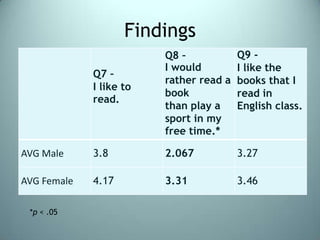
Findings*p < .05
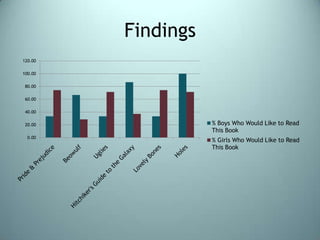
Findings
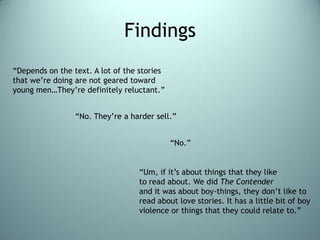
Findings“Depends on the text. A lot of the stories that we’re doing are not geared toward young men…They’re definitely reluctant.”“No. They’re a harder sell.”“No.”“Um, if it’s about things that they liketo read about. We did The Contenderand it was about boy-things, they don’t like to read about love stories. It has a little bit of boy violence or things that they could relate to.”
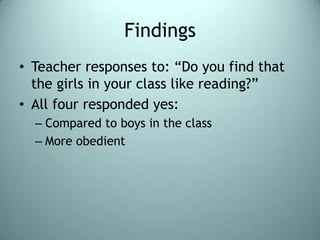
FindingsTeacher responses to: “Do you find that the girls in your class like reading?”All four responded yes:Compared to boys in the classMore obedient
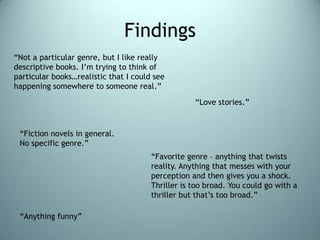
Findings“Not a particular genre, but I like really descriptive books. I’m trying to think of particular books…realistic that I could see happening somewhere to someone real.”“Love stories.”“Fiction novels in general. No specific genre.”“Favorite genre – anything that twists reality. Anything that messes with your perception and then gives you a shock. Thriller is too broad. You could go with a thriller but that’s too broad.”“Anything funny”
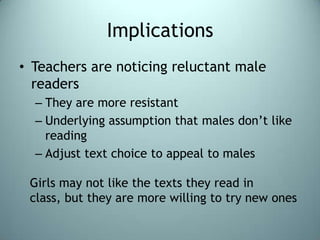
ImplicationsTeachers are noticing reluctant male readersThey are more resistantUnderlying assumption that males don’t like reading Adjust text choice to appeal to malesGirls may not like the texts they read in class, but they are more willing to try new ones
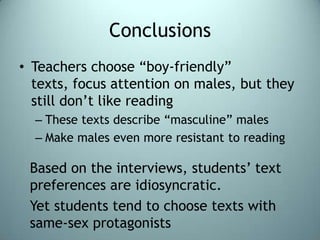
ConclusionsTeachers choose “boy-friendly” texts, focus attention on males, but they still don’t like readingThese texts describe “masculine” malesMake males even more resistant to readingBased on the interviews, students’ text preferences are idiosyncratic.Yet students tend to choose texts with same-sex protagonists
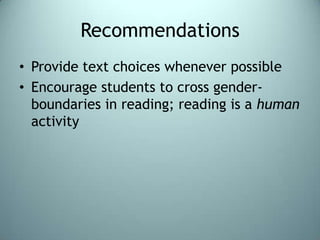
RecommendationsProvide text choices whenever possibleEncourage students to cross gender-boundaries in reading; reading is a human activity
ReferencesBerkant, H. G. (2009). An investigation of students' meaningful causal thinking abilities in terms of academic achievement, reading comprehension and gender. Educational Sciences:Theoryand Practice, 9(3), 1149-1165.Giroux, H. A. (1988). Teachers as Intellectuals: Toward a Critical Pedagogy of Learning. Bergin & Garvey Paperback.Hyde, J. S. (2005). The gender similarities hypothesis. American Psychologist, 60(6), 581-592.Klecker, B. M. (2006). The gender gap in NAEP fourth-, eighth-, and twelfth-grade reading scores across years. Reading Improvement, 43(1), 50-56.Lietz, P. (2006). Issues in the change in gender differences in reading achievement in crossnational research studies since 1992: a meta-analytic view. International Education Journal, 7(2), 127-149.Marks, G. N. (2008). Accounting for the gender gaps in student performance in reading and mathematics: evidence from 31 countries. Oxford Review of Education, 34(1), 89-109.Martino, W., & Kehler, M. (2007). Gender-based literacy reform: a question of challenging or recuperating gender binaries. Canadian Journal of Education, 30(2), 406-431.Watson, A., Kehler, M., & Martino, W. (2010). The problem of boys' literacy underachievement: raising some questions. Journal of Adolescent & Adult Literacy, 53(5), 356-361.
Questions?

Holland c mrp powerpoint

  • 1.
    Recognizing the HiddenCurriculum of Gender RolesThe Relationship Between Reading and Gender A Master’s Research Project byCatherine HollandSt. Mary’s College of Maryland
  • 2.
    IntroductionSchools: tools forsocializationStated curriculum vs. “hidden curriculum” (Giroux, 1988)Reinforcing traditional gender roles
  • 3.
    The ProblemResearchers reportgender inequalitiesOn standardized tests (Lietz, 2006; Marks, 2008)Increasing over time (Klecker, 2006)Influencing educational policies (Martino & Kehler 2007)
  • 4.
    The ProblemGender SimilaritiesHypothesis (Hyde, 2005)Gender isn’t a predictor of causal thinking abilities (Berkant, 2009)Gender isn’t related to preferred learning style (Younger & Warrington, 2005 as cited in Watson, Kehler, & Martino, 2010)
  • 5.
    The ProblemDifferences betweengenders are socially created, not biologically innate.
  • 6.
    Research QuestionsDo boysconsider reading to be a gendered activity? Do girls?Is it primarily teachers or their students who replicate and encourage these gender-specific behaviors and opinions?
  • 7.
    PopulationAP English Literaturestudents; grade 12English teachersPublic high school in Southern Maryland
  • 8.
    MethodsAffective surveyQuestionnaireOpen-ended questionBookdescriptionsStudent interviewsTeacher interviews
  • 9.
  • 10.
  • 11.
    Findings“Depends on thetext. A lot of the stories that we’re doing are not geared toward young men…They’re definitely reluctant.”“No. They’re a harder sell.”“No.”“Um, if it’s about things that they liketo read about. We did The Contenderand it was about boy-things, they don’t like to read about love stories. It has a little bit of boy violence or things that they could relate to.”
  • 12.
    FindingsTeacher responses to:“Do you find that the girls in your class like reading?”All four responded yes:Compared to boys in the classMore obedient
  • 13.
    Findings“Not a particulargenre, but I like really descriptive books. I’m trying to think of particular books…realistic that I could see happening somewhere to someone real.”“Love stories.”“Fiction novels in general. No specific genre.”“Favorite genre – anything that twists reality. Anything that messes with your perception and then gives you a shock. Thriller is too broad. You could go with a thriller but that’s too broad.”“Anything funny”
  • 14.
    ImplicationsTeachers are noticingreluctant male readersThey are more resistantUnderlying assumption that males don’t like reading Adjust text choice to appeal to malesGirls may not like the texts they read in class, but they are more willing to try new ones
  • 15.
    ConclusionsTeachers choose “boy-friendly”texts, focus attention on males, but they still don’t like readingThese texts describe “masculine” malesMake males even more resistant to readingBased on the interviews, students’ text preferences are idiosyncratic.Yet students tend to choose texts with same-sex protagonists
  • 16.
    RecommendationsProvide text choiceswhenever possibleEncourage students to cross gender-boundaries in reading; reading is a human activity
  • 17.
    ReferencesBerkant, H. G.(2009). An investigation of students' meaningful causal thinking abilities in terms of academic achievement, reading comprehension and gender. Educational Sciences:Theoryand Practice, 9(3), 1149-1165.Giroux, H. A. (1988). Teachers as Intellectuals: Toward a Critical Pedagogy of Learning. Bergin & Garvey Paperback.Hyde, J. S. (2005). The gender similarities hypothesis. American Psychologist, 60(6), 581-592.Klecker, B. M. (2006). The gender gap in NAEP fourth-, eighth-, and twelfth-grade reading scores across years. Reading Improvement, 43(1), 50-56.Lietz, P. (2006). Issues in the change in gender differences in reading achievement in crossnational research studies since 1992: a meta-analytic view. International Education Journal, 7(2), 127-149.Marks, G. N. (2008). Accounting for the gender gaps in student performance in reading and mathematics: evidence from 31 countries. Oxford Review of Education, 34(1), 89-109.Martino, W., & Kehler, M. (2007). Gender-based literacy reform: a question of challenging or recuperating gender binaries. Canadian Journal of Education, 30(2), 406-431.Watson, A., Kehler, M., & Martino, W. (2010). The problem of boys' literacy underachievement: raising some questions. Journal of Adolescent & Adult Literacy, 53(5), 356-361.
  • 18.

Editor's Notes

  • #12 Teacher responses to: “Do you find that the boys in your class like reading?”None of the teachers found that boys liked reading, and two teachers said that boys only liked reading particular male-oriented texts.
  • #13 It seemed that the underlying assumption was that girls already liked to read, and thus needed less special teacher attention – they already like reading, and thus are more willing to try new texts.
  • #14 Student Responses to “Which kind of book is more appealing to you?”
  • #15 Presumably, girls already like reading, so teachers focus energy on the boys.
  • #16 Typically, masculine males do not read. These texts only remind students that if they are to be “proper” males, they will be violent and independent. Reading = passive; passive = feminine.
  • #17 Classroom Teachers should provide choices whenever possible so that students won’t feel as though they’re being “forced” to read a text. Teachers should try to discourage reading along gender boundaries – reading is a human activity, and it is essential to doing well in school. Teachers can help most by introducing and engaging students effectively – the text isn’t going to sell itself.