Hoard: A Scalable Memory Allocator for Multithreaded Applications Emery Berger , Kathryn McKinley * ,  Robert Blumofe, Paul Wilson Department of Computer Sciences * Department of Computer Science
Motivation Parallel multithreaded programs becoming prevalent web servers, search engines, database managers, etc. run on SMP’s for high performance often embarrassingly parallel Memory allocation is a bottleneck prevents scaling with number of processors
Assessment Criteria for Multiprocessor Allocators Speed competitive with uniprocessor allocators on one processor Scalability performance linear with the number of processors Fragmentation  (= max allocated / max in use) competitive with uniprocessor allocators worst-case  and  average-case
Uniprocessor Allocators on Multiprocessors Fragmentation:  Excellent Very low for most programs [Wilson & Johnstone] Speed & Scalability:  Poor Heap contention a single lock protects the heap Can exacerbate false sharing different processors can share cache lines
Allocator-Induced False Sharing Allocators cause false sharing! Cache lines can end up spread across a number of processors Practically all allocators do this processor 1 processor 2 x2 = malloc(s); x1 = malloc(s); A cache line thrash… thrash…
Existing Multiprocessor Allocators Speed: One concurrent heap (e.g., concurrent B-tree):    too expensive too many locks/atomic updates O(log n) cost per memory operation    Fast allocators use multiple heaps Scalability: Allocator-induced false sharing and other bottlenecks Fragmentation:  P-fold increase or even unbounded
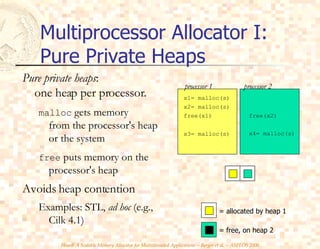
Multiprocessor Allocator I: Pure Private Heaps Pure private heaps : one heap per processor. malloc  gets memory from the processor's heap or the system free  puts memory on the processor's heap Avoids heap contention Examples: STL,  ad hoc  (e.g., Cilk 4.1) x1= malloc(s) free(x1) free(x2) x3= malloc(s) x2= malloc(s) x4= malloc(s) processor 1 processor 2 = allocated by heap 1 = free, on heap 2
How to Break Pure Private Heaps: Fragmentation Pure private heaps : memory consumption can grow without bound! Producer-consumer: processor 1 allocates processor 2 frees free(x1) x2= malloc(s) free(x2) x1= malloc(s) processor 1 processor 2 x3= malloc(s) free(x3)
Multiprocessor Allocator II: Private Heaps with Ownership Private heaps with ownership: free  puts memory back on the  originating processor 's heap. Avoids unbounded memory consumption Examples:  ptmalloc  [Gloger],  LKmalloc  [Larson & Krishnan] x1= malloc(s) free(x1) free(x2) x2= malloc(s) processor 1 processor 2
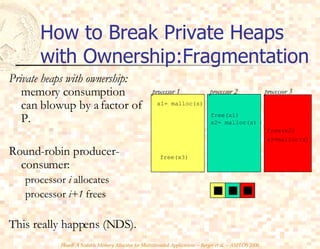
How to Break Private Heaps with Ownership:Fragmentation Private heaps with ownership: memory consumption can blowup by a factor of P. Round-robin producer-consumer: processor  i  allocates processor  i+1  frees This really happens (NDS). free(x2) free(x1) free(x3) x1= malloc(s) x2= malloc(s) x3=malloc(s) processor 1 processor 2 processor 3
So What Do We Do Now?
The Hoard Multiprocessor Memory Allocator Manages memory in page-sized  superblocks  of same-sized objects - Avoids false sharing by not carving up cache lines - Avoids heap contention - local heaps allocate & free small blocks from their set of superblocks Adds a  global heap  that is a repository of superblocks When the fraction of free memory exceeds the  empty fraction , moves superblocks to the global heap - Avoids blowup in memory consumption
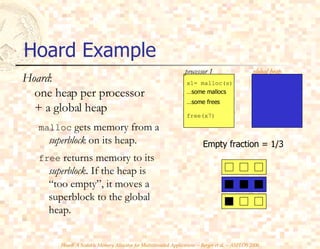
Hoard Example Hoard : one heap per processor + a global heap malloc  gets memory from a  superblock  on its heap. free  returns memory to its  superblock . If the heap is “too empty”, it moves a superblock to the global heap. x1= malloc(s) processor 1 global heap free(x7) … some mallocs … some frees Empty fraction = 1/3
Summary of Analytical Results Worst-case memory consumption: O(n log M/m  + P ) [instead of O( P  n log M/m)] n = memory required M = biggest object size m = smallest object size P = number of processors Best possible: O(n log M/m) [Robson] Provably low synchronization in most cases
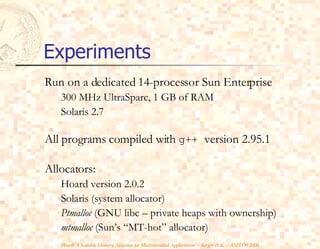
Experiments Run on a dedicated 14-processor Sun Enterprise 300 MHz UltraSparc, 1 GB of RAM Solaris 2.7 All programs compiled with  g++  version 2.95.1 Allocators: Hoard version 2.0.2 Solaris (system allocator) Ptmalloc  (GNU libc – private heaps with ownership) mtmalloc  (Sun’s “MT-hot” allocator)
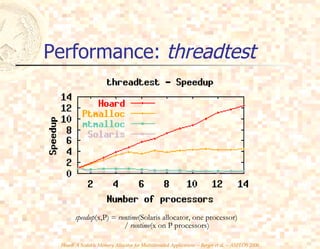
Performance:  threadtest speedup (x,P) =  runtime (Solaris allocator, one processor)   /  runtime (x on P processors)
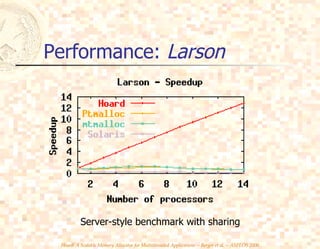
Performance:  Larson Server-style benchmark with sharing
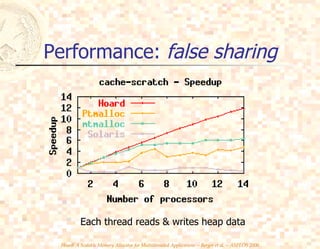
Performance:  false sharing Each thread reads & writes heap data
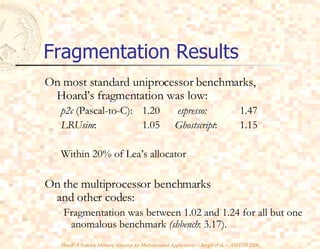
Fragmentation Results On most standard uniprocessor benchmarks, Hoard’s fragmentation was low: p2c  (Pascal-to-C):  1.20   espresso: 1.47 LRUsim :  1.05 Ghostscript : 1.15 Within 20% of Lea’s allocator On the multiprocessor benchmarks and other codes: Fragmentation was between 1.02 and 1.24 for all but one anomalous benchmark  (shbench : 3.17) .
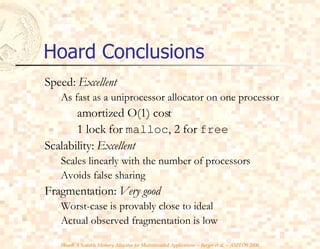
Hoard Conclusions Speed:  Excellent As fast as a uniprocessor allocator on one processor amortized O(1) cost 1 lock for  malloc , 2 for  free Scalability:  Excellent Scales linearly with the number of processors Avoids false sharing Fragmentation:  Very good Worst-case is provably close to ideal Actual observed fragmentation is low
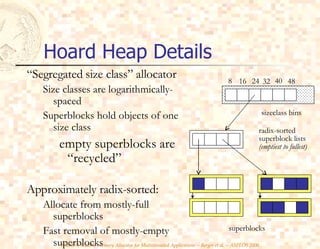
Hoard Heap Details “ Segregated size class” allocator Size classes are logarithmically-spaced Superblocks hold objects of one size class empty superblocks are “recycled” Approximately radix-sorted: Allocate from mostly-full superblocks Fast removal of mostly-empty superblocks 8 16 24 32 40 48 sizeclass bins radix-sorted superblock lists (emptiest to fullest) superblocks

Hoard: A Scalable Memory Allocator for Multithreaded Applications

  • 1.
    Hoard: A ScalableMemory Allocator for Multithreaded Applications Emery Berger , Kathryn McKinley * , Robert Blumofe, Paul Wilson Department of Computer Sciences * Department of Computer Science
  • 2.
    Motivation Parallel multithreadedprograms becoming prevalent web servers, search engines, database managers, etc. run on SMP’s for high performance often embarrassingly parallel Memory allocation is a bottleneck prevents scaling with number of processors
  • 3.
    Assessment Criteria forMultiprocessor Allocators Speed competitive with uniprocessor allocators on one processor Scalability performance linear with the number of processors Fragmentation (= max allocated / max in use) competitive with uniprocessor allocators worst-case and average-case
  • 4.
    Uniprocessor Allocators onMultiprocessors Fragmentation: Excellent Very low for most programs [Wilson & Johnstone] Speed & Scalability: Poor Heap contention a single lock protects the heap Can exacerbate false sharing different processors can share cache lines
  • 5.
    Allocator-Induced False SharingAllocators cause false sharing! Cache lines can end up spread across a number of processors Practically all allocators do this processor 1 processor 2 x2 = malloc(s); x1 = malloc(s); A cache line thrash… thrash…
  • 6.
    Existing Multiprocessor AllocatorsSpeed: One concurrent heap (e.g., concurrent B-tree): too expensive too many locks/atomic updates O(log n) cost per memory operation  Fast allocators use multiple heaps Scalability: Allocator-induced false sharing and other bottlenecks Fragmentation: P-fold increase or even unbounded
  • 7.
    Multiprocessor Allocator I:Pure Private Heaps Pure private heaps : one heap per processor. malloc gets memory from the processor's heap or the system free puts memory on the processor's heap Avoids heap contention Examples: STL, ad hoc (e.g., Cilk 4.1) x1= malloc(s) free(x1) free(x2) x3= malloc(s) x2= malloc(s) x4= malloc(s) processor 1 processor 2 = allocated by heap 1 = free, on heap 2
  • 8.
    How to BreakPure Private Heaps: Fragmentation Pure private heaps : memory consumption can grow without bound! Producer-consumer: processor 1 allocates processor 2 frees free(x1) x2= malloc(s) free(x2) x1= malloc(s) processor 1 processor 2 x3= malloc(s) free(x3)
  • 9.
    Multiprocessor Allocator II:Private Heaps with Ownership Private heaps with ownership: free puts memory back on the originating processor 's heap. Avoids unbounded memory consumption Examples: ptmalloc [Gloger], LKmalloc [Larson & Krishnan] x1= malloc(s) free(x1) free(x2) x2= malloc(s) processor 1 processor 2
  • 10.
    How to BreakPrivate Heaps with Ownership:Fragmentation Private heaps with ownership: memory consumption can blowup by a factor of P. Round-robin producer-consumer: processor i allocates processor i+1 frees This really happens (NDS). free(x2) free(x1) free(x3) x1= malloc(s) x2= malloc(s) x3=malloc(s) processor 1 processor 2 processor 3
  • 11.
    So What DoWe Do Now?
  • 12.
    The Hoard MultiprocessorMemory Allocator Manages memory in page-sized superblocks of same-sized objects - Avoids false sharing by not carving up cache lines - Avoids heap contention - local heaps allocate & free small blocks from their set of superblocks Adds a global heap that is a repository of superblocks When the fraction of free memory exceeds the empty fraction , moves superblocks to the global heap - Avoids blowup in memory consumption
  • 13.
    Hoard Example Hoard: one heap per processor + a global heap malloc gets memory from a superblock on its heap. free returns memory to its superblock . If the heap is “too empty”, it moves a superblock to the global heap. x1= malloc(s) processor 1 global heap free(x7) … some mallocs … some frees Empty fraction = 1/3
  • 14.
    Summary of AnalyticalResults Worst-case memory consumption: O(n log M/m + P ) [instead of O( P n log M/m)] n = memory required M = biggest object size m = smallest object size P = number of processors Best possible: O(n log M/m) [Robson] Provably low synchronization in most cases
  • 15.
    Experiments Run ona dedicated 14-processor Sun Enterprise 300 MHz UltraSparc, 1 GB of RAM Solaris 2.7 All programs compiled with g++ version 2.95.1 Allocators: Hoard version 2.0.2 Solaris (system allocator) Ptmalloc (GNU libc – private heaps with ownership) mtmalloc (Sun’s “MT-hot” allocator)
  • 16.
    Performance: threadtestspeedup (x,P) = runtime (Solaris allocator, one processor) / runtime (x on P processors)
  • 17.
    Performance: LarsonServer-style benchmark with sharing
  • 18.
    Performance: falsesharing Each thread reads & writes heap data
  • 19.
    Fragmentation Results Onmost standard uniprocessor benchmarks, Hoard’s fragmentation was low: p2c (Pascal-to-C): 1.20 espresso: 1.47 LRUsim : 1.05 Ghostscript : 1.15 Within 20% of Lea’s allocator On the multiprocessor benchmarks and other codes: Fragmentation was between 1.02 and 1.24 for all but one anomalous benchmark (shbench : 3.17) .
  • 20.
    Hoard Conclusions Speed: Excellent As fast as a uniprocessor allocator on one processor amortized O(1) cost 1 lock for malloc , 2 for free Scalability: Excellent Scales linearly with the number of processors Avoids false sharing Fragmentation: Very good Worst-case is provably close to ideal Actual observed fragmentation is low
  • 21.
    Hoard Heap Details“ Segregated size class” allocator Size classes are logarithmically-spaced Superblocks hold objects of one size class empty superblocks are “recycled” Approximately radix-sorted: Allocate from mostly-full superblocks Fast removal of mostly-empty superblocks 8 16 24 32 40 48 sizeclass bins radix-sorted superblock lists (emptiest to fullest) superblocks