Incentives and Reliefs R&D Patent Box
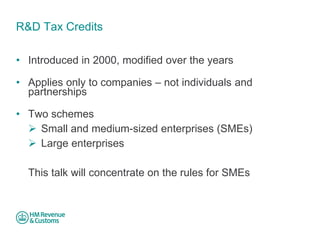
R&D Tax Credits 
• 
Introduced in 2000, modified over the years 
• 
Applies only to companies – not individuals and partnerships 
• 
Two schemes 
 
Small and medium-sized enterprises (SMEs) 
 
Large enterprises 
This talk will concentrate on the rules for SMEs
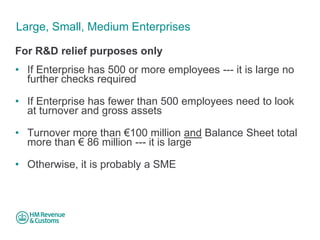
Large, Small, Medium Enterprises 
For R&D relief purposes only 
• 
If Enterprise has 500 or more employees --- it is large no further checks required 
• 
If Enterprise has fewer than 500 employees need to look at turnover and gross assets 
• 
Turnover more than €100 million and Balance Sheet total more than € 86 million --- it is large 
• 
Otherwise, it is probably a SME
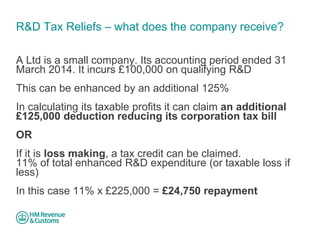
R&D Tax Reliefs – what does the company receive? 
A Ltd is a small company. Its accounting period ended 31 March 2014. It incurs £100,000 on qualifying R&D This can be enhanced by an additional 125% In calculating its taxable profits it can claim an additional £125,000 deduction reducing its corporation tax bill OR If it is loss making, a tax credit can be claimed. 11% of total enhanced R&D expenditure (or taxable loss if less) In this case 11% x £225,000 = £24,750 repayment
What is R&D for tax purposes 
• 
Statutory definition, but based on guidelines produced by BIS (Department for Business Innovation and Skills) 
• 
R&D takes place when a project seeks to achieve an advance in science or technology. It must be an overall advance, not just within the claimant company 
• 
Uncertainties that can be readily resolved by a competent professional working in the field are not scientific or technological uncertainties.
What can be claimed? 
• 
The staffing costs of those actually doing the R&D 
• 
Certain staffing costs of those supporting the R&D project 
• 
Consumable Items 
• 
Software 
• 
Subcontracted R&D costs 
• 
Cost of externally provided workers (EPW) 
• 
Capital Expenditure and Allowances – the RDA scheme
What can’t be claimed 
• 
Non R&D costs (general administrative and secretarial costs; general wages not specific to R&D: production costs; marketing costs) 
• 
Most consultancy payments 
• 
For SMEs expenditure covered by a grant (see next slide)
Grants and SMEs 
• 
If a grant is received for a project, it is necessary to determine whether it is a Notified State Aid 
• 
Receipt of a Notified State Aid affects all of a project’s costs; other grants and subsidies affect only the amount of the costs subsidised 
• 
If you can’t claim under the SME scheme – may be able to under the Large scheme (even if you are a SME) 
• 
From 1 April 2013 a tax credit may be available under the large scheme
Making a Claim 
• 
Time Limits – 2 years from the end of the accounting period. We rarely accept late claims 
• 
It helps us to understand your claim if you include a summary of R&D undertaken – for each project and relevant to year of claim 
• 
Breakdown of expenses – salaries; consumables; software; subcontractors; EPWs – and additional information for salaries/subcontractors/EPW
Patent Box from 1 April 2013 
Provides an additional incentive for UK companies to: 
– 
retain and commercialise existing patents and to develop new innovative patented products 
– 
locate the high-value jobs associated with the development, manufacture and exploitation of patents in the UK 
How? 
–Income derived from patents attracts a lower rate of corporation tax (10% by 2017)
And Finally…. 
Remember that the Incentive and Relief teams are there to help you with your claim Online guidance available from HMRC website If you are making a claim for a cash tax credit we will endeavour to pay it within 28 days or tell you why we cannot make the payment
Any Questions?

9 September 2014: HM Revenue & Customs

  • 1.
    Incentives and ReliefsR&D Patent Box
  • 2.
    R&D Tax Credits • Introduced in 2000, modified over the years • Applies only to companies – not individuals and partnerships • Two schemes  Small and medium-sized enterprises (SMEs)  Large enterprises This talk will concentrate on the rules for SMEs
  • 3.
    Large, Small, MediumEnterprises For R&D relief purposes only • If Enterprise has 500 or more employees --- it is large no further checks required • If Enterprise has fewer than 500 employees need to look at turnover and gross assets • Turnover more than €100 million and Balance Sheet total more than € 86 million --- it is large • Otherwise, it is probably a SME
  • 4.
    R&D Tax Reliefs– what does the company receive? A Ltd is a small company. Its accounting period ended 31 March 2014. It incurs £100,000 on qualifying R&D This can be enhanced by an additional 125% In calculating its taxable profits it can claim an additional £125,000 deduction reducing its corporation tax bill OR If it is loss making, a tax credit can be claimed. 11% of total enhanced R&D expenditure (or taxable loss if less) In this case 11% x £225,000 = £24,750 repayment
  • 5.
    What is R&Dfor tax purposes • Statutory definition, but based on guidelines produced by BIS (Department for Business Innovation and Skills) • R&D takes place when a project seeks to achieve an advance in science or technology. It must be an overall advance, not just within the claimant company • Uncertainties that can be readily resolved by a competent professional working in the field are not scientific or technological uncertainties.
  • 6.
    What can beclaimed? • The staffing costs of those actually doing the R&D • Certain staffing costs of those supporting the R&D project • Consumable Items • Software • Subcontracted R&D costs • Cost of externally provided workers (EPW) • Capital Expenditure and Allowances – the RDA scheme
  • 7.
    What can’t beclaimed • Non R&D costs (general administrative and secretarial costs; general wages not specific to R&D: production costs; marketing costs) • Most consultancy payments • For SMEs expenditure covered by a grant (see next slide)
  • 8.
    Grants and SMEs • If a grant is received for a project, it is necessary to determine whether it is a Notified State Aid • Receipt of a Notified State Aid affects all of a project’s costs; other grants and subsidies affect only the amount of the costs subsidised • If you can’t claim under the SME scheme – may be able to under the Large scheme (even if you are a SME) • From 1 April 2013 a tax credit may be available under the large scheme
  • 9.
    Making a Claim • Time Limits – 2 years from the end of the accounting period. We rarely accept late claims • It helps us to understand your claim if you include a summary of R&D undertaken – for each project and relevant to year of claim • Breakdown of expenses – salaries; consumables; software; subcontractors; EPWs – and additional information for salaries/subcontractors/EPW
  • 10.
    Patent Box from1 April 2013 Provides an additional incentive for UK companies to: – retain and commercialise existing patents and to develop new innovative patented products – locate the high-value jobs associated with the development, manufacture and exploitation of patents in the UK How? –Income derived from patents attracts a lower rate of corporation tax (10% by 2017)
  • 11.
    And Finally…. Rememberthat the Incentive and Relief teams are there to help you with your claim Online guidance available from HMRC website If you are making a claim for a cash tax credit we will endeavour to pay it within 28 days or tell you why we cannot make the payment
  • 12.