Helping Individuals Visualize Excellence
Mission Statement
• The Mission of

elping ndividuals isualize xcellence (

)

is to provide highly effective and accessible Behavioral Health
Services, restoring hope and improving the quality of life for At-Risk

youth ages 11-17, their families and our communities.
•

http://www.daytopnj.org/
Theoretical Model of the Group
is a short-term program lasting between 3 to 5 weekly
sessions, typically lasting about three months. Sessions are
conducted in a community setting to the whole family and are
provided by trained and supervised interventionists. The program
strives to improve family communication by promoting positive
family interactions. It assists family members in adopting positive
solutions to family problems by recognizing that they can be related
to factors involving school, peers, healthy decision-making skills. A
major goal of
is to utilize the family's strengths to help build
positive interactions within the family as well as within the
community. The services we provide include family therapy, case
management and educational advocacy.

• (sheildsforfamily.org) access 10/22/2013
Theoretical Model- Family Systems Theory
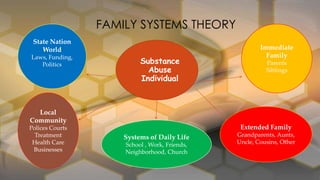
• A person who is abusing substances influences a number of
systems. These systems also interact with each other. (CHART)
• The theory focuses attention on the family because the interactions
in the family are among the most powerful forces in a person’s life
and are most easily available for observation and intervention The
family context therefore provides a unique resource for creating
change.
• The Therapist role is to empower the family and help everyone to
behave responsibly and helpfully.
• McCollum, E.E., and Trepper, T.S. Family Solutions for Substance
Abuse: Clinical and Counseling Approaches. Binghamton, NY:
Haworth Press, 2001.
FAMILY SYSTEMS THEORY
State Nation
World
Laws, Funding,
Politics

• Substance
Abuse
Individual

Immediate
Family
Parents
Siblings

Local
Community
Polices Courts
Treatment
Health Care
Businesses

Extended Family
Systems of Daily Life
School , Work, Friends,
Neighborhood, Church

Grandparents, Aunts,
Uncle, Cousins, Other
Functional Therapy System
• Functional Family Therapy (FFT) is a
prevention/intervention program for youth who have
demonstrated a range of maladaptive, acting out
behaviors and related syndromes. Intervention services
consist primarily of direct contact with family members,
in person and telephone; however, services may be
coupled with supportive system services such as remedial
education, job training and placement and school
placement. Some youth are also assigned trackers who
advocate for these youth for a period of at least three
months after release.
Family Roles Activity
Think of a bad
experience from your
life that still affects you
now. Imagine that
some part of you ran
away because of the
pain of that experience.

Identify what part of
you ran away: strength,
joy, confidence,
peacefulness, power,
pride, courage, trust in
others, self-esteem, etc.
(http://www.expressivetherapist.com/group-activities.html)

• Part I

Process Questions:

• Draw, color, or paint a picture of
how that part of you looks or feels
when it is in its full and healthy
state.

• How did you feel

• Part II
• Write a letter to that part of you,
asking it to return. Make your own
letter or use the following sample:
• "Dear ____, I know you left because
of ____. It is now safe for you to
return because ____. I promise to
make sure it stays safe by _____. I
miss you and I need you in my life
because _____. Please return so I
can be whole. Love, ____"
If desired, write a response letter
from the missing part

recapturing those old
feelings?

•How does it feel to give
yourself permission to feel
those feelings again?
• How does it feel to get
rid of those negative
feelings?
Co-Dependency Behavior Activity
“Letting go doesn't
mean bout someone
anymore. It's just
realizing that the
only person you
really have control
over is yourself.”Deborah Reber

• Write down five goals you have for the
future.
• Once done label how many of these goals are
for yourself and how many are related to
your family member.
• Process Questions:

– Was there a discrepancy between the number of
goals you had for yourself and the ones you had
for your family member?
– Why do you have less/more goals for yourself or
for the family member?
– What can you do to help each other accomplish
their own goals?
Objective:
–Learn to focus on our own goals/future and help
each other along the way.
Children of Alcoholics Activity
Serenity
God grant me the
serenity to accept the
things I can't change,
the courage to change
the things I can, and
the wisdom to know the
difference.

Make two lists:
• "The things I can change"
• "The things I can't change."
• On side, list the “Things you can
and can't change in your life.
• On another sheet of paper, draw
how your life would look after you
successfully changed the things on
your list, "The things I can change."

•

(http://www.expressivetherapist.com/group-activities.html)

Process Questions:

• Which side did you find the
easiest to come up with a list?
• Are you willing to make
whatever adjustments to your
list of “The things I can
change?”
• How will these changes affect
my future?
Evidence-Based Intervention
• In a Utah study, FFT families showed significant improvement compared to no
treatment and alternative treatment groups in rates of re-offense (26% versus
47%-73%), juvenile court records of siblings of targeted youth (20% versus 40%63%), and recidivism among serious delinquent youth (60% versus 89%-93).
• In an Ohio study, FFT families showed significant improvement compared to
usual services in recidivism after 28 months (11% versus 67%) and after 60
months (9% versus 41%).
• In a Swedish study with a 2-year follow-up, FFT families showed improvement
compared to a usual-treatment group in recidivism (41% versus 82%) and in
youth and parent reports of externalizing and internalizing symptoms.
• In a Washington State study, FFT families who worked with a competent
therapist showed significant improvement in 18-month recidivism (44% versus
50%-54%) compared to families in control groups or working with not competent
therapists.

• A meta-analysis of effect size for eight evaluations of FFT (Aos et al., 2011) reported an
adjusted mean effect size of 32.
Evidence Based Intervention
• A study of New Jersey youth with behavior problems
showed improvement from FFT relative to others
receiving individual therapy or mentoring in
–life domain functioning related to family, school, and
vocation;
–child behavioral/emotional needs (impulsivity,
depression, anxiety, anger control, substance abuse), and
–child risk behaviors (suicide risk, self-mutilation, danger
to others, sexual aggression, running away, delinquency,
fire setting).
Program Treatment Referrals
OPTIONS Counseling
9 W. Broadway
Paterson, NJ 07505
973-345-1883
DAYTOP
80 W Main St
Mendham, NJ 07945
973- 543-5656
Carrier Care
252 County Road 601,
Belle Mead, NJ 08502
800-933-3579

New Pathways Counseling
20 Powers Dr
Paramus, NJ 07652
201-262-1382

• Giant Step Program
H 61 Monroe Street
Hoboken, NJ 07030
201-792-8290
• North Hudson Community
Corp
5301 Broadway
West New York
201-866-9320
• Mt. Carmel Guild Behavioral
Healthcare
2201 Bergenline Avenue
Union City, NJ 07087
201-558-3700
• Palisades Counseling Center
7600 River Rd,
North Bergen, NJ 07047
201-854-5000

High Focus Centers
70 Eisenhower Dr.
Paramus, NJ 07652
(201) 291-0055
Christ Hospital Adolescent
Treatment (CHAT)
179 Palisade Avenue
Jersey City, NJ 07306
(201) 795-8375
Inter County Council on
Drug/Alcohol Abuse
480 Kearny Avenue
Kearny 07032
(201) 998-7422
Child Protection Services
• The Division of Children and Family Services (DCF)
DCF Office of Adolescent Services
PO Box 717
Trenton, NJ 08625-0717
609-888-7100
dcf_adolescentservices@dcf.state.nj.us

• Child Protective and Permanency
Hudson Central LO- #470
438 Summit Avenue, 4th Floor
Jersey City, NJ 07306
201-795-0423
800-982-7397
Fax: 201-217-7010
Passaic North LO - #472
100 Hamilton Plaza, 11th Floor
Paterson, NJ 07505
973-523-6090
800-847-1743
Fax: 973-977-6026/6027
Manager - Maria Rios
http://www.nj.gov/dcf/contact/dcpplocal/

• (www.state.nj.us) access 10/22/2013
References
• (sheildsforfamily.org) access 10/22/2013

• (http://www.expressivetherapist.com/group-activities.html)
• http://www.daytopnj.org/ accessed on 11/23/2013
• (www.state.nj.us) access 10/22/2013

Hive presentation njcu

  • 1.
  • 2.
    Mission Statement • TheMission of elping ndividuals isualize xcellence ( ) is to provide highly effective and accessible Behavioral Health Services, restoring hope and improving the quality of life for At-Risk youth ages 11-17, their families and our communities. • http://www.daytopnj.org/
  • 3.
    Theoretical Model ofthe Group is a short-term program lasting between 3 to 5 weekly sessions, typically lasting about three months. Sessions are conducted in a community setting to the whole family and are provided by trained and supervised interventionists. The program strives to improve family communication by promoting positive family interactions. It assists family members in adopting positive solutions to family problems by recognizing that they can be related to factors involving school, peers, healthy decision-making skills. A major goal of is to utilize the family's strengths to help build positive interactions within the family as well as within the community. The services we provide include family therapy, case management and educational advocacy. • (sheildsforfamily.org) access 10/22/2013
  • 4.
    Theoretical Model- FamilySystems Theory • A person who is abusing substances influences a number of systems. These systems also interact with each other. (CHART) • The theory focuses attention on the family because the interactions in the family are among the most powerful forces in a person’s life and are most easily available for observation and intervention The family context therefore provides a unique resource for creating change. • The Therapist role is to empower the family and help everyone to behave responsibly and helpfully. • McCollum, E.E., and Trepper, T.S. Family Solutions for Substance Abuse: Clinical and Counseling Approaches. Binghamton, NY: Haworth Press, 2001.
  • 5.
    FAMILY SYSTEMS THEORY StateNation World Laws, Funding, Politics • Substance Abuse Individual Immediate Family Parents Siblings Local Community Polices Courts Treatment Health Care Businesses Extended Family Systems of Daily Life School , Work, Friends, Neighborhood, Church Grandparents, Aunts, Uncle, Cousins, Other
  • 6.
    Functional Therapy System •Functional Family Therapy (FFT) is a prevention/intervention program for youth who have demonstrated a range of maladaptive, acting out behaviors and related syndromes. Intervention services consist primarily of direct contact with family members, in person and telephone; however, services may be coupled with supportive system services such as remedial education, job training and placement and school placement. Some youth are also assigned trackers who advocate for these youth for a period of at least three months after release.
  • 7.
    Family Roles Activity Thinkof a bad experience from your life that still affects you now. Imagine that some part of you ran away because of the pain of that experience. Identify what part of you ran away: strength, joy, confidence, peacefulness, power, pride, courage, trust in others, self-esteem, etc. (http://www.expressivetherapist.com/group-activities.html) • Part I Process Questions: • Draw, color, or paint a picture of how that part of you looks or feels when it is in its full and healthy state. • How did you feel • Part II • Write a letter to that part of you, asking it to return. Make your own letter or use the following sample: • "Dear ____, I know you left because of ____. It is now safe for you to return because ____. I promise to make sure it stays safe by _____. I miss you and I need you in my life because _____. Please return so I can be whole. Love, ____" If desired, write a response letter from the missing part recapturing those old feelings? •How does it feel to give yourself permission to feel those feelings again? • How does it feel to get rid of those negative feelings?
  • 8.
    Co-Dependency Behavior Activity “Lettinggo doesn't mean bout someone anymore. It's just realizing that the only person you really have control over is yourself.”Deborah Reber • Write down five goals you have for the future. • Once done label how many of these goals are for yourself and how many are related to your family member. • Process Questions: – Was there a discrepancy between the number of goals you had for yourself and the ones you had for your family member? – Why do you have less/more goals for yourself or for the family member? – What can you do to help each other accomplish their own goals? Objective: –Learn to focus on our own goals/future and help each other along the way.
  • 9.
    Children of AlcoholicsActivity Serenity God grant me the serenity to accept the things I can't change, the courage to change the things I can, and the wisdom to know the difference. Make two lists: • "The things I can change" • "The things I can't change." • On side, list the “Things you can and can't change in your life. • On another sheet of paper, draw how your life would look after you successfully changed the things on your list, "The things I can change." • (http://www.expressivetherapist.com/group-activities.html) Process Questions: • Which side did you find the easiest to come up with a list? • Are you willing to make whatever adjustments to your list of “The things I can change?” • How will these changes affect my future?
  • 10.
    Evidence-Based Intervention • Ina Utah study, FFT families showed significant improvement compared to no treatment and alternative treatment groups in rates of re-offense (26% versus 47%-73%), juvenile court records of siblings of targeted youth (20% versus 40%63%), and recidivism among serious delinquent youth (60% versus 89%-93). • In an Ohio study, FFT families showed significant improvement compared to usual services in recidivism after 28 months (11% versus 67%) and after 60 months (9% versus 41%). • In a Swedish study with a 2-year follow-up, FFT families showed improvement compared to a usual-treatment group in recidivism (41% versus 82%) and in youth and parent reports of externalizing and internalizing symptoms. • In a Washington State study, FFT families who worked with a competent therapist showed significant improvement in 18-month recidivism (44% versus 50%-54%) compared to families in control groups or working with not competent therapists. • A meta-analysis of effect size for eight evaluations of FFT (Aos et al., 2011) reported an adjusted mean effect size of 32.
  • 11.
    Evidence Based Intervention •A study of New Jersey youth with behavior problems showed improvement from FFT relative to others receiving individual therapy or mentoring in –life domain functioning related to family, school, and vocation; –child behavioral/emotional needs (impulsivity, depression, anxiety, anger control, substance abuse), and –child risk behaviors (suicide risk, self-mutilation, danger to others, sexual aggression, running away, delinquency, fire setting).
  • 12.
    Program Treatment Referrals OPTIONSCounseling 9 W. Broadway Paterson, NJ 07505 973-345-1883 DAYTOP 80 W Main St Mendham, NJ 07945 973- 543-5656 Carrier Care 252 County Road 601, Belle Mead, NJ 08502 800-933-3579 New Pathways Counseling 20 Powers Dr Paramus, NJ 07652 201-262-1382 • Giant Step Program H 61 Monroe Street Hoboken, NJ 07030 201-792-8290 • North Hudson Community Corp 5301 Broadway West New York 201-866-9320 • Mt. Carmel Guild Behavioral Healthcare 2201 Bergenline Avenue Union City, NJ 07087 201-558-3700 • Palisades Counseling Center 7600 River Rd, North Bergen, NJ 07047 201-854-5000 High Focus Centers 70 Eisenhower Dr. Paramus, NJ 07652 (201) 291-0055 Christ Hospital Adolescent Treatment (CHAT) 179 Palisade Avenue Jersey City, NJ 07306 (201) 795-8375 Inter County Council on Drug/Alcohol Abuse 480 Kearny Avenue Kearny 07032 (201) 998-7422
  • 13.
    Child Protection Services •The Division of Children and Family Services (DCF) DCF Office of Adolescent Services PO Box 717 Trenton, NJ 08625-0717 609-888-7100 dcf_adolescentservices@dcf.state.nj.us • Child Protective and Permanency Hudson Central LO- #470 438 Summit Avenue, 4th Floor Jersey City, NJ 07306 201-795-0423 800-982-7397 Fax: 201-217-7010 Passaic North LO - #472 100 Hamilton Plaza, 11th Floor Paterson, NJ 07505 973-523-6090 800-847-1743 Fax: 973-977-6026/6027 Manager - Maria Rios http://www.nj.gov/dcf/contact/dcpplocal/ • (www.state.nj.us) access 10/22/2013
  • 14.
    References • (sheildsforfamily.org) access10/22/2013 • (http://www.expressivetherapist.com/group-activities.html) • http://www.daytopnj.org/ accessed on 11/23/2013 • (www.state.nj.us) access 10/22/2013