hiv and opportunistic infections
PRESENTED BY
SOWPARNIKA TREASA SABU
1ST YEAR MPHARM PHARMACY PRACTICE
GOVERNMENT MEDICAL COLLEGE, TRIVANDRUM.
HIV (Human
immunodeficiency virus)
• RNA retrovirus of the
genes lentivirus that infects
and destroys viral cells of
the human immune system,
such as helper T cells.
[CD4+ cells]
•HIV-1 : most common.
•HIV-2 :limited to West
Africa.
•It causes AIDS
Opportunistic infection
•Infections that are uncommon except when they are given an
opportunity to infect a person, disrupted gut flora, a penetrating
injury, weakened immune system etc.
•Most life threatening ,when CD4 count is below 200 cells/mm3
•Main cause of death for people with HIV/AIDS.
STAGES OF HIV
1)
PRIMARY
2)
ASYMPTOMAT
IC
3)
SYMPTOMAT
IC
4) HIV
to AIDS
•Short, flu
like illness-
occurs 1-6
weeks after
infection.
•No
symptoms.
•Infected
person can
infect other
people.
•Last for average
of 10 years.
•No symptoms.
•May be swollen
glands.
•The level of HIV
in blood very low.
•HIV antibodies
detectable in
blood.
•Mild
symptoms.
•Immune
system
deteriorate.
•Emergence of
opportunistic
infection and
cancers.
•Immune
system
weakens.
•The
illness
more
severe
leading
to AIDS
•AIDS-
Disease caused by reterovirus HIV and
characterised by profound immunosuppression that leads
to opportunistic infection, secondary malignancies and
neurological manifestations.
EPIDEMIOLOGY
•Worldwide about 34-36 million adult and children
infected with HIV.
•Occurs in all ages.
•All areas of the country are affected.
•In some cities, as many as 50% of males are HIV
positive .
•AIDS is now the second leading cause of death for all
men aged 25-44 years.
ETIOLOGY
There are 3 primary modes.
1) Sexual intercourse.
2) Parenteral.
• Contaminated needles
• Drug abusers.
• Occupationally
acquiring
3) Perinatal infection.
• From mother to child
• Breast feeding by
infected mother
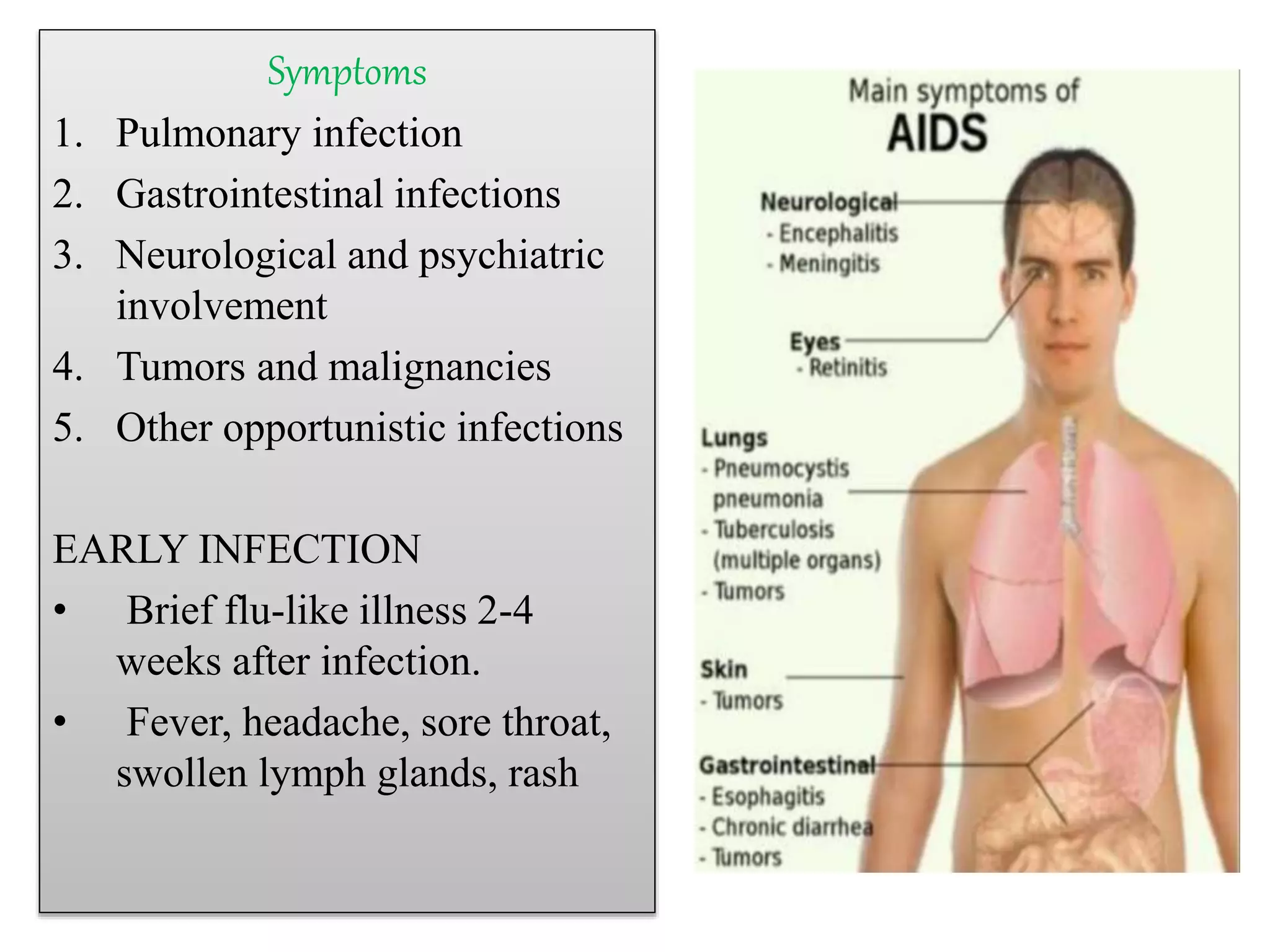
Symptoms
1. Pulmonary infection
2. Gastrointestinal infections
3. Neurological and psychiatric
involvement
4. Tumors and malignancies
5. Other opportunistic infections
EARLY INFECTION
• Brief flu-like illness 2-4
weeks after infection.
• Fever, headache, sore throat,
swollen lymph glands, rash
pathophysiology
PATHOPHYSIOLOGY
1. Gp 120 of virus attach with target cell- 1 ⁰
attachment.
2. Co receptor activate and GP 41 slip on side and
enter to membrane – Fusion
3. After fusion uncoating and viral capsid enter to
target cell.
4. Viral Genetic material RNA by reverse transcriptase
enzyme converted to DNA- Reverse transcription.
5. Integration of viral DNA to target DNA and become
its functional part forever – integration
6. Transcription- DNA to genomic RNA and messenger
RNA
7. Translation – RNA to protien
8. Assembly of all material (DNA, Genes-Gag,pol)for new
cell.
9. Budding- as buds new viral cells come out.
10. Releases new viral cell and lipid membrane is taken
from the host cell.
11. Maturation by protease enzyme, result new viral cell .
DIAGNOSIS
•Test blood or saliva for antibodies to the virus (12 weeks)
•Test for HIV antigen, protein produced by the virus immediately
after infection.
Test to stage disease and treatment
CD4 T cell count-
•CD4 T cells are white blood cells that are specifically
targeted and destroyed by HIV.
•HIV to AIDS, if count below 200
Viral load (HIV RNA)
•Test amount of virus in blood
•Higher level linked to a worse outcome
Drug resistance
•Some strains of HIV are resistant to medication.
TREATMENT
NON PHARMACOLOGICAL THERAPY
•Patient education.
•Lifestyle modification.
•Sympathetic attitude, family and public support.
•Take adequate rest and diet rich in protiens and vitamins.
•Smoking cessation
•Stop drinking alcohol
•Do regular excercise or yoga
PHARMACOLOGICAL THERAPY
GOALS OF THERAPY
•Improving quality and duration of life
•Preventing deterioration of immune function
•Restoring immune status.
•Preventing and or treating opportunistic infection.
•Relieving symptoms.
ALGORITHM-ASSESSMENT AND MONITORING OF CHRONIC HIV
1. Antiretoviral therapy
2. Treatment of opportunistic infection
3. Malignancies
4. Neurological manifestation
1. ANTIRETOVIRAL THERAPY
i. Nucloeside analogue reverse transcriptase inhibitors
• M/A – phosphorylated intracellularly , inhibit viral
reverse transcriptase enzyme by acting as a false
substrate.
• A/E :peripheral neuropathy, pancreatitis, hepatitis,
mitochondrial toxicity
Eg: Abacavir -300 mg bd
Combivir – one tab bd (300mg zidovudine+150mg
lamivudine)
Lamivudine-150 mg bd or 300mg od
Stavudine-if > 60 kg 40mg bd; <60 kg 30mg bd
Zidovudine- 250 mg bd
• Combinations: zidovudine + lamivudine
Zidovudine +lamivudine +abacavir
ii. Non Nucloeside analogue reverse transcriptase inhibitors
• M/A-Inhibit reverse transcriptase enzyme by binding to its
active site.
• A/E :rash, fever, nausea, diarrhoea, hepato-toxicity
• Eg: Efavirenz – 600mg od
Nevirapine – 200 mg od 1st 2 week,
then 200 mg bd
iii. Protease inhibitors
• M/A -Bind to the active site of HIV-1 protease enzyme,
preventing the maturation of newly produced virions so
that they remain non- infectious.
• A/E –Lipidystrophy, GI intolerance, hyperglycaemia, lipid
abnormalities
• Eg; Atazanavir-300mg od
Darunavir-600 mg bd
Fosamprenavir -700mg bd
Ritonavir -100-200 mg od-bd; boost other protease
inhibitors
indinavir-800 mg every 8h with ritonavir
iv. Entry inhibitors
a) Fusion inhibitor
• M/A –Block the structural rearrangement of HIV-1 gp 41
and thus stop the fusion of viral cell membrane with the
target cell membrane, preventing viral RNA from entering
the cell
• Eg: Enfuvirtide -90 mg bd every 12 h
• A/E- Injection site reaction common, insomnia, headache
b) CCR5 inhibitor
• M/A – selectively bind to the human chemokine receptor
CCR5 preventing CCR5 tropic HIV from entering cell.
• Eg: Maraviroc -150,300mg used when resistant to one or
more other retroviral classes
v. Integrase inhibitors
• M/A- bind to integrase enzyme thus blocking the
integration of viral DNA into host DNA
• Eg:Raltegravir-400mg bd
• A/E-Nausea, headache, Vertigo, abdominal pain, flatulence
2. TREATMENT OF OPPORTUNISTIC INFECTION
A. Fungal infection
p.Jiroveci pneumonia
• Symptoms: non productive cough, shortness of breath, fever,
anorexia, weight loss
• Diagnosis :exercise induced oxygen desaturation, chest-
radiography, confirmed by silver staining .
• Treatment : high dose cotrimoxazole for 21 days.
• Mild- oral 1920 mg tid
• Moderate to severe –IV :120mg/kg/day for 3 days then,
90mg/kg/day for 18 days
B. Protozoal infection
Toxoplasmosis
• T .gondii cause of CNS disease in patient with AIDS
• Symptoms: Headache, fever, confusion, seizure
• Diagnosis: ring enhancing lesion on CT scan, brain biopsy
• Treatment: sulphadiazine with pyrimethamine with folinic
acid to prevent myelo suppression for 6 weeks, maintainence
therapy with lower dose same drug until CD4 maintained above
200cells/mm3
C. Bacterial infection
Mycobacterium TB
• symptoms: rapid progression
• Diagnosis :culture of organism
• Treatment: CNS TB- isoniazid, rifampicin, pyrazinamide,
ethambutol for 2 month
•Followed by isoniazid, rifampicin for atleast 10 months.
D. Viral infection
Cytomegalovirus- herpes virus
• Site of infection- retina, GIT
• Diagnosis-clinical appearance
• Symptoms: blurred vision, visual field defect and ultimately
blindness
drug induction maintanence
Ganciclovir 5mg/kg 6mg/kg on 5day
a week
Valganciclovir 900mg bd 900mg od
3) MALIGNANCIES
A. kaposi`s sarcoma-
• Common with HIV infection and trigerred by HHV-8
• Symptoms :lesion affect the skin and appear as raised purple
papules
• Severe: oedema, ulceration, infection
• Treatment :cosmetic camouflage, antiretroviral therapy
B. Lymphomas
• High grade B-cell type
• Primary CNS lymphoma is common
• Diagnosis :biopsy
• HAART reduce incidence of all lymphoma
4) NEUROLOGICAL MANIFESTATION
• Due to opportunistic infection, tumours, primary neurological
effects of HIV
• HIV encephalopathy or AIDS Dementia Complex (ADC) BY
HIV infection on CNS
• Symptoms :amnesia, cognitive dysfunction
• Reduced incidence due to use of HAART
5) HEPATITIS B,C -CO INFECTION
HIV can impact on HBV and HCV INFECTION
•HB vaccine, HC Therapy less succesful and responsive
•Chronic and high level of virus
•Progression to cirrhosis
•Hepatocellular carcinoma
•Treatment of HB-HAART REGIMEN WITH 2 anti hepatic B agent
.eg: tenofovir with lamivudine
5) Women with HIV
• Specific issues
 Cervical screening- carried out atleast annually to check
gynaecological manifestation
 Drug toxicity
Eg:nevirapine – breast feeding
• interaction between antiretroviral and oral and injectable
contraceptive agent.
•Potential teratogenecity
•Increased toxicity to mother and child.
•Use of ARV and other strategies to reduce transmission of HIV
from mother to child.
•Treatment-
Risk/benefit evaluation
HAART
Zidovudine when viaral load low <10,000 cpies/ml
If < 10,000 copies/ml- start by 26 week
>10,000- start by 20 week
32,000- start without delay
Avoid breast feeding.
ART to new born for 4 weeks after birth.
Reference
1. Clinical pharmacy and therapeutics by Roger Walker and Cate
Whittlesea 5th edition page no:621-51.
Hiv and opportunistic infection

Hiv and opportunistic infection

  • 1.
    hiv and opportunisticinfections PRESENTED BY SOWPARNIKA TREASA SABU 1ST YEAR MPHARM PHARMACY PRACTICE GOVERNMENT MEDICAL COLLEGE, TRIVANDRUM.
  • 2.
    HIV (Human immunodeficiency virus) •RNA retrovirus of the genes lentivirus that infects and destroys viral cells of the human immune system, such as helper T cells. [CD4+ cells] •HIV-1 : most common. •HIV-2 :limited to West Africa. •It causes AIDS
  • 3.
    Opportunistic infection •Infections thatare uncommon except when they are given an opportunity to infect a person, disrupted gut flora, a penetrating injury, weakened immune system etc. •Most life threatening ,when CD4 count is below 200 cells/mm3 •Main cause of death for people with HIV/AIDS.
  • 4.
    STAGES OF HIV 1) PRIMARY 2) ASYMPTOMAT IC 3) SYMPTOMAT IC 4)HIV to AIDS •Short, flu like illness- occurs 1-6 weeks after infection. •No symptoms. •Infected person can infect other people. •Last for average of 10 years. •No symptoms. •May be swollen glands. •The level of HIV in blood very low. •HIV antibodies detectable in blood. •Mild symptoms. •Immune system deteriorate. •Emergence of opportunistic infection and cancers. •Immune system weakens. •The illness more severe leading to AIDS
  • 5.
    •AIDS- Disease caused byreterovirus HIV and characterised by profound immunosuppression that leads to opportunistic infection, secondary malignancies and neurological manifestations.
  • 6.
    EPIDEMIOLOGY •Worldwide about 34-36million adult and children infected with HIV. •Occurs in all ages. •All areas of the country are affected. •In some cities, as many as 50% of males are HIV positive . •AIDS is now the second leading cause of death for all men aged 25-44 years.
  • 7.
    ETIOLOGY There are 3primary modes. 1) Sexual intercourse. 2) Parenteral. • Contaminated needles • Drug abusers. • Occupationally acquiring 3) Perinatal infection. • From mother to child • Breast feeding by infected mother
  • 8.
    Symptoms 1. Pulmonary infection 2.Gastrointestinal infections 3. Neurological and psychiatric involvement 4. Tumors and malignancies 5. Other opportunistic infections EARLY INFECTION • Brief flu-like illness 2-4 weeks after infection. • Fever, headache, sore throat, swollen lymph glands, rash
  • 9.
  • 10.
    PATHOPHYSIOLOGY 1. Gp 120of virus attach with target cell- 1 ⁰ attachment. 2. Co receptor activate and GP 41 slip on side and enter to membrane – Fusion 3. After fusion uncoating and viral capsid enter to target cell. 4. Viral Genetic material RNA by reverse transcriptase enzyme converted to DNA- Reverse transcription. 5. Integration of viral DNA to target DNA and become its functional part forever – integration 6. Transcription- DNA to genomic RNA and messenger RNA 7. Translation – RNA to protien
  • 11.
    8. Assembly ofall material (DNA, Genes-Gag,pol)for new cell. 9. Budding- as buds new viral cells come out. 10. Releases new viral cell and lipid membrane is taken from the host cell. 11. Maturation by protease enzyme, result new viral cell .
  • 12.
    DIAGNOSIS •Test blood orsaliva for antibodies to the virus (12 weeks) •Test for HIV antigen, protein produced by the virus immediately after infection.
  • 13.
    Test to stagedisease and treatment CD4 T cell count- •CD4 T cells are white blood cells that are specifically targeted and destroyed by HIV. •HIV to AIDS, if count below 200 Viral load (HIV RNA) •Test amount of virus in blood •Higher level linked to a worse outcome Drug resistance •Some strains of HIV are resistant to medication.
  • 14.
    TREATMENT NON PHARMACOLOGICAL THERAPY •Patienteducation. •Lifestyle modification. •Sympathetic attitude, family and public support. •Take adequate rest and diet rich in protiens and vitamins. •Smoking cessation •Stop drinking alcohol •Do regular excercise or yoga
  • 15.
    PHARMACOLOGICAL THERAPY GOALS OFTHERAPY •Improving quality and duration of life •Preventing deterioration of immune function •Restoring immune status. •Preventing and or treating opportunistic infection. •Relieving symptoms.
  • 16.
  • 17.
    1. Antiretoviral therapy 2.Treatment of opportunistic infection 3. Malignancies 4. Neurological manifestation
  • 19.
    1. ANTIRETOVIRAL THERAPY i.Nucloeside analogue reverse transcriptase inhibitors • M/A – phosphorylated intracellularly , inhibit viral reverse transcriptase enzyme by acting as a false substrate. • A/E :peripheral neuropathy, pancreatitis, hepatitis, mitochondrial toxicity Eg: Abacavir -300 mg bd Combivir – one tab bd (300mg zidovudine+150mg lamivudine) Lamivudine-150 mg bd or 300mg od Stavudine-if > 60 kg 40mg bd; <60 kg 30mg bd Zidovudine- 250 mg bd
  • 20.
    • Combinations: zidovudine+ lamivudine Zidovudine +lamivudine +abacavir ii. Non Nucloeside analogue reverse transcriptase inhibitors • M/A-Inhibit reverse transcriptase enzyme by binding to its active site. • A/E :rash, fever, nausea, diarrhoea, hepato-toxicity • Eg: Efavirenz – 600mg od Nevirapine – 200 mg od 1st 2 week, then 200 mg bd
  • 21.
    iii. Protease inhibitors •M/A -Bind to the active site of HIV-1 protease enzyme, preventing the maturation of newly produced virions so that they remain non- infectious. • A/E –Lipidystrophy, GI intolerance, hyperglycaemia, lipid abnormalities • Eg; Atazanavir-300mg od Darunavir-600 mg bd Fosamprenavir -700mg bd Ritonavir -100-200 mg od-bd; boost other protease inhibitors indinavir-800 mg every 8h with ritonavir
  • 22.
    iv. Entry inhibitors a)Fusion inhibitor • M/A –Block the structural rearrangement of HIV-1 gp 41 and thus stop the fusion of viral cell membrane with the target cell membrane, preventing viral RNA from entering the cell • Eg: Enfuvirtide -90 mg bd every 12 h • A/E- Injection site reaction common, insomnia, headache b) CCR5 inhibitor • M/A – selectively bind to the human chemokine receptor CCR5 preventing CCR5 tropic HIV from entering cell. • Eg: Maraviroc -150,300mg used when resistant to one or more other retroviral classes
  • 23.
    v. Integrase inhibitors •M/A- bind to integrase enzyme thus blocking the integration of viral DNA into host DNA • Eg:Raltegravir-400mg bd • A/E-Nausea, headache, Vertigo, abdominal pain, flatulence
  • 24.
    2. TREATMENT OFOPPORTUNISTIC INFECTION A. Fungal infection p.Jiroveci pneumonia • Symptoms: non productive cough, shortness of breath, fever, anorexia, weight loss • Diagnosis :exercise induced oxygen desaturation, chest- radiography, confirmed by silver staining . • Treatment : high dose cotrimoxazole for 21 days. • Mild- oral 1920 mg tid • Moderate to severe –IV :120mg/kg/day for 3 days then, 90mg/kg/day for 18 days
  • 25.
    B. Protozoal infection Toxoplasmosis •T .gondii cause of CNS disease in patient with AIDS • Symptoms: Headache, fever, confusion, seizure • Diagnosis: ring enhancing lesion on CT scan, brain biopsy • Treatment: sulphadiazine with pyrimethamine with folinic acid to prevent myelo suppression for 6 weeks, maintainence therapy with lower dose same drug until CD4 maintained above 200cells/mm3 C. Bacterial infection Mycobacterium TB • symptoms: rapid progression • Diagnosis :culture of organism • Treatment: CNS TB- isoniazid, rifampicin, pyrazinamide, ethambutol for 2 month
  • 26.
    •Followed by isoniazid,rifampicin for atleast 10 months. D. Viral infection Cytomegalovirus- herpes virus • Site of infection- retina, GIT • Diagnosis-clinical appearance • Symptoms: blurred vision, visual field defect and ultimately blindness drug induction maintanence Ganciclovir 5mg/kg 6mg/kg on 5day a week Valganciclovir 900mg bd 900mg od
  • 27.
    3) MALIGNANCIES A. kaposi`ssarcoma- • Common with HIV infection and trigerred by HHV-8 • Symptoms :lesion affect the skin and appear as raised purple papules • Severe: oedema, ulceration, infection • Treatment :cosmetic camouflage, antiretroviral therapy B. Lymphomas • High grade B-cell type • Primary CNS lymphoma is common • Diagnosis :biopsy • HAART reduce incidence of all lymphoma
  • 28.
    4) NEUROLOGICAL MANIFESTATION •Due to opportunistic infection, tumours, primary neurological effects of HIV • HIV encephalopathy or AIDS Dementia Complex (ADC) BY HIV infection on CNS • Symptoms :amnesia, cognitive dysfunction • Reduced incidence due to use of HAART 5) HEPATITIS B,C -CO INFECTION HIV can impact on HBV and HCV INFECTION •HB vaccine, HC Therapy less succesful and responsive •Chronic and high level of virus •Progression to cirrhosis •Hepatocellular carcinoma •Treatment of HB-HAART REGIMEN WITH 2 anti hepatic B agent .eg: tenofovir with lamivudine
  • 29.
    5) Women withHIV • Specific issues  Cervical screening- carried out atleast annually to check gynaecological manifestation  Drug toxicity Eg:nevirapine – breast feeding • interaction between antiretroviral and oral and injectable contraceptive agent. •Potential teratogenecity •Increased toxicity to mother and child. •Use of ARV and other strategies to reduce transmission of HIV from mother to child.
  • 30.
    •Treatment- Risk/benefit evaluation HAART Zidovudine whenviaral load low <10,000 cpies/ml If < 10,000 copies/ml- start by 26 week >10,000- start by 20 week 32,000- start without delay Avoid breast feeding. ART to new born for 4 weeks after birth.
  • 31.
    Reference 1. Clinical pharmacyand therapeutics by Roger Walker and Cate Whittlesea 5th edition page no:621-51.