Migration &
Empire,
1830-1939
Scottish emigration –
Pull Factors
In today’s class I am learning to:
• Identify factors which attracted Scots
to emigrate during the 1800s-1900s
• Explain why each factor led to Scottish
emigration
Scottish emigration – Pull Factors
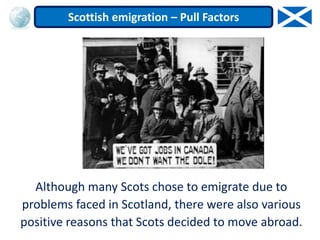
Although many Scots chose to emigrate due to
problems faced in Scotland, there were also various
positive reasons that Scots decided to move abroad.
Scottish emigration – Pull Factors
Pull factors are when
people are attracted to
move elsewhere by the
prospect of a better life in
their new homes.
Scots were encouraged to
move due to employment,
higher wages, land,
family, religion and better
housing.
Scottish emigration – Pull Factors
Job
opportunities
Scottish emigration – Pull Factors
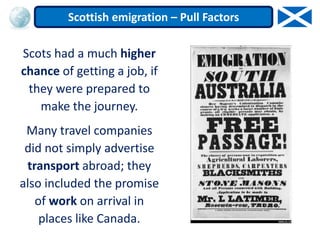
Scots had a much higher
chance of getting a job, if
they were prepared to
make the journey.
Many travel companies
did not simply advertise
transport abroad; they
also included the promise
of work on arrival in
places like Canada.
Scottish emigration – Pull Factors
Scots used their skills -
such as factory work and
trades - to get jobs in their
new homes.
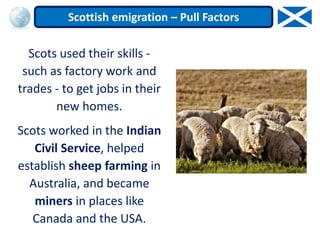
Scots worked in the Indian
Civil Service, helped
establish sheep farming in
Australia, and became
miners in places like
Canada and the USA.
Scottish emigration – Pull Factors
It was not just manual or
industrial workers that
emigrated – professionals
were recruited too.
British and Colonial
governments encouraged
doctors, lawyers and
teachers to travel, often
due to guaranteed jobs or
better wages.
Scottish emigration – Pull Factors
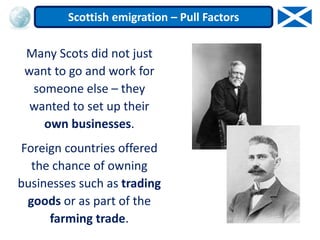
Many Scots did not just
want to go and work for
someone else – they
wanted to set up their
own businesses.
Foreign countries offered
the chance of owning
businesses such as trading
goods or as part of the
farming trade.
Scottish emigration – Pull Factors
Many famous businesses
were set up and have links
to Scottish emigrants.
Andrew Buick from
Arbroath made the
famous Buick car. The son
of a Scottish emigrant in
Australia founded a
chocolate company which
makes Freddos.
Scottish emigration – Pull Factors
Wages and
money
Scottish emigration – Pull Factors
Britain’s Empire colonies
needed workers with a
variety of skills, including
farmers, factory workers,
miners and professionals.
One of the ways that they
tried to attract these
people was with the
promise of higher wages
than in Scotland.
Scottish emigration – Pull Factors
On average, emigrant
Scots with a job could
expect to earn more
overseas than they could
back home.
For instance, in the late
1800s, granite workers in
the USA could earn more
than three times their
income in Scotland.
Scottish emigration – Pull Factors
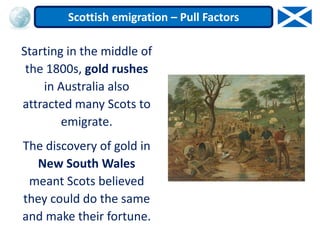
Starting in the middle of
the 1800s, gold rushes
in Australia also
attracted many Scots to
emigrate.
The discovery of gold in
New South Wales
meant Scots believed
they could do the same
and make their fortune.
Scottish emigration – Pull Factors
Free or cheap
land
Scottish emigration – Pull Factors
Many Scottish emigrants
were farmers who lived in
poverty, with too little
land to make a living.
In the Highlands they lived
on land owned by
someone else, and lived
with the risk of paying
higher rents or being
evicted from their homes.
Scottish emigration – Pull Factors
Countries such as Canada
and Australia needed
experienced farmers to
grow crops on their land.
Emigrant Scots were
offered cheap or even free
land if they travelled,
allowing them to become
a landowner and giving
security against eviction.
Scottish emigration – Pull Factors
The Scots made great use
of these opportunities.
Scots helped develop
Australia’s wool industry,
and Scottish farmers
prospered in parts of
Canada because they had
experience growing crops
and tending animals in a
similar climate.
Scottish emigration – Pull Factors
Better
housing
Scottish emigration – Pull Factors
Many emigrant Scots had
the chance of better
housing abroad.
Scottish housing included
problems such as
overcrowding (including in
single ends), low quality
buildings, poor sanitation
and also the spread of
disease.
Scottish emigration – Pull Factors
Some Scots found their
new homes had less
illness, partly because
many of the sickest
people could not make
the long journey.
Others had homes built for
them, like Dr John
Hutchison in Canada, his
town’s first doctor.
Scottish emigration – Pull Factors
Many farms and towns
abroad came with homes
already built.
Starting in the 1800s, the
Canadian Pacific Railroad
company offered ready-
made farms in the west of
Canada to encourage
Scots to move across the
country.
Scottish emigration – Pull Factors
Other Scots had better
housing standards
because they were able to
build their own.
Farming Scots who were
given free or cheap land
built their own homes,
and could do this to a
higher standard than they
had previously had.
Scottish emigration – Pull Factors
Family and
friends
Scottish emigration – Pull Factors
Family and friends played
a crucial role in attracting
Scots to move to other
countries.
People in Scotland often
received letters from
abroad describing better
lives abroad and
encouraging them to make
the journey too.
Scottish emigration – Pull Factors
Family and friends were
also able to help arrange
jobs and housing for
emigrant Scots before they
had even travelled.
In addition, knowing
people overseas meant
that Scots knew they could
continue their culture,
such as religion.
Scottish emigration – Pull Factors
Scots used these links to
keep a connection with
Scotland.
Sports such as Highland
Games were played, and
Scottish groups such as
Caledonian Societies were
set up. Presbyterian
churches were also
opened.
Scottish emigration – Pull Factors
Religious
reasons
Scottish emigration – Pull Factors
Some Scots chose to
journey abroad due to
their religious faith.
They believed it was their
duty to spread the
Christian message around
the world, and so travelled
to parts of the Empire
where Christianity was not
properly established.
Scottish emigration – Pull Factors
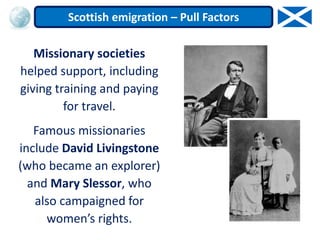
Missionary societies
helped support, including
giving training and paying
for travel.
Famous missionaries
include David Livingstone
(who became an explorer)
and Mary Slessor, who
also campaigned for
women’s rights.
Scottish emigration – Pull Factors
Other Scots travelled to
help fellow Scots continue
to practise their religion
faith.
Scottish churches – such
as Presbyterian churches
– were opened in
countries around the
world, including Australia
and New Zealand.

Scottish emigration – Pull Factors
Steam ship
travel
Scottish emigration – Pull Factors
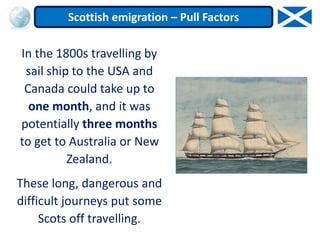
In the 1800s travelling by
sail ship to the USA and
Canada could take up to
one month, and it was
potentially three months
to get to Australia or New
Zealand.

These long, dangerous and
difficult journeys put some
Scots off travelling.
Scottish emigration – Pull Factors
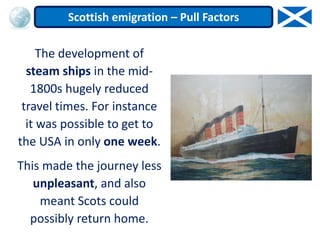
The development of
steam ships in the mid-
1800s hugely reduced
travel times. For instance
it was possible to get to
the USA in only one week.
This made the journey less
unpleasant, and also
meant Scots could
possibly return home.
Scottish emigration – Pull Factors
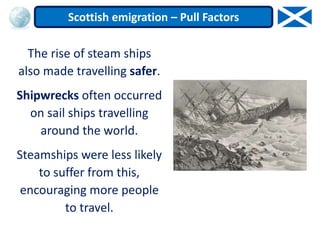
The rise of steam ships
also made travelling safer.
Shipwrecks often occurred
on sail ships travelling
around the world.
Steamships were less likely
to suffer from this,
encouraging more people
to travel.

Scottish emigration – Pull Factors
Help to
travel
Scottish emigration – Pull Factors
Many Scots wanted better
lives but did not know
how to get this.
Colonial governments
used different methods to
encourage them to move.
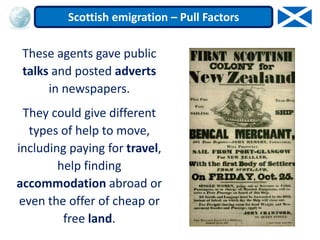
Recruiting agents were
hired by colonial
governments.
Scottish emigration – Pull Factors
These agents gave public
talks and posted adverts
in newspapers.
They could give different
types of help to move,
including paying for travel,
help finding
accommodation abroad or
even the offer of cheap or
free land.
Scottish emigration – Pull Factors
Britain’s government
provided different types of
help, including paying for
land for those that
emigrated, or giving them
tickets to travel.
The government also
provided training courses
to give people the skills
they needed to move.
Scottish emigration – Pull Factors
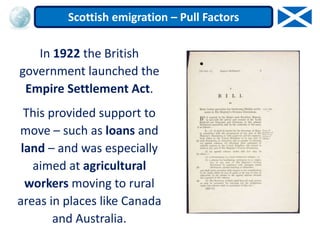
In 1922 the British
government launched the
Empire Settlement Act.
This provided support to
move – such as loans and
land – and was especially
aimed at agricultural
workers moving to rural
areas in places like Canada
and Australia.
Scottish emigration – Pull Factors

Higher Migration and Empire - Pull factors (Emigration)

  • 1.
  • 2.
    In today’s classI am learning to: • Identify factors which attracted Scots to emigrate during the 1800s-1900s • Explain why each factor led to Scottish emigration Scottish emigration – Pull Factors
  • 3.
    Although many Scotschose to emigrate due to problems faced in Scotland, there were also various positive reasons that Scots decided to move abroad. Scottish emigration – Pull Factors
  • 4.
    Pull factors arewhen people are attracted to move elsewhere by the prospect of a better life in their new homes. Scots were encouraged to move due to employment, higher wages, land, family, religion and better housing. Scottish emigration – Pull Factors
  • 5.
  • 6.
    Scots had amuch higher chance of getting a job, if they were prepared to make the journey. Many travel companies did not simply advertise transport abroad; they also included the promise of work on arrival in places like Canada. Scottish emigration – Pull Factors
  • 7.
    Scots used theirskills - such as factory work and trades - to get jobs in their new homes. Scots worked in the Indian Civil Service, helped establish sheep farming in Australia, and became miners in places like Canada and the USA. Scottish emigration – Pull Factors
  • 8.
    It was notjust manual or industrial workers that emigrated – professionals were recruited too. British and Colonial governments encouraged doctors, lawyers and teachers to travel, often due to guaranteed jobs or better wages. Scottish emigration – Pull Factors
  • 9.
    Many Scots didnot just want to go and work for someone else – they wanted to set up their own businesses. Foreign countries offered the chance of owning businesses such as trading goods or as part of the farming trade. Scottish emigration – Pull Factors
  • 10.
    Many famous businesses wereset up and have links to Scottish emigrants. Andrew Buick from Arbroath made the famous Buick car. The son of a Scottish emigrant in Australia founded a chocolate company which makes Freddos. Scottish emigration – Pull Factors
  • 11.
  • 12.
    Britain’s Empire colonies neededworkers with a variety of skills, including farmers, factory workers, miners and professionals. One of the ways that they tried to attract these people was with the promise of higher wages than in Scotland. Scottish emigration – Pull Factors
  • 13.
    On average, emigrant Scotswith a job could expect to earn more overseas than they could back home. For instance, in the late 1800s, granite workers in the USA could earn more than three times their income in Scotland. Scottish emigration – Pull Factors
  • 14.
    Starting in themiddle of the 1800s, gold rushes in Australia also attracted many Scots to emigrate. The discovery of gold in New South Wales meant Scots believed they could do the same and make their fortune. Scottish emigration – Pull Factors
  • 15.
    Free or cheap land Scottishemigration – Pull Factors
  • 16.
    Many Scottish emigrants werefarmers who lived in poverty, with too little land to make a living. In the Highlands they lived on land owned by someone else, and lived with the risk of paying higher rents or being evicted from their homes. Scottish emigration – Pull Factors
  • 17.
    Countries such asCanada and Australia needed experienced farmers to grow crops on their land. Emigrant Scots were offered cheap or even free land if they travelled, allowing them to become a landowner and giving security against eviction. Scottish emigration – Pull Factors
  • 18.
    The Scots madegreat use of these opportunities. Scots helped develop Australia’s wool industry, and Scottish farmers prospered in parts of Canada because they had experience growing crops and tending animals in a similar climate. Scottish emigration – Pull Factors
  • 19.
  • 20.
    Many emigrant Scotshad the chance of better housing abroad. Scottish housing included problems such as overcrowding (including in single ends), low quality buildings, poor sanitation and also the spread of disease. Scottish emigration – Pull Factors
  • 21.
    Some Scots foundtheir new homes had less illness, partly because many of the sickest people could not make the long journey. Others had homes built for them, like Dr John Hutchison in Canada, his town’s first doctor. Scottish emigration – Pull Factors
  • 22.
    Many farms andtowns abroad came with homes already built. Starting in the 1800s, the Canadian Pacific Railroad company offered ready- made farms in the west of Canada to encourage Scots to move across the country. Scottish emigration – Pull Factors
  • 23.
    Other Scots hadbetter housing standards because they were able to build their own. Farming Scots who were given free or cheap land built their own homes, and could do this to a higher standard than they had previously had. Scottish emigration – Pull Factors
  • 24.
  • 25.
    Family and friendsplayed a crucial role in attracting Scots to move to other countries. People in Scotland often received letters from abroad describing better lives abroad and encouraging them to make the journey too. Scottish emigration – Pull Factors
  • 26.
    Family and friendswere also able to help arrange jobs and housing for emigrant Scots before they had even travelled. In addition, knowing people overseas meant that Scots knew they could continue their culture, such as religion. Scottish emigration – Pull Factors
  • 27.
    Scots used theselinks to keep a connection with Scotland. Sports such as Highland Games were played, and Scottish groups such as Caledonian Societies were set up. Presbyterian churches were also opened. Scottish emigration – Pull Factors
  • 28.
  • 29.
    Some Scots choseto journey abroad due to their religious faith. They believed it was their duty to spread the Christian message around the world, and so travelled to parts of the Empire where Christianity was not properly established. Scottish emigration – Pull Factors
  • 30.
    Missionary societies helped support,including giving training and paying for travel. Famous missionaries include David Livingstone (who became an explorer) and Mary Slessor, who also campaigned for women’s rights. Scottish emigration – Pull Factors
  • 31.
    Other Scots travelledto help fellow Scots continue to practise their religion faith. Scottish churches – such as Presbyterian churches – were opened in countries around the world, including Australia and New Zealand. Scottish emigration – Pull Factors
  • 32.
  • 33.
    In the 1800stravelling by sail ship to the USA and Canada could take up to one month, and it was potentially three months to get to Australia or New Zealand. These long, dangerous and difficult journeys put some Scots off travelling. Scottish emigration – Pull Factors
  • 34.
    The development of steamships in the mid- 1800s hugely reduced travel times. For instance it was possible to get to the USA in only one week. This made the journey less unpleasant, and also meant Scots could possibly return home. Scottish emigration – Pull Factors
  • 35.
    The rise ofsteam ships also made travelling safer. Shipwrecks often occurred on sail ships travelling around the world. Steamships were less likely to suffer from this, encouraging more people to travel. Scottish emigration – Pull Factors
  • 36.
  • 37.
    Many Scots wantedbetter lives but did not know how to get this. Colonial governments used different methods to encourage them to move. Recruiting agents were hired by colonial governments. Scottish emigration – Pull Factors
  • 38.
    These agents gavepublic talks and posted adverts in newspapers. They could give different types of help to move, including paying for travel, help finding accommodation abroad or even the offer of cheap or free land. Scottish emigration – Pull Factors
  • 39.
    Britain’s government provided differenttypes of help, including paying for land for those that emigrated, or giving them tickets to travel. The government also provided training courses to give people the skills they needed to move. Scottish emigration – Pull Factors
  • 40.
    In 1922 theBritish government launched the Empire Settlement Act. This provided support to move – such as loans and land – and was especially aimed at agricultural workers moving to rural areas in places like Canada and Australia. Scottish emigration – Pull Factors