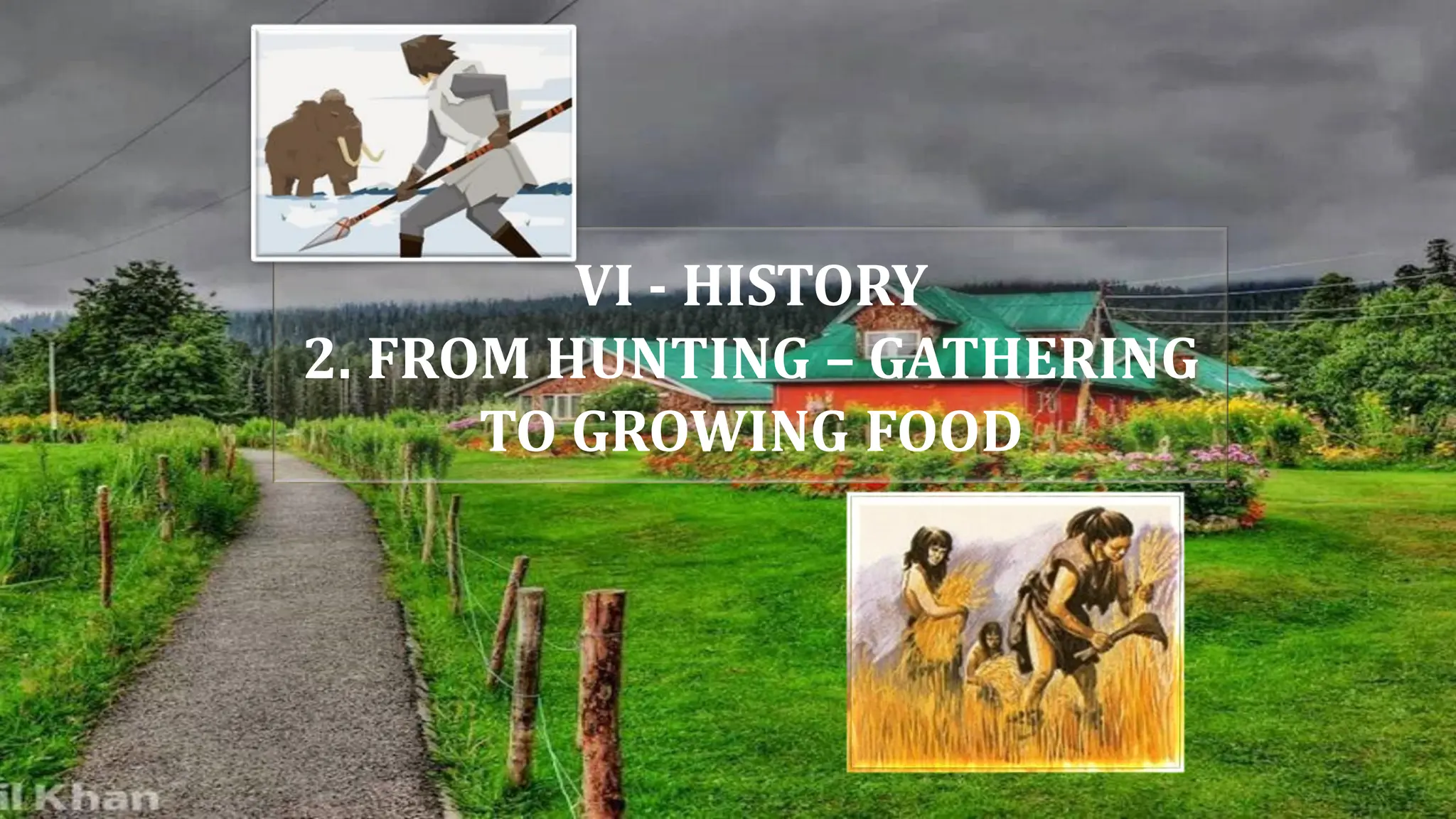
VI - HISTORY
2. FROM HUNTING – GATHERING
TO GROWING FOOD
HUNTER -
GATHERER
Hunted animals, birds
and caught fish
Gathered food like
nuts, roots, fruits,
seeds leaves,
stalks and eggs
Made tools of stone
wood and bones
Lived near
water sources
like river and
caves
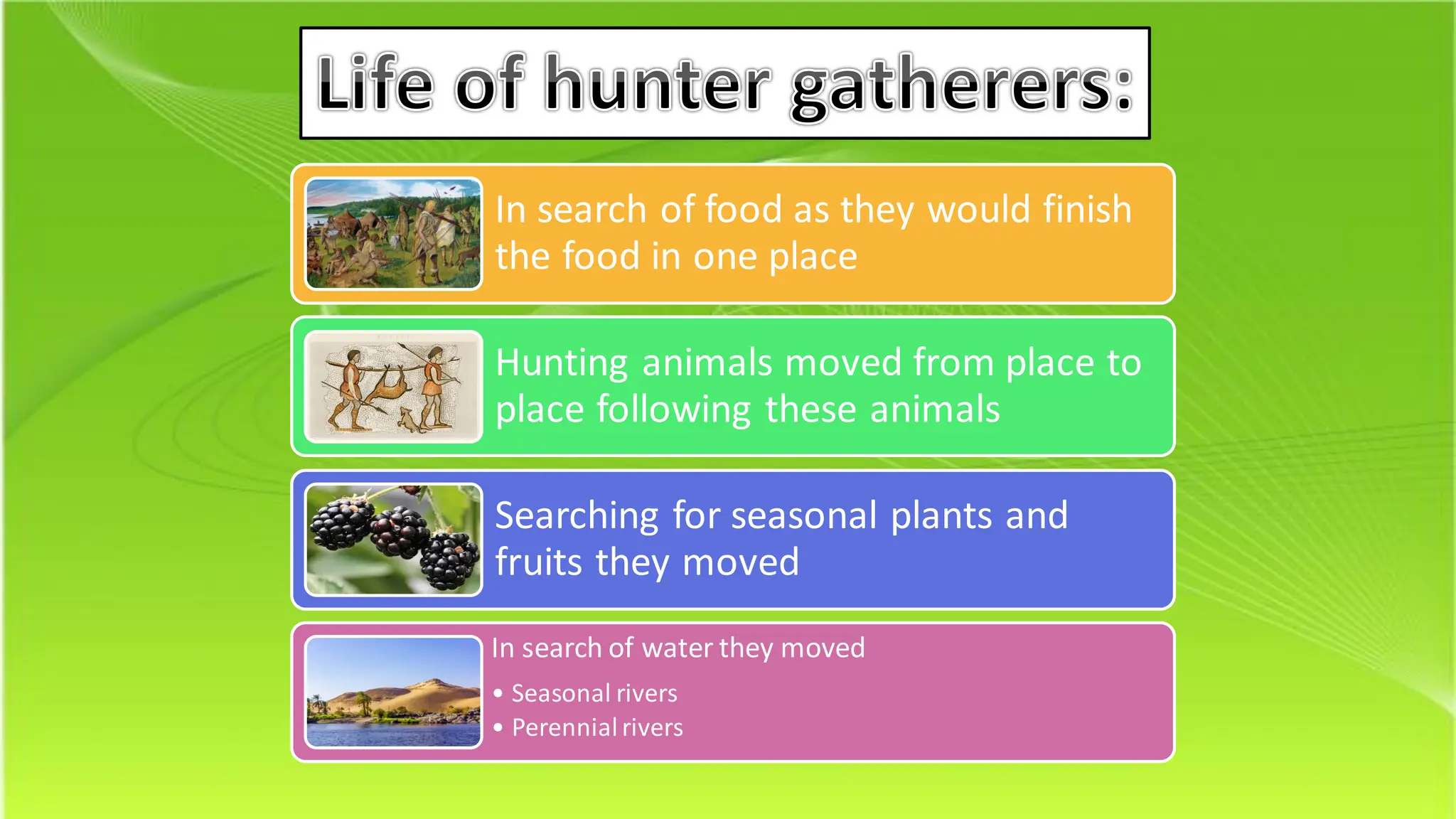
Life of hunter gatherers:
In search of food as they would finish
the food in one place
Hunting animals moved from place to
place following these animals
Searching for seasonal plants and
fruits they moved
In search of water they moved
• Seasonal rivers
• Perennialrivers
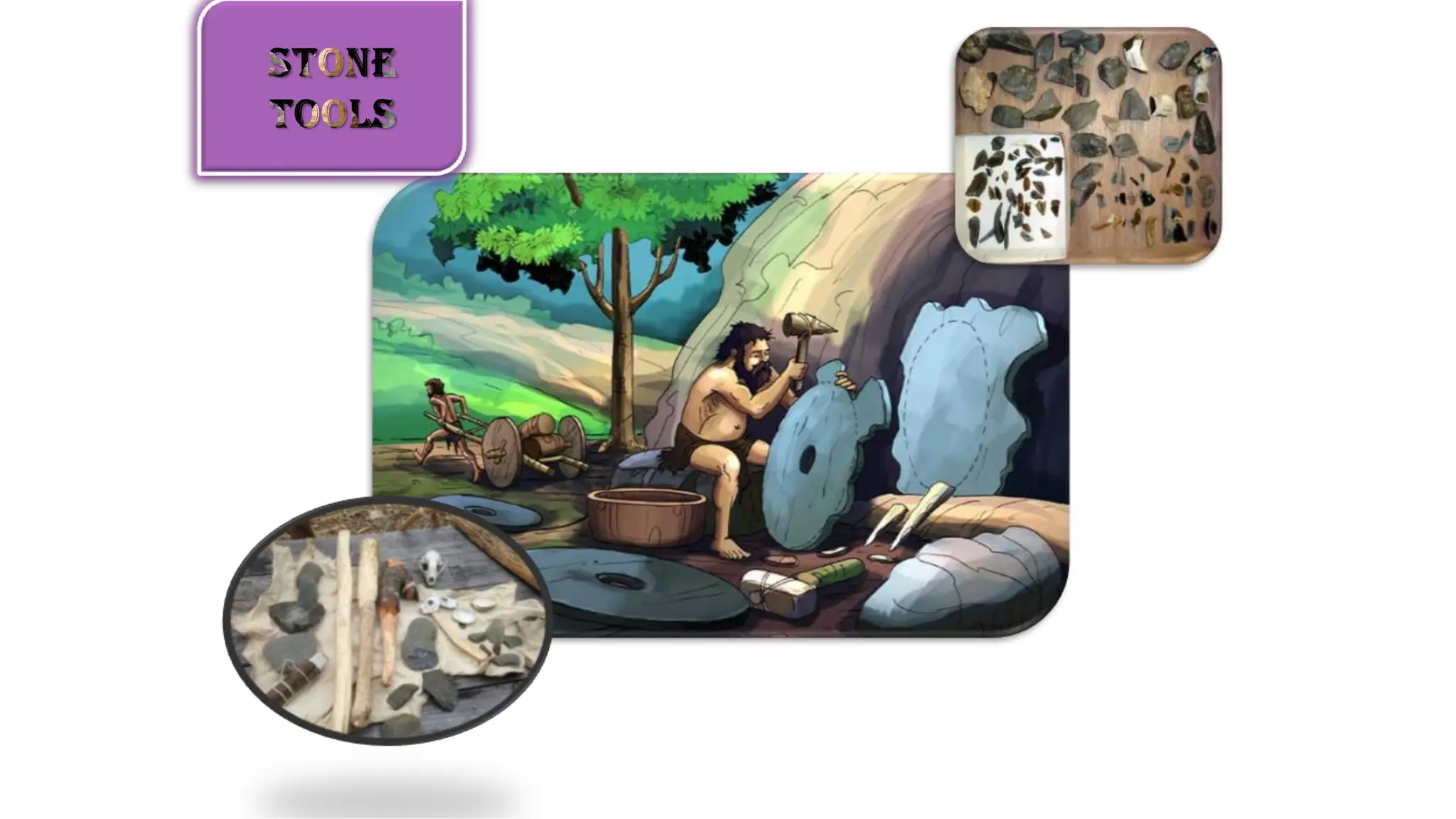
STONE
TOOLS
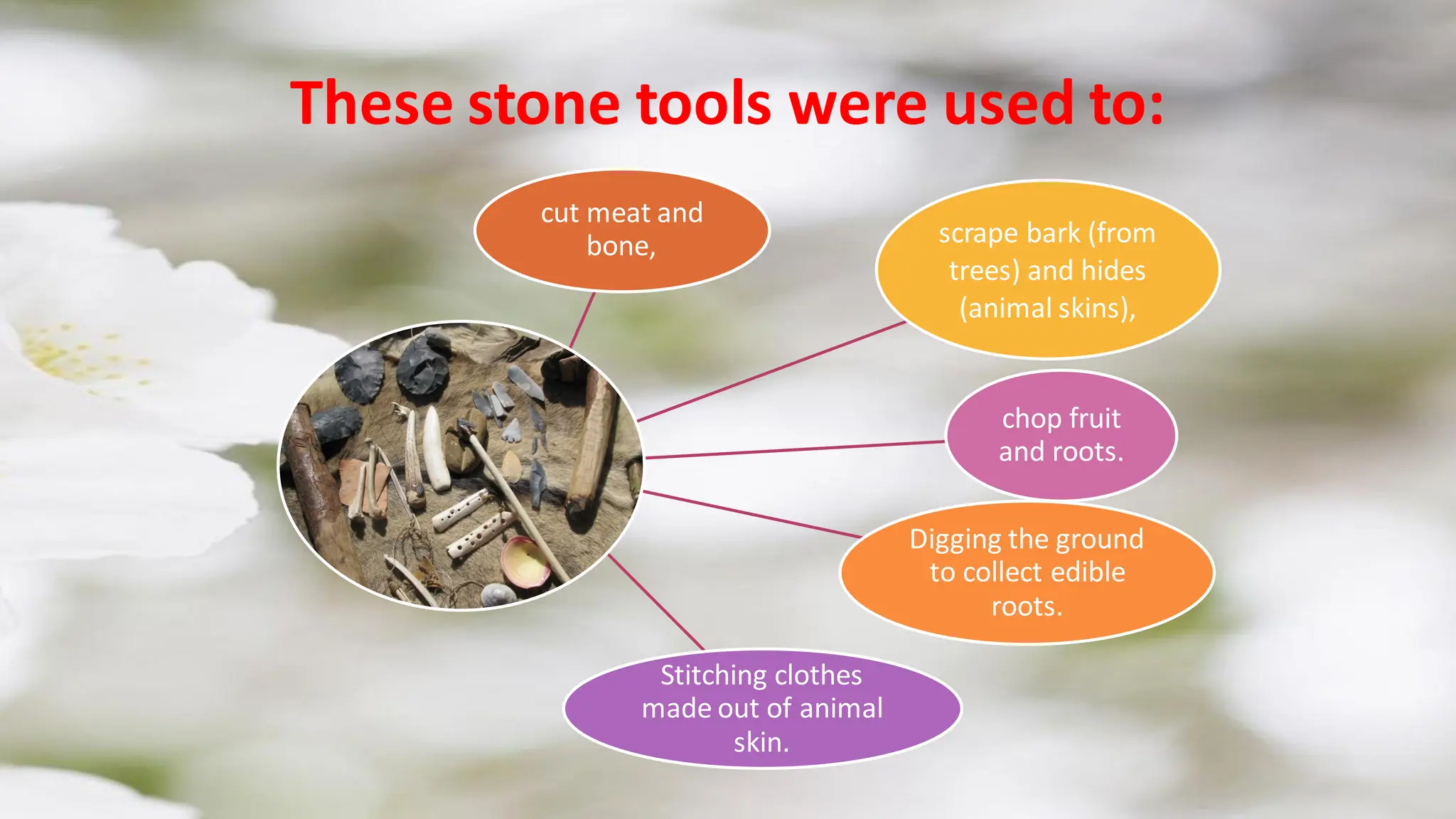
cut meat and
bone, scrape bark (from
trees) and hides
(animal skins),
chop fruit
and roots.
Digging the ground
to collect edible
roots.
Stitching clothes
made out of animal
skin.
These stone tools were used to:
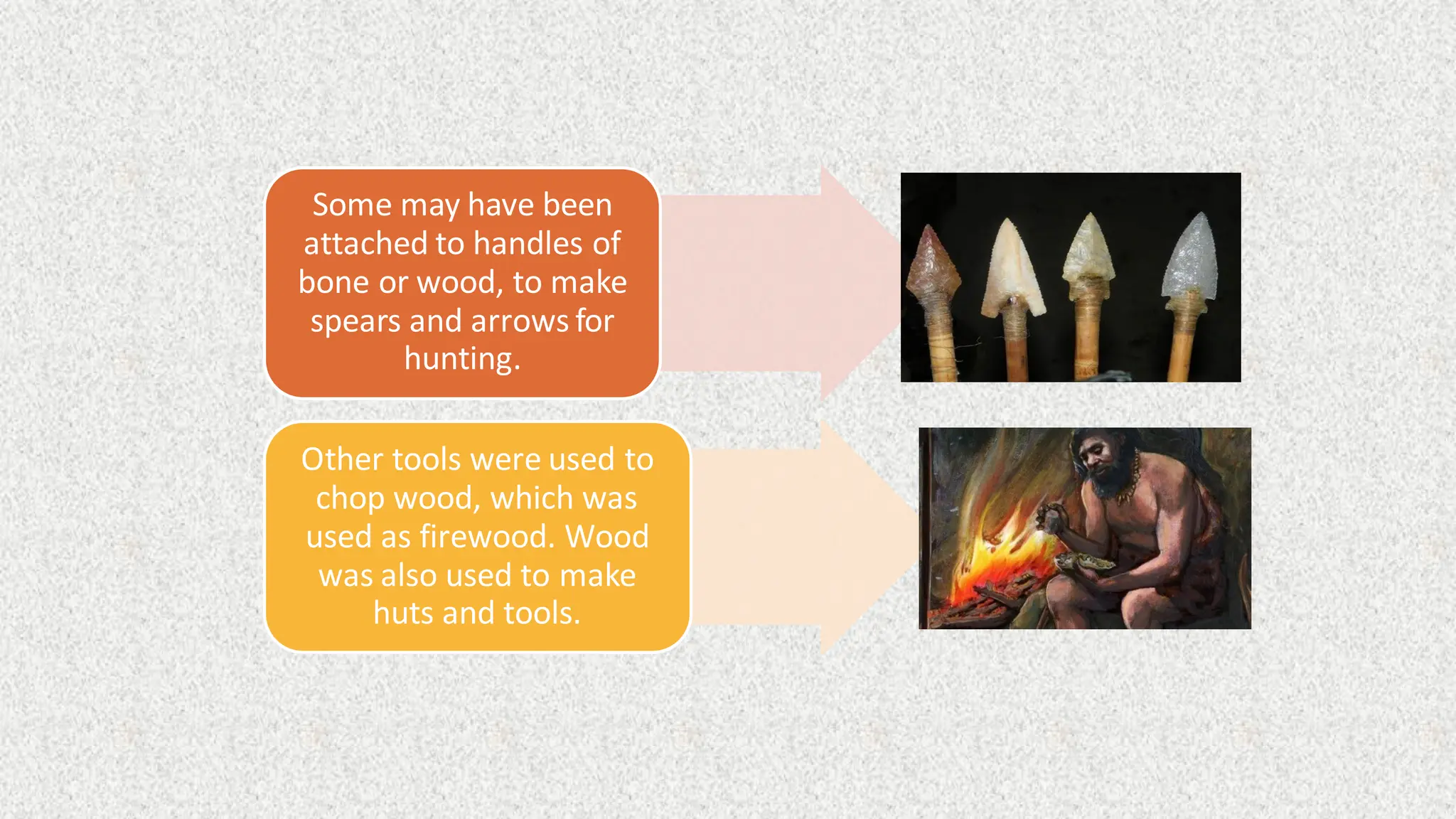
Some may have been
attached to handles of
bone or wood, to make
spears and arrows for
hunting.
Other tools were used to
chop wood, which was
used as firewood. Wood
was also used to make
huts and tools.
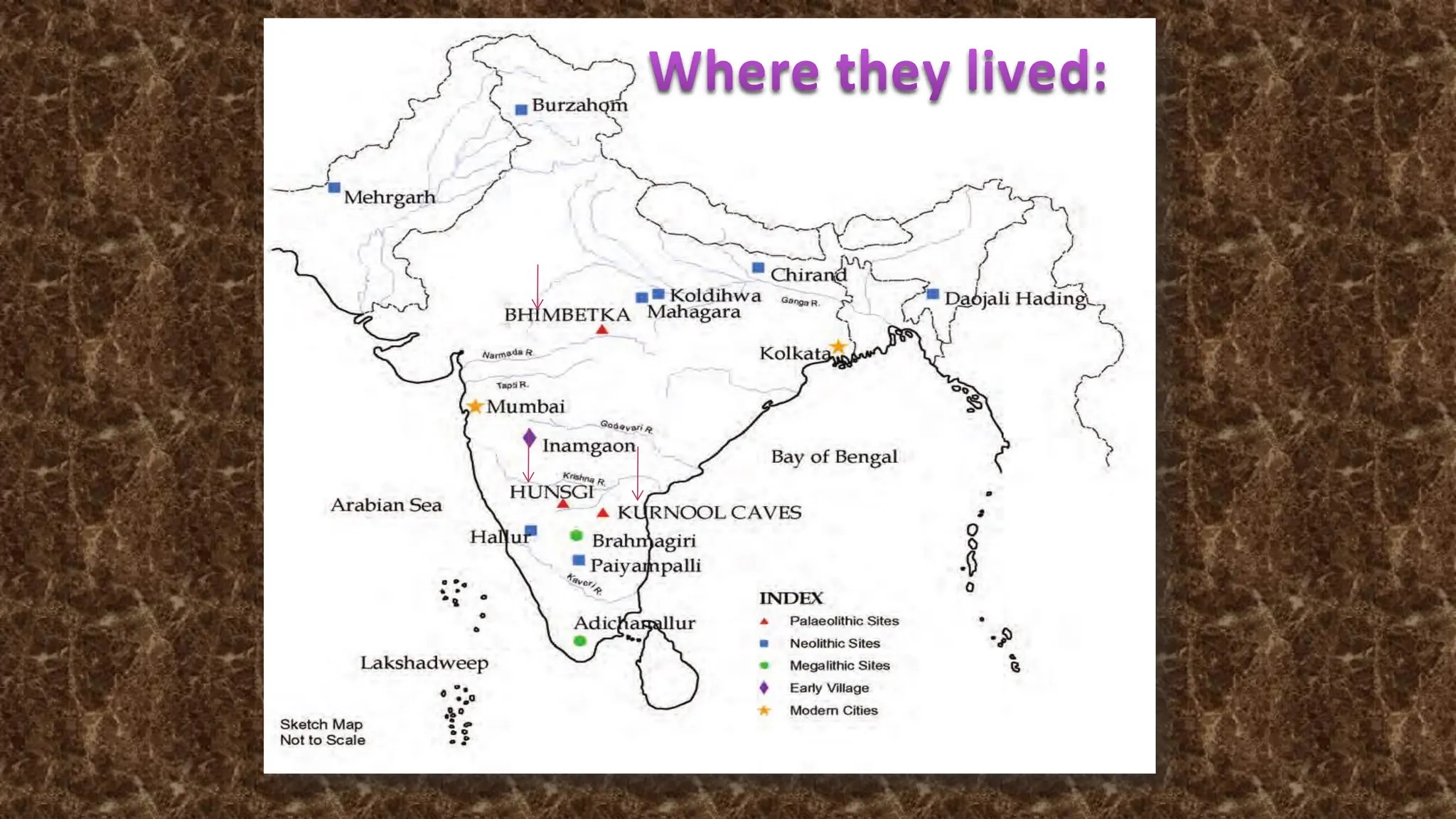
Where they lived:
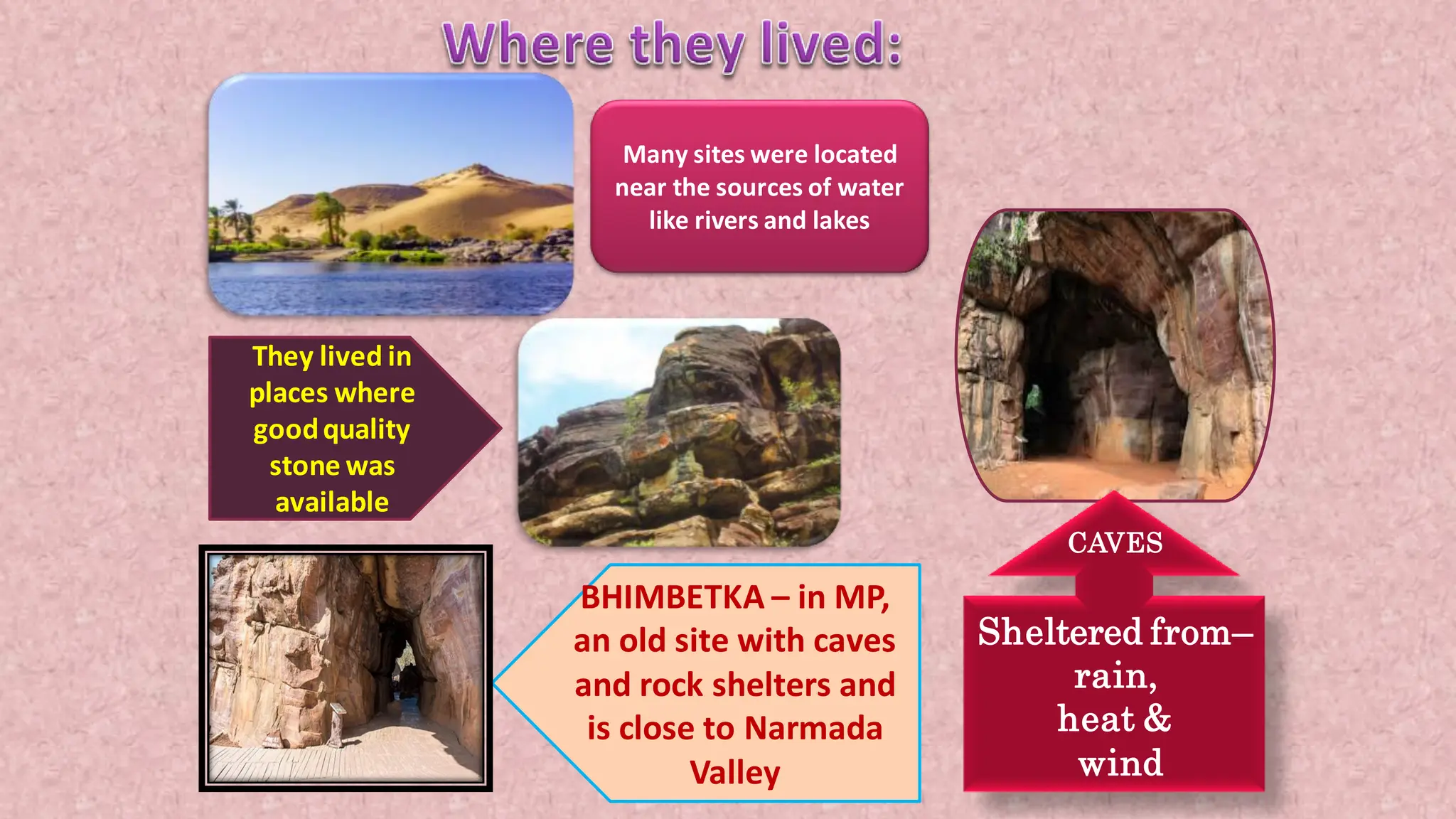
BHIMBETKA – in MP,
an old site with caves
and rock shelters and
is close to Narmada
Valley
They lived in
places where
goodquality
stone was
available
Many sites were located
near the sources of water
like rivers and lakes
Sheltered from–
rain,
heat &
wind
CAVES
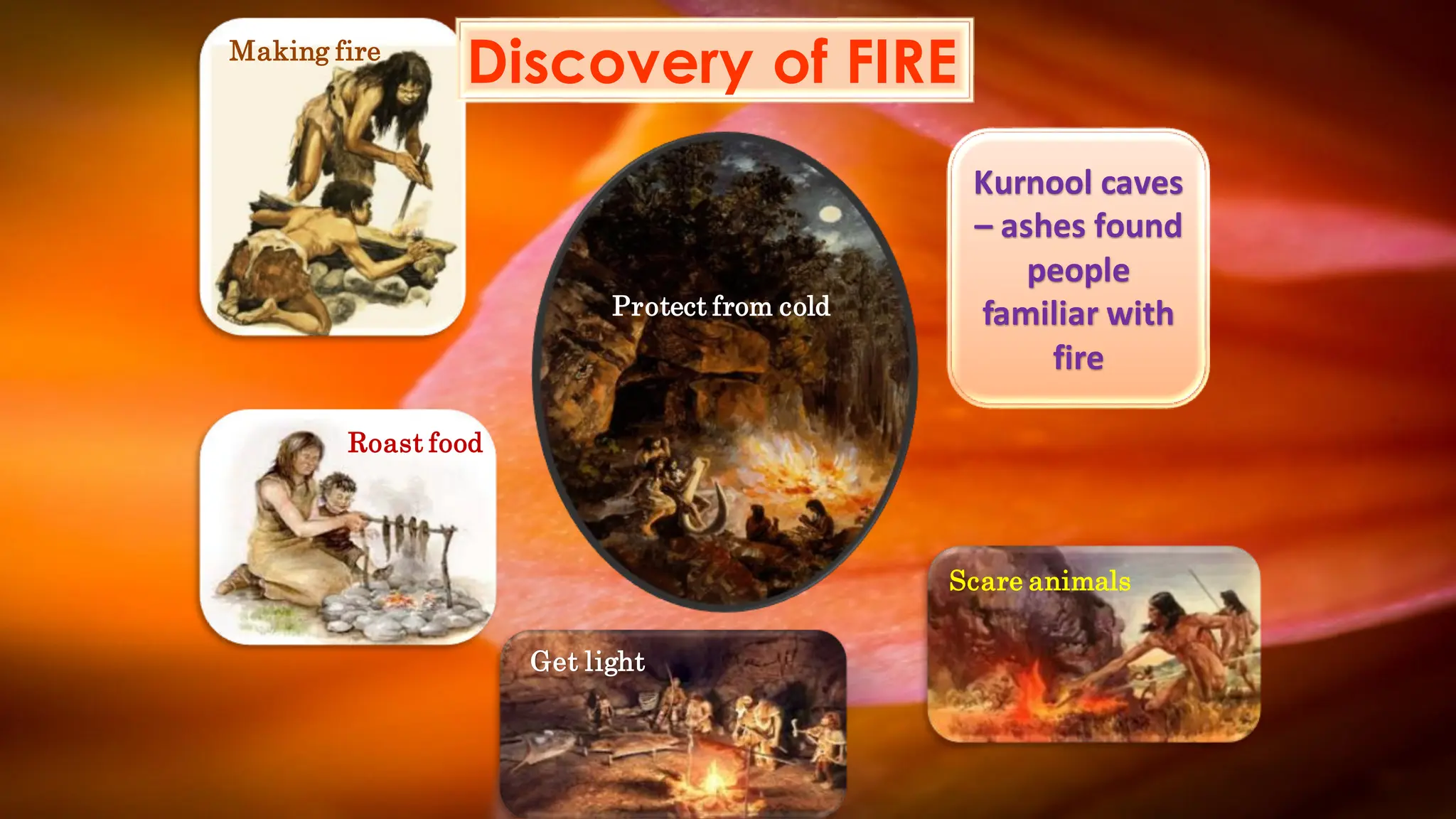
Discovery of FIRE
Making fire
Protect from cold
Roast food
Scare animals
Get light
Kurnool caves
– ashes found
people
familiar with
fire
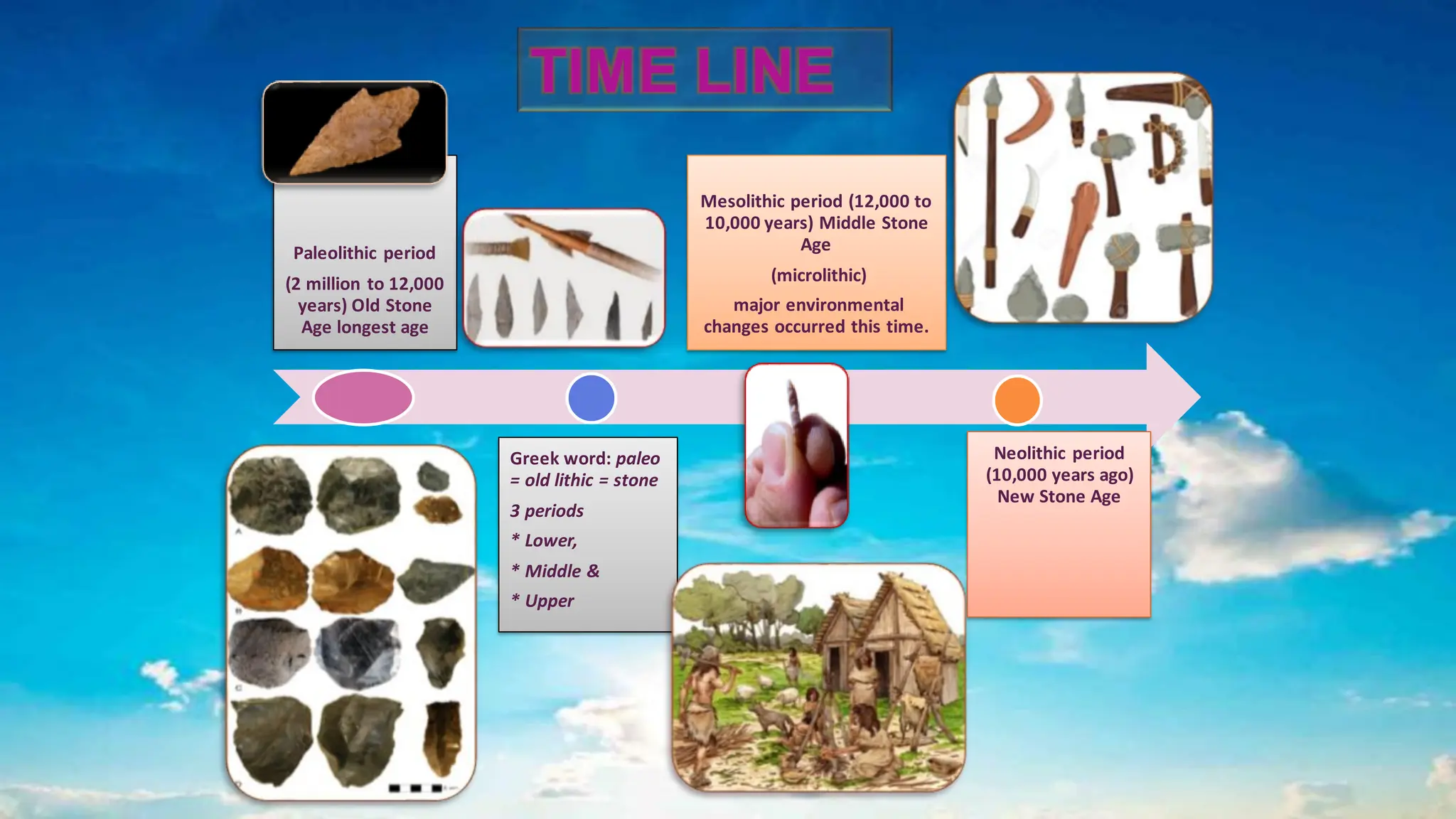
Paleolithic period
(2 million to 12,000
years) Old Stone
Age longest age
Greek word: paleo
= old lithic = stone
3 periods
* Lower,
* Middle &
* Upper
Mesolithic period (12,000 to
10,000 years) Middle Stone
Age
(microlithic)
major environmental
changes occurred this time.
Neolithic period
(10,000 years ago)
New Stone Age
TIME LINE
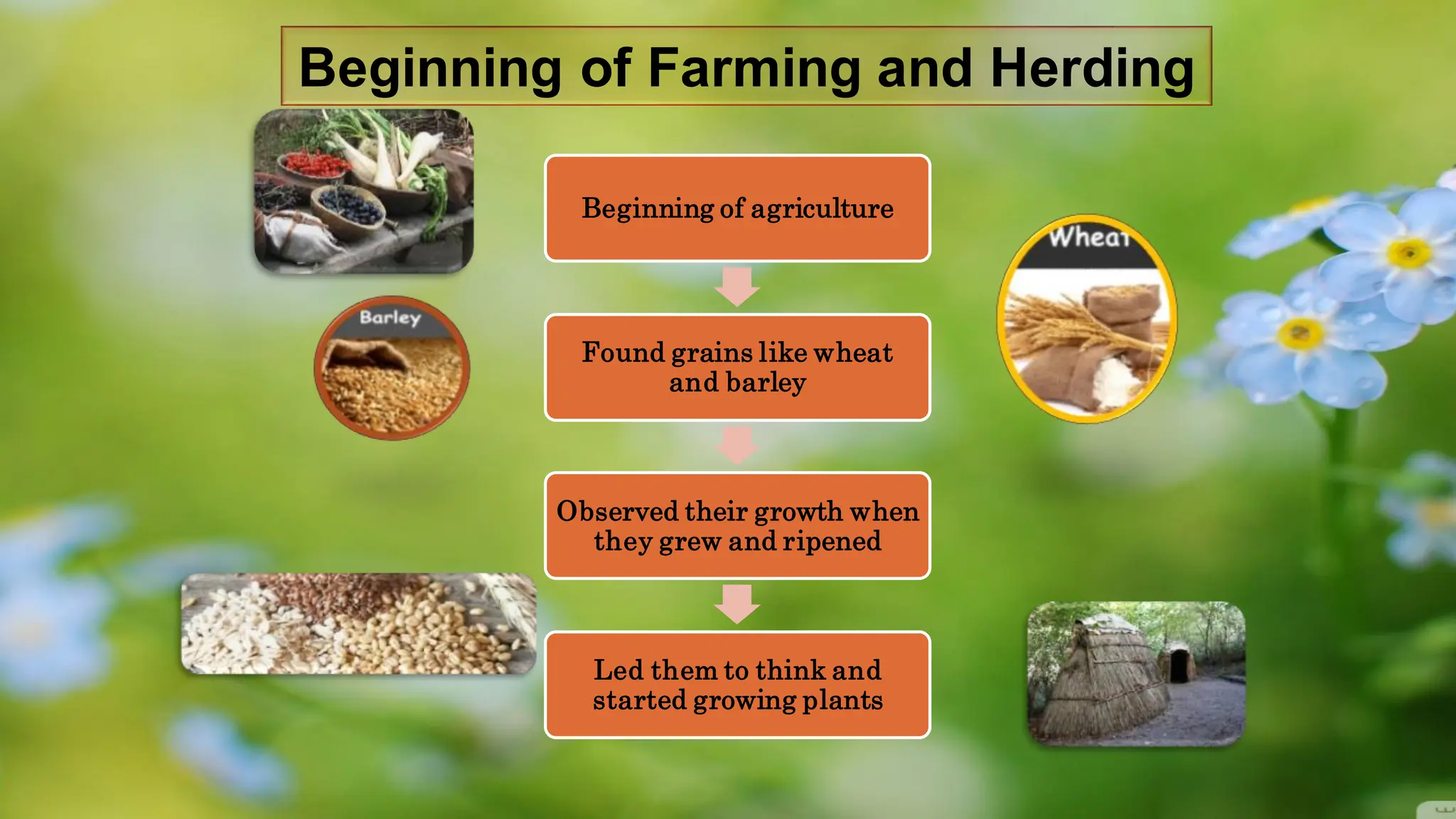
Beginning of Farming and Herding
Beginning of agriculture
Found grains like wheat
and barley
Observed their growth when
they grew and ripened
Led them to think and
started growing plants
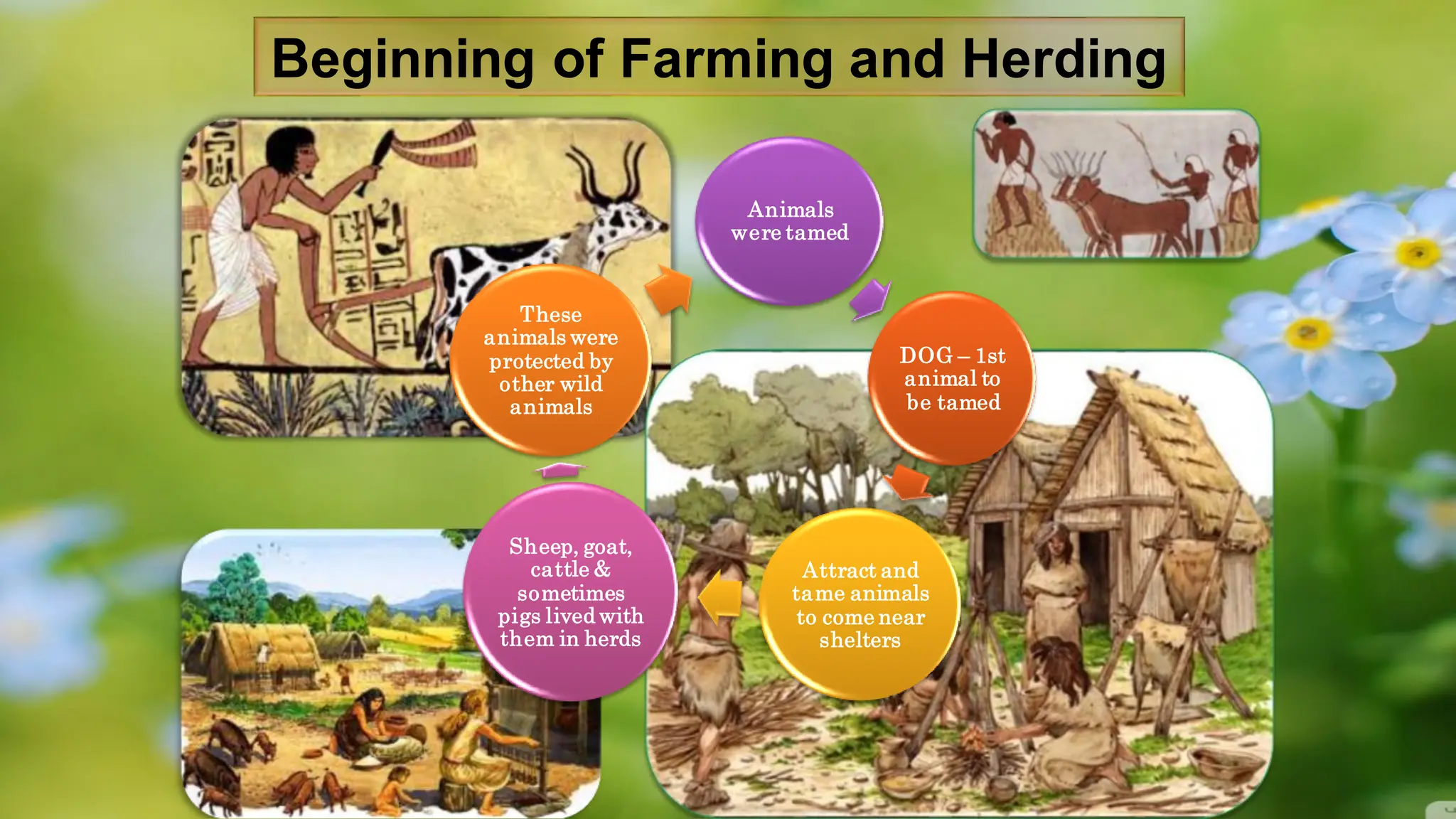
Animals
were tamed
DOG – 1st
animal to
be tamed
Attract and
tame animals
to come near
shelters
Sheep, goat,
cattle &
sometimes
pigs lived with
them in herds
These
animals were
protected by
other wild
animals
Beginning of Farming and Herding
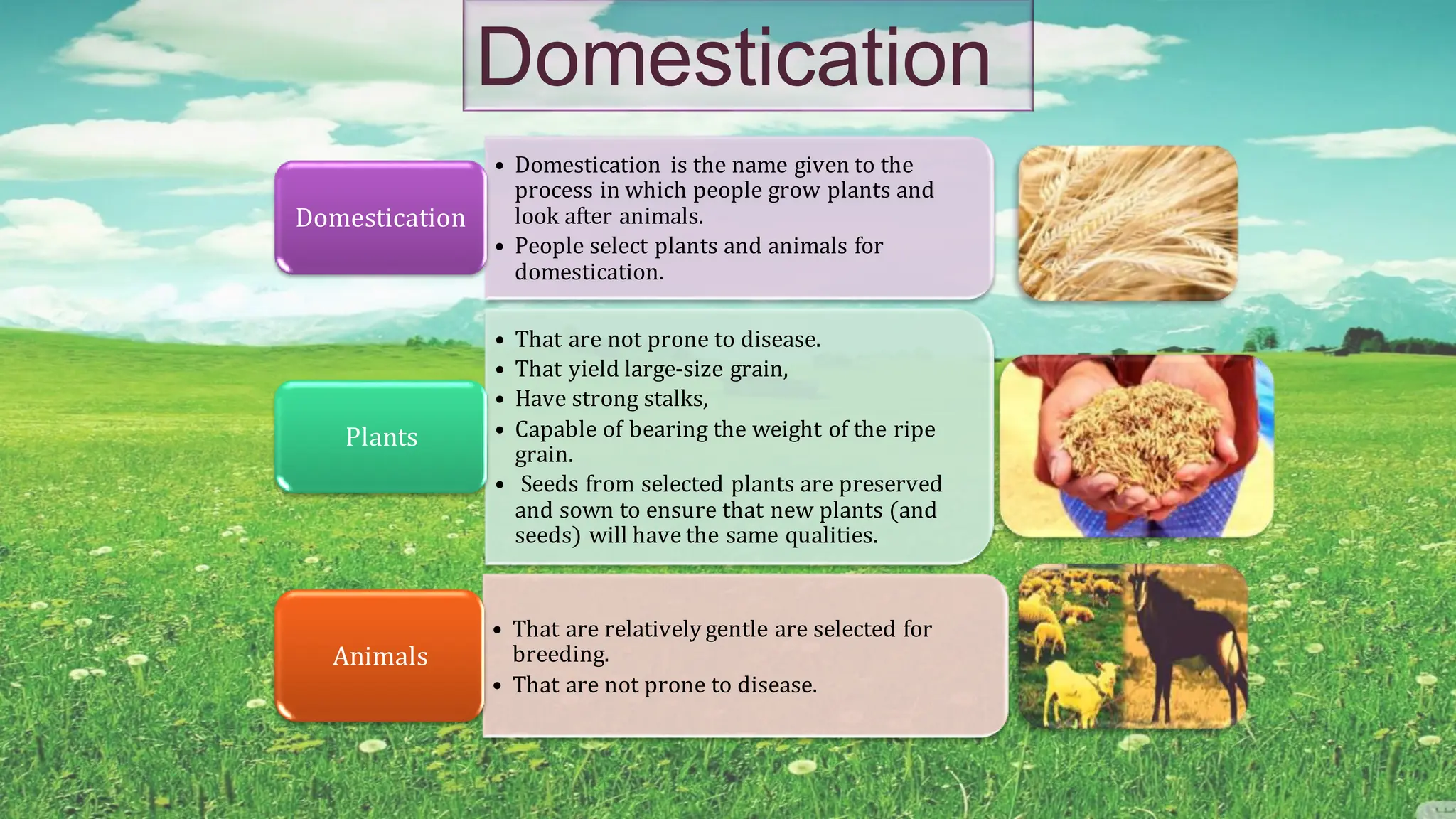
• Domestication is the name given to the
process in which people grow plants and
look after animals.
• People select plants and animals for
domestication.
Domestication
• That are not prone to disease.
• That yield large-size grain,
• Have strong stalks,
• Capable of bearing the weight of the ripe
grain.
• Seeds from selected plants are preserved
and sown to ensure that new plants (and
seeds) will have the same qualities.
Plants
• That are relatively gentle are selected for
breeding.
• That are not prone to disease.
Animals
Domestication
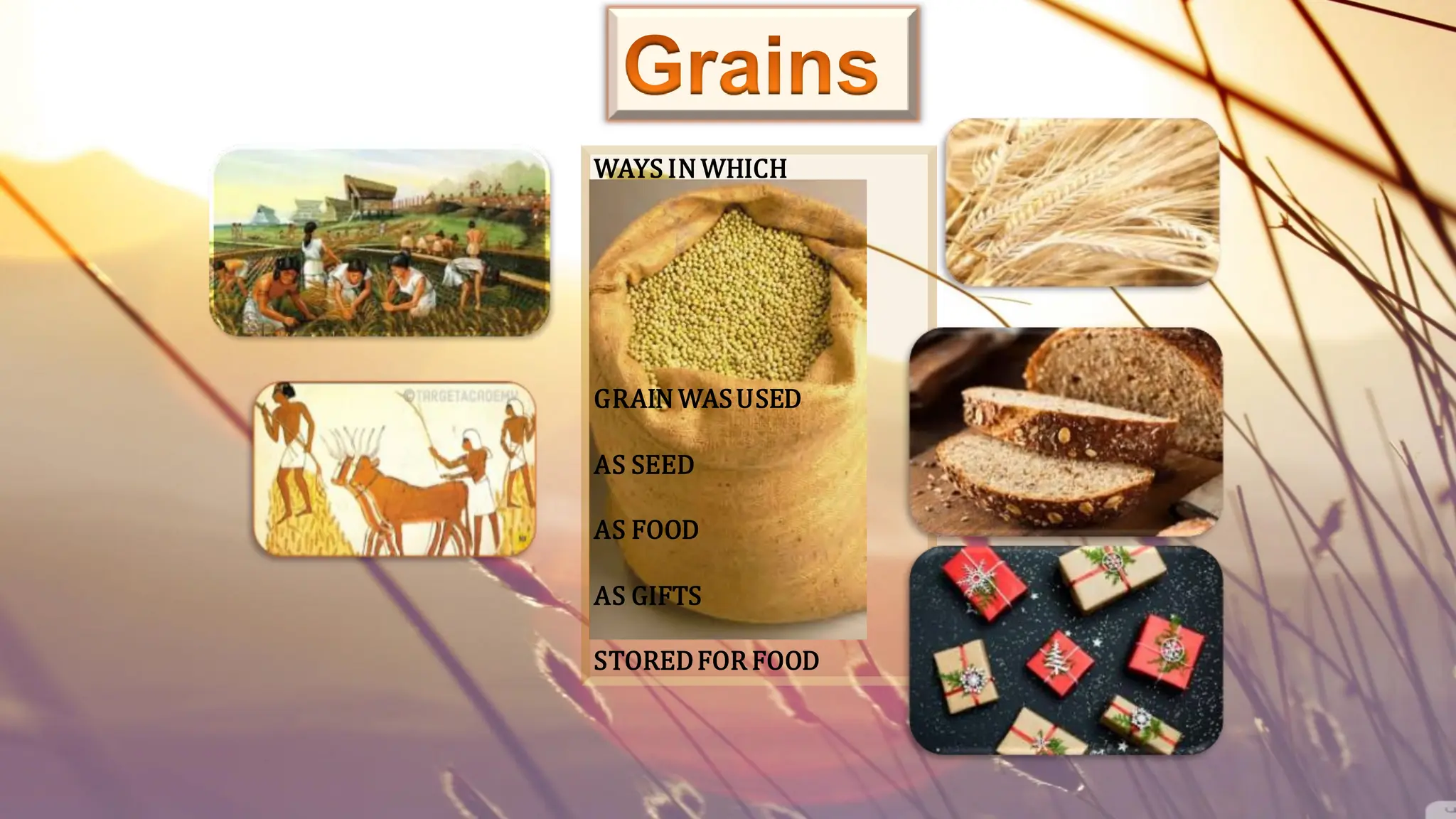
WAYS IN WHICH
GRAIN WASUSED
AS SEED
AS FOOD
AS GIFTS
STOREDFOR FOOD
Grains
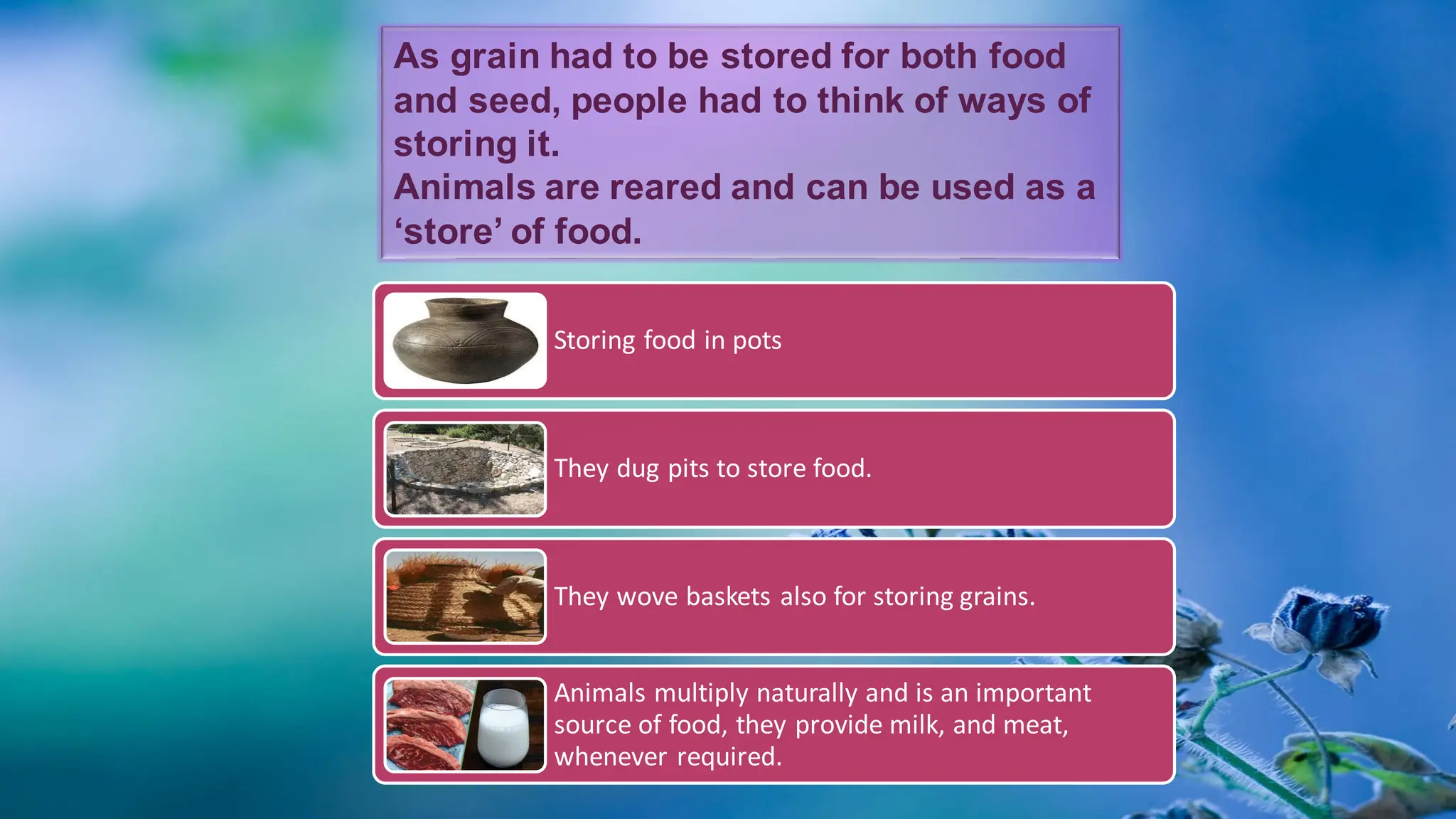
Storing food in pots
They dug pits to store food.
They wove baskets also for storing grains.
Animals multiply naturally and is an important
source of food, they provide milk, and meat,
whenever required.
As grain had to be stored for both food
and seed, people had to think of ways of
storing it.
Animals are reared and can be used as a
‘store’ of food.
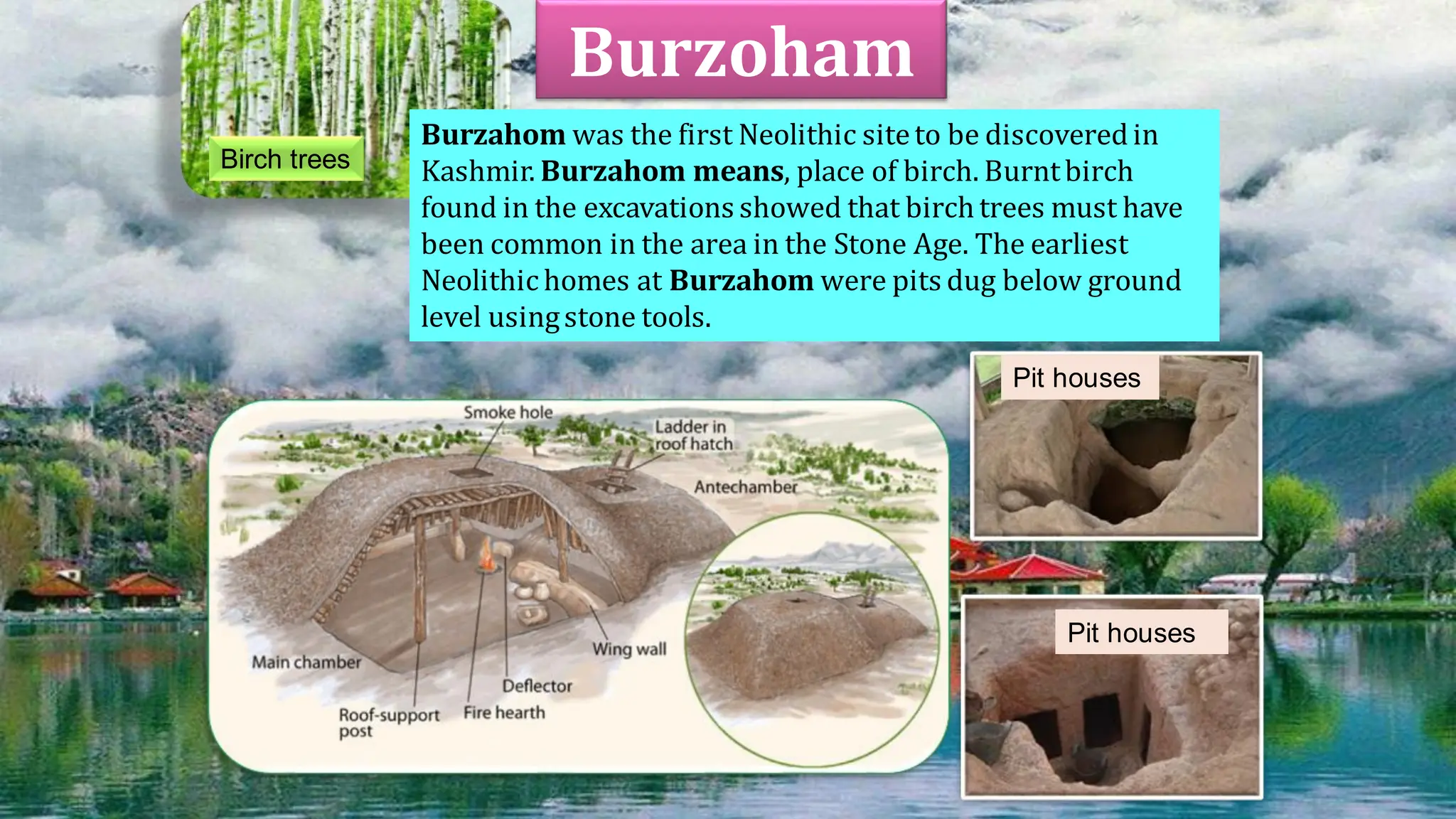
Burzoham
Burzahom was the first Neolithic siteto be discoveredin
Kashmir. Burzahom means, place of birch. Burntbirch
found in the excavations showed that birch trees must have
been common in the area in the Stone Age. The earliest
Neolithic homes at Burzahom were pits dug below ground
level usingstone tools.
Birch trees
Pit houses
Pit houses
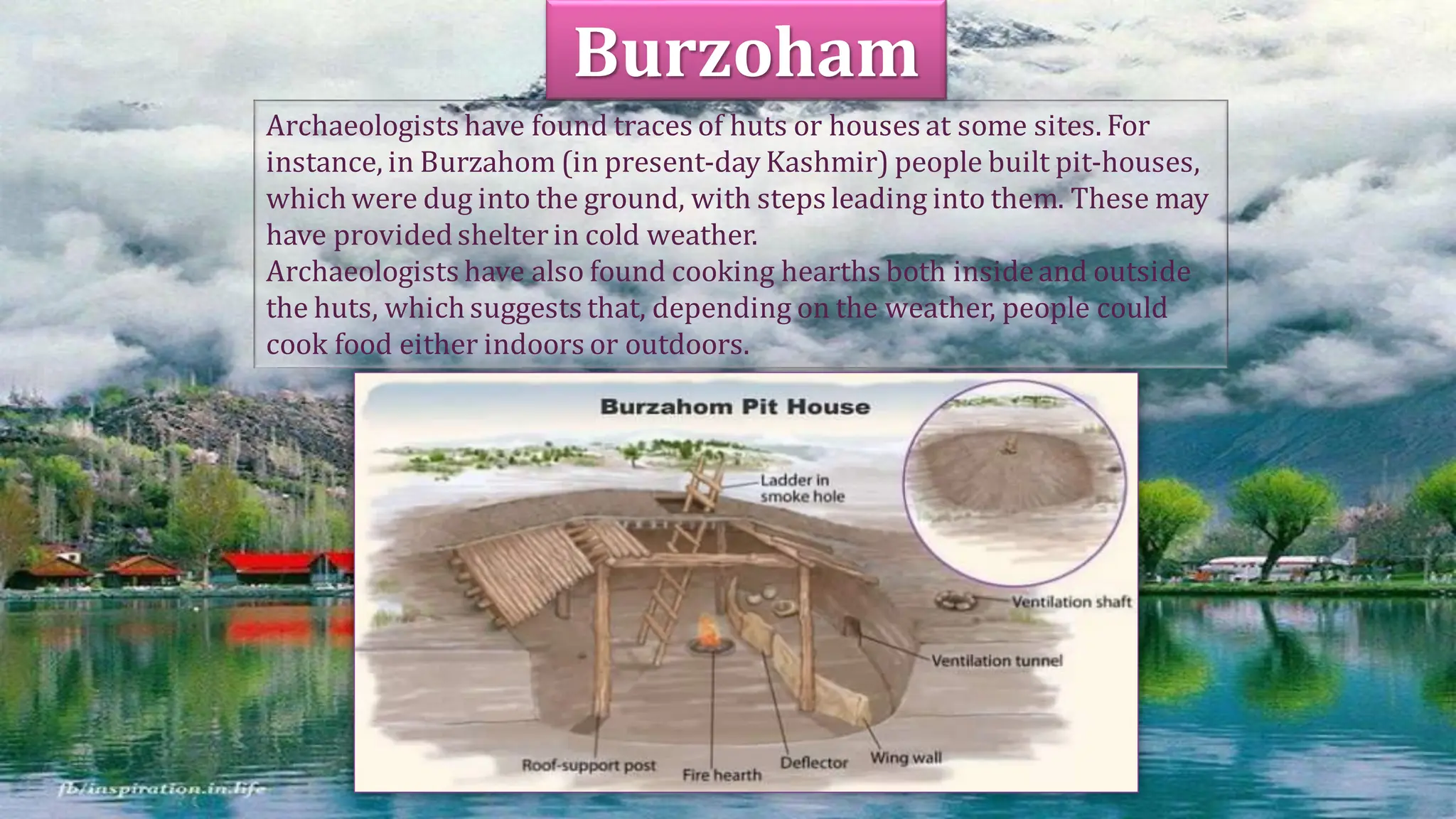
Archaeologists have found traces of huts or houses at some sites. For
instance, in Burzahom (in present-day Kashmir) people built pit-houses,
which were dug into the ground, with steps leading into them. These may
have providedshelterin cold weather.
Archaeologists have also found cooking hearths both insideand outside
the huts, which suggests that, depending on the weather, people could
cook food either indoors or outdoors.
Burzoham
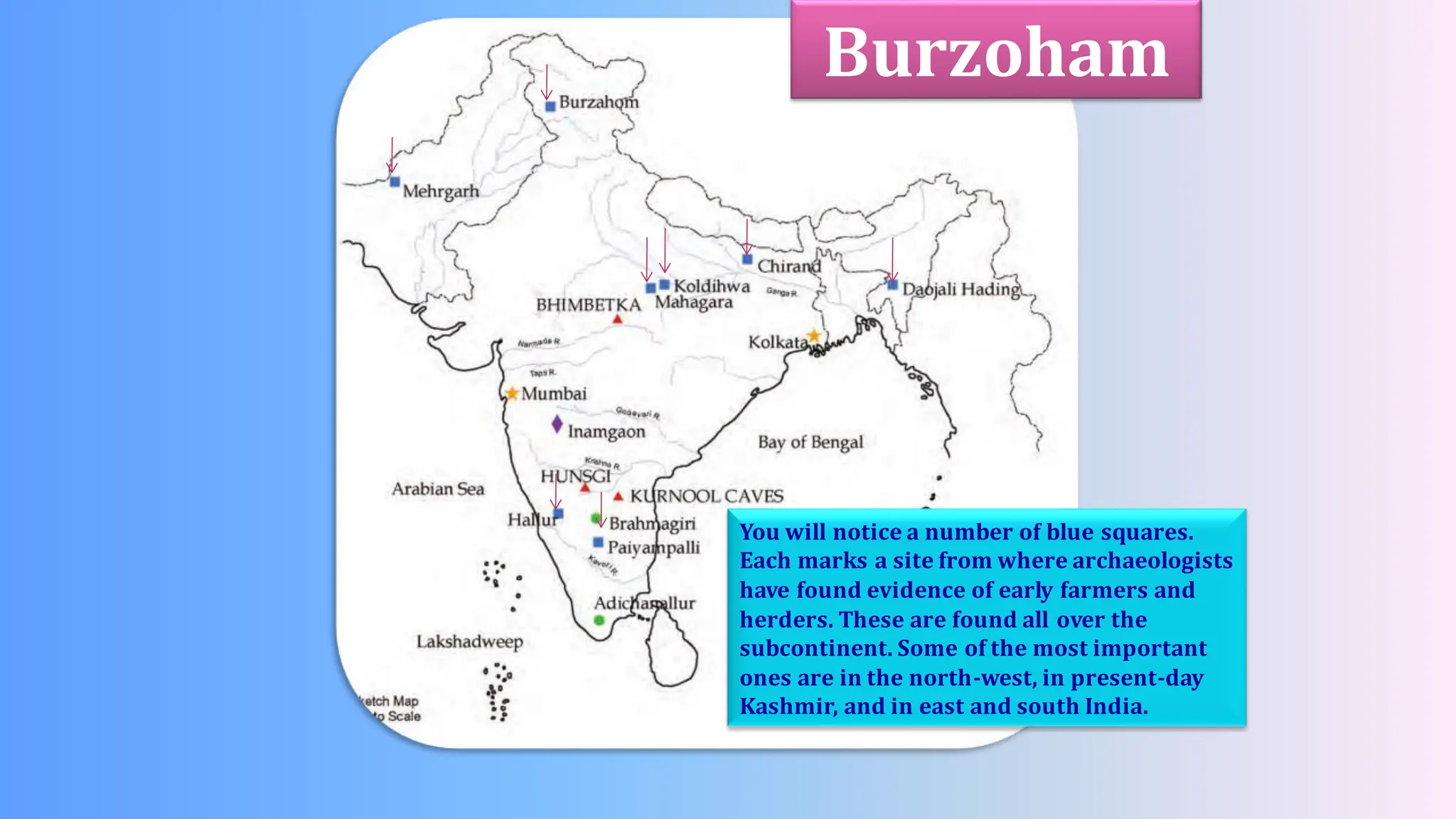
You will notice a number of blue squares.
Each marks a site from where archaeologists
have found evidence of early farmers and
herders. These are found all over the
subcontinent. Some of the most important
ones are in the north-west, in present-day
Kashmir, and in east and south India.
Burzoham
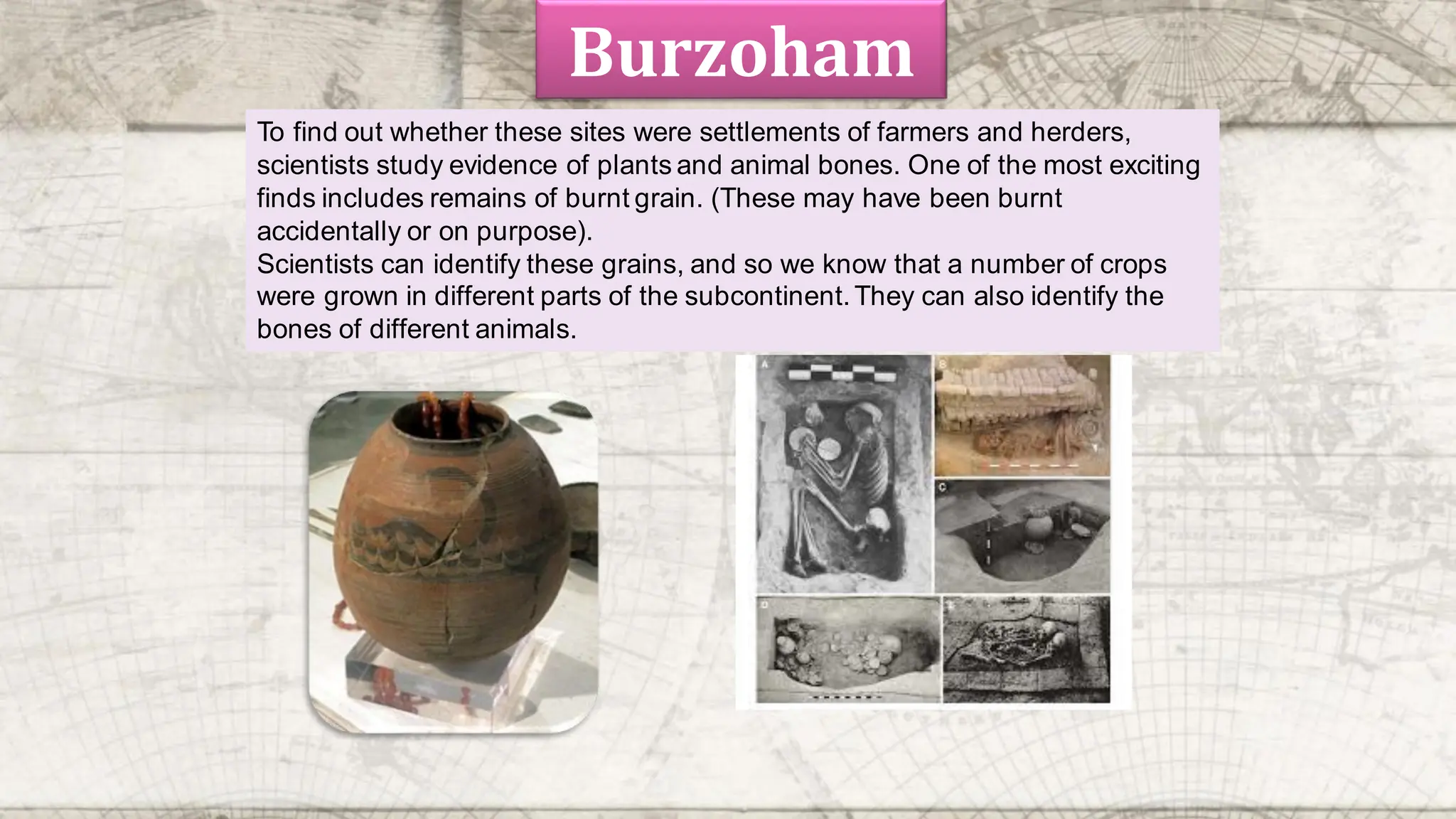
To find out whether these sites were settlements of farmers and herders,
scientists study evidence of plants and animal bones. One of the most exciting
finds includes remains of burnt grain. (These may have been burnt
accidentally or on purpose).
Scientists can identify these grains, and so we know that a number of crops
were grown in different parts of the subcontinent.They can also identify the
bones of different animals.
Burzoham
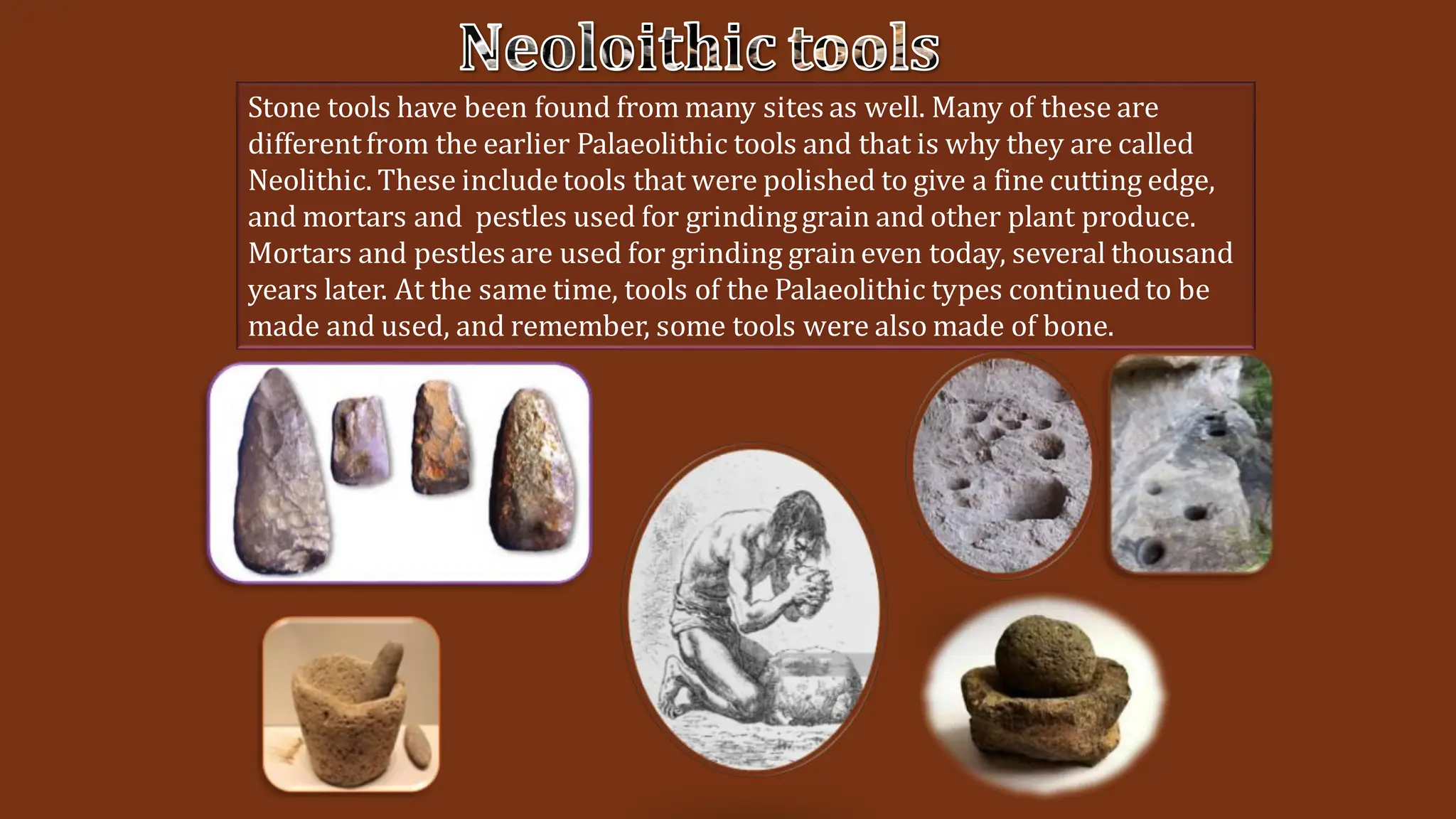
Stone tools have been found from many sites as well. Many of these are
differentfrom the earlier Palaeolithic tools and that is why they are called
Neolithic. These includetools that were polished to give a fine cutting edge,
and mortars and pestles used for grindinggrain and other plant produce.
Mortars and pestles are used for grinding graineven today, several thousand
years later. At the same time, tools of the Palaeolithic types continuedto be
made and used, and remember, some tools were also made of bone.
Neoloithic tools
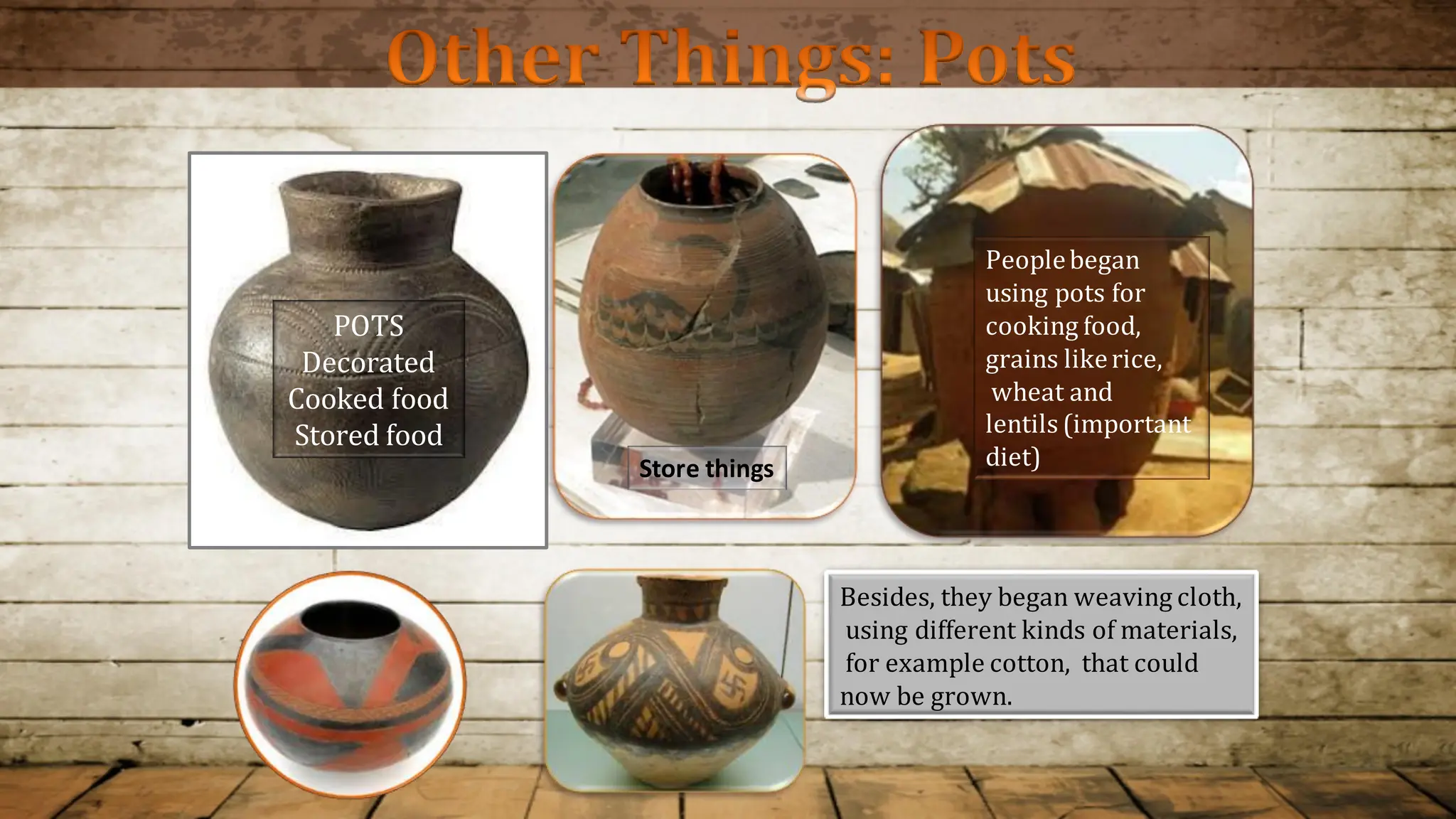
Peoplebegan
using pots for
cooking food,
grains likerice,
wheat and
lentils (important
diet)
POTS
Decorated
Cooked food
Stored food
Store things
Besides, they began weaving cloth,
using different kinds of materials,
for example cotton, that could
now be grown.
Other Things: Pots
Living and dying in Mehrgarh
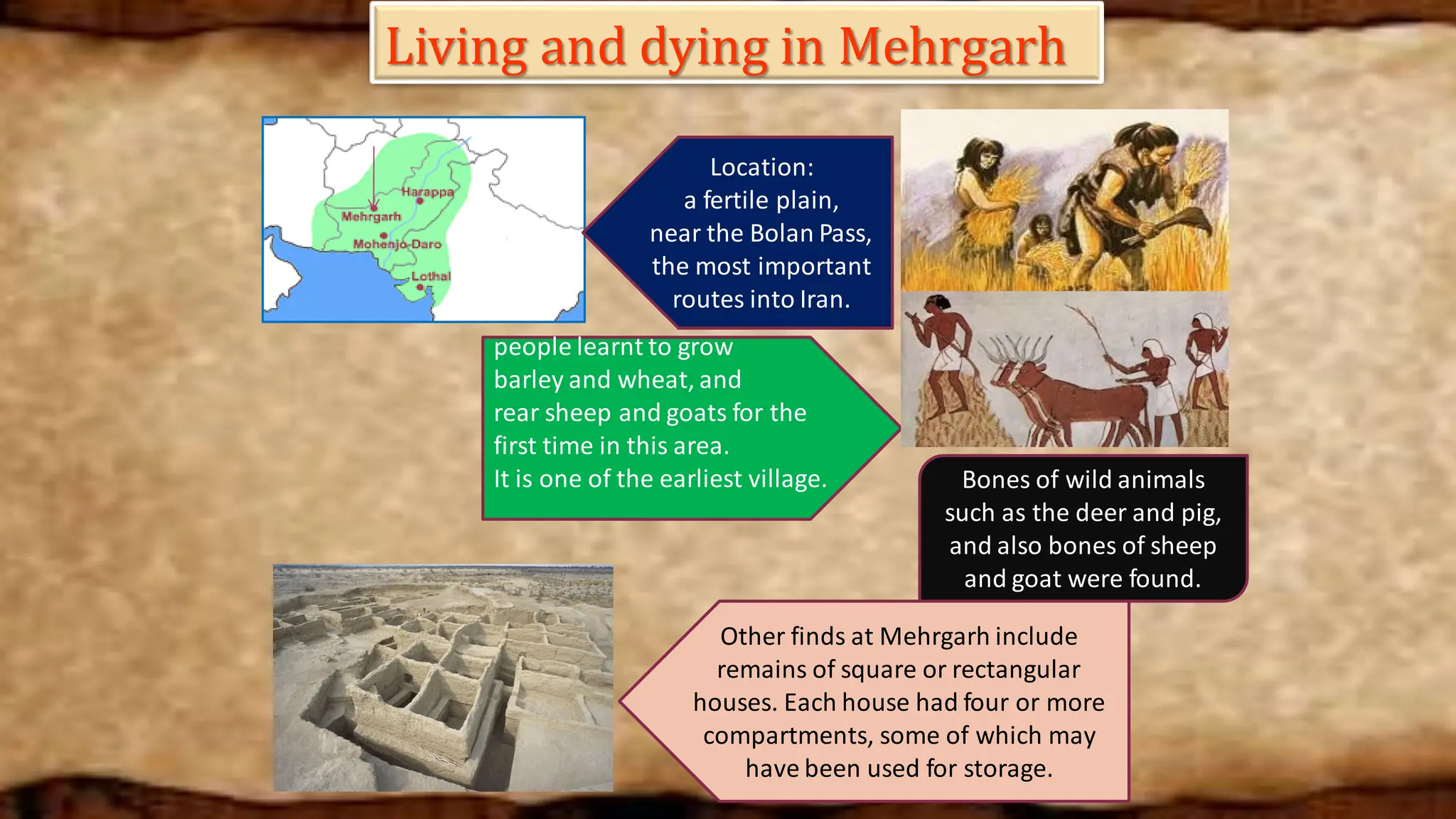
Location:
a fertile plain,
near the Bolan Pass,
the most important
routes into Iran.
people learnt to grow
barley and wheat, and
rear sheep and goats for the
first time in this area.
It is one of the earliest village. Bones of wild animals
such as the deer and pig,
and also bones of sheep
and goat were found.
Other finds at Mehrgarh include
remains of square or rectangular
houses. Each house had four or more
compartments, some of which may
have been used for storage.
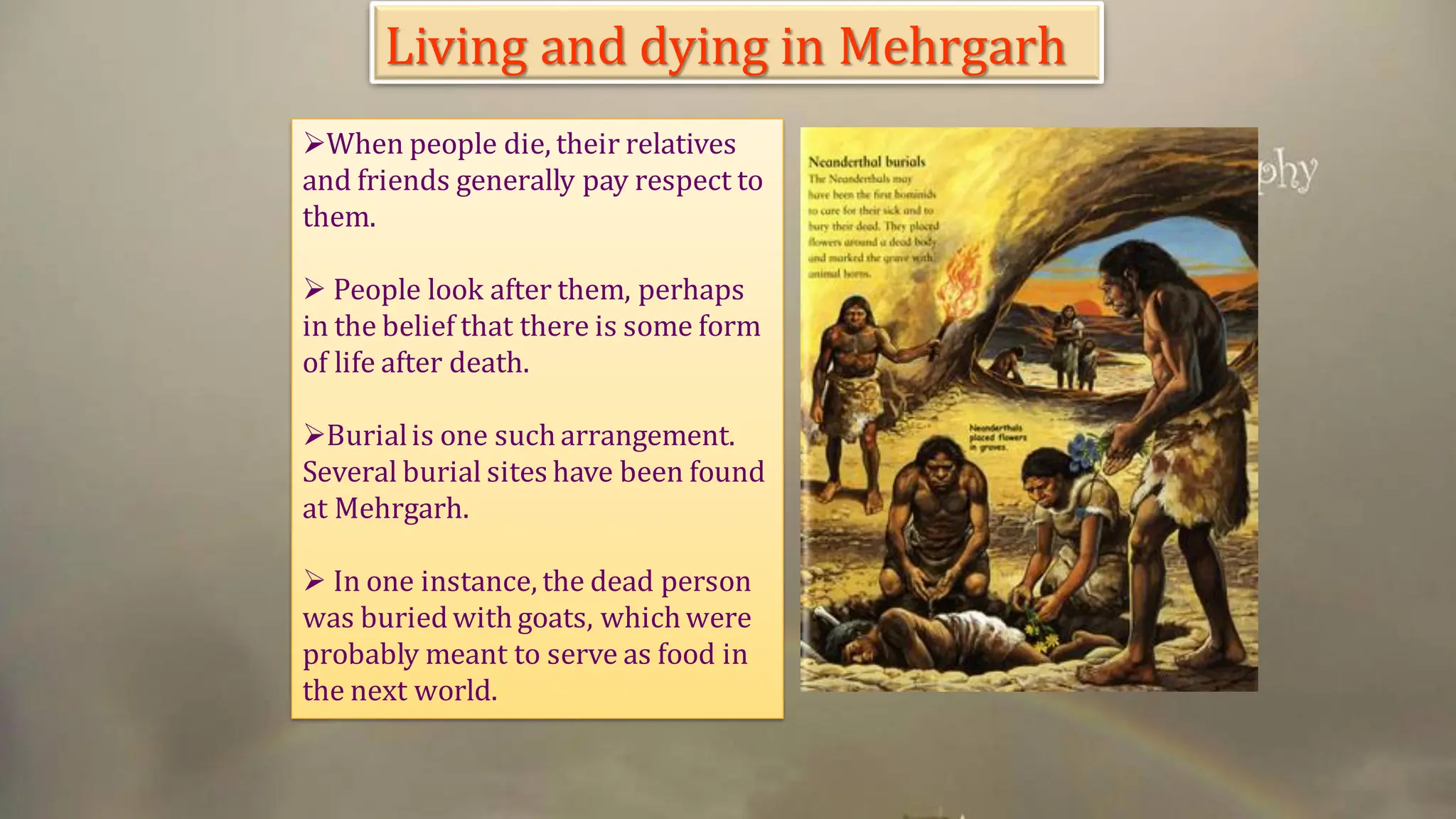
➢When people die, their relatives
and friends generally pay respect to
them.
➢ People look after them, perhaps
in the belief that there is some form
of life after death.
➢Burialis one such arrangement.
Several burial sites have been found
at Mehrgarh.
➢ In one instance, the dead person
was buriedwith goats, which were
probably meant to serve as food in
the next world.
Living and dying in Mehrgarh
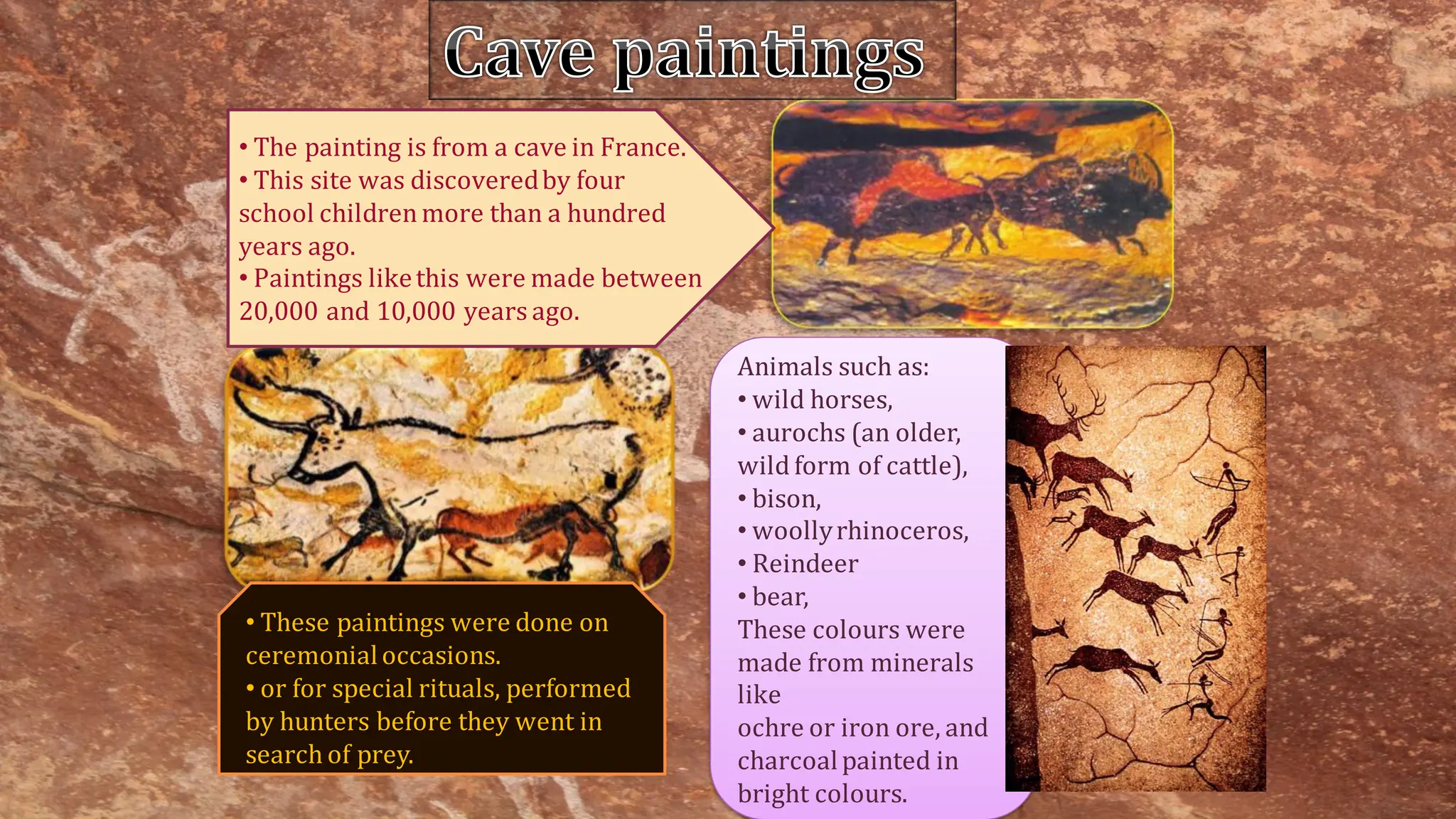
• The painting is from a cave in France.
• This site was discoveredby four
school childrenmore than a hundred
years ago.
• Paintings likethis were made between
20,000 and 10,000 years ago.
Animals such as:
• wild horses,
• aurochs (an older,
wild form of cattle),
• bison,
• woollyrhinoceros,
• Reindeer
• bear,
These colours were
made from minerals
like
ochre or iron ore, and
charcoalpainted in
bright colours.
• These paintings were done on
ceremonialoccasions.
• or for special rituals, performed
by hunters before they went in
search of prey.
Cave paintings
THANK YOU

historyclass6lesson hunters and gatherers

  • 1.
    VI - HISTORY 2.FROM HUNTING – GATHERING TO GROWING FOOD
  • 2.
    HUNTER - GATHERER Hunted animals,birds and caught fish Gathered food like nuts, roots, fruits, seeds leaves, stalks and eggs Made tools of stone wood and bones Lived near water sources like river and caves
  • 3.
    Life of huntergatherers: In search of food as they would finish the food in one place Hunting animals moved from place to place following these animals Searching for seasonal plants and fruits they moved In search of water they moved • Seasonal rivers • Perennialrivers
  • 4.
  • 5.
    cut meat and bone,scrape bark (from trees) and hides (animal skins), chop fruit and roots. Digging the ground to collect edible roots. Stitching clothes made out of animal skin. These stone tools were used to:
  • 6.
    Some may havebeen attached to handles of bone or wood, to make spears and arrows for hunting. Other tools were used to chop wood, which was used as firewood. Wood was also used to make huts and tools.
  • 7.
  • 8.
    BHIMBETKA – inMP, an old site with caves and rock shelters and is close to Narmada Valley They lived in places where goodquality stone was available Many sites were located near the sources of water like rivers and lakes Sheltered from– rain, heat & wind CAVES
  • 9.
    Discovery of FIRE Makingfire Protect from cold Roast food Scare animals Get light Kurnool caves – ashes found people familiar with fire
  • 10.
    Paleolithic period (2 millionto 12,000 years) Old Stone Age longest age Greek word: paleo = old lithic = stone 3 periods * Lower, * Middle & * Upper Mesolithic period (12,000 to 10,000 years) Middle Stone Age (microlithic) major environmental changes occurred this time. Neolithic period (10,000 years ago) New Stone Age TIME LINE
  • 11.
    Beginning of Farmingand Herding Beginning of agriculture Found grains like wheat and barley Observed their growth when they grew and ripened Led them to think and started growing plants
  • 12.
    Animals were tamed DOG –1st animal to be tamed Attract and tame animals to come near shelters Sheep, goat, cattle & sometimes pigs lived with them in herds These animals were protected by other wild animals Beginning of Farming and Herding
  • 13.
    • Domestication isthe name given to the process in which people grow plants and look after animals. • People select plants and animals for domestication. Domestication • That are not prone to disease. • That yield large-size grain, • Have strong stalks, • Capable of bearing the weight of the ripe grain. • Seeds from selected plants are preserved and sown to ensure that new plants (and seeds) will have the same qualities. Plants • That are relatively gentle are selected for breeding. • That are not prone to disease. Animals Domestication
  • 14.
    WAYS IN WHICH GRAINWASUSED AS SEED AS FOOD AS GIFTS STOREDFOR FOOD Grains
  • 15.
    Storing food inpots They dug pits to store food. They wove baskets also for storing grains. Animals multiply naturally and is an important source of food, they provide milk, and meat, whenever required. As grain had to be stored for both food and seed, people had to think of ways of storing it. Animals are reared and can be used as a ‘store’ of food.
  • 16.
    Burzoham Burzahom was thefirst Neolithic siteto be discoveredin Kashmir. Burzahom means, place of birch. Burntbirch found in the excavations showed that birch trees must have been common in the area in the Stone Age. The earliest Neolithic homes at Burzahom were pits dug below ground level usingstone tools. Birch trees Pit houses Pit houses
  • 17.
    Archaeologists have foundtraces of huts or houses at some sites. For instance, in Burzahom (in present-day Kashmir) people built pit-houses, which were dug into the ground, with steps leading into them. These may have providedshelterin cold weather. Archaeologists have also found cooking hearths both insideand outside the huts, which suggests that, depending on the weather, people could cook food either indoors or outdoors. Burzoham
  • 18.
    You will noticea number of blue squares. Each marks a site from where archaeologists have found evidence of early farmers and herders. These are found all over the subcontinent. Some of the most important ones are in the north-west, in present-day Kashmir, and in east and south India. Burzoham
  • 19.
    To find outwhether these sites were settlements of farmers and herders, scientists study evidence of plants and animal bones. One of the most exciting finds includes remains of burnt grain. (These may have been burnt accidentally or on purpose). Scientists can identify these grains, and so we know that a number of crops were grown in different parts of the subcontinent.They can also identify the bones of different animals. Burzoham
  • 20.
    Stone tools havebeen found from many sites as well. Many of these are differentfrom the earlier Palaeolithic tools and that is why they are called Neolithic. These includetools that were polished to give a fine cutting edge, and mortars and pestles used for grindinggrain and other plant produce. Mortars and pestles are used for grinding graineven today, several thousand years later. At the same time, tools of the Palaeolithic types continuedto be made and used, and remember, some tools were also made of bone. Neoloithic tools
  • 21.
    Peoplebegan using pots for cookingfood, grains likerice, wheat and lentils (important diet) POTS Decorated Cooked food Stored food Store things Besides, they began weaving cloth, using different kinds of materials, for example cotton, that could now be grown. Other Things: Pots
  • 22.
    Living and dyingin Mehrgarh Location: a fertile plain, near the Bolan Pass, the most important routes into Iran. people learnt to grow barley and wheat, and rear sheep and goats for the first time in this area. It is one of the earliest village. Bones of wild animals such as the deer and pig, and also bones of sheep and goat were found. Other finds at Mehrgarh include remains of square or rectangular houses. Each house had four or more compartments, some of which may have been used for storage.
  • 23.
    ➢When people die,their relatives and friends generally pay respect to them. ➢ People look after them, perhaps in the belief that there is some form of life after death. ➢Burialis one such arrangement. Several burial sites have been found at Mehrgarh. ➢ In one instance, the dead person was buriedwith goats, which were probably meant to serve as food in the next world. Living and dying in Mehrgarh
  • 24.
    • The paintingis from a cave in France. • This site was discoveredby four school childrenmore than a hundred years ago. • Paintings likethis were made between 20,000 and 10,000 years ago. Animals such as: • wild horses, • aurochs (an older, wild form of cattle), • bison, • woollyrhinoceros, • Reindeer • bear, These colours were made from minerals like ochre or iron ore, and charcoalpainted in bright colours. • These paintings were done on ceremonialoccasions. • or for special rituals, performed by hunters before they went in search of prey. Cave paintings
  • 25.