CHAPTERI
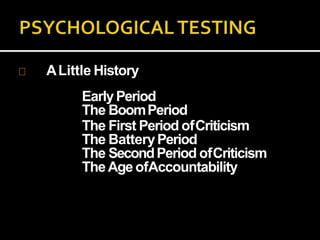
ALittle History
EarlyPeriod
The BoomPeriod
The First Period ofCriticism
The BatteryPeriod
The SecondPeriod ofCriticism
TheAge ofAccountability
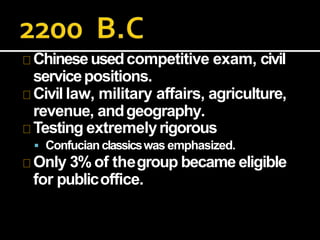
Chineseusedcompetitive exam, civil
servicepositions.
Civil law, military affairs, agriculture,
revenue, andgeography.
Testing extremelyrigorous
 Confucianclassicswas emphasized.
Only 3%of thegroup became eligible
for publicoffice.
Chineseserved as
models for developing
civil serviceexams in
Europe andAmericain
the 1800s.
Chinesefailed to validatethe
selection procedures.
- Penmanship wasat that
time given a relevant
predictor for suitabilityfor
office.
Formal measurementprocedures
Western educationalsystem
 19thCentury
 Wundt,Galton, andCattell laid the
foundation for the 20th Century
testing.
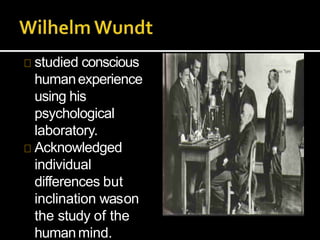
studied conscious
humanexperience
using his
psychological
laboratory.
Acknowledged
individual
differences but
inclination wason
the study of the
humanmind.
Hislegacy wason the rigorous
experimental control of
procedures, which is very
important in tests
administration under
standardized conditions.
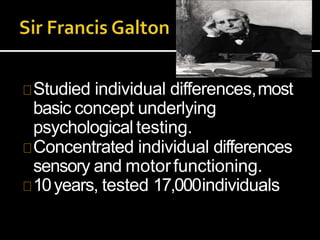
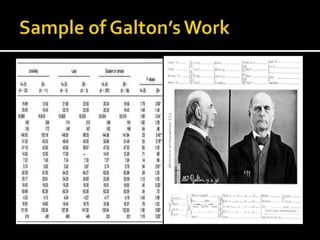
Studied individual differences,most
basic concept underlying
psychological testing.
Concentrated individual differences
sensory and motorfunctioning.
10years, tested 17,000individuals
He pioneered thestudy of individual
differences in mentalability.
 Related intellectual ability to skills
suchasreaction time, sensitivityto
physicalstimuli, and body
proportions.
Demonstrated that objective tests
could be devised throughstandardized
procedures.
Cattell transported brass instruments to the
U.S.; did an elaborate reaction time studies;
invented the term mentaltest.
Some of his famous studentswere:
 Thorndike (1898)
 Woodworth (1899) and E.K. Strong (1911)whose
Vocational Interest Blank ,after somany revisions,
is still in wide use.
Wundt,Galton, andCattell laid
the foundation for the 20th
Century testing.
Others keeptrack onCattell andGalton’s
interests.
 Wissler
▪ Correlated mental tests and academic
performance which showed weak
relationship between reaction time and
sensory discrimination asmeasures of
intelligence.
▪ desirable development in the history of
psychologicaltesting; abandonment of RT
and sensorydiscrimination
Abandonment of RT
and sensory as
measures
Premature abandonment
poor research
method, homogenoussample
and lesser number oftrials.
70years later correlationwas
established and Stenberg
recognized the valueof RTin
intelligence.
VOID INTESTING
Alfred Binet wason the
verge of amajor break
through in intelligence
testing.
Binet developed his test to
help identify children in Paris
school system who could not
profit from ordinary
instruction.
1905: Binet-Simon Scale
was established; major
breakthrough in the
creation of modern test.
15-year boom period
New science ofPsychology was called
on to play apart in military situations
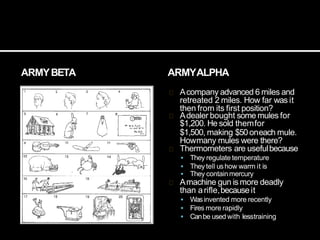
 Yerkes used the Army Alpha(Verbal)
and Army Beta for selection of
individuals for militaryservice.
• Robert Yerkes,a Harvard psychology
professor. Convinced the Departmentof
War that it should test all of its 1.75
million recruits for intelligence tests, so
they could be classified and given
appropriate assignments (Goddard and
Terman also chaired thiscommittee).
The height of Goddard's successcame at atime when America
was experiencing alarge influx of immigrants from Europe. The
Immigration Restriction Act, passedin 1924 (which remained in
effect until 1965)wasinfluenced byAmerican eugenics'efforts. In
1913Goddard was invited to Ellis Island to help detect morons in
the immigrant population. In his Intelligence Classification of
Immigrants of Different Nationalities (1917)he asserted that most
of the Ellis Island immigrants were mentally deficient. For
example, he indicated that 83%of all Jewstested were feeble-
minded, aswere 80% of the Hungarians, 79%of the Italians, and
87%of the Russians.The result was that many immigrants were
turned away andsent back to Europe.
ARMYBETA ARMYALPHA
Acompany advanced 6 miles and
retreated 2 miles. How far was it
then from its first position?
Adealer bought some mules for
$1,200. He sold themfor
$1,500, making $50oneach mule.
Howmany mules were there?
Thermometers are usefulbecause
 They regulate temperature
 Theytell ushow warm it is
 They containmercury
Amachine gun is more deadly
than arifle,because it
 Wasinvented more recently
 Fires more rapidly
 Canbe used with lesstraining
Measurement expanded in12
years after thewar;
vocational, and personality tests
were developed.
PersonalityTests: 1920-1940 (WWII)
Structured personality tests:paper
and pencil tests; i.e., Woodworth
Personal DataSheet
tests like MMPI were published
test developers and users
placed too much reliance on
the correctness of tests results
regarding people’s abilities
and characteristics
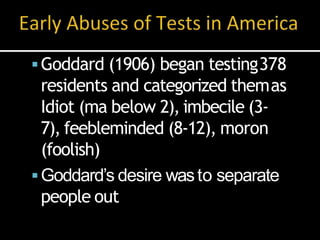
Goddard (1906) began testing378
residents and categorized themas
Idiot (ma below 2), imbecile (3-
7), feebleminded (8-12), moron
(foolish)
Goddard’s desire wasto separate
people out
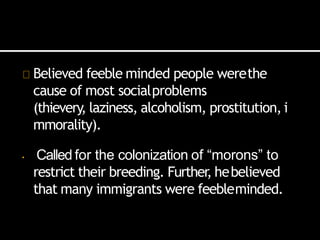
Believed feeble minded people werethe
cause of most socialproblems
(thievery, laziness, alcoholism, prostitution, i
mmorality).
• Called for the colonization of “morons” to
restrict their breeding. Further
, hebelieved
that many immigrants were feebleminded.
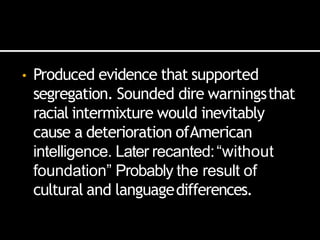
• Produced evidence that supported
segregation. Sounded dire warningsthat
racial intermixture would inevitably
cause a deterioration ofAmerican
intelligence. Later recanted:“without
foundation” Probably the result of
cultural and languagedifferences.
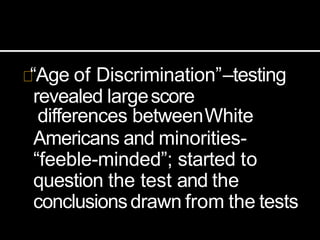
“Age of Discrimination”–testing
revealed largescore
differences betweenWhite
Americans and minorities-
“feeble-minded”; started to
question the test and the
conclusionsdrawn from the tests
1930s saw a crash in the
expectations of mental
measurement.
criticisms led young
Psychologist to initiate the
Mental Measurements
Yearbook (MMY) tocritically
review test.
Psychological measurementwas
used again for military service
where batteries of tests were
developed that measure several
abilities.
Reducedfailure rates and led to
emphasis on testbatteries.
1950seducational and
psychological testing grew and
expanded not lonely in the field
of education but other fields like
business, industry,clinics.
APAset guidelines for good
testing practice.
In1965, civil rights
movement were in full
swing; reacted totest’s
invasion of privacy.
Testswere seen asbiased
tools; discriminatewomen
and minorities in
education and
employment.
despite criticisms ,governments
and specifically educational
institutions were puttinggreater
faith in testing to determine
whether government and
educational programs were
achieving theirobjectives.
Despite failures, school are
accountable for maximum
learning ofthe students
Failures
▪ Segregation between/amongminorities.
▪ Created intellectualhierarchy between/among races.
▪ Labelling: Americans superior overAfricanAmericans
and otherminorities.
▪ Discrimination between men and women in
employment.
▪ Invasion of privacy

History of testing.pptx

  • 1.
  • 2.
    ALittle History EarlyPeriod The BoomPeriod TheFirst Period ofCriticism The BatteryPeriod The SecondPeriod ofCriticism TheAge ofAccountability
  • 3.
    Chineseusedcompetitive exam, civil servicepositions. Civillaw, military affairs, agriculture, revenue, andgeography. Testing extremelyrigorous  Confucianclassicswas emphasized. Only 3%of thegroup became eligible for publicoffice.
  • 4.
    Chineseserved as models fordeveloping civil serviceexams in Europe andAmericain the 1800s.
  • 5.
    Chinesefailed to validatethe selectionprocedures. - Penmanship wasat that time given a relevant predictor for suitabilityfor office.
  • 6.
    Formal measurementprocedures Western educationalsystem 19thCentury  Wundt,Galton, andCattell laid the foundation for the 20th Century testing.
  • 7.
  • 8.
    Hislegacy wason therigorous experimental control of procedures, which is very important in tests administration under standardized conditions.
  • 9.
    Studied individual differences,most basicconcept underlying psychological testing. Concentrated individual differences sensory and motorfunctioning. 10years, tested 17,000individuals
  • 10.
    He pioneered thestudyof individual differences in mentalability.  Related intellectual ability to skills suchasreaction time, sensitivityto physicalstimuli, and body proportions. Demonstrated that objective tests could be devised throughstandardized procedures.
  • 12.
    Cattell transported brassinstruments to the U.S.; did an elaborate reaction time studies; invented the term mentaltest. Some of his famous studentswere:  Thorndike (1898)  Woodworth (1899) and E.K. Strong (1911)whose Vocational Interest Blank ,after somany revisions, is still in wide use.
  • 13.
    Wundt,Galton, andCattell laid thefoundation for the 20th Century testing.
  • 14.
    Others keeptrack onCattellandGalton’s interests.  Wissler ▪ Correlated mental tests and academic performance which showed weak relationship between reaction time and sensory discrimination asmeasures of intelligence. ▪ desirable development in the history of psychologicaltesting; abandonment of RT and sensorydiscrimination
  • 15.
    Abandonment of RT andsensory as measures
  • 16.
    Premature abandonment poor research method,homogenoussample and lesser number oftrials. 70years later correlationwas established and Stenberg recognized the valueof RTin intelligence.
  • 17.
  • 18.
    Alfred Binet wasonthe verge of amajor break through in intelligence testing.
  • 19.
    Binet developed histest to help identify children in Paris school system who could not profit from ordinary instruction.
  • 20.
    1905: Binet-Simon Scale wasestablished; major breakthrough in the creation of modern test.
  • 21.
    15-year boom period Newscience ofPsychology was called on to play apart in military situations  Yerkes used the Army Alpha(Verbal) and Army Beta for selection of individuals for militaryservice.
  • 22.
    • Robert Yerkes,aHarvard psychology professor. Convinced the Departmentof War that it should test all of its 1.75 million recruits for intelligence tests, so they could be classified and given appropriate assignments (Goddard and Terman also chaired thiscommittee).
  • 23.
    The height ofGoddard's successcame at atime when America was experiencing alarge influx of immigrants from Europe. The Immigration Restriction Act, passedin 1924 (which remained in effect until 1965)wasinfluenced byAmerican eugenics'efforts. In 1913Goddard was invited to Ellis Island to help detect morons in the immigrant population. In his Intelligence Classification of Immigrants of Different Nationalities (1917)he asserted that most of the Ellis Island immigrants were mentally deficient. For example, he indicated that 83%of all Jewstested were feeble- minded, aswere 80% of the Hungarians, 79%of the Italians, and 87%of the Russians.The result was that many immigrants were turned away andsent back to Europe.
  • 24.
    ARMYBETA ARMYALPHA Acompany advanced6 miles and retreated 2 miles. How far was it then from its first position? Adealer bought some mules for $1,200. He sold themfor $1,500, making $50oneach mule. Howmany mules were there? Thermometers are usefulbecause  They regulate temperature  Theytell ushow warm it is  They containmercury Amachine gun is more deadly than arifle,because it  Wasinvented more recently  Fires more rapidly  Canbe used with lesstraining
  • 25.
    Measurement expanded in12 yearsafter thewar; vocational, and personality tests were developed.
  • 26.
    PersonalityTests: 1920-1940 (WWII) Structuredpersonality tests:paper and pencil tests; i.e., Woodworth Personal DataSheet tests like MMPI were published
  • 27.
    test developers andusers placed too much reliance on the correctness of tests results regarding people’s abilities and characteristics
  • 28.
    Goddard (1906) begantesting378 residents and categorized themas Idiot (ma below 2), imbecile (3- 7), feebleminded (8-12), moron (foolish) Goddard’s desire wasto separate people out
  • 29.
    Believed feeble mindedpeople werethe cause of most socialproblems (thievery, laziness, alcoholism, prostitution, i mmorality). • Called for the colonization of “morons” to restrict their breeding. Further , hebelieved that many immigrants were feebleminded.
  • 30.
    • Produced evidencethat supported segregation. Sounded dire warningsthat racial intermixture would inevitably cause a deterioration ofAmerican intelligence. Later recanted:“without foundation” Probably the result of cultural and languagedifferences.
  • 31.
    “Age of Discrimination”–testing revealedlargescore differences betweenWhite Americans and minorities- “feeble-minded”; started to question the test and the conclusionsdrawn from the tests
  • 32.
    1930s saw acrash in the expectations of mental measurement. criticisms led young Psychologist to initiate the Mental Measurements Yearbook (MMY) tocritically review test.
  • 33.
    Psychological measurementwas used againfor military service where batteries of tests were developed that measure several abilities. Reducedfailure rates and led to emphasis on testbatteries.
  • 34.
    1950seducational and psychological testinggrew and expanded not lonely in the field of education but other fields like business, industry,clinics. APAset guidelines for good testing practice.
  • 35.
    In1965, civil rights movementwere in full swing; reacted totest’s invasion of privacy.
  • 36.
    Testswere seen asbiased tools;discriminatewomen and minorities in education and employment.
  • 37.
    despite criticisms ,governments andspecifically educational institutions were puttinggreater faith in testing to determine whether government and educational programs were achieving theirobjectives.
  • 38.
    Despite failures, schoolare accountable for maximum learning ofthe students
  • 39.
    Failures ▪ Segregation between/amongminorities. ▪Created intellectualhierarchy between/among races. ▪ Labelling: Americans superior overAfricanAmericans and otherminorities. ▪ Discrimination between men and women in employment. ▪ Invasion of privacy