History of Testing and Measurement and Evaluation.pdf
1.
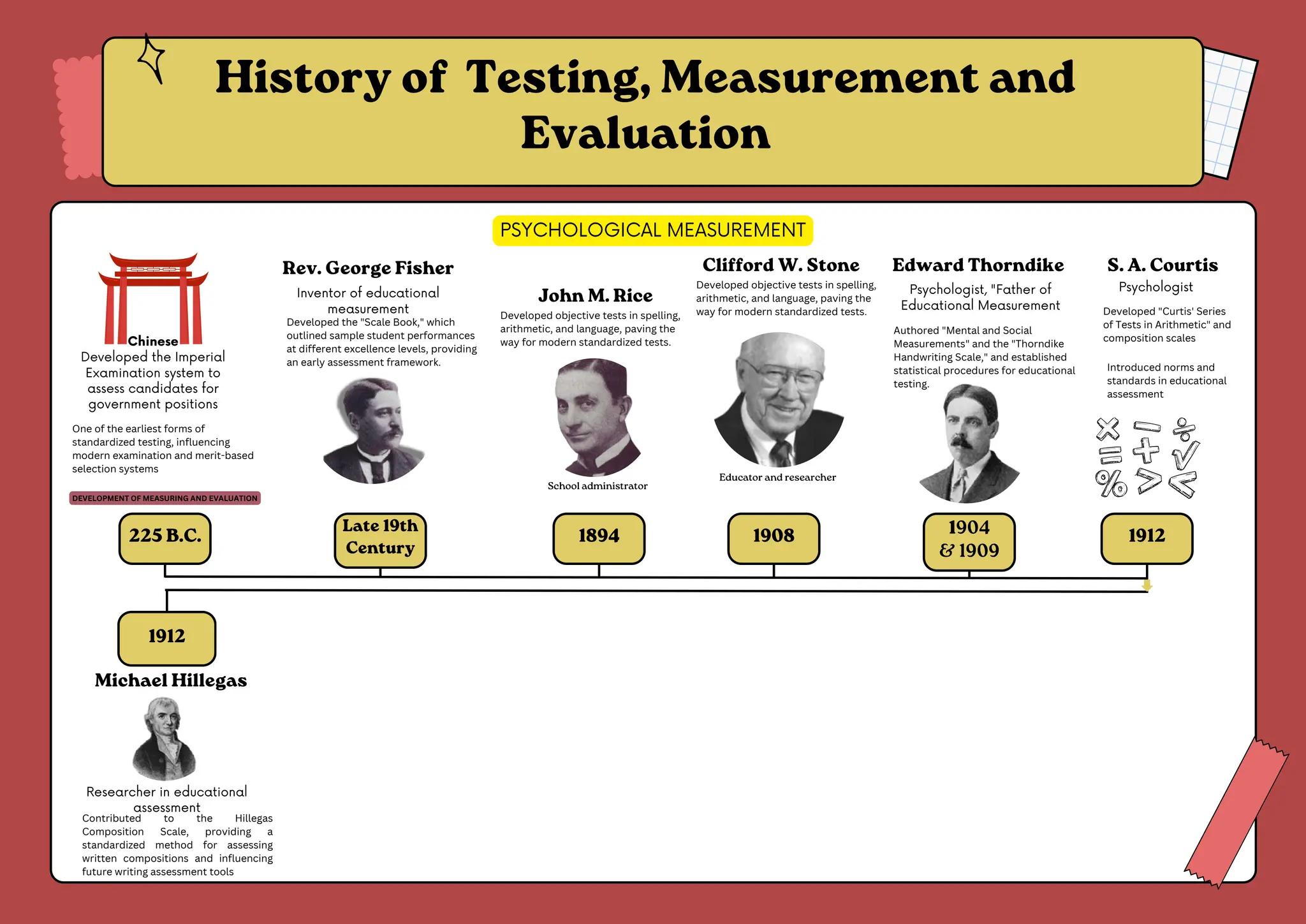
225 B.C.
Late 19th
Century
18941908 1904
& 1909
1912
1912
Educator and researcher
Authored "Mental and Social
Measurements" and the "Thorndike
Handwriting Scale," and established
statistical procedures for educational
testing.
Chinese
Developed the Imperial
Examination system to
assess candidates for
government positions
History of Testing, Measurement and
Evaluation
PSYCHOLOGICAL MEASUREMENT
One of the earliest forms of
standardized testing, influencing
modern examination and merit-based
selection systems
DEVELOPMENT OF MEASURING AND EVALUATION
Rev. George Fisher
Inventor of educational
measurement
Developed the "Scale Book," which
outlined sample student performances
at different excellence levels, providing
an early assessment framework.
John M. Rice
Developed objective tests in spelling,
arithmetic, and language, paving the
way for modern standardized tests.
Clifford W. Stone
Developed objective tests in spelling,
arithmetic, and language, paving the
way for modern standardized tests.
School administrator
Edward Thorndike
Psychologist, "Father of
Educational Measurement
S. A. Courtis
Introduced norms and
standards in educational
assessment
Developed "Curtis' Series
of Tests in Arithmetic" and
composition scales
Psychologist
Michael Hillegas
Contributed to the Hillegas
Composition Scale, providing a
standardized method for assessing
written compositions and influencing
future writing assessment tools
Researcher in educational
assessment
2.
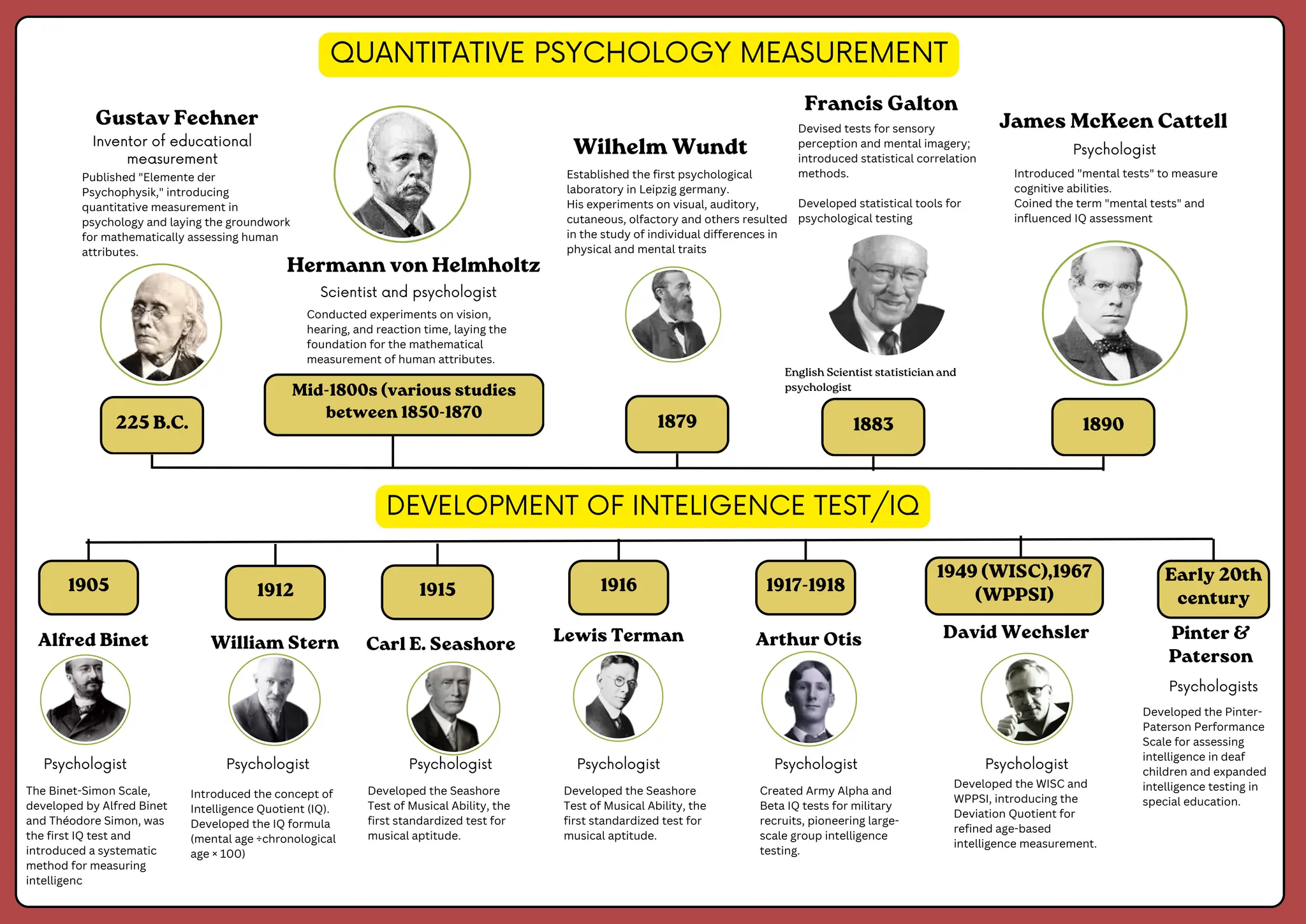
QUANTITATIVE PSYCHOLOGY MEASUREMENT
225B.C.
Mid-1800s (various studies
between 1850-1870
Hermann von Helmholtz
Scientist and psychologist
Published "Elemente der
Psychophysik," introducing
quantitative measurement in
psychology and laying the groundwork
for mathematically assessing human
attributes.
1883
English Scientist statistician and
psychologist
Francis Galton
Devised tests for sensory
perception and mental imagery;
introduced statistical correlation
methods.
Developed statistical tools for
psychological testing
Gustav Fechner
Inventor of educational
measurement
Conducted experiments on vision,
hearing, and reaction time, laying the
foundation for the mathematical
measurement of human attributes.
1879
Wilhelm Wundt
Established the first psychological
laboratory in Leipzig germany.
His experiments on visual, auditory,
cutaneous, olfactory and others resulted
in the study of individual differences in
physical and mental traits
1890
Introduced "mental tests" to measure
cognitive abilities.
Coined the term "mental tests" and
influenced IQ assessment
James McKeen Cattell
Psychologist
DEVELOPMENT OF INTELIGENCE TEST/IQ
The Binet-Simon Scale,
developed by Alfred Binet
and Théodore Simon, was
the first IQ test and
introduced a systematic
method for measuring
intelligenc
1905
Alfred Binet
1912
William Stern
Early 20th
century
Pinter &
Paterson
1916
Lewis Terman
1917-1918
Arthur Otis
1915
Carl E. Seashore
1949 (WISC),1967
(WPPSI)
David Wechsler
Psychologist
Introduced the concept of
Intelligence Quotient (IQ).
Developed the IQ formula
(mental age ÷chronological
age × 100)
Psychologist Psychologist Psychologist Psychologist Psychologist
Psychologists
Developed the Seashore
Test of Musical Ability, the
first standardized test for
musical aptitude.
Developed the Seashore
Test of Musical Ability, the
first standardized test for
musical aptitude.
Created Army Alpha and
Beta IQ tests for military
recruits, pioneering large-
scale group intelligence
testing.
Developed the WISC and
WPPSI, introducing the
Deviation Quotient for
refined age-based
intelligence measurement.
Developed the Pinter-
Paterson Performance
Scale for assessing
intelligence in deaf
children and expanded
intelligence testing in
special education.
3.
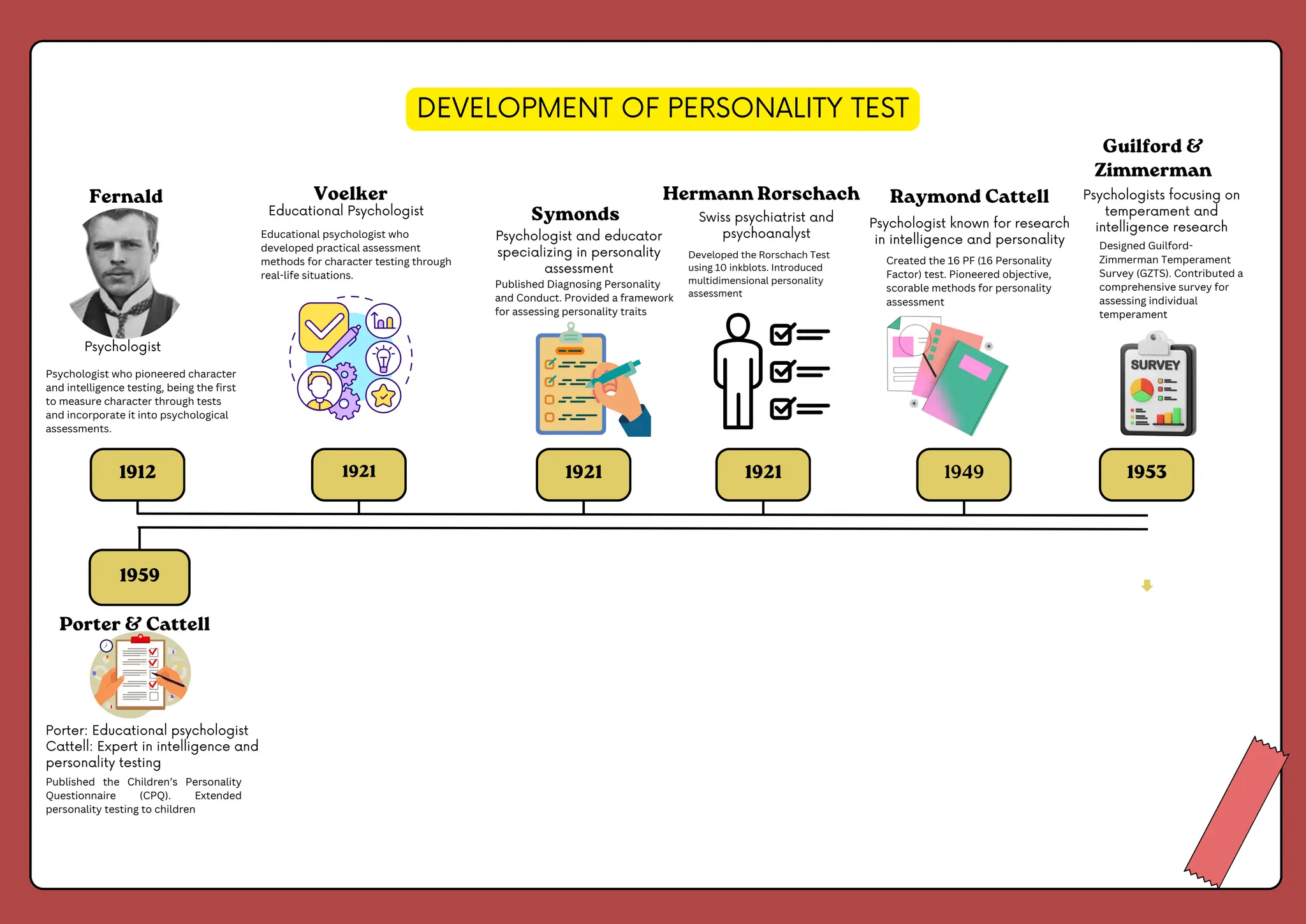
1912 1921 19211921 1949 1953
1959
DEVELOPMENT OF PERSONALITY TEST
Fernald
Porter & Cattell
Created the 16 PF (16 Personality
Factor) test. Pioneered objective,
scorable methods for personality
assessment
Psychologist who pioneered character
and intelligence testing, being the first
to measure character through tests
and incorporate it into psychological
assessments.
Raymond Cattell
Educational Psychologist
Educational psychologist who
developed practical assessment
methods for character testing through
real-life situations.
Guilford &
Zimmerman
Published Diagnosing Personality
and Conduct. Provided a framework
for assessing personality traits
Developed the Rorschach Test
using 10 inkblots. Introduced
multidimensional personality
assessment
Psychologist known for research
in intelligence and personality
Voelker
Designed Guilford-
Zimmerman Temperament
Survey (GZTS). Contributed a
comprehensive survey for
assessing individual
temperament
Psychologists focusing on
temperament and
intelligence research
Symonds
Published the Children’s Personality
Questionnaire (CPQ). Extended
personality testing to children
Porter: Educational psychologist
Cattell: Expert in intelligence and
personality testing
Hermann Rorschach
Psychologist
Psychologist and educator
specializing in personality
assessment
Swiss psychiatrist and
psychoanalyst
4.
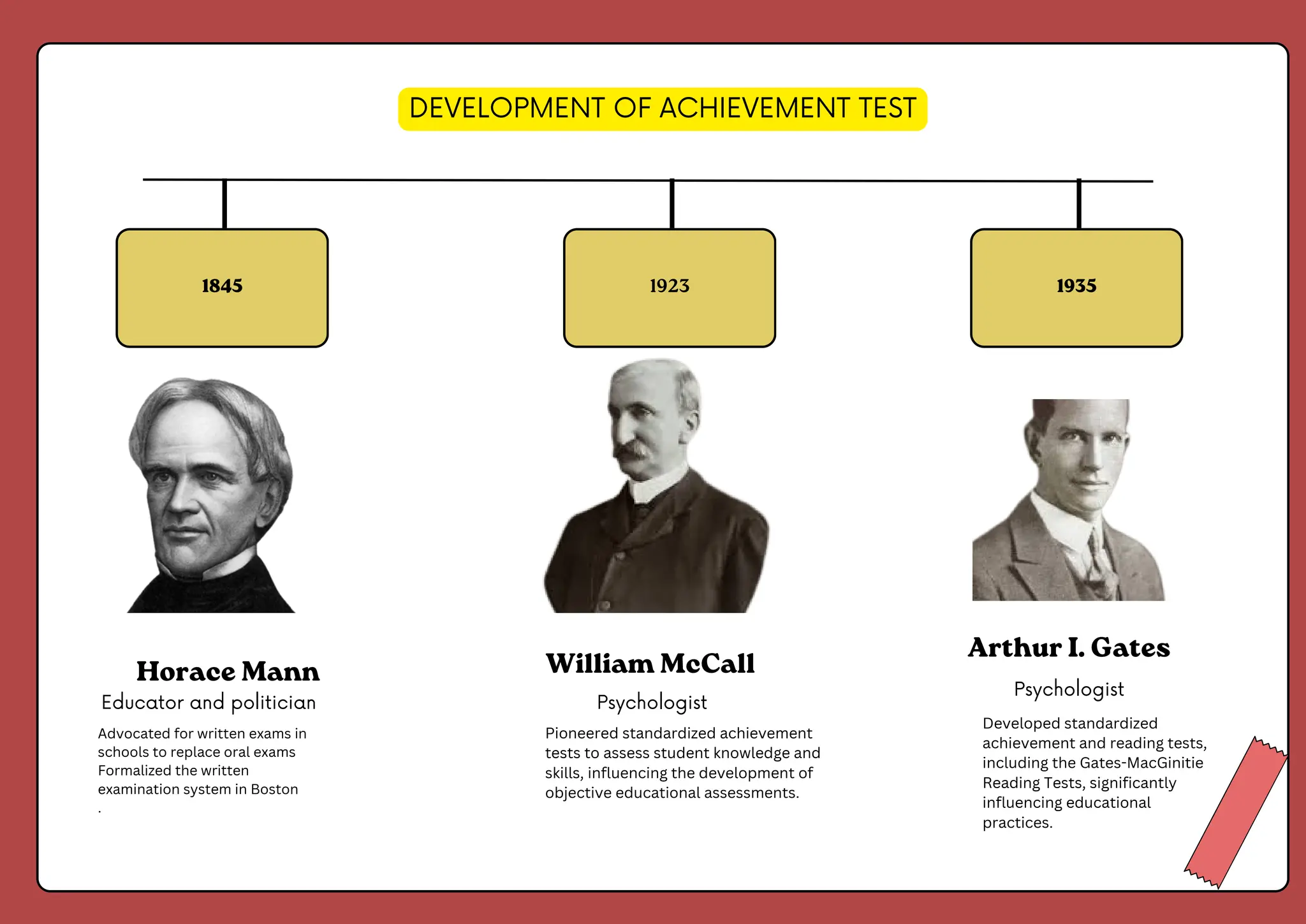
1845 1923 1935
DEVELOPMENTOF ACHIEVEMENT TEST
Pioneered standardized achievement
tests to assess student knowledge and
skills, influencing the development of
objective educational assessments.
William McCall
Psychologist
Arthur I. Gates
Developed standardized
achievement and reading tests,
including the Gates-MacGinitie
Reading Tests, significantly
influencing educational
practices.
Psychologist
Advocated for written exams in
schools to replace oral exams
Formalized the written
examination system in Boston
.
Horace Mann
Educator and politician