History ofHistory of
Medicare and MedicaidMedicare and Medicaid
The following chronology is based on aThe following chronology is based on a
document originally prepared by thedocument originally prepared by the
Social Security Administration (SSA).Social Security Administration (SSA).
Presented by Peter A. Bell, D.O.Presented by Peter A. Bell, D.O.
19371937
 The Technical Committee on Medical CareThe Technical Committee on Medical Care
was established under the interdepartmentalwas established under the interdepartmental
Committee to Coordinate Health and WelfareCommittee to Coordinate Health and Welfare
Activities. The Technical Committee wasActivities. The Technical Committee was
composed of staff members of thecomposed of staff members of the

Children's BureauChildren's Bureau

U.S. Public Health ServiceU.S. Public Health Service

Social Security BoardSocial Security Board
February 1938February 1938
 The report of the Technical Committee onThe report of the Technical Committee on
Medical Care,Medical Care,
"A National Health Program: A Summary,""A National Health Program: A Summary,"
was published.was published.
July 18-20, 1938July 18-20, 1938
 The National Health Conference was held inThe National Health Conference was held in
Washington under the auspices of theWashington under the auspices of the
Interdepartmental Committee to CoordinateInterdepartmental Committee to Coordinate
Health and Welfare Activities, to bring theHealth and Welfare Activities, to bring the
problems of national health and certainproblems of national health and certain
recommendations for a national healthrecommendations for a national health
program before professional groups and theprogram before professional groups and the
public.public.
January 23, 1939January 23, 1939
 A Health Security Message of the PresidentA Health Security Message of the President
was transmitted to Congress; the report andwas transmitted to Congress; the report and
recommendations of the Interdepartmentalrecommendations of the Interdepartmental
Committee to Coordinate Health and WelfareCommittee to Coordinate Health and Welfare
Activities.Activities.
February 1939February 1939
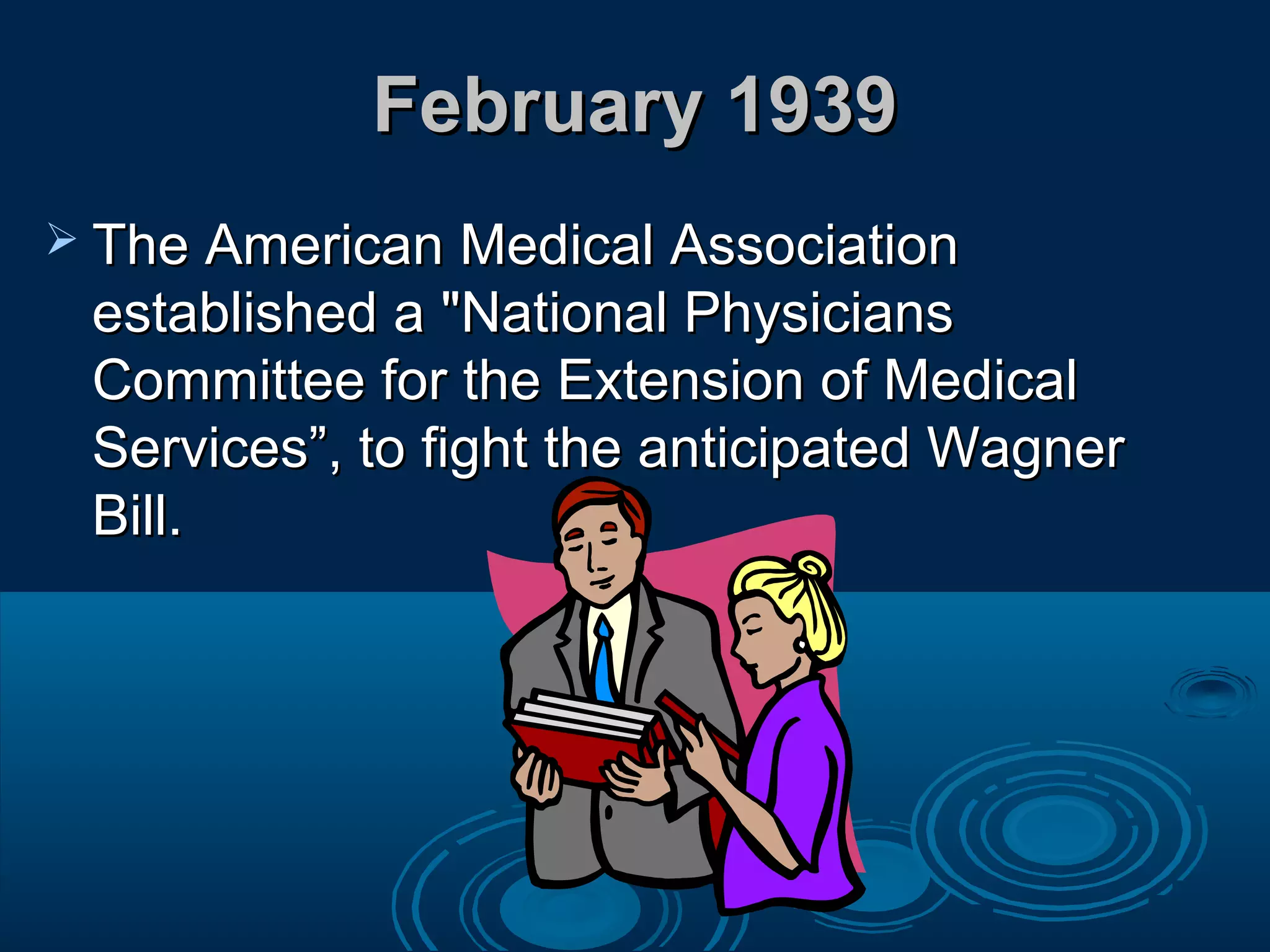
 The American Medical AssociationThe American Medical Association
established a "National Physiciansestablished a "National Physicians
Committee for the Extension of MedicalCommittee for the Extension of Medical
Services”, to fight the anticipated WagnerServices”, to fight the anticipated Wagner
Bill.Bill.
February 28, 1939February 28, 1939
 Senator Robert Wagner introduced S.1620Senator Robert Wagner introduced S.1620
to create the National Health Act of 1939.to create the National Health Act of 1939.
 A national compulsory health insurance forA national compulsory health insurance for
almost all employees and their dependentsalmost all employees and their dependents
was proposed by this Bill.was proposed by this Bill.
February 28, 1939 (cont.)February 28, 1939 (cont.)
 Benefits were to include physician's services,Benefits were to include physician's services,
hospitalization, drugs, and laboratoryhospitalization, drugs, and laboratory
diagnostic services.diagnostic services.
 Costs were to be covered through employerCosts were to be covered through employer
and employee contributions which were toand employee contributions which were to
have been deposited in a health insurancehave been deposited in a health insurance
fund. The plan was to be administeredfund. The plan was to be administered
through the States. No final action was takenthrough the States. No final action was taken
on the Bill--although hearings were held Aprilon the Bill--although hearings were held April
29-July 13. The Bill died in committee.29-July 13. The Bill died in committee.
January 11, 1944January 11, 1944
 President Roosevelt outlined in his State ofPresident Roosevelt outlined in his State of
the Union Message, an "economic Bill ofthe Union Message, an "economic Bill of
rights," which included "the right to adequaterights," which included "the right to adequate
medical care and the opportunity to achievemedical care and the opportunity to achieve
and enjoy good health." However, he did notand enjoy good health." However, he did not
make any subsequent proposal for healthmake any subsequent proposal for health
insurance.insurance.
January 6, 1945January 6, 1945
 President Roosevelt in his State of the UnionPresident Roosevelt in his State of the Union
message again made reference to the rightmessage again made reference to the right
to "good medical care" but made no specificto "good medical care" but made no specific
recommendations.recommendations.
November 19, 1945November 19, 1945
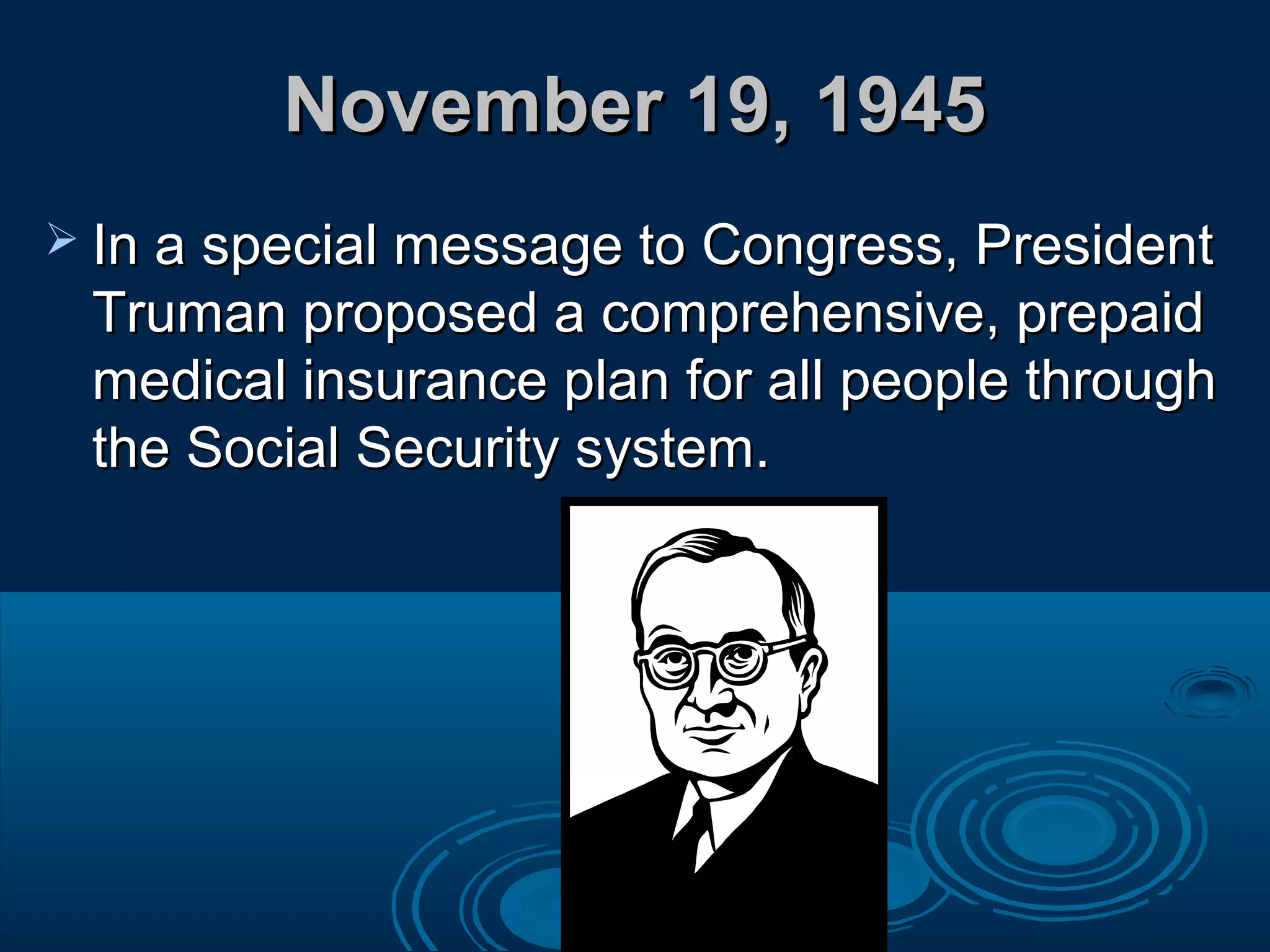
 In a special message to Congress, PresidentIn a special message to Congress, President
Truman proposed a comprehensive, prepaidTruman proposed a comprehensive, prepaid
medical insurance plan for all people throughmedical insurance plan for all people through
the Social Security system.the Social Security system.
November 19, 1945 (cont.)November 19, 1945 (cont.)
 The plan would have covered doctors,The plan would have covered doctors,
hospital, nursing, laboratory and dentalhospital, nursing, laboratory and dental
services for people covered by the Socialservices for people covered by the Social
Security program (medicare); it would alsoSecurity program (medicare); it would also
have provided benefits financed fromhave provided benefits financed from
Federal Revenues for needy peopleFederal Revenues for needy people
(medicaid).(medicaid).
 A revised Wagner-Murray-Dingell BillA revised Wagner-Murray-Dingell Bill
providing for National Health Insurance wasproviding for National Health Insurance was
immediately introduced.immediately introduced.
May 19, 1947May 19, 1947
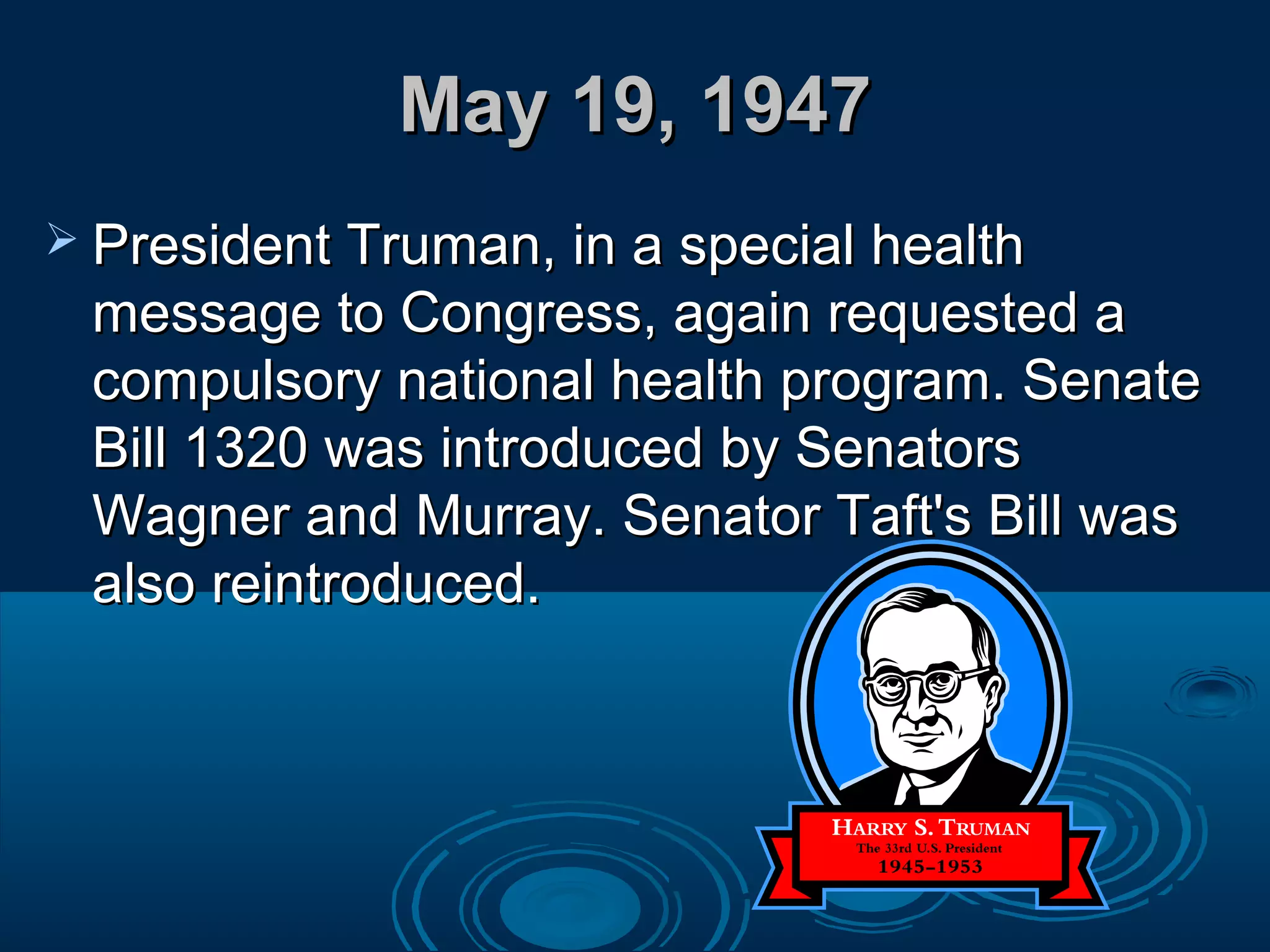
 President Truman, in a special healthPresident Truman, in a special health
message to Congress, again requested amessage to Congress, again requested a
compulsory national health program. Senatecompulsory national health program. Senate
Bill 1320 was introduced by SenatorsBill 1320 was introduced by Senators
Wagner and Murray. Senator Taft's Bill wasWagner and Murray. Senator Taft's Bill was
also reintroduced.also reintroduced.
January 5, 1949January 5, 1949
 In his State of the Union Message, PresidentIn his State of the Union Message, President
Truman again called for compulsory nationalTruman again called for compulsory national
health insurance for persons of all ages,health insurance for persons of all ages,
financed by a Federal payroll tax (medicarefinanced by a Federal payroll tax (medicare
tax).tax).
December 29, 1951December 29, 1951
 President Truman created, by executivePresident Truman created, by executive
order, the President's Commission on theorder, the President's Commission on the
Health Needs of the Nation.Health Needs of the Nation.
 The Commission was to determine theThe Commission was to determine the
Nation's total health requirements, bothNation's total health requirements, both
immediate and long term, and to recommendimmediate and long term, and to recommend
courses of action to meet those needs.courses of action to meet those needs.
February 26, 1952February 26, 1952
 Federal Security Administrator Oscar EwingFederal Security Administrator Oscar Ewing
proposed a substitute health insuranceproposed a substitute health insurance
measure limited to the payment, through themeasure limited to the payment, through the
Social Security system, of hospital costs forSocial Security system, of hospital costs for
retired beneficiaries and their dependents asretired beneficiaries and their dependents as
a step toward a larger goal (medicare parta step toward a larger goal (medicare part
A).A).
September 13, 1960September 13, 1960
 The Social Security Amendments of 1960The Social Security Amendments of 1960
were enacted.were enacted.
 The new law provided increased FederalThe new law provided increased Federal
grants to States for medical care programsgrants to States for medical care programs
for aged people getting old-age assistance iffor aged people getting old-age assistance if
the increase was spent on vendor medicalthe increase was spent on vendor medical
payments.payments.
vsvs
September 13, 1960 (cont.)September 13, 1960 (cont.)

In addition, a new program (commonly referredIn addition, a new program (commonly referred
to as "Kerr-Mills") of Federal grants to States forto as "Kerr-Mills") of Federal grants to States for
vendor medical care programs for aged peoplevendor medical care programs for aged people
not on public assistance but unable to pay fornot on public assistance but unable to pay for
needed medical services was provided.needed medical services was provided.

Old-age and survivors' insurance was amendedOld-age and survivors' insurance was amended
to provide disability insurance benefits toto provide disability insurance benefits to
disabled workers of all ages and to theirdisabled workers of all ages and to their
dependents; the retirement test was liberalized,dependents; the retirement test was liberalized,
as well as were eligibility requirements.as well as were eligibility requirements.
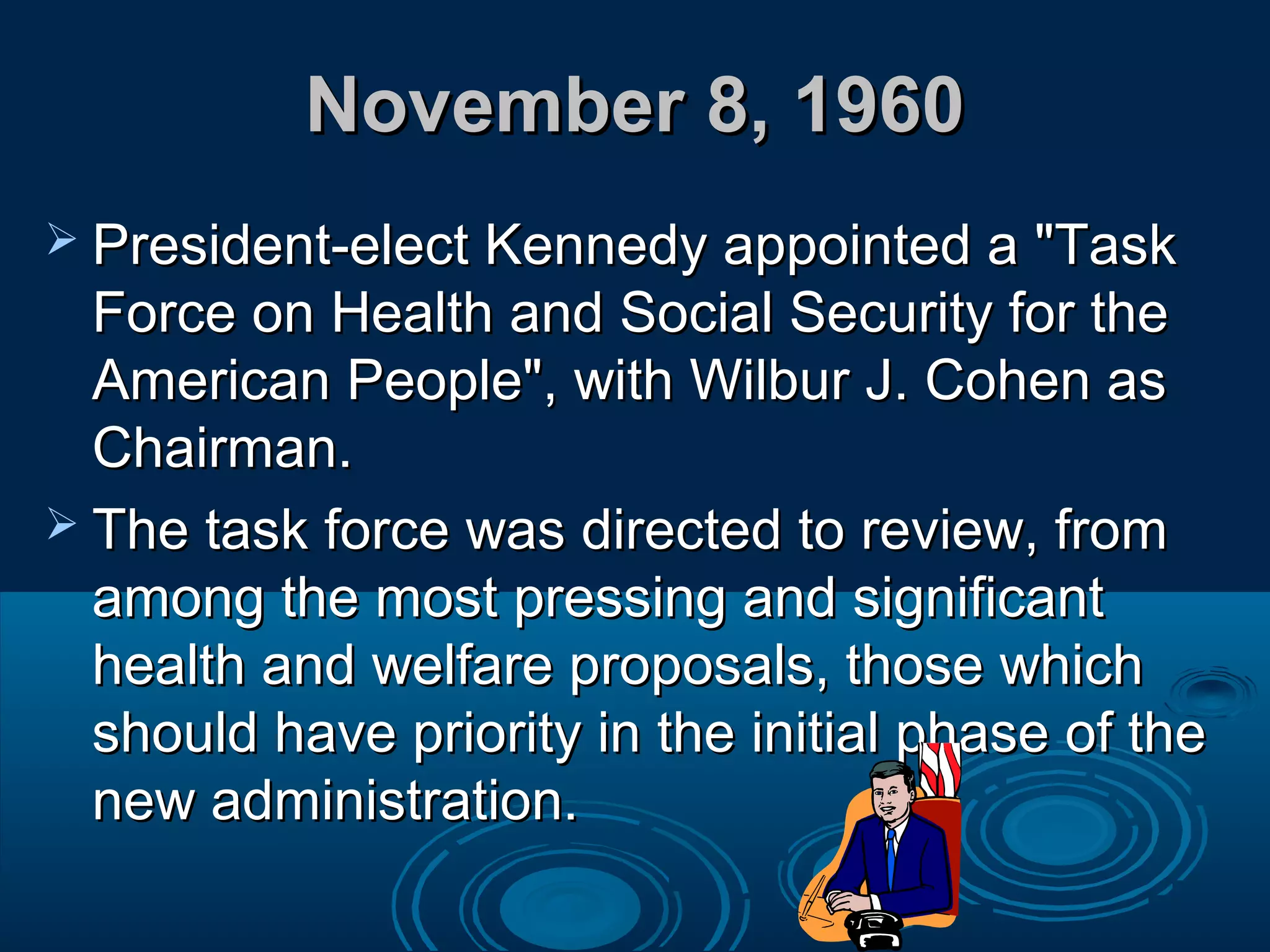
November 8, 1960November 8, 1960
 President-elect Kennedy appointed a "TaskPresident-elect Kennedy appointed a "Task
Force on Health and Social Security for theForce on Health and Social Security for the
American People", with Wilbur J. Cohen asAmerican People", with Wilbur J. Cohen as
Chairman.Chairman.
 The task force was directed to review, fromThe task force was directed to review, from
among the most pressing and significantamong the most pressing and significant
health and welfare proposals, those whichhealth and welfare proposals, those which
should have priority in the initial phase of theshould have priority in the initial phase of the
new administration.new administration.
January 10, 1961January 10, 1961
 The Task Force onThe Task Force on Health and SocialHealth and Social
Security for the American PeopleSecurity for the American People waswas
reported to the President. The report made areported to the President. The report made a
number of recommendations regardingnumber of recommendations regarding
health care, including a program of hospitalhealth care, including a program of hospital
insurance for the aged through the Socialinsurance for the aged through the Social
Security system.Security system.
February 13, 1961February 13, 1961
 H.R. 4222, the Health Insurance Benefits ActH.R. 4222, the Health Insurance Benefits Act
of 1961, proposing a program along the linesof 1961, proposing a program along the lines
set forth by the President, was introduced byset forth by the President, was introduced by
Representative King of California. S. 909, aRepresentative King of California. S. 909, a
companion Bill, was introduced in the Senatecompanion Bill, was introduced in the Senate
by Senator Anderson. The House Bill wasby Senator Anderson. The House Bill was
referred to the Committee on Ways andreferred to the Committee on Ways and
Means.Means.
January 11, 1962January 11, 1962
 In his State of the Union Message, PresidentIn his State of the Union Message, President
Kennedy renewed his 1961 request that theKennedy renewed his 1961 request that the
old-age, survivors, and disability provisionsold-age, survivors, and disability provisions
of the Social Security Act be amended toof the Social Security Act be amended to
provide health insurance for the aged.provide health insurance for the aged.
February 27, 1962February 27, 1962
 In his Health Message, President KennedyIn his Health Message, President Kennedy
renewed his 1961 request that the old-age,renewed his 1961 request that the old-age,
survivors and disability provisions of thesurvivors and disability provisions of the
Social Security Act be amended to provideSocial Security Act be amended to provide
health insurance protection for the aged.health insurance protection for the aged.
July 21,1964July 21,1964
 The Senate Special Aging, Health of theThe Senate Special Aging, Health of the
Elderly Subcommittee released its report,Elderly Subcommittee released its report,
entitled, "Blue Cross and Private Healthentitled, "Blue Cross and Private Health
Insurance Coverage of Older Americans.“Insurance Coverage of Older Americans.“
 It stated that private health insurance wasIt stated that private health insurance was
unable to provide the large majority of olderunable to provide the large majority of older
Americans with "adequate hospital protectionAmericans with "adequate hospital protection
at reasonable premium cost."at reasonable premium cost."
January 7, 1965January 7, 1965
 President Johnson's first legislative messagePresident Johnson's first legislative message
to the 89th Congress,to the 89th Congress, Advancing theAdvancing the
Nation's HealthNation's Health, detailed a program including, detailed a program including
hospital insurance for the aged under Socialhospital insurance for the aged under Social
Security and health care for needy childrenSecurity and health care for needy children
(beginning of SCHIP).(beginning of SCHIP).
March 23, 1965March 23, 1965
 The Committee on Ways and Means of theThe Committee on Ways and Means of the
House of Representatives approved a Bill toHouse of Representatives approved a Bill to
replace the Administration's proposal with anreplace the Administration's proposal with an
unprecedented package of health benefitsunprecedented package of health benefits
and Social Security improvements.and Social Security improvements.
(The Mills Bill)(The Mills Bill)
March 24, 1965March 24, 1965
 H.R. 6675 was introduced by RepresentativeH.R. 6675 was introduced by Representative
Wilbur Mills as the "Social SecurityWilbur Mills as the "Social Security
Amendments of 1965."Amendments of 1965."
April 8, 1965April 8, 1965
 The House passed H. R. 6675, the "MillsThe House passed H. R. 6675, the "Mills
Bill," without amendmentBill," without amendment
 Medicare was about to be bornMedicare was about to be born
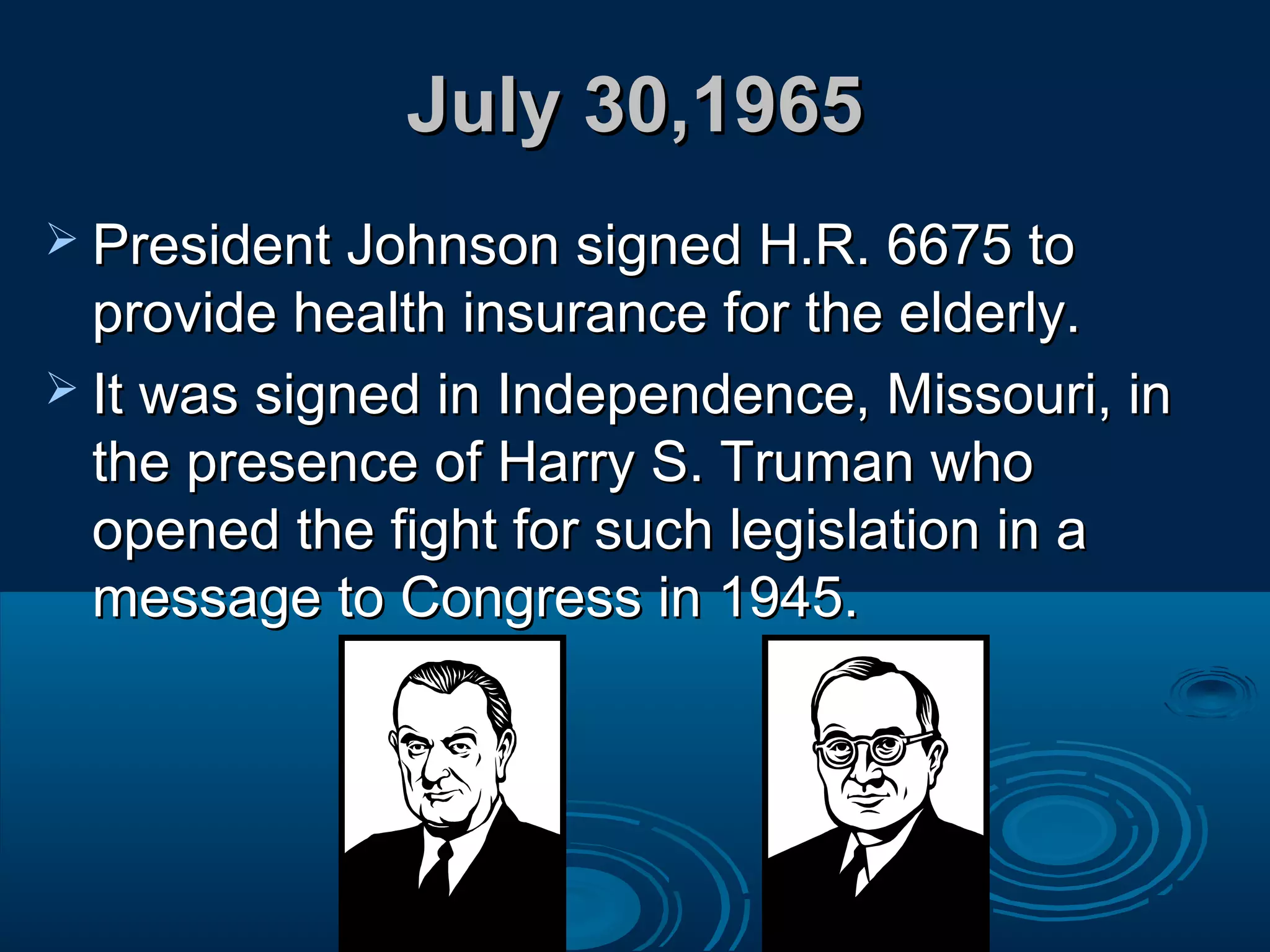
July 30,1965July 30,1965
 President Johnson signed H.R. 6675 toPresident Johnson signed H.R. 6675 to
provide health insurance for the elderly.provide health insurance for the elderly.
 It was signed in Independence, Missouri, inIt was signed in Independence, Missouri, in
the presence of Harry S. Truman whothe presence of Harry S. Truman who
opened the fight for such legislation in aopened the fight for such legislation in a
message to Congress in 1945.message to Congress in 1945.
January 1966January 1966
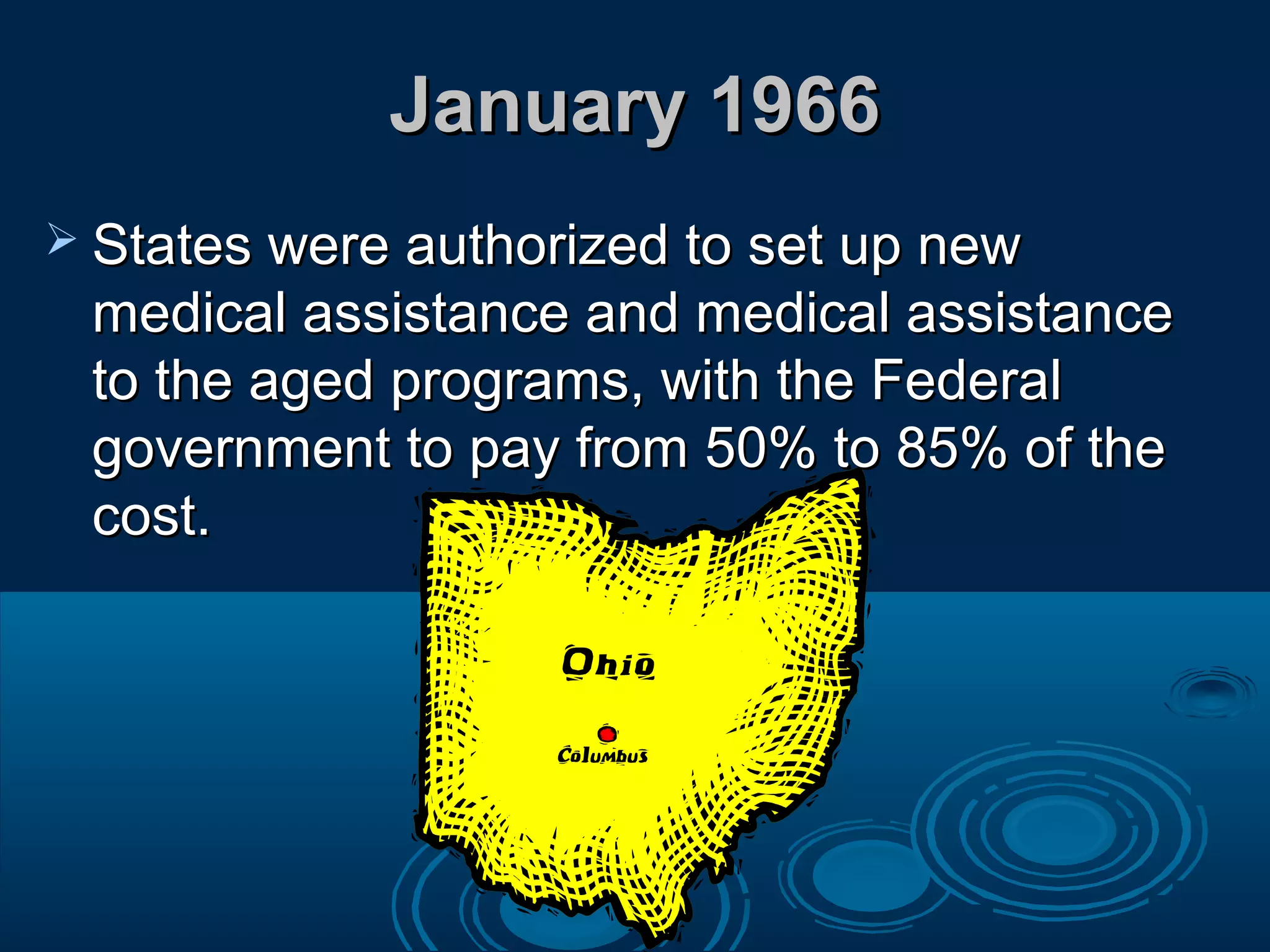
 States were authorized to set up newStates were authorized to set up new
medical assistance and medical assistancemedical assistance and medical assistance
to the aged programs, with the Federalto the aged programs, with the Federal
government to pay from 50% to 85% of thegovernment to pay from 50% to 85% of the
cost.cost.
February 12, 1966February 12, 1966
 The Social Security AdministrationThe Social Security Administration
announced the selection of 32 Blue Shieldannounced the selection of 32 Blue Shield
organizations, 16 commercial insuranceorganizations, 16 commercial insurance
companies and one private insurer tocompanies and one private insurer to
perform the major administrative functions ofperform the major administrative functions of
the voluntary part of the Medicare program.the voluntary part of the Medicare program.
March 31, 1966March 31, 1966
 This was the deadline for Social SecurityThis was the deadline for Social Security
beneficiaries to enroll in the voluntarybeneficiaries to enroll in the voluntary
medical insurance program for coverage tomedical insurance program for coverage to
start on July 1, 1966.start on July 1, 1966.
 All beneficiaries who reached their 65thAll beneficiaries who reached their 65th
birthday prior to January 1, 1966, werebirthday prior to January 1, 1966, were
eligible.eligible.
March 31, 1966 (cont.)March 31, 1966 (cont.)
 Persons who reached their 65th birthdayPersons who reached their 65th birthday
after that date had to enroll during the three-after that date had to enroll during the three-
month period before they became 65.month period before they became 65.
 The medical insurance payment of $3 aThe medical insurance payment of $3 a
month was to be taken out of the person'smonth was to be taken out of the person's
Old-Age, Survivors, and Disability InsuranceOld-Age, Survivors, and Disability Insurance
(OASDI) check, but his public assistance(OASDI) check, but his public assistance
grants could be raised to compensate for thegrants could be raised to compensate for the
deduction.deduction.
July 1, 1966July 1, 1966
 On this date all persons over 65 wereOn this date all persons over 65 were
automatically covered under all of theautomatically covered under all of the
hospital insurance provisions of the newhospital insurance provisions of the new
legislation, except for the nursing homelegislation, except for the nursing home
provision.provision.
 Public assistance funds were needed to payPublic assistance funds were needed to pay
the deductibles for those who could notthe deductibles for those who could not
afford them.afford them.
July 1, 1966 (cont.)July 1, 1966 (cont.)
 Benefits under the voluntary medicalBenefits under the voluntary medical
insurance program began for OASDIinsurance program began for OASDI
beneficiaries who signed up for it earlier andbeneficiaries who signed up for it earlier and
for elderly persons who received publicfor elderly persons who received public
assistance payments in States thatassistance payments in States that
previously entered into an agreement forpreviously entered into an agreement for
their coverage.their coverage.
January 2, 1968January 2, 1968
 President Johnson signed into law the 1967President Johnson signed into law the 1967
Amendments to the Social Security Act. InAmendments to the Social Security Act. In
addition to a 13% increase in benefits, theaddition to a 13% increase in benefits, the
measure made changes in the minimummeasure made changes in the minimum
benefit, in the retirement test, in disabilitybenefit, in the retirement test, in disability
benefits, coverage, hospital and Medicarebenefits, coverage, hospital and Medicare
insurance and increased the earnings baseinsurance and increased the earnings base
from $6,600 to $7,800.from $6,600 to $7,800.
January 13, 1969January 13, 1969
 The Secretary of the Health, Education andThe Secretary of the Health, Education and
Welfare (HEW), sent to the President theWelfare (HEW), sent to the President the
report of the Task Force on Prescriptionreport of the Task Force on Prescription
Drugs as called for by the 1967Drugs as called for by the 1967
amendments.amendments.
January 15, 1969January 15, 1969
 President Johnson's budget proposed aPresident Johnson's budget proposed a
minimum 10% increase in Social Securityminimum 10% increase in Social Security
benefit payments for 1970.benefit payments for 1970.
March 4, 1969March 4, 1969
 Regulations were issued by HEW to theRegulations were issued by HEW to the
States to ensure efficient and economicalStates to ensure efficient and economical
use of Medicaid services.use of Medicaid services.
 Under the new regulations, States had toUnder the new regulations, States had to
include in the administration of the Medicaidinclude in the administration of the Medicaid
program procedures to review the utilizationprogram procedures to review the utilization
of health care services provided by theof health care services provided by the
program.program.
May 1969May 1969
 Secretary Finch released the final report ofSecretary Finch released the final report of
the Task Force on Prescription Drugs. Dr.the Task Force on Prescription Drugs. Dr.
Philip R. Lee headed the Task Force from itsPhilip R. Lee headed the Task Force from its
inception in May 19, 1967.inception in May 19, 1967.
 The Task Force's charge was to study theThe Task Force's charge was to study the
possibility of adding prescription drugpossibility of adding prescription drug
coverage to the recently enacted Medicarecoverage to the recently enacted Medicare
program.program.
July 1969July 1969
 The Bureau of Health Insurance set up aThe Bureau of Health Insurance set up a
program in SRS integrity staff to counterprogram in SRS integrity staff to counter
abuses in the health insurance program.abuses in the health insurance program.
19691969
 HEW Secretary Finch established aHEW Secretary Finch established a
Secretary's Task Force on Medicaid andSecretary's Task Force on Medicaid and
Related Programs.Related Programs.
 The President of the National Blue CrossThe President of the National Blue Cross
Association, Walter J. McNurney, was madeAssociation, Walter J. McNurney, was made
chairman; Arthur Hess was its staff director.chairman; Arthur Hess was its staff director.
October 30, 1972October 30, 1972
 President Nixon signed the Social SecurityPresident Nixon signed the Social Security
Amendments of 1972 (PL 92-603).Amendments of 1972 (PL 92-603).
 The law liberalized several of the cashThe law liberalized several of the cash
benefit provisions, made substantial changesbenefit provisions, made substantial changes
in Medicare, revised the contributionin Medicare, revised the contribution
schedule, amended some coverageschedule, amended some coverage
provisions, and established a new Federalprovisions, and established a new Federal
security income program for the needy aged,security income program for the needy aged,
blind, and disabled (the SSI program).blind, and disabled (the SSI program).
19771977
 The Health Care Financing AdministrationThe Health Care Financing Administration
(HCFA) was created to administer both the(HCFA) was created to administer both the
Medicare and Medicaid programs.Medicare and Medicaid programs.
 About 1,500 employees were transferred toAbout 1,500 employees were transferred to
HCFA from the Social SecurityHCFA from the Social Security
Administration.Administration.
January 26, 1982January 26, 1982
 In his State of the Union Address PresidentIn his State of the Union Address President
Reagan called for the transfer of $47 BillionReagan called for the transfer of $47 Billion
in Federal programs to the jurisdiction ofin Federal programs to the jurisdiction of
State and local governments.State and local governments.
 Among other things, the proposal would giveAmong other things, the proposal would give
the States full responsibility for Aid tothe States full responsibility for Aid to
Families with Dependent Children and foodFamilies with Dependent Children and food
stamps and the Federal government fullstamps and the Federal government full
responsibility for the Medicaid program.responsibility for the Medicaid program.
August 5, 1997August 5, 1997
 President Clinton signed H.R. 2015, thePresident Clinton signed H.R. 2015, the
Balanced Budget Act of 1997 (BBA), intoBalanced Budget Act of 1997 (BBA), into
law.law.
 The BBA made the most far reachingThe BBA made the most far reaching
changes in the Medicare program sincechanges in the Medicare program since
enactment.enactment.
August 5, 1997 (cont.)August 5, 1997 (cont.)
 It extended the insolvency of the HI trustIt extended the insolvency of the HI trust
fund to 2010, reduced the rate of increase infund to 2010, reduced the rate of increase in
payments to providers, created several newpayments to providers, created several new
prospective payment systems, addedprospective payment systems, added
coverage of certain preventive benefits, andcoverage of certain preventive benefits, and
added the Medicare+Choice program whichadded the Medicare+Choice program which
allows Medicare beneficiaries to chooseallows Medicare beneficiaries to choose
additional types of health plans.additional types of health plans.
August 5, 1997 (cont.)August 5, 1997 (cont.)
 The BBA also created the new StateThe BBA also created the new State
Children's Health Insurance ProgramChildren's Health Insurance Program
(SCHIP) which is designed to assist those(SCHIP) which is designed to assist those
working families with incomes too high forworking families with incomes too high for
Medicaid but too low to be able to affordMedicaid but too low to be able to afford
private health insurance.private health insurance.
November 29, 1999November 29, 1999
 President Clinton signed the Medicare,President Clinton signed the Medicare,
Medicaid, and SCHIP Balanced BudgetMedicaid, and SCHIP Balanced Budget
Refinement Act of 1999 (BBRA).Refinement Act of 1999 (BBRA).
 It made numerous changes to the MedicareIt made numerous changes to the Medicare
program aimed at reducing the impact of theprogram aimed at reducing the impact of the
payment reductions to providers in the BBApayment reductions to providers in the BBA
of 1997, stabilized the SCHIP allotmentof 1997, stabilized the SCHIP allotment
formula and modified the Medicaid DSHformula and modified the Medicaid DSH
program.program.
November 29, 1999 (cont.)November 29, 1999 (cont.)
 On December 17, 1999, President ClintonOn December 17, 1999, President Clinton
signed the Ticket to Work and Worksigned the Ticket to Work and Work
Incentives Improvement Act of 1999Incentives Improvement Act of 1999
(TWWIIA) which expanded the availability of(TWWIIA) which expanded the availability of
Medicare and Medicaid for certain disabledMedicare and Medicaid for certain disabled
beneficiaries who return to work.beneficiaries who return to work.
December 21, 2000December 21, 2000
 President Clinton signed the BenefitsPresident Clinton signed the Benefits
Improvement and Protection Act of 2000Improvement and Protection Act of 2000
(BIPA).(BIPA).
 It made numerous changes to the Medicare,It made numerous changes to the Medicare,
Medicaid and SCHIP programs.Medicaid and SCHIP programs.
 Other related legislation improved MedicaidOther related legislation improved Medicaid
coverage of certain women's health services.coverage of certain women's health services.
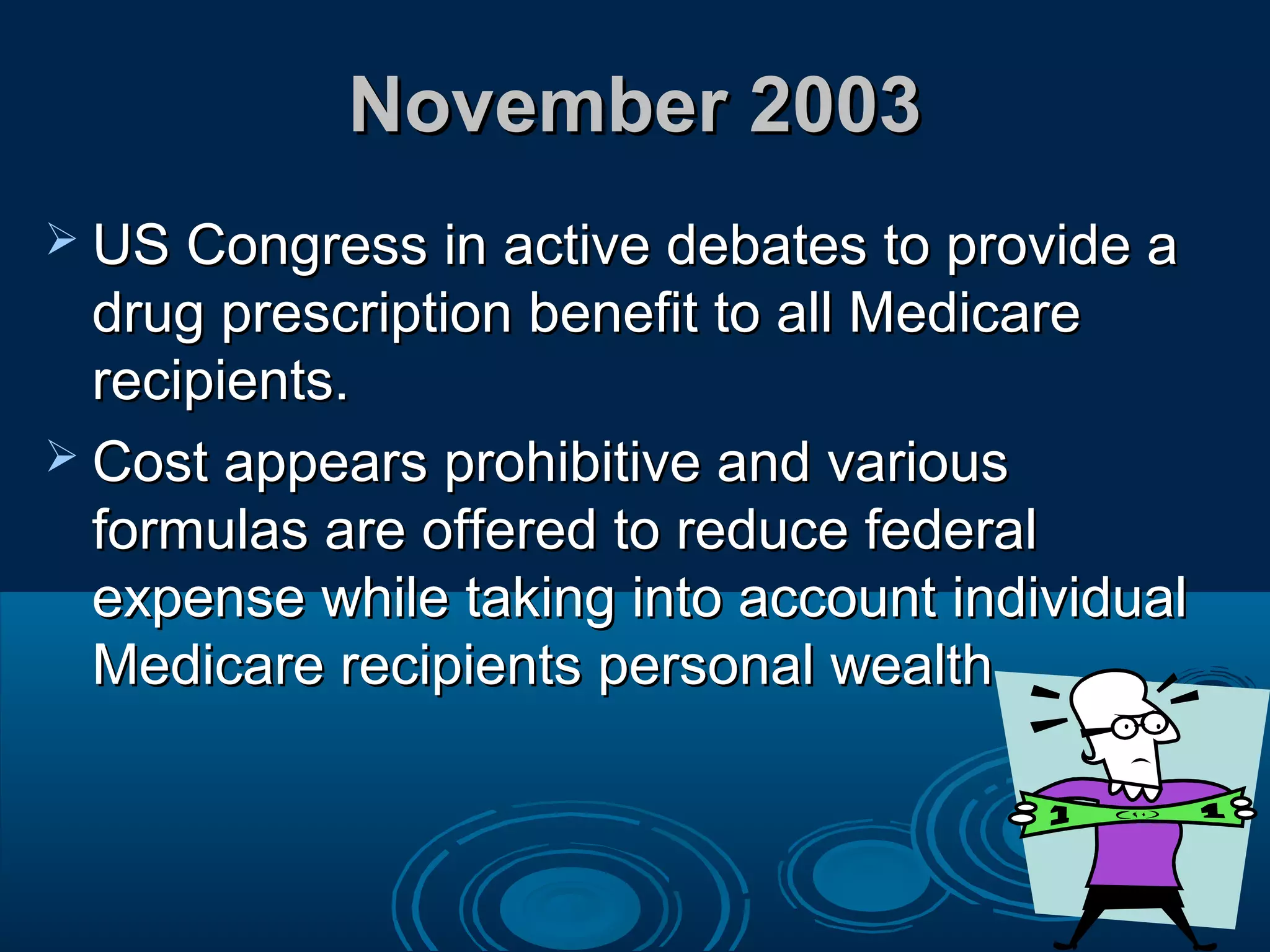
November 2003November 2003
 US Congress in active debates to provide aUS Congress in active debates to provide a
drug prescription benefit to all Medicaredrug prescription benefit to all Medicare
recipients.recipients.
 Cost appears prohibitive and variousCost appears prohibitive and various
formulas are offered to reduce federalformulas are offered to reduce federal
expense while taking into account individualexpense while taking into account individual
Medicare recipients personal wealth.Medicare recipients personal wealth.
Timeline SummaryTimeline Summary
 BCBC Greek City States with health ins.Greek City States with health ins.
 17981798 US Gov Marine Hospital ins.US Gov Marine Hospital ins.
 18541854 Prussian health ins.Prussian health ins.
 18831883 German health ins.German health ins.
 19021902 US Workers’ Comp ins. (unconstitutional)US Workers’ Comp ins. (unconstitutional)
 19081908 Work Comp. ins. for Fed. EmployeesWork Comp. ins. for Fed. Employees
 19111911 British National health ins.British National health ins.
 19121912 T Roosevelt proposes social/health ins.T Roosevelt proposes social/health ins.
 1913-291913-29 Great Debate of social responsibilityGreat Debate of social responsibility
 19331933 Blue Cross establishedBlue Cross established
 19351935 First Fed health ins. “Epstein” bill (failed)First Fed health ins. “Epstein” bill (failed)
Timeline SummaryTimeline Summary
 19381938 Report,Report, “A National Health Program: A Summary”“A National Health Program: A Summary”
 19391939 “National Health Act”“National Health Act”
• Comprehensive employee/employer planComprehensive employee/employer plan
• AMA opposesAMA opposes
• FailsFails
 1944-451944-45 Pres Roosevelt calls for health ins. PlanPres Roosevelt calls for health ins. Plan
 19451945 Pres Truman proposes plan thru SSPres Truman proposes plan thru SS
 19471947 Truman requests a compulsory planTruman requests a compulsory plan
 19491949 Truman props plan thru Fed payroll taxTruman props plan thru Fed payroll tax
 19511951 Truman CommissionTruman Commission “Health Needs of the“Health Needs of the
Nation”Nation”
 19521952 Proposal; SS pay for hospital careProposal; SS pay for hospital care
Timeline SummaryTimeline Summary
 19601960 SS AmendmentsSS Amendments
• Increase Fed grants to states for care to elderlyIncrease Fed grants to states for care to elderly
Pres KennedyPres Kennedy
• ““Task Force on Health and SS for American PeopleTask Force on Health and SS for American People””
 19611961 “Health Ins. Benefits Act ’61”“Health Ins. Benefits Act ’61”
• died in committeedied in committee
 19621962 Pres Kennedy request to expand SS ActPres Kennedy request to expand SS Act
 19641964 Senate Subcommittee on Aging/ElderlySenate Subcommittee on Aging/Elderly
• Conclude unable to provide majority of elderly w/Conclude unable to provide majority of elderly w/
adequate hospital coverage at reasonable costadequate hospital coverage at reasonable cost
Timeline SummaryTimeline Summary
 19651965 Pres Johnson proposes SS hospitalPres Johnson proposes SS hospital
coverage plus needy childcoverage plus needy child
““Mills Bill: SS Amendments ’65” passedMills Bill: SS Amendments ’65” passed
July 30July 30thth
Pres Johnson signs bill enactingPres Johnson signs bill enacting
Medicare/Medicaid with former PresMedicare/Medicaid with former Pres
Truman as special guestTruman as special guest
 19661966 States set up the new programsStates set up the new programs
BS and commercial carriers administerBS and commercial carriers administer
Persons 65+ voluntarily enrollPersons 65+ voluntarily enroll
Timeline SummaryTimeline Summary
 19681968 Pres Johnson expands coverage/benefitsPres Johnson expands coverage/benefits
 19691969 Task Force on Medicaid/related prgrmsTask Force on Medicaid/related prgrms
 19721972 Pres Nixon established SSIPres Nixon established SSI
 19771977 HCFA createdHCFA created
 19821982 Pres ReaganPres Reagan
• Transferred $ and responsibility for Aid to FamiliesTransferred $ and responsibility for Aid to Families
w/ Dependant Child and Food Stamps to Statesw/ Dependant Child and Food Stamps to States
• Fed government still responsible for MedicaidFed government still responsible for Medicaid
 19971997 Pres Clinton “Balanced Budget Act ’97”Pres Clinton “Balanced Budget Act ’97”
• Decrease GME payment scheduleDecrease GME payment schedule
• Decrease provider payment scheduleDecrease provider payment schedule
• Extend insolvency of health ins. Trust to 2010Extend insolvency of health ins. Trust to 2010
• Created SCHIPCreated SCHIP
Timeline SummaryTimeline Summary
 19991999 Pres Clinton “Balanced Budget Act ’99”Pres Clinton “Balanced Budget Act ’99”
• Adjusted payments to providersAdjusted payments to providers
• Stabilized SCHIPStabilized SCHIP
• Modified DSH (disproportionate share hospitals)Modified DSH (disproportionate share hospitals)
Pres Clinton “Ticket to Work IncentivesPres Clinton “Ticket to Work Incentives
Improvement Act of ’99”Improvement Act of ’99”
• Disabled get health ins. If return to workDisabled get health ins. If return to work
 20002000 Pres Clinton “Benefits Improvement andPres Clinton “Benefits Improvement and
Protection Act ’00”Protection Act ’00”
 20032003 Medicare Prescription BenefitMedicare Prescription Benefit

History of CMS

  • 1.
    History ofHistory of Medicareand MedicaidMedicare and Medicaid The following chronology is based on aThe following chronology is based on a document originally prepared by thedocument originally prepared by the Social Security Administration (SSA).Social Security Administration (SSA). Presented by Peter A. Bell, D.O.Presented by Peter A. Bell, D.O.
  • 2.
    19371937  The TechnicalCommittee on Medical CareThe Technical Committee on Medical Care was established under the interdepartmentalwas established under the interdepartmental Committee to Coordinate Health and WelfareCommittee to Coordinate Health and Welfare Activities. The Technical Committee wasActivities. The Technical Committee was composed of staff members of thecomposed of staff members of the  Children's BureauChildren's Bureau  U.S. Public Health ServiceU.S. Public Health Service  Social Security BoardSocial Security Board
  • 3.
    February 1938February 1938 The report of the Technical Committee onThe report of the Technical Committee on Medical Care,Medical Care, "A National Health Program: A Summary,""A National Health Program: A Summary," was published.was published.
  • 4.
    July 18-20, 1938July18-20, 1938  The National Health Conference was held inThe National Health Conference was held in Washington under the auspices of theWashington under the auspices of the Interdepartmental Committee to CoordinateInterdepartmental Committee to Coordinate Health and Welfare Activities, to bring theHealth and Welfare Activities, to bring the problems of national health and certainproblems of national health and certain recommendations for a national healthrecommendations for a national health program before professional groups and theprogram before professional groups and the public.public.
  • 5.
    January 23, 1939January23, 1939  A Health Security Message of the PresidentA Health Security Message of the President was transmitted to Congress; the report andwas transmitted to Congress; the report and recommendations of the Interdepartmentalrecommendations of the Interdepartmental Committee to Coordinate Health and WelfareCommittee to Coordinate Health and Welfare Activities.Activities.
  • 6.
    February 1939February 1939 The American Medical AssociationThe American Medical Association established a "National Physiciansestablished a "National Physicians Committee for the Extension of MedicalCommittee for the Extension of Medical Services”, to fight the anticipated WagnerServices”, to fight the anticipated Wagner Bill.Bill.
  • 7.
    February 28, 1939February28, 1939  Senator Robert Wagner introduced S.1620Senator Robert Wagner introduced S.1620 to create the National Health Act of 1939.to create the National Health Act of 1939.  A national compulsory health insurance forA national compulsory health insurance for almost all employees and their dependentsalmost all employees and their dependents was proposed by this Bill.was proposed by this Bill.
  • 8.
    February 28, 1939(cont.)February 28, 1939 (cont.)  Benefits were to include physician's services,Benefits were to include physician's services, hospitalization, drugs, and laboratoryhospitalization, drugs, and laboratory diagnostic services.diagnostic services.  Costs were to be covered through employerCosts were to be covered through employer and employee contributions which were toand employee contributions which were to have been deposited in a health insurancehave been deposited in a health insurance fund. The plan was to be administeredfund. The plan was to be administered through the States. No final action was takenthrough the States. No final action was taken on the Bill--although hearings were held Aprilon the Bill--although hearings were held April 29-July 13. The Bill died in committee.29-July 13. The Bill died in committee.
  • 9.
    January 11, 1944January11, 1944  President Roosevelt outlined in his State ofPresident Roosevelt outlined in his State of the Union Message, an "economic Bill ofthe Union Message, an "economic Bill of rights," which included "the right to adequaterights," which included "the right to adequate medical care and the opportunity to achievemedical care and the opportunity to achieve and enjoy good health." However, he did notand enjoy good health." However, he did not make any subsequent proposal for healthmake any subsequent proposal for health insurance.insurance.
  • 10.
    January 6, 1945January6, 1945  President Roosevelt in his State of the UnionPresident Roosevelt in his State of the Union message again made reference to the rightmessage again made reference to the right to "good medical care" but made no specificto "good medical care" but made no specific recommendations.recommendations.
  • 11.
    November 19, 1945November19, 1945  In a special message to Congress, PresidentIn a special message to Congress, President Truman proposed a comprehensive, prepaidTruman proposed a comprehensive, prepaid medical insurance plan for all people throughmedical insurance plan for all people through the Social Security system.the Social Security system.
  • 12.
    November 19, 1945(cont.)November 19, 1945 (cont.)  The plan would have covered doctors,The plan would have covered doctors, hospital, nursing, laboratory and dentalhospital, nursing, laboratory and dental services for people covered by the Socialservices for people covered by the Social Security program (medicare); it would alsoSecurity program (medicare); it would also have provided benefits financed fromhave provided benefits financed from Federal Revenues for needy peopleFederal Revenues for needy people (medicaid).(medicaid).  A revised Wagner-Murray-Dingell BillA revised Wagner-Murray-Dingell Bill providing for National Health Insurance wasproviding for National Health Insurance was immediately introduced.immediately introduced.
  • 13.
    May 19, 1947May19, 1947  President Truman, in a special healthPresident Truman, in a special health message to Congress, again requested amessage to Congress, again requested a compulsory national health program. Senatecompulsory national health program. Senate Bill 1320 was introduced by SenatorsBill 1320 was introduced by Senators Wagner and Murray. Senator Taft's Bill wasWagner and Murray. Senator Taft's Bill was also reintroduced.also reintroduced.
  • 14.
    January 5, 1949January5, 1949  In his State of the Union Message, PresidentIn his State of the Union Message, President Truman again called for compulsory nationalTruman again called for compulsory national health insurance for persons of all ages,health insurance for persons of all ages, financed by a Federal payroll tax (medicarefinanced by a Federal payroll tax (medicare tax).tax).
  • 15.
    December 29, 1951December29, 1951  President Truman created, by executivePresident Truman created, by executive order, the President's Commission on theorder, the President's Commission on the Health Needs of the Nation.Health Needs of the Nation.  The Commission was to determine theThe Commission was to determine the Nation's total health requirements, bothNation's total health requirements, both immediate and long term, and to recommendimmediate and long term, and to recommend courses of action to meet those needs.courses of action to meet those needs.
  • 16.
    February 26, 1952February26, 1952  Federal Security Administrator Oscar EwingFederal Security Administrator Oscar Ewing proposed a substitute health insuranceproposed a substitute health insurance measure limited to the payment, through themeasure limited to the payment, through the Social Security system, of hospital costs forSocial Security system, of hospital costs for retired beneficiaries and their dependents asretired beneficiaries and their dependents as a step toward a larger goal (medicare parta step toward a larger goal (medicare part A).A).
  • 17.
    September 13, 1960September13, 1960  The Social Security Amendments of 1960The Social Security Amendments of 1960 were enacted.were enacted.  The new law provided increased FederalThe new law provided increased Federal grants to States for medical care programsgrants to States for medical care programs for aged people getting old-age assistance iffor aged people getting old-age assistance if the increase was spent on vendor medicalthe increase was spent on vendor medical payments.payments. vsvs
  • 18.
    September 13, 1960(cont.)September 13, 1960 (cont.)  In addition, a new program (commonly referredIn addition, a new program (commonly referred to as "Kerr-Mills") of Federal grants to States forto as "Kerr-Mills") of Federal grants to States for vendor medical care programs for aged peoplevendor medical care programs for aged people not on public assistance but unable to pay fornot on public assistance but unable to pay for needed medical services was provided.needed medical services was provided.  Old-age and survivors' insurance was amendedOld-age and survivors' insurance was amended to provide disability insurance benefits toto provide disability insurance benefits to disabled workers of all ages and to theirdisabled workers of all ages and to their dependents; the retirement test was liberalized,dependents; the retirement test was liberalized, as well as were eligibility requirements.as well as were eligibility requirements.
  • 19.
    November 8, 1960November8, 1960  President-elect Kennedy appointed a "TaskPresident-elect Kennedy appointed a "Task Force on Health and Social Security for theForce on Health and Social Security for the American People", with Wilbur J. Cohen asAmerican People", with Wilbur J. Cohen as Chairman.Chairman.  The task force was directed to review, fromThe task force was directed to review, from among the most pressing and significantamong the most pressing and significant health and welfare proposals, those whichhealth and welfare proposals, those which should have priority in the initial phase of theshould have priority in the initial phase of the new administration.new administration.
  • 20.
    January 10, 1961January10, 1961  The Task Force onThe Task Force on Health and SocialHealth and Social Security for the American PeopleSecurity for the American People waswas reported to the President. The report made areported to the President. The report made a number of recommendations regardingnumber of recommendations regarding health care, including a program of hospitalhealth care, including a program of hospital insurance for the aged through the Socialinsurance for the aged through the Social Security system.Security system.
  • 21.
    February 13, 1961February13, 1961  H.R. 4222, the Health Insurance Benefits ActH.R. 4222, the Health Insurance Benefits Act of 1961, proposing a program along the linesof 1961, proposing a program along the lines set forth by the President, was introduced byset forth by the President, was introduced by Representative King of California. S. 909, aRepresentative King of California. S. 909, a companion Bill, was introduced in the Senatecompanion Bill, was introduced in the Senate by Senator Anderson. The House Bill wasby Senator Anderson. The House Bill was referred to the Committee on Ways andreferred to the Committee on Ways and Means.Means.
  • 22.
    January 11, 1962January11, 1962  In his State of the Union Message, PresidentIn his State of the Union Message, President Kennedy renewed his 1961 request that theKennedy renewed his 1961 request that the old-age, survivors, and disability provisionsold-age, survivors, and disability provisions of the Social Security Act be amended toof the Social Security Act be amended to provide health insurance for the aged.provide health insurance for the aged.
  • 23.
    February 27, 1962February27, 1962  In his Health Message, President KennedyIn his Health Message, President Kennedy renewed his 1961 request that the old-age,renewed his 1961 request that the old-age, survivors and disability provisions of thesurvivors and disability provisions of the Social Security Act be amended to provideSocial Security Act be amended to provide health insurance protection for the aged.health insurance protection for the aged.
  • 24.
    July 21,1964July 21,1964 The Senate Special Aging, Health of theThe Senate Special Aging, Health of the Elderly Subcommittee released its report,Elderly Subcommittee released its report, entitled, "Blue Cross and Private Healthentitled, "Blue Cross and Private Health Insurance Coverage of Older Americans.“Insurance Coverage of Older Americans.“  It stated that private health insurance wasIt stated that private health insurance was unable to provide the large majority of olderunable to provide the large majority of older Americans with "adequate hospital protectionAmericans with "adequate hospital protection at reasonable premium cost."at reasonable premium cost."
  • 25.
    January 7, 1965January7, 1965  President Johnson's first legislative messagePresident Johnson's first legislative message to the 89th Congress,to the 89th Congress, Advancing theAdvancing the Nation's HealthNation's Health, detailed a program including, detailed a program including hospital insurance for the aged under Socialhospital insurance for the aged under Social Security and health care for needy childrenSecurity and health care for needy children (beginning of SCHIP).(beginning of SCHIP).
  • 26.
    March 23, 1965March23, 1965  The Committee on Ways and Means of theThe Committee on Ways and Means of the House of Representatives approved a Bill toHouse of Representatives approved a Bill to replace the Administration's proposal with anreplace the Administration's proposal with an unprecedented package of health benefitsunprecedented package of health benefits and Social Security improvements.and Social Security improvements. (The Mills Bill)(The Mills Bill)
  • 27.
    March 24, 1965March24, 1965  H.R. 6675 was introduced by RepresentativeH.R. 6675 was introduced by Representative Wilbur Mills as the "Social SecurityWilbur Mills as the "Social Security Amendments of 1965."Amendments of 1965."
  • 28.
    April 8, 1965April8, 1965  The House passed H. R. 6675, the "MillsThe House passed H. R. 6675, the "Mills Bill," without amendmentBill," without amendment  Medicare was about to be bornMedicare was about to be born
  • 29.
    July 30,1965July 30,1965 President Johnson signed H.R. 6675 toPresident Johnson signed H.R. 6675 to provide health insurance for the elderly.provide health insurance for the elderly.  It was signed in Independence, Missouri, inIt was signed in Independence, Missouri, in the presence of Harry S. Truman whothe presence of Harry S. Truman who opened the fight for such legislation in aopened the fight for such legislation in a message to Congress in 1945.message to Congress in 1945.
  • 30.
    January 1966January 1966 States were authorized to set up newStates were authorized to set up new medical assistance and medical assistancemedical assistance and medical assistance to the aged programs, with the Federalto the aged programs, with the Federal government to pay from 50% to 85% of thegovernment to pay from 50% to 85% of the cost.cost.
  • 31.
    February 12, 1966February12, 1966  The Social Security AdministrationThe Social Security Administration announced the selection of 32 Blue Shieldannounced the selection of 32 Blue Shield organizations, 16 commercial insuranceorganizations, 16 commercial insurance companies and one private insurer tocompanies and one private insurer to perform the major administrative functions ofperform the major administrative functions of the voluntary part of the Medicare program.the voluntary part of the Medicare program.
  • 32.
    March 31, 1966March31, 1966  This was the deadline for Social SecurityThis was the deadline for Social Security beneficiaries to enroll in the voluntarybeneficiaries to enroll in the voluntary medical insurance program for coverage tomedical insurance program for coverage to start on July 1, 1966.start on July 1, 1966.  All beneficiaries who reached their 65thAll beneficiaries who reached their 65th birthday prior to January 1, 1966, werebirthday prior to January 1, 1966, were eligible.eligible.
  • 33.
    March 31, 1966(cont.)March 31, 1966 (cont.)  Persons who reached their 65th birthdayPersons who reached their 65th birthday after that date had to enroll during the three-after that date had to enroll during the three- month period before they became 65.month period before they became 65.  The medical insurance payment of $3 aThe medical insurance payment of $3 a month was to be taken out of the person'smonth was to be taken out of the person's Old-Age, Survivors, and Disability InsuranceOld-Age, Survivors, and Disability Insurance (OASDI) check, but his public assistance(OASDI) check, but his public assistance grants could be raised to compensate for thegrants could be raised to compensate for the deduction.deduction.
  • 34.
    July 1, 1966July1, 1966  On this date all persons over 65 wereOn this date all persons over 65 were automatically covered under all of theautomatically covered under all of the hospital insurance provisions of the newhospital insurance provisions of the new legislation, except for the nursing homelegislation, except for the nursing home provision.provision.  Public assistance funds were needed to payPublic assistance funds were needed to pay the deductibles for those who could notthe deductibles for those who could not afford them.afford them.
  • 35.
    July 1, 1966(cont.)July 1, 1966 (cont.)  Benefits under the voluntary medicalBenefits under the voluntary medical insurance program began for OASDIinsurance program began for OASDI beneficiaries who signed up for it earlier andbeneficiaries who signed up for it earlier and for elderly persons who received publicfor elderly persons who received public assistance payments in States thatassistance payments in States that previously entered into an agreement forpreviously entered into an agreement for their coverage.their coverage.
  • 36.
    January 2, 1968January2, 1968  President Johnson signed into law the 1967President Johnson signed into law the 1967 Amendments to the Social Security Act. InAmendments to the Social Security Act. In addition to a 13% increase in benefits, theaddition to a 13% increase in benefits, the measure made changes in the minimummeasure made changes in the minimum benefit, in the retirement test, in disabilitybenefit, in the retirement test, in disability benefits, coverage, hospital and Medicarebenefits, coverage, hospital and Medicare insurance and increased the earnings baseinsurance and increased the earnings base from $6,600 to $7,800.from $6,600 to $7,800.
  • 37.
    January 13, 1969January13, 1969  The Secretary of the Health, Education andThe Secretary of the Health, Education and Welfare (HEW), sent to the President theWelfare (HEW), sent to the President the report of the Task Force on Prescriptionreport of the Task Force on Prescription Drugs as called for by the 1967Drugs as called for by the 1967 amendments.amendments.
  • 38.
    January 15, 1969January15, 1969  President Johnson's budget proposed aPresident Johnson's budget proposed a minimum 10% increase in Social Securityminimum 10% increase in Social Security benefit payments for 1970.benefit payments for 1970.
  • 39.
    March 4, 1969March4, 1969  Regulations were issued by HEW to theRegulations were issued by HEW to the States to ensure efficient and economicalStates to ensure efficient and economical use of Medicaid services.use of Medicaid services.  Under the new regulations, States had toUnder the new regulations, States had to include in the administration of the Medicaidinclude in the administration of the Medicaid program procedures to review the utilizationprogram procedures to review the utilization of health care services provided by theof health care services provided by the program.program.
  • 40.
    May 1969May 1969 Secretary Finch released the final report ofSecretary Finch released the final report of the Task Force on Prescription Drugs. Dr.the Task Force on Prescription Drugs. Dr. Philip R. Lee headed the Task Force from itsPhilip R. Lee headed the Task Force from its inception in May 19, 1967.inception in May 19, 1967.  The Task Force's charge was to study theThe Task Force's charge was to study the possibility of adding prescription drugpossibility of adding prescription drug coverage to the recently enacted Medicarecoverage to the recently enacted Medicare program.program.
  • 41.
    July 1969July 1969 The Bureau of Health Insurance set up aThe Bureau of Health Insurance set up a program in SRS integrity staff to counterprogram in SRS integrity staff to counter abuses in the health insurance program.abuses in the health insurance program.
  • 42.
    19691969  HEW SecretaryFinch established aHEW Secretary Finch established a Secretary's Task Force on Medicaid andSecretary's Task Force on Medicaid and Related Programs.Related Programs.  The President of the National Blue CrossThe President of the National Blue Cross Association, Walter J. McNurney, was madeAssociation, Walter J. McNurney, was made chairman; Arthur Hess was its staff director.chairman; Arthur Hess was its staff director.
  • 43.
    October 30, 1972October30, 1972  President Nixon signed the Social SecurityPresident Nixon signed the Social Security Amendments of 1972 (PL 92-603).Amendments of 1972 (PL 92-603).  The law liberalized several of the cashThe law liberalized several of the cash benefit provisions, made substantial changesbenefit provisions, made substantial changes in Medicare, revised the contributionin Medicare, revised the contribution schedule, amended some coverageschedule, amended some coverage provisions, and established a new Federalprovisions, and established a new Federal security income program for the needy aged,security income program for the needy aged, blind, and disabled (the SSI program).blind, and disabled (the SSI program).
  • 44.
    19771977  The HealthCare Financing AdministrationThe Health Care Financing Administration (HCFA) was created to administer both the(HCFA) was created to administer both the Medicare and Medicaid programs.Medicare and Medicaid programs.  About 1,500 employees were transferred toAbout 1,500 employees were transferred to HCFA from the Social SecurityHCFA from the Social Security Administration.Administration.
  • 45.
    January 26, 1982January26, 1982  In his State of the Union Address PresidentIn his State of the Union Address President Reagan called for the transfer of $47 BillionReagan called for the transfer of $47 Billion in Federal programs to the jurisdiction ofin Federal programs to the jurisdiction of State and local governments.State and local governments.  Among other things, the proposal would giveAmong other things, the proposal would give the States full responsibility for Aid tothe States full responsibility for Aid to Families with Dependent Children and foodFamilies with Dependent Children and food stamps and the Federal government fullstamps and the Federal government full responsibility for the Medicaid program.responsibility for the Medicaid program.
  • 46.
    August 5, 1997August5, 1997  President Clinton signed H.R. 2015, thePresident Clinton signed H.R. 2015, the Balanced Budget Act of 1997 (BBA), intoBalanced Budget Act of 1997 (BBA), into law.law.  The BBA made the most far reachingThe BBA made the most far reaching changes in the Medicare program sincechanges in the Medicare program since enactment.enactment.
  • 47.
    August 5, 1997(cont.)August 5, 1997 (cont.)  It extended the insolvency of the HI trustIt extended the insolvency of the HI trust fund to 2010, reduced the rate of increase infund to 2010, reduced the rate of increase in payments to providers, created several newpayments to providers, created several new prospective payment systems, addedprospective payment systems, added coverage of certain preventive benefits, andcoverage of certain preventive benefits, and added the Medicare+Choice program whichadded the Medicare+Choice program which allows Medicare beneficiaries to chooseallows Medicare beneficiaries to choose additional types of health plans.additional types of health plans.
  • 48.
    August 5, 1997(cont.)August 5, 1997 (cont.)  The BBA also created the new StateThe BBA also created the new State Children's Health Insurance ProgramChildren's Health Insurance Program (SCHIP) which is designed to assist those(SCHIP) which is designed to assist those working families with incomes too high forworking families with incomes too high for Medicaid but too low to be able to affordMedicaid but too low to be able to afford private health insurance.private health insurance.
  • 49.
    November 29, 1999November29, 1999  President Clinton signed the Medicare,President Clinton signed the Medicare, Medicaid, and SCHIP Balanced BudgetMedicaid, and SCHIP Balanced Budget Refinement Act of 1999 (BBRA).Refinement Act of 1999 (BBRA).  It made numerous changes to the MedicareIt made numerous changes to the Medicare program aimed at reducing the impact of theprogram aimed at reducing the impact of the payment reductions to providers in the BBApayment reductions to providers in the BBA of 1997, stabilized the SCHIP allotmentof 1997, stabilized the SCHIP allotment formula and modified the Medicaid DSHformula and modified the Medicaid DSH program.program.
  • 50.
    November 29, 1999(cont.)November 29, 1999 (cont.)  On December 17, 1999, President ClintonOn December 17, 1999, President Clinton signed the Ticket to Work and Worksigned the Ticket to Work and Work Incentives Improvement Act of 1999Incentives Improvement Act of 1999 (TWWIIA) which expanded the availability of(TWWIIA) which expanded the availability of Medicare and Medicaid for certain disabledMedicare and Medicaid for certain disabled beneficiaries who return to work.beneficiaries who return to work.
  • 51.
    December 21, 2000December21, 2000  President Clinton signed the BenefitsPresident Clinton signed the Benefits Improvement and Protection Act of 2000Improvement and Protection Act of 2000 (BIPA).(BIPA).  It made numerous changes to the Medicare,It made numerous changes to the Medicare, Medicaid and SCHIP programs.Medicaid and SCHIP programs.  Other related legislation improved MedicaidOther related legislation improved Medicaid coverage of certain women's health services.coverage of certain women's health services.
  • 52.
    November 2003November 2003 US Congress in active debates to provide aUS Congress in active debates to provide a drug prescription benefit to all Medicaredrug prescription benefit to all Medicare recipients.recipients.  Cost appears prohibitive and variousCost appears prohibitive and various formulas are offered to reduce federalformulas are offered to reduce federal expense while taking into account individualexpense while taking into account individual Medicare recipients personal wealth.Medicare recipients personal wealth.
  • 53.
    Timeline SummaryTimeline Summary BCBC Greek City States with health ins.Greek City States with health ins.  17981798 US Gov Marine Hospital ins.US Gov Marine Hospital ins.  18541854 Prussian health ins.Prussian health ins.  18831883 German health ins.German health ins.  19021902 US Workers’ Comp ins. (unconstitutional)US Workers’ Comp ins. (unconstitutional)  19081908 Work Comp. ins. for Fed. EmployeesWork Comp. ins. for Fed. Employees  19111911 British National health ins.British National health ins.  19121912 T Roosevelt proposes social/health ins.T Roosevelt proposes social/health ins.  1913-291913-29 Great Debate of social responsibilityGreat Debate of social responsibility  19331933 Blue Cross establishedBlue Cross established  19351935 First Fed health ins. “Epstein” bill (failed)First Fed health ins. “Epstein” bill (failed)
  • 54.
    Timeline SummaryTimeline Summary 19381938 Report,Report, “A National Health Program: A Summary”“A National Health Program: A Summary”  19391939 “National Health Act”“National Health Act” • Comprehensive employee/employer planComprehensive employee/employer plan • AMA opposesAMA opposes • FailsFails  1944-451944-45 Pres Roosevelt calls for health ins. PlanPres Roosevelt calls for health ins. Plan  19451945 Pres Truman proposes plan thru SSPres Truman proposes plan thru SS  19471947 Truman requests a compulsory planTruman requests a compulsory plan  19491949 Truman props plan thru Fed payroll taxTruman props plan thru Fed payroll tax  19511951 Truman CommissionTruman Commission “Health Needs of the“Health Needs of the Nation”Nation”  19521952 Proposal; SS pay for hospital careProposal; SS pay for hospital care
  • 55.
    Timeline SummaryTimeline Summary 19601960 SS AmendmentsSS Amendments • Increase Fed grants to states for care to elderlyIncrease Fed grants to states for care to elderly Pres KennedyPres Kennedy • ““Task Force on Health and SS for American PeopleTask Force on Health and SS for American People””  19611961 “Health Ins. Benefits Act ’61”“Health Ins. Benefits Act ’61” • died in committeedied in committee  19621962 Pres Kennedy request to expand SS ActPres Kennedy request to expand SS Act  19641964 Senate Subcommittee on Aging/ElderlySenate Subcommittee on Aging/Elderly • Conclude unable to provide majority of elderly w/Conclude unable to provide majority of elderly w/ adequate hospital coverage at reasonable costadequate hospital coverage at reasonable cost
  • 56.
    Timeline SummaryTimeline Summary 19651965 Pres Johnson proposes SS hospitalPres Johnson proposes SS hospital coverage plus needy childcoverage plus needy child ““Mills Bill: SS Amendments ’65” passedMills Bill: SS Amendments ’65” passed July 30July 30thth Pres Johnson signs bill enactingPres Johnson signs bill enacting Medicare/Medicaid with former PresMedicare/Medicaid with former Pres Truman as special guestTruman as special guest  19661966 States set up the new programsStates set up the new programs BS and commercial carriers administerBS and commercial carriers administer Persons 65+ voluntarily enrollPersons 65+ voluntarily enroll
  • 57.
    Timeline SummaryTimeline Summary 19681968 Pres Johnson expands coverage/benefitsPres Johnson expands coverage/benefits  19691969 Task Force on Medicaid/related prgrmsTask Force on Medicaid/related prgrms  19721972 Pres Nixon established SSIPres Nixon established SSI  19771977 HCFA createdHCFA created  19821982 Pres ReaganPres Reagan • Transferred $ and responsibility for Aid to FamiliesTransferred $ and responsibility for Aid to Families w/ Dependant Child and Food Stamps to Statesw/ Dependant Child and Food Stamps to States • Fed government still responsible for MedicaidFed government still responsible for Medicaid  19971997 Pres Clinton “Balanced Budget Act ’97”Pres Clinton “Balanced Budget Act ’97” • Decrease GME payment scheduleDecrease GME payment schedule • Decrease provider payment scheduleDecrease provider payment schedule • Extend insolvency of health ins. Trust to 2010Extend insolvency of health ins. Trust to 2010 • Created SCHIPCreated SCHIP
  • 58.
    Timeline SummaryTimeline Summary 19991999 Pres Clinton “Balanced Budget Act ’99”Pres Clinton “Balanced Budget Act ’99” • Adjusted payments to providersAdjusted payments to providers • Stabilized SCHIPStabilized SCHIP • Modified DSH (disproportionate share hospitals)Modified DSH (disproportionate share hospitals) Pres Clinton “Ticket to Work IncentivesPres Clinton “Ticket to Work Incentives Improvement Act of ’99”Improvement Act of ’99” • Disabled get health ins. If return to workDisabled get health ins. If return to work  20002000 Pres Clinton “Benefits Improvement andPres Clinton “Benefits Improvement and Protection Act ’00”Protection Act ’00”  20032003 Medicare Prescription BenefitMedicare Prescription Benefit