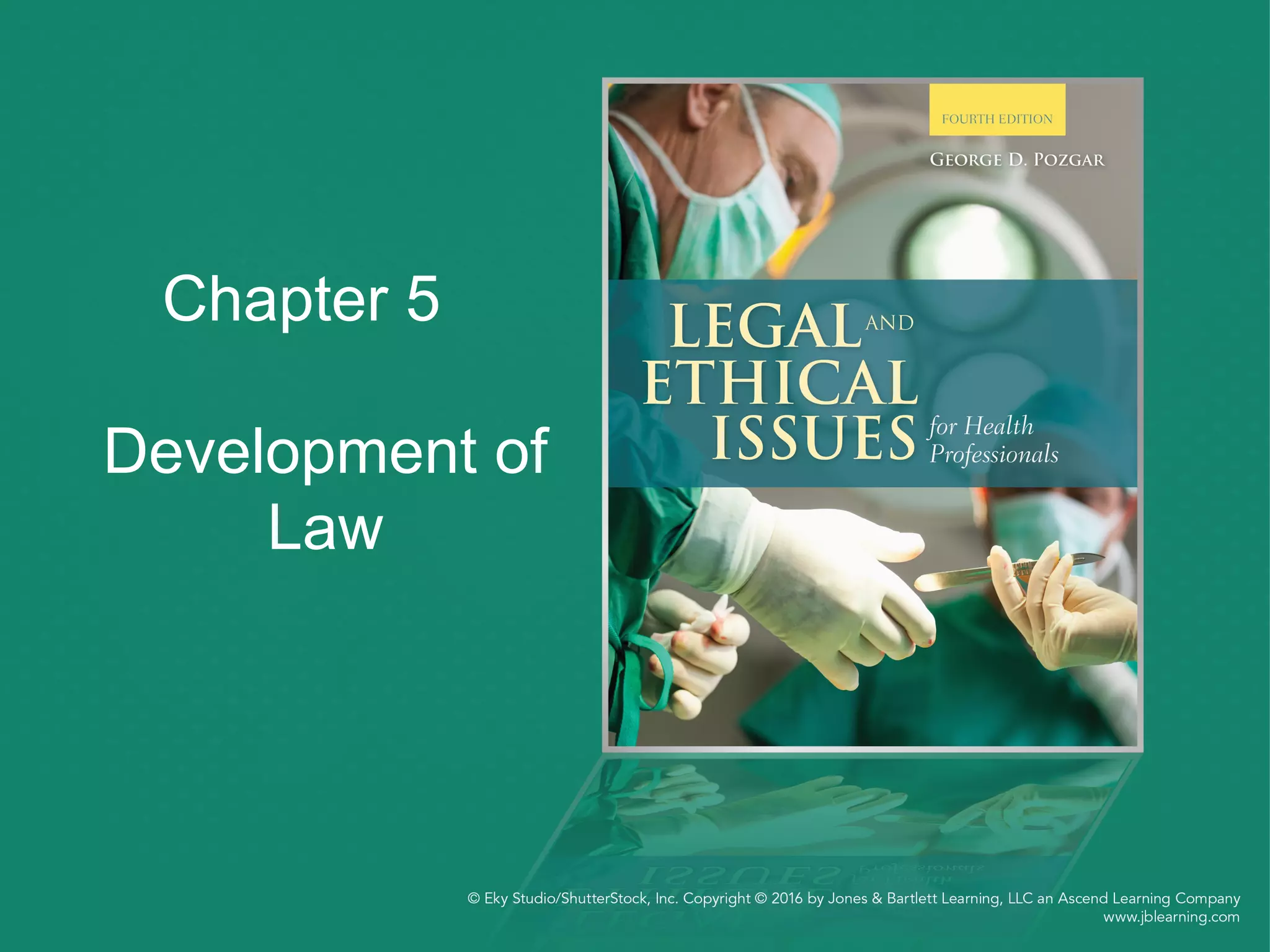
Chapter 5
Development of
Law
Learning Objectives – I
• Understand the development and sources of
law.
• Describe how the government is organized
through the three branches of government.
• Explain the principle separation of powers.
Learning Objectives – II
• Describe what is meant by conflict of laws.
• Describe the functions of the Department of
Health and Human Resources and its various
operating divisions.
Laws
• A system of principles and processes by which
people in a society deal with their disputes &
problems, seeking to solve or settle them
without resorting to force
• General rules of conduct enforced by
government.
Development of Law
– Tradition
– Culture
– Customs
– Beliefs
Why Laws Change
• Political Climate
• Social Change
• Religious Beliefs
• Values Change
Categories of Law
• Public law
– relationships between individuals &
government
• Private law
– relationships between individuals
Sources of Law
• Common Law
• Statutory Law
• Administrative Law
Common Law – I
• Derived from Judicial Decisions
– Origins - English common law
– Responds to issues beyond written law
• Common often differs State to State
Common Law – II
• Common-law principles prevail
– unless a statute governs
• Judicial decision in one state does not set
precedent for another
Common-Law Principles
• Precedent
• Res judicata
• Stare decisis
Statutory Law
• Written law - emanates from legislative bodies.
• Courts often interpret how various statutes apply
to each set of facts.
• U.S. Constitution highest in hierarchy of enacted
law.
Bill of Rights
• Amendments to the U.S. constitution were
added to protect rights of citizens.
– freedom of religion
– right to keep & bear arms
– freedom of speech
Administrative Law
• Public law is issued by administrative agencies
to direct enacted laws
• Administrative Procedures Act
– procedures under which federal agencies
operate
• Rules & Regulations administered within intent
of law
• Regulations subject to judicial review
Government Organization
Legislative Branch
• Enacts laws
• Amends or repeals existing legislation
• Creates new legislation
Government Organization
Judicial Branch
• Resolves legal disputes
• Supreme Court
– nation’s highest court
– 8 associate justices & 1 chief justice
As I have said in the past, when government
bureaus and agencies go awry, which are adjuncts
of the legislative or executive branches, the people
flee to the third branch, their courts, for solace and
justice.
-Justice J. Henderson, Supreme Ct. of South Dakota
Government Organization
Executive Branch
• Administers & enforce the law.
• Executive Power vested in the President.
• Cabinet advises the President.
Separation of Powers
• System of checks & balances.
• No one branch of government dominant over
other two.
Health & Human Services
• Cabinet level department.
• Responsible for carrying out national health &
human services policy.
• Main source of regulations affecting the health
care industry.
HHS Divisions & Agencies
• Centers for Medicare & Medicaid Services
• Public Health Service
• National Institutes of Health
• Centers for Disease Control and Prevention
• Food and Drug Administration
HHS Divisions & Agencies - II
• Substance Abuse and Mental Health Services
Administration
• Health Resources and Services Administration
(HRSA)
• Agency for Healthcare Research and Quality
• Agency for Toxic Substances and Disease
Registry
• Indian Health Service
REVIEW QUESTIONS
• Define the term law and describe the sources
from which law is derived.
• Describe and contrast the legal terms res
judicata and stare decisis.
• Describe the function of each branch of
government.
• What is the meaning of separation of powers?
• What is the function of an administrative
agency?
• Describe the various operating divisions and
agencies within the DHHS.

HIT1443 LEIHP4e Ch05

  • 1.
  • 2.
    Learning Objectives –I • Understand the development and sources of law. • Describe how the government is organized through the three branches of government. • Explain the principle separation of powers.
  • 3.
    Learning Objectives –II • Describe what is meant by conflict of laws. • Describe the functions of the Department of Health and Human Resources and its various operating divisions.
  • 4.
    Laws • A systemof principles and processes by which people in a society deal with their disputes & problems, seeking to solve or settle them without resorting to force • General rules of conduct enforced by government.
  • 5.
    Development of Law –Tradition – Culture – Customs – Beliefs
  • 6.
    Why Laws Change •Political Climate • Social Change • Religious Beliefs • Values Change
  • 7.
    Categories of Law •Public law – relationships between individuals & government • Private law – relationships between individuals
  • 8.
    Sources of Law •Common Law • Statutory Law • Administrative Law
  • 9.
    Common Law –I • Derived from Judicial Decisions – Origins - English common law – Responds to issues beyond written law • Common often differs State to State
  • 10.
    Common Law –II • Common-law principles prevail – unless a statute governs • Judicial decision in one state does not set precedent for another
  • 11.
    Common-Law Principles • Precedent •Res judicata • Stare decisis
  • 12.
    Statutory Law • Writtenlaw - emanates from legislative bodies. • Courts often interpret how various statutes apply to each set of facts. • U.S. Constitution highest in hierarchy of enacted law.
  • 13.
    Bill of Rights •Amendments to the U.S. constitution were added to protect rights of citizens. – freedom of religion – right to keep & bear arms – freedom of speech
  • 14.
    Administrative Law • Publiclaw is issued by administrative agencies to direct enacted laws • Administrative Procedures Act – procedures under which federal agencies operate • Rules & Regulations administered within intent of law • Regulations subject to judicial review
  • 15.
    Government Organization Legislative Branch •Enacts laws • Amends or repeals existing legislation • Creates new legislation
  • 16.
    Government Organization Judicial Branch •Resolves legal disputes • Supreme Court – nation’s highest court – 8 associate justices & 1 chief justice
  • 17.
    As I havesaid in the past, when government bureaus and agencies go awry, which are adjuncts of the legislative or executive branches, the people flee to the third branch, their courts, for solace and justice. -Justice J. Henderson, Supreme Ct. of South Dakota
  • 18.
    Government Organization Executive Branch •Administers & enforce the law. • Executive Power vested in the President. • Cabinet advises the President.
  • 19.
    Separation of Powers •System of checks & balances. • No one branch of government dominant over other two.
  • 20.
    Health & HumanServices • Cabinet level department. • Responsible for carrying out national health & human services policy. • Main source of regulations affecting the health care industry.
  • 21.
    HHS Divisions &Agencies • Centers for Medicare & Medicaid Services • Public Health Service • National Institutes of Health • Centers for Disease Control and Prevention • Food and Drug Administration
  • 22.
    HHS Divisions &Agencies - II • Substance Abuse and Mental Health Services Administration • Health Resources and Services Administration (HRSA) • Agency for Healthcare Research and Quality • Agency for Toxic Substances and Disease Registry • Indian Health Service
  • 23.
    REVIEW QUESTIONS • Definethe term law and describe the sources from which law is derived. • Describe and contrast the legal terms res judicata and stare decisis. • Describe the function of each branch of government.
  • 24.
    • What isthe meaning of separation of powers? • What is the function of an administrative agency? • Describe the various operating divisions and agencies within the DHHS.