Proprioceptive Improvements of Lower-
Limb Amputees under Training with a
Vibrotactile Device – A Pilot Study
Jairo Maldonado-Contreras1, Panadda Marayong1, I-Hung Khoo2, Rae
Rivera1, Brian Ruhe4, and Will Wu3
1Department of Mechanical and Aerospace Engineering, California State University, Long Beach, CA
2Department of Electrical Engineering, California State University, Long Beach, CA
3Department of Kinesiology, California State University, Long Beach, CA
4VA Long Beach Health Care System, Long Beach, CA
Overview
• Background
• Research Focus
• Experimental Protocol
• Data Analysis Methods
• Results
• Conclusion and Future Work
Background
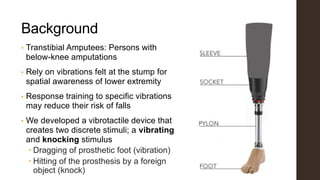
• Transtibial Amputees: Persons with
below-knee amputations
• Rely on vibrations felt at the stump for
spatial awareness of lower extremity
• Response training to specific vibrations
may reduce their risk of falls
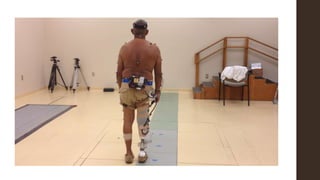
• We developed a vibrotactile device that
creates two discrete stimuli; a vibrating
and knocking stimulus
 Dragging of prosthetic foot (vibration)
 Hitting of the prosthesis by a foreign
object (knock)
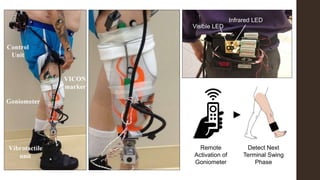
Infrared LED
Visible LED
Detect Next
Terminal Swing
Phase
Remote
Activation of
Goniometer
►
Research Focus
• Test functionality of vibrotactile device in training
 Reliability, versatility, perturbation strength
• Develop motion analysis methods to measure reactionary
improvements to stimuli
• Implement an attentional focus in training
 Wulf et al
 Tested External vs Internal Focus during motor skill learning
with transtibial amputees
 External Focus: Attention to the effects of their movements
 Internal Focus: Attention to their own movements
 External Focus outperformed Internal Focus
Experimental Protocol
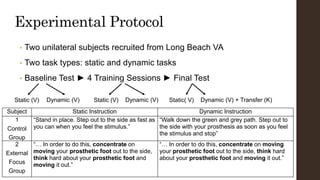
• Two unilateral subjects recruited from Long Beach VA
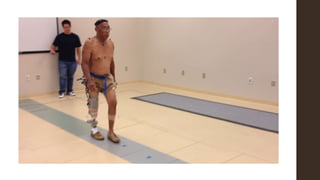
• Two task types: static and dynamic tasks
• Baseline Test ► 4 Training Sessions ► Final Test
Subject Static Instruction Dynamic Instruction
1
Control
Group
“Stand in place. Step out to the side as fast as
you can when you feel the stimulus.”
“Walk down the green and grey path. Step out to
the side with your prosthesis as soon as you feel
the stimulus and stop”
2
External
Focus
Group
“… In order to do this, concentrate on
moving your prosthetic foot out to the side,
think hard about your prosthetic foot and
moving it out.”
“… In order to do this, concentrate on moving
your prosthetic foot out to the side, think hard
about your prosthetic foot and moving it out.”
Static (V) Dynamic (V) Static (V) Dynamic (V) Static( V) Dynamic (V) + Transfer (K)
Equipment
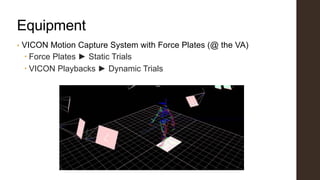
• VICON Motion Capture System with Force Plates (@ the VA)
 Force Plates ► Static Trials
 VICON Playbacks ► Dynamic Trials
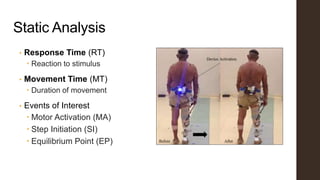
Static Analysis
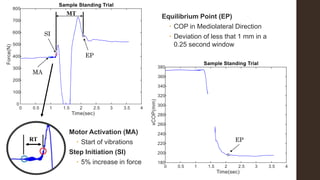
• Response Time (RT)
 Reaction to stimulus
• Movement Time (MT)
 Duration of movement
• Events of Interest
 Motor Activation (MA)
 Step Initiation (SI)
 Equilibrium Point (EP)
MA
EP
EP
SI
RT
MT
Motor Activation (MA)
 Start of vibrations
Step Initiation (SI)
 5% increase in force
Equilibrium Point (EP)
 COP in Mediolateral Direction
 Deviation of less that 1 mm in a
0.25 second window
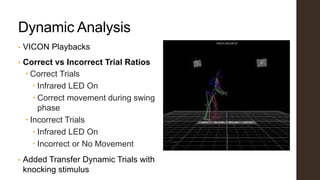
Dynamic Analysis
• VICON Playbacks
• Correct vs Incorrect Trial Ratios
 Correct Trials
 Infrared LED On
 Correct movement during swing
phase
 Incorrect Trials
 Infrared LED On
 Incorrect or No Movement
• Added Transfer Dynamic Trials with
knocking stimulus
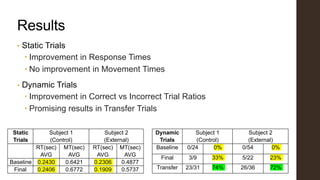
Results
• Static Trials
 Improvement in Response Times
 No improvement in Movement Times
• Dynamic Trials
 Improvement in Correct vs Incorrect Trial Ratios
 Promising results in Transfer Trials
Static
Trials
Subject 1
(Control)
Subject 2
(External)
RT(sec)
AVG
MT(sec)
AVG
RT(sec)
AVG
MT(sec)
AVG
Baseline 0.2430 0.6421 0.2306 0.4877
Final 0.2406 0.6772 0.1909 0.5737
Dynamic
Trials
Subject 1
(Control)
Subject 2
(External)
Baseline 0/24 0% 0/54 0%
Final 3/9 33% 5/22 23%
Transfer 23/31 74% 26/36 72%
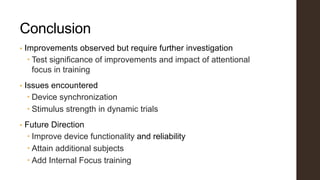
Conclusion
• Improvements observed but require further investigation
 Test significance of improvements and impact of attentional
focus in training
• Issues encountered
 Device synchronization
 Stimulus strength in dynamic trials
• Future Direction
 Improve device functionality and reliability
 Attain additional subjects
 Add Internal Focus training
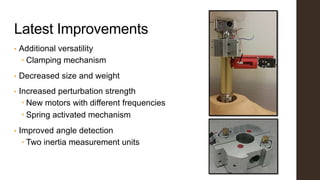
Latest Improvements
• Additional versatility
 Clamping mechanism
• Decreased size and weight
• Increased perturbation strength
 New motors with different frequencies
 Spring activated mechanism
• Improved angle detection
 Two inertia measurement units
Acknowledgements
Lab Partners
Diane Kim, Cody Dunn, and Stephen Cortez
Additional Collaborators
Dana Craig, Director of the VA Long Beach Gait and Motion Analysis
Lab
Funding Support
CSUPERB Joint Venture Grant and CSULB BUILD (National
Institute of General Medical Science of the National Institutes of
Health under Award Numbers; 8UL1GM118979-02;8TL4GM118980-
02; 8RL5GM11897802)
References
1. K. Kaufman, M. Wyatt, P. Sessoms, and M. Grabiner, "Task-specific fall prevention training is
effective for warfighters with transtibial amputations," Clinical Orthopedics and Related Research,
vol. 472, pp. 3076-3084, May 2014.
2. K. Nguyen, N. Bharti, P. Marayong, I. Khoo, D. Craig, B. Ruhe and W. Wu, “Design of vibrotactile
device for rehabilitative training of persons with recent lower-limb amputation,” presented at the CSU
Biotechnology Symposium, 2013.
3. R.J. Rivera, P. Marayong, B. Ruhe, and I.H. Khoo, “Performance analysis of a vibrotactile device
for rehabilitation training of persons with transtibial amputation,” presented at the 28th Annual
CSUPERB, 2016.
4. P. Marayong, I.H. Khoo, K. Nguyen, N. Bharti, B. Ruhe, D. Craig and W. Wu, “Vibrotactile Device
for Rehabilitative Training of Persons with Lower-limb Amputation,” IEEE Healthcare Innovation
Conference, 2014.
Questions?
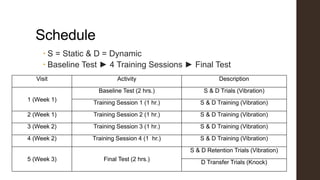
Schedule
Visit Activity Description
1 (Week 1)
Baseline Test (2 hrs.) S & D Trials (Vibration)
Training Session 1 (1 hr.) S & D Training (Vibration)
2 (Week 1) Training Session 2 (1 hr.) S & D Training (Vibration)
3 (Week 2) Training Session 3 (1 hr.) S & D Training (Vibration)
4 (Week 2) Training Session 4 (1 hr.) S & D Training (Vibration)
5 (Week 3) Final Test (2 hrs.)
S & D Retention Trials (Vibration)
D Transfer Trials (Knock)
 S = Static & D = Dynamic
 Baseline Test ► 4 Training Sessions ► Final Test

HI-POCT Conference PowerPoint Presentation

  • 1.
    Proprioceptive Improvements ofLower- Limb Amputees under Training with a Vibrotactile Device – A Pilot Study Jairo Maldonado-Contreras1, Panadda Marayong1, I-Hung Khoo2, Rae Rivera1, Brian Ruhe4, and Will Wu3 1Department of Mechanical and Aerospace Engineering, California State University, Long Beach, CA 2Department of Electrical Engineering, California State University, Long Beach, CA 3Department of Kinesiology, California State University, Long Beach, CA 4VA Long Beach Health Care System, Long Beach, CA
  • 2.
    Overview • Background • ResearchFocus • Experimental Protocol • Data Analysis Methods • Results • Conclusion and Future Work
  • 3.
    Background • Transtibial Amputees:Persons with below-knee amputations • Rely on vibrations felt at the stump for spatial awareness of lower extremity • Response training to specific vibrations may reduce their risk of falls • We developed a vibrotactile device that creates two discrete stimuli; a vibrating and knocking stimulus  Dragging of prosthetic foot (vibration)  Hitting of the prosthesis by a foreign object (knock)
  • 4.
    Infrared LED Visible LED DetectNext Terminal Swing Phase Remote Activation of Goniometer ►
  • 5.
    Research Focus • Testfunctionality of vibrotactile device in training  Reliability, versatility, perturbation strength • Develop motion analysis methods to measure reactionary improvements to stimuli • Implement an attentional focus in training  Wulf et al  Tested External vs Internal Focus during motor skill learning with transtibial amputees  External Focus: Attention to the effects of their movements  Internal Focus: Attention to their own movements  External Focus outperformed Internal Focus
  • 6.
    Experimental Protocol • Twounilateral subjects recruited from Long Beach VA • Two task types: static and dynamic tasks • Baseline Test ► 4 Training Sessions ► Final Test Subject Static Instruction Dynamic Instruction 1 Control Group “Stand in place. Step out to the side as fast as you can when you feel the stimulus.” “Walk down the green and grey path. Step out to the side with your prosthesis as soon as you feel the stimulus and stop” 2 External Focus Group “… In order to do this, concentrate on moving your prosthetic foot out to the side, think hard about your prosthetic foot and moving it out.” “… In order to do this, concentrate on moving your prosthetic foot out to the side, think hard about your prosthetic foot and moving it out.” Static (V) Dynamic (V) Static (V) Dynamic (V) Static( V) Dynamic (V) + Transfer (K)
  • 7.
    Equipment • VICON MotionCapture System with Force Plates (@ the VA)  Force Plates ► Static Trials  VICON Playbacks ► Dynamic Trials
  • 8.
    Static Analysis • ResponseTime (RT)  Reaction to stimulus • Movement Time (MT)  Duration of movement • Events of Interest  Motor Activation (MA)  Step Initiation (SI)  Equilibrium Point (EP)
  • 10.
    MA EP EP SI RT MT Motor Activation (MA) Start of vibrations Step Initiation (SI)  5% increase in force Equilibrium Point (EP)  COP in Mediolateral Direction  Deviation of less that 1 mm in a 0.25 second window
  • 11.
    Dynamic Analysis • VICONPlaybacks • Correct vs Incorrect Trial Ratios  Correct Trials  Infrared LED On  Correct movement during swing phase  Incorrect Trials  Infrared LED On  Incorrect or No Movement • Added Transfer Dynamic Trials with knocking stimulus
  • 13.
    Results • Static Trials Improvement in Response Times  No improvement in Movement Times • Dynamic Trials  Improvement in Correct vs Incorrect Trial Ratios  Promising results in Transfer Trials Static Trials Subject 1 (Control) Subject 2 (External) RT(sec) AVG MT(sec) AVG RT(sec) AVG MT(sec) AVG Baseline 0.2430 0.6421 0.2306 0.4877 Final 0.2406 0.6772 0.1909 0.5737 Dynamic Trials Subject 1 (Control) Subject 2 (External) Baseline 0/24 0% 0/54 0% Final 3/9 33% 5/22 23% Transfer 23/31 74% 26/36 72%
  • 14.
    Conclusion • Improvements observedbut require further investigation  Test significance of improvements and impact of attentional focus in training • Issues encountered  Device synchronization  Stimulus strength in dynamic trials • Future Direction  Improve device functionality and reliability  Attain additional subjects  Add Internal Focus training
  • 15.
    Latest Improvements • Additionalversatility  Clamping mechanism • Decreased size and weight • Increased perturbation strength  New motors with different frequencies  Spring activated mechanism • Improved angle detection  Two inertia measurement units
  • 16.
    Acknowledgements Lab Partners Diane Kim,Cody Dunn, and Stephen Cortez Additional Collaborators Dana Craig, Director of the VA Long Beach Gait and Motion Analysis Lab Funding Support CSUPERB Joint Venture Grant and CSULB BUILD (National Institute of General Medical Science of the National Institutes of Health under Award Numbers; 8UL1GM118979-02;8TL4GM118980- 02; 8RL5GM11897802)
  • 17.
    References 1. K. Kaufman,M. Wyatt, P. Sessoms, and M. Grabiner, "Task-specific fall prevention training is effective for warfighters with transtibial amputations," Clinical Orthopedics and Related Research, vol. 472, pp. 3076-3084, May 2014. 2. K. Nguyen, N. Bharti, P. Marayong, I. Khoo, D. Craig, B. Ruhe and W. Wu, “Design of vibrotactile device for rehabilitative training of persons with recent lower-limb amputation,” presented at the CSU Biotechnology Symposium, 2013. 3. R.J. Rivera, P. Marayong, B. Ruhe, and I.H. Khoo, “Performance analysis of a vibrotactile device for rehabilitation training of persons with transtibial amputation,” presented at the 28th Annual CSUPERB, 2016. 4. P. Marayong, I.H. Khoo, K. Nguyen, N. Bharti, B. Ruhe, D. Craig and W. Wu, “Vibrotactile Device for Rehabilitative Training of Persons with Lower-limb Amputation,” IEEE Healthcare Innovation Conference, 2014.
  • 18.
  • 19.
    Schedule Visit Activity Description 1(Week 1) Baseline Test (2 hrs.) S & D Trials (Vibration) Training Session 1 (1 hr.) S & D Training (Vibration) 2 (Week 1) Training Session 2 (1 hr.) S & D Training (Vibration) 3 (Week 2) Training Session 3 (1 hr.) S & D Training (Vibration) 4 (Week 2) Training Session 4 (1 hr.) S & D Training (Vibration) 5 (Week 3) Final Test (2 hrs.) S & D Retention Trials (Vibration) D Transfer Trials (Knock)  S = Static & D = Dynamic  Baseline Test ► 4 Training Sessions ► Final Test