Biomechanics and Medical Application Laboratory Bing-Shiang Yang, Ph.D., P.E Department of Mechanical Engineering
People 10 graduate students (1 doctoral std) 10 undergraduate students 1 part-time assistant Collaborators Brain Research Center, Dept. of EE, CS, NCTU Hsinchu General Hospital Chang Gung Memorial Hospital National Taipei University of Technology
Facility  120 m 2  lab space Motion analysis system Electromyography measurement Surface reaction measurement Transcranial magnetic stimulator Musculoskeletal modeling package Net conference system
Funding National Science Council Ministry of Education
Stroke neuro-rehabilitation Integrated smart living technology Biomechanical considerations for living environment Interactive fitness/training equipment development Light weight vehicle for the elderly Current Research Topics
The feasibility of using vibratory afferent input for stroke hand rehabilitation S-J Chen, K-T Huang, P-C Lin, & S-C Liao Collaborators:  Hsinchu General Hospital &   Chang-Gung Memorial Hospital Stroke Neuro-rehabilitation
Introduction  Stroke is the leading cause of long-term disability  (Turney et al. 1984; American Heart Association 2005) Hand dysfunction is  the most common impairment post-stroke.  (Butefisch et al. 2003; Lang and Schieber 2003) Lack of finger independency or muscle selectivity is a primary contributor  (Li et al. 2003; Lang & Schieber 2003, 2004) …  A strategy to reduce abnormal coupling? Muscle vibration affects the motor-evoked potential (MEP) of the vibrated muscle in healthy and possibly stroke individuals.  (Siggelkow et al. 1999; Rosenkranz and Rothwell 2003; Yang et al. 2006).
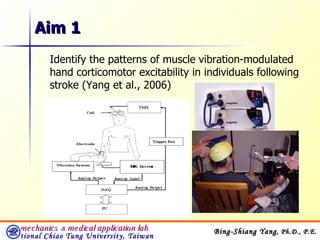
Aim 1 Identify the patterns of muscle vibration-modulated hand corticomotor excitability in individuals following stroke (Yang et al., 2006)
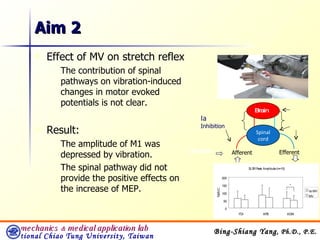
Aim 2 Effect of MV on stretch reflex The contribution of spinal pathways on vibration-induced changes in motor evoked potentials is not clear.  Result: The amplitude of M1 was depressed by vibration. The spinal pathway did not provide the positive effects on the increase of MEP. Ia  Inhibition Afferent Stretch Vibration  = Efferent 1. M1↓ 2. M2 = Spinal cord Brain +
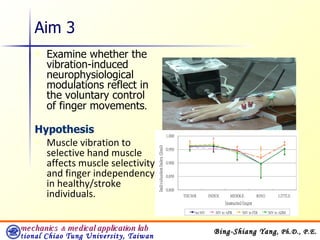
Aim 3 Examine whether the vibration-induced neurophysiological modulations reflect in the voluntary control of finger movements . Hypothesis Muscle vibration to selective hand muscle affects muscle selectivity and finger independency in healthy/stroke individuals.
Aim 4 Examine the effect of attended prolonged muscle vibration on hand corticomotor excitability and control of finger movements.  Hypotheses: prolong muscle vibration and subject’s attention to vibration provide long-lasting effect on hand corticomotor excitability. the long-lasting modulations of motor pathway excitability also reflect on control of finger movements.
Integrated Smart Living Technology H-Y Hu, C-C Wang, S-W Chou, T-S Chen, S-T Liao & Yi-Ting Yang Collaborators: Brain Research Center, EE & CS Dept, NTHU, YMU, NCU…
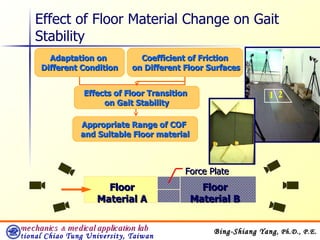
Effect of Floor Material Change on Gait Stability Force Plate Floor Material B Floor Material A Coefficient of Friction  on Different Floor Surfaces Effects of Floor Transition  on Gait Stability Adaptation on  Different Condition Appropriate Range of COF  and Suitable Floor material
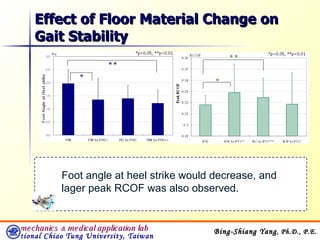
Effect of Floor Material Change on Gait Stability Foot angle at heel strike would decrease, and  lager peak RCOF was also observed.
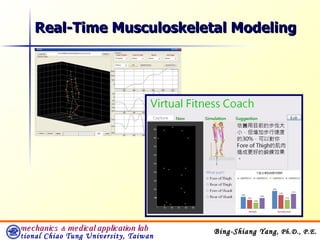
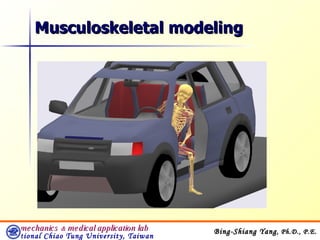
Real-Time Musculoskeletal Modeling
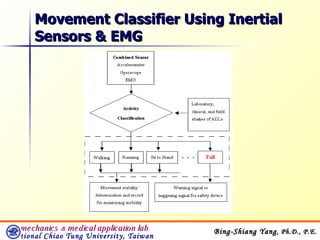
Movement Classifier Using Inertial Sensors & EMG
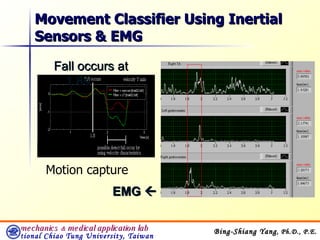
Movement Classifier Using Inertial Sensors & EMG Fall occurs at 1.8s EMG   Motion capture
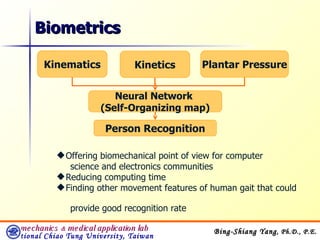
Biometrics Offering biomechanical point of view for computer  science and electronics communities Reducing computing time Finding other movement features of human gait that could  provide good recognition rate Kinetics Neural Network  (Self-Organizing map) Kinematics Plantar Pressure Person Recognition
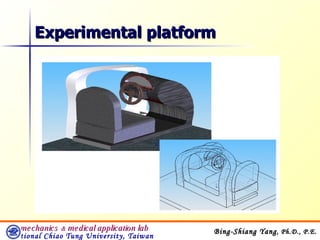
Light weight vehicle for the elderly S-W Chou, T-S Chen, S-T Liao, & S-T Wu Collaborator:  National Taipei University of Technology
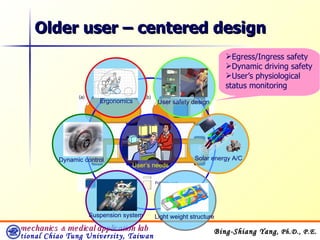
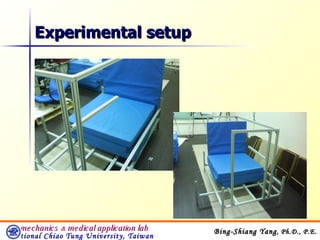
Older user – centered design Egress/Ingress safety Dynamic driving safety User’s physiological status monitoring Wheelchair or Scooter Foldable seat Dynamic control User’s needs Ergonomics Suspension system Light weight structure Solar energy A/C User safety design
Experimental platform
Experimental setup
Musculoskeletal modeling
Biomechanics and Medical Application Laboratory Bing-Shiang Yang, Ph.D., P.E Department of Mechanical Engineering

實驗室簡介 Final

  • 1.
    Biomechanics and MedicalApplication Laboratory Bing-Shiang Yang, Ph.D., P.E Department of Mechanical Engineering
  • 2.
    People 10 graduatestudents (1 doctoral std) 10 undergraduate students 1 part-time assistant Collaborators Brain Research Center, Dept. of EE, CS, NCTU Hsinchu General Hospital Chang Gung Memorial Hospital National Taipei University of Technology
  • 3.
    Facility 120m 2 lab space Motion analysis system Electromyography measurement Surface reaction measurement Transcranial magnetic stimulator Musculoskeletal modeling package Net conference system
  • 4.
    Funding National ScienceCouncil Ministry of Education
  • 5.
    Stroke neuro-rehabilitation Integratedsmart living technology Biomechanical considerations for living environment Interactive fitness/training equipment development Light weight vehicle for the elderly Current Research Topics
  • 6.
    The feasibility ofusing vibratory afferent input for stroke hand rehabilitation S-J Chen, K-T Huang, P-C Lin, & S-C Liao Collaborators: Hsinchu General Hospital & Chang-Gung Memorial Hospital Stroke Neuro-rehabilitation
  • 7.
    Introduction Strokeis the leading cause of long-term disability (Turney et al. 1984; American Heart Association 2005) Hand dysfunction is the most common impairment post-stroke. (Butefisch et al. 2003; Lang and Schieber 2003) Lack of finger independency or muscle selectivity is a primary contributor (Li et al. 2003; Lang & Schieber 2003, 2004) … A strategy to reduce abnormal coupling? Muscle vibration affects the motor-evoked potential (MEP) of the vibrated muscle in healthy and possibly stroke individuals. (Siggelkow et al. 1999; Rosenkranz and Rothwell 2003; Yang et al. 2006).
  • 8.
    Aim 1 Identifythe patterns of muscle vibration-modulated hand corticomotor excitability in individuals following stroke (Yang et al., 2006)
  • 9.
    Aim 2 Effectof MV on stretch reflex The contribution of spinal pathways on vibration-induced changes in motor evoked potentials is not clear. Result: The amplitude of M1 was depressed by vibration. The spinal pathway did not provide the positive effects on the increase of MEP. Ia Inhibition Afferent Stretch Vibration = Efferent 1. M1↓ 2. M2 = Spinal cord Brain +
  • 10.
    Aim 3 Examinewhether the vibration-induced neurophysiological modulations reflect in the voluntary control of finger movements . Hypothesis Muscle vibration to selective hand muscle affects muscle selectivity and finger independency in healthy/stroke individuals.
  • 11.
    Aim 4 Examinethe effect of attended prolonged muscle vibration on hand corticomotor excitability and control of finger movements. Hypotheses: prolong muscle vibration and subject’s attention to vibration provide long-lasting effect on hand corticomotor excitability. the long-lasting modulations of motor pathway excitability also reflect on control of finger movements.
  • 12.
    Integrated Smart LivingTechnology H-Y Hu, C-C Wang, S-W Chou, T-S Chen, S-T Liao & Yi-Ting Yang Collaborators: Brain Research Center, EE & CS Dept, NTHU, YMU, NCU…
  • 13.
    Effect of FloorMaterial Change on Gait Stability Force Plate Floor Material B Floor Material A Coefficient of Friction on Different Floor Surfaces Effects of Floor Transition on Gait Stability Adaptation on Different Condition Appropriate Range of COF and Suitable Floor material
  • 14.
    Effect of FloorMaterial Change on Gait Stability Foot angle at heel strike would decrease, and lager peak RCOF was also observed.
  • 15.
  • 16.
    Movement Classifier UsingInertial Sensors & EMG
  • 17.
    Movement Classifier UsingInertial Sensors & EMG Fall occurs at 1.8s EMG  Motion capture
  • 18.
    Biometrics Offering biomechanicalpoint of view for computer science and electronics communities Reducing computing time Finding other movement features of human gait that could provide good recognition rate Kinetics Neural Network (Self-Organizing map) Kinematics Plantar Pressure Person Recognition
  • 19.
    Light weight vehiclefor the elderly S-W Chou, T-S Chen, S-T Liao, & S-T Wu Collaborator: National Taipei University of Technology
  • 20.
    Older user –centered design Egress/Ingress safety Dynamic driving safety User’s physiological status monitoring Wheelchair or Scooter Foldable seat Dynamic control User’s needs Ergonomics Suspension system Light weight structure Solar energy A/C User safety design
  • 21.
  • 22.
  • 23.
  • 24.
    Biomechanics and MedicalApplication Laboratory Bing-Shiang Yang, Ph.D., P.E Department of Mechanical Engineering