HIP
INSTABILITY IN
NEWBORN
Dr Kishore. V Ms(ortho)
Senior Resident ,
Depa. Of orthopaedics,
s.v medical college.
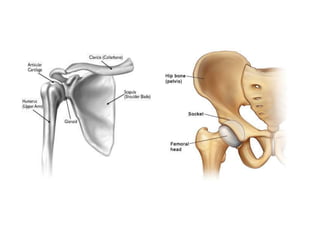
WHICH IS THE MOST COMMON JOINT TO
DISLOCATE???
• Why???
Any difference???
INSTABILITY OF HIP IN NEW BORN
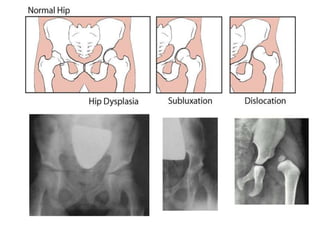
• Primary acetabular dysplasia.
• Subluxation of femoral head.
• Dislocated femoral head.
• This is a developmental process.
classification
• Primary hip dysplasia (idiopathic)---CDH/ DDH.
• Secondary hip dysplasia
Neurological; cerebral palsy,
myelomeningocele.
CTD’S : Ehlers danlos syndrome.
Myopathic: AMC (arthrogryposis
multiplex congenita)
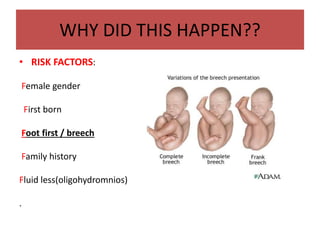
WHY DID THIS HAPPEN??
• RISK FACTORS:
Female gender
First born
Foot first / breech
Family history
Fluid less(oligohydromnios)
.
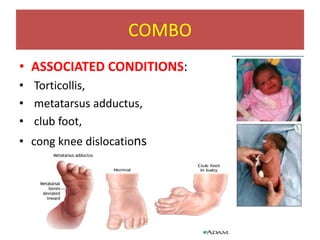
COMBO
• ASSOCIATED CONDITIONS:
• Torticollis,
• metatarsus adductus,
• club foot,
• cong knee dislocations
What happens if I miss the case….
NATURAL HISTORY
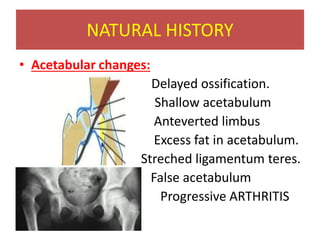
• Acetabular changes:
Delayed ossification.
Shallow acetabulum
Anteverted limbus
Excess fat in acetabulum.
Streched ligamentum teres.
False acetabulum
Progressive ARTHRITIS
NATURAL HISTORY
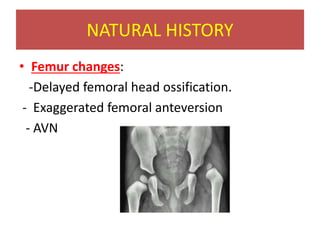
• Femur changes:
-Delayed femoral head ossification.
- Exaggerated femoral anteversion
- AVN
HOW DO I KNOW IT??
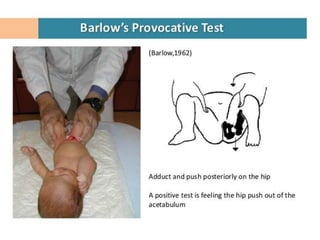
• NEW BORN:
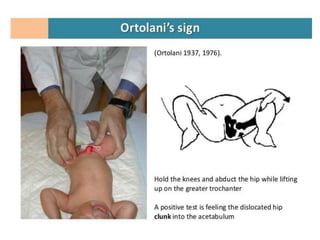
Tests: Barlow’s test
Ortolani’s test
Positive upto three months
DIAGNOSIS
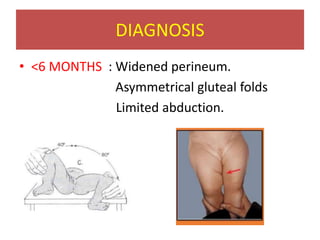
• <6 MONTHS : Widened perineum.
Asymmetrical gluteal folds
Limited abduction.
Radiological? ,6MONTHS CHILD
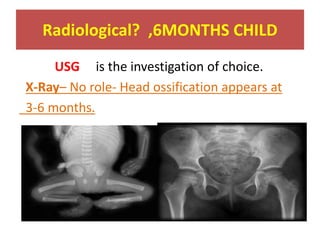
USG is the investigation of choice.
X-Ray– No role- Head ossification appears at
3-6 months.
> 6 months
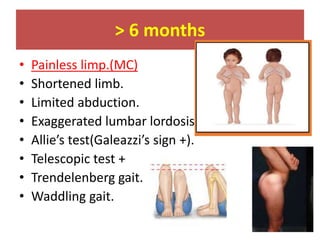
• Painless limp.(MC)
• Shortened limb.
• Limited abduction.
• Exaggerated lumbar lordosis.
• Allie’s test(Galeazzi’s sign +).
• Telescopic test +
• Trendelenberg gait.
• Waddling gait.
DIAGNOSIS
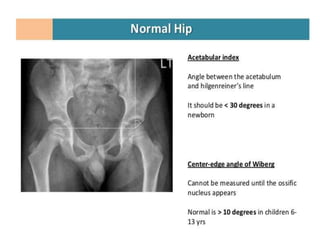
• X-Ray : Investigation of choice after 6 months.
• CT: Limited role.
• MRI: Soft tissue changes, unreducible
dislocations
TREATMENT(< 6 months)
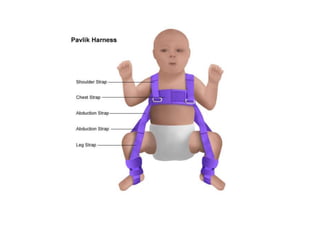
• CLOSED REDUCTION AND IMMOBILISATION
WITH PAVLIK HARNESS SPLINT.
• Follow up weekly with USG.
• Check for reduction in each visit
• Maintain splint for 6-8 weeks and then
remove
• f/up monthly upto 6 months
• Then followup yearly upto skeletal maturity.
What should I do if I am not able to
reduce hip????
What should I do if I am not able to
maintain reduction???
• Do an mri/arthrography.
evaluate for the causes of irreducible
dislocation…..
Open reduction and hip spica.
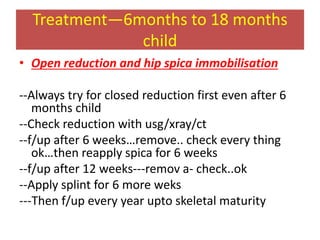
Treatment—6months to 18 months
child
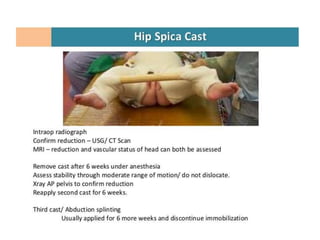
• Open reduction and hip spica immobilisation
--Always try for closed reduction first even after 6
months child
--Check reduction with usg/xray/ct
--f/up after 6 weeks…remove.. check every thing
ok…then reapply spica for 6 weeks
--f/up after 12 weeks---remov a- check..ok
--Apply splint for 6 more weks
---Then f/up every year upto skeletal maturity
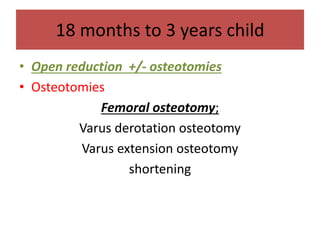
18 months to 3 years child
• Open reduction +/- osteotomies
• Osteotomies
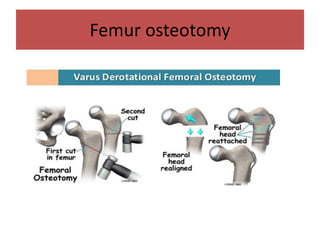
Femoral osteotomy;
Varus derotation osteotomy
Varus extension osteotomy
shortening
Femur osteotomy
• Pelvic osteotomies
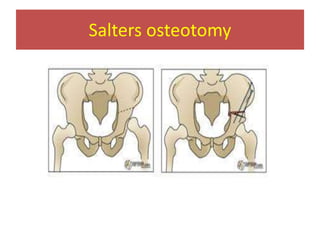
• Salter
• Pembertons
• Chiari
• Shelf operations
• Steel
• ganz
Salters osteotomy
>8years
• A combination of osteotomies femoral and
pevis
• Total hip replacement
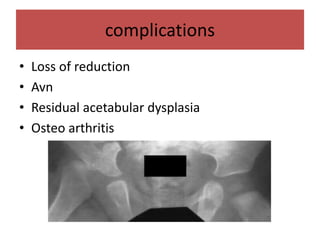
complications
• Loss of reduction
• Avn
• Residual acetabular dysplasia
• Osteo arthritis
That’s all
my show
this
time… • Any doubts???
(mail me;krrish5622@gmail.com)

Hip instability in newborn ddh (ug)

  • 1.
    HIP INSTABILITY IN NEWBORN Dr Kishore.V Ms(ortho) Senior Resident , Depa. Of orthopaedics, s.v medical college.
  • 2.
    WHICH IS THEMOST COMMON JOINT TO DISLOCATE??? • Why???
  • 4.
  • 5.
    INSTABILITY OF HIPIN NEW BORN • Primary acetabular dysplasia. • Subluxation of femoral head. • Dislocated femoral head. • This is a developmental process.
  • 7.
    classification • Primary hipdysplasia (idiopathic)---CDH/ DDH. • Secondary hip dysplasia Neurological; cerebral palsy, myelomeningocele. CTD’S : Ehlers danlos syndrome. Myopathic: AMC (arthrogryposis multiplex congenita)
  • 8.
    WHY DID THISHAPPEN?? • RISK FACTORS: Female gender First born Foot first / breech Family history Fluid less(oligohydromnios) .
  • 9.
    COMBO • ASSOCIATED CONDITIONS: •Torticollis, • metatarsus adductus, • club foot, • cong knee dislocations
  • 10.
    What happens ifI miss the case….
  • 11.
    NATURAL HISTORY • Acetabularchanges: Delayed ossification. Shallow acetabulum Anteverted limbus Excess fat in acetabulum. Streched ligamentum teres. False acetabulum Progressive ARTHRITIS
  • 12.
    NATURAL HISTORY • Femurchanges: -Delayed femoral head ossification. - Exaggerated femoral anteversion - AVN
  • 13.
    HOW DO IKNOW IT?? • NEW BORN: Tests: Barlow’s test Ortolani’s test Positive upto three months
  • 16.
    DIAGNOSIS • <6 MONTHS: Widened perineum. Asymmetrical gluteal folds Limited abduction.
  • 17.
    Radiological? ,6MONTHS CHILD USGis the investigation of choice. X-Ray– No role- Head ossification appears at 3-6 months.
  • 18.
    > 6 months •Painless limp.(MC) • Shortened limb. • Limited abduction. • Exaggerated lumbar lordosis. • Allie’s test(Galeazzi’s sign +). • Telescopic test + • Trendelenberg gait. • Waddling gait.
  • 19.
    DIAGNOSIS • X-Ray :Investigation of choice after 6 months. • CT: Limited role. • MRI: Soft tissue changes, unreducible dislocations
  • 21.
    TREATMENT(< 6 months) •CLOSED REDUCTION AND IMMOBILISATION WITH PAVLIK HARNESS SPLINT. • Follow up weekly with USG. • Check for reduction in each visit • Maintain splint for 6-8 weeks and then remove • f/up monthly upto 6 months • Then followup yearly upto skeletal maturity.
  • 23.
    What should Ido if I am not able to reduce hip???? What should I do if I am not able to maintain reduction??? • Do an mri/arthrography. evaluate for the causes of irreducible dislocation….. Open reduction and hip spica.
  • 24.
    Treatment—6months to 18months child • Open reduction and hip spica immobilisation --Always try for closed reduction first even after 6 months child --Check reduction with usg/xray/ct --f/up after 6 weeks…remove.. check every thing ok…then reapply spica for 6 weeks --f/up after 12 weeks---remov a- check..ok --Apply splint for 6 more weks ---Then f/up every year upto skeletal maturity
  • 26.
    18 months to3 years child • Open reduction +/- osteotomies • Osteotomies Femoral osteotomy; Varus derotation osteotomy Varus extension osteotomy shortening
  • 27.
  • 28.
    • Pelvic osteotomies •Salter • Pembertons • Chiari • Shelf operations • Steel • ganz
  • 29.
  • 30.
    >8years • A combinationof osteotomies femoral and pevis • Total hip replacement
  • 31.
    complications • Loss ofreduction • Avn • Residual acetabular dysplasia • Osteo arthritis
  • 32.
    That’s all my show this time…• Any doubts??? (mail me;krrish5622@gmail.com)