by: Shara May M. Anacay
BSE - English
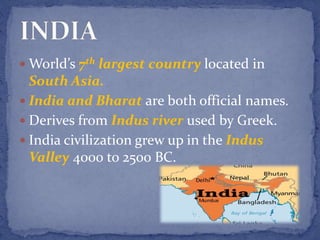
 World’s 7th largest country located in
South Asia.
 India and Bharat are both official names.
 Derives from Indus river used by Greek.
 India civilization grew up in the Indus
Valley 4000 to 2500 BC.
1. Himalayan Mountain system on the north
2. Northern plain drained by the Indus, Ganges
and Brahmaputra rivers in North Central India.
3. Peninsular India in the South.
The earliest Indians may have migrated from
Australia and Pacific Islands.
Language: more than 200 languages are spoken
in India.
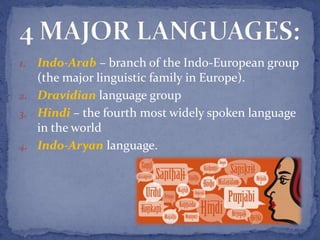
1. Indo-Arab – branch of the Indo-European group
(the major linguistic family in Europe).
2. Dravidian language group
3. Hindi – the fourth most widely spoken language
in the world
4. Indo-Aryan language.
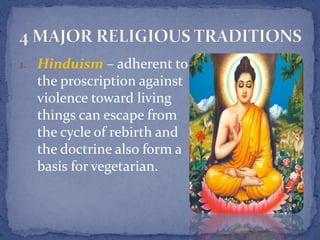
1. Hinduism – adherent to
the proscription against
violence toward living
things can escape from
the cycle of rebirth and
the doctrine also form a
basis for vegetarian.
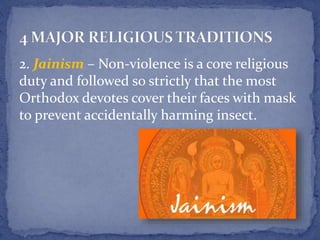
2. Jainism – Non-violence is a core religious
duty and followed so strictly that the most
Orthodox devotes cover their faces with mask
to prevent accidentally harming insect.
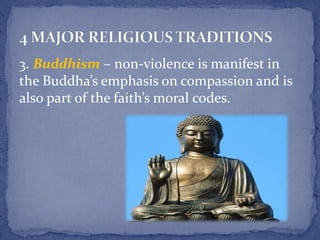
3. Buddhism – non-violence is manifest in
the Buddha’s emphasis on compassion and is
also part of the faith’s moral codes.
4. Sikhism - a monotheistic religion, and the
basic Sikh belief is represented in the phrase
Ik Onkar meaning “One God”.
- was founded in the Punjab region
in India in the 15th century by Guru Nanak
Dev.
1. Brahmins - priests, the highest caste
2. Kshatriyas – warriors and kings
3. Vaishyas – merchants
4. Shudras – manual labourers
Dalits or untouchables – they have traditionally
been tasked with work such as cleaning streets and
working with human and animal corpses and waste.
They are also known as Harijans.
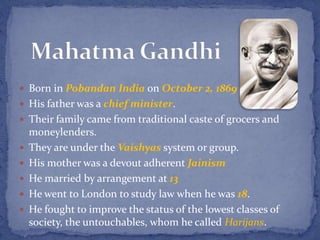
 Born in Pobandan India on October 2, 1869
 His father was a chief minister.
 Their family came from traditional caste of grocers and
moneylenders.
 They are under the Vaishyas system or group.
 His mother was a devout adherent Jainism
 He married by arrangement at 13
 He went to London to study law when he was 18.
 He fought to improve the status of the lowest classes of
society, the untouchables, whom he called Harijans.
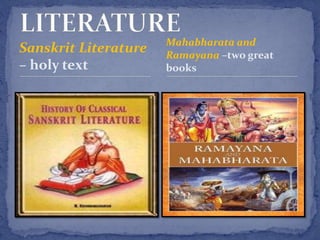
Sanskrit Literature
– holy text
Mahabharata and
Ramayana –two great
books
 Michael Madhusudan Dutt and Jayashankar
Prasad – introduced the black verse in sonnet into
Indian poetry.
 Aranucala Kavi – developed a utilitarian prose
style
 Madhusudan Dutt – wrote the 1st plays modeled
on Western Drama.
 Sir Rabindranath Tagore - introduces the short
story to vernacular writing in India
 Iqbal – major poets of the period
1. The Vedic period
2. Sanskrit period
Religious works
• Poetry
o The Rig Veda – sacred hymns
o The Yajur Veda – knowledge and melodies
o The Sama Veda – sacrifice
o The Atharva Veda – magic spells and other folk
knowledge
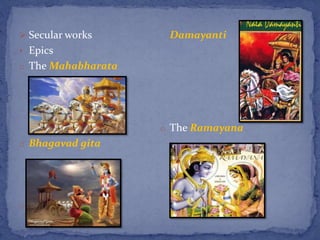
 Secular works
• Epics
o The Mahabharata
o Bhagavad gita
o Nala and
Damayanti
o The Ramayana
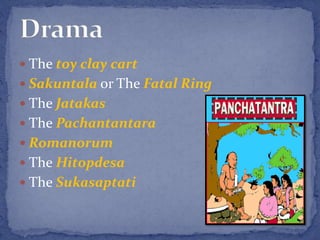
 The toy clay cart
 Sakuntala or The Fatal Ring
 The Jatakas
 The Pachantantara
 Romanorum
 The Hitopdesa
 The Sukasaptati
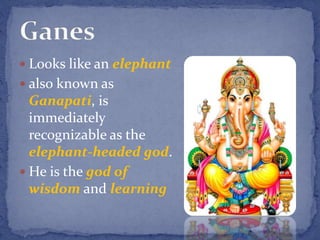
 Looks like an elephant
 also known as
Ganapati, is
immediately
recognizable as the
elephant-headed god.
 He is the god of
wisdom and learning
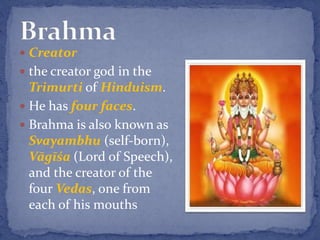
 Creator
 the creator god in the
Trimurti of Hinduism.
 He has four faces.
 Brahma is also known as
Svayambhu (self-born),
Vāgīśa (Lord of Speech),
and the creator of the
four Vedas, one from
each of his mouths
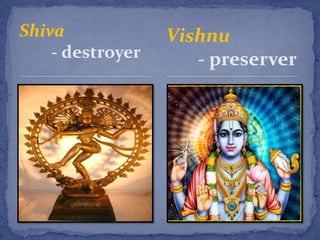
Shiva
- destroyer
Vishnu
- preserver
 Reincarnation – belief that the soul repeatedly
goes through a cycle of being born into a body,
dying, being reborn again in a new body.
 Karma – a force that determines the quality of
each life, depending on how well one behaved in a
past life.
 Hinduism says we create karma by our actions on
earth. If we live a good life, you create good
karma. If you live a bad life, you create bad
karma.
 Each time a Hindu soul is born into a better
life, it has the opportunity to improve itself
further, and get closer to ultimate
liberation.
 The ones who reach this state no longer
struggle with the cycle of life and death.
 The way to get Moksha is that do not create
any karma.
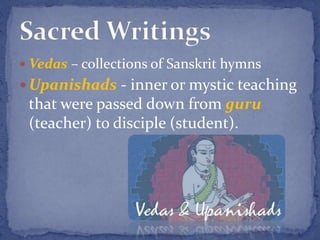
 Vedas – collections of Sanskrit hymns
 Upanishads - inner or mystic teaching
that were passed down from guru
(teacher) to disciple (student).
 Mahabharata, Sanskrit for Great story , is
one of the great epic poems of ancient India.
 The story is about the battle of one family
over a kingdom in northern India.
 The Bhagavad Gita (Song of God) –
contained in the Mahabharata. It is a
dialouge between Krishna and the hero
Arjuna on the meaning of life.
 Ramayana was written in 3rd century, and
tells a story of Rama, and his wife, Sita.
 Rama and Sita are generally seen as ideal
examples of great manly heroism and
wifely devotion.
 Hinduism is about the sort of life one should lead
in order to be born into a better life next time and
ultimately achieve liberation.
 4 Legitimate goals in life:
1. Dharma (appropriate living)
2. Artha (the pursuit of material gain by lawful
means)
3. Kama ( delight of the senses)
4. Moksha ( release from rebirth)
 4 Daily duties:
1. Revere deities
2. Respect ancestors
3. Respect all beings
4. Honor all humankind
 Mahabharata
 Pachantantra
 Pachantantra stories
 Bhagavad Gita
 Rabindranath Tagore
 Gitanjali
 kalidasa
Hindu literature ppt

Hindu literature ppt

  • 1.
    by: Shara MayM. Anacay BSE - English
  • 2.
     World’s 7thlargest country located in South Asia.  India and Bharat are both official names.  Derives from Indus river used by Greek.  India civilization grew up in the Indus Valley 4000 to 2500 BC.
  • 3.
    1. Himalayan Mountainsystem on the north 2. Northern plain drained by the Indus, Ganges and Brahmaputra rivers in North Central India. 3. Peninsular India in the South. The earliest Indians may have migrated from Australia and Pacific Islands. Language: more than 200 languages are spoken in India.
  • 4.
    1. Indo-Arab –branch of the Indo-European group (the major linguistic family in Europe). 2. Dravidian language group 3. Hindi – the fourth most widely spoken language in the world 4. Indo-Aryan language.
  • 5.
    1. Hinduism –adherent to the proscription against violence toward living things can escape from the cycle of rebirth and the doctrine also form a basis for vegetarian.
  • 6.
    2. Jainism –Non-violence is a core religious duty and followed so strictly that the most Orthodox devotes cover their faces with mask to prevent accidentally harming insect.
  • 7.
    3. Buddhism –non-violence is manifest in the Buddha’s emphasis on compassion and is also part of the faith’s moral codes.
  • 8.
    4. Sikhism -a monotheistic religion, and the basic Sikh belief is represented in the phrase Ik Onkar meaning “One God”. - was founded in the Punjab region in India in the 15th century by Guru Nanak Dev.
  • 9.
    1. Brahmins -priests, the highest caste 2. Kshatriyas – warriors and kings 3. Vaishyas – merchants 4. Shudras – manual labourers Dalits or untouchables – they have traditionally been tasked with work such as cleaning streets and working with human and animal corpses and waste. They are also known as Harijans.
  • 10.
     Born inPobandan India on October 2, 1869  His father was a chief minister.  Their family came from traditional caste of grocers and moneylenders.  They are under the Vaishyas system or group.  His mother was a devout adherent Jainism  He married by arrangement at 13  He went to London to study law when he was 18.  He fought to improve the status of the lowest classes of society, the untouchables, whom he called Harijans.
  • 11.
    Sanskrit Literature – holytext Mahabharata and Ramayana –two great books
  • 12.
     Michael MadhusudanDutt and Jayashankar Prasad – introduced the black verse in sonnet into Indian poetry.  Aranucala Kavi – developed a utilitarian prose style  Madhusudan Dutt – wrote the 1st plays modeled on Western Drama.  Sir Rabindranath Tagore - introduces the short story to vernacular writing in India  Iqbal – major poets of the period
  • 13.
    1. The Vedicperiod 2. Sanskrit period Religious works • Poetry o The Rig Veda – sacred hymns o The Yajur Veda – knowledge and melodies o The Sama Veda – sacrifice o The Atharva Veda – magic spells and other folk knowledge
  • 14.
     Secular works •Epics o The Mahabharata o Bhagavad gita o Nala and Damayanti o The Ramayana
  • 15.
     The toyclay cart  Sakuntala or The Fatal Ring  The Jatakas  The Pachantantara  Romanorum  The Hitopdesa  The Sukasaptati
  • 16.
     Looks likean elephant  also known as Ganapati, is immediately recognizable as the elephant-headed god.  He is the god of wisdom and learning
  • 17.
     Creator  thecreator god in the Trimurti of Hinduism.  He has four faces.  Brahma is also known as Svayambhu (self-born), Vāgīśa (Lord of Speech), and the creator of the four Vedas, one from each of his mouths
  • 18.
  • 19.
     Reincarnation –belief that the soul repeatedly goes through a cycle of being born into a body, dying, being reborn again in a new body.  Karma – a force that determines the quality of each life, depending on how well one behaved in a past life.  Hinduism says we create karma by our actions on earth. If we live a good life, you create good karma. If you live a bad life, you create bad karma.
  • 20.
     Each timea Hindu soul is born into a better life, it has the opportunity to improve itself further, and get closer to ultimate liberation.  The ones who reach this state no longer struggle with the cycle of life and death.  The way to get Moksha is that do not create any karma.
  • 21.
     Vedas –collections of Sanskrit hymns  Upanishads - inner or mystic teaching that were passed down from guru (teacher) to disciple (student).
  • 22.
     Mahabharata, Sanskritfor Great story , is one of the great epic poems of ancient India.  The story is about the battle of one family over a kingdom in northern India.  The Bhagavad Gita (Song of God) – contained in the Mahabharata. It is a dialouge between Krishna and the hero Arjuna on the meaning of life.
  • 23.
     Ramayana waswritten in 3rd century, and tells a story of Rama, and his wife, Sita.  Rama and Sita are generally seen as ideal examples of great manly heroism and wifely devotion.
  • 24.
     Hinduism isabout the sort of life one should lead in order to be born into a better life next time and ultimately achieve liberation.  4 Legitimate goals in life: 1. Dharma (appropriate living) 2. Artha (the pursuit of material gain by lawful means) 3. Kama ( delight of the senses) 4. Moksha ( release from rebirth)
  • 25.
     4 Dailyduties: 1. Revere deities 2. Respect ancestors 3. Respect all beings 4. Honor all humankind
  • 26.
     Mahabharata  Pachantantra Pachantantra stories  Bhagavad Gita  Rabindranath Tagore  Gitanjali  kalidasa