Shri Vile Parle Kelavani Mandal’s Institute of Technology, Dhule
Department of Civil Engineering 1
Academic Year : 2024-25
Course Code : BTCVC603
Semester : VI
Course Title :Transportation
Engg.
Shri Vile Parle Kelavani Mandal’s Institute of Technology, Dhule
Department of Civil Engineering 2
Program Specific Outcomes (PSO)
addressed by the Course:
A graduate of the Civil Engineering
Program will be able to
PSO1: Work in Civil Engineering sector
which involves various aspects of
planning, designing and construction of
structures.
PSO2: Undertake higher studies, identify
complex problems of Civil Engineering
and formulate research thinking.
PSO3: Use comprehended knowledge in
the broad domain of Civil Engineering to
undertake various competitive
examination.
Program Outcomes:
Engineering Graduates will be able to:
1. Engineering knowledge:
2. Problem analysis:
3. Design/development of solutions:
4. Conduct investigations of complex problems:
5. Modern tool usage:
6. The engineer and society:
7. Environment and sustainability:
8. Ethics:
9. Individual and team work:
10. Communication:.
11. Project management and finance:
12. Life-long learning:
Shri Vile Parle Kelavani Mandal’s Institute of Technology, Dhule
Department of Civil Engineering 3
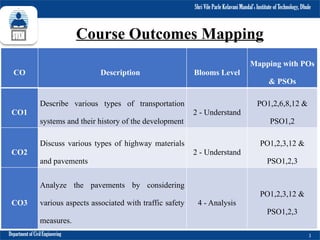
CO Description Blooms Level
Mapping with POs
& PSOs
CO1
Describe various types of transportation
systems and their history of the development
2 - Understand
PO1,2,6,8,12 &
PSO1,2
CO2
Discuss various types of highway materials
and pavements
2 - Understand
PO1,2,3,12 &
PSO1,2,3
CO3
Analyze the pavements by considering
various aspects associated with traffic safety
measures.
4 - Analysis
PO1,2,3,12 &
PSO1,2,3
Course Outcomes Mapping
Shri Vile Parle Kelavani Mandal’s Institute of Technology, Dhule
Department of Civil Engineering 4
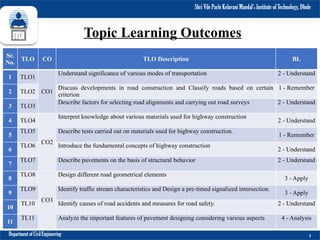
Sr.
No.
TLO CO TLO Description BL
1 TLO1
CO1
Understand significance of various modes of transportation 2 - Understand
2 TLO2
Discuss developments in road construction and Classify roads based on certain
criterion
1 - Remember
3 TLO3
Describe factors for selecting road alignments and carrying out road surveys 2 - Understand
4 TLO4
CO2
Interpret knowledge about various materials used for highway construction
2 - Understand
5
TLO5 Describe tests carried out on materials used for highway construction.
1 - Remember
6
TLO6 Introduce the fundamental concepts of highway construction
2 - Understand
7
TLO7 Describe pavements on the basis of structural behavior 2 - Understand
8
TLO8
CO3
Design different road geometrical elements
3 - Apply
9
TLO9 Identify traffic stream characteristics and Design a pre-timed signalized intersection.
3 - Apply
10
TL10 Identify causes of road accidents and measures for road safety. 2 - Understand
11
TL11 Analyze the important features of pavement designing considering various aspects 4 - Analysis
Topic Learning Outcomes
Shri Vile Parle Kelavani Mandal’s Institute of Technology, Dhule
Department of Civil Engineering
Module 1: Introduction (6 Lectures)
• Importance of various modes of transportation
• Highway Engineering, Road Classification
• Developments in Road Construction, Highway
Planning, Alignment and Surveys
5
Shri Vile Parle Kelavani Mandal’s Institute of Technology, Dhule
Department of Civil Engineering
6
Module 2: (6 Lectures)
• Geometric Design- Cross section elements, Sight
distances
• Horizontal alignment Vertical alignment, Intersections,
• Construction of Pavements
• Construction and Maintenance of Drainage
• Road Arboriculture
Shri Vile Parle Kelavani Mandal’s Institute of Technology, Dhule
Department of Civil Engineering
7
Module 3: (8 Lectures)
• Highway Materials: Soil relevant properties, Various
tests,
• Aggregates – strength, hardness, toughness, soundness,
durability, shape, specific gravity, water absorption
• Bituminous materials – Bitumen, Tar, and Asphalt –
various properties
• Design of Bituminous paving mixes-Marshall stability
Shri Vile Parle Kelavani Mandal’s Institute of Technology, Dhule
Department of Civil Engineering
•Module 4: Traffic Engineering (8 Lectures)
• Traffic Characteristics, Speed, Journey Time and Delays,
Vehicle Volume Counts, Origin and Destination Studies,
Analysis and Interpretation of Survey Data, Traffic
Operations
• Design of Signals and Rotary intersections, Parking
Space Design, Highway Lighting, Planning and
Administration, Road Markings, Signs
•Road Accidents and Safety: Classification, Causes,
Mitigation and Control Measures, Aspects of Safety in
Usage of Roads, Type and Design of anti-crash barriers
• Introduction to Intelligent Transport Systems (ITS).
8
Shri Vile Parle Kelavani Mandal’s Institute of Technology, Dhule
Department of Civil Engineering
Module 5: Pavement Design (8 Lectures)
• Basic Principles, Methods for different Types of
Pavements, Design of flexible pavement using IRC:
37- 2012, Design of rigid pavement using IRC: 58-
2011
Other modes of Transport
• Introduction to Railways, Airways, Waterways,
Pipeline Transportation, Classification, Requirements,
Comparative Studies
9
Shri Vile Parle Kelavani Mandal’s Institute of Technology, Dhule
Department of Civil Engineering
References
• Khanna and Justo, “Highway Engineering”, Nemchand& Bros.,
Roorkee
• Khanna S.K., “Highway Engineering”,
• Arora N. L., “Transportation Engineering”
• Bindra and Arora, “Highway Engineering”, Standard Publishers
• Vazirani V.N. and Chandola S.P., “Transportation Engineering”,
VolIKhanna Publishers, N. Delhi
• Vazirani V.N. and Chandola S.P., “Transportation Engineering”, Vol
II Khanna Publishers, N. Delhi ISBN NO: N/A
• Shahani P.B, “Road Techniques” Khanna Publishers, N. Delhi ISBN
NO: 978-81-7409-197-1 PRICE 149/-
• Kadiyali L.R, “Traffic Engineering and Transport Planning”,
Khanna Publishers, N. Delhi, ISBN NO:978-81-7409-220-X
Shri Vile Parle Kelavani Mandal’s Institute of Technology, Dhule
Department of Civil Engineering
Shri Vile Parle Kelavani Mandal’s Institute of Technology, Dhule
Department of Civil Engineering
Shri Vile Parle Kelavani Mandal’s Institute of Technology, Dhule
Department of Civil Engineering
Shri Vile Parle Kelavani Mandal’s Institute of Technology, Dhule
Department of Civil Engineering
Shri Vile Parle Kelavani Mandal’s Institute of Technology, Dhule
Department of Civil Engineering
Objective of Transportation System:-
 Main objective of a good transportation system is to
provide safe, economical, efficient transportation
facility for the travel of passengers and transportation
of goods.
15
Shri Vile Parle Kelavani Mandal’s Institute of Technology, Dhule
Department of Civil Engineering
Role of Transportation:
1) Transportation is an index of economic, social, cultural, industrial &
commercial progress of a country.
2) Transportation is vital for the economic development of any region, whether it
is agricultural or industrial product needs to be transported from production to
distribution.
3) Transportation is also required for carrying raw material for production.
4) The whole structure of industry and commerce rests on the well laid
foundation of transport.
5) No country or region can ever flourish if it lacks adequate transport facilities.
6) Main role of transportation is to provide safe, economical, efficient
transportation facility for the travel of passengers and transportation of goods.
Shri Vile Parle Kelavani Mandal’s Institute of Technology, Dhule
Department of Civil Engineering
Importance of Transportation System:-
1) Economic Activity & Transport: production, supply, consumption, human demand.
2) Social Effects of Transportation: Population have always settled along the routes.
3) Sectionalism: Cultural exchange, living condition improvement, increase of knowledge,
etc.
4) Concentration of Population in Urban Area: Employment opportunity & superior
facilities.
5) Aspects of Safety, Law & Order: emergency, external aggression, etc.
6) Development in Rural Area: 75 % population living in rural area, balanced development
of city & village.
17
Shri Vile Parle Kelavani Mandal’s Institute of Technology, Dhule
Department of Civil Engineering
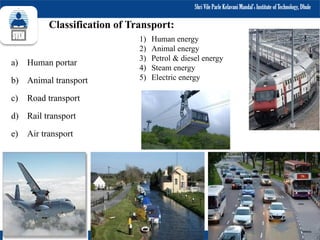
a) Human portar
b) Animal transport
c) Road transport
d) Rail transport
e) Air transport
18
Classification of Transport:
1) Human energy
2) Animal energy
3) Petrol & diesel energy
4) Steam energy
5) Electric energy
Shri Vile Parle Kelavani Mandal’s Institute of Technology, Dhule
Department of Civil Engineering
Different Mode of Transportation:
Classification from Surface Point of View:
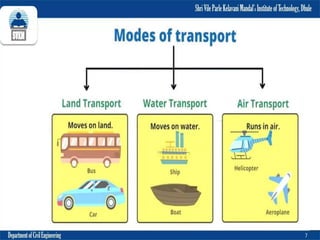
1) Land Transport: Highways, Railways, Cableways, etc.
2) Water Transport: Canal ways, River ways, Ocean ways, Lake ways, etc.
3) Air Transport: Airways.
Classification based on Freedom to Move:
4) One Degree Freedom: Vehicles are free to move along a line. Ex. Railways.
5) Two Degree Freedom: move along a line as well as laterally. Ex. Ship, bats, etc.
6) Three Degree Freedom: free to move in any plane. Ex. Aero-planes.
Shri Vile Parle Kelavani Mandal’s Institute of Technology, Dhule
Department of Civil Engineering
Different Mode of Transportation:
1) Road Transport: Transportation by road system is the only mode
which could give maximum flexibility of service from origin to
destination, to one & all. Nearest to people
2) Rail Transport: Transportation could be economical between the
railway station & advantages for passenger & goods for long
distance. (as resistance to traction along the track for the movement
is much lower)
3) Water Transport: Transportation is most energy efficient but slow.
4) Air Transport: Fastest among the four modes, Comfortable,
energy requirement more, costly & affected by weather condition.
Shri Vile Parle Kelavani Mandal’s Institute of Technology, Dhule
Department of Civil Engineering
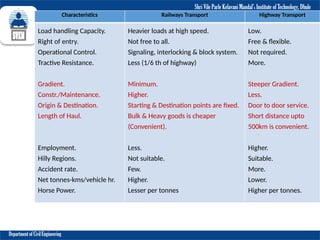
Characteristics Railways Transport Highway Transport
Load handling Capacity.
Right of entry.
Operational Control.
Tractive Resistance.
Gradient.
Constr./Maintenance.
Origin & Destination.
Length of Haul.
Employment.
Hilly Regions.
Accident rate.
Net tonnes-kms/vehicle hr.
Horse Power.
Heavier loads at high speed.
Not free to all.
Signaling, interlocking & block system.
Less (1/6 th of highway)
Minimum.
Higher.
Starting & Destination points are fixed.
Bulk & Heavy goods is cheaper
(Convenient).
Less.
Not suitable.
Few.
Higher.
Lesser per tonnes
Low.
Free & flexible.
Not required.
More.
Steeper Gradient.
Less.
Door to door service.
Short distance upto
500km is convenient.
Higher.
Suitable.
More.
Lower.
Higher per tonnes.
Shri Vile Parle Kelavani Mandal’s Institute of Technology, Dhule
Department of Civil Engineering
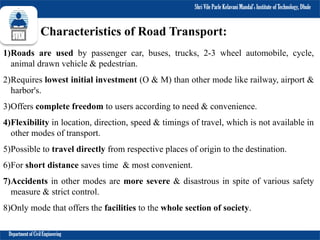
Characteristics of Road Transport:
1)Roads are used by passenger car, buses, trucks, 2-3 wheel automobile, cycle,
animal drawn vehicle & pedestrian.
2)Requires lowest initial investment (O & M) than other mode like railway, airport &
harbor's.
3)Offers complete freedom to users according to need & convenience.
4)Flexibility in location, direction, speed & timings of travel, which is not available in
other modes of transport.
5)Possible to travel directly from respective places of origin to the destination.
6)For short distance saves time & most convenient.
7)Accidents in other modes are more severe & disastrous in spite of various safety
measure & strict control.
8)Only mode that offers the facilities to the whole section of society.
Shri Vile Parle Kelavani Mandal’s Institute of Technology, Dhule
Department of Civil Engineering
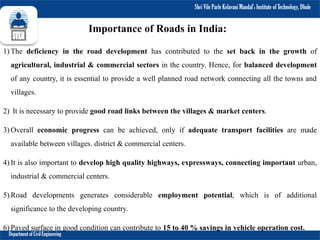
Importance of Roads in India:
1) The deficiency in the road development has contributed to the set back in the growth of
agricultural, industrial & commercial sectors in the country. Hence, for balanced development
of any country, it is essential to provide a well planned road network connecting all the towns and
villages.
2) It is necessary to provide good road links between the villages & market centers.
3) Overall economic progress can be achieved, only if adequate transport facilities are made
available between villages. district & commercial centers.
4) It is also important to develop high quality highways, expressways, connecting important urban,
industrial & commercial centers.
5) Road developments generates considerable employment potential, which is of additional
significance to the developing country.
6) Paved surface in good condition can contribute to 15 to 40 % savings in vehicle operation cost.
Shri Vile Parle Kelavani Mandal’s Institute of Technology, Dhule
Department of Civil Engineering
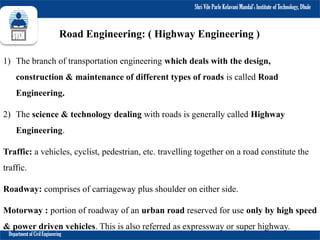
Road Engineering: ( Highway Engineering )
1) The branch of transportation engineering which deals with the design,
construction & maintenance of different types of roads is called Road
Engineering.
2) The science & technology dealing with roads is generally called Highway
Engineering.
Traffic: a vehicles, cyclist, pedestrian, etc. travelling together on a road constitute the
traffic.
Roadway: comprises of carriageway plus shoulder on either side.
Motorway : portion of roadway of an urban road reserved for use only by high speed
& power driven vehicles. This is also referred as expressway or super highway.
Shri Vile Parle Kelavani Mandal’s Institute of Technology, Dhule
Department of Civil Engineering
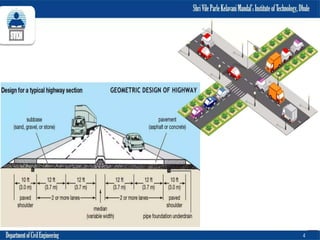
Scope of Highway Engineering:
1)Development, planning & location of roads.
2)Highway design.
3)Material required for construction &
maintenance.
4)Highway traffic performance & control.
5)Economics, finance & administration.
Shri Vile Parle Kelavani Mandal’s Institute of Technology, Dhule
Department of Civil Engineering
Development of Road Construction:
1)The first road was constructed in 1900 B.C. by
Assyrian empire as per authentic record.
2)Romans are the pioneers in ancient road
construction 312 B.C.
3)Roads were constructed on a large scale only
during the period of Roman empire.
Tresaguet Method of Construction:
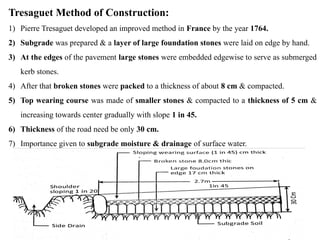
1) Pierre Tresaguet developed an improved method in France by the year 1764.
2) Subgrade was prepared & a layer of large foundation stones were laid on edge by hand.
3) At the edges of the pavement large stones were embedded edgewise to serve as submerged
kerb stones.
4) After that broken stones were packed to a thickness of about 8 cm & compacted.
5) Top wearing course was made of smaller stones & compacted to a thickness of 5 cm &
increasing towards center gradually with slope 1 in 45.
6) Thickness of the road need be only 30 cm.
7) Importance given to subgrade moisture & drainage of surface water.
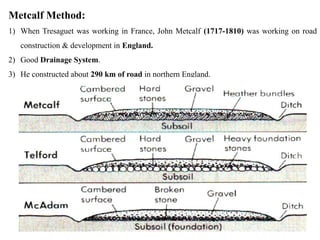
Metcalf Method:
1) When Tresaguet was working in France, John Metcalf (1717-1810) was working on road
construction & development in England.
2) Good Drainage System.
3) He constructed about 290 km of road in northern England.
Shri Vile Parle Kelavani Mandal’s Institute of Technology, Dhule
Department of Civil Engineering
Telford Method:
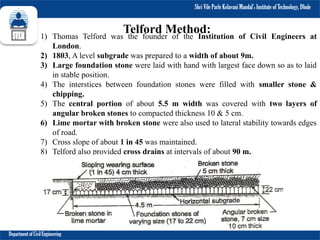
1) Thomas Telford was the founder of the Institution of Civil Engineers at
London.
2) 1803, A level subgrade was prepared to a width of about 9m.
3) Large foundation stone were laid with hand with largest face down so as to laid
in stable position.
4) The interstices between foundation stones were filled with smaller stone &
chipping.
5) The central portion of about 5.5 m width was covered with two layers of
angular broken stones to compacted thickness 10 & 5 cm.
6) Lime mortar with broken stone were also used to lateral stability towards edges
of road.
7) Cross slope of about 1 in 45 was maintained.
8) Telford also provided cross drains at intervals of about 90 m.
Shri Vile Parle Kelavani Mandal’s Institute of Technology, Dhule
Department of Civil Engineering
1) 1827, John Macadam put forward an entirely new method of road construction
as compared to all the previous methods.
2) The soil subgrade being the lowest portion of the pavement should be prepared
properly & kept drained so as to carry the load transmitted through the pavement.
3) Therefore subgrade was compacted & prepared with a cross slope of 1 in 36.
4) Small size broken stones were spread over the prepared soil subgrade &
compacted. Similarly next layer were constructed.
5) This technique helped to improve the load dispersion characteristics even though
thickness were less than previous methods.
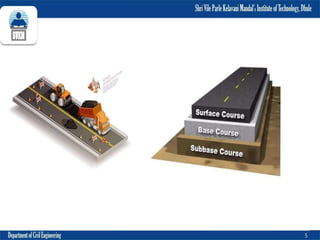
6) Water Bound Macadam, Penetration Macadam, Bituminous Macadam & Dense
Bituminous Macadam method developed with slight modification .
Macadam Method:
Shri Vile Parle Kelavani Mandal’s Institute of Technology, Dhule
Department of Civil Engineering
Water Bound Macadam Method: WBM Method
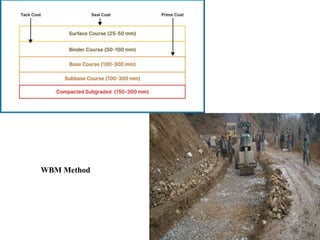
1) WBM road construction method is improved method based on Macadam
method.
2) Crushed stones mechanically interlocked by rolling & voids filled by
screening & binding material with water.
3) Thickness of each compacted layer 7.5 to 10 cm.
4) Coarse aggregate of size 40 to 90 mm used for sub-base.
5) Subgrade i.e lowest portion of pavement is prepared with compacted layer
of smaller size broken stones carry the load transmitted.
6) Compacted layer of smaller size stones at bottom replaced the heavy
foundation stones used before this.
7) Stresses due to the wheel load of traffic gets decreased at the lower layer of
pavement & larger size stones are not necessary at the lowest layer.
8) Compacted stones of smaller size are better for load dispersion.
9) Economical, locally available material is used & not required skilled labor.
10)Maintenance is high & life is less.
WBM Method
Shri Vile Parle Kelavani Mandal’s Institute of Technology, Dhule
Department of Civil Engineering
Road Development in India:
1)Road were exist in Mohenjo-Daro & Harappa, 25 to 35
centuries (B.C.)
2)Emperor Ashoka had improved the roads.
3)Roads of India were also improved during the Mughal
periods.
4)1865, Lord Dalhousie, Governor General formed PWD
& which constructed Grand Trunk Road.
For several centuries, it has linked the eastern and western
regions of the Indian subcontinent, running from Bengal,
across north Republic of India, into Peshawar in Pakistan
Shri Vile Parle Kelavani Mandal’s Institute of Technology, Dhule
Department of Civil Engineering
Progress of Road Development in India:
1)Road development in India started after initiation of the Nagpur Road Plan
in the year 1943.
2)The road development works progressed with the implementation of plans
with effect from the year 1951 & subsequent road development plan.
3)The total road length in the country has increased from 4 lakh km in the
year 1951 to over 42 lakh km .
4)Only 35-40% of total revenue from the road transport sector in the country
has been invested on road maintenance works & for development plans
during the past several decades.
Shri Vile Parle Kelavani Mandal’s Institute of Technology, Dhule
Department of Civil Engineering
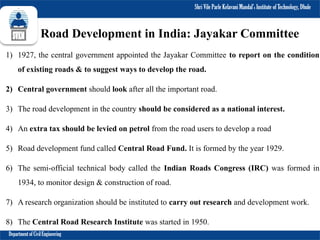
Road Development in India: Jayakar Committee
1) 1927, the central government appointed the Jayakar Committee to report on the condition
of existing roads & to suggest ways to develop the road.
2) Central government should look after all the important road.
3) The road development in the country should be considered as a national interest.
4) An extra tax should be levied on petrol from the road users to develop a road
5) Road development fund called Central Road Fund. It is formed by the year 1929.
6) The semi-official technical body called the Indian Roads Congress (IRC) was formed in
1934, to monitor design & construction of road.
7) A research organization should be instituted to carry out research and development work.
8) The Central Road Research Institute was started in 1950.
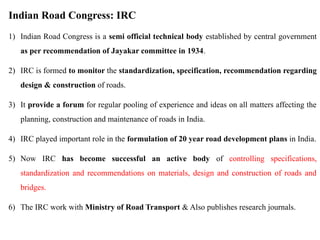
Indian Road Congress: IRC
1) Indian Road Congress is a semi official technical body established by central government
as per recommendation of Jayakar committee in 1934.
2) IRC is formed to monitor the standardization, specification, recommendation regarding
design & construction of roads.
3) It provide a forum for regular pooling of experience and ideas on all matters affecting the
planning, construction and maintenance of roads in India.
4) IRC played important role in the formulation of 20 year road development plans in India.
5) Now IRC has become successful an active body of controlling specifications,
standardization and recommendations on materials, design and construction of roads and
bridges.
6) The IRC work with Ministry of Road Transport & Also publishes research journals.
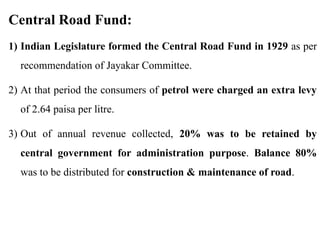
Central Road Fund:
1) Indian Legislature formed the Central Road Fund in 1929 as per
recommendation of Jayakar Committee.
2) At that period the consumers of petrol were charged an extra levy
of 2.64 paisa per litre.
3) Out of annual revenue collected, 20% was to be retained by
central government for administration purpose. Balance 80%
was to be distributed for construction & maintenance of road.
Motor Vehicle Act:
1) In 1939 the motor vehicles Act was brought into effect by
Government of India to regulate the road traffic in the form of
traffic laws, ordinances and regulations.
2) The three phases primarily covered are control of the driver, vehicle
ownership and vehicle operation on roads and in traffic stream.
3) The motor vehicle act has been appended with several ordinances
subsequently. The motor vehicle act has been revised in the year
1988.
Nagpur Road Congress:
1) A conference of the chief Engineers of all the states and provinces was conducted
in 1943 by the Govt. of India at Nagpur, at initiative of the IRC to finalize the
first road development plan for the country as a whole.
2) This is the landmark in the history of road development in India, as it was the
first attempt to prepare a co-ordinated road development programme in a
planned manner.
3) In this, first 20 year road development plan finalized & popularly known as the
Nagpur Road Plan.
4) Target was to build 16 km length of road per 100 Km2
area of country.
National Highway Act:
1) In 1956 the National Highway Act was passed.
2) The responsibility of development and maintenance of the National
highway (NH) to be provisionally taken by the central
government.
3) The central govt. to be empowered to declare any other highways as
NH or to omit any of existing national highways from the list.
4) Also empowered to acquire land for the development of NH.
5) National Highway Authority of India (NHAI) started operating
1995.
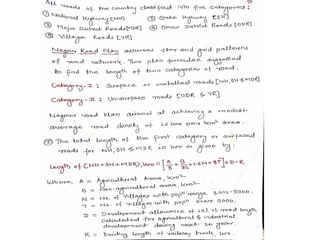
Nagpur Road Plan (1943-63): First 20 Year Road Development Plan
1) Responsibility of construction & maintenance of national highways was assigned to the
central government.
2) Nagpur Road Plan (1943-63) aiming to provide for 1,98,000 km of surface roads and
3,33,600 km of un-surfaced roads to reach 16 km road length per100 sq.km area.
3) The formulae were based on star and grid pattern of road network. But the existing
irregular pattern of roads and obligatory points not fitting in the geometric pattern were to
be given due consideration.
4) Size of the grid of road in agricultural area would be 16 km so that the maximum
distance from the center is 8 km and the average distance of the villages from metaled roads
would be less than 3.2 km.
5) In non-agricultural area the size of the grid is of 64 km sides, the farthest distance from
the center to the metaled roads being 32 km.
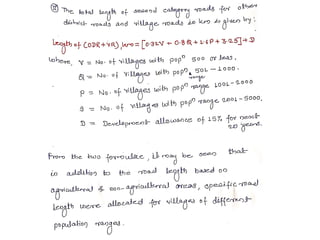
6) The second category roads are meant to provide internal road system linking small villages
with first category roads.
Nagpur Road Plan: First 20 Year Road Development Plan
 The length of railway tracks in the area was also considered in deciding the length of first
category road.
 Recommendations were made for the geometric standards of roads, bridge
specifications & highway organizations.
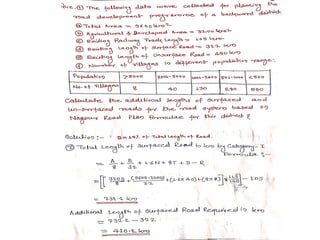
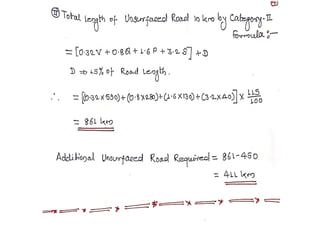
 Two formulae were finalized at the Nagpur Conference for deciding the road length for
the country as a whole as well as for individual areas (like district)
 The road network in the country was classified into five categories:
1) National Highways,
2) State Highways,
3) Major District Road
4) Other District Roads &
5) Village Roads
Second 20 Year Road Development Plan: (1961-81) Bombay Road Plan
1) First 20 year road plan’s target road length was nearly completed earlier in 1961, Hence
next 20 year road plan commenced from 1961 by the IRC, sub committee and Chief
Engineers.
2) The second road plan expected overall road length of 10,57330 km by the year 1981.The
cost of the plan has been worked out to Rs.5200 crore.
3) The target of this plan is to provide a total road length of 32 km per 100 sq.km area
which is almost double of that achieved up to the year 1961.
4) Maximum distance of any place in a developed area would be 6.4 km from a metaled road
and 2.4 km from any category of roads.
5) The maximum distance from any place in as semi-developed area would be 12.8 km from
a metaled road.
6) Similarly the maximum distance in an undeveloped area would be 19.2 km from a metaled
road and 8 km from any road.
Second 20 Year Road Development Plan: (1961-81) Bombay Road Plan
7) Every town with population above 2000 in plains and above 1000 in semi hill areas and
above 500 in hilly areas should be connected by a metaled road.
8) Expressways 1600 km of length has been included in the proposed target of NH.
9) Length of railway track is considered independent of the road system and hence it is not
subtracted to get the road length.
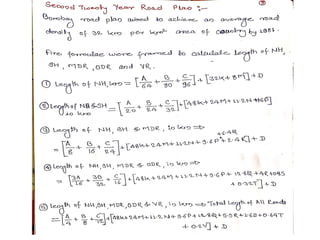
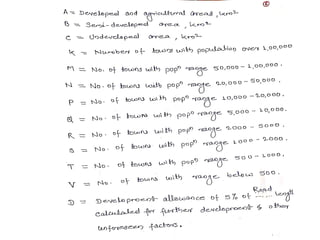
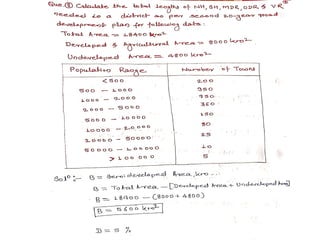
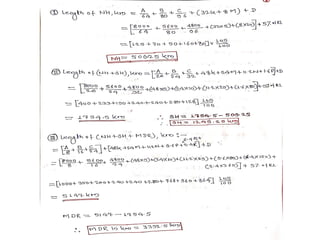
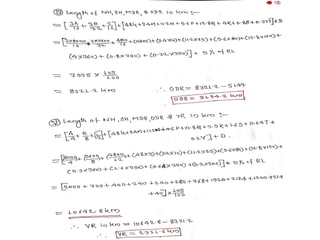
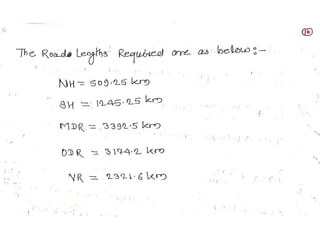
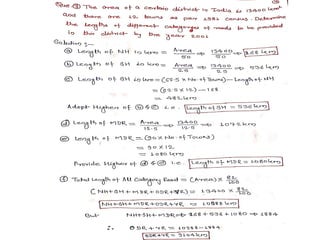
10)Five different formulae were framed to calculate the length of NH, SH, MDR, ODR & VR.
Third 20 Year Road Development Plan: (1981-2001) Lucknow Road Plan
1) Villages having population over 500 should be connected by all weather roads.
2) Overall density of road in the country should be increased to 82 km per 100 sq. km.
3) NH network should be expanded to form square grid of 100 km sides so that no part of the
country is more than 50 km away from a NH.
4) All villages with population over 1500 should be connected by MDR & population 1000 to
1500 by ODR.
5) Villages of population less than 500 should be connected by road within a distance of 3
km in plain & 5 km in hilly area.
6) Roads should be constructed in less industrialized area to attract growth of industries.
7) The existing roads should be improved by rectifying the defects in geometric design.
8) Improving the pavements surface & widening of pavements, as necessary, so that safety &
economy is achieved.
National Highway Development Projects: 2000
1) NHAI took up the National Highway Development Projects by the year 2000.
2) Phase-I : Golden Quadrilateral of total length 5864 km connecting 4 major cities.
• Delhi – Mumbai
• Mumbai – Chennai
• Chennai - Kolkatta
• Kolkatta – Delhi
3) Phase-II :
• North – South corridor connecting Srinagar to Kanyakumari.
• East – West corridor connecting Silchar to Porbandar.
4) Phase-III, IV, V, VI & VII : Development of NH, Expreesways & improvement of urban
road network.
Classification of Roads:
Depending on whether they can be used during different season of the year:
1) All Weather Road: negotiable during all season of the year.
2) Fair Weather Road: traffic may be interrupted during monsoon season.
Road Classification as per Nagpur Road Plan based on location & function:
3) National Highway (NH): connecting major ports, foreign highways, capitals of large states
& industrial area. NH-4 Thane- Bangalore- Chennai.
4) State Highway (SH): Connecting NH of adjacent highways, district head quarter &
important cities within state. Same design speed & geometric design specification used for
NH & SH.
5) Major District Roads (MDR): Important roads within a district serving areas of
production and markets. Also connecting with other major roads or SH.
6) Other District Roads (ODR): Roads are serving rural areas of production & markets.
7) Village Roads (VR): Connecting villages.
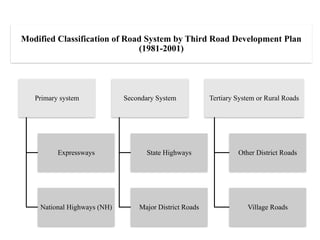
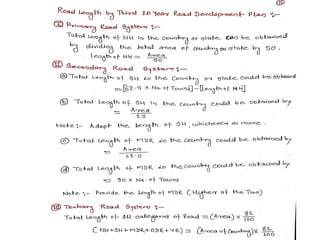
Modified Classification of Road System by Third Road Development Plan
(1981-2001)
Primary system
Expressways
National Highways (NH)
Secondary System
State Highways
Major District Roads
Tertiary System or Rural Roads
Other District Roads
Village Roads
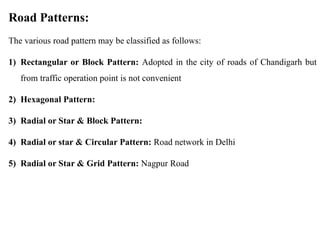
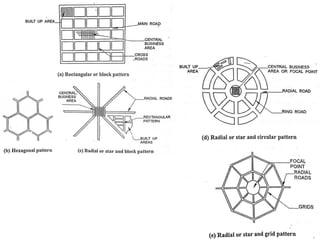
Road Patterns:
The various road pattern may be classified as follows:
1) Rectangular or Block Pattern: Adopted in the city of roads of Chandigarh but
from traffic operation point is not convenient
2) Hexagonal Pattern:
3) Radial or Star & Block Pattern:
4) Radial or star & Circular Pattern: Road network in Delhi
5) Radial or Star & Grid Pattern: Nagpur Road
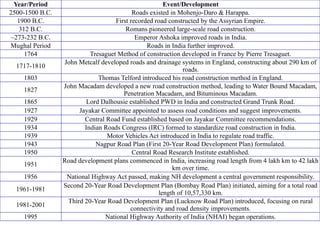
Year/Period Event/Development
2500-1500 B.C. Roads existed in Mohenjo-Daro & Harappa.
1900 B.C. First recorded road constructed by the Assyrian Empire.
312 B.C. Romans pioneered large-scale road construction.
~273-232 B.C. Emperor Ashoka improved roads in India.
Mughal Period Roads in India further improved.
1764 Tresaguet Method of construction developed in France by Pierre Tresaguet.
1717-1810
John Metcalf developed roads and drainage systems in England, constructing about 290 km of
roads.
1803 Thomas Telford introduced his road construction method in England.
1827
John Macadam developed a new road construction method, leading to Water Bound Macadam,
Penetration Macadam, and Bituminous Macadam.
1865 Lord Dalhousie established PWD in India and constructed Grand Trunk Road.
1927 Jayakar Committee appointed to assess road conditions and suggest improvements.
1929 Central Road Fund established based on Jayakar Committee recommendations.
1934 Indian Roads Congress (IRC) formed to standardize road construction in India.
1939 Motor Vehicles Act introduced in India to regulate road traffic.
1943 Nagpur Road Plan (First 20-Year Road Development Plan) formulated.
1950 Central Road Research Institute established.
1951
Road development plans commenced in India, increasing road length from 4 lakh km to 42 lakh
km over time.
1956 National Highway Act passed, making NH development a central government responsibility.
1961-1981
Second 20-Year Road Development Plan (Bombay Road Plan) initiated, aiming for a total road
length of 10,57,330 km.
1981-2001
Third 20-Year Road Development Plan (Lucknow Road Plan) introduced, focusing on rural
connectivity and road density improvements.
1995 National Highway Authority of India (NHAI) began operations.
Shri Vile Parle Kelavani Mandal’s Institute of
Technology, Dhule
• The initial definition of the need for any
highway or bridge improvement project takes
place during the planning stage.
• This problem definition occurs at the State,
regional, or local level, depending on the scale
of the proposed improvement.
Highway Planning
Department of Civil Engineering 65
Shri Vile Parle Kelavani Mandal’s Institute of Technology, Dhule
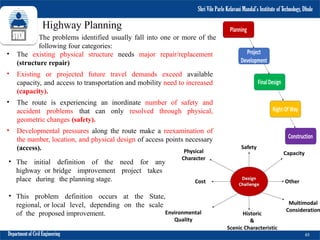
The problems identified usually fall into one or more of the
following four categories:
• The existing physical structure needs major repair/replacement
(structure repair)
• Existing or projected future travel demands exceed available
capacity, and access to transportation and mobility need to increased
(capacity).
• The route is experiencing an inordinate number of safety and
accident problems that can only resolved through physical,
geometric changes (safety).
• Developmental pressures along the route make a reexamination of
the number, location, and physical design of access points necessary
(access).
Shri Vile Parle Kelavani Mandal’s Institute of Technology, Dhule
Department of Civil Engineering 66
Highway Planning
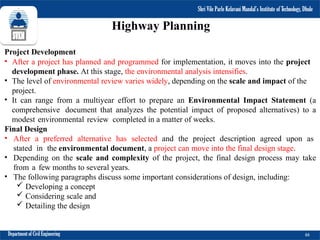
Project Development
• After a project has planned and programmed for implementation, it moves into the project
development phase. At this stage, the environmental analysis intensifies.
• The level of environmental review varies widely, depending on the scale and impact of the
project.
• It can range from a multiyear effort to prepare an Environmental Impact Statement (a
comprehensive document that analyzes the potential impact of proposed alternatives) to a
modest environmental review completed in a matter of weeks.
Final Design
• After a preferred alternative has selected and the project description agreed upon as
stated in the environmental document, a project can move into the final design stage.
• Depending on the scale and complexity of the project, the final design process may take
from a few months to several years.
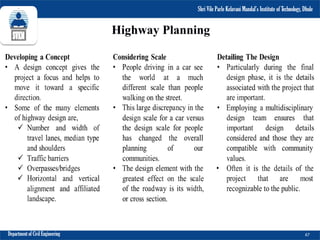
• The following paragraphs discuss some important considerations of design, including:
 Developing a concept
 Considering scale and
 Detailing the design
Shri Vile Parle Kelavani Mandal’s Institute of Technology, Dhule
Department of Civil Engineering 67
Shri Vile Parle Kelavani Mandal’s Institute of Technology, Dhule
Highway Planning
Shri Vile Parle Kelavani Mandal’s Institute of Technology, Dhule
Department of Civil Engineering 68
Right-of-way, Construction, And Maintenance
• Once the final designs have prepared and needed right-of-way is purchased, construction bid
packages made available, a contractor selected, and construction initiated.
• During the right-of-way acquisition and construction stages, minor adjustments in the design
may be necessary; therefore, there should be continuous involvement of the design team throughout
these stages.
• Construction may be simple or complex and may require a few months to several years.
• Once construction has completed, the facility is ready to begin its normal sequence of operations and
maintenance.
• Even after the completion of construction, the character of a road can changed by
inappropriate maintenance actions.
• For example, the replacement of sections of guardrail damaged or destroyed in crashes commonly
utilizes whatever spare guardrail sections may be available to the local highway maintenance
personnel at the time.
Shri Vile Parle Kelavani Mandal’s Institute of Technology, Dhule
Highway Planning
Shri Vile Parle Kelavani Mandal’s Institute of Technology, Dhule
Alignment and Surveys
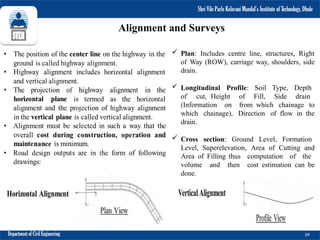
 Plan: Includes centre line, structures, Right
of Way (ROW), carriage way, shoulders, side
drain.
 Longitudinal Profile: Soil Type, Depth
of cut, Height of Fill, Side drain
(Information on from which chainage to
which chainage), Direction of flow in the
drain.
 Cross section: Ground Level, Formation
Level, Superelevation, Area of Cutting and
Area of Filling thus computation of the
volume and then cost estimation can be
done.
Department of Civil Engineering 69
Shri Vile Parle Kelavani Mandal’s Institute of Technology, Dhule
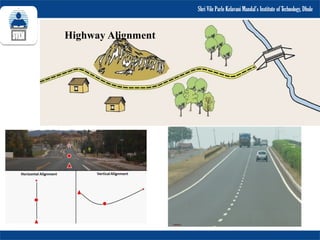
Highway Alignment
Shri Vile Parle Kelavani Mandal’s Institute of Technology, Dhule
Shri Vile Parle Kelavani Mandal’s Institute of
Technology, Dhule
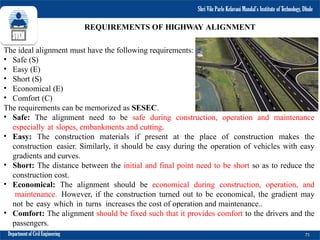
The ideal alignment must have the following requirements:
• Safe (S)
• Easy (E)
• Short (S)
• Economical (E)
• Comfort (C)
The requirements can be memorized as SESEC.
• Safe: The alignment need to be safe during construction, operation and maintenance
especially at slopes, embankments and cutting.
• Easy: The construction materials if present at the place of construction makes the
construction easier. Similarly, it should be easy during the operation of vehicles with easy
gradients and curves.
• Short: The distance between the initial and final point need to be short so as to reduce the
construction cost.
• Economical: The alignment should be economical during construction, operation, and
maintenance. However, if the construction turned out to be economical, the gradient may
not be easy which in turns increases the cost of operation and maintenance..
• Comfort: The alignment should be fixed such that it provides comfort to the drivers and the
passengers.
Department of Civil Engineering 71
Shri Vile Parle Kelavani Mandal’s Institute of Technology, Dhule
REQUIREMENTS OF HIGHWAY ALIGNMENT
Factors Controlling Highway Alignment:
1. Government Alignment:
As the road project needs a large investment, the government should be
clear about the requirement of the road (when, what, how and why to
construct).
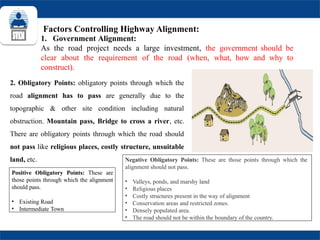
Positive Obligatory Points: These are
those points through which the alignment
should pass.
• Existing Road
• Intermediate Town
Negative Obligatory Points: These are those points through which the
alignment should not pass.
• Valleys, ponds, and marshy land
• Religious places
• Costly structures present in the way of alignment
• Conservation areas and restricted zones.
• Densely populated area.
• The road should not be within the boundary of the country.
2. Obligatory Points: obligatory points through which the
road alignment has to pass are generally due to the
topographic & other site condition including natural
obstruction. Mountain pass, Bridge to cross a river, etc.
There are obligatory points through which the road should
not pass like religious places, costly structure, unsuitable
land, etc.
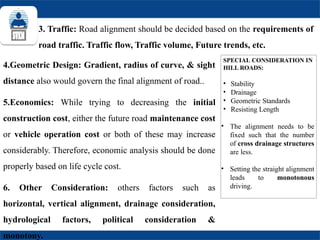
3. Traffic: Road alignment should be decided based on the requirements of
road traffic. Traffic flow, Traffic volume, Future trends, etc.
SPECIAL CONSIDERATION IN
HILL ROADS:
• Stability
• Drainage
• Geometric Standards
• Resisting Length
• The alignment needs to be
fixed such that the number
of cross drainage structures
are less.
• Setting the straight alignment
leads to monotonous
driving.
4.Geometric Design: Gradient, radius of curve, & sight
distance also would govern the final alignment of road..
5.Economics: While trying to decreasing the initial
construction cost, either the future road maintenance cost
or vehicle operation cost or both of these may increase
considerably. Therefore, economic analysis should be done
properly based on life cycle cost.
6. Other Consideration: others factors such as
horizontal, vertical alignment, drainage consideration,
hydrological factors, political consideration &
monotony.
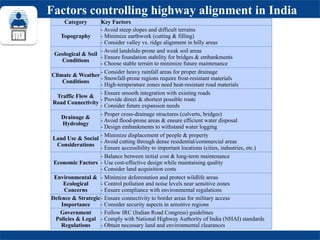
Category Key Factors
Topography
- Avoid steep slopes and difficult terrains
- Minimize earthwork (cutting & filling)
- Consider valley vs. ridge alignment in hilly areas
Geological & Soil
Conditions
- Avoid landslide-prone and weak soil areas
- Ensure foundation stability for bridges & embankments
- Choose stable terrain to minimize future maintenance
Climate & Weather
Conditions
- Consider heavy rainfall areas for proper drainage
- Snowfall-prone regions require frost-resistant materials
- High-temperature zones need heat-resistant road materials
Traffic Flow &
Road Connectivity
- Ensure smooth integration with existing roads
- Provide direct & shortest possible route
- Consider future expansion needs
Drainage &
Hydrology
- Proper cross-drainage structures (culverts, bridges)
- Avoid flood-prone areas & ensure efficient water disposal
- Design embankments to withstand water logging
Land Use & Social
Considerations
- Minimize displacement of people & property
- Avoid cutting through dense residential/commercial areas
- Ensure accessibility to important locations (cities, industries, etc.)
Economic Factors
- Balance between initial cost & long-term maintenance
- Use cost-effective design while maintaining quality
- Consider land acquisition costs
Environmental &
Ecological
Concerns
- Minimize deforestation and protect wildlife areas
- Control pollution and noise levels near sensitive zones
- Ensure compliance with environmental regulations
Defence & Strategic
Importance
- Ensure connectivity to border areas for military access
- Consider security aspects in sensitive regions
Government
Policies & Legal
Regulations
- Follow IRC (Indian Road Congress) guidelines
- Comply with National Highway Authority of India (NHAI) standards
- Obtain necessary land and environmental clearances
Factors controlling highway alignment in India
Shri Vile Parle Kelavani Mandal’s Institute of
Technology, Dhule
Department of Civil Engineering 75
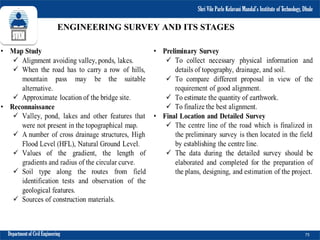
ENGINEERING SURVEY AND ITS STAGES
Shri Vile Parle Kelavani Mandal’s Institute of Technology, Dhule
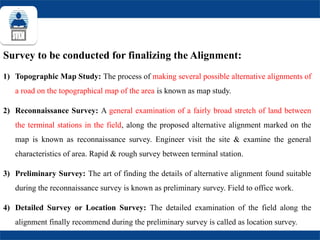
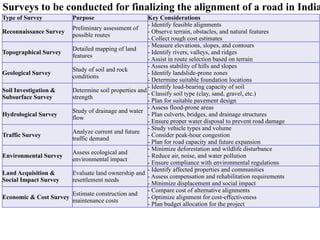
Survey to be conducted for finalizing the Alignment:
1) Topographic Map Study: The process of making several possible alternative alignments of
a road on the topographical map of the area is known as map study.
2) Reconnaissance Survey: A general examination of a fairly broad stretch of land between
the terminal stations in the field, along the proposed alternative alignment marked on the
map is known as reconnaissance survey. Engineer visit the site & examine the general
characteristics of area. Rapid & rough survey between terminal station.
3) Preliminary Survey: The art of finding the details of alternative alignment found suitable
during the reconnaissance survey is known as preliminary survey. Field to office work.
4) Detailed Survey or Location Survey: The detailed examination of the field along the
alignment finally recommend during the preliminary survey is called as location survey.
Type of Survey Purpose Key Considerations
Reconnaissance Survey
Preliminary assessment of
possible routes
- Identify feasible alignments
- Observe terrain, obstacles, and natural features
- Collect rough cost estimates
Topographical Survey
Detailed mapping of land
features
- Measure elevations, slopes, and contours
- Identify rivers, valleys, and ridges
- Assist in route selection based on terrain
Geological Survey
Study of soil and rock
conditions
- Assess stability of hills and slopes
- Identify landslide-prone zones
- Determine suitable foundation locations
Soil Investigation &
Subsurface Survey
Determine soil properties and
strength
- Identify load-bearing capacity of soil
- Classify soil type (clay, sand, gravel, etc.)
- Plan for suitable pavement design
Hydrological Survey
Study of drainage and water
flow
- Assess flood-prone areas
- Plan culverts, bridges, and drainage structures
- Ensure proper water disposal to prevent road damage
Traffic Survey
Analyze current and future
traffic demand
- Study vehicle types and volume
- Consider peak-hour congestion
- Plan for road capacity and future expansion
Environmental Survey
Assess ecological and
environmental impact
- Minimize deforestation and wildlife disturbance
- Reduce air, noise, and water pollution
- Ensure compliance with environmental regulations
Land Acquisition &
Social Impact Survey
Evaluate land ownership and
resettlement needs
- Identify affected properties and communities
- Assess compensation and rehabilitation requirements
- Minimize displacement and social impact
Economic & Cost Survey
Estimate construction and
maintenance costs
- Compare cost of alternative alignments
- Optimize alignment for cost-effectiveness
- Plan budget allocation for the project
Surveys to be conducted for finalizing the alignment of a road in India

Highway Engineering: Introduction to Transportation Systems and Road Development

  • 1.
    Shri Vile ParleKelavani Mandal’s Institute of Technology, Dhule Department of Civil Engineering 1 Academic Year : 2024-25 Course Code : BTCVC603 Semester : VI Course Title :Transportation Engg.
  • 2.
    Shri Vile ParleKelavani Mandal’s Institute of Technology, Dhule Department of Civil Engineering 2 Program Specific Outcomes (PSO) addressed by the Course: A graduate of the Civil Engineering Program will be able to PSO1: Work in Civil Engineering sector which involves various aspects of planning, designing and construction of structures. PSO2: Undertake higher studies, identify complex problems of Civil Engineering and formulate research thinking. PSO3: Use comprehended knowledge in the broad domain of Civil Engineering to undertake various competitive examination. Program Outcomes: Engineering Graduates will be able to: 1. Engineering knowledge: 2. Problem analysis: 3. Design/development of solutions: 4. Conduct investigations of complex problems: 5. Modern tool usage: 6. The engineer and society: 7. Environment and sustainability: 8. Ethics: 9. Individual and team work: 10. Communication:. 11. Project management and finance: 12. Life-long learning:
  • 3.
    Shri Vile ParleKelavani Mandal’s Institute of Technology, Dhule Department of Civil Engineering 3 CO Description Blooms Level Mapping with POs & PSOs CO1 Describe various types of transportation systems and their history of the development 2 - Understand PO1,2,6,8,12 & PSO1,2 CO2 Discuss various types of highway materials and pavements 2 - Understand PO1,2,3,12 & PSO1,2,3 CO3 Analyze the pavements by considering various aspects associated with traffic safety measures. 4 - Analysis PO1,2,3,12 & PSO1,2,3 Course Outcomes Mapping
  • 4.
    Shri Vile ParleKelavani Mandal’s Institute of Technology, Dhule Department of Civil Engineering 4 Sr. No. TLO CO TLO Description BL 1 TLO1 CO1 Understand significance of various modes of transportation 2 - Understand 2 TLO2 Discuss developments in road construction and Classify roads based on certain criterion 1 - Remember 3 TLO3 Describe factors for selecting road alignments and carrying out road surveys 2 - Understand 4 TLO4 CO2 Interpret knowledge about various materials used for highway construction 2 - Understand 5 TLO5 Describe tests carried out on materials used for highway construction. 1 - Remember 6 TLO6 Introduce the fundamental concepts of highway construction 2 - Understand 7 TLO7 Describe pavements on the basis of structural behavior 2 - Understand 8 TLO8 CO3 Design different road geometrical elements 3 - Apply 9 TLO9 Identify traffic stream characteristics and Design a pre-timed signalized intersection. 3 - Apply 10 TL10 Identify causes of road accidents and measures for road safety. 2 - Understand 11 TL11 Analyze the important features of pavement designing considering various aspects 4 - Analysis Topic Learning Outcomes
  • 5.
    Shri Vile ParleKelavani Mandal’s Institute of Technology, Dhule Department of Civil Engineering Module 1: Introduction (6 Lectures) • Importance of various modes of transportation • Highway Engineering, Road Classification • Developments in Road Construction, Highway Planning, Alignment and Surveys 5
  • 6.
    Shri Vile ParleKelavani Mandal’s Institute of Technology, Dhule Department of Civil Engineering 6 Module 2: (6 Lectures) • Geometric Design- Cross section elements, Sight distances • Horizontal alignment Vertical alignment, Intersections, • Construction of Pavements • Construction and Maintenance of Drainage • Road Arboriculture
  • 7.
    Shri Vile ParleKelavani Mandal’s Institute of Technology, Dhule Department of Civil Engineering 7 Module 3: (8 Lectures) • Highway Materials: Soil relevant properties, Various tests, • Aggregates – strength, hardness, toughness, soundness, durability, shape, specific gravity, water absorption • Bituminous materials – Bitumen, Tar, and Asphalt – various properties • Design of Bituminous paving mixes-Marshall stability
  • 8.
    Shri Vile ParleKelavani Mandal’s Institute of Technology, Dhule Department of Civil Engineering •Module 4: Traffic Engineering (8 Lectures) • Traffic Characteristics, Speed, Journey Time and Delays, Vehicle Volume Counts, Origin and Destination Studies, Analysis and Interpretation of Survey Data, Traffic Operations • Design of Signals and Rotary intersections, Parking Space Design, Highway Lighting, Planning and Administration, Road Markings, Signs •Road Accidents and Safety: Classification, Causes, Mitigation and Control Measures, Aspects of Safety in Usage of Roads, Type and Design of anti-crash barriers • Introduction to Intelligent Transport Systems (ITS). 8
  • 9.
    Shri Vile ParleKelavani Mandal’s Institute of Technology, Dhule Department of Civil Engineering Module 5: Pavement Design (8 Lectures) • Basic Principles, Methods for different Types of Pavements, Design of flexible pavement using IRC: 37- 2012, Design of rigid pavement using IRC: 58- 2011 Other modes of Transport • Introduction to Railways, Airways, Waterways, Pipeline Transportation, Classification, Requirements, Comparative Studies 9
  • 10.
    Shri Vile ParleKelavani Mandal’s Institute of Technology, Dhule Department of Civil Engineering References • Khanna and Justo, “Highway Engineering”, Nemchand& Bros., Roorkee • Khanna S.K., “Highway Engineering”, • Arora N. L., “Transportation Engineering” • Bindra and Arora, “Highway Engineering”, Standard Publishers • Vazirani V.N. and Chandola S.P., “Transportation Engineering”, VolIKhanna Publishers, N. Delhi • Vazirani V.N. and Chandola S.P., “Transportation Engineering”, Vol II Khanna Publishers, N. Delhi ISBN NO: N/A • Shahani P.B, “Road Techniques” Khanna Publishers, N. Delhi ISBN NO: 978-81-7409-197-1 PRICE 149/- • Kadiyali L.R, “Traffic Engineering and Transport Planning”, Khanna Publishers, N. Delhi, ISBN NO:978-81-7409-220-X
  • 11.
    Shri Vile ParleKelavani Mandal’s Institute of Technology, Dhule Department of Civil Engineering
  • 12.
    Shri Vile ParleKelavani Mandal’s Institute of Technology, Dhule Department of Civil Engineering
  • 13.
    Shri Vile ParleKelavani Mandal’s Institute of Technology, Dhule Department of Civil Engineering
  • 14.
    Shri Vile ParleKelavani Mandal’s Institute of Technology, Dhule Department of Civil Engineering
  • 15.
    Shri Vile ParleKelavani Mandal’s Institute of Technology, Dhule Department of Civil Engineering Objective of Transportation System:-  Main objective of a good transportation system is to provide safe, economical, efficient transportation facility for the travel of passengers and transportation of goods. 15
  • 16.
    Shri Vile ParleKelavani Mandal’s Institute of Technology, Dhule Department of Civil Engineering Role of Transportation: 1) Transportation is an index of economic, social, cultural, industrial & commercial progress of a country. 2) Transportation is vital for the economic development of any region, whether it is agricultural or industrial product needs to be transported from production to distribution. 3) Transportation is also required for carrying raw material for production. 4) The whole structure of industry and commerce rests on the well laid foundation of transport. 5) No country or region can ever flourish if it lacks adequate transport facilities. 6) Main role of transportation is to provide safe, economical, efficient transportation facility for the travel of passengers and transportation of goods.
  • 17.
    Shri Vile ParleKelavani Mandal’s Institute of Technology, Dhule Department of Civil Engineering Importance of Transportation System:- 1) Economic Activity & Transport: production, supply, consumption, human demand. 2) Social Effects of Transportation: Population have always settled along the routes. 3) Sectionalism: Cultural exchange, living condition improvement, increase of knowledge, etc. 4) Concentration of Population in Urban Area: Employment opportunity & superior facilities. 5) Aspects of Safety, Law & Order: emergency, external aggression, etc. 6) Development in Rural Area: 75 % population living in rural area, balanced development of city & village. 17
  • 18.
    Shri Vile ParleKelavani Mandal’s Institute of Technology, Dhule Department of Civil Engineering a) Human portar b) Animal transport c) Road transport d) Rail transport e) Air transport 18 Classification of Transport: 1) Human energy 2) Animal energy 3) Petrol & diesel energy 4) Steam energy 5) Electric energy
  • 19.
    Shri Vile ParleKelavani Mandal’s Institute of Technology, Dhule Department of Civil Engineering Different Mode of Transportation: Classification from Surface Point of View: 1) Land Transport: Highways, Railways, Cableways, etc. 2) Water Transport: Canal ways, River ways, Ocean ways, Lake ways, etc. 3) Air Transport: Airways. Classification based on Freedom to Move: 4) One Degree Freedom: Vehicles are free to move along a line. Ex. Railways. 5) Two Degree Freedom: move along a line as well as laterally. Ex. Ship, bats, etc. 6) Three Degree Freedom: free to move in any plane. Ex. Aero-planes.
  • 20.
    Shri Vile ParleKelavani Mandal’s Institute of Technology, Dhule Department of Civil Engineering Different Mode of Transportation: 1) Road Transport: Transportation by road system is the only mode which could give maximum flexibility of service from origin to destination, to one & all. Nearest to people 2) Rail Transport: Transportation could be economical between the railway station & advantages for passenger & goods for long distance. (as resistance to traction along the track for the movement is much lower) 3) Water Transport: Transportation is most energy efficient but slow. 4) Air Transport: Fastest among the four modes, Comfortable, energy requirement more, costly & affected by weather condition.
  • 21.
    Shri Vile ParleKelavani Mandal’s Institute of Technology, Dhule Department of Civil Engineering Characteristics Railways Transport Highway Transport Load handling Capacity. Right of entry. Operational Control. Tractive Resistance. Gradient. Constr./Maintenance. Origin & Destination. Length of Haul. Employment. Hilly Regions. Accident rate. Net tonnes-kms/vehicle hr. Horse Power. Heavier loads at high speed. Not free to all. Signaling, interlocking & block system. Less (1/6 th of highway) Minimum. Higher. Starting & Destination points are fixed. Bulk & Heavy goods is cheaper (Convenient). Less. Not suitable. Few. Higher. Lesser per tonnes Low. Free & flexible. Not required. More. Steeper Gradient. Less. Door to door service. Short distance upto 500km is convenient. Higher. Suitable. More. Lower. Higher per tonnes.
  • 22.
    Shri Vile ParleKelavani Mandal’s Institute of Technology, Dhule Department of Civil Engineering Characteristics of Road Transport: 1)Roads are used by passenger car, buses, trucks, 2-3 wheel automobile, cycle, animal drawn vehicle & pedestrian. 2)Requires lowest initial investment (O & M) than other mode like railway, airport & harbor's. 3)Offers complete freedom to users according to need & convenience. 4)Flexibility in location, direction, speed & timings of travel, which is not available in other modes of transport. 5)Possible to travel directly from respective places of origin to the destination. 6)For short distance saves time & most convenient. 7)Accidents in other modes are more severe & disastrous in spite of various safety measure & strict control. 8)Only mode that offers the facilities to the whole section of society.
  • 23.
    Shri Vile ParleKelavani Mandal’s Institute of Technology, Dhule Department of Civil Engineering Importance of Roads in India: 1) The deficiency in the road development has contributed to the set back in the growth of agricultural, industrial & commercial sectors in the country. Hence, for balanced development of any country, it is essential to provide a well planned road network connecting all the towns and villages. 2) It is necessary to provide good road links between the villages & market centers. 3) Overall economic progress can be achieved, only if adequate transport facilities are made available between villages. district & commercial centers. 4) It is also important to develop high quality highways, expressways, connecting important urban, industrial & commercial centers. 5) Road developments generates considerable employment potential, which is of additional significance to the developing country. 6) Paved surface in good condition can contribute to 15 to 40 % savings in vehicle operation cost.
  • 24.
    Shri Vile ParleKelavani Mandal’s Institute of Technology, Dhule Department of Civil Engineering Road Engineering: ( Highway Engineering ) 1) The branch of transportation engineering which deals with the design, construction & maintenance of different types of roads is called Road Engineering. 2) The science & technology dealing with roads is generally called Highway Engineering. Traffic: a vehicles, cyclist, pedestrian, etc. travelling together on a road constitute the traffic. Roadway: comprises of carriageway plus shoulder on either side. Motorway : portion of roadway of an urban road reserved for use only by high speed & power driven vehicles. This is also referred as expressway or super highway.
  • 25.
    Shri Vile ParleKelavani Mandal’s Institute of Technology, Dhule Department of Civil Engineering Scope of Highway Engineering: 1)Development, planning & location of roads. 2)Highway design. 3)Material required for construction & maintenance. 4)Highway traffic performance & control. 5)Economics, finance & administration.
  • 26.
    Shri Vile ParleKelavani Mandal’s Institute of Technology, Dhule Department of Civil Engineering Development of Road Construction: 1)The first road was constructed in 1900 B.C. by Assyrian empire as per authentic record. 2)Romans are the pioneers in ancient road construction 312 B.C. 3)Roads were constructed on a large scale only during the period of Roman empire.
  • 27.
    Tresaguet Method ofConstruction: 1) Pierre Tresaguet developed an improved method in France by the year 1764. 2) Subgrade was prepared & a layer of large foundation stones were laid on edge by hand. 3) At the edges of the pavement large stones were embedded edgewise to serve as submerged kerb stones. 4) After that broken stones were packed to a thickness of about 8 cm & compacted. 5) Top wearing course was made of smaller stones & compacted to a thickness of 5 cm & increasing towards center gradually with slope 1 in 45. 6) Thickness of the road need be only 30 cm. 7) Importance given to subgrade moisture & drainage of surface water.
  • 28.
    Metcalf Method: 1) WhenTresaguet was working in France, John Metcalf (1717-1810) was working on road construction & development in England. 2) Good Drainage System. 3) He constructed about 290 km of road in northern England.
  • 29.
    Shri Vile ParleKelavani Mandal’s Institute of Technology, Dhule Department of Civil Engineering Telford Method: 1) Thomas Telford was the founder of the Institution of Civil Engineers at London. 2) 1803, A level subgrade was prepared to a width of about 9m. 3) Large foundation stone were laid with hand with largest face down so as to laid in stable position. 4) The interstices between foundation stones were filled with smaller stone & chipping. 5) The central portion of about 5.5 m width was covered with two layers of angular broken stones to compacted thickness 10 & 5 cm. 6) Lime mortar with broken stone were also used to lateral stability towards edges of road. 7) Cross slope of about 1 in 45 was maintained. 8) Telford also provided cross drains at intervals of about 90 m.
  • 30.
    Shri Vile ParleKelavani Mandal’s Institute of Technology, Dhule Department of Civil Engineering 1) 1827, John Macadam put forward an entirely new method of road construction as compared to all the previous methods. 2) The soil subgrade being the lowest portion of the pavement should be prepared properly & kept drained so as to carry the load transmitted through the pavement. 3) Therefore subgrade was compacted & prepared with a cross slope of 1 in 36. 4) Small size broken stones were spread over the prepared soil subgrade & compacted. Similarly next layer were constructed. 5) This technique helped to improve the load dispersion characteristics even though thickness were less than previous methods. 6) Water Bound Macadam, Penetration Macadam, Bituminous Macadam & Dense Bituminous Macadam method developed with slight modification . Macadam Method:
  • 31.
    Shri Vile ParleKelavani Mandal’s Institute of Technology, Dhule Department of Civil Engineering Water Bound Macadam Method: WBM Method 1) WBM road construction method is improved method based on Macadam method. 2) Crushed stones mechanically interlocked by rolling & voids filled by screening & binding material with water. 3) Thickness of each compacted layer 7.5 to 10 cm. 4) Coarse aggregate of size 40 to 90 mm used for sub-base. 5) Subgrade i.e lowest portion of pavement is prepared with compacted layer of smaller size broken stones carry the load transmitted. 6) Compacted layer of smaller size stones at bottom replaced the heavy foundation stones used before this. 7) Stresses due to the wheel load of traffic gets decreased at the lower layer of pavement & larger size stones are not necessary at the lowest layer. 8) Compacted stones of smaller size are better for load dispersion. 9) Economical, locally available material is used & not required skilled labor. 10)Maintenance is high & life is less.
  • 32.
  • 33.
    Shri Vile ParleKelavani Mandal’s Institute of Technology, Dhule Department of Civil Engineering Road Development in India: 1)Road were exist in Mohenjo-Daro & Harappa, 25 to 35 centuries (B.C.) 2)Emperor Ashoka had improved the roads. 3)Roads of India were also improved during the Mughal periods. 4)1865, Lord Dalhousie, Governor General formed PWD & which constructed Grand Trunk Road. For several centuries, it has linked the eastern and western regions of the Indian subcontinent, running from Bengal, across north Republic of India, into Peshawar in Pakistan
  • 34.
    Shri Vile ParleKelavani Mandal’s Institute of Technology, Dhule Department of Civil Engineering Progress of Road Development in India: 1)Road development in India started after initiation of the Nagpur Road Plan in the year 1943. 2)The road development works progressed with the implementation of plans with effect from the year 1951 & subsequent road development plan. 3)The total road length in the country has increased from 4 lakh km in the year 1951 to over 42 lakh km . 4)Only 35-40% of total revenue from the road transport sector in the country has been invested on road maintenance works & for development plans during the past several decades.
  • 35.
    Shri Vile ParleKelavani Mandal’s Institute of Technology, Dhule Department of Civil Engineering Road Development in India: Jayakar Committee 1) 1927, the central government appointed the Jayakar Committee to report on the condition of existing roads & to suggest ways to develop the road. 2) Central government should look after all the important road. 3) The road development in the country should be considered as a national interest. 4) An extra tax should be levied on petrol from the road users to develop a road 5) Road development fund called Central Road Fund. It is formed by the year 1929. 6) The semi-official technical body called the Indian Roads Congress (IRC) was formed in 1934, to monitor design & construction of road. 7) A research organization should be instituted to carry out research and development work. 8) The Central Road Research Institute was started in 1950.
  • 36.
    Indian Road Congress:IRC 1) Indian Road Congress is a semi official technical body established by central government as per recommendation of Jayakar committee in 1934. 2) IRC is formed to monitor the standardization, specification, recommendation regarding design & construction of roads. 3) It provide a forum for regular pooling of experience and ideas on all matters affecting the planning, construction and maintenance of roads in India. 4) IRC played important role in the formulation of 20 year road development plans in India. 5) Now IRC has become successful an active body of controlling specifications, standardization and recommendations on materials, design and construction of roads and bridges. 6) The IRC work with Ministry of Road Transport & Also publishes research journals.
  • 37.
    Central Road Fund: 1)Indian Legislature formed the Central Road Fund in 1929 as per recommendation of Jayakar Committee. 2) At that period the consumers of petrol were charged an extra levy of 2.64 paisa per litre. 3) Out of annual revenue collected, 20% was to be retained by central government for administration purpose. Balance 80% was to be distributed for construction & maintenance of road.
  • 38.
    Motor Vehicle Act: 1)In 1939 the motor vehicles Act was brought into effect by Government of India to regulate the road traffic in the form of traffic laws, ordinances and regulations. 2) The three phases primarily covered are control of the driver, vehicle ownership and vehicle operation on roads and in traffic stream. 3) The motor vehicle act has been appended with several ordinances subsequently. The motor vehicle act has been revised in the year 1988.
  • 39.
    Nagpur Road Congress: 1)A conference of the chief Engineers of all the states and provinces was conducted in 1943 by the Govt. of India at Nagpur, at initiative of the IRC to finalize the first road development plan for the country as a whole. 2) This is the landmark in the history of road development in India, as it was the first attempt to prepare a co-ordinated road development programme in a planned manner. 3) In this, first 20 year road development plan finalized & popularly known as the Nagpur Road Plan. 4) Target was to build 16 km length of road per 100 Km2 area of country.
  • 40.
    National Highway Act: 1)In 1956 the National Highway Act was passed. 2) The responsibility of development and maintenance of the National highway (NH) to be provisionally taken by the central government. 3) The central govt. to be empowered to declare any other highways as NH or to omit any of existing national highways from the list. 4) Also empowered to acquire land for the development of NH. 5) National Highway Authority of India (NHAI) started operating 1995.
  • 41.
    Nagpur Road Plan(1943-63): First 20 Year Road Development Plan 1) Responsibility of construction & maintenance of national highways was assigned to the central government. 2) Nagpur Road Plan (1943-63) aiming to provide for 1,98,000 km of surface roads and 3,33,600 km of un-surfaced roads to reach 16 km road length per100 sq.km area. 3) The formulae were based on star and grid pattern of road network. But the existing irregular pattern of roads and obligatory points not fitting in the geometric pattern were to be given due consideration. 4) Size of the grid of road in agricultural area would be 16 km so that the maximum distance from the center is 8 km and the average distance of the villages from metaled roads would be less than 3.2 km. 5) In non-agricultural area the size of the grid is of 64 km sides, the farthest distance from the center to the metaled roads being 32 km. 6) The second category roads are meant to provide internal road system linking small villages with first category roads.
  • 42.
    Nagpur Road Plan:First 20 Year Road Development Plan  The length of railway tracks in the area was also considered in deciding the length of first category road.  Recommendations were made for the geometric standards of roads, bridge specifications & highway organizations.  Two formulae were finalized at the Nagpur Conference for deciding the road length for the country as a whole as well as for individual areas (like district)  The road network in the country was classified into five categories: 1) National Highways, 2) State Highways, 3) Major District Road 4) Other District Roads & 5) Village Roads
  • 43.
    Second 20 YearRoad Development Plan: (1961-81) Bombay Road Plan 1) First 20 year road plan’s target road length was nearly completed earlier in 1961, Hence next 20 year road plan commenced from 1961 by the IRC, sub committee and Chief Engineers. 2) The second road plan expected overall road length of 10,57330 km by the year 1981.The cost of the plan has been worked out to Rs.5200 crore. 3) The target of this plan is to provide a total road length of 32 km per 100 sq.km area which is almost double of that achieved up to the year 1961. 4) Maximum distance of any place in a developed area would be 6.4 km from a metaled road and 2.4 km from any category of roads. 5) The maximum distance from any place in as semi-developed area would be 12.8 km from a metaled road. 6) Similarly the maximum distance in an undeveloped area would be 19.2 km from a metaled road and 8 km from any road.
  • 44.
    Second 20 YearRoad Development Plan: (1961-81) Bombay Road Plan 7) Every town with population above 2000 in plains and above 1000 in semi hill areas and above 500 in hilly areas should be connected by a metaled road. 8) Expressways 1600 km of length has been included in the proposed target of NH. 9) Length of railway track is considered independent of the road system and hence it is not subtracted to get the road length. 10)Five different formulae were framed to calculate the length of NH, SH, MDR, ODR & VR.
  • 45.
    Third 20 YearRoad Development Plan: (1981-2001) Lucknow Road Plan 1) Villages having population over 500 should be connected by all weather roads. 2) Overall density of road in the country should be increased to 82 km per 100 sq. km. 3) NH network should be expanded to form square grid of 100 km sides so that no part of the country is more than 50 km away from a NH. 4) All villages with population over 1500 should be connected by MDR & population 1000 to 1500 by ODR. 5) Villages of population less than 500 should be connected by road within a distance of 3 km in plain & 5 km in hilly area. 6) Roads should be constructed in less industrialized area to attract growth of industries. 7) The existing roads should be improved by rectifying the defects in geometric design. 8) Improving the pavements surface & widening of pavements, as necessary, so that safety & economy is achieved.
  • 46.
    National Highway DevelopmentProjects: 2000 1) NHAI took up the National Highway Development Projects by the year 2000. 2) Phase-I : Golden Quadrilateral of total length 5864 km connecting 4 major cities. • Delhi – Mumbai • Mumbai – Chennai • Chennai - Kolkatta • Kolkatta – Delhi 3) Phase-II : • North – South corridor connecting Srinagar to Kanyakumari. • East – West corridor connecting Silchar to Porbandar. 4) Phase-III, IV, V, VI & VII : Development of NH, Expreesways & improvement of urban road network.
  • 47.
    Classification of Roads: Dependingon whether they can be used during different season of the year: 1) All Weather Road: negotiable during all season of the year. 2) Fair Weather Road: traffic may be interrupted during monsoon season. Road Classification as per Nagpur Road Plan based on location & function: 3) National Highway (NH): connecting major ports, foreign highways, capitals of large states & industrial area. NH-4 Thane- Bangalore- Chennai. 4) State Highway (SH): Connecting NH of adjacent highways, district head quarter & important cities within state. Same design speed & geometric design specification used for NH & SH. 5) Major District Roads (MDR): Important roads within a district serving areas of production and markets. Also connecting with other major roads or SH. 6) Other District Roads (ODR): Roads are serving rural areas of production & markets. 7) Village Roads (VR): Connecting villages.
  • 49.
    Modified Classification ofRoad System by Third Road Development Plan (1981-2001) Primary system Expressways National Highways (NH) Secondary System State Highways Major District Roads Tertiary System or Rural Roads Other District Roads Village Roads
  • 50.
    Road Patterns: The variousroad pattern may be classified as follows: 1) Rectangular or Block Pattern: Adopted in the city of roads of Chandigarh but from traffic operation point is not convenient 2) Hexagonal Pattern: 3) Radial or Star & Block Pattern: 4) Radial or star & Circular Pattern: Road network in Delhi 5) Radial or Star & Grid Pattern: Nagpur Road
  • 52.
    Year/Period Event/Development 2500-1500 B.C.Roads existed in Mohenjo-Daro & Harappa. 1900 B.C. First recorded road constructed by the Assyrian Empire. 312 B.C. Romans pioneered large-scale road construction. ~273-232 B.C. Emperor Ashoka improved roads in India. Mughal Period Roads in India further improved. 1764 Tresaguet Method of construction developed in France by Pierre Tresaguet. 1717-1810 John Metcalf developed roads and drainage systems in England, constructing about 290 km of roads. 1803 Thomas Telford introduced his road construction method in England. 1827 John Macadam developed a new road construction method, leading to Water Bound Macadam, Penetration Macadam, and Bituminous Macadam. 1865 Lord Dalhousie established PWD in India and constructed Grand Trunk Road. 1927 Jayakar Committee appointed to assess road conditions and suggest improvements. 1929 Central Road Fund established based on Jayakar Committee recommendations. 1934 Indian Roads Congress (IRC) formed to standardize road construction in India. 1939 Motor Vehicles Act introduced in India to regulate road traffic. 1943 Nagpur Road Plan (First 20-Year Road Development Plan) formulated. 1950 Central Road Research Institute established. 1951 Road development plans commenced in India, increasing road length from 4 lakh km to 42 lakh km over time. 1956 National Highway Act passed, making NH development a central government responsibility. 1961-1981 Second 20-Year Road Development Plan (Bombay Road Plan) initiated, aiming for a total road length of 10,57,330 km. 1981-2001 Third 20-Year Road Development Plan (Lucknow Road Plan) introduced, focusing on rural connectivity and road density improvements. 1995 National Highway Authority of India (NHAI) began operations.
  • 65.
    Shri Vile ParleKelavani Mandal’s Institute of Technology, Dhule • The initial definition of the need for any highway or bridge improvement project takes place during the planning stage. • This problem definition occurs at the State, regional, or local level, depending on the scale of the proposed improvement. Highway Planning Department of Civil Engineering 65 Shri Vile Parle Kelavani Mandal’s Institute of Technology, Dhule The problems identified usually fall into one or more of the following four categories: • The existing physical structure needs major repair/replacement (structure repair) • Existing or projected future travel demands exceed available capacity, and access to transportation and mobility need to increased (capacity). • The route is experiencing an inordinate number of safety and accident problems that can only resolved through physical, geometric changes (safety). • Developmental pressures along the route make a reexamination of the number, location, and physical design of access points necessary (access).
  • 66.
    Shri Vile ParleKelavani Mandal’s Institute of Technology, Dhule Department of Civil Engineering 66 Highway Planning Project Development • After a project has planned and programmed for implementation, it moves into the project development phase. At this stage, the environmental analysis intensifies. • The level of environmental review varies widely, depending on the scale and impact of the project. • It can range from a multiyear effort to prepare an Environmental Impact Statement (a comprehensive document that analyzes the potential impact of proposed alternatives) to a modest environmental review completed in a matter of weeks. Final Design • After a preferred alternative has selected and the project description agreed upon as stated in the environmental document, a project can move into the final design stage. • Depending on the scale and complexity of the project, the final design process may take from a few months to several years. • The following paragraphs discuss some important considerations of design, including:  Developing a concept  Considering scale and  Detailing the design Shri Vile Parle Kelavani Mandal’s Institute of Technology, Dhule
  • 67.
    Shri Vile ParleKelavani Mandal’s Institute of Technology, Dhule Department of Civil Engineering 67 Shri Vile Parle Kelavani Mandal’s Institute of Technology, Dhule Highway Planning
  • 68.
    Shri Vile ParleKelavani Mandal’s Institute of Technology, Dhule Department of Civil Engineering 68 Right-of-way, Construction, And Maintenance • Once the final designs have prepared and needed right-of-way is purchased, construction bid packages made available, a contractor selected, and construction initiated. • During the right-of-way acquisition and construction stages, minor adjustments in the design may be necessary; therefore, there should be continuous involvement of the design team throughout these stages. • Construction may be simple or complex and may require a few months to several years. • Once construction has completed, the facility is ready to begin its normal sequence of operations and maintenance. • Even after the completion of construction, the character of a road can changed by inappropriate maintenance actions. • For example, the replacement of sections of guardrail damaged or destroyed in crashes commonly utilizes whatever spare guardrail sections may be available to the local highway maintenance personnel at the time. Shri Vile Parle Kelavani Mandal’s Institute of Technology, Dhule Highway Planning
  • 69.
    Shri Vile ParleKelavani Mandal’s Institute of Technology, Dhule Alignment and Surveys  Plan: Includes centre line, structures, Right of Way (ROW), carriage way, shoulders, side drain.  Longitudinal Profile: Soil Type, Depth of cut, Height of Fill, Side drain (Information on from which chainage to which chainage), Direction of flow in the drain.  Cross section: Ground Level, Formation Level, Superelevation, Area of Cutting and Area of Filling thus computation of the volume and then cost estimation can be done. Department of Civil Engineering 69 Shri Vile Parle Kelavani Mandal’s Institute of Technology, Dhule
  • 70.
    Highway Alignment Shri VileParle Kelavani Mandal’s Institute of Technology, Dhule
  • 71.
    Shri Vile ParleKelavani Mandal’s Institute of Technology, Dhule The ideal alignment must have the following requirements: • Safe (S) • Easy (E) • Short (S) • Economical (E) • Comfort (C) The requirements can be memorized as SESEC. • Safe: The alignment need to be safe during construction, operation and maintenance especially at slopes, embankments and cutting. • Easy: The construction materials if present at the place of construction makes the construction easier. Similarly, it should be easy during the operation of vehicles with easy gradients and curves. • Short: The distance between the initial and final point need to be short so as to reduce the construction cost. • Economical: The alignment should be economical during construction, operation, and maintenance. However, if the construction turned out to be economical, the gradient may not be easy which in turns increases the cost of operation and maintenance.. • Comfort: The alignment should be fixed such that it provides comfort to the drivers and the passengers. Department of Civil Engineering 71 Shri Vile Parle Kelavani Mandal’s Institute of Technology, Dhule REQUIREMENTS OF HIGHWAY ALIGNMENT
  • 72.
    Factors Controlling HighwayAlignment: 1. Government Alignment: As the road project needs a large investment, the government should be clear about the requirement of the road (when, what, how and why to construct). Positive Obligatory Points: These are those points through which the alignment should pass. • Existing Road • Intermediate Town Negative Obligatory Points: These are those points through which the alignment should not pass. • Valleys, ponds, and marshy land • Religious places • Costly structures present in the way of alignment • Conservation areas and restricted zones. • Densely populated area. • The road should not be within the boundary of the country. 2. Obligatory Points: obligatory points through which the road alignment has to pass are generally due to the topographic & other site condition including natural obstruction. Mountain pass, Bridge to cross a river, etc. There are obligatory points through which the road should not pass like religious places, costly structure, unsuitable land, etc.
  • 73.
    3. Traffic: Roadalignment should be decided based on the requirements of road traffic. Traffic flow, Traffic volume, Future trends, etc. SPECIAL CONSIDERATION IN HILL ROADS: • Stability • Drainage • Geometric Standards • Resisting Length • The alignment needs to be fixed such that the number of cross drainage structures are less. • Setting the straight alignment leads to monotonous driving. 4.Geometric Design: Gradient, radius of curve, & sight distance also would govern the final alignment of road.. 5.Economics: While trying to decreasing the initial construction cost, either the future road maintenance cost or vehicle operation cost or both of these may increase considerably. Therefore, economic analysis should be done properly based on life cycle cost. 6. Other Consideration: others factors such as horizontal, vertical alignment, drainage consideration, hydrological factors, political consideration & monotony.
  • 74.
    Category Key Factors Topography -Avoid steep slopes and difficult terrains - Minimize earthwork (cutting & filling) - Consider valley vs. ridge alignment in hilly areas Geological & Soil Conditions - Avoid landslide-prone and weak soil areas - Ensure foundation stability for bridges & embankments - Choose stable terrain to minimize future maintenance Climate & Weather Conditions - Consider heavy rainfall areas for proper drainage - Snowfall-prone regions require frost-resistant materials - High-temperature zones need heat-resistant road materials Traffic Flow & Road Connectivity - Ensure smooth integration with existing roads - Provide direct & shortest possible route - Consider future expansion needs Drainage & Hydrology - Proper cross-drainage structures (culverts, bridges) - Avoid flood-prone areas & ensure efficient water disposal - Design embankments to withstand water logging Land Use & Social Considerations - Minimize displacement of people & property - Avoid cutting through dense residential/commercial areas - Ensure accessibility to important locations (cities, industries, etc.) Economic Factors - Balance between initial cost & long-term maintenance - Use cost-effective design while maintaining quality - Consider land acquisition costs Environmental & Ecological Concerns - Minimize deforestation and protect wildlife areas - Control pollution and noise levels near sensitive zones - Ensure compliance with environmental regulations Defence & Strategic Importance - Ensure connectivity to border areas for military access - Consider security aspects in sensitive regions Government Policies & Legal Regulations - Follow IRC (Indian Road Congress) guidelines - Comply with National Highway Authority of India (NHAI) standards - Obtain necessary land and environmental clearances Factors controlling highway alignment in India
  • 75.
    Shri Vile ParleKelavani Mandal’s Institute of Technology, Dhule Department of Civil Engineering 75 ENGINEERING SURVEY AND ITS STAGES Shri Vile Parle Kelavani Mandal’s Institute of Technology, Dhule
  • 76.
    Survey to beconducted for finalizing the Alignment: 1) Topographic Map Study: The process of making several possible alternative alignments of a road on the topographical map of the area is known as map study. 2) Reconnaissance Survey: A general examination of a fairly broad stretch of land between the terminal stations in the field, along the proposed alternative alignment marked on the map is known as reconnaissance survey. Engineer visit the site & examine the general characteristics of area. Rapid & rough survey between terminal station. 3) Preliminary Survey: The art of finding the details of alternative alignment found suitable during the reconnaissance survey is known as preliminary survey. Field to office work. 4) Detailed Survey or Location Survey: The detailed examination of the field along the alignment finally recommend during the preliminary survey is called as location survey.
  • 77.
    Type of SurveyPurpose Key Considerations Reconnaissance Survey Preliminary assessment of possible routes - Identify feasible alignments - Observe terrain, obstacles, and natural features - Collect rough cost estimates Topographical Survey Detailed mapping of land features - Measure elevations, slopes, and contours - Identify rivers, valleys, and ridges - Assist in route selection based on terrain Geological Survey Study of soil and rock conditions - Assess stability of hills and slopes - Identify landslide-prone zones - Determine suitable foundation locations Soil Investigation & Subsurface Survey Determine soil properties and strength - Identify load-bearing capacity of soil - Classify soil type (clay, sand, gravel, etc.) - Plan for suitable pavement design Hydrological Survey Study of drainage and water flow - Assess flood-prone areas - Plan culverts, bridges, and drainage structures - Ensure proper water disposal to prevent road damage Traffic Survey Analyze current and future traffic demand - Study vehicle types and volume - Consider peak-hour congestion - Plan for road capacity and future expansion Environmental Survey Assess ecological and environmental impact - Minimize deforestation and wildlife disturbance - Reduce air, noise, and water pollution - Ensure compliance with environmental regulations Land Acquisition & Social Impact Survey Evaluate land ownership and resettlement needs - Identify affected properties and communities - Assess compensation and rehabilitation requirements - Minimize displacement and social impact Economic & Cost Survey Estimate construction and maintenance costs - Compare cost of alternative alignments - Optimize alignment for cost-effectiveness - Plan budget allocation for the project Surveys to be conducted for finalizing the alignment of a road in India