© 2017 Acxiom Corporation. All rights reserved. Acxiom is a registered trademark of Acxiom Corporation.
FIVE BEST PRACTICES FOR DATA-DRIVEN MARKETING ACROSS TOUCHPOINTS
A Guide to Omnichannel
Personalization
2 | A Guide to Omnichannel Personalization © 2017 Acxiom Corporation.
EXECUTIVE SUMMARY
»» Personalization should span all channels — because your customer is omnichannel
and uses multiple touch points in his or her journey with your organization.
»» The fragmentation of channels and customer data makes digital and offline
personalization extremely challenging.
»» A unified data layer helps consolidate “data signals” from across channels to form a
complete, 360-degree view of the customer that enables personalized experiences.
»» It is imperative to apply ethical standards to how data should be used and joined as
you direct your organization toward deeper omnichannel personalization.
2 | A Guide to Omnichannel Personalization © 2017 Acxiom Corporation.
3 | A Guide to Omnichannel Personalization © 2017 Acxiom Corporation.
PERSONALIZED MARKETING:
A MUST-HAVE FOR EVERY
INDUSTRY
Personalization is nothing new — it has been around as long as marketers have been
trying to sell products and services to consumers. Today’s marketers know that a
deep understanding of customer needs and interests leads to relevant messaging and
experiences. In today’s digital age, the methods and means for communicating with
customers have shifted dramatically. But that’s not news to you. No organization or
industry is exempt from the challenge of meeting its customers with relevant, timely,
and personalized experiences across touch points along the entire customer journey.
Omnichannel Personalization Spans All Touch Points
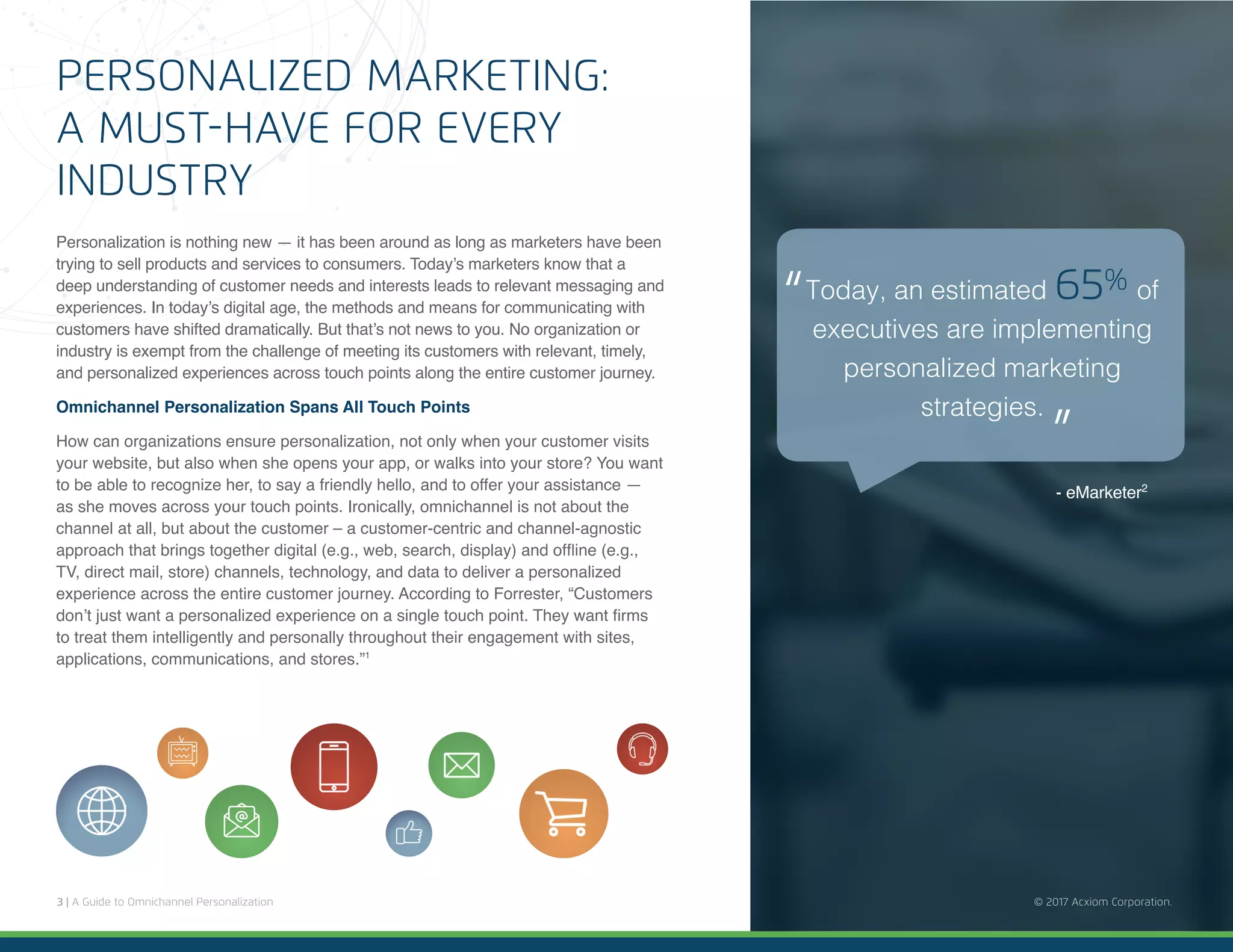
How can organizations ensure personalization, not only when your customer visits
your website, but also when she opens your app, or walks into your store? You want
to be able to recognize her, to say a friendly hello, and to offer your assistance —
as she moves across your touch points. Ironically, omnichannel is not about the
channel at all, but about the customer – a customer-centric and channel-agnostic
approach that brings together digital (e.g., web, search, display) and offline (e.g.,
TV, direct mail, store) channels, technology, and data to deliver a personalized
experience across the entire customer journey. According to Forrester, “Customers
don’t just want a personalized experience on a single touch point. They want firms
to treat them intelligently and personally throughout their engagement with sites,
applications, communications, and stores.”1
© 2017 Acxiom Corporation.
- eMarketer2
Today, an estimated 65% of
executives are implementing
personalized marketing
strategies.
“
“
4 | A Guide to Omnichannel Personalization © 2017 Acxiom Corporation.
KEY PERSONALIZATION TRENDS
In a research study commissioned by SAP Hybris, more than half of marketers use only “rule-based
segmentation” to personalize email messages.3
This approach requires creating audience segments
(based on demographics, behaviors, etc.) and a set of rules to indicate the specific content or message
that should be presented to each segment. Consequently, true 1:1 personalization, where every
individual receives a unique message or experience, remains a stretch goal for many organizations.
Market Leaders Are Unlocking Data for Omnichannel Personalization
Customer data can be a powerful asset for delivering a great customer experience. For example,
Marriott Hotels has spent the last three years creating an “entirely new customer experience live and
on-property” and across digital touch points.4
When a customer enters one of Marriott’s hotel lobbies
for first time, Marriott sends a welcome message (in-app) asking him or her if there’s anything the
hotel can do to help. While on property, customers can make mobile requests for any type of service
and experience real-time, two-way chats with Marriott personnel. During a session at the 2017 Adobe
Summit conference, Kollin Killian, Senior Consultant for Adobe, explained that Marriott’s omnichannel
personalization strategy “did not focus on a single channel” but instead established “a defined global
data layer across all of (its) properties to be able to orchestrate campaigns across channels.” 4
Artificial Intelligence and Machine Learning: The Next Frontier
According to Forrester, in contrast to current approaches, “AI-powered solutions, however, can
automatically discover and generate thousands of discrete segments to evaluate exponentially
more permutations of data, rules, and treatments.” 5
Today, industry-leading tech companies such
as Adobe and Salesforce are adding AI capabilities to their personalization platforms. For example,
Adobe Sensei’s “machine learning crunches the numbers, helps you see how your customers behave,
uses those insights to serve relevant and personalized experiences, and anticipates what they’ll want
next.” 6
These emerging technologies can help marketers reduce the time and effort required to deliver
1:1 personalization across touch points, potentially improving conversion rates and revenue.
© 2017 Acxiom Corporation.
- Adobe Sensei
Machine learning
crunches the numbers,
helps you see how your
customers behave, uses
those insights to serve
relevant and personalized
experiences, and
anticipates what they’ll
want next.
“
“
5 | A Guide to Omnichannel Personalization © 2017 Acxiom Corporation.
CHALLENGES TO PERSONALIZED EXPERIENCES
Organizational Misalignment
To achieve omnichannel personalization, there’s a major question you need to ask: Is my
organization fully aligned in terms of strategy, data, technology, and process to deliver
personalization that delights customers? Let’s say you work for a clothing retailer and collect
information about customer preferences (e.g., jeans, jackets) and have the marketing
technology to personalize content related only to those preferences. However, sales leadership
requests that you send promotional messages for all product categories to all customers
because they need more Q4 revenue. This type of strategic misalignment between the teams
within your organization and business goals should be addressed upfront before embarking on
your personalization efforts.
The Elephant in the Room: Customer Data Fragmentation and Silos
If you’re like most marketers, you’re sitting on what we call a marketing technology stack that
is composed of best-of-breed systems and marketing suites (e.g., Adobe Marketing Cloud).
These systems all create, store, and manage customer data for your marketing channels. And,
since we live in an omnichannel world, you likely have dozens to hundreds of data silos across
your enterprise. Today’s marketers are navigating through a spider web of siloed systems and
customer data that can be classified as known or unknown data (see sidebar).
Furthermore, to enhance your understanding of known or anonymous consumers, you can
purchase 3rd party data such as demographics (e.g., millennial), lifestyle (e.g., exercises
frequently), and propensity information (e.g. looking to purchase a new car). In summary, all of
your organization’s data about customers and prospects can live in multiple systems and silos.
Consequently, the biggest challenge that prevents you from delivering personalized customer
experiences across channels is the lack of a complete, 360-degree view of your customer. Is
any organization able to do this today? Let’s study how one market leader, Heathrow Airport,
has tackled the challenge of unifying customer data.
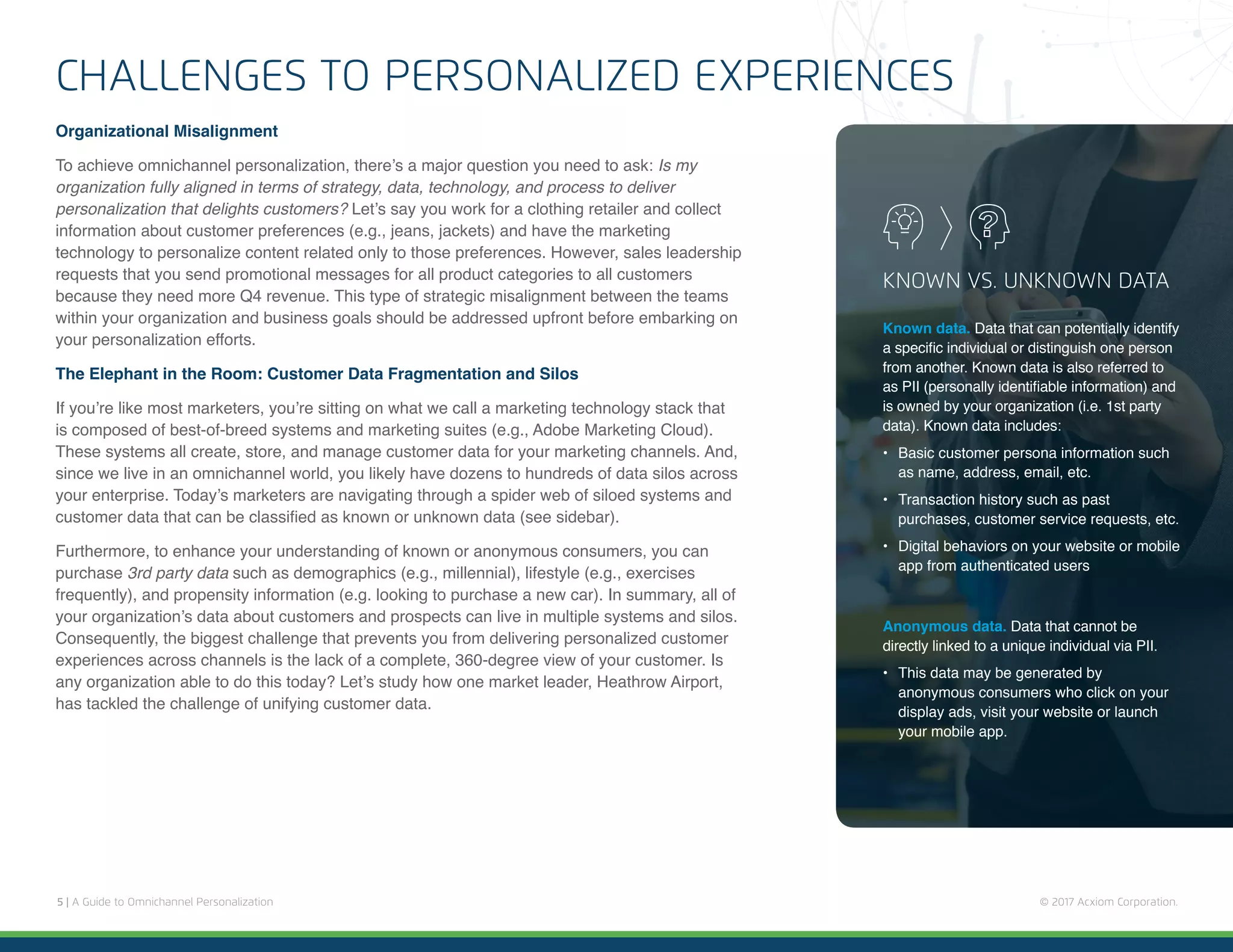
KNOWN VS. UNKNOWN DATA
Known data. Data that can potentially identify
a specific individual or distinguish one person
from another. Known data is also referred to
as PII (personally identifiable information) and
is owned by your organization (i.e. 1st party
data). Known data includes:
•	 Basic customer persona information such
as name, address, email, etc.
•	 Transaction history such as past
purchases, customer service requests, etc.
•	 Digital behaviors on your website or mobile
app from authenticated users
Anonymous data. Data that cannot be
directly linked to a unique individual via PII.
•	 This data may be generated by
anonymous consumers who click on your
display ads, visit your website or launch
your mobile app.
6 | A Guide to Omnichannel Personalization © 2017 Acxiom Corporation.
OMNICHANNEL PERSONALIZATION
IN ACTION: HEATHROW AIRPORT
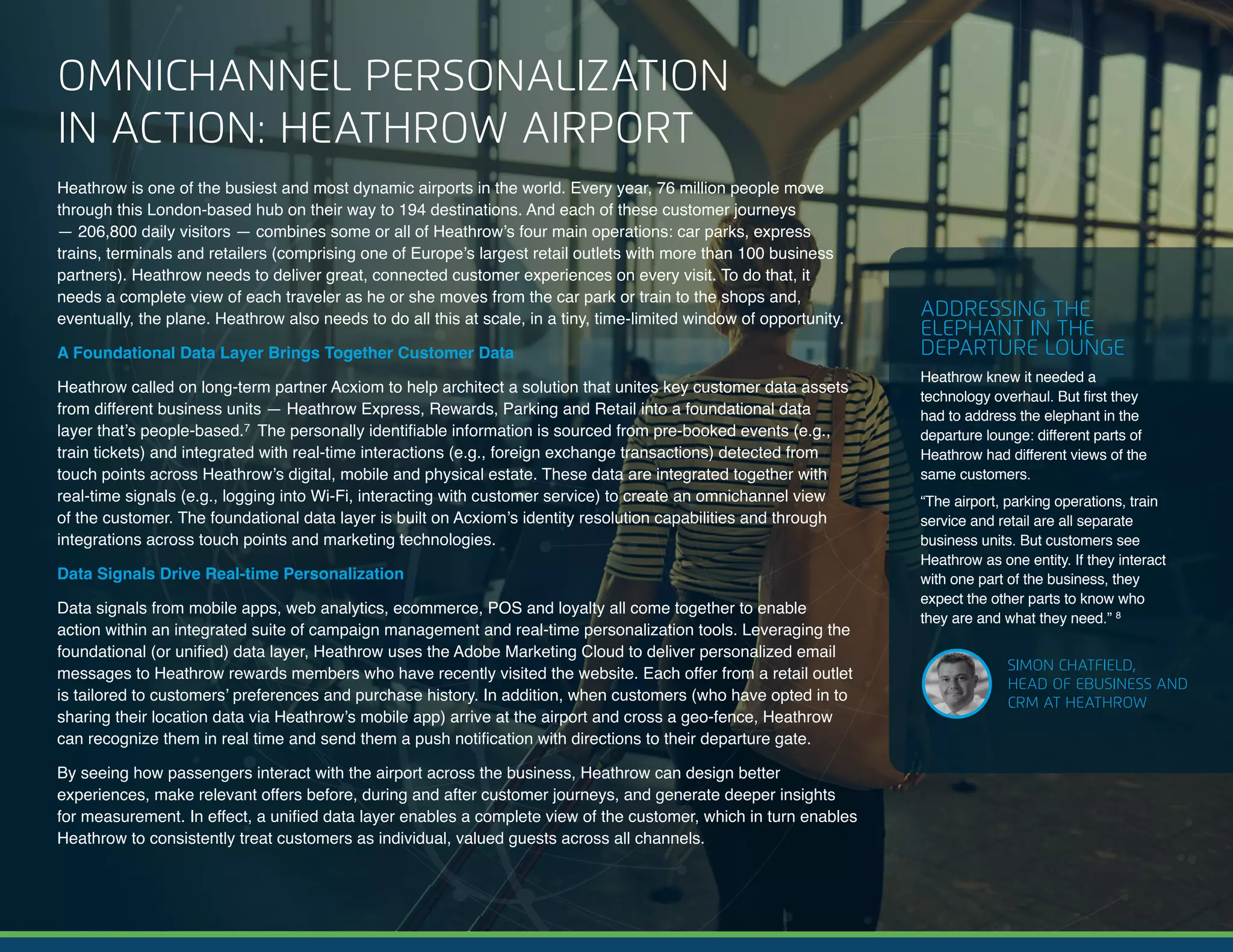
Heathrow is one of the busiest and most dynamic airports in the world. Every year, 76 million people 
move
through this London-based hub on their way to 194 destinations. And each of these customer 
journeys
— 206,800 daily visitors — combines some or all of Heathrow’s four main operations: car parks, express
trains, terminals and retailers (comprising one of Europe’s largest retail outlets with more than 100 business
partners). Heathrow needs to deliver great, connected customer experiences on every visit. To do that, it
needs a complete view of each traveler as he or she moves from the car park or train to the shops and,
eventually, the plane. Heathrow also needs to do all this at scale, in a tiny, time-limited window of opportunity.
A Foundational Data Layer Brings Together Customer Data
Heathrow called on long-term partner Acxiom to help architect a solution that unites key customer data assets
from different business units — Heathrow Express, Rewards, Parking and Retail into a foundational data
layer that’s people-based.7 The personally identifiable information is sourced from pre-booked events (e.g.,
train tickets) and integrated with real-time interactions (e.g., foreign exchange transactions) detected from
touch points across Heathrow’s digital, mobile and physical estate. These data are integrated together with
real-time signals (e.g., logging into Wi-Fi, interacting with customer service) to create an omnichannel view
of the customer. The foundational data layer is built on Acxiom’s identity resolution capabilities and through
integrations across touch points and marketing technologies.
Data Signals Drive Real-time Personalization
Data signals from mobile apps, web analytics, ecommerce, POS and loyalty all come together to enable
action within an integrated suite of campaign management and real-time personalization tools. Leveraging the
foundational (or unified) data layer, Heathrow uses the Adobe Marketing Cloud to deliver personalized email
messages to Heathrow rewards members who have recently visited the website. Each offer from a retail outlet
is tailored to customers’ preferences and purchase history. In addition, when customers (who have opted in to
sharing their location data via Heathrow’s mobile app) arrive at the airport and cross a geo-fence, Heathrow
can recognize them in real time and send them a push notification with directions to their departure gate.
By seeing how passengers interact with the airport across the business, Heathrow can design better
experiences, make relevant offers before, during and after customer journeys, and generate deeper insights
for measurement. In effect, a unified data layer enables a complete view of the customer, which in turn enables
Heathrow to consistently treat customers as individual, valued guests across all channels.
ADDRESSING THE
ELEPHANT IN THE
DEPARTURE LOUNGE
Heathrow knew it needed a
technology overhaul. But first they
had to address the elephant in the
departure lounge: different parts of
Heathrow had different views of the
same customers.
“The airport, parking operations, train
service and retail are all separate
business units. But customers see
Heathrow as one entity. If they interact
with one part of the business, they
expect the other parts to know who
they are and what they need.” 8
SIMON CHATFIELD,
HEAD OF EBUSINESS AND
CRM AT HEATHROW
7 | A Guide to Omnichannel Personalization © 2017 Acxiom Corporation.
Crawl
“Mindful”
Walk
“Responsive”
Run
“Relevant”
Fly
“Delightful”
Strategy
A few channels with
separate approaches to
personalization
Enterprise-wide
personalization program
Customer-centric
business model
Personalization extends
beyond brand-owned touches
Data
•	 Data silos and
disconnected customer
data
•	 Audience segments
built from 1st party data
•	 Efforts to inventory all data
•	 Audience segments integrate
1st and 3rd party data
•	 Aiming for 360-degree view
•	 Integrated, cohesive
information and insights drive
touchpoints
•	 Blend of explicit and inferred
preferences
•	 Omnichannel fully operational
•	 Complete, unified data layer enables
1:1 personalization
•	 2nd party data use optimized
Tech
•	 Very tool-dependent
•	 Email and display
personalization
•	 Digital asset management
•	 Website personalization
•	 Automated with full(er) stack
•	 Integrated data and proven
tactics
•	 Preference center
•	 Predictive with minimal marketer
involvement (AI and machine
learning)
Process
•	 Pockets of capabilities
•	 Some areas of lifecycle
marketing
•	 Exponential demand for
assets
•	 More emphasis on testing
•	 Customer care disjointed
from marketing calendar and
campaign-led tactics
•	 Multi-channel personalization
•	 Most marketing efforts are
automated
•	 Behavior-based triggers
and optimized inbound
responsiveness
•	 Personalization extends to partner
interactions and beyond owned touch
points
•	 Brand loyalty and advocacy drive
revenue growth and cost savings
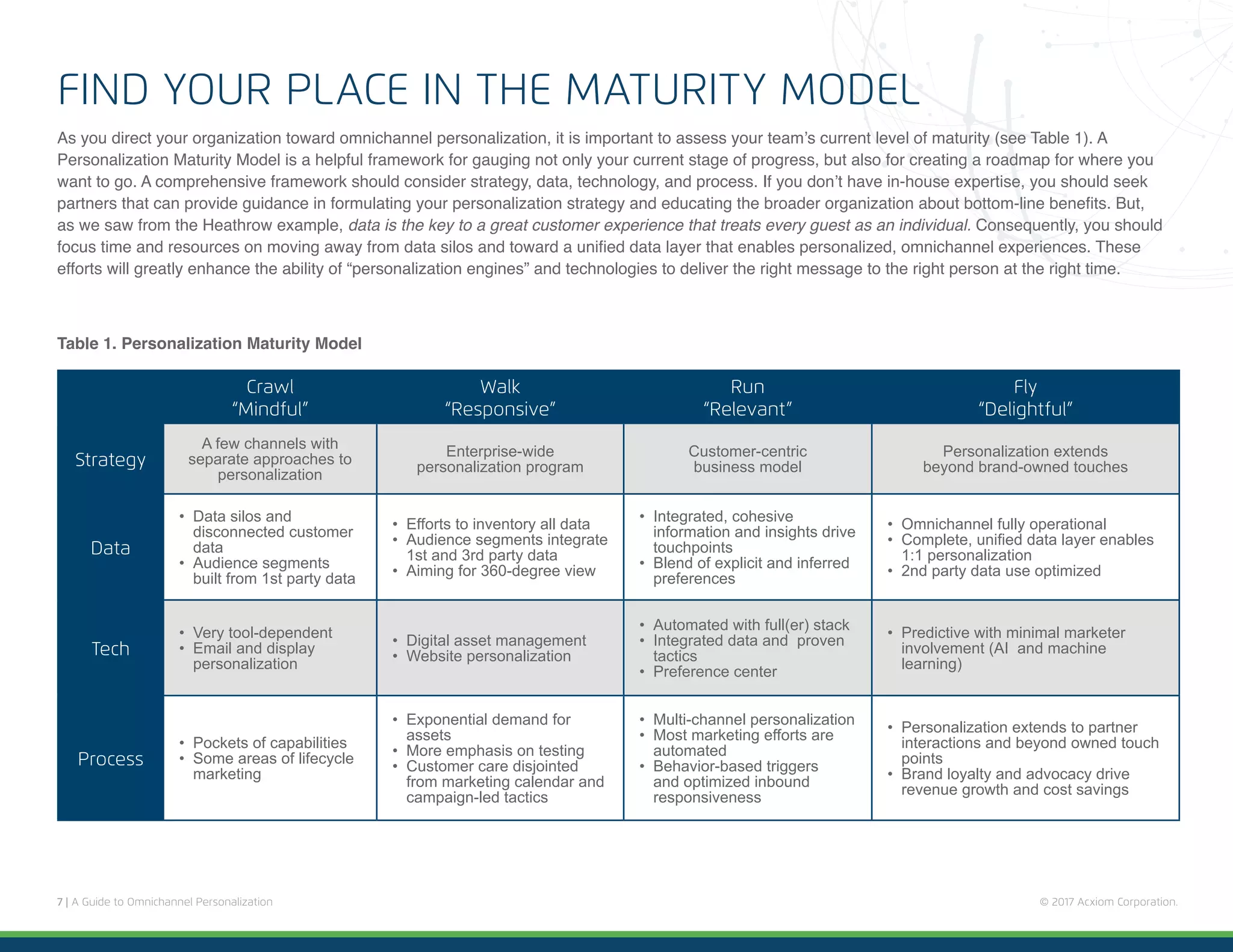
FIND YOUR PLACE IN THE MATURITY MODEL
As you direct your organization toward omnichannel personalization, it is important to assess your team’s current level of maturity (see Table 1). A
Personalization Maturity Model is a helpful framework for gauging not only your current stage of progress, but also for creating a roadmap for where you
want to go. A comprehensive framework should consider strategy, data, technology, and process. If you don’t have in-house expertise, you should seek
partners that can provide guidance in formulating your personalization strategy and educating the broader organization about bottom-line benefits. But,
as we saw from the Heathrow example, data is the key to a great customer experience that treats every guest as an individual. Consequently, you should
focus time and resources on moving away from data silos and toward a unified data layer that enables personalized, omnichannel experiences. These
efforts will greatly enhance the ability of “personalization engines” and technologies to deliver the right message to the right person at the right time.
Table 1. Personalization Maturity Model
8 | A Guide to Omnichannel Personalization © 2017 Acxiom Corporation.
GET YOUR CUSTOMER
DATA IN ORDER
Personalization requires that every organization treat
customer data as a critical asset. But, as we’ve noted,
data sits in different places. For example, your customer
persona may live in a CRM system while your customer
transaction history resides in a commerce system. As
shown in Table 1, to begin “walking,” you should first
understand what data you have. Gather and inventory
your data across touch points so you have the correct
information for delivering the right experience and
messages to consumers. Work with your martech and
adtech vendors and IT teams to consolidate 1st party
data about your known and anonymous customers.
In addition, your organization may have purchased 3rd
party data to enhance your understanding of known and
anonymous consumers with demographic, lifestyle, and
propensity information. To enable relevant targeting, you
should bring together 1st and 3rd party data to form a
more complete view of the consumer and build audience
personas that match your most desirable customers.
For example, cookie data about website visitors can be
enhanced with demographic data such as age, gender,
or occupation.
8 | A Guide to Omnichannel Personalization © 2017 Acxiom Corporation.
9 | A Guide to Omnichannel Personalization © 2017 Acxiom Corporation.
ESTABLISH A UNIFIED DATA LAYER FOR
OMNICHANNEL PERSONALIZATION
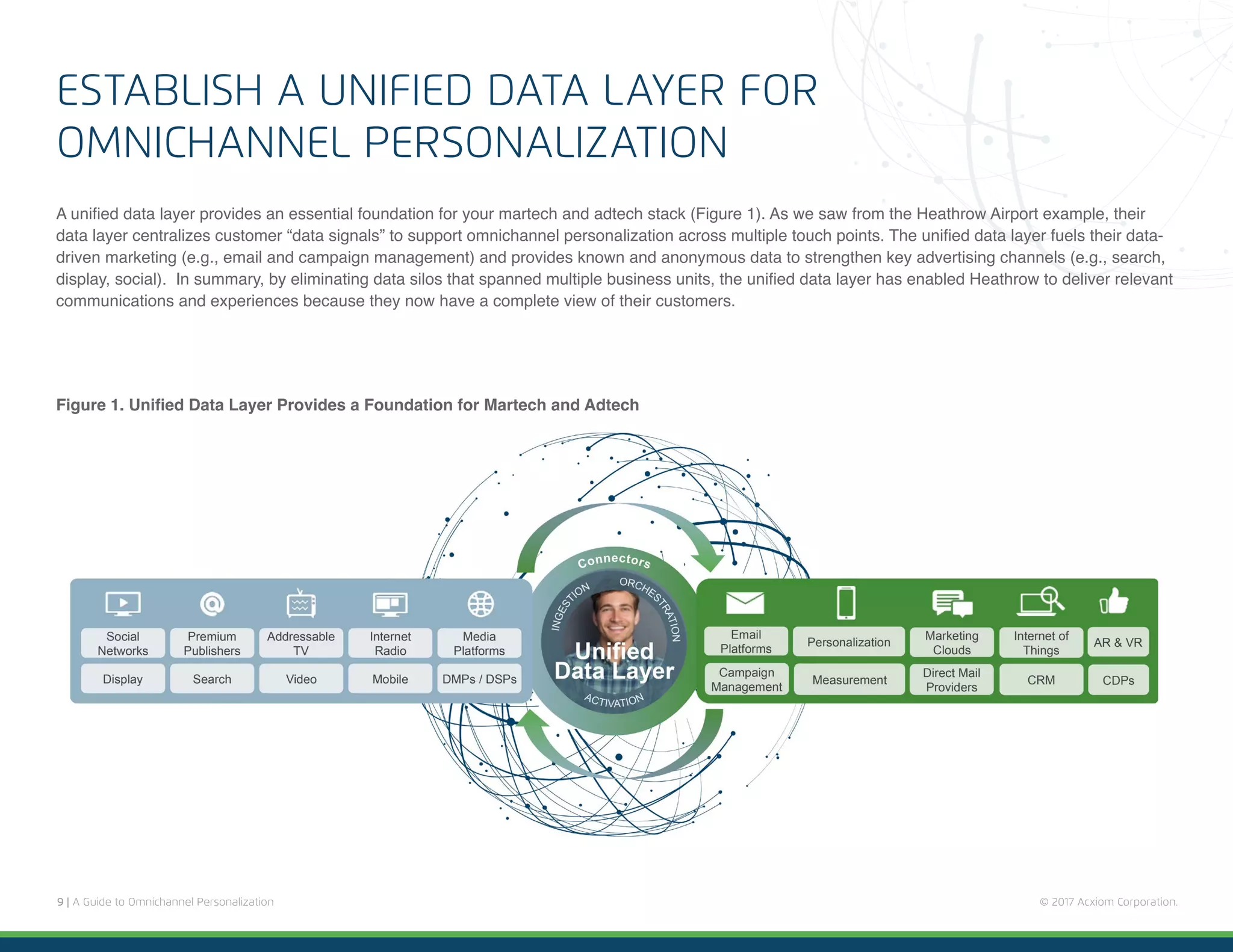
A unified data layer provides an essential foundation for your martech and adtech stack (Figure 1). As we saw from the Heathrow Airport example, their
data layer centralizes customer “data signals” to support omnichannel personalization across multiple touch points. The unified data layer fuels their data-
driven marketing (e.g., email and campaign management) and provides known and anonymous data to strengthen key advertising channels (e.g., search,
display, social). In summary, by eliminating data silos that spanned multiple business units, the unified data layer has enabled Heathrow to deliver relevant
communications and experiences because they now have a complete view of their customers.
Figure 1. Unified Data Layer Provides a Foundation for Martech and Adtech
10 | A Guide to Omnichannel Personalization © 2017 Acxiom Corporation.
USE IDENTITY RESOLUTION TO ENSURE
RELEVANT MARKETING
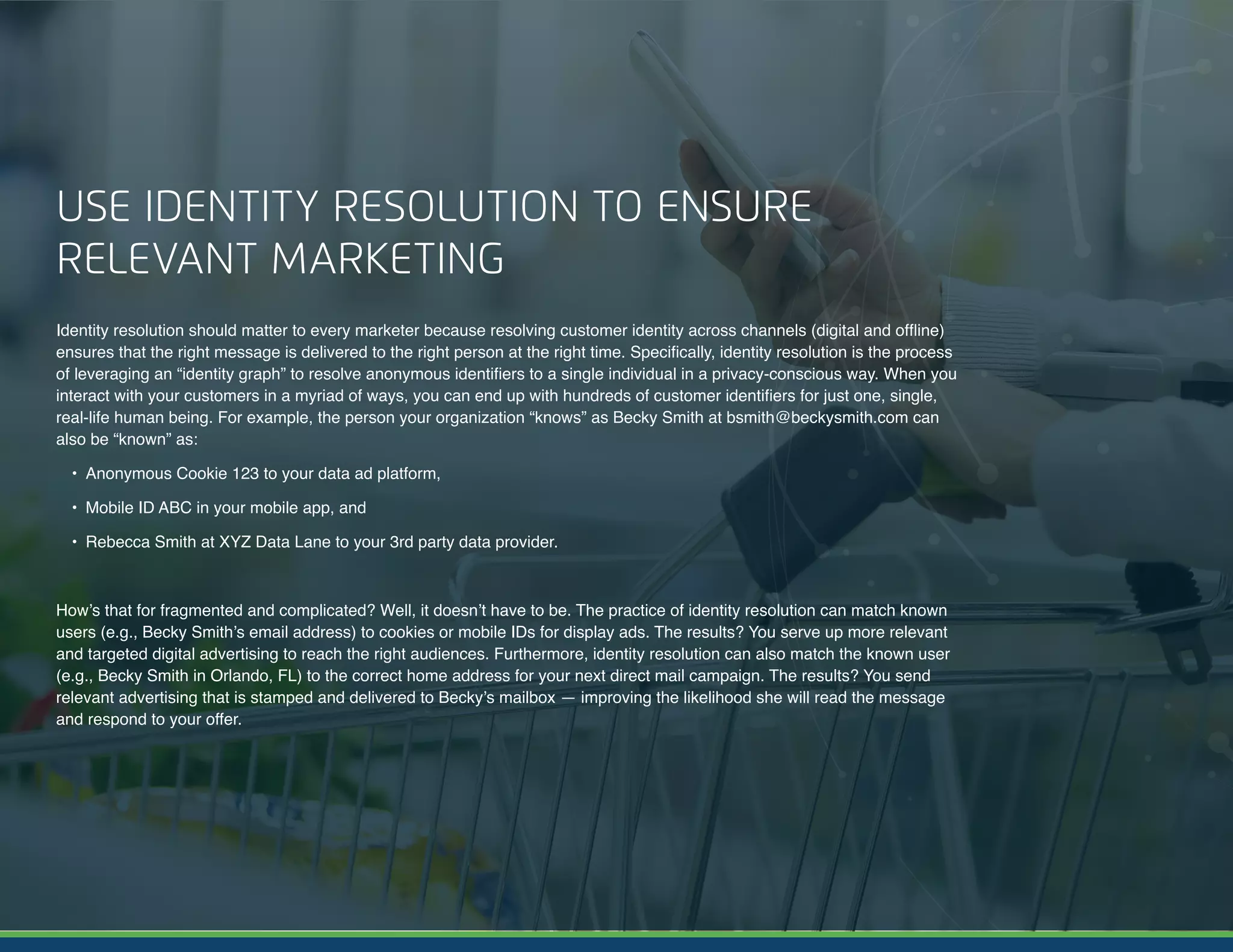
Identity resolution should matter to every marketer because resolving customer identity across channels (digital and offline)
ensures that the right message is delivered to the right person at the right time. Specifically, identity resolution is the process
of leveraging an “identity graph” to resolve anonymous identifiers to a single individual in a privacy-conscious way. When you
interact with your customers in a myriad of ways, you can end up with hundreds of customer identifiers for just one, single,
real-life human being. For example, the person your organization “knows” as Becky Smith at bsmith@beckysmith.com can
also be “known” as:
•	 Anonymous Cookie 123 to your data ad platform,
•	 Mobile ID ABC in your mobile app, and
•	 Rebecca Smith at XYZ Data Lane to your 3rd party data provider.
How’s that for fragmented and complicated? Well, it doesn’t have to be. The practice of identity resolution can match known
users (e.g., Becky Smith’s email address) to cookies or mobile IDs for display ads. The results? You serve up more relevant
and targeted digital advertising to reach the right audiences. Furthermore, identity resolution can also match the known user
(e.g., Becky Smith in Orlando, FL) to the correct home address for your next direct mail campaign. The results? You send
relevant advertising that is stamped and delivered to Becky’s mailbox — improving the likelihood she will read the message
and respond to your offer.
11 | A Guide to Omnichannel Personalization © 2017 Acxiom Corporation.
Marketers and advertisers may not be aware of the customer pitfalls and the level of organizational risk when personalized experiences are
not executed properly. Consequently, defining ethical data use and reinforcing the importance of guidelines (especially as data sets — digital
and online — are combined more and more) is particularly urgent today. It is imperative to think ahead about how to ensure responsible
use of your organization’s customer data as you direct your company toward deeper omnichannel personalization. The best organizations
are constantly exploring the relationship between data, technology, and ethics and staying informed on the latest industry standards. More
than ever, customers can punish organizations that don’t clearly demonstrate they know how to treat personal data in a way that meets their
expectations. Consequently, organizations today must do everything in their power to: a) demonstrate that the customer has given consent,
b) ensure organizational transparency, and c) provide customer controls.9
•	 Consent. Your organization acts in response to the legitimate (real and communicated) interest of a customer. In the past, customers
who provided such details to organizations (opting in, expressing legitimate interest) had no choice but to implicitly trust that their
personal information would be treated with care as part of the organization’s promise to them. Today, such trust is not so easily given,
and when trust is broken, customers are opting out of communications. Today’s customers can opt out entirely with a variety of ad-
blocking technologies across channels.
•	 Transparency. In its most basic form, your organization’s terms and conditions must be clear — explaining what customer data you will
collect and how you will use it for marketing purposes.
•	 Controls. You should provide consumers with easy access to your organization’s “preference center” — where your customer can easily
access and control how he or she wants to interact with your organization. Here, you shift the control of information away from your
organization and into the hands of satisfied customers — putting them in the “driver’s seat,” empowering them to opt in or out; allowing
them to change the “rules” of the game (or how they relate to your organization) at any time. This is customer-centricity at its heart.
USE CUSTOMER DATA ETHICALLY
12 | A Guide to Omnichannel Personalization © 2017 Acxiom Corporation.
RECOMMENDATIONS
Personalization should span all channels — because your customer is omnichannel and uses multiple touch points in his or her journey with your
organization. However, omnichannel personalization is one of the most challenging use cases to address because of channel and data fragmentation.
The following recommendations can help you get started:
DEVELOP A PERSONALIZATION STRATEGY THAT SPANS THE CUSTOMER JOURNEY
It’s not just about touch points today, it’s about the customer journey. This means digital and offline; prospects and loyal customers;
and known and anonymous users. Today’s most innovative organizations are developing and implementing personalization
strategies that span the entire customer journey.
PERFORM A DATA GOVERNANCE ASSESSMENT
Seek expertise from experienced partners or internal teams to identify what customer data you have today, where it is located and
who is (or isn’t) responsible for it. This assessment will help you understand the availability of data assets for personalization use
cases and identify gaps that should be filled to achieve personalization maturity.
BRING YOUR CUSTOMER DATA TOGETHER WITH A UNIFIED DATA LAYER
A unified data layer provides a foundation for your omnichannel marketing and advertising ecosystem. It brings together data from
digital and offline channels, known and anonymous consumers, along with prospects and customers into a single, privacy-conscious
data foundation. By using identity resolution capabilities, the unified data layer provides a complete view of the customer to ensure
relevant marketing. Since ethical data use is a critical requirement, a unified data layer supports your personalization objectives
while respecting consumer privacy.
IMPLEMENT PROCESSES TO ENSURE ETHICAL DATA USE
Today’s leading organizations apply data ethics through careful planning and implementation of privacy-conscious processes.
Organizations should seek objective guidance from experienced partners with expertise in data governance and stewardship as you
seek to deepen your omnichannel personalization strategies.
13 | A Guide to Omnichannel Personalization © 2017 Acxiom Corporation.13 | The Age of the Omnichannel Integrator © 2017 Acxiom Corporation.
ABOUT ACXIOM
We provide the data foundation for the world’s best marketers. We enable
people-based marketing everywhere through a simple, open approach to
connecting systems and data that drives seamless customer experiences
and higher ROI. A leader in identity and the ethical data use for more than
45 years, Acxiom helps thousands of clients and partners around the globe
work together to create a world where all marketing is relevant.
© 2017 Acxiom Corporation. All rights reserved. Acxiom is a registered trademark of Acxiom Corporation.
VISIT: https://www.acxiom.com/how-we-can-help/personalize-communications
EMAIL: info@acxiom.com
14 | A Guide to Omnichannel Personalization © 2017 Acxiom Corporation.14 | The Age of the Omnichannel Integrator © 2017 Acxiom Corporation.
© 2017 Acxiom Corporation. All rights reserved. Acxiom is a registered trademark of Acxiom Corporation.
References
1
“Unlock Personalization’s Potential With Help From Service Providers,” Forrester Research, June 2017
https://www.forrester.com/report/Unlock+Personalizations+Potential+With+Help+From+Service+Providers/-/E-RES138046
2
“Executives Are Stepping Up on Personalized Marketing,” eMarketer, May 2017
https://www.emarketer.com/Article/Executives-Stepping-Up-on-Personalized-Marketing/1015913
3
“Study finds marketers are prioritizing personalization… but are further behind than they realize,” Venturebeat 2015
https://venturebeat.com/2015/12/14/study-finds-marketers-are-prioritizing-personalization-but-are-further-behind-than-they-realize/
4
“Marriott’s mobile app: Driving revenue and loyalty through personalization,” Adobe Summit, 2017
https://summit.adobe.com/na/sessions/summit-online/online-2017/#17594
5
“AI Must Learn The Basics Before It Can Transform Marketing,” Forrester Research, June 2017
https://www.forrester.com/report/AI+Must+Learn+The+Basics+Before+It+Can+Transform+Marketing/-/E-RES137223
6
“Adobe Sensei,” Adobe, 2017
http://www.adobe.com/sensei.html
7
“Inside Heathrow’s Incredible Customer Experience Operation,” Acxiom, 2017
https://www.acxiom.com/wp-content/uploads/2017/04/Inside-Heathrows-Incredible-Customer-Experience-Operation-ebook.pdf
8
“The Age of the Omnichannel Integrator,” Acxiom, 2017
https://marketing.acxiom.com/rs/982-LRE-196/images/Omnichannel%20Integrator%20eBook.pdf
9
“The New Codes of Conduct: Guiding Principles for the Ethical Use of Data,” Acxiom, 2017
https://marketing.acxiom.com/US-Parent-Guiding-Principles-for-the-Ethical-Use-of-Data-EB-Main.html?CID=7011A000001Hb1F
Acxiom Resources for Ethical Data Use
1.	“The New Codes of Conduct: Guiding Principles for the Ethical Use of Data”
https://marketing.acxiom.com/US-Parent-Guiding-Principles-for-the-Ethical-Use-of-Data-EB-Main.html?CID=7011A000001Hb1F
2.	“Can vs. should, and why it matters in data-driven marketing”
https://www.slideshare.net/acxiomcorp/can-vs-should-and-why-it-matters-in-datadriven-marketing
3.	Information Commissioner’s Office (ICO) Consent Guidance for General Data Protection Regulation (GDPR) with Alex Hazell, Head of Legal, Acxiom UK
https://dma.org.uk/webinar/webinar-the-ico-s-gdpr-consent-guidance

A Guide to Omnichannel Personalization

  • 1.
    © 2017 AcxiomCorporation. All rights reserved. Acxiom is a registered trademark of Acxiom Corporation. FIVE BEST PRACTICES FOR DATA-DRIVEN MARKETING ACROSS TOUCHPOINTS A Guide to Omnichannel Personalization
  • 2.
    2 | AGuide to Omnichannel Personalization © 2017 Acxiom Corporation. EXECUTIVE SUMMARY »» Personalization should span all channels — because your customer is omnichannel and uses multiple touch points in his or her journey with your organization. »» The fragmentation of channels and customer data makes digital and offline personalization extremely challenging. »» A unified data layer helps consolidate “data signals” from across channels to form a complete, 360-degree view of the customer that enables personalized experiences. »» It is imperative to apply ethical standards to how data should be used and joined as you direct your organization toward deeper omnichannel personalization. 2 | A Guide to Omnichannel Personalization © 2017 Acxiom Corporation.
  • 3.
    3 | AGuide to Omnichannel Personalization © 2017 Acxiom Corporation. PERSONALIZED MARKETING: A MUST-HAVE FOR EVERY INDUSTRY Personalization is nothing new — it has been around as long as marketers have been trying to sell products and services to consumers. Today’s marketers know that a deep understanding of customer needs and interests leads to relevant messaging and experiences. In today’s digital age, the methods and means for communicating with customers have shifted dramatically. But that’s not news to you. No organization or industry is exempt from the challenge of meeting its customers with relevant, timely, and personalized experiences across touch points along the entire customer journey. Omnichannel Personalization Spans All Touch Points How can organizations ensure personalization, not only when your customer visits your website, but also when she opens your app, or walks into your store? You want to be able to recognize her, to say a friendly hello, and to offer your assistance — as she moves across your touch points. Ironically, omnichannel is not about the channel at all, but about the customer – a customer-centric and channel-agnostic approach that brings together digital (e.g., web, search, display) and offline (e.g., TV, direct mail, store) channels, technology, and data to deliver a personalized experience across the entire customer journey. According to Forrester, “Customers don’t just want a personalized experience on a single touch point. They want firms to treat them intelligently and personally throughout their engagement with sites, applications, communications, and stores.”1 © 2017 Acxiom Corporation. - eMarketer2 Today, an estimated 65% of executives are implementing personalized marketing strategies. “ “
  • 4.
    4 | AGuide to Omnichannel Personalization © 2017 Acxiom Corporation. KEY PERSONALIZATION TRENDS In a research study commissioned by SAP Hybris, more than half of marketers use only “rule-based segmentation” to personalize email messages.3 This approach requires creating audience segments (based on demographics, behaviors, etc.) and a set of rules to indicate the specific content or message that should be presented to each segment. Consequently, true 1:1 personalization, where every individual receives a unique message or experience, remains a stretch goal for many organizations. Market Leaders Are Unlocking Data for Omnichannel Personalization Customer data can be a powerful asset for delivering a great customer experience. For example, Marriott Hotels has spent the last three years creating an “entirely new customer experience live and on-property” and across digital touch points.4 When a customer enters one of Marriott’s hotel lobbies for first time, Marriott sends a welcome message (in-app) asking him or her if there’s anything the hotel can do to help. While on property, customers can make mobile requests for any type of service and experience real-time, two-way chats with Marriott personnel. During a session at the 2017 Adobe Summit conference, Kollin Killian, Senior Consultant for Adobe, explained that Marriott’s omnichannel personalization strategy “did not focus on a single channel” but instead established “a defined global data layer across all of (its) properties to be able to orchestrate campaigns across channels.” 4 Artificial Intelligence and Machine Learning: The Next Frontier According to Forrester, in contrast to current approaches, “AI-powered solutions, however, can automatically discover and generate thousands of discrete segments to evaluate exponentially more permutations of data, rules, and treatments.” 5 Today, industry-leading tech companies such as Adobe and Salesforce are adding AI capabilities to their personalization platforms. For example, Adobe Sensei’s “machine learning crunches the numbers, helps you see how your customers behave, uses those insights to serve relevant and personalized experiences, and anticipates what they’ll want next.” 6 These emerging technologies can help marketers reduce the time and effort required to deliver 1:1 personalization across touch points, potentially improving conversion rates and revenue. © 2017 Acxiom Corporation. - Adobe Sensei Machine learning crunches the numbers, helps you see how your customers behave, uses those insights to serve relevant and personalized experiences, and anticipates what they’ll want next. “ “
  • 5.
    5 | AGuide to Omnichannel Personalization © 2017 Acxiom Corporation. CHALLENGES TO PERSONALIZED EXPERIENCES Organizational Misalignment To achieve omnichannel personalization, there’s a major question you need to ask: Is my organization fully aligned in terms of strategy, data, technology, and process to deliver personalization that delights customers? Let’s say you work for a clothing retailer and collect information about customer preferences (e.g., jeans, jackets) and have the marketing technology to personalize content related only to those preferences. However, sales leadership requests that you send promotional messages for all product categories to all customers because they need more Q4 revenue. This type of strategic misalignment between the teams within your organization and business goals should be addressed upfront before embarking on your personalization efforts. The Elephant in the Room: Customer Data Fragmentation and Silos If you’re like most marketers, you’re sitting on what we call a marketing technology stack that is composed of best-of-breed systems and marketing suites (e.g., Adobe Marketing Cloud). These systems all create, store, and manage customer data for your marketing channels. And, since we live in an omnichannel world, you likely have dozens to hundreds of data silos across your enterprise. Today’s marketers are navigating through a spider web of siloed systems and customer data that can be classified as known or unknown data (see sidebar). Furthermore, to enhance your understanding of known or anonymous consumers, you can purchase 3rd party data such as demographics (e.g., millennial), lifestyle (e.g., exercises frequently), and propensity information (e.g. looking to purchase a new car). In summary, all of your organization’s data about customers and prospects can live in multiple systems and silos. Consequently, the biggest challenge that prevents you from delivering personalized customer experiences across channels is the lack of a complete, 360-degree view of your customer. Is any organization able to do this today? Let’s study how one market leader, Heathrow Airport, has tackled the challenge of unifying customer data. KNOWN VS. UNKNOWN DATA Known data. Data that can potentially identify a specific individual or distinguish one person from another. Known data is also referred to as PII (personally identifiable information) and is owned by your organization (i.e. 1st party data). Known data includes: • Basic customer persona information such as name, address, email, etc. • Transaction history such as past purchases, customer service requests, etc. • Digital behaviors on your website or mobile app from authenticated users Anonymous data. Data that cannot be directly linked to a unique individual via PII. • This data may be generated by anonymous consumers who click on your display ads, visit your website or launch your mobile app.
  • 6.
    6 | AGuide to Omnichannel Personalization © 2017 Acxiom Corporation. OMNICHANNEL PERSONALIZATION IN ACTION: HEATHROW AIRPORT Heathrow is one of the busiest and most dynamic airports in the world. Every year, 76 million people 
move through this London-based hub on their way to 194 destinations. And each of these customer 
journeys — 206,800 daily visitors — combines some or all of Heathrow’s four main operations: car parks, express trains, terminals and retailers (comprising one of Europe’s largest retail outlets with more than 100 business partners). Heathrow needs to deliver great, connected customer experiences on every visit. To do that, it needs a complete view of each traveler as he or she moves from the car park or train to the shops and, eventually, the plane. Heathrow also needs to do all this at scale, in a tiny, time-limited window of opportunity. A Foundational Data Layer Brings Together Customer Data Heathrow called on long-term partner Acxiom to help architect a solution that unites key customer data assets from different business units — Heathrow Express, Rewards, Parking and Retail into a foundational data layer that’s people-based.7 The personally identifiable information is sourced from pre-booked events (e.g., train tickets) and integrated with real-time interactions (e.g., foreign exchange transactions) detected from touch points across Heathrow’s digital, mobile and physical estate. These data are integrated together with real-time signals (e.g., logging into Wi-Fi, interacting with customer service) to create an omnichannel view of the customer. The foundational data layer is built on Acxiom’s identity resolution capabilities and through integrations across touch points and marketing technologies. Data Signals Drive Real-time Personalization Data signals from mobile apps, web analytics, ecommerce, POS and loyalty all come together to enable action within an integrated suite of campaign management and real-time personalization tools. Leveraging the foundational (or unified) data layer, Heathrow uses the Adobe Marketing Cloud to deliver personalized email messages to Heathrow rewards members who have recently visited the website. Each offer from a retail outlet is tailored to customers’ preferences and purchase history. In addition, when customers (who have opted in to sharing their location data via Heathrow’s mobile app) arrive at the airport and cross a geo-fence, Heathrow can recognize them in real time and send them a push notification with directions to their departure gate. By seeing how passengers interact with the airport across the business, Heathrow can design better experiences, make relevant offers before, during and after customer journeys, and generate deeper insights for measurement. In effect, a unified data layer enables a complete view of the customer, which in turn enables Heathrow to consistently treat customers as individual, valued guests across all channels. ADDRESSING THE ELEPHANT IN THE DEPARTURE LOUNGE Heathrow knew it needed a technology overhaul. But first they had to address the elephant in the departure lounge: different parts of Heathrow had different views of the same customers. “The airport, parking operations, train service and retail are all separate business units. But customers see Heathrow as one entity. If they interact with one part of the business, they expect the other parts to know who they are and what they need.” 8 SIMON CHATFIELD, HEAD OF EBUSINESS AND CRM AT HEATHROW
  • 7.
    7 | AGuide to Omnichannel Personalization © 2017 Acxiom Corporation. Crawl “Mindful” Walk “Responsive” Run “Relevant” Fly “Delightful” Strategy A few channels with separate approaches to personalization Enterprise-wide personalization program Customer-centric business model Personalization extends beyond brand-owned touches Data • Data silos and disconnected customer data • Audience segments built from 1st party data • Efforts to inventory all data • Audience segments integrate 1st and 3rd party data • Aiming for 360-degree view • Integrated, cohesive information and insights drive touchpoints • Blend of explicit and inferred preferences • Omnichannel fully operational • Complete, unified data layer enables 1:1 personalization • 2nd party data use optimized Tech • Very tool-dependent • Email and display personalization • Digital asset management • Website personalization • Automated with full(er) stack • Integrated data and proven tactics • Preference center • Predictive with minimal marketer involvement (AI and machine learning) Process • Pockets of capabilities • Some areas of lifecycle marketing • Exponential demand for assets • More emphasis on testing • Customer care disjointed from marketing calendar and campaign-led tactics • Multi-channel personalization • Most marketing efforts are automated • Behavior-based triggers and optimized inbound responsiveness • Personalization extends to partner interactions and beyond owned touch points • Brand loyalty and advocacy drive revenue growth and cost savings FIND YOUR PLACE IN THE MATURITY MODEL As you direct your organization toward omnichannel personalization, it is important to assess your team’s current level of maturity (see Table 1). A Personalization Maturity Model is a helpful framework for gauging not only your current stage of progress, but also for creating a roadmap for where you want to go. A comprehensive framework should consider strategy, data, technology, and process. If you don’t have in-house expertise, you should seek partners that can provide guidance in formulating your personalization strategy and educating the broader organization about bottom-line benefits. But, as we saw from the Heathrow example, data is the key to a great customer experience that treats every guest as an individual. Consequently, you should focus time and resources on moving away from data silos and toward a unified data layer that enables personalized, omnichannel experiences. These efforts will greatly enhance the ability of “personalization engines” and technologies to deliver the right message to the right person at the right time. Table 1. Personalization Maturity Model
  • 8.
    8 | AGuide to Omnichannel Personalization © 2017 Acxiom Corporation. GET YOUR CUSTOMER DATA IN ORDER Personalization requires that every organization treat customer data as a critical asset. But, as we’ve noted, data sits in different places. For example, your customer persona may live in a CRM system while your customer transaction history resides in a commerce system. As shown in Table 1, to begin “walking,” you should first understand what data you have. Gather and inventory your data across touch points so you have the correct information for delivering the right experience and messages to consumers. Work with your martech and adtech vendors and IT teams to consolidate 1st party data about your known and anonymous customers. In addition, your organization may have purchased 3rd party data to enhance your understanding of known and anonymous consumers with demographic, lifestyle, and propensity information. To enable relevant targeting, you should bring together 1st and 3rd party data to form a more complete view of the consumer and build audience personas that match your most desirable customers. For example, cookie data about website visitors can be enhanced with demographic data such as age, gender, or occupation. 8 | A Guide to Omnichannel Personalization © 2017 Acxiom Corporation.
  • 9.
    9 | AGuide to Omnichannel Personalization © 2017 Acxiom Corporation. ESTABLISH A UNIFIED DATA LAYER FOR OMNICHANNEL PERSONALIZATION A unified data layer provides an essential foundation for your martech and adtech stack (Figure 1). As we saw from the Heathrow Airport example, their data layer centralizes customer “data signals” to support omnichannel personalization across multiple touch points. The unified data layer fuels their data- driven marketing (e.g., email and campaign management) and provides known and anonymous data to strengthen key advertising channels (e.g., search, display, social). In summary, by eliminating data silos that spanned multiple business units, the unified data layer has enabled Heathrow to deliver relevant communications and experiences because they now have a complete view of their customers. Figure 1. Unified Data Layer Provides a Foundation for Martech and Adtech
  • 10.
    10 | AGuide to Omnichannel Personalization © 2017 Acxiom Corporation. USE IDENTITY RESOLUTION TO ENSURE RELEVANT MARKETING Identity resolution should matter to every marketer because resolving customer identity across channels (digital and offline) ensures that the right message is delivered to the right person at the right time. Specifically, identity resolution is the process of leveraging an “identity graph” to resolve anonymous identifiers to a single individual in a privacy-conscious way. When you interact with your customers in a myriad of ways, you can end up with hundreds of customer identifiers for just one, single, real-life human being. For example, the person your organization “knows” as Becky Smith at bsmith@beckysmith.com can also be “known” as: • Anonymous Cookie 123 to your data ad platform, • Mobile ID ABC in your mobile app, and • Rebecca Smith at XYZ Data Lane to your 3rd party data provider. How’s that for fragmented and complicated? Well, it doesn’t have to be. The practice of identity resolution can match known users (e.g., Becky Smith’s email address) to cookies or mobile IDs for display ads. The results? You serve up more relevant and targeted digital advertising to reach the right audiences. Furthermore, identity resolution can also match the known user (e.g., Becky Smith in Orlando, FL) to the correct home address for your next direct mail campaign. The results? You send relevant advertising that is stamped and delivered to Becky’s mailbox — improving the likelihood she will read the message and respond to your offer.
  • 11.
    11 | AGuide to Omnichannel Personalization © 2017 Acxiom Corporation. Marketers and advertisers may not be aware of the customer pitfalls and the level of organizational risk when personalized experiences are not executed properly. Consequently, defining ethical data use and reinforcing the importance of guidelines (especially as data sets — digital and online — are combined more and more) is particularly urgent today. It is imperative to think ahead about how to ensure responsible use of your organization’s customer data as you direct your company toward deeper omnichannel personalization. The best organizations are constantly exploring the relationship between data, technology, and ethics and staying informed on the latest industry standards. More than ever, customers can punish organizations that don’t clearly demonstrate they know how to treat personal data in a way that meets their expectations. Consequently, organizations today must do everything in their power to: a) demonstrate that the customer has given consent, b) ensure organizational transparency, and c) provide customer controls.9 • Consent. Your organization acts in response to the legitimate (real and communicated) interest of a customer. In the past, customers who provided such details to organizations (opting in, expressing legitimate interest) had no choice but to implicitly trust that their personal information would be treated with care as part of the organization’s promise to them. Today, such trust is not so easily given, and when trust is broken, customers are opting out of communications. Today’s customers can opt out entirely with a variety of ad- blocking technologies across channels. • Transparency. In its most basic form, your organization’s terms and conditions must be clear — explaining what customer data you will collect and how you will use it for marketing purposes. • Controls. You should provide consumers with easy access to your organization’s “preference center” — where your customer can easily access and control how he or she wants to interact with your organization. Here, you shift the control of information away from your organization and into the hands of satisfied customers — putting them in the “driver’s seat,” empowering them to opt in or out; allowing them to change the “rules” of the game (or how they relate to your organization) at any time. This is customer-centricity at its heart. USE CUSTOMER DATA ETHICALLY
  • 12.
    12 | AGuide to Omnichannel Personalization © 2017 Acxiom Corporation. RECOMMENDATIONS Personalization should span all channels — because your customer is omnichannel and uses multiple touch points in his or her journey with your organization. However, omnichannel personalization is one of the most challenging use cases to address because of channel and data fragmentation. The following recommendations can help you get started: DEVELOP A PERSONALIZATION STRATEGY THAT SPANS THE CUSTOMER JOURNEY It’s not just about touch points today, it’s about the customer journey. This means digital and offline; prospects and loyal customers; and known and anonymous users. Today’s most innovative organizations are developing and implementing personalization strategies that span the entire customer journey. PERFORM A DATA GOVERNANCE ASSESSMENT Seek expertise from experienced partners or internal teams to identify what customer data you have today, where it is located and who is (or isn’t) responsible for it. This assessment will help you understand the availability of data assets for personalization use cases and identify gaps that should be filled to achieve personalization maturity. BRING YOUR CUSTOMER DATA TOGETHER WITH A UNIFIED DATA LAYER A unified data layer provides a foundation for your omnichannel marketing and advertising ecosystem. It brings together data from digital and offline channels, known and anonymous consumers, along with prospects and customers into a single, privacy-conscious data foundation. By using identity resolution capabilities, the unified data layer provides a complete view of the customer to ensure relevant marketing. Since ethical data use is a critical requirement, a unified data layer supports your personalization objectives while respecting consumer privacy. IMPLEMENT PROCESSES TO ENSURE ETHICAL DATA USE Today’s leading organizations apply data ethics through careful planning and implementation of privacy-conscious processes. Organizations should seek objective guidance from experienced partners with expertise in data governance and stewardship as you seek to deepen your omnichannel personalization strategies.
  • 13.
    13 | AGuide to Omnichannel Personalization © 2017 Acxiom Corporation.13 | The Age of the Omnichannel Integrator © 2017 Acxiom Corporation. ABOUT ACXIOM We provide the data foundation for the world’s best marketers. We enable people-based marketing everywhere through a simple, open approach to connecting systems and data that drives seamless customer experiences and higher ROI. A leader in identity and the ethical data use for more than 45 years, Acxiom helps thousands of clients and partners around the globe work together to create a world where all marketing is relevant. © 2017 Acxiom Corporation. All rights reserved. Acxiom is a registered trademark of Acxiom Corporation. VISIT: https://www.acxiom.com/how-we-can-help/personalize-communications EMAIL: info@acxiom.com
  • 14.
    14 | AGuide to Omnichannel Personalization © 2017 Acxiom Corporation.14 | The Age of the Omnichannel Integrator © 2017 Acxiom Corporation. © 2017 Acxiom Corporation. All rights reserved. Acxiom is a registered trademark of Acxiom Corporation. References 1 “Unlock Personalization’s Potential With Help From Service Providers,” Forrester Research, June 2017 https://www.forrester.com/report/Unlock+Personalizations+Potential+With+Help+From+Service+Providers/-/E-RES138046 2 “Executives Are Stepping Up on Personalized Marketing,” eMarketer, May 2017 https://www.emarketer.com/Article/Executives-Stepping-Up-on-Personalized-Marketing/1015913 3 “Study finds marketers are prioritizing personalization… but are further behind than they realize,” Venturebeat 2015 https://venturebeat.com/2015/12/14/study-finds-marketers-are-prioritizing-personalization-but-are-further-behind-than-they-realize/ 4 “Marriott’s mobile app: Driving revenue and loyalty through personalization,” Adobe Summit, 2017 https://summit.adobe.com/na/sessions/summit-online/online-2017/#17594 5 “AI Must Learn The Basics Before It Can Transform Marketing,” Forrester Research, June 2017 https://www.forrester.com/report/AI+Must+Learn+The+Basics+Before+It+Can+Transform+Marketing/-/E-RES137223 6 “Adobe Sensei,” Adobe, 2017 http://www.adobe.com/sensei.html 7 “Inside Heathrow’s Incredible Customer Experience Operation,” Acxiom, 2017 https://www.acxiom.com/wp-content/uploads/2017/04/Inside-Heathrows-Incredible-Customer-Experience-Operation-ebook.pdf 8 “The Age of the Omnichannel Integrator,” Acxiom, 2017 https://marketing.acxiom.com/rs/982-LRE-196/images/Omnichannel%20Integrator%20eBook.pdf 9 “The New Codes of Conduct: Guiding Principles for the Ethical Use of Data,” Acxiom, 2017 https://marketing.acxiom.com/US-Parent-Guiding-Principles-for-the-Ethical-Use-of-Data-EB-Main.html?CID=7011A000001Hb1F Acxiom Resources for Ethical Data Use 1. “The New Codes of Conduct: Guiding Principles for the Ethical Use of Data” https://marketing.acxiom.com/US-Parent-Guiding-Principles-for-the-Ethical-Use-of-Data-EB-Main.html?CID=7011A000001Hb1F 2. “Can vs. should, and why it matters in data-driven marketing” https://www.slideshare.net/acxiomcorp/can-vs-should-and-why-it-matters-in-datadriven-marketing 3. Information Commissioner’s Office (ICO) Consent Guidance for General Data Protection Regulation (GDPR) with Alex Hazell, Head of Legal, Acxiom UK https://dma.org.uk/webinar/webinar-the-ico-s-gdpr-consent-guidance