*S8497612*
©
National
Qualications
SPECIMEN ONLYH
Total marks — 28
Attempt ALL questions
Write your answers clearly in the answer booklet provided. In the answer booklet you must
clearly identify the question number you are attempting.
Use blue or black ink.
Before leaving the examination room you must give your answer booklet to the Invigilator;
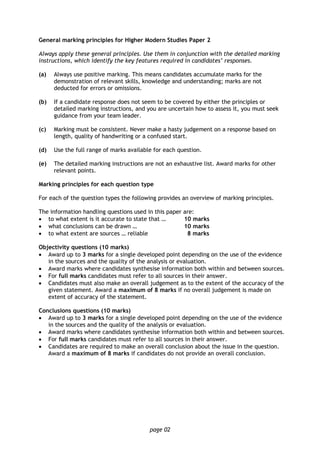
if you do not, you may lose all the marks for this paper.
S849/76/12 Modern Studies
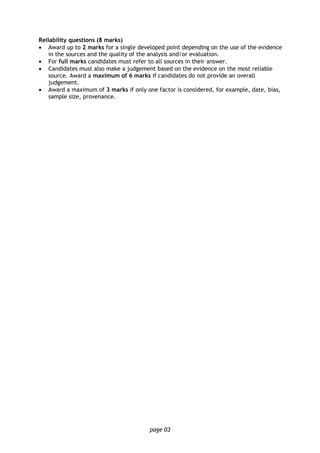
Paper 2
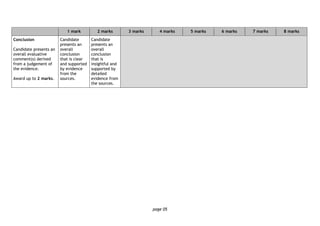
Date — Not applicable
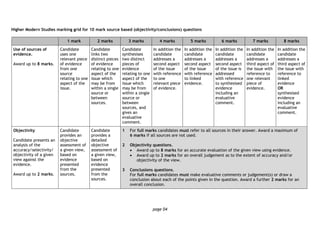
Duration — 1 hour 15 minutes
page 02
Total marks — 28
Attempt ALL questions
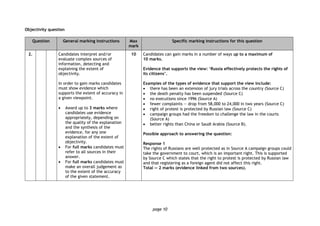
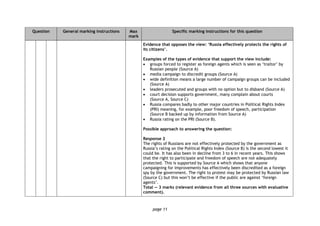
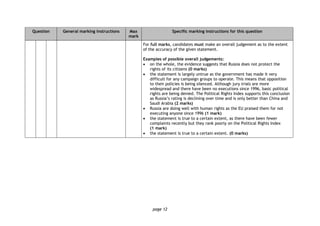
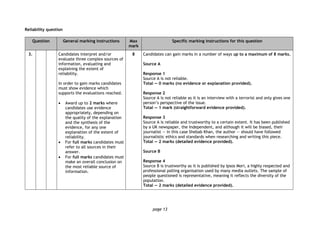
Question 1
Study Sources A, B and C then attempt the question that follows.
Source A
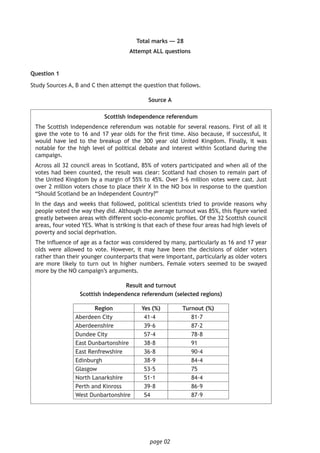
Scottish independence referendum
The Scottish independence referendum was notable for several reasons. First of all it
gave the vote to 16 and 17 year olds for the first time. Also because, if successful, it
would have led to the breakup of the 300 year old United Kingdom. Finally, it was
notable for the high level of political debate and interest within Scotland during the
campaign.
Across all 32 council areas in Scotland, 85% of voters participated and when all of the
votes had been counted, the result was clear: Scotland had chosen to remain part of
the United Kingdom by a margin of 55% to 45%. Over 3·6 million votes were cast. Just
over 2 million voters chose to place their X in the NO box in response to the question
“Should Scotland be an Independent Country?”
In the days and weeks that followed, political scientists tried to provide reasons why
people voted the way they did. Although the average turnout was 85%, this figure varied
greatly between areas with different socio-economic profiles. Of the 32 Scottish council
areas, four voted YES. What is striking is that each of these four areas had high levels of
poverty and social deprivation.
The influence of age as a factor was considered by many, particularly as 16 and 17 year
olds were allowed to vote. However, it may have been the decisions of older voters
rather than their younger counterparts that were important, particularly as older voters
are more likely to turn out in higher numbers. Female voters seemed to be swayed
more by the NO campaign’s arguments.
Result and turnout
Scottish independence referendum (selected regions)
Region Yes (%) Turnout (%)
Aberdeen City 41·4 81·7
Aberdeenshire 39·6 87·2
Dundee City 57·4 78·8
East Dunbartonshire 38·8 91
East Renfrewshire 36·8 90·4
Edinburgh 38·9 84·4
Glasgow 53·5 75
North Lanarkshire 51·1 84·4
Perth and Kinross 39·8 86·9
West Dunbartonshire 54 87·9
page 03
Question 1 (continued)
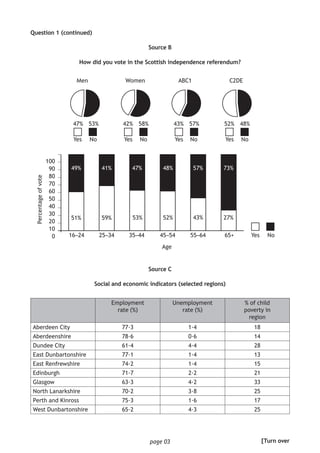
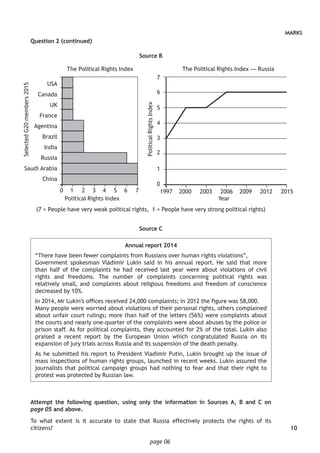
Source B
How did you vote in the Scottish independence referendum?
Age
Source C
Social and economic indicators (selected regions)
Employment
rate (%)
Unemployment
rate (%)
% of child
poverty in
region
Aberdeen City 77·3 1·4 18
Aberdeenshire 78·6 0·6 14
Dundee City 61·4 4·4 28
East Dunbartonshire 77·1 1·4 13
East Renfrewshire 74·2 1·4 15
Edinburgh 71·7 2·2 21
Glasgow 63·3 4·2 33
North Lanarkshire 70·2 3·8 25
Perth and Kinross 75·3 1·6 17
West Dunbartonshire 65·2 4·3 25
[Turn over
C2DEABC1WomenMen
Yes Yes Yes YesNo No No No
48%52%57%43%58%42%53%47%
100
90
80
70
60
50
40
30
20
10
0 16–24 25–34 35–44 45–54 55–64 65+
51% 59% 53% 52% 43% 27%
57% 73%47% 48%49% 41%
Yes No
Percentageofvote
page 04
MARKS
Attempt the following question, using only the information in Sources A, B and C on
pages 02 and 03.
Question 1	 (continued)
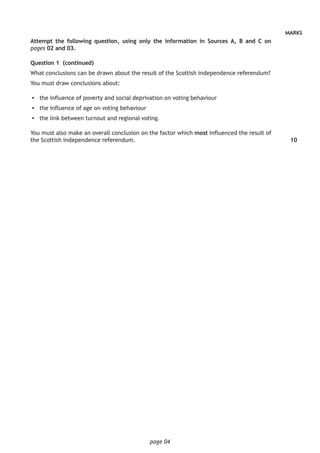
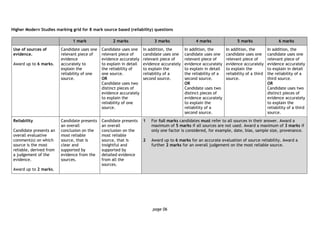
What conclusions can be drawn about the result of the Scottish independence referendum?
You must draw conclusions about:
•	 the influence of poverty and social deprivation on voting behaviour
•	 the influence of age on voting behaviour
•	 the link between turnout and regional voting.
You must also make an overall conclusion on the factor which most influenced the result of
the Scottish independence referendum. 10
page 05
Question 2
Study Sources A, B and C then attempt the question that follows.
Source A
Russia’s ‘foreign agents’
In 2012 Russia’s parliament adopted a law that required campaign groups to register as
‘foreign agents’ with the Ministry of Justice if they engaged in ‘political activity’ and received
foreign funding. The definition of political activity under the law is so broad and vague that it
covered almost all campaign groups in Russia.
Russian authorities arrested and harassed activists, blocked independent online media and
proposed measures that would further stifle free expression. More recently pro-government
media published material blaming the Government of Ukraine for the ongoing civil war in that
country, trying to deflect attention away from Russia’s invasion and occupation of Crimea.
In Russia ‘foreign agent’ is interpreted as ‘spy’ or ‘traitor’. The groups campaigning for political
freedoms were in no doubt that the law aimed to demonise them, and to turn the public
against them. Russia’s many human rights groups boycotted the law, calling it ‘slanderous’.
Many of them have now been forced to disband and many of their leaders have been
prosecuted for refusing to register as a foreign agent. In the past such individuals may have
faced the death sentence but Russia has not executed anyone since 1996.
In August 2013, four organisations challenged the law in Russia’s Constitutional Court. On
8 April 2014 the court upheld the law, ruling that the term ‘foreign agent’ had no negative
connotations, therefore its use was ‘not intended to persecute or discredit’ anyone. The court
also found that labelling campaign groups as foreign agents was in the interests of state
security and did not affect the right to protest. The ruling has been heavily criticised by many
foreign governments.
[Turn over
page 06
MARKS
Question 2 (continued)
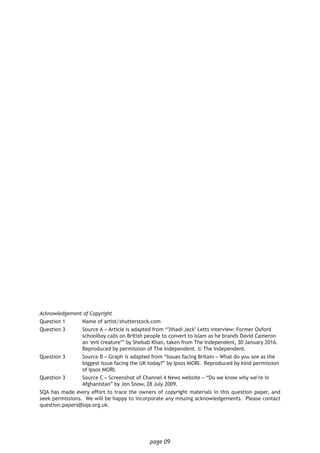
Source B
USA
Canada
UK
France
Agentina
Brazil
India
Russia
Saudi Arabia
China
0 1 2 3 4 5 6 7 1997 2000 2003 2006 2009 2012 2015
7
6
5
4
3
2
1
0
Political Rights Index Year
SelectedG20members2015
PoliticalRightsIndex
The Political Rights Index The Political Rights Index — Russia
(7 = People have very weak political rights, 1 = People have very strong political rights)
Source C
Annual report 2014
“There have been fewer complaints from Russians over human rights violations”,
Government spokesman Vladimir Lukin said in his annual report. He said that more
than half of the complaints he had received last year were about violations of civil
rights and freedoms. The number of complaints concerning political rights was
relatively small, and complaints about religious freedoms and freedom of conscience
decreased by 10%.
In 2014, Mr Lukin’s offices received 24,000 complaints; in 2012 the figure was 58,000.
Many people were worried about violations of their personal rights, others complained
about unfair court rulings; more than half of the letters (56%) were complaints about
the courts and nearly one-quarter of the complaints were about abuses by the police or
prison staff. As for political complaints, they accounted for 2% of the total. Lukin also
praised a recent report by the European Union which congratulated Russia on its
expansion of jury trials across Russia and its suspension of the death penalty.
As he submitted his report to President Vladimir Putin, Lukin brought up the issue of
mass inspections of human rights groups, launched in recent weeks. Lukin assured the
journalists that political campaign groups had nothing to fear and that their right to
protest was protected by Russian law.
Attempt the following question, using only the information in Sources A, B and C on
page 05 and above.
To what extent is it accurate to state that Russia effectively protects the rights of its
citizens? 10
page 07
Question 3
Study Sources A, B and C then attempt the question that follows.
Source A
Interview with British jihadi in Syria
What made you leave the UK? What was the deciding factor?
To come to Syria. To leave dar al kufr [the land of disbelievers].
Why are you out in Syria?
To spread the religion of Allah and to help Muslims. I can speak Arabic and English. That’s like
my only skill. I’ve spent efforts to take down the Syrian government. That’s all I want to say.
Have you joined Isis?
I’m not Isis, but I believe in the Sharia. I believe we should follow Islam how the first Muslims
did. I also think that whatever I say, the media will probably freestyle with it and make up
more nicknames for me as a result of the void they have in their lives.
What do you think about Isis? Can you give us an insight into what’s going on in Syria with
Isis? They’ve recently released a video saying they’ll attack the UK — what are your thoughts
on that?
I’m doing my own thing. I don’t focus that much on what Isis does. Also this may sound strange
but this is genuinely the first time someone’s told me they threatened to attack the UK, which
is probably a bit embarrassing, seeing as I’m in Syria and you’d expect I’d hear these things. If
Britain stopped bombing Muslims in Syria the Muslims in Syria would stop attacking them. Is
that hard to understand?
Source: The Independent, ‘Jihadi Jack’ Letts interview: Former Oxford schoolboy calls on British
people to convert to Islam as he brands David Cameron an ‘evil creature’ by Shebab Khan,
published 30 January 2016.
Source B
Public opinion survey: issues facing Britain
What do you see as the biggest issue facing the UK today?
Source: Ipsos MORI interviewed a representative quota sample of 1,011 adults aged 18+ across
Great Britain, 7–20 January 2016.
[Turn over
Immigration/immigrants
NHS/hospitals/healthcare
Economy
Defence/foreign affairs/terrorism
Poverty/inequality
Housing
Education/schools
European Union/Europe
Unemployment
Low pay/fair wages
38%
46%
26%
23%
17%
17%
17%
16%
15%
12%
page 08
MARKS
Question 3 (continued)
Source C
Channel 4 website
Source: Channel 4 News website, “Do we know why we are in Afghanistan?” by
Jon Snow, published 28 July 2009.
Attempt the following question, using only the information in Sources A, B and C on
page 07 and above.
To what extent are Sources A, B and C reliable?
You must provide an overall conclusion on the most reliable source of information.
[END OF SPECIMEN QUESTION PAPER]
8
page 09
Acknowledgement of Copyright
Question 1	 Name of artist/shutterstock.com
Question 3 	 Source A – Article is adapted from “’Jihadi Jack’ Letts interview: Former Oxford 	
	 schoolboy calls on British people to convert to Islam as he brands David Cameron 	
	 an ‘evil creature’” by Shebab Khan, taken from The Independent, 30 January 2016. 	
	 Reproduced by permission of The Independent. © The Independent.
Question 3 	 Source B – Graph is adapted from “Issues facing Britain – What do you see as the 	
	 biggest issue facing the UK today?” by Ipsos MORI. Reproduced by kind permission 	
	 of Ipsos MORI.
Question 3 	 Source C – Screenshot of Channel 4 News website – “Do we know why we’re in 		
	 Afghanistan” by Jon Snow, 28 July 2009.
SQA has made every effort to trace the owners of copyright materials in this question paper, and
seek permissions. We will be happy to incorporate any missing acknowledgements. Please contact
question.papers@sqa.org.uk.
©
National
Qualications
SPECIMEN ONLYHS849/76/11 Modern Studies
Paper 2
Marking Instructions
The information in this publication may be reproduced to support SQA qualifications only
on a non-commercial basis. If it is reproduced, SQA should be clearly acknowledged as
the source. If it is to be used for any other purpose, written permission must be obtained
from permissions@sqa.org.uk.
Where the publication includes materials from sources other than SQA (ie secondary
copyright), this material should only be reproduced for the purposes of examination or
assessment. If it needs to be reproduced for any other purpose it is the user’s
responsibility to obtain the necessary copyright clearance.
These marking instructions have been provided to show how SQA would mark this
specimen question paper.
page 02
General marking principles for Higher Modern Studies Paper 2
Always apply these general principles. Use them in conjunction with the detailed marking
instructions, which identify the key features required in candidates’ responses.
(a) Always use positive marking. This means candidates accumulate marks for the
demonstration of relevant skills, knowledge and understanding; marks are not
deducted for errors or omissions.
(b) If a candidate response does not seem to be covered by either the principles or
detailed marking instructions, and you are uncertain how to assess it, you must seek
guidance from your team leader.
(c) Marking must be consistent. Never make a hasty judgement on a response based on
length, quality of handwriting or a confused start.
(d) Use the full range of marks available for each question.
(e) The detailed marking instructions are not an exhaustive list. Award marks for other
relevant points.
Marking principles for each question type
For each of the question types the following provides an overview of marking principles.
The information handling questions used in this paper are:
 to what extent is it accurate to state that … 10 marks
 what conclusions can be drawn … 10 marks
 to what extent are sources … reliable 8 marks
Objectivity questions (10 marks)
 Award up to 3 marks for a single developed point depending on the use of the evidence
in the sources and the quality of the analysis or evaluation.
 Award marks where candidates synthesise information both within and between sources.
 For full marks candidates must refer to all sources in their answer.
 Candidates must also make an overall judgement as to the extent of the accuracy of the
given statement. Award a maximum of 8 marks if no overall judgement is made on
extent of accuracy of the statement.
Conclusions questions (10 marks)
 Award up to 3 marks for a single developed point depending on the use of the evidence
in the sources and the quality of the analysis or evaluation.
 Award marks where candidates synthesise information both within and between sources.
 For full marks candidates must refer to all sources in their answer.
 Candidates are required to make an overall conclusion about the issue in the question.
Award a maximum of 8 marks if candidates do not provide an overall conclusion.
page 03
Reliability questions (8 marks)
 Award up to 2 marks for a single developed point depending on the use of the evidence
in the sources and the quality of the analysis and/or evaluation.
 For full marks candidates must refer to all sources in their answer.
 Candidates must also make a judgement based on the evidence on the most reliable
source. Award a maximum of 6 marks if candidates do not provide an overall
judgement.
 Award a maximum of 3 marks if only one factor is considered, for example, date, bias,
sample size, provenance.
page 04
Higher Modern Studies marking grid for 10 mark source based (objectivity/conclusions) questions
1 mark 2 marks 3 marks 4 marks 5 marks 6 marks 7 marks 8 marks
Use of sources of
evidence.
Award up to 8 marks.
Candidate
uses one
relevant piece
of evidence
from one
source
relating to one
aspect of the
issue.
Candidate
links two
distinct pieces
of evidence
relating to one
aspect of the
issue which
may be from
within a single
source or
between
sources.
Candidate
synthesises
two distinct
pieces of
evidence
relating to one
aspect of the
issue which
may be from
within a single
source or
between
sources, and
gives an
evaluative
comment.
In addition the
candidate
addresses a
second aspect
of the issue
with reference
to one
relevant piece
of evidence.
In addition the
candidate
addresses a
second aspect
of the issue
with reference
to linked
evidence.
In addition the
candidate
addresses a
second aspect
of the issue is
addressed
with reference
to synthesised
evidence
including an
evaluative
comment.
In addition the
candidate
addresses a
third aspect of
the issue with
reference to
one relevant
piece of
evidence.
In addition the
candidate
addresses a
third aspect of
the issue with
reference to
linked
evidence
OR
synthesised
evidence
including an
evaluative
comment.
Objectivity
Candidate presents an
analysis of the
accuracy/selectivity/
objectivity of a given
view against the
evidence.
Award up to 2 marks.
Candidate
provides an
objective
assessment of
a given view,
based on
evidence
presented
from the
sources.
Candidate
provides a
detailed
objective
assessment of
a given view,
based on
evidence
presented
from the
sources.
1 For full marks candidates must refer to all sources in their answer. Award a maximum of
6 marks if all sources are not used.
2 Objectivity questions.
 Award up to 8 marks for an accurate evaluation of the given view using evidence.
 Award up to 2 marks for an overall judgement as to the extent of accuracy and/or
objectivity of the view.
3 Conclusions questions.
For full marks candidates must make evaluative comments or judgement(s) or draw a
conclusion about each of the points given in the question. Award a further 2 marks for an
overall conclusion.
page 05
1 mark 2 marks 3 marks 4 marks 5 marks 6 marks 7 marks 8 marks
Conclusion
Candidate presents an
overall evaluative
comment(s) derived
from a judgement of
the evidence.
Award up to 2 marks.
Candidate
presents an
overall
conclusion
that is clear
and supported
by evidence
from the
sources.
Candidate
presents an
overall
conclusion
that is
insightful and
supported by
detailed
evidence from
the sources.
page 06
Higher Modern Studies marking grid for 8 mark source based (reliability) questions
1 mark 2 marks 3 marks 4 marks 5 marks 6 marks
Use of sources of
evidence.
Award up to 6 marks.
Candidate uses one
relevant piece of
evidence
accurately to
explain the
reliability of one
source.
Candidate uses one
relevant piece of
evidence accurately
to explain in detail
the reliability of
one source.
OR
Candidate uses two
distinct pieces of
evidence accurately
to explain the
reliability of one
source.
In addition, the
candidate uses one
relevant piece of
evidence accurately
to explain the
reliability of a
second source.
In addition, the
candidate uses one
relevant piece of
evidence accurately
to explain in detail
the reliability of a
second source.
OR
Candidate uses two
distinct pieces of
evidence accurately
to explain the
reliability of a
second source.
In addition, the
candidate uses one
relevant piece of
evidence accurately
to explain the
reliability of a third
source.
In addition, the
candidate uses one
relevant piece of
evidence accurately
to explain in detail
the reliability of a
third source.
OR
Candidate uses two
distinct pieces of
evidence accurately
to explain the
reliability of a third
source.
Reliability
Candidate presents an
overall evaluative
comment(s) on which
source is the most
reliable, derived from
a judgement of the
evidence.
Award up to 2 marks.
Candidate presents
an overall
conclusion on the
most reliable
source, that is
clear and
supported by
evidence from the
sources.
Candidate presents
an overall
conclusion on the
most reliable
source, that is
insightful and
supported by
detailed evidence
from all the
sources.
1 For full marks candidates must refer to all sources in their answer. Award a
maximum of 5 marks if all sources are not used. Award a maximum of 3 marks if
only one factor is considered, for example, date, bias, sample size, provenance.
2 Award up to 6 marks for an accurate evaluation of source reliability. Award a
further 2 marks for an overall judgement on the most reliable source.
page 07
Marking instructions for each question
Conclusions question
Question General marking instructions Max
mark
Specific marking instructions for this question
1. Candidates interpret and/or
evaluate complex sources in order
to reach conclusions.
In order to gain marks candidates
must show evidence which
explains the conclusions reached.
 Award up to 3 marks where
candidates use evidence
appropriately, depending on
the quality of the explanation
and the synthesis of the
evidence to reach any one
conclusion.
 For full marks candidates must
refer to all sources in their
answer.
 For full marks candidates must
reach conclusions about each
of the points given and make
an overall conclusion on the
issue.
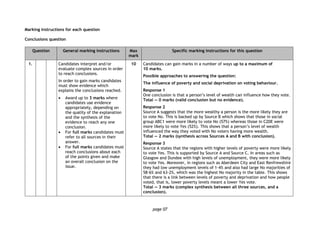
10 Candidates can gain marks in a number of ways up to a maximum of
10 marks.
Possible approaches to answering the question:
The influence of poverty and social deprivation on voting behaviour.
Response 1
One conclusion is that a person’s level of wealth can influence how they vote.
Total — 0 marks (valid conclusion but no evidence).
Response 2
Source A suggests that the more wealthy a person is the more likely they are
to vote No. This is backed up by Source B which shows that those in social
group ABC1 were more likely to vote No (57%) whereas those in C2DE were
more likely to vote Yes (52%). This shows that a person’s level of wealth
influenced the way they voted with No voters having more wealth.
Total — 2 marks (synthesis across Sources A and B with conclusion).
Response 3
Source A states that the regions with higher levels of poverty were more likely
to vote Yes. This is supported by Source A and Source C. In areas such as
Glasgow and Dundee with high levels of unemployment, they were more likely
to vote Yes. Moreover, in regions such as Aberdeen City and East Renfrewshire
they had low unemployment levels of 1·4% and also had large No majorities of
58·6% and 63·2%, which was the highest No majority in the table. This shows
that there is a link between levels of poverty and deprivation and how people
voted, that is, lower poverty levels meant a lower Yes vote.
Total — 3 marks (complex synthesis between all three sources, and a
conclusion).
page 08
Question General marking instructions Max
mark
Specific marking instructions for this question
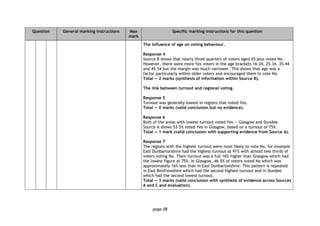
The influence of age on voting behaviour.
Response 4
Source B shows that nearly three quarters of voters aged 65 plus voted No.
However, there were more Yes voters in the age brackets 16–24, 25–34, 35–44
and 45–54 but the margin was much narrower. This shows that age was a
factor particularly within older voters and encouraged them to vote No.
Total — 2 marks (synthesis of information within Source B).
The link between turnout and regional voting.
Response 5
Turnout was generally lowest in regions that voted Yes.
Total — 0 marks (valid conclusion but no evidence).
Response 6
Both of the areas with lowest turnout voted Yes — Glasgow and Dundee.
Source A shows 53·5% voted Yes in Glasgow, based on a turnout of 75%.
Total — 1 mark (valid conclusion with supporting evidence from Source A).
Response 7
The regions with the highest turnout were most likely to vote No, for example
East Dunbartonshire had the highest turnout at 91% with almost two thirds of
voters voting No. Their turnout was a full 16% higher than Glasgow which had
the lowest figure at 75%. In Glasgow, 46·5% of voters voted No which was
approximately 16% less than in East Dunbartonshire. This pattern is repeated
in East Renfrewshire which had the second highest turnout and in Dundee
which had the second lowest turnout.
Total — 3 marks (valid conclusion with synthesis of evidence across Sources
A and C and evaluation).
page 09
Question General marking instructions Max
mark
Specific marking instructions for this question
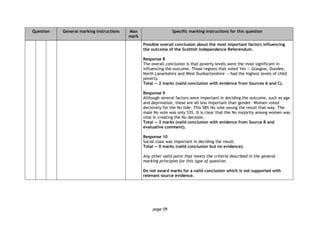
Possible overall conclusion about the most important factors influencing
the outcome of the Scottish Independence Referendum.
Response 8
The overall conclusion is that poverty levels were the most significant in
influencing the outcome. Those regions that voted Yes — Glasgow, Dundee,
North Lanarkshire and West Dunbartonshire — had the highest levels of child
poverty.
Total — 2 marks (valid conclusion with evidence from Sources A and C).
Response 9
Although several factors were important in deciding the outcome, such as age
and deprivation, these are all less important than gender. Women voted
decisively for the No side. This 58% No vote swung the result that way. The
male No vote was only 53%. It is clear that the No majority among women was
vital in creating the No decision.
Total — 2 marks (valid conclusion with evidence from Source B and
evaluative comment).
Response 10
Social class was important in deciding the result.
Total — 0 marks (valid conclusion but no evidence).
Any other valid point that meets the criteria described in the general
marking principles for this type of question.
Do not award marks for a valid conclusion which is not supported with
relevant source evidence.
page 10
Objectivity question
Question General marking instructions Max
mark
Specific marking instructions for this question
2. Candidates interpret and/or
evaluate complex sources of
information, detecting and
explaining the extent of
objectivity.
In order to gain marks candidates
must show evidence which
supports the extent of accuracy in
a given viewpoint.
 Award up to 3 marks where
candidates use evidence
appropriately, depending on
the quality of the explanation
and the synthesis of the
evidence, for any one
explanation of the extent of
objectivity.
 For full marks candidates must
refer to all sources in their
answer.
 For full marks candidates must
make an overall judgement as
to the extent of the accuracy
of the given statement.
10 Candidates can gain marks in a number of ways up to a maximum of
10 marks.
Evidence that supports the view: ‘Russia effectively protects the rights of
its citizens’.
Examples of the types of evidence that support the view include:
 there has been an extension of jury trials across the country (Source C)
 the death penalty has been suspended (Source C)
 no executions since 1996 (Source A)
 fewer complaints — drop from 58,000 to 24,000 in two years (Source C)
 right of protest is protected by Russian law (Source C)
 campaign groups had the freedom to challenge the law in the courts
(Source A)
 better rights than China or Saudi Arabia (Source B).
Possible approach to answering the question:
Response 1
The rights of Russians are well protected as in Source A campaign groups could
take the government to court, which is an important right. This is supported
by Source C which states that the right to protest is protected by Russian law
and that registering as a foreign agent did not affect this right.
Total — 2 marks (evidence linked from two sources).
page 11
Question General marking instructions Max
mark
Specific marking instructions for this question
Evidence that opposes the view: ‘Russia effectively protects the rights of
its citizens’.
Examples of the types of evidence that support the view include:
 groups forced to register as foreign agents which is seen as ‘traitor’ by
Russian people (Source A)
 media campaign to discredit groups (Source A)
 wide definition means a large number of campaign groups can be included
(Source A)
 leaders prosecuted and groups with no option but to disband (Source A)
 court decision supports government, many complain about courts
(Source A, Source C)
 Russia compares badly to other major countries in Political Rights Index
(PRI) meaning, for example, poor freedom of speech, participation
(Source B backed up by information from Source A)
 Russia rating on the PRI (Source B).
Possible approach to answering the question:
Response 2
The rights of Russians are not effectively protected by the government as
Russia’s rating on the Political Rights Index (Source B) is the second lowest it
could be. It has also been in decline from 3 to 6 in recent years. This shows
that the right to participate and freedom of speech are not adequately
protected. This is supported by Source A which shows that anyone
campaigning for improvements has effectively been discredited as a foreign
spy by the government. The right to protest may be protected by Russian law
(Source C) but this won’t be effective if the public are against ‘foreign
agents’.
Total — 3 marks (relevant evidence from all three sources with evaluative
comment).
page 12
Question General marking instructions Max
mark
Specific marking instructions for this question
For full marks, candidates must make an overall judgement as to the extent
of the accuracy of the given statement.
Examples of possible overall judgements:
 on the whole, the evidence suggests that Russia does not protect the
rights of its citizens (0 marks)
 the statement is largely untrue as the government has made it very
difficult for any campaign groups to operate. This means that opposition
to their policies is being silenced. Although jury trials are more
widespread and there have been no executions since 1996, basic political
rights are being denied. The Political Rights Index supports this conclusion
as Russia’s rating is declining over time and is only better than China and
Saudi Arabia (2 marks)
 Russia are doing well with human rights as the EU praised them for not
executing anyone since 1996 (1 mark)
 the statement is true to a certain extent, as there have been fewer
complaints recently but they rank poorly on the Political Rights Index
(1 mark)
 the statement is true to a certain extent. (0 marks)
page 13
Reliability question
Question General marking instructions Max
mark
Specific marking instructions for this question
3. Candidates interpret and/or
evaluate three complex sources of
information, evaluating and
explaining the extent of
reliability.
In order to gain marks candidates
must show evidence which
supports the evaluations reached.
 Award up to 2 marks where
candidates use evidence
appropriately, depending on
the quality of the explanation
and the synthesis of the
evidence, for any one
explanation of the extent of
reliability.
 For full marks candidates must
refer to all sources in their
answer.
 For full marks candidates must
make an overall conclusion on
the most reliable source of
information.
8 Candidates can gain marks in a number of ways up to a maximum of 8 marks.
Source A
Response 1
Source A is not reliable.
Total — 0 marks (no evidence or explanation provided).
Response 2
Source A is not reliable as it is an interview with a terrorist and only gives one
person’s perspective of the issue.
Total — 1 mark (straightforward evidence provided).
Response 3
Source A is reliable and trustworthy to a certain extent. It has been published
by a UK newspaper, the Independent, and although it will be biased, their
journalist — in this case Shebab Khan, the author — should have followed
journalistic ethics and standards when researching and writing this piece.
Total — 2 marks (detailed evidence provided).
Source B
Response 4
Source B is trustworthy as it is published by Ipsos Mori, a highly respected and
professional polling organisation used by many media outlets. The sample of
people questioned is representative, meaning it reflects the diversity of the
population.
Total — 2 marks (detailed evidence provided).
page 14
Question General marking instructions Max
mark
Specific marking instructions for this question
Source C
Response 5
Although Source C is from a respected news organisation, Channel 4, which
has high trust ratings amongst UK sources of news, this was published in 2009
which reduces the article’s reliability as events will have changed since then
and it will not contain the most up-to-date information. Therefore Source C’s
reliability is questionable.
Total — 2 marks (detailed evidence provided).
Examples of an overall conclusion on the most reliable source of
information:
Response 6
Source A is the most reliable source as it is the most up-to-date having been
published on 30 January 2016.
Total — 1 mark (overall conclusion supported by evidence from one
source).
Response 7
Source B is the most reliable source as the survey was carried out in January
2016 and is more up-to-date than Source C which was published in 2009.
Source B is also likely to be more objective than Source A which is from a
newspaper, and likely to be biased.
Total — 2 marks (overall conclusion supported by detailed evidence from
all sources)
For full marks, candidates must make an overall judgement on the most
reliable source.
[END OF SPECIMEN MARKING INSTRUCTIONS]

Higher Modern Studies - exemplar Paper 2

  • 1.
    *S8497612* © National Qualications SPECIMEN ONLYH Total marks— 28 Attempt ALL questions Write your answers clearly in the answer booklet provided. In the answer booklet you must clearly identify the question number you are attempting. Use blue or black ink. Before leaving the examination room you must give your answer booklet to the Invigilator; if you do not, you may lose all the marks for this paper. S849/76/12 Modern Studies Paper 2 Date — Not applicable Duration — 1 hour 15 minutes
  • 2.
    page 02 Total marks— 28 Attempt ALL questions Question 1 Study Sources A, B and C then attempt the question that follows. Source A Scottish independence referendum The Scottish independence referendum was notable for several reasons. First of all it gave the vote to 16 and 17 year olds for the first time. Also because, if successful, it would have led to the breakup of the 300 year old United Kingdom. Finally, it was notable for the high level of political debate and interest within Scotland during the campaign. Across all 32 council areas in Scotland, 85% of voters participated and when all of the votes had been counted, the result was clear: Scotland had chosen to remain part of the United Kingdom by a margin of 55% to 45%. Over 3·6 million votes were cast. Just over 2 million voters chose to place their X in the NO box in response to the question “Should Scotland be an Independent Country?” In the days and weeks that followed, political scientists tried to provide reasons why people voted the way they did. Although the average turnout was 85%, this figure varied greatly between areas with different socio-economic profiles. Of the 32 Scottish council areas, four voted YES. What is striking is that each of these four areas had high levels of poverty and social deprivation. The influence of age as a factor was considered by many, particularly as 16 and 17 year olds were allowed to vote. However, it may have been the decisions of older voters rather than their younger counterparts that were important, particularly as older voters are more likely to turn out in higher numbers. Female voters seemed to be swayed more by the NO campaign’s arguments. Result and turnout Scottish independence referendum (selected regions) Region Yes (%) Turnout (%) Aberdeen City 41·4 81·7 Aberdeenshire 39·6 87·2 Dundee City 57·4 78·8 East Dunbartonshire 38·8 91 East Renfrewshire 36·8 90·4 Edinburgh 38·9 84·4 Glasgow 53·5 75 North Lanarkshire 51·1 84·4 Perth and Kinross 39·8 86·9 West Dunbartonshire 54 87·9
  • 3.
    page 03 Question 1(continued) Source B How did you vote in the Scottish independence referendum? Age Source C Social and economic indicators (selected regions) Employment rate (%) Unemployment rate (%) % of child poverty in region Aberdeen City 77·3 1·4 18 Aberdeenshire 78·6 0·6 14 Dundee City 61·4 4·4 28 East Dunbartonshire 77·1 1·4 13 East Renfrewshire 74·2 1·4 15 Edinburgh 71·7 2·2 21 Glasgow 63·3 4·2 33 North Lanarkshire 70·2 3·8 25 Perth and Kinross 75·3 1·6 17 West Dunbartonshire 65·2 4·3 25 [Turn over C2DEABC1WomenMen Yes Yes Yes YesNo No No No 48%52%57%43%58%42%53%47% 100 90 80 70 60 50 40 30 20 10 0 16–24 25–34 35–44 45–54 55–64 65+ 51% 59% 53% 52% 43% 27% 57% 73%47% 48%49% 41% Yes No Percentageofvote
  • 4.
    page 04 MARKS Attempt thefollowing question, using only the information in Sources A, B and C on pages 02 and 03. Question 1 (continued) What conclusions can be drawn about the result of the Scottish independence referendum? You must draw conclusions about: • the influence of poverty and social deprivation on voting behaviour • the influence of age on voting behaviour • the link between turnout and regional voting. You must also make an overall conclusion on the factor which most influenced the result of the Scottish independence referendum. 10
  • 5.
    page 05 Question 2 StudySources A, B and C then attempt the question that follows. Source A Russia’s ‘foreign agents’ In 2012 Russia’s parliament adopted a law that required campaign groups to register as ‘foreign agents’ with the Ministry of Justice if they engaged in ‘political activity’ and received foreign funding. The definition of political activity under the law is so broad and vague that it covered almost all campaign groups in Russia. Russian authorities arrested and harassed activists, blocked independent online media and proposed measures that would further stifle free expression. More recently pro-government media published material blaming the Government of Ukraine for the ongoing civil war in that country, trying to deflect attention away from Russia’s invasion and occupation of Crimea. In Russia ‘foreign agent’ is interpreted as ‘spy’ or ‘traitor’. The groups campaigning for political freedoms were in no doubt that the law aimed to demonise them, and to turn the public against them. Russia’s many human rights groups boycotted the law, calling it ‘slanderous’. Many of them have now been forced to disband and many of their leaders have been prosecuted for refusing to register as a foreign agent. In the past such individuals may have faced the death sentence but Russia has not executed anyone since 1996. In August 2013, four organisations challenged the law in Russia’s Constitutional Court. On 8 April 2014 the court upheld the law, ruling that the term ‘foreign agent’ had no negative connotations, therefore its use was ‘not intended to persecute or discredit’ anyone. The court also found that labelling campaign groups as foreign agents was in the interests of state security and did not affect the right to protest. The ruling has been heavily criticised by many foreign governments. [Turn over
  • 6.
    page 06 MARKS Question 2(continued) Source B USA Canada UK France Agentina Brazil India Russia Saudi Arabia China 0 1 2 3 4 5 6 7 1997 2000 2003 2006 2009 2012 2015 7 6 5 4 3 2 1 0 Political Rights Index Year SelectedG20members2015 PoliticalRightsIndex The Political Rights Index The Political Rights Index — Russia (7 = People have very weak political rights, 1 = People have very strong political rights) Source C Annual report 2014 “There have been fewer complaints from Russians over human rights violations”, Government spokesman Vladimir Lukin said in his annual report. He said that more than half of the complaints he had received last year were about violations of civil rights and freedoms. The number of complaints concerning political rights was relatively small, and complaints about religious freedoms and freedom of conscience decreased by 10%. In 2014, Mr Lukin’s offices received 24,000 complaints; in 2012 the figure was 58,000. Many people were worried about violations of their personal rights, others complained about unfair court rulings; more than half of the letters (56%) were complaints about the courts and nearly one-quarter of the complaints were about abuses by the police or prison staff. As for political complaints, they accounted for 2% of the total. Lukin also praised a recent report by the European Union which congratulated Russia on its expansion of jury trials across Russia and its suspension of the death penalty. As he submitted his report to President Vladimir Putin, Lukin brought up the issue of mass inspections of human rights groups, launched in recent weeks. Lukin assured the journalists that political campaign groups had nothing to fear and that their right to protest was protected by Russian law. Attempt the following question, using only the information in Sources A, B and C on page 05 and above. To what extent is it accurate to state that Russia effectively protects the rights of its citizens? 10
  • 7.
    page 07 Question 3 StudySources A, B and C then attempt the question that follows. Source A Interview with British jihadi in Syria What made you leave the UK? What was the deciding factor? To come to Syria. To leave dar al kufr [the land of disbelievers]. Why are you out in Syria? To spread the religion of Allah and to help Muslims. I can speak Arabic and English. That’s like my only skill. I’ve spent efforts to take down the Syrian government. That’s all I want to say. Have you joined Isis? I’m not Isis, but I believe in the Sharia. I believe we should follow Islam how the first Muslims did. I also think that whatever I say, the media will probably freestyle with it and make up more nicknames for me as a result of the void they have in their lives. What do you think about Isis? Can you give us an insight into what’s going on in Syria with Isis? They’ve recently released a video saying they’ll attack the UK — what are your thoughts on that? I’m doing my own thing. I don’t focus that much on what Isis does. Also this may sound strange but this is genuinely the first time someone’s told me they threatened to attack the UK, which is probably a bit embarrassing, seeing as I’m in Syria and you’d expect I’d hear these things. If Britain stopped bombing Muslims in Syria the Muslims in Syria would stop attacking them. Is that hard to understand? Source: The Independent, ‘Jihadi Jack’ Letts interview: Former Oxford schoolboy calls on British people to convert to Islam as he brands David Cameron an ‘evil creature’ by Shebab Khan, published 30 January 2016. Source B Public opinion survey: issues facing Britain What do you see as the biggest issue facing the UK today? Source: Ipsos MORI interviewed a representative quota sample of 1,011 adults aged 18+ across Great Britain, 7–20 January 2016. [Turn over Immigration/immigrants NHS/hospitals/healthcare Economy Defence/foreign affairs/terrorism Poverty/inequality Housing Education/schools European Union/Europe Unemployment Low pay/fair wages 38% 46% 26% 23% 17% 17% 17% 16% 15% 12%
  • 8.
    page 08 MARKS Question 3(continued) Source C Channel 4 website Source: Channel 4 News website, “Do we know why we are in Afghanistan?” by Jon Snow, published 28 July 2009. Attempt the following question, using only the information in Sources A, B and C on page 07 and above. To what extent are Sources A, B and C reliable? You must provide an overall conclusion on the most reliable source of information. [END OF SPECIMEN QUESTION PAPER] 8
  • 9.
    page 09 Acknowledgement ofCopyright Question 1 Name of artist/shutterstock.com Question 3 Source A – Article is adapted from “’Jihadi Jack’ Letts interview: Former Oxford schoolboy calls on British people to convert to Islam as he brands David Cameron an ‘evil creature’” by Shebab Khan, taken from The Independent, 30 January 2016. Reproduced by permission of The Independent. © The Independent. Question 3 Source B – Graph is adapted from “Issues facing Britain – What do you see as the biggest issue facing the UK today?” by Ipsos MORI. Reproduced by kind permission of Ipsos MORI. Question 3 Source C – Screenshot of Channel 4 News website – “Do we know why we’re in Afghanistan” by Jon Snow, 28 July 2009. SQA has made every effort to trace the owners of copyright materials in this question paper, and seek permissions. We will be happy to incorporate any missing acknowledgements. Please contact question.papers@sqa.org.uk.
  • 10.
    © National Qualications SPECIMEN ONLYHS849/76/11 ModernStudies Paper 2 Marking Instructions The information in this publication may be reproduced to support SQA qualifications only on a non-commercial basis. If it is reproduced, SQA should be clearly acknowledged as the source. If it is to be used for any other purpose, written permission must be obtained from permissions@sqa.org.uk. Where the publication includes materials from sources other than SQA (ie secondary copyright), this material should only be reproduced for the purposes of examination or assessment. If it needs to be reproduced for any other purpose it is the user’s responsibility to obtain the necessary copyright clearance. These marking instructions have been provided to show how SQA would mark this specimen question paper.
  • 11.
    page 02 General markingprinciples for Higher Modern Studies Paper 2 Always apply these general principles. Use them in conjunction with the detailed marking instructions, which identify the key features required in candidates’ responses. (a) Always use positive marking. This means candidates accumulate marks for the demonstration of relevant skills, knowledge and understanding; marks are not deducted for errors or omissions. (b) If a candidate response does not seem to be covered by either the principles or detailed marking instructions, and you are uncertain how to assess it, you must seek guidance from your team leader. (c) Marking must be consistent. Never make a hasty judgement on a response based on length, quality of handwriting or a confused start. (d) Use the full range of marks available for each question. (e) The detailed marking instructions are not an exhaustive list. Award marks for other relevant points. Marking principles for each question type For each of the question types the following provides an overview of marking principles. The information handling questions used in this paper are:  to what extent is it accurate to state that … 10 marks  what conclusions can be drawn … 10 marks  to what extent are sources … reliable 8 marks Objectivity questions (10 marks)  Award up to 3 marks for a single developed point depending on the use of the evidence in the sources and the quality of the analysis or evaluation.  Award marks where candidates synthesise information both within and between sources.  For full marks candidates must refer to all sources in their answer.  Candidates must also make an overall judgement as to the extent of the accuracy of the given statement. Award a maximum of 8 marks if no overall judgement is made on extent of accuracy of the statement. Conclusions questions (10 marks)  Award up to 3 marks for a single developed point depending on the use of the evidence in the sources and the quality of the analysis or evaluation.  Award marks where candidates synthesise information both within and between sources.  For full marks candidates must refer to all sources in their answer.  Candidates are required to make an overall conclusion about the issue in the question. Award a maximum of 8 marks if candidates do not provide an overall conclusion.
  • 12.
    page 03 Reliability questions(8 marks)  Award up to 2 marks for a single developed point depending on the use of the evidence in the sources and the quality of the analysis and/or evaluation.  For full marks candidates must refer to all sources in their answer.  Candidates must also make a judgement based on the evidence on the most reliable source. Award a maximum of 6 marks if candidates do not provide an overall judgement.  Award a maximum of 3 marks if only one factor is considered, for example, date, bias, sample size, provenance.
  • 13.
    page 04 Higher ModernStudies marking grid for 10 mark source based (objectivity/conclusions) questions 1 mark 2 marks 3 marks 4 marks 5 marks 6 marks 7 marks 8 marks Use of sources of evidence. Award up to 8 marks. Candidate uses one relevant piece of evidence from one source relating to one aspect of the issue. Candidate links two distinct pieces of evidence relating to one aspect of the issue which may be from within a single source or between sources. Candidate synthesises two distinct pieces of evidence relating to one aspect of the issue which may be from within a single source or between sources, and gives an evaluative comment. In addition the candidate addresses a second aspect of the issue with reference to one relevant piece of evidence. In addition the candidate addresses a second aspect of the issue with reference to linked evidence. In addition the candidate addresses a second aspect of the issue is addressed with reference to synthesised evidence including an evaluative comment. In addition the candidate addresses a third aspect of the issue with reference to one relevant piece of evidence. In addition the candidate addresses a third aspect of the issue with reference to linked evidence OR synthesised evidence including an evaluative comment. Objectivity Candidate presents an analysis of the accuracy/selectivity/ objectivity of a given view against the evidence. Award up to 2 marks. Candidate provides an objective assessment of a given view, based on evidence presented from the sources. Candidate provides a detailed objective assessment of a given view, based on evidence presented from the sources. 1 For full marks candidates must refer to all sources in their answer. Award a maximum of 6 marks if all sources are not used. 2 Objectivity questions.  Award up to 8 marks for an accurate evaluation of the given view using evidence.  Award up to 2 marks for an overall judgement as to the extent of accuracy and/or objectivity of the view. 3 Conclusions questions. For full marks candidates must make evaluative comments or judgement(s) or draw a conclusion about each of the points given in the question. Award a further 2 marks for an overall conclusion.
  • 14.
    page 05 1 mark2 marks 3 marks 4 marks 5 marks 6 marks 7 marks 8 marks Conclusion Candidate presents an overall evaluative comment(s) derived from a judgement of the evidence. Award up to 2 marks. Candidate presents an overall conclusion that is clear and supported by evidence from the sources. Candidate presents an overall conclusion that is insightful and supported by detailed evidence from the sources.
  • 15.
    page 06 Higher ModernStudies marking grid for 8 mark source based (reliability) questions 1 mark 2 marks 3 marks 4 marks 5 marks 6 marks Use of sources of evidence. Award up to 6 marks. Candidate uses one relevant piece of evidence accurately to explain the reliability of one source. Candidate uses one relevant piece of evidence accurately to explain in detail the reliability of one source. OR Candidate uses two distinct pieces of evidence accurately to explain the reliability of one source. In addition, the candidate uses one relevant piece of evidence accurately to explain the reliability of a second source. In addition, the candidate uses one relevant piece of evidence accurately to explain in detail the reliability of a second source. OR Candidate uses two distinct pieces of evidence accurately to explain the reliability of a second source. In addition, the candidate uses one relevant piece of evidence accurately to explain the reliability of a third source. In addition, the candidate uses one relevant piece of evidence accurately to explain in detail the reliability of a third source. OR Candidate uses two distinct pieces of evidence accurately to explain the reliability of a third source. Reliability Candidate presents an overall evaluative comment(s) on which source is the most reliable, derived from a judgement of the evidence. Award up to 2 marks. Candidate presents an overall conclusion on the most reliable source, that is clear and supported by evidence from the sources. Candidate presents an overall conclusion on the most reliable source, that is insightful and supported by detailed evidence from all the sources. 1 For full marks candidates must refer to all sources in their answer. Award a maximum of 5 marks if all sources are not used. Award a maximum of 3 marks if only one factor is considered, for example, date, bias, sample size, provenance. 2 Award up to 6 marks for an accurate evaluation of source reliability. Award a further 2 marks for an overall judgement on the most reliable source.
  • 16.
    page 07 Marking instructionsfor each question Conclusions question Question General marking instructions Max mark Specific marking instructions for this question 1. Candidates interpret and/or evaluate complex sources in order to reach conclusions. In order to gain marks candidates must show evidence which explains the conclusions reached.  Award up to 3 marks where candidates use evidence appropriately, depending on the quality of the explanation and the synthesis of the evidence to reach any one conclusion.  For full marks candidates must refer to all sources in their answer.  For full marks candidates must reach conclusions about each of the points given and make an overall conclusion on the issue. 10 Candidates can gain marks in a number of ways up to a maximum of 10 marks. Possible approaches to answering the question: The influence of poverty and social deprivation on voting behaviour. Response 1 One conclusion is that a person’s level of wealth can influence how they vote. Total — 0 marks (valid conclusion but no evidence). Response 2 Source A suggests that the more wealthy a person is the more likely they are to vote No. This is backed up by Source B which shows that those in social group ABC1 were more likely to vote No (57%) whereas those in C2DE were more likely to vote Yes (52%). This shows that a person’s level of wealth influenced the way they voted with No voters having more wealth. Total — 2 marks (synthesis across Sources A and B with conclusion). Response 3 Source A states that the regions with higher levels of poverty were more likely to vote Yes. This is supported by Source A and Source C. In areas such as Glasgow and Dundee with high levels of unemployment, they were more likely to vote Yes. Moreover, in regions such as Aberdeen City and East Renfrewshire they had low unemployment levels of 1·4% and also had large No majorities of 58·6% and 63·2%, which was the highest No majority in the table. This shows that there is a link between levels of poverty and deprivation and how people voted, that is, lower poverty levels meant a lower Yes vote. Total — 3 marks (complex synthesis between all three sources, and a conclusion).
  • 17.
    page 08 Question Generalmarking instructions Max mark Specific marking instructions for this question The influence of age on voting behaviour. Response 4 Source B shows that nearly three quarters of voters aged 65 plus voted No. However, there were more Yes voters in the age brackets 16–24, 25–34, 35–44 and 45–54 but the margin was much narrower. This shows that age was a factor particularly within older voters and encouraged them to vote No. Total — 2 marks (synthesis of information within Source B). The link between turnout and regional voting. Response 5 Turnout was generally lowest in regions that voted Yes. Total — 0 marks (valid conclusion but no evidence). Response 6 Both of the areas with lowest turnout voted Yes — Glasgow and Dundee. Source A shows 53·5% voted Yes in Glasgow, based on a turnout of 75%. Total — 1 mark (valid conclusion with supporting evidence from Source A). Response 7 The regions with the highest turnout were most likely to vote No, for example East Dunbartonshire had the highest turnout at 91% with almost two thirds of voters voting No. Their turnout was a full 16% higher than Glasgow which had the lowest figure at 75%. In Glasgow, 46·5% of voters voted No which was approximately 16% less than in East Dunbartonshire. This pattern is repeated in East Renfrewshire which had the second highest turnout and in Dundee which had the second lowest turnout. Total — 3 marks (valid conclusion with synthesis of evidence across Sources A and C and evaluation).
  • 18.
    page 09 Question Generalmarking instructions Max mark Specific marking instructions for this question Possible overall conclusion about the most important factors influencing the outcome of the Scottish Independence Referendum. Response 8 The overall conclusion is that poverty levels were the most significant in influencing the outcome. Those regions that voted Yes — Glasgow, Dundee, North Lanarkshire and West Dunbartonshire — had the highest levels of child poverty. Total — 2 marks (valid conclusion with evidence from Sources A and C). Response 9 Although several factors were important in deciding the outcome, such as age and deprivation, these are all less important than gender. Women voted decisively for the No side. This 58% No vote swung the result that way. The male No vote was only 53%. It is clear that the No majority among women was vital in creating the No decision. Total — 2 marks (valid conclusion with evidence from Source B and evaluative comment). Response 10 Social class was important in deciding the result. Total — 0 marks (valid conclusion but no evidence). Any other valid point that meets the criteria described in the general marking principles for this type of question. Do not award marks for a valid conclusion which is not supported with relevant source evidence.
  • 19.
    page 10 Objectivity question QuestionGeneral marking instructions Max mark Specific marking instructions for this question 2. Candidates interpret and/or evaluate complex sources of information, detecting and explaining the extent of objectivity. In order to gain marks candidates must show evidence which supports the extent of accuracy in a given viewpoint.  Award up to 3 marks where candidates use evidence appropriately, depending on the quality of the explanation and the synthesis of the evidence, for any one explanation of the extent of objectivity.  For full marks candidates must refer to all sources in their answer.  For full marks candidates must make an overall judgement as to the extent of the accuracy of the given statement. 10 Candidates can gain marks in a number of ways up to a maximum of 10 marks. Evidence that supports the view: ‘Russia effectively protects the rights of its citizens’. Examples of the types of evidence that support the view include:  there has been an extension of jury trials across the country (Source C)  the death penalty has been suspended (Source C)  no executions since 1996 (Source A)  fewer complaints — drop from 58,000 to 24,000 in two years (Source C)  right of protest is protected by Russian law (Source C)  campaign groups had the freedom to challenge the law in the courts (Source A)  better rights than China or Saudi Arabia (Source B). Possible approach to answering the question: Response 1 The rights of Russians are well protected as in Source A campaign groups could take the government to court, which is an important right. This is supported by Source C which states that the right to protest is protected by Russian law and that registering as a foreign agent did not affect this right. Total — 2 marks (evidence linked from two sources).
  • 20.
    page 11 Question Generalmarking instructions Max mark Specific marking instructions for this question Evidence that opposes the view: ‘Russia effectively protects the rights of its citizens’. Examples of the types of evidence that support the view include:  groups forced to register as foreign agents which is seen as ‘traitor’ by Russian people (Source A)  media campaign to discredit groups (Source A)  wide definition means a large number of campaign groups can be included (Source A)  leaders prosecuted and groups with no option but to disband (Source A)  court decision supports government, many complain about courts (Source A, Source C)  Russia compares badly to other major countries in Political Rights Index (PRI) meaning, for example, poor freedom of speech, participation (Source B backed up by information from Source A)  Russia rating on the PRI (Source B). Possible approach to answering the question: Response 2 The rights of Russians are not effectively protected by the government as Russia’s rating on the Political Rights Index (Source B) is the second lowest it could be. It has also been in decline from 3 to 6 in recent years. This shows that the right to participate and freedom of speech are not adequately protected. This is supported by Source A which shows that anyone campaigning for improvements has effectively been discredited as a foreign spy by the government. The right to protest may be protected by Russian law (Source C) but this won’t be effective if the public are against ‘foreign agents’. Total — 3 marks (relevant evidence from all three sources with evaluative comment).
  • 21.
    page 12 Question Generalmarking instructions Max mark Specific marking instructions for this question For full marks, candidates must make an overall judgement as to the extent of the accuracy of the given statement. Examples of possible overall judgements:  on the whole, the evidence suggests that Russia does not protect the rights of its citizens (0 marks)  the statement is largely untrue as the government has made it very difficult for any campaign groups to operate. This means that opposition to their policies is being silenced. Although jury trials are more widespread and there have been no executions since 1996, basic political rights are being denied. The Political Rights Index supports this conclusion as Russia’s rating is declining over time and is only better than China and Saudi Arabia (2 marks)  Russia are doing well with human rights as the EU praised them for not executing anyone since 1996 (1 mark)  the statement is true to a certain extent, as there have been fewer complaints recently but they rank poorly on the Political Rights Index (1 mark)  the statement is true to a certain extent. (0 marks)
  • 22.
    page 13 Reliability question QuestionGeneral marking instructions Max mark Specific marking instructions for this question 3. Candidates interpret and/or evaluate three complex sources of information, evaluating and explaining the extent of reliability. In order to gain marks candidates must show evidence which supports the evaluations reached.  Award up to 2 marks where candidates use evidence appropriately, depending on the quality of the explanation and the synthesis of the evidence, for any one explanation of the extent of reliability.  For full marks candidates must refer to all sources in their answer.  For full marks candidates must make an overall conclusion on the most reliable source of information. 8 Candidates can gain marks in a number of ways up to a maximum of 8 marks. Source A Response 1 Source A is not reliable. Total — 0 marks (no evidence or explanation provided). Response 2 Source A is not reliable as it is an interview with a terrorist and only gives one person’s perspective of the issue. Total — 1 mark (straightforward evidence provided). Response 3 Source A is reliable and trustworthy to a certain extent. It has been published by a UK newspaper, the Independent, and although it will be biased, their journalist — in this case Shebab Khan, the author — should have followed journalistic ethics and standards when researching and writing this piece. Total — 2 marks (detailed evidence provided). Source B Response 4 Source B is trustworthy as it is published by Ipsos Mori, a highly respected and professional polling organisation used by many media outlets. The sample of people questioned is representative, meaning it reflects the diversity of the population. Total — 2 marks (detailed evidence provided).
  • 23.
    page 14 Question Generalmarking instructions Max mark Specific marking instructions for this question Source C Response 5 Although Source C is from a respected news organisation, Channel 4, which has high trust ratings amongst UK sources of news, this was published in 2009 which reduces the article’s reliability as events will have changed since then and it will not contain the most up-to-date information. Therefore Source C’s reliability is questionable. Total — 2 marks (detailed evidence provided). Examples of an overall conclusion on the most reliable source of information: Response 6 Source A is the most reliable source as it is the most up-to-date having been published on 30 January 2016. Total — 1 mark (overall conclusion supported by evidence from one source). Response 7 Source B is the most reliable source as the survey was carried out in January 2016 and is more up-to-date than Source C which was published in 2009. Source B is also likely to be more objective than Source A which is from a newspaper, and likely to be biased. Total — 2 marks (overall conclusion supported by detailed evidence from all sources) For full marks, candidates must make an overall judgement on the most reliable source. [END OF SPECIMEN MARKING INSTRUCTIONS]