DuPage County IASB
Dinner Meeting
October 2018
Glenn W. “Max” McGee
maxmcgee@hyasearch.com
224.234.6129
@glennmaxmcgee
www.glennmaxmcgee.com
From Distress to Success
1
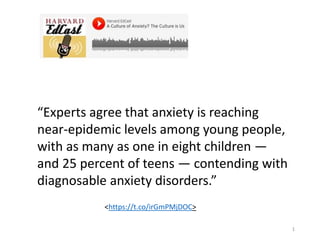
“Experts agree that anxiety is reaching
near-epidemic levels among young people,
with as many as one in eight children —
and 25 percent of teens — contending with
diagnosable anxiety disorders.”
<https://t.co/irGmPMjDOC>
2
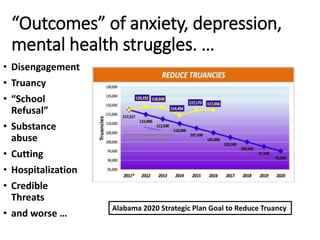
“Outcomes” of anxiety, depression,
mental health struggles. …
• Disengagement
• Truancy
• “School
Refusal”
• Substance
abuse
• Cutting
• Hospitalization
• Credible
Threats
• and worse …
3
Alabama 2020 Strategic Plan Goal to Reduce Truancy
• However, there is hope. This presentation will
share some successful practices driven by
courageous, innovative, compassionate, and
impassioned leaders, teachers, parents, and
students. These practices have made the schools
more humane, healthy, and engaging. Strong
academics have been sustained and definitions of
success have expanded.
4
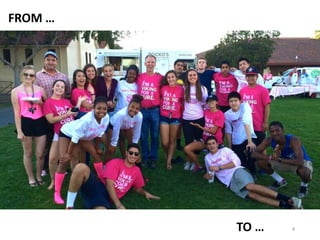
FROM …
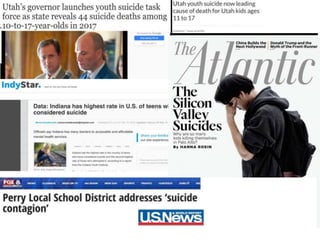
TO …
5
6
7
• However, there is hope. This presentation will
share some successful practices driven by
courageous, innovative, compassionate, and
impassioned leaders, teachers, parents, and
students. These practices have made the schools
more humane, healthy, and engaging. Strong
academics have been sustained and definitions of
success have expanded.
8
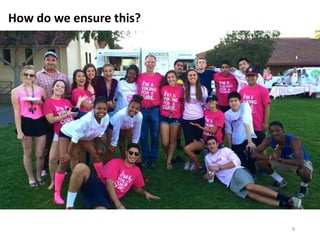
How do we ensure this?
Five Fundamental Beliefs about
Social Emotional Health …
Students who are mentally healthy and social-emotionally
sound are:
1. More likely to succeed academically
2. Have the self-confidence, resilience, grit, and coping
skills to persist in the face of difficult challenges
3. More friendly and skilled in managing positive
relationships
4. More engaged in and connected to school
5. More likely to make wise decisions and thus less likely to
have discipline problems
9
Research supports these beliefs
10
The ability to recognize and manage emotions and establish and maintain
positive relationships impacts both readiness to learn and the ability to
benefit from learning opportunities. In 2011, a team of researchers conducted a
comprehensive meta analysis of school based universal social emotional
interventions which included 213 schools and 270,034 students ranging from
kindergarten through high school.
On average, the researchers found that students receiving social emotional
interventions improved significantly compared to those not receiving an
intervention. Social emotional skills, social behaviors, and academic performance
increased, attitudes towards self and others were more positive, conduct problems
were reduced, and emotional distress lessened.
Farrington, Roderick, Allensworth, Nagaoka, Keyes, Johnson, & Beechum. (2012). Teaching adolescents to become learners: The role of
noncognitive factors in shaping school performance. A critical literature review. Chicago, IL: University of Chicago Consortium on Chicago
School Research.
Durlak et al. (2011). The impact of enhancing students’ social and emotional learning: A metaanalysis of school based universal interventions.
Child Development, 872 (1).
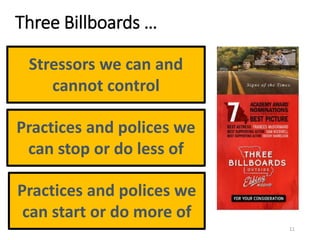
Three Billboards …
Stressors we can and
cannot control
Practices and polices we
can stop or do less of
Practices and polices we
can start or do more of
11
Stressors we cannot control …
12
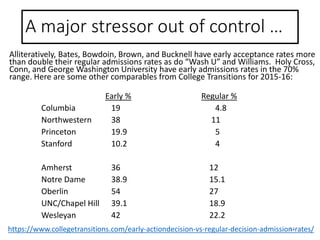
A major stressor out of control …
Alliteratively, Bates, Bowdoin, Brown, and Bucknell have early acceptance rates more
than double their regular admissions rates as do “Wash U” and Williams. Holy Cross,
Conn, and George Washington University have early admissions rates in the 70%
range. Here are some other comparables from College Transitions for 2015-16:
Early % Regular %
Columbia 19 4.8
Northwestern 38 11
Princeton 19.9 5
Stanford 10.2 4
Amherst 36 12
Notre Dame 38.9 15.1
Oberlin 54 27
UNC/Chapel Hill 39.1 18.9
Wesleyan 42 22.2
13https://www.collegetransitions.com/early-actiondecision-vs-regular-decision-admission-rates/
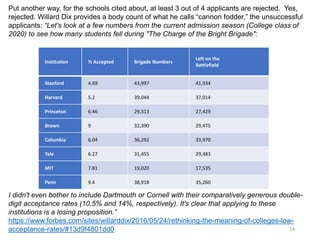
Institution % Accepted Brigade Numbers
Left on the
Battlefield
Stanford 4.69 43,997 41,934
Harvard 5.2 39,044 37,014
Princeton 6.46 29,313 27,429
Brown 9 32,390 29,475
Columbia 6.04 36,292 33,970
Yale 6.27 31,455 29,483
MIT 7.81 19,020 17,535
Penn 9.4 38,918 35,260
14
Put another way, for the schools cited about, at least 3 out of 4 applicants are rejected. Yes,
rejected. Willard Dix provides a body count of what he calls “cannon fodder,” the unsuccessful
applicants: “Let's look at a few numbers from the current admission season (College class of
2020) to see how many students fell during "The Charge of the Bright Brigade":
I didn't even bother to include Dartmouth or Cornell with their comparatively generous double-
digit acceptance rates (10.5% and 14%, respectively). It's clear that applying to these
institutions is a losing proposition.”
https://www.forbes.com/sites/willarddix/2016/05/24/rethinking-the-meaning-of-colleges-low-
acceptance-rates/#13d9f4801dd0
• Student schedules
• Grading and ranking
• Student and STAFF workload
• School climate and culture
• Access to support services and programs
• Recruitment, retention, and evaluation of
administrators and teachers
• Information flow to stakeholders
• Technology use during school hours
• More …. 15
Stressors we can control
• Homework (besides
reading)
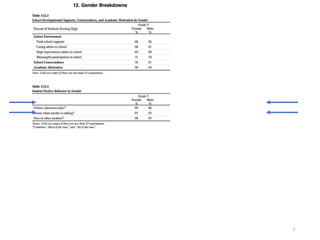
• Discounting gender
differences
• Half-day kindergarten
(kids need half day
for “school” and half
day for choice,
movement, play,
exploration …)
16
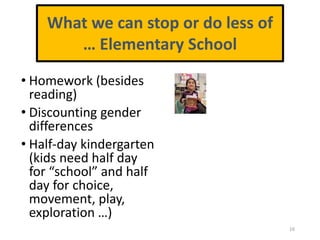
What we can stop or do less of
… Elementary School
• Homework (besides
reading)
• Discounting gender
differences
• Half-day kindergarten
(kids need half day
for “school” and half
day for choice,
movement, play,
exploration …)
17
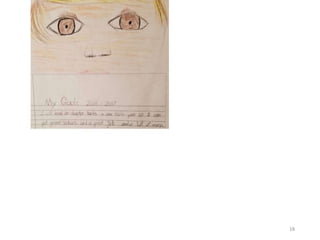
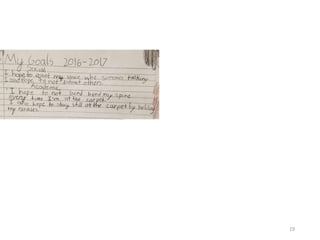
What we can stop or do less of
… Elementary School
18
19
20
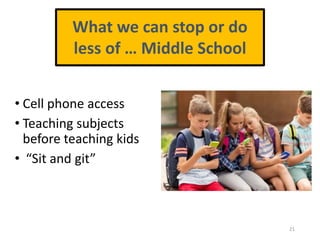
• Cell phone access
• Teaching subjects
before teaching kids
• “Sit and git”
21
What we can stop or do
less of … Middle School
22
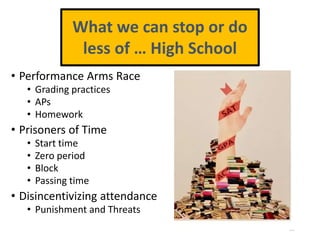
• Performance Arms Race
• Grading practices
• APs
• Homework
• Prisoners of Time
• Start time
• Zero period
• Block
• Passing time
• Disincentivizing attendance
• Punishment and Threats
23
What we can stop or do
less of … High School
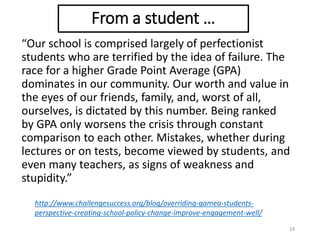
“Our school is comprised largely of perfectionist
students who are terrified by the idea of failure. The
race for a higher Grade Point Average (GPA)
dominates in our community. Our worth and value in
the eyes of our friends, family, and, worst of all,
ourselves, is dictated by this number. Being ranked
by GPA only worsens the crisis through constant
comparison to each other. Mistakes, whether during
lectures or on tests, become viewed by students, and
even many teachers, as signs of weakness and
stupidity.”
24
http://www.challengesuccess.org/blog/overriding-gamea-students-
perspective-creating-school-policy-change-improve-engagement-well/
From a student …
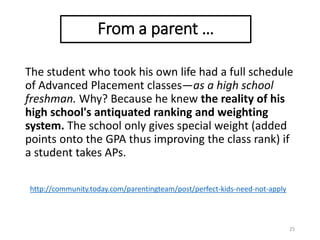
The student who took his own life had a full schedule
of Advanced Placement classes—as a high school
freshman. Why? Because he knew the reality of his
high school's antiquated ranking and weighting
system. The school only gives special weight (added
points onto the GPA thus improving the class rank) if
a student takes APs.
25
http://community.today.com/parentingteam/post/perfect-kids-need-not-apply
From a parent …
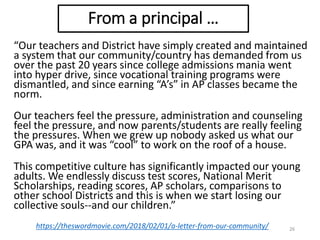
“Our teachers and District have simply created and maintained
a system that our community/country has demanded from us
over the past 20 years since college admissions mania went
into hyper drive, since vocational training programs were
dismantled, and since earning “A’s” in AP classes became the
norm.
Our teachers feel the pressure, administration and counseling
feel the pressure, and now parents/students are really feeling
the pressures. When we grew up nobody asked us what our
GPA was, and it was “cool” to work on the roof of a house.
This competitive culture has significantly impacted our young
adults. We endlessly discuss test scores, National Merit
Scholarships, reading scores, AP scholars, comparisons to
other school Districts and this is when we start losing our
collective souls--and our children.”
26https://theswordmovie.com/2018/02/01/a-letter-from-our-community/
From a principal …
Challenge Success white paper
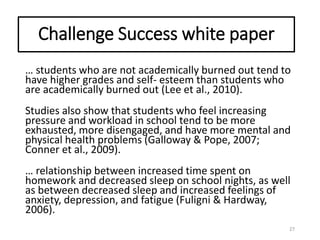
… students who are not academically burned out tend to
have higher grades and self- esteem than students who
are academically burned out (Lee et al., 2010).
Studies also show that students who feel increasing
pressure and workload in school tend to be more
exhausted, more disengaged, and have more mental and
physical health problems (Galloway & Pope, 2007;
Conner et al., 2009).
… relationship between increased time spent on
homework and decreased sleep on school nights, as well
as between decreased sleep and increased feelings of
anxiety, depression, and fatigue (Fuligni & Hardway,
2006).
27
• Performance Arms Race
• Grading practices: eliminate weighting, zeros, inconsistencies
• APs: “warning labels,” open access but restricting amount
• Homework: weekly/daily limit, project stacking monitoring
• Prisoner of Time
• Start time: move it back
• Zero period: dump it
• Block: adopt one
• Advisory/flex: offer it
• Passing periods: lengthen
• Disincentivizing attendance
• Punishment: rewards e.g. finals, passes, …
• Notices: empathy, support
28
Summarizing what we can stop or
do less of …High School
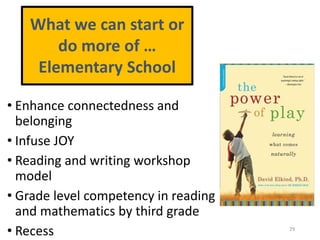
• Enhance connectedness and
belonging
• Infuse JOY
• Reading and writing workshop
model
• Grade level competency in reading
and mathematics by third grade
• Recess 29
What we can start or
do more of …
Elementary School
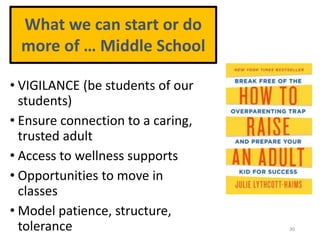
• VIGILANCE (be students of our
students)
• Ensure connection to a caring,
trusted adult
• Access to wellness supports
• Opportunities to move in
classes
• Model patience, structure,
tolerance 30
What we can start or do
more of … Middle School
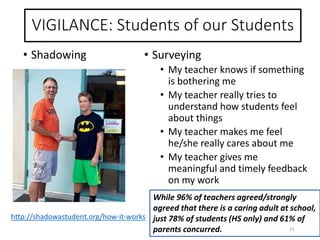
VIGILANCE: Students of our Students
• Shadowing
31
• Surveying
• My teacher knows if something
is bothering me
• My teacher really tries to
understand how students feel
about things
• My teacher makes me feel
he/she really cares about me
• My teacher gives me
meaningful and timely feedback
on my work
While 96% of teachers agreed/strongly
agreed that there is a caring adult at school,
just 78% of students (HS only) and 61% of
parents concurred.
http://shadowastudent.org/how-it-works
• Enhance connectedness and belonging
through purpose, meaning, and joy
• Access to wellness supports
• Incentivize attendance
• Information to parents and students
• Admissions
• Destigmatize help-seeking
• Means restriction
• Provide for AUTHENTIC student choice and
voice
32
What we can start or do
more of … High School
VIGILANCE: Stop, Look, Listen
33
• Stop
• Focusing on adult issues
• Rationalizing their behavioral
changes as mood swings
• Talking and look and listen more
• Look
• Signs of sleep deprivation
• Disengaging in favorite activities
• Into their social media
• Listen
• To what is not being said
• To you child’s peers
• To your own gut
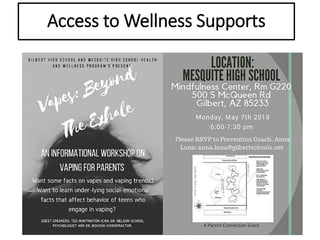
Access to Wellness Supports
34
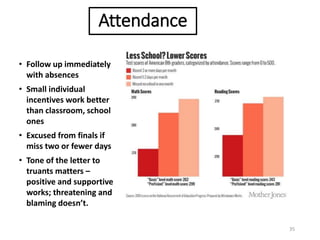
Attendance
35
• Follow up immediately
with absences
• Small individual
incentives work better
than classroom, school
ones
• Excused from finals if
miss two or fewer days
• Tone of the letter to
truants matters –
positive and supportive
works; threatening and
blaming doesn’t.
36
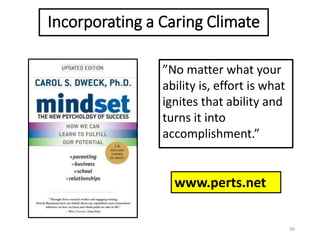
”No matter what your
ability is, effort is what
ignites that ability and
turns it into
accomplishment.”
www.perts.net
Incorporating a Caring Climate
WHY: Students with a growth
mindset have …
• More
Resilience
• Stronger
Desire for
Learning
• Higher
Achievement
• Greater
Motivation
37
FEEDBACK: Breaking the Cycle of Mistrust:
Wise Interventions to Provide Critical
Feedback Across the Racial Divide
• The wise feedback treatment note stated, “I’m
giving you these comments because I have very high
expectations and I know that you can reach them.”
• By contrast, the placebo control note stated, “I’m
giving you these comments so that you’ll have
feedback on your paper.”
38
Journal of Experimental Psychology
American Psychological Association
2014, Vol. 143, No. 2, 804–824
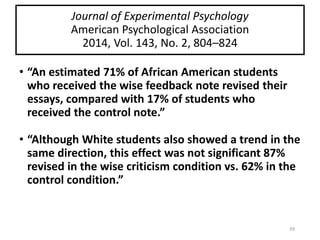
• “An estimated 71% of African American students
who received the wise feedback note revised their
essays, compared with 17% of students who
received the control note.”
• “Although White students also showed a trend in the
same direction, this effect was not significant 87%
revised in the wise criticism condition vs. 62% in the
control condition.”
39
40
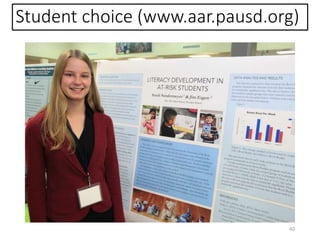
Student choice (www.aar.pausd.org)
41
FREE Resources
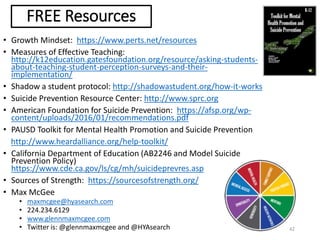
• Growth Mindset: https://www.perts.net/resources
• Measures of Effective Teaching:
http://k12education.gatesfoundation.org/resource/asking-students-
about-teaching-student-perception-surveys-and-their-
implementation/
• Shadow a student protocol: http://shadowastudent.org/how-it-works
• Suicide Prevention Resource Center: http://www.sprc.org
• American Foundation for Suicide Prevention: https://afsp.org/wp-
content/uploads/2016/01/recommendations.pdf
• PAUSD Toolkit for Mental Health Promotion and Suicide Prevention
http://www.heardalliance.org/help-toolkit/
• California Department of Education (AB2246 and Model Suicide
Prevention Policy)
https://www.cde.ca.gov/ls/cg/mh/suicideprevres.asp
• Sources of Strength: https://sourcesofstrength.org/
• Max McGee
• maxmcgee@hyasearch.com
• 224.234.6129
• www.glennmaxmcgee.com
• Twitter is: @glennmaxmcgee and @HYAsearch 42

IASB DINNER MEETING PRESENTATION

  • 1.
    DuPage County IASB DinnerMeeting October 2018 Glenn W. “Max” McGee maxmcgee@hyasearch.com 224.234.6129 @glennmaxmcgee www.glennmaxmcgee.com From Distress to Success
  • 2.
    1 “Experts agree thatanxiety is reaching near-epidemic levels among young people, with as many as one in eight children — and 25 percent of teens — contending with diagnosable anxiety disorders.” <https://t.co/irGmPMjDOC>
  • 3.
  • 4.
    “Outcomes” of anxiety,depression, mental health struggles. … • Disengagement • Truancy • “School Refusal” • Substance abuse • Cutting • Hospitalization • Credible Threats • and worse … 3 Alabama 2020 Strategic Plan Goal to Reduce Truancy
  • 5.
    • However, thereis hope. This presentation will share some successful practices driven by courageous, innovative, compassionate, and impassioned leaders, teachers, parents, and students. These practices have made the schools more humane, healthy, and engaging. Strong academics have been sustained and definitions of success have expanded. 4 FROM … TO …
  • 6.
  • 7.
  • 8.
  • 9.
    • However, thereis hope. This presentation will share some successful practices driven by courageous, innovative, compassionate, and impassioned leaders, teachers, parents, and students. These practices have made the schools more humane, healthy, and engaging. Strong academics have been sustained and definitions of success have expanded. 8 How do we ensure this?
  • 10.
    Five Fundamental Beliefsabout Social Emotional Health … Students who are mentally healthy and social-emotionally sound are: 1. More likely to succeed academically 2. Have the self-confidence, resilience, grit, and coping skills to persist in the face of difficult challenges 3. More friendly and skilled in managing positive relationships 4. More engaged in and connected to school 5. More likely to make wise decisions and thus less likely to have discipline problems 9
  • 11.
    Research supports thesebeliefs 10 The ability to recognize and manage emotions and establish and maintain positive relationships impacts both readiness to learn and the ability to benefit from learning opportunities. In 2011, a team of researchers conducted a comprehensive meta analysis of school based universal social emotional interventions which included 213 schools and 270,034 students ranging from kindergarten through high school. On average, the researchers found that students receiving social emotional interventions improved significantly compared to those not receiving an intervention. Social emotional skills, social behaviors, and academic performance increased, attitudes towards self and others were more positive, conduct problems were reduced, and emotional distress lessened. Farrington, Roderick, Allensworth, Nagaoka, Keyes, Johnson, & Beechum. (2012). Teaching adolescents to become learners: The role of noncognitive factors in shaping school performance. A critical literature review. Chicago, IL: University of Chicago Consortium on Chicago School Research. Durlak et al. (2011). The impact of enhancing students’ social and emotional learning: A metaanalysis of school based universal interventions. Child Development, 872 (1).
  • 12.
    Three Billboards … Stressorswe can and cannot control Practices and polices we can stop or do less of Practices and polices we can start or do more of 11
  • 13.
    Stressors we cannotcontrol … 12
  • 14.
    A major stressorout of control … Alliteratively, Bates, Bowdoin, Brown, and Bucknell have early acceptance rates more than double their regular admissions rates as do “Wash U” and Williams. Holy Cross, Conn, and George Washington University have early admissions rates in the 70% range. Here are some other comparables from College Transitions for 2015-16: Early % Regular % Columbia 19 4.8 Northwestern 38 11 Princeton 19.9 5 Stanford 10.2 4 Amherst 36 12 Notre Dame 38.9 15.1 Oberlin 54 27 UNC/Chapel Hill 39.1 18.9 Wesleyan 42 22.2 13https://www.collegetransitions.com/early-actiondecision-vs-regular-decision-admission-rates/
  • 15.
    Institution % AcceptedBrigade Numbers Left on the Battlefield Stanford 4.69 43,997 41,934 Harvard 5.2 39,044 37,014 Princeton 6.46 29,313 27,429 Brown 9 32,390 29,475 Columbia 6.04 36,292 33,970 Yale 6.27 31,455 29,483 MIT 7.81 19,020 17,535 Penn 9.4 38,918 35,260 14 Put another way, for the schools cited about, at least 3 out of 4 applicants are rejected. Yes, rejected. Willard Dix provides a body count of what he calls “cannon fodder,” the unsuccessful applicants: “Let's look at a few numbers from the current admission season (College class of 2020) to see how many students fell during "The Charge of the Bright Brigade": I didn't even bother to include Dartmouth or Cornell with their comparatively generous double- digit acceptance rates (10.5% and 14%, respectively). It's clear that applying to these institutions is a losing proposition.” https://www.forbes.com/sites/willarddix/2016/05/24/rethinking-the-meaning-of-colleges-low- acceptance-rates/#13d9f4801dd0
  • 16.
    • Student schedules •Grading and ranking • Student and STAFF workload • School climate and culture • Access to support services and programs • Recruitment, retention, and evaluation of administrators and teachers • Information flow to stakeholders • Technology use during school hours • More …. 15 Stressors we can control
  • 17.
    • Homework (besides reading) •Discounting gender differences • Half-day kindergarten (kids need half day for “school” and half day for choice, movement, play, exploration …) 16 What we can stop or do less of … Elementary School
  • 18.
    • Homework (besides reading) •Discounting gender differences • Half-day kindergarten (kids need half day for “school” and half day for choice, movement, play, exploration …) 17 What we can stop or do less of … Elementary School
  • 19.
  • 20.
  • 21.
  • 22.
    • Cell phoneaccess • Teaching subjects before teaching kids • “Sit and git” 21 What we can stop or do less of … Middle School
  • 23.
  • 24.
    • Performance ArmsRace • Grading practices • APs • Homework • Prisoners of Time • Start time • Zero period • Block • Passing time • Disincentivizing attendance • Punishment and Threats 23 What we can stop or do less of … High School
  • 25.
    “Our school iscomprised largely of perfectionist students who are terrified by the idea of failure. The race for a higher Grade Point Average (GPA) dominates in our community. Our worth and value in the eyes of our friends, family, and, worst of all, ourselves, is dictated by this number. Being ranked by GPA only worsens the crisis through constant comparison to each other. Mistakes, whether during lectures or on tests, become viewed by students, and even many teachers, as signs of weakness and stupidity.” 24 http://www.challengesuccess.org/blog/overriding-gamea-students- perspective-creating-school-policy-change-improve-engagement-well/ From a student …
  • 26.
    The student whotook his own life had a full schedule of Advanced Placement classes—as a high school freshman. Why? Because he knew the reality of his high school's antiquated ranking and weighting system. The school only gives special weight (added points onto the GPA thus improving the class rank) if a student takes APs. 25 http://community.today.com/parentingteam/post/perfect-kids-need-not-apply From a parent …
  • 27.
    “Our teachers andDistrict have simply created and maintained a system that our community/country has demanded from us over the past 20 years since college admissions mania went into hyper drive, since vocational training programs were dismantled, and since earning “A’s” in AP classes became the norm. Our teachers feel the pressure, administration and counseling feel the pressure, and now parents/students are really feeling the pressures. When we grew up nobody asked us what our GPA was, and it was “cool” to work on the roof of a house. This competitive culture has significantly impacted our young adults. We endlessly discuss test scores, National Merit Scholarships, reading scores, AP scholars, comparisons to other school Districts and this is when we start losing our collective souls--and our children.” 26https://theswordmovie.com/2018/02/01/a-letter-from-our-community/ From a principal …
  • 28.
    Challenge Success whitepaper … students who are not academically burned out tend to have higher grades and self- esteem than students who are academically burned out (Lee et al., 2010). Studies also show that students who feel increasing pressure and workload in school tend to be more exhausted, more disengaged, and have more mental and physical health problems (Galloway & Pope, 2007; Conner et al., 2009). … relationship between increased time spent on homework and decreased sleep on school nights, as well as between decreased sleep and increased feelings of anxiety, depression, and fatigue (Fuligni & Hardway, 2006). 27
  • 29.
    • Performance ArmsRace • Grading practices: eliminate weighting, zeros, inconsistencies • APs: “warning labels,” open access but restricting amount • Homework: weekly/daily limit, project stacking monitoring • Prisoner of Time • Start time: move it back • Zero period: dump it • Block: adopt one • Advisory/flex: offer it • Passing periods: lengthen • Disincentivizing attendance • Punishment: rewards e.g. finals, passes, … • Notices: empathy, support 28 Summarizing what we can stop or do less of …High School
  • 30.
    • Enhance connectednessand belonging • Infuse JOY • Reading and writing workshop model • Grade level competency in reading and mathematics by third grade • Recess 29 What we can start or do more of … Elementary School
  • 31.
    • VIGILANCE (bestudents of our students) • Ensure connection to a caring, trusted adult • Access to wellness supports • Opportunities to move in classes • Model patience, structure, tolerance 30 What we can start or do more of … Middle School
  • 32.
    VIGILANCE: Students ofour Students • Shadowing 31 • Surveying • My teacher knows if something is bothering me • My teacher really tries to understand how students feel about things • My teacher makes me feel he/she really cares about me • My teacher gives me meaningful and timely feedback on my work While 96% of teachers agreed/strongly agreed that there is a caring adult at school, just 78% of students (HS only) and 61% of parents concurred. http://shadowastudent.org/how-it-works
  • 33.
    • Enhance connectednessand belonging through purpose, meaning, and joy • Access to wellness supports • Incentivize attendance • Information to parents and students • Admissions • Destigmatize help-seeking • Means restriction • Provide for AUTHENTIC student choice and voice 32 What we can start or do more of … High School
  • 34.
    VIGILANCE: Stop, Look,Listen 33 • Stop • Focusing on adult issues • Rationalizing their behavioral changes as mood swings • Talking and look and listen more • Look • Signs of sleep deprivation • Disengaging in favorite activities • Into their social media • Listen • To what is not being said • To you child’s peers • To your own gut
  • 35.
    Access to WellnessSupports 34
  • 36.
    Attendance 35 • Follow upimmediately with absences • Small individual incentives work better than classroom, school ones • Excused from finals if miss two or fewer days • Tone of the letter to truants matters – positive and supportive works; threatening and blaming doesn’t.
  • 37.
    36 ”No matter whatyour ability is, effort is what ignites that ability and turns it into accomplishment.” www.perts.net Incorporating a Caring Climate
  • 38.
    WHY: Students witha growth mindset have … • More Resilience • Stronger Desire for Learning • Higher Achievement • Greater Motivation 37
  • 39.
    FEEDBACK: Breaking theCycle of Mistrust: Wise Interventions to Provide Critical Feedback Across the Racial Divide • The wise feedback treatment note stated, “I’m giving you these comments because I have very high expectations and I know that you can reach them.” • By contrast, the placebo control note stated, “I’m giving you these comments so that you’ll have feedback on your paper.” 38
  • 40.
    Journal of ExperimentalPsychology American Psychological Association 2014, Vol. 143, No. 2, 804–824 • “An estimated 71% of African American students who received the wise feedback note revised their essays, compared with 17% of students who received the control note.” • “Although White students also showed a trend in the same direction, this effect was not significant 87% revised in the wise criticism condition vs. 62% in the control condition.” 39
  • 41.
  • 42.
  • 43.
    FREE Resources • GrowthMindset: https://www.perts.net/resources • Measures of Effective Teaching: http://k12education.gatesfoundation.org/resource/asking-students- about-teaching-student-perception-surveys-and-their- implementation/ • Shadow a student protocol: http://shadowastudent.org/how-it-works • Suicide Prevention Resource Center: http://www.sprc.org • American Foundation for Suicide Prevention: https://afsp.org/wp- content/uploads/2016/01/recommendations.pdf • PAUSD Toolkit for Mental Health Promotion and Suicide Prevention http://www.heardalliance.org/help-toolkit/ • California Department of Education (AB2246 and Model Suicide Prevention Policy) https://www.cde.ca.gov/ls/cg/mh/suicideprevres.asp • Sources of Strength: https://sourcesofstrength.org/ • Max McGee • maxmcgee@hyasearch.com • 224.234.6129 • www.glennmaxmcgee.com • Twitter is: @glennmaxmcgee and @HYAsearch 42