High Performance Websites

Alla Gringaus
Daniel Mendelsohn
Aaron Grogg
Time Inc. Interactive
Front-end Web Development Team.
Lunch & Learn.
02.12.2008
In the blink of an eye…

 You only have one chance to make a first impression.
 "In the blink of an eye" your site (blog or website) is judged.
 With so many sites and blogs to choose from, a site that loads
 at a snail's pace or is hard to navigate will send frustrated
 potential visitors on to their next destination.

 Good design, effective usability and speedy site performance
 are three very important considerations for building and
 keeping an audience. They add to your credibility and help
 build your audience’s trust, which is the only way to achieve
 user loyalty.
How much information is out there?

 How large is the Web?
 Tens of billions of documents? Hundreds?
 10KB/doc => 100s of Terabytes
 Email, personal files, databases, broadcast media, archives
 Estimated 5 Exabyte/year (growing at 30%)
 800MB/Year/Person – 90% in magnetic media
 Web is just a tiny starting point
 Google is working on how to organize all this information
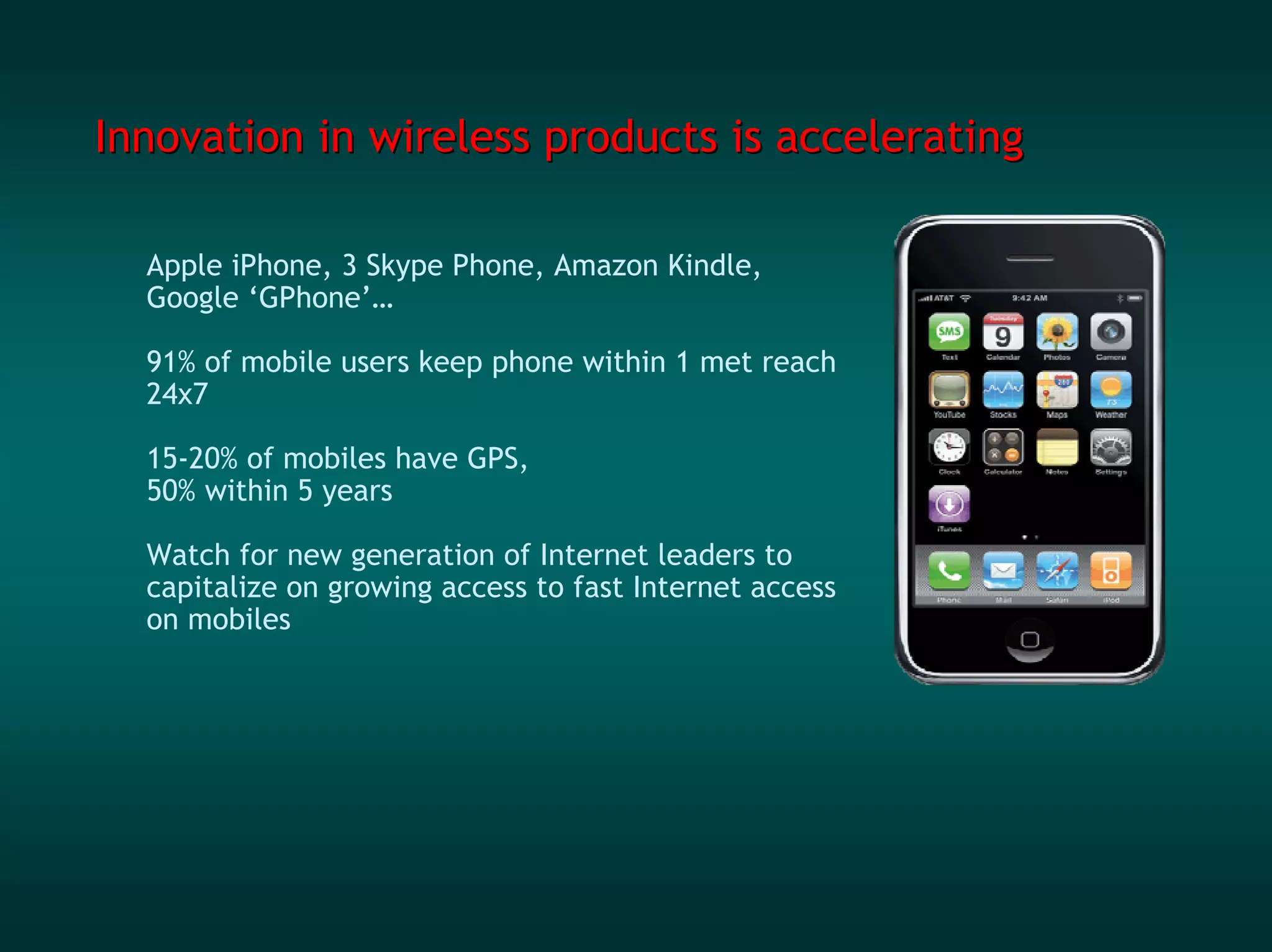
Innovation in wireless products is accelerating

  Apple iPhone, 3 Skype Phone, Amazon Kindle,
  Google ‘GPhone’…

  91% of mobile users keep phone within 1 met reach
  24x7

  15-20% of mobiles have GPS,
  50% within 5 years

  Watch for new generation of Internet leaders to
  capitalize on growing access to fast Internet access
  on mobiles
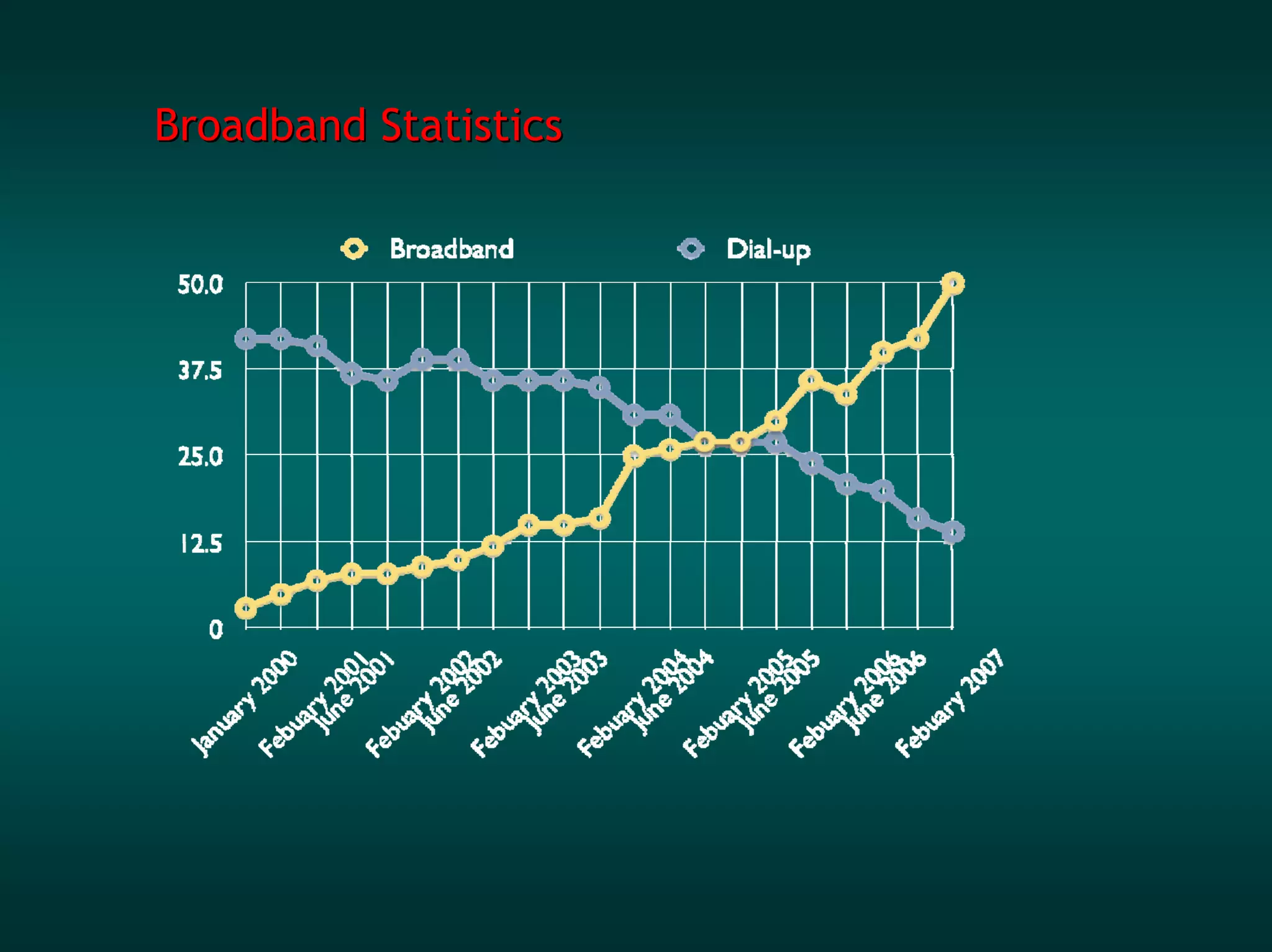
Broadband Statistics
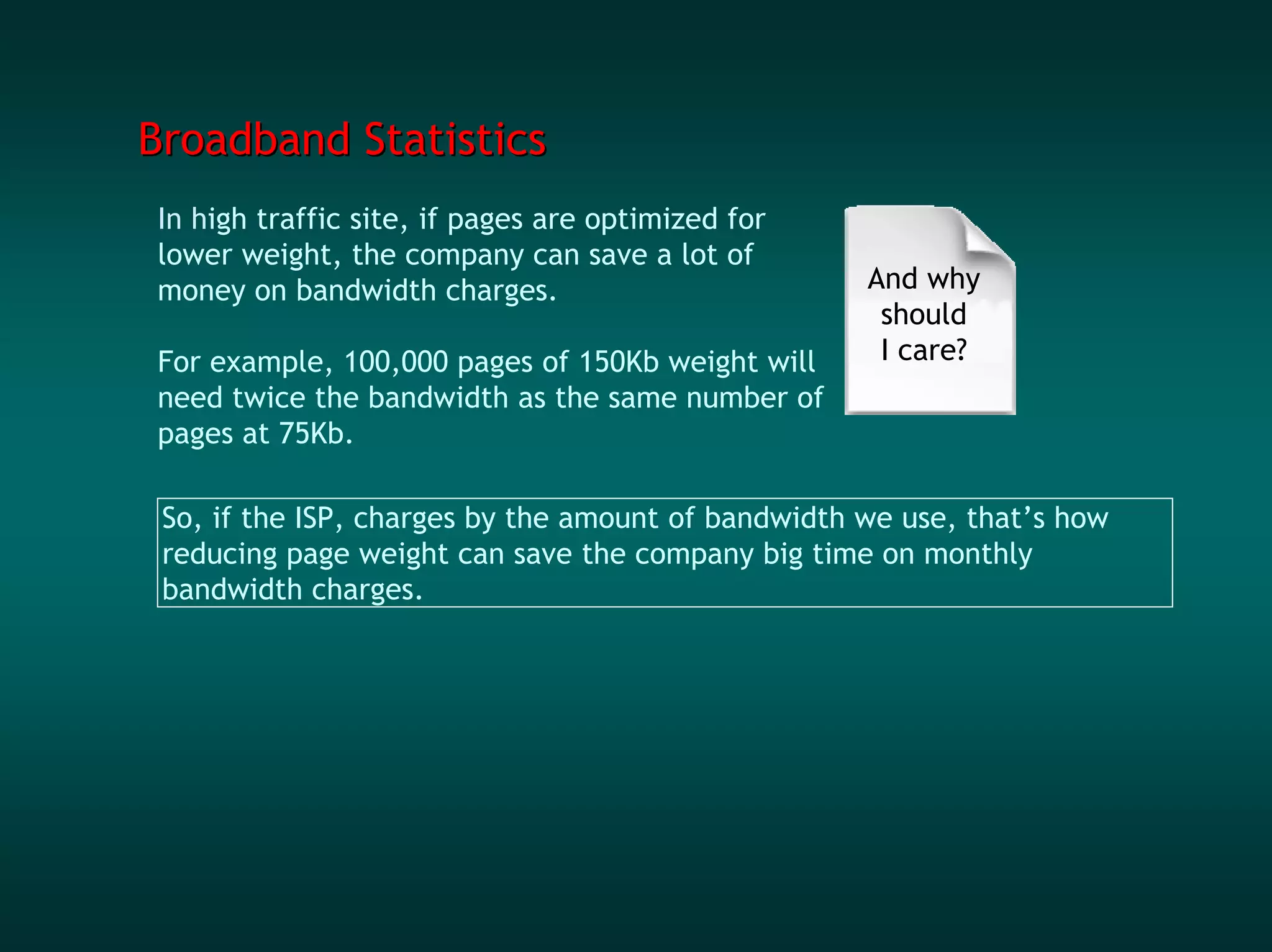
In high traffic site, if pages are optimized for
lower weight, the company can save a lot of
money on bandwidth charges.                         And why
                                                     should
For example, 100,000 pages of 150Kb weight will      I care?
need twice the bandwidth as the same number of
pages at 75Kb.

 So, if the ISP, charges by the amount of bandwidth we use, that’s how
 reducing page weight can save the company big time on monthly
 bandwidth charges.
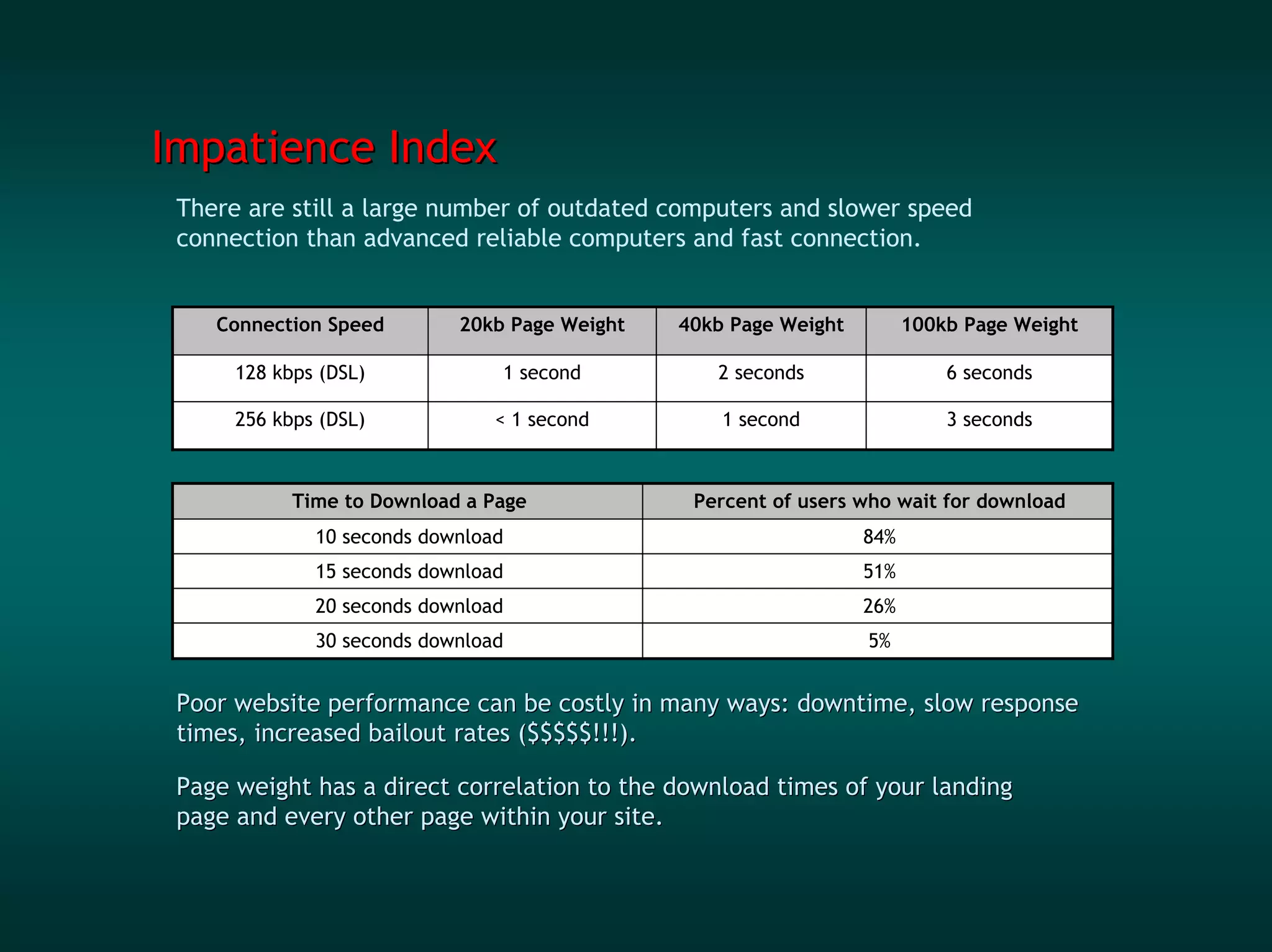
Impatience Index
 There are still a large number of outdated computers and slower speed
 connection than advanced reliable computers and fast connection.


    Connection Speed        20kb Page Weight   40kb Page Weight         100kb Page Weight

      128 kbps (DSL)            1 second          2 seconds                 6 seconds

      256 kbps (DSL)            < 1 second         1 second                 3 seconds


            Time to Download a Page             Percent of users who wait for download
              10 seconds download                                 84%
              15 seconds download                                 51%
              20 seconds download                                 26%
              30 seconds download                                 5%


 Poor website performance can be costly in many ways: downtime, slow response
 times, increased bailout rates ($$$$$!!!).

 Page weight has a direct correlation to the download times of your landing
 page and every other page within your site.
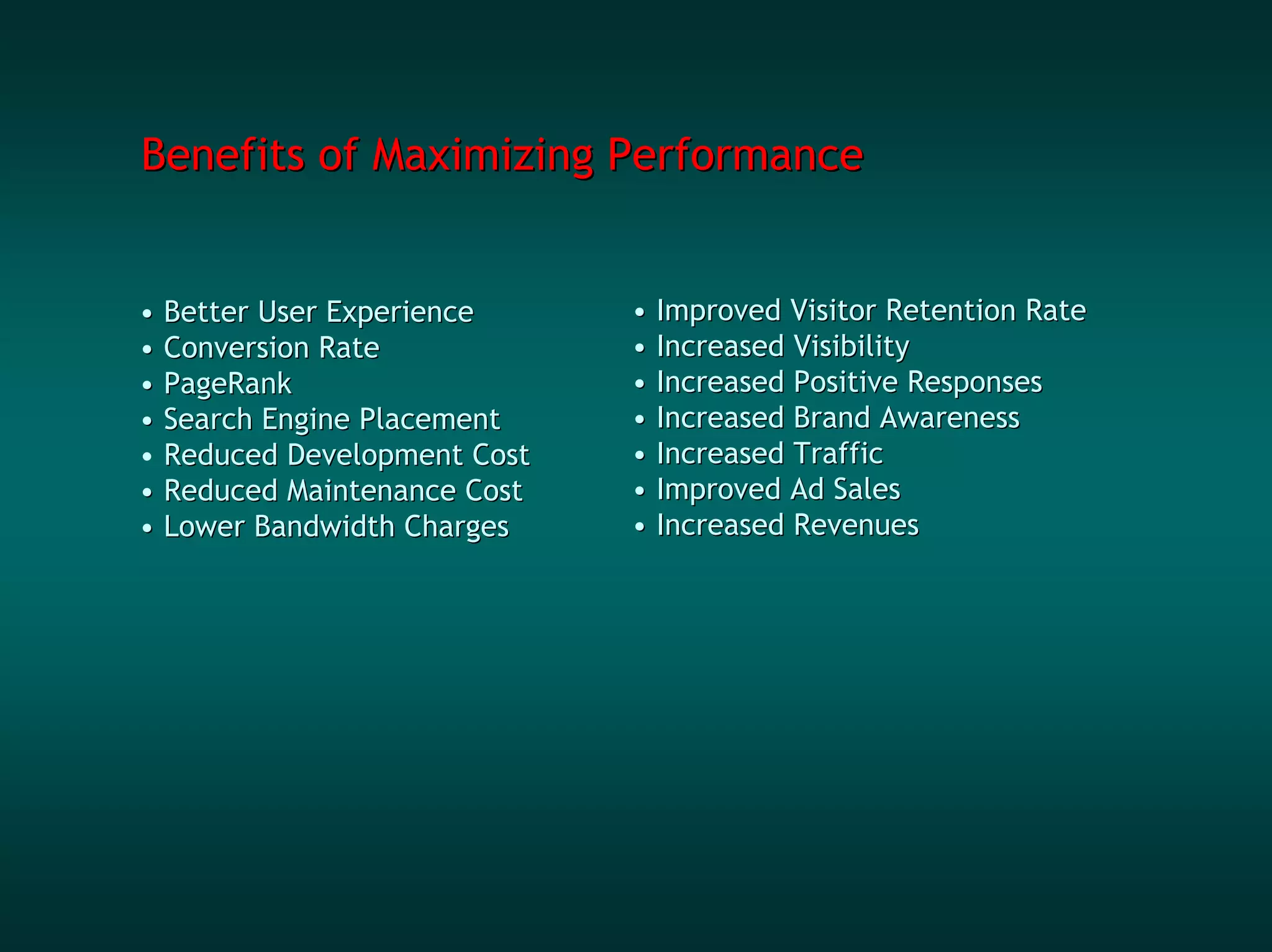
Benefits of Maximizing Performance


• Better User Experience     • Improved Visitor Retention Rate
• Conversion Rate            • Increased Visibility
• PageRank                   • Increased Positive Responses
• Search Engine Placement    • Increased Brand Awareness
• Reduced Development Cost   • Increased Traffic
• Reduced Maintenance Cost   • Improved Ad Sales
• Lower Bandwidth Charges    • Increased Revenues
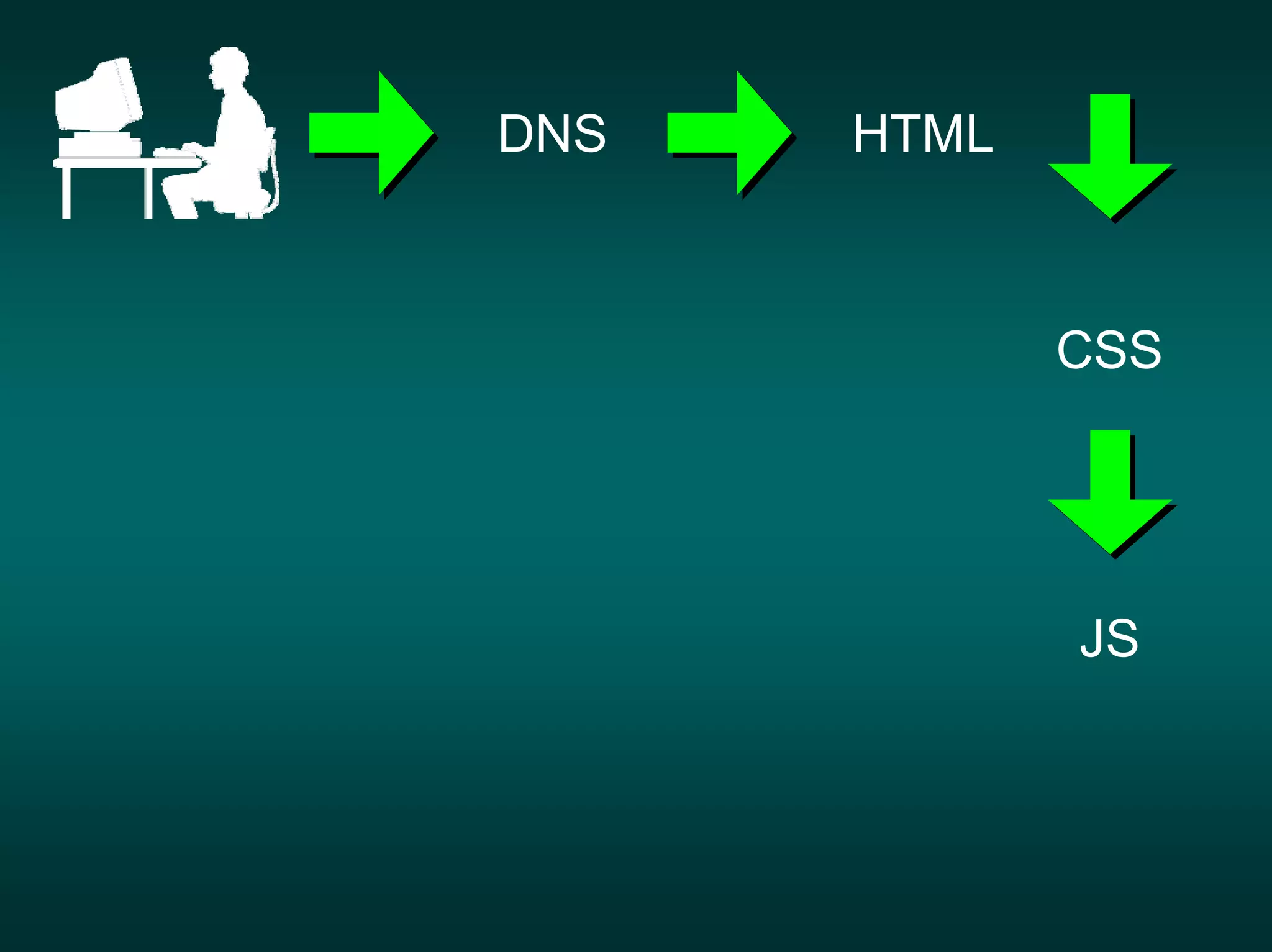
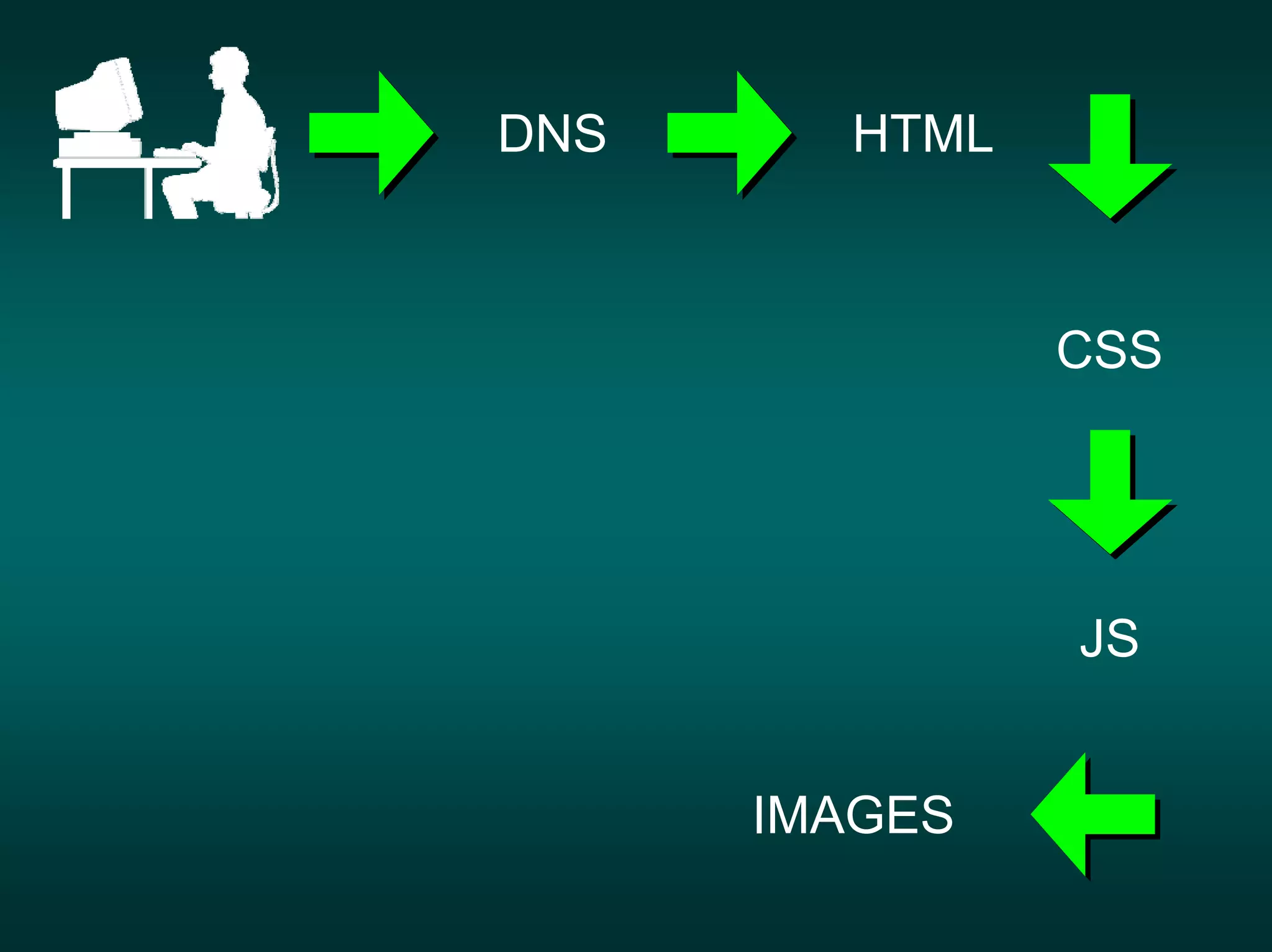
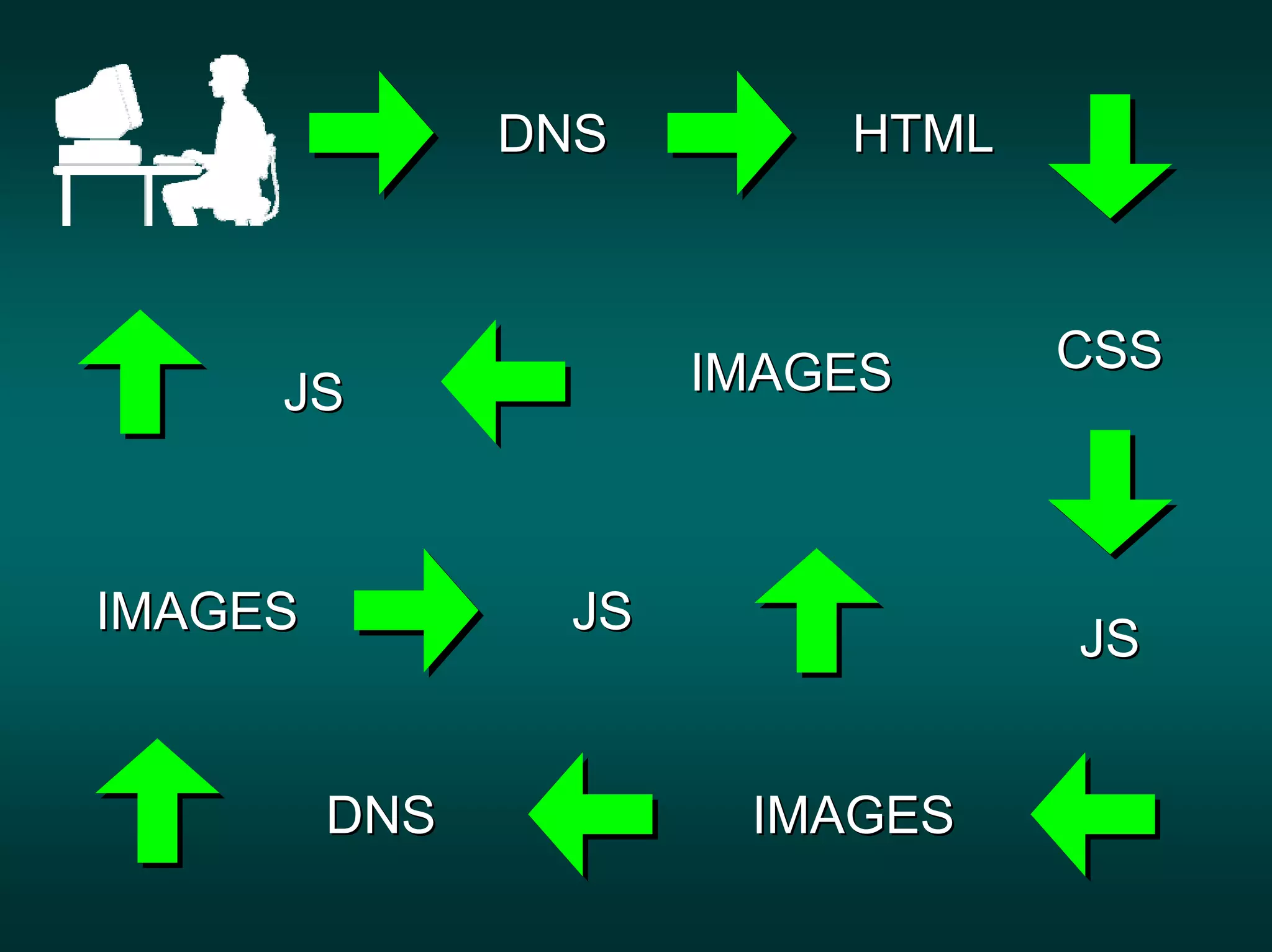
How the web works in 5 minutes,
        hold on tight...
DNS
DNS


152.255.255.37
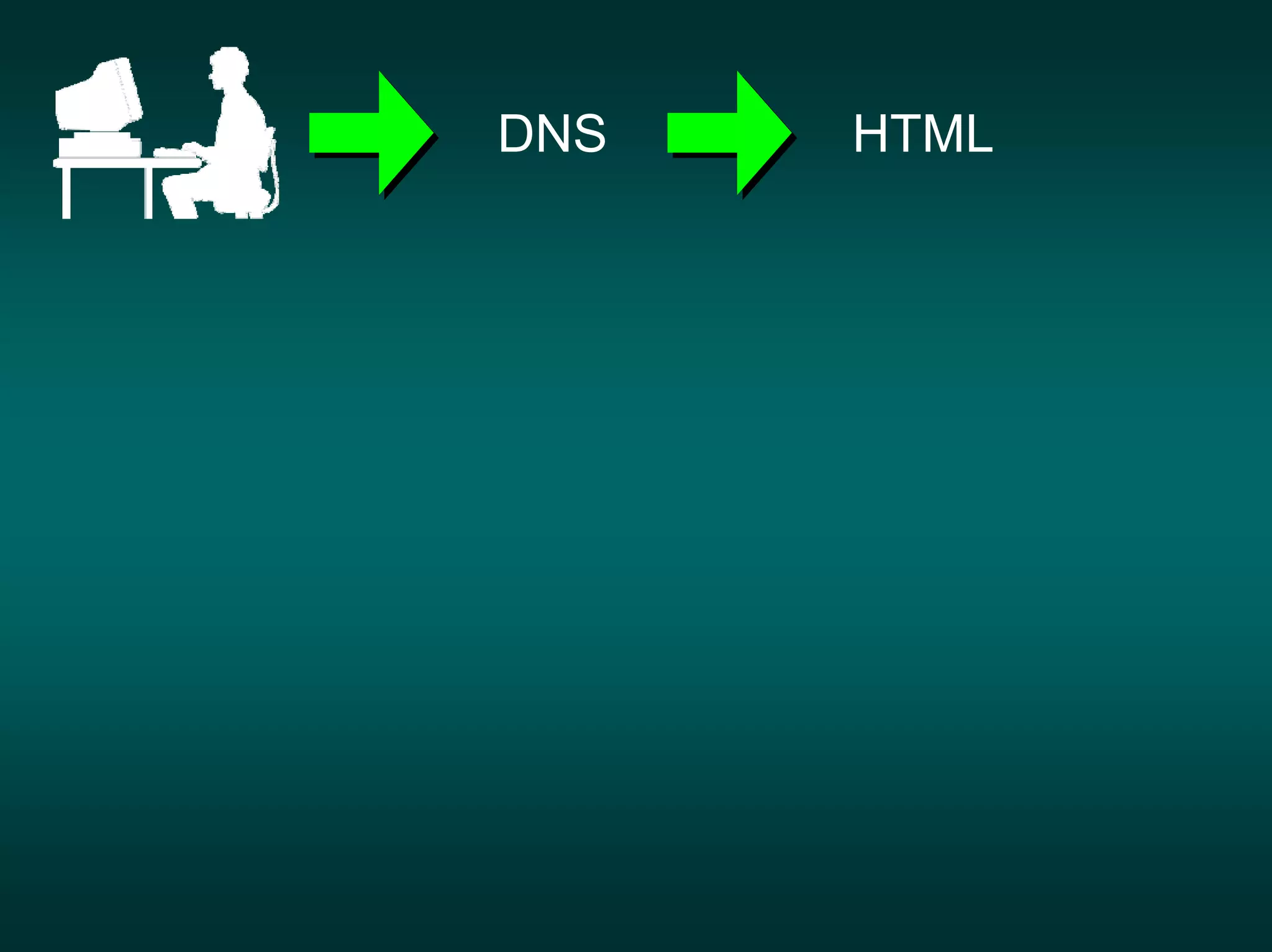
DNS   HTML
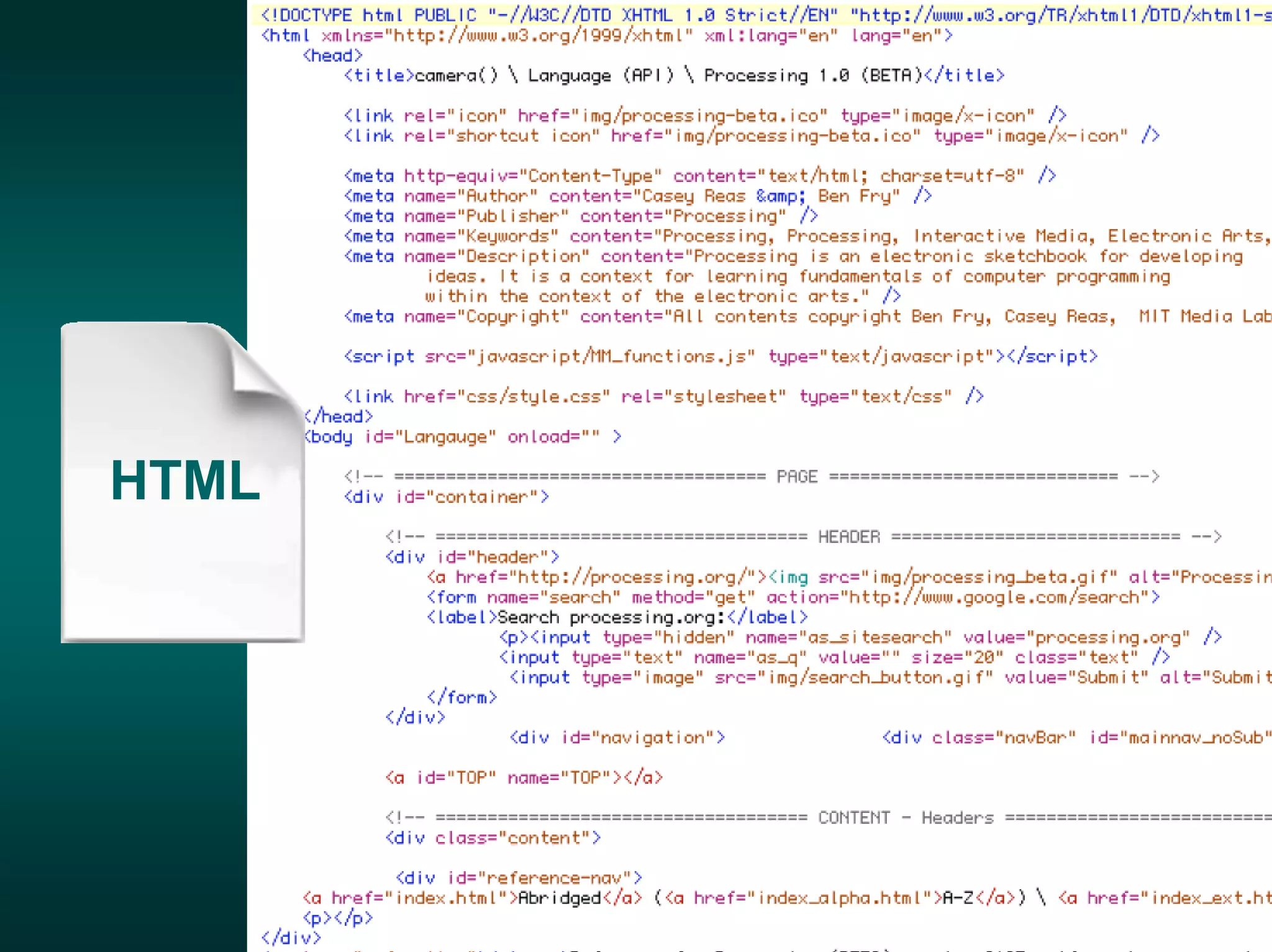
HTML
DNS   HTML


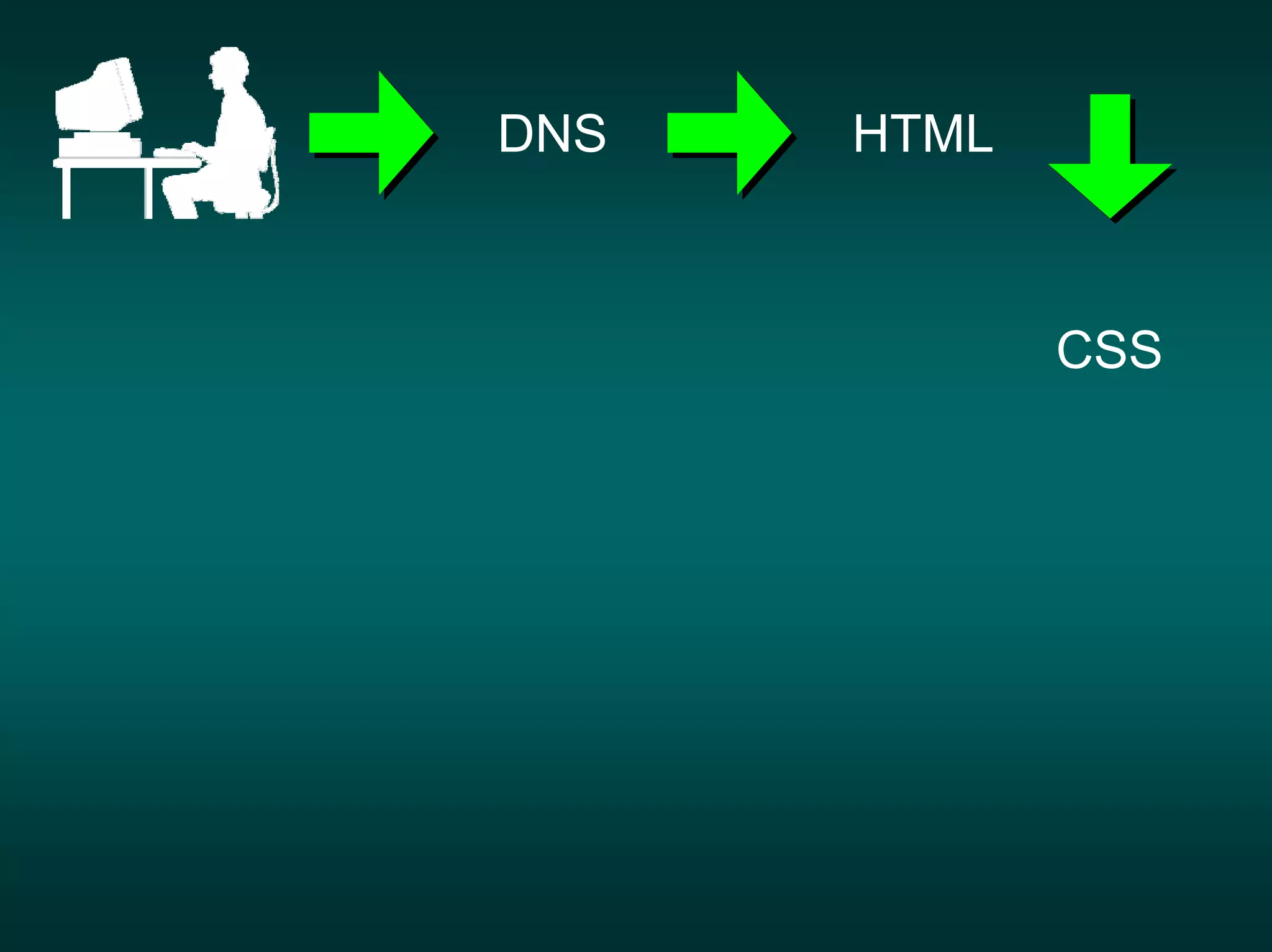
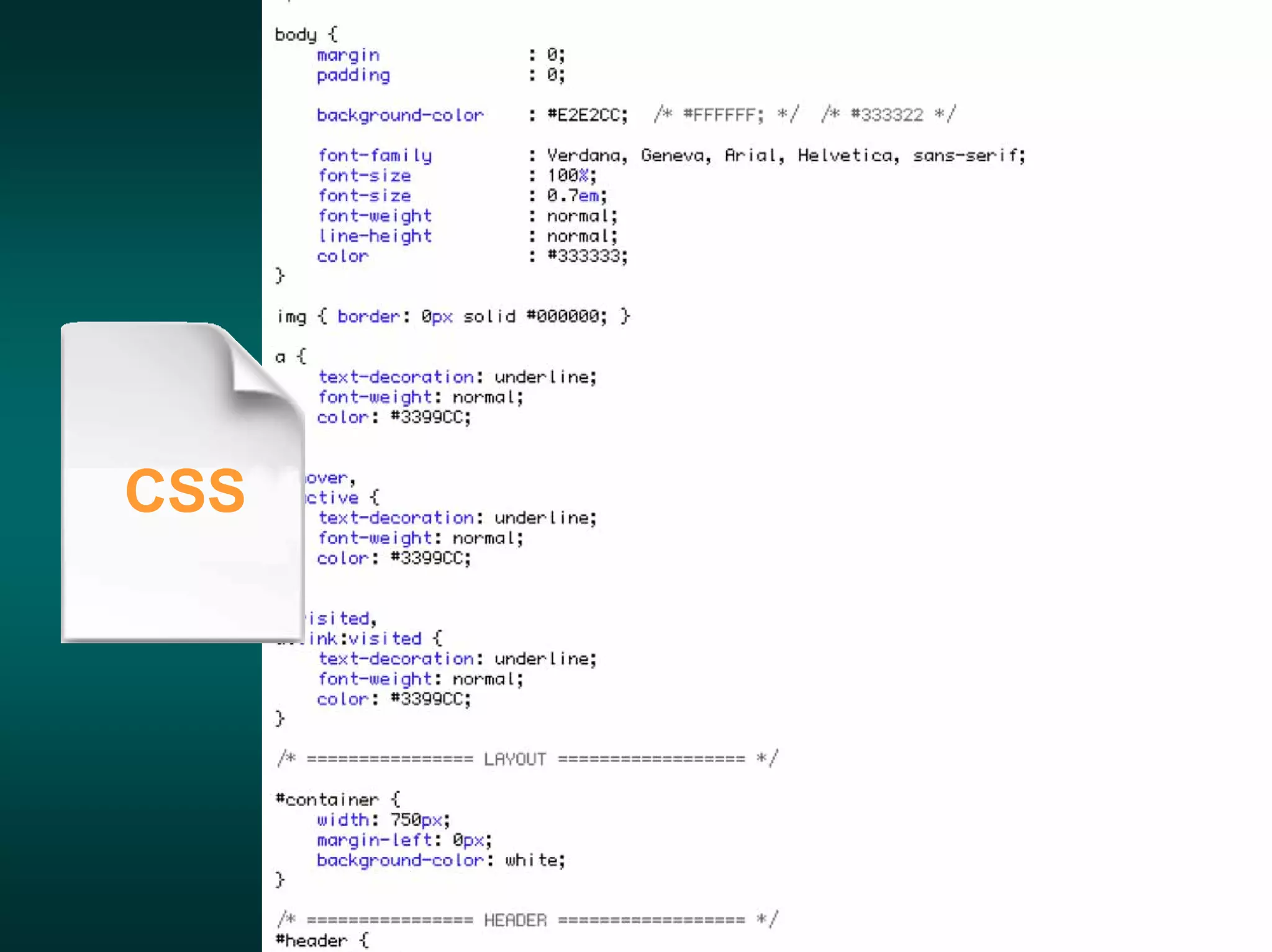
             CSS
CSS
DNS   HTML


             CSS


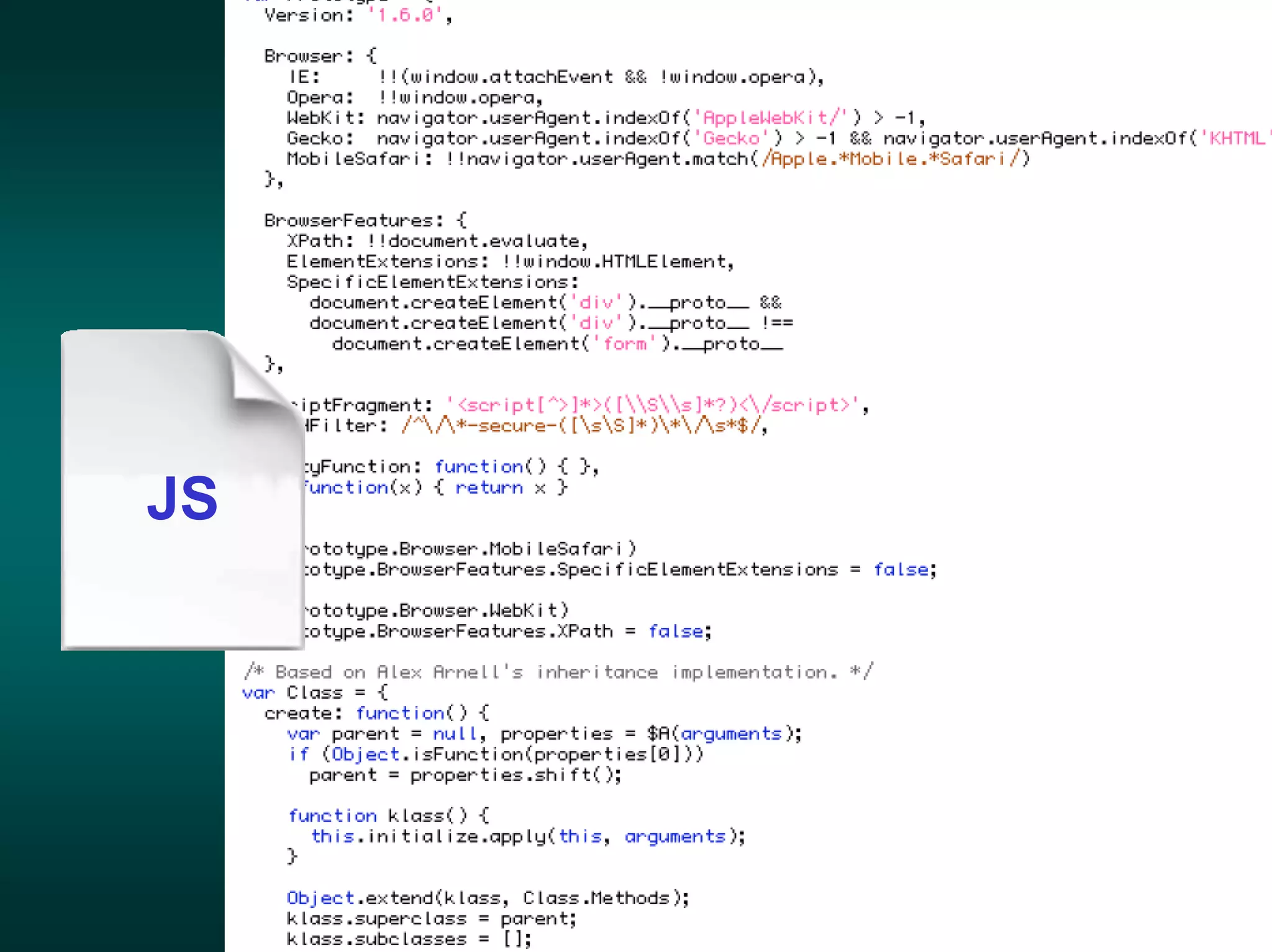
             JS
JS
DNS     HTML


               CSS


               JS


      IMAGES
IMAGES
DNS       HTML


                     IMAGES     CSS
     JS


IMAGES          JS
                                JS


         DNS          IMAGES
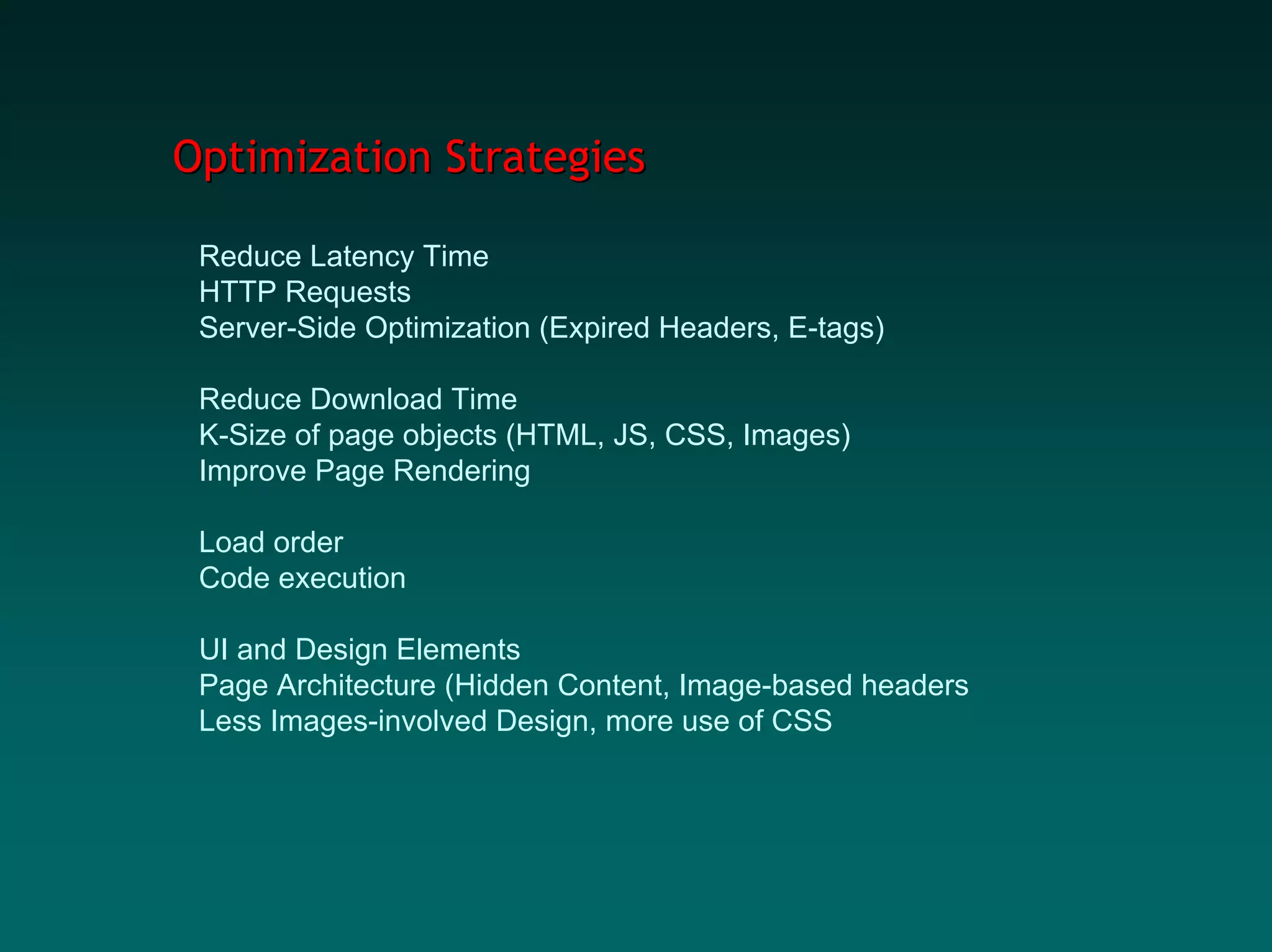
Optimization Strategies

 Reduce Latency Time
 HTTP Requests
 Server-Side Optimization (Expired Headers, E-tags)

 Reduce Download Time
 K-Size of page objects (HTML, JS, CSS, Images)
 Improve Page Rendering

 Load order
 Code execution

 UI and Design Elements
 Page Architecture (Hidden Content, Image-based headers
 Less Images-involved Design, more use of CSS
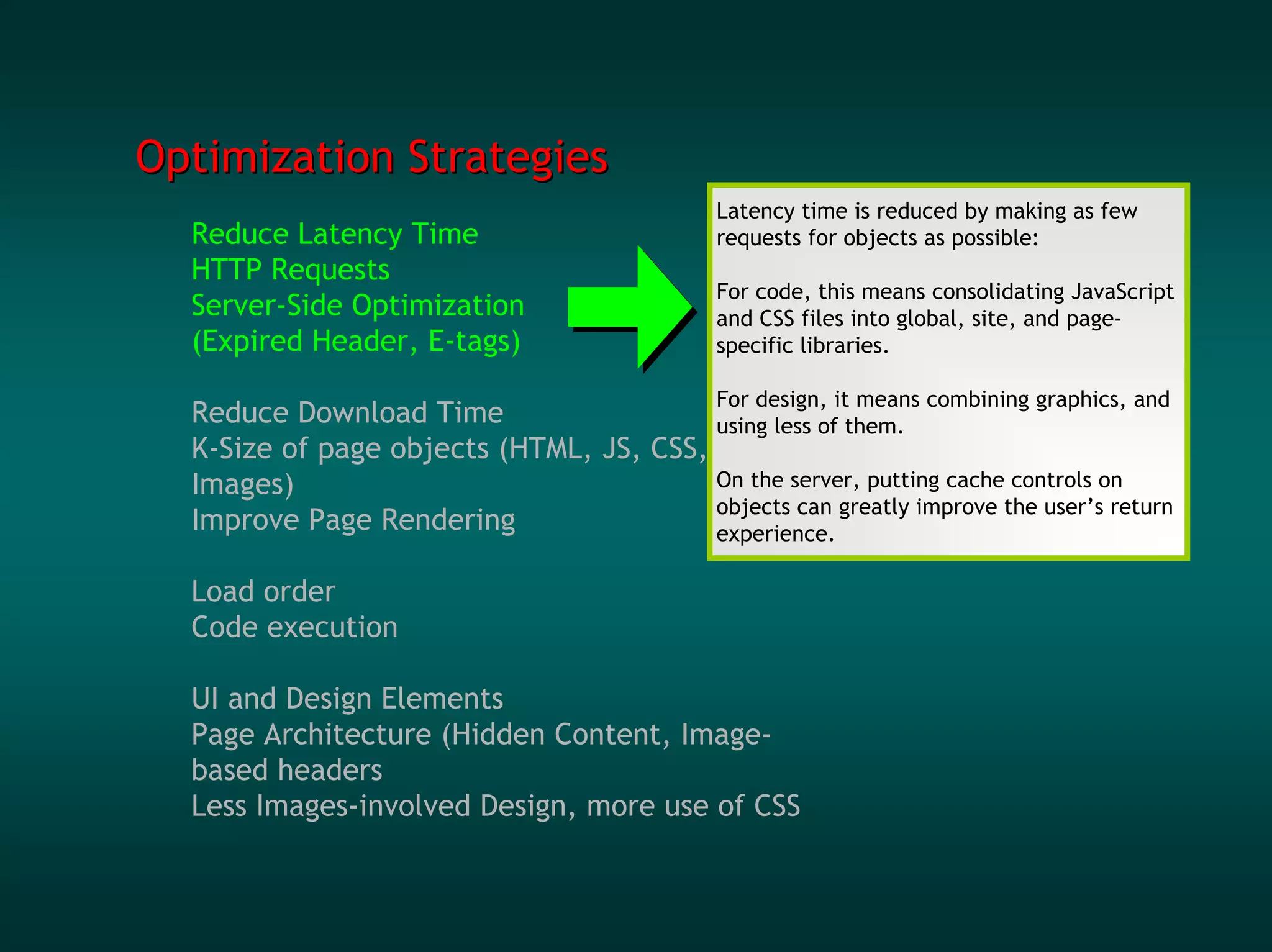
Optimization Strategies
                                              Latency time is reduced by making as few
  Reduce Latency Time                         requests for objects as possible:
  HTTP Requests
                                              For code, this means consolidating JavaScript
  Server-Side Optimization                    and CSS files into global, site, and page-
  (Expired Header, E-tags)                    specific libraries.

                                              For design, it means combining graphics, and
  Reduce Download Time                   using less of them.
  K-Size of page objects (HTML, JS, CSS,
  Images)                                On the server, putting cache controls on
                                         objects can greatly improve the user’s return
  Improve Page Rendering                 experience.

  Load order
  Code execution

  UI and Design Elements
  Page Architecture (Hidden Content, Image-
  based headers
  Less Images-involved Design, more use of CSS
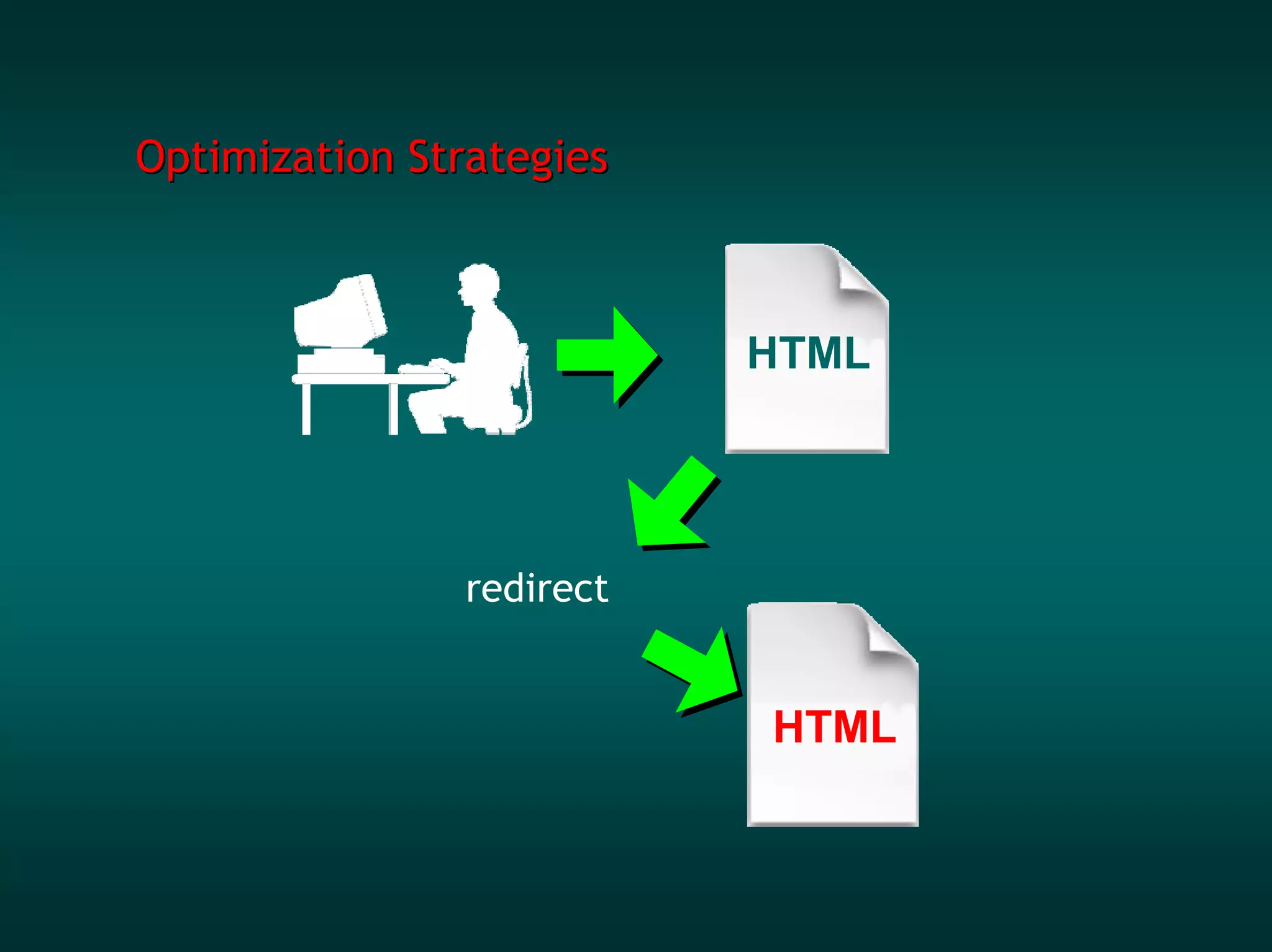
Optimization Strategies


                           HTML


                redirect


                           HTML
Optimization Strategies


            the slash of DOOM

            http://www.ew.com/ew/tv
            http://www.ew.com/ew/tv/
Optimization Strategies


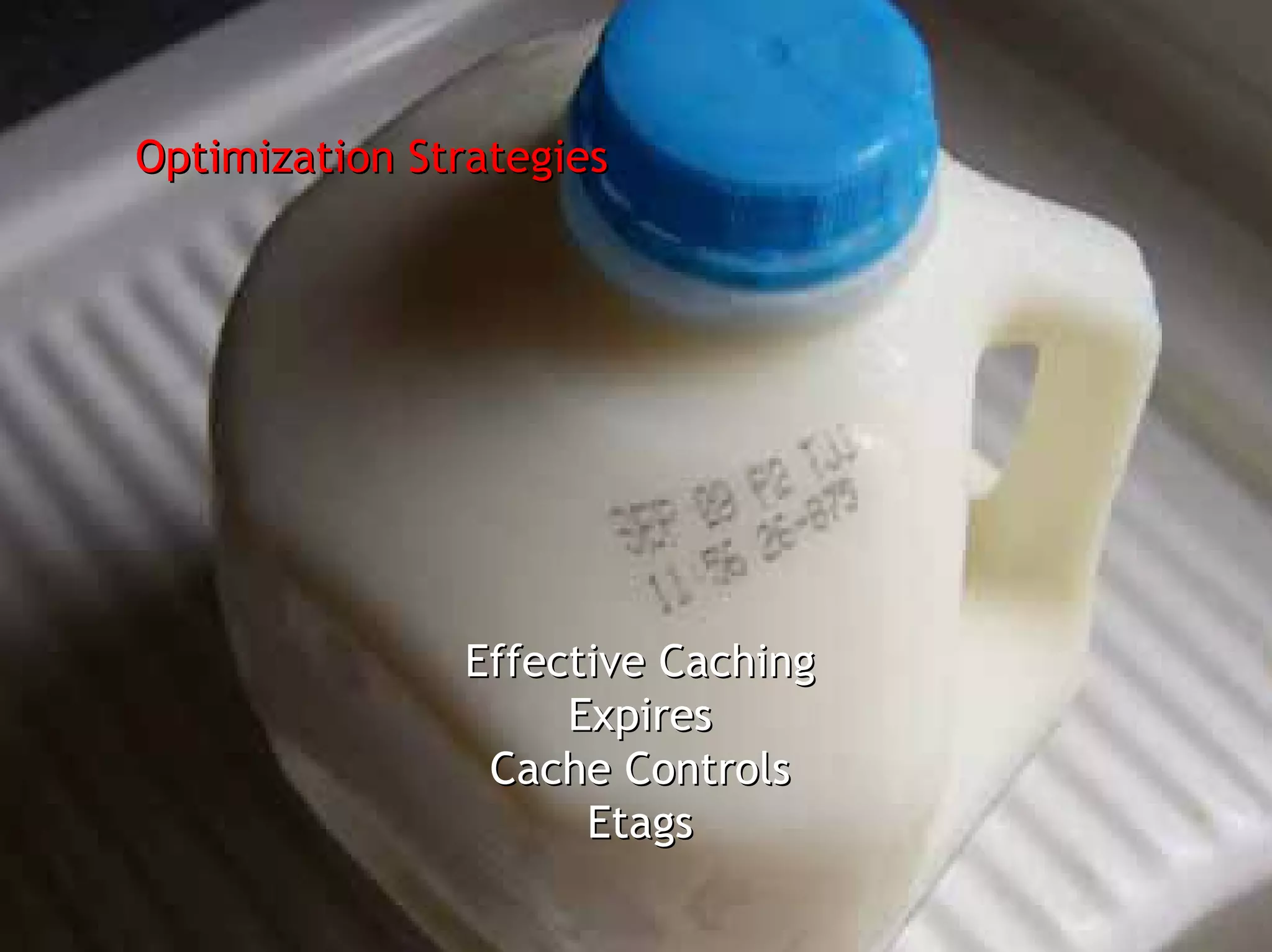
               Effective Caching
                    Expires
                Cache Controls
                     Etags
Optimization Strategies

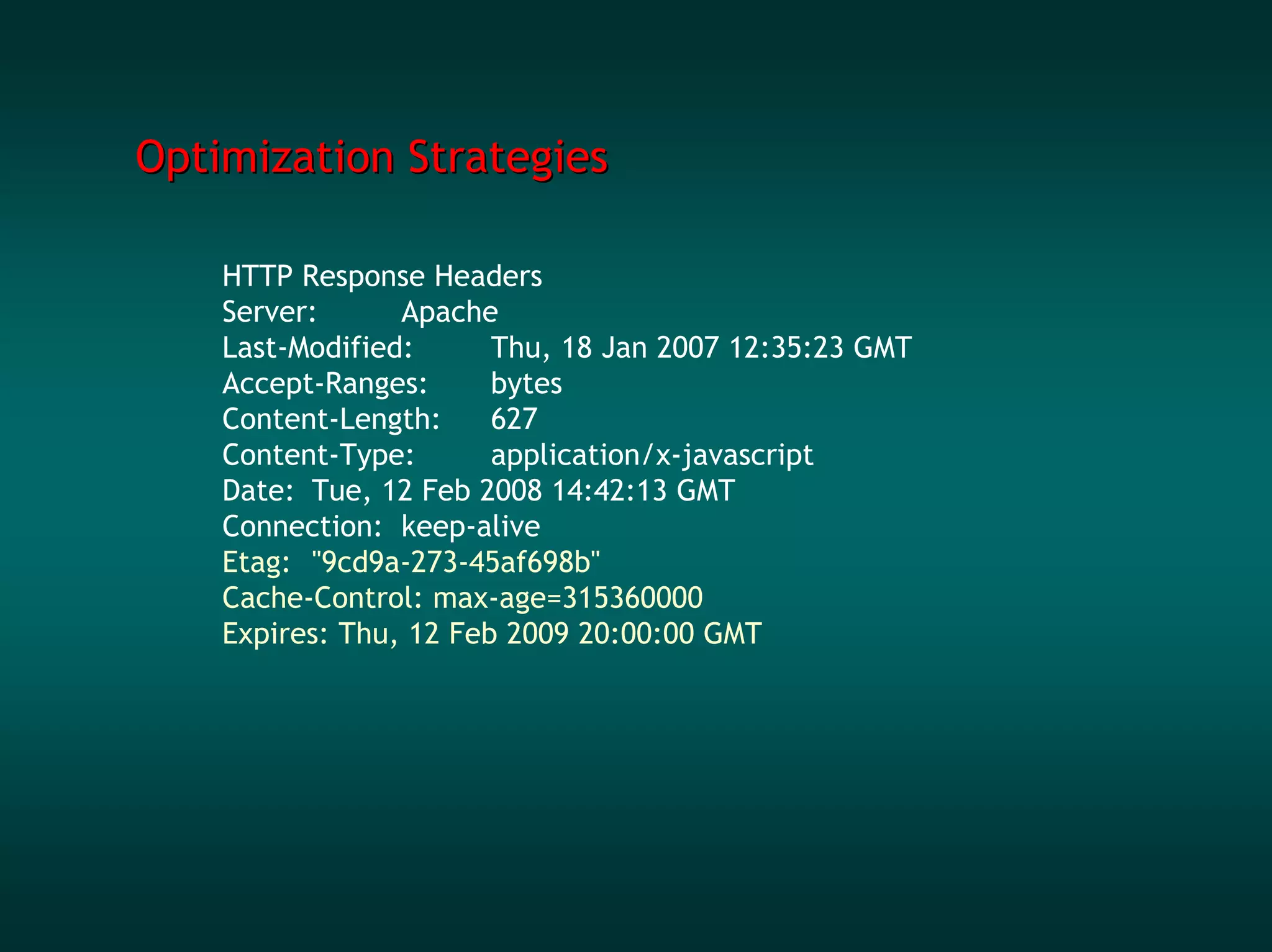
    HTTP Response Headers
    Server:      Apache
    Last-Modified:      Thu, 18 Jan 2007 12:35:23 GMT
    Accept-Ranges:      bytes
    Content-Length:     627
    Content-Type:       application/x-javascript
    Date: Tue, 12 Feb 2008 14:42:13 GMT
    Connection: keep-alive
    Etag: "9cd9a-273-45af698b"
    Cache-Control: max-age=315360000
    Expires: Thu, 12 Feb 2009 20:00:00 GMT
Optimization Strategies
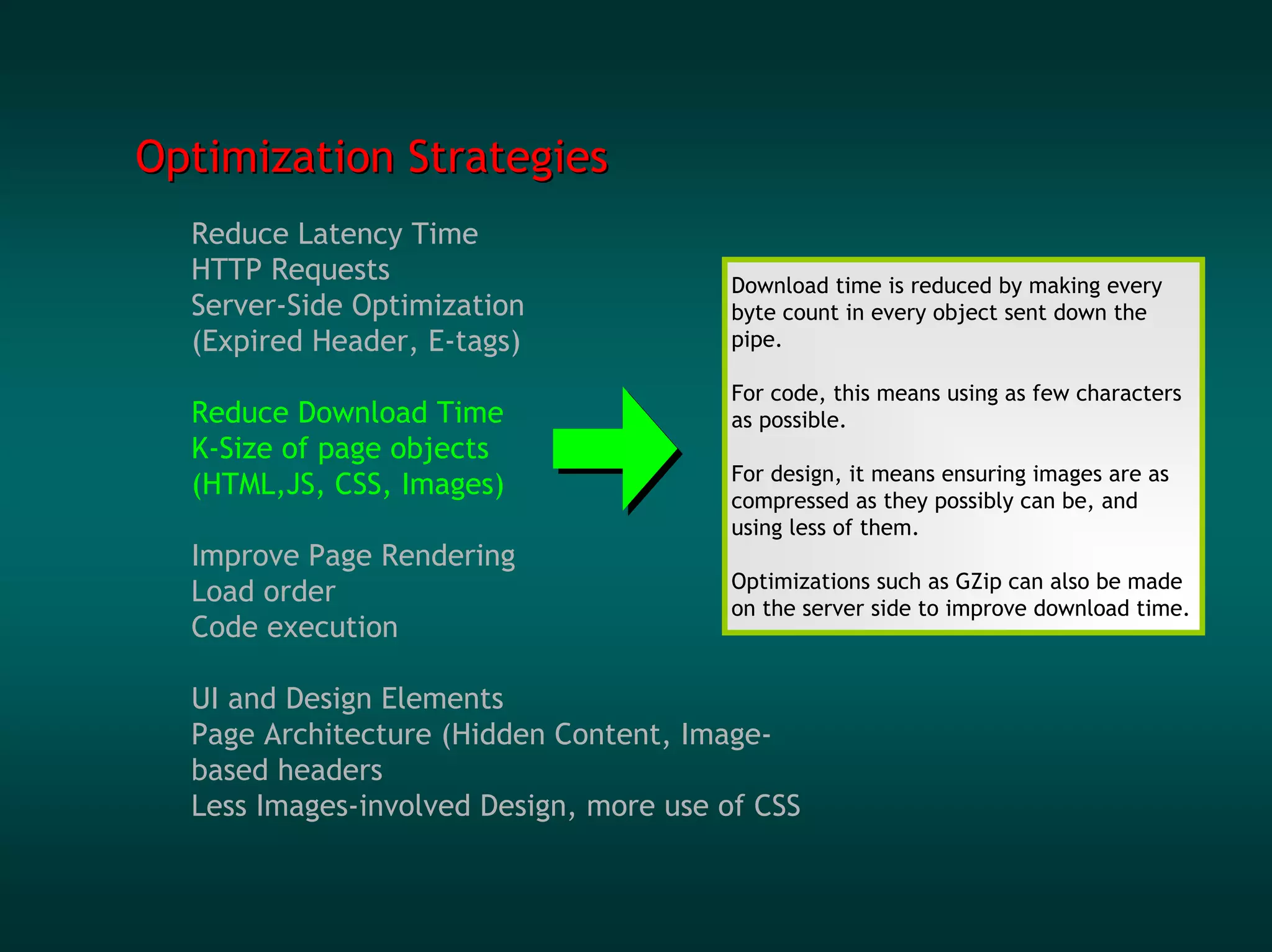
  Reduce Latency Time
  HTTP Requests                         Download time is reduced by making every
  Server-Side Optimization              byte count in every object sent down the
  (Expired Header, E-tags)              pipe.

                                        For code, this means using as few characters
  Reduce Download Time                  as possible.
  K-Size of page objects
                                        For design, it means ensuring images are as
  (HTML,JS, CSS, Images)                compressed as they possibly can be, and
                                        using less of them.
  Improve Page Rendering
                                        Optimizations such as GZip can also be made
  Load order                            on the server side to improve download time.
  Code execution

  UI and Design Elements
  Page Architecture (Hidden Content, Image-
  based headers
  Less Images-involved Design, more use of CSS
Optimization Strategies


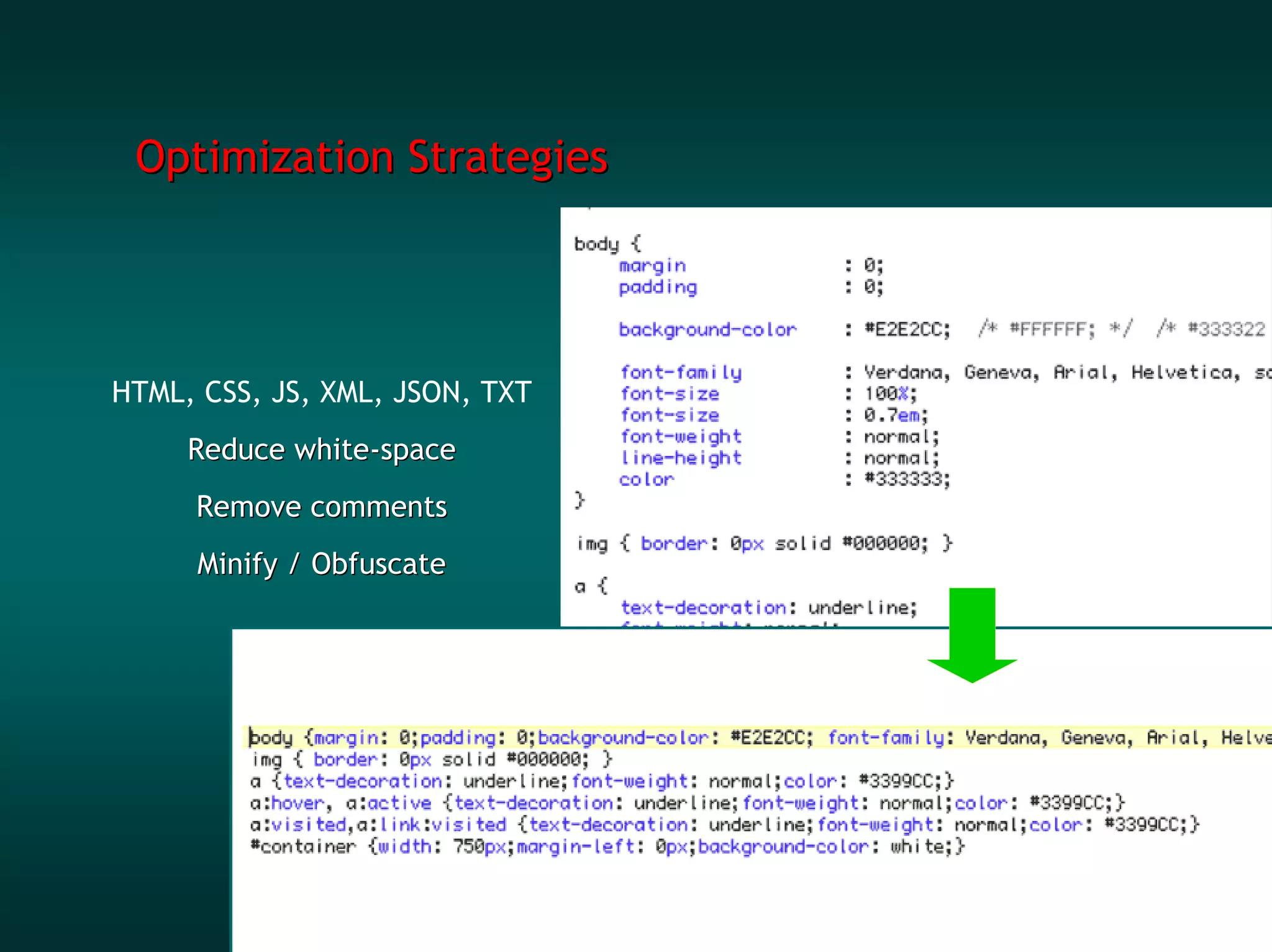
HTML, CSS, JS, XML, JSON, TXT
     Reduce white-space
     Remove comments
     Minify / Obfuscate
Optimize images
  Use Sprites
Replace with CSS
Optimization Strategies


                GZip on servers

                Compress: HTML, CSS, JS, XML,JSON, TXT

                Don’t compress: JPEG, GIF, SWF, PDF


Server-side compression can be made to improve download times.
This effective technique requires additional work and project
management but undoubtedly impacts your bottom line (see
Benefits of Maximizing Performance)
Optimization Strategies
    Reduce Latency Time
    HTTP Requests
    Server-Side Optimization
    (Expired Header, E-tags)

    Reduce Download Time
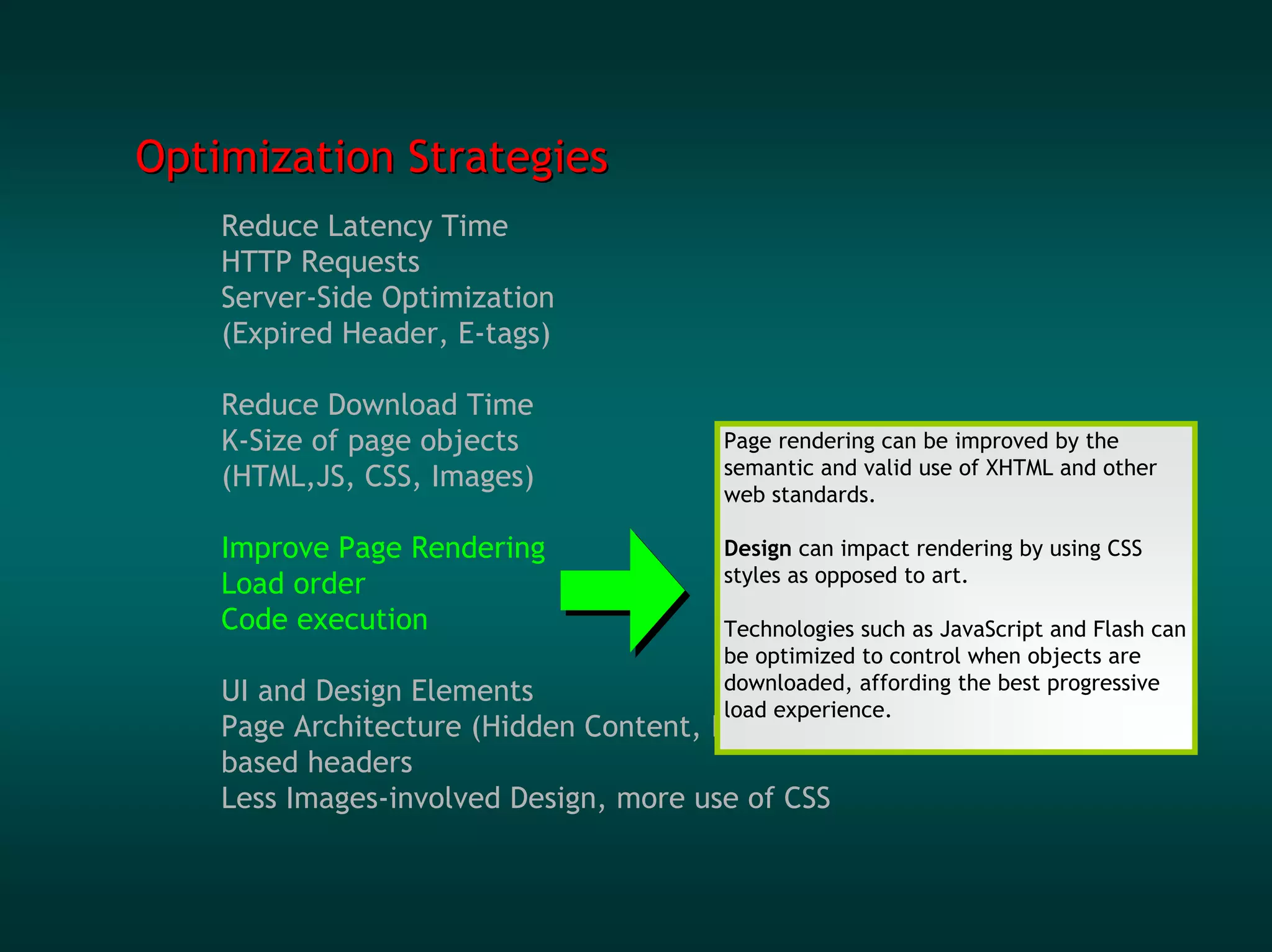
    K-Size of page objects              Page rendering can be improved by the
    (HTML,JS, CSS, Images)              semantic and valid use of XHTML and other
                                        web standards.

    Improve Page Rendering              Design can impact rendering by using CSS
    Load order                          styles as opposed to art.

    Code execution                      Technologies such as JavaScript and Flash can
                                        be optimized to control when objects are
    UI and Design Elements              downloaded, affording the best progressive
                                        load experience.
    Page Architecture (Hidden Content, Image-
    based headers
    Less Images-involved Design, more use of CSS
Optimization Strategies


                        HTML


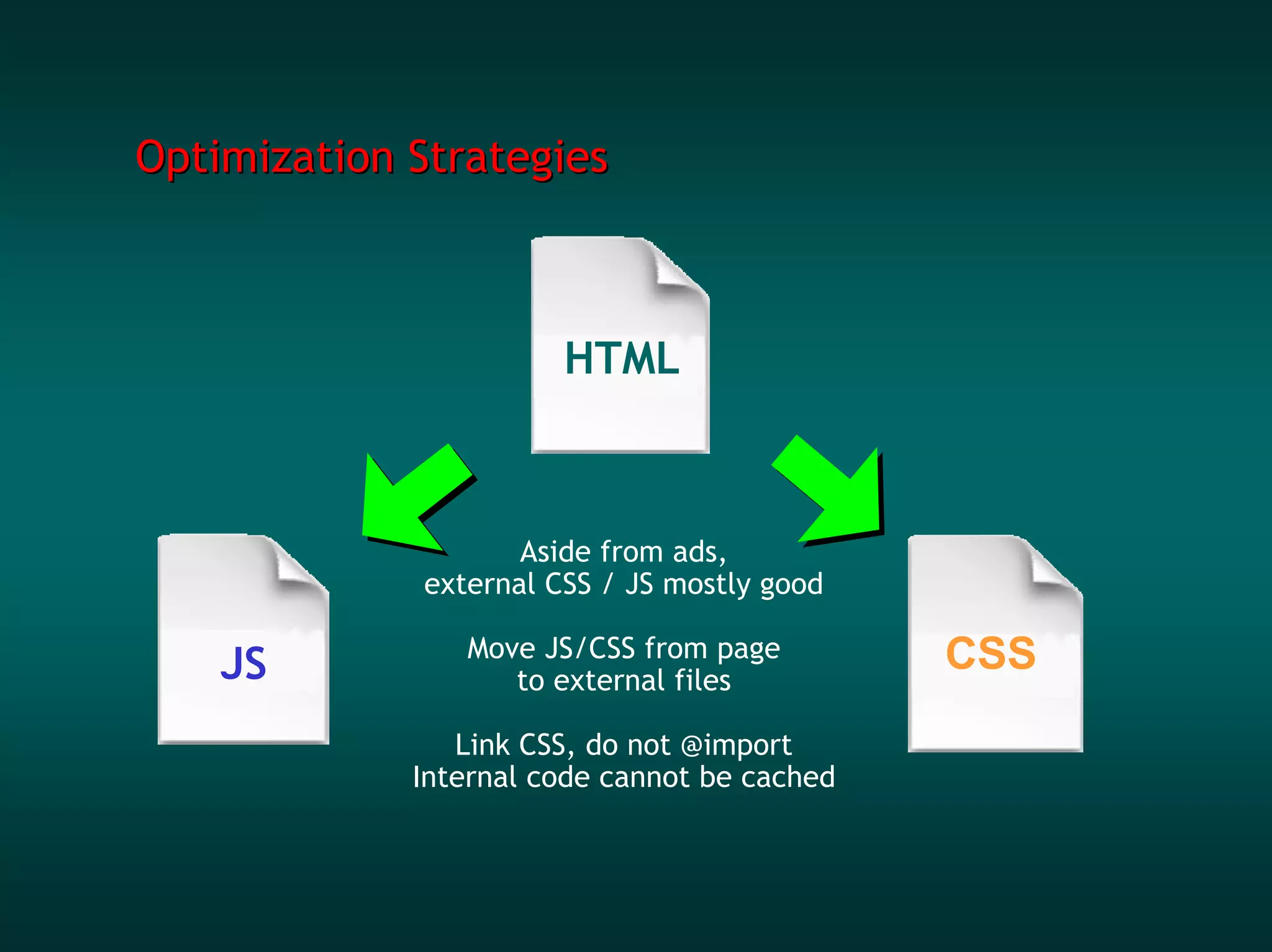
                     Aside from ads,
              external CSS / JS mostly good

                 Move JS/CSS from page        CSS
    JS              to external files

                Link CSS, do not @import
             Internal code cannot be cached
Optimization Strategies


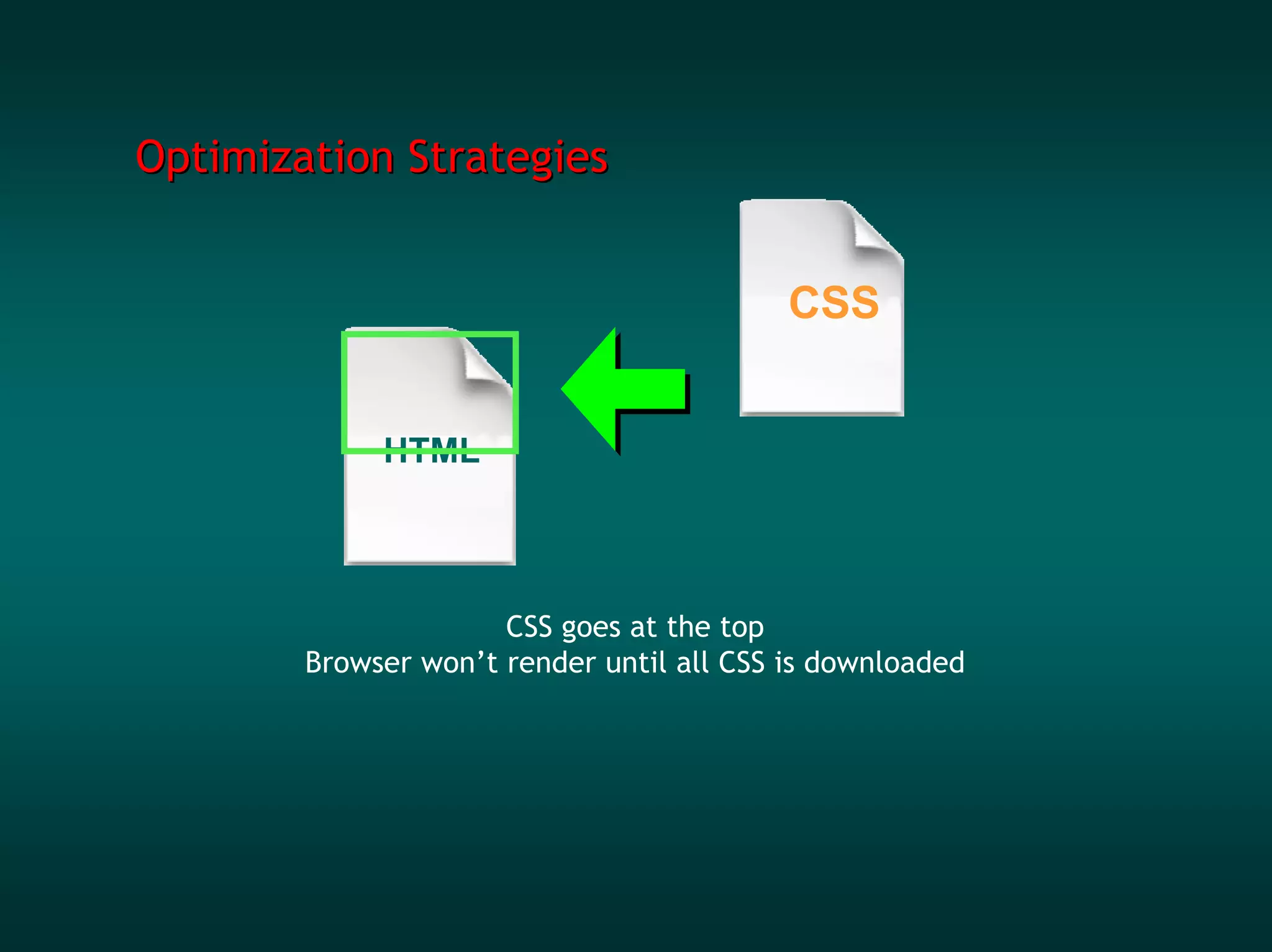
                                           CSS


             HTML


                      CSS goes at the top
        Browser won’t render until all CSS is downloaded
Optimization Strategies


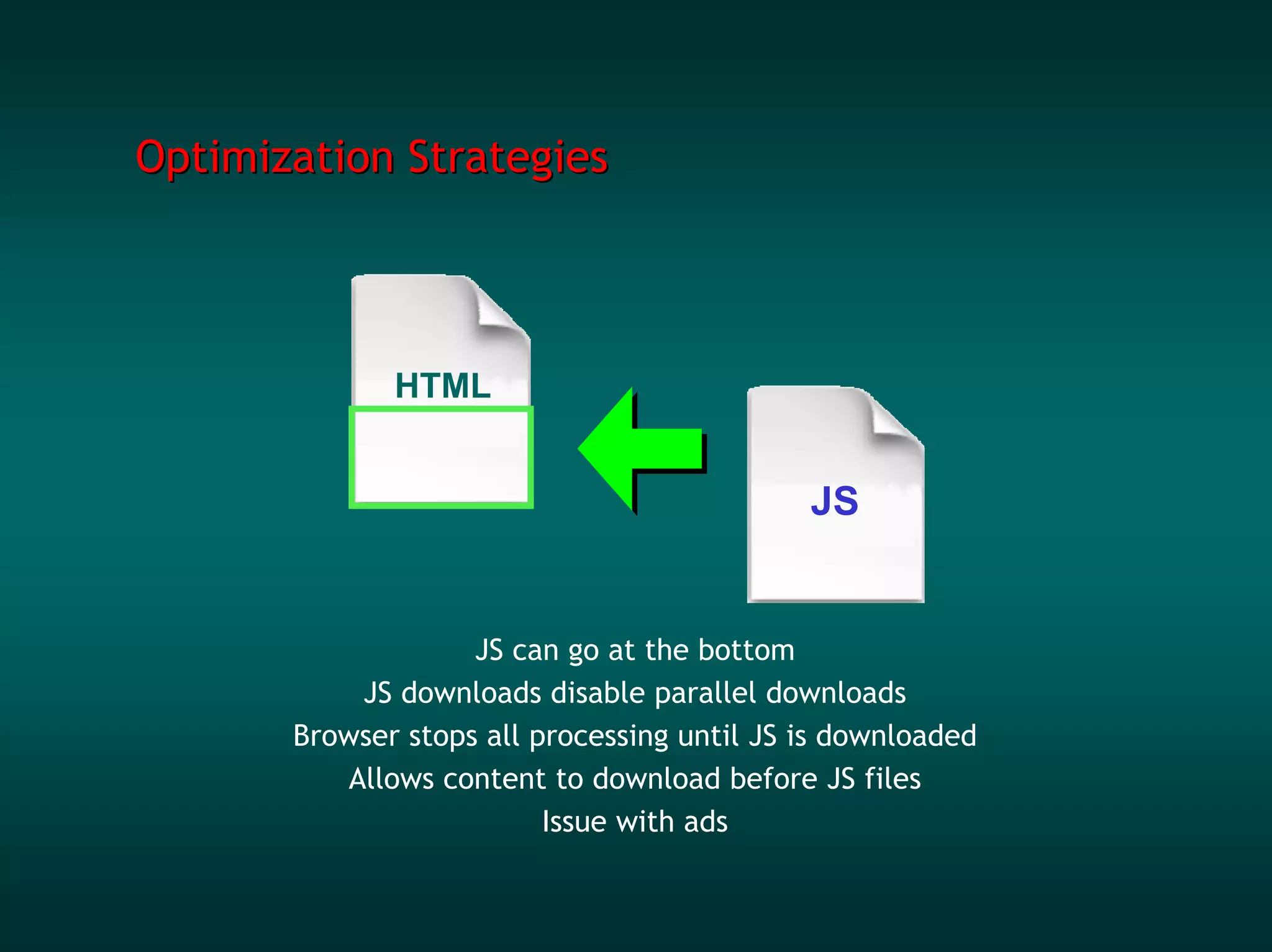
              HTML


                                             JS


                    JS can go at the bottom
           JS downloads disable parallel downloads
       Browser stops all processing until JS is downloaded
          Allows content to download before JS files
                          Issue with ads
Optimization Strategies
   Reduce Latency Time
   HTTP Requests
   Server-Side Optimization
   (Expired Header, E-tags)

   Reduce Download Time
   K-Size of page objects
   (HTML,JS, CSS, Images)

   Improve Page Rendering
   Load order
   Code execution
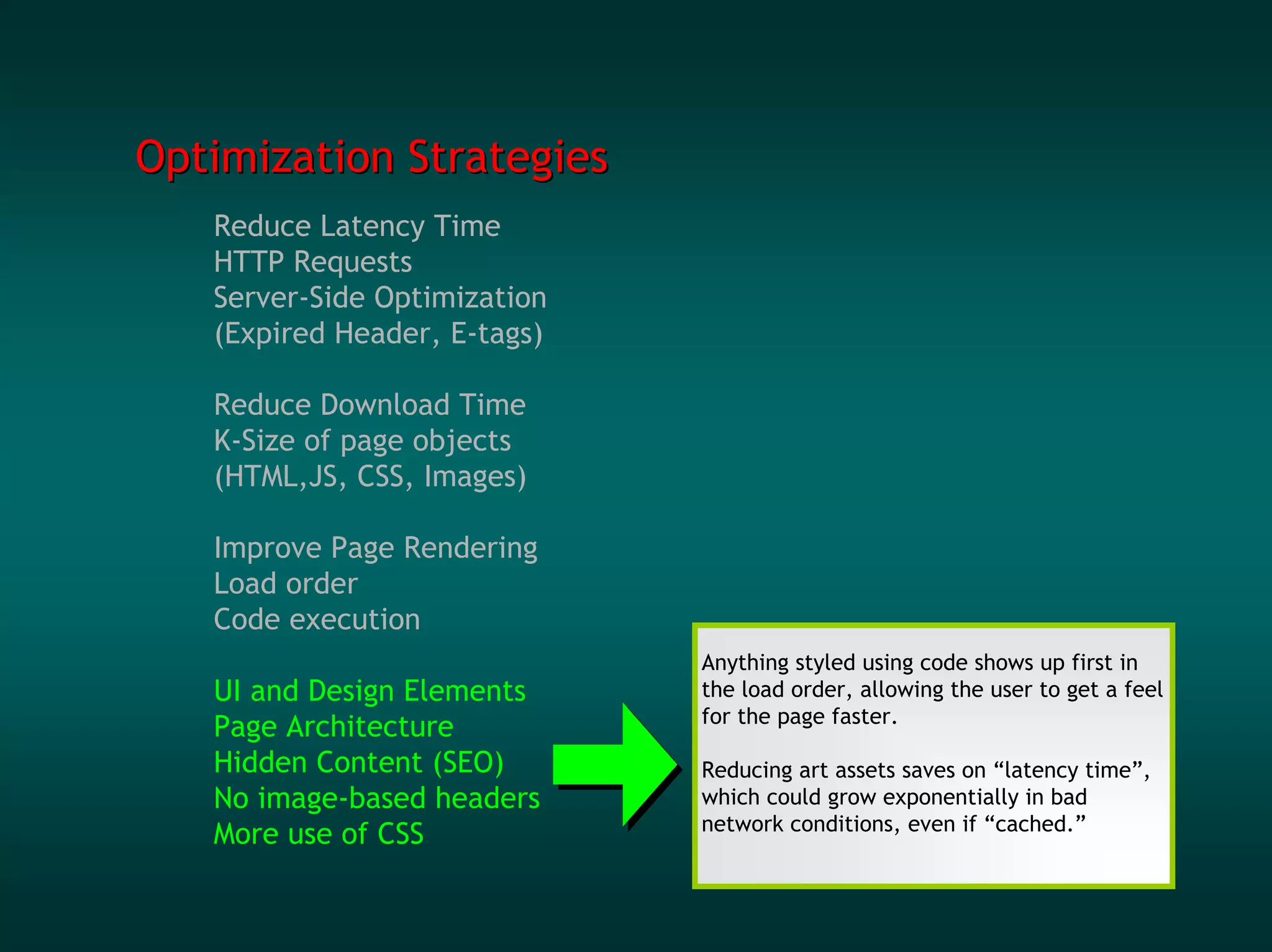
                              Anything styled using code shows up first in
   UI and Design Elements     the load order, allowing the user to get a feel
                              for the page faster.
   Page Architecture
   Hidden Content (SEO)       Reducing art assets saves on “latency time”,
   No image-based headers     which could grow exponentially in bad
                              network conditions, even if “cached.”
   More use of CSS
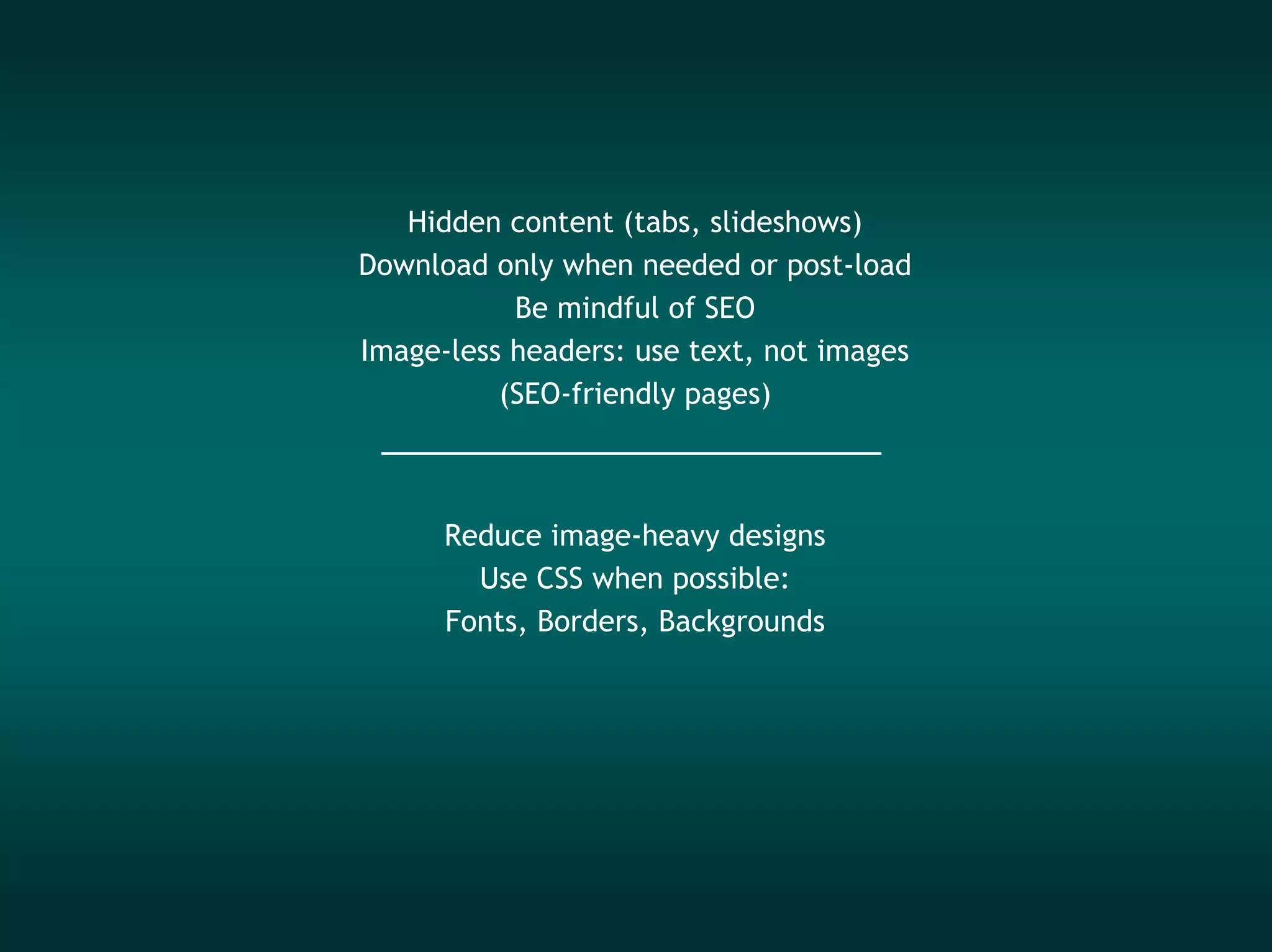
Hidden content (tabs, slideshows)
Download only when needed or post-load
           Be mindful of SEO
Image-less headers: use text, not images
          (SEO-friendly pages)


      Reduce image-heavy designs
        Use CSS when possible:
      Fonts, Borders, Backgrounds
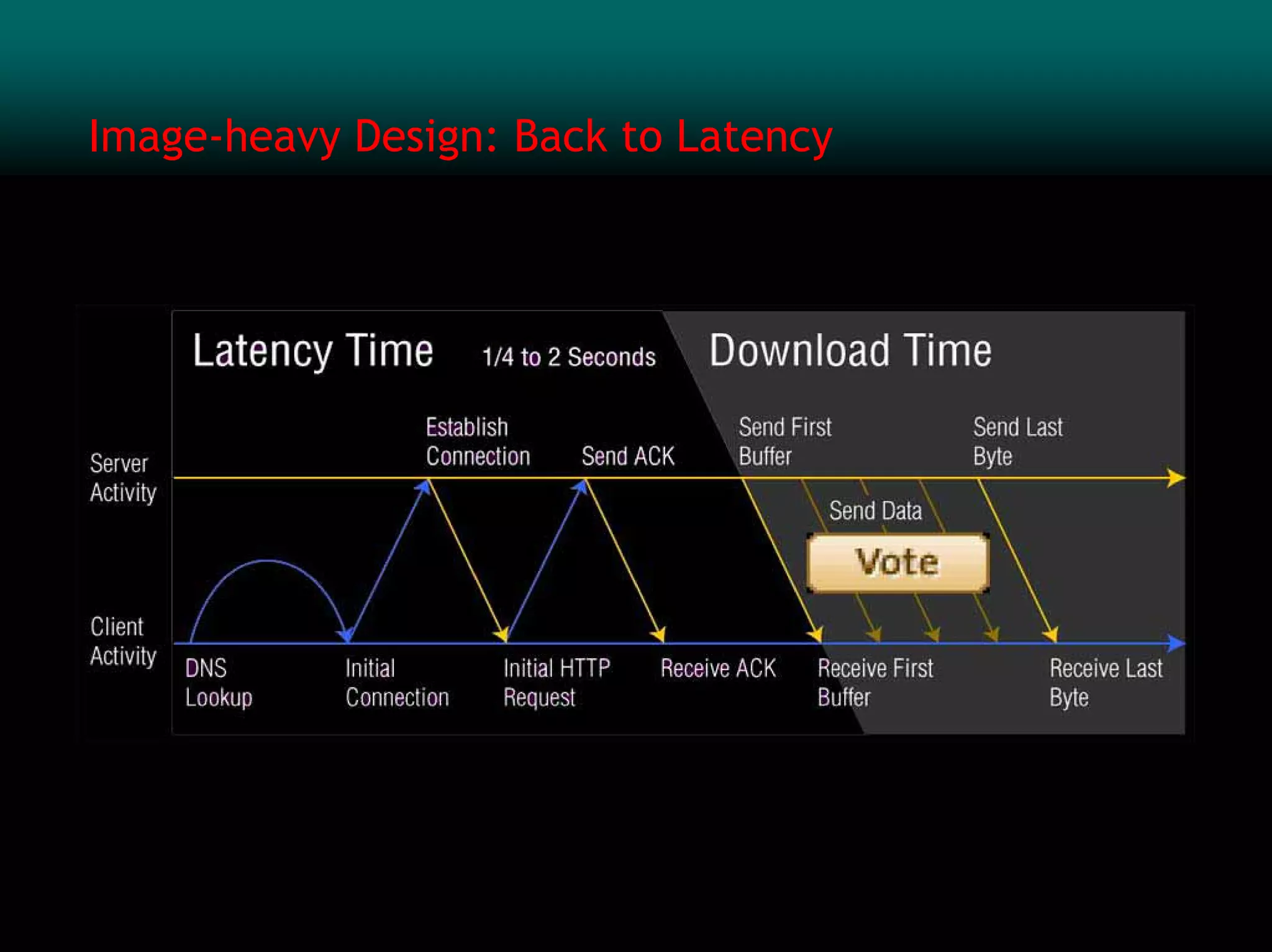
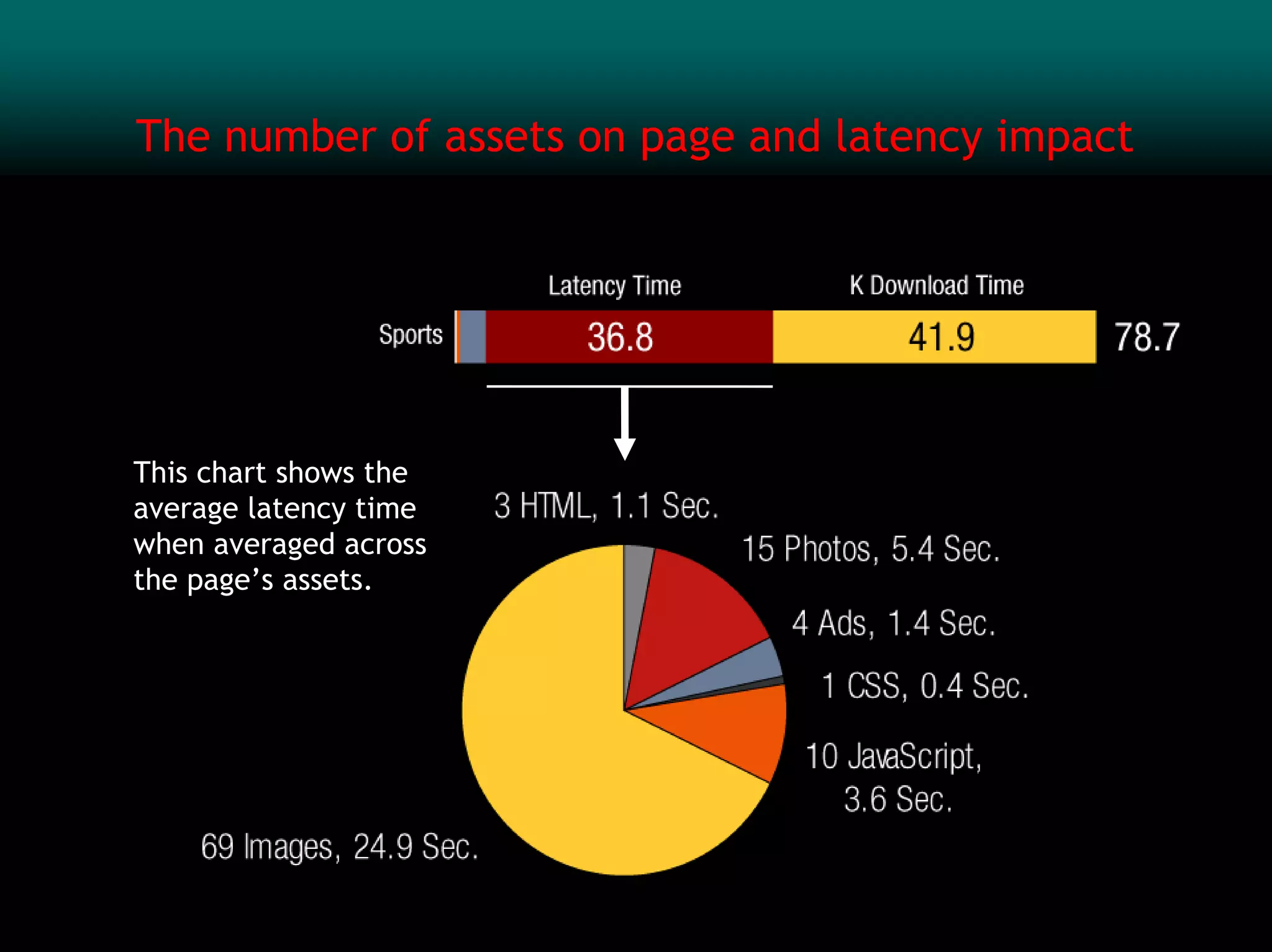
Image-heavy Design: Back to Latency
The number of assets on page and latency impact


This chart shows the
average latency time
when averaged across
the page’s assets.
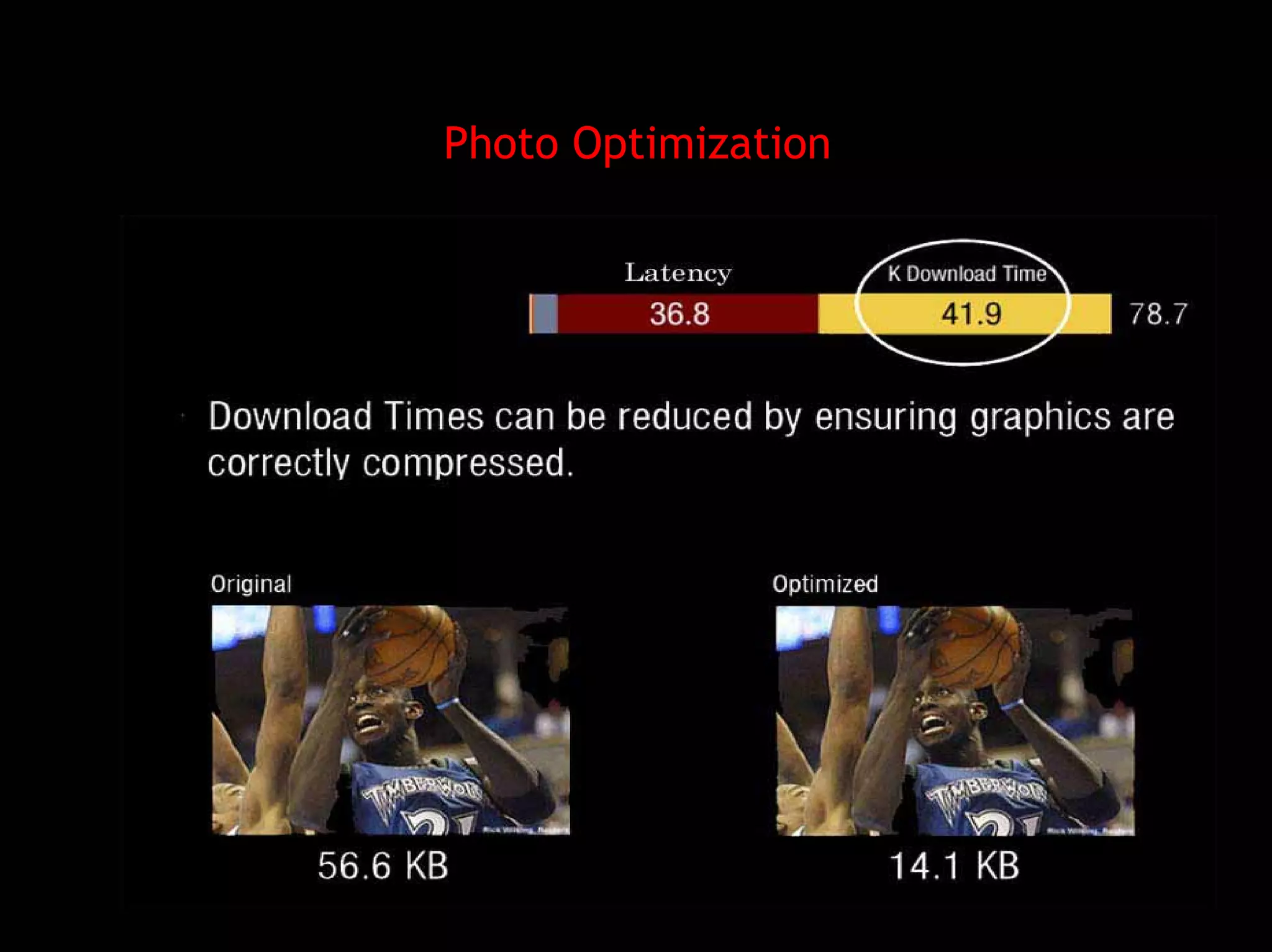
Photo Optimization
Photo Optimization
Leaderboard Optimization: GOLF.com

                     Before                                                After


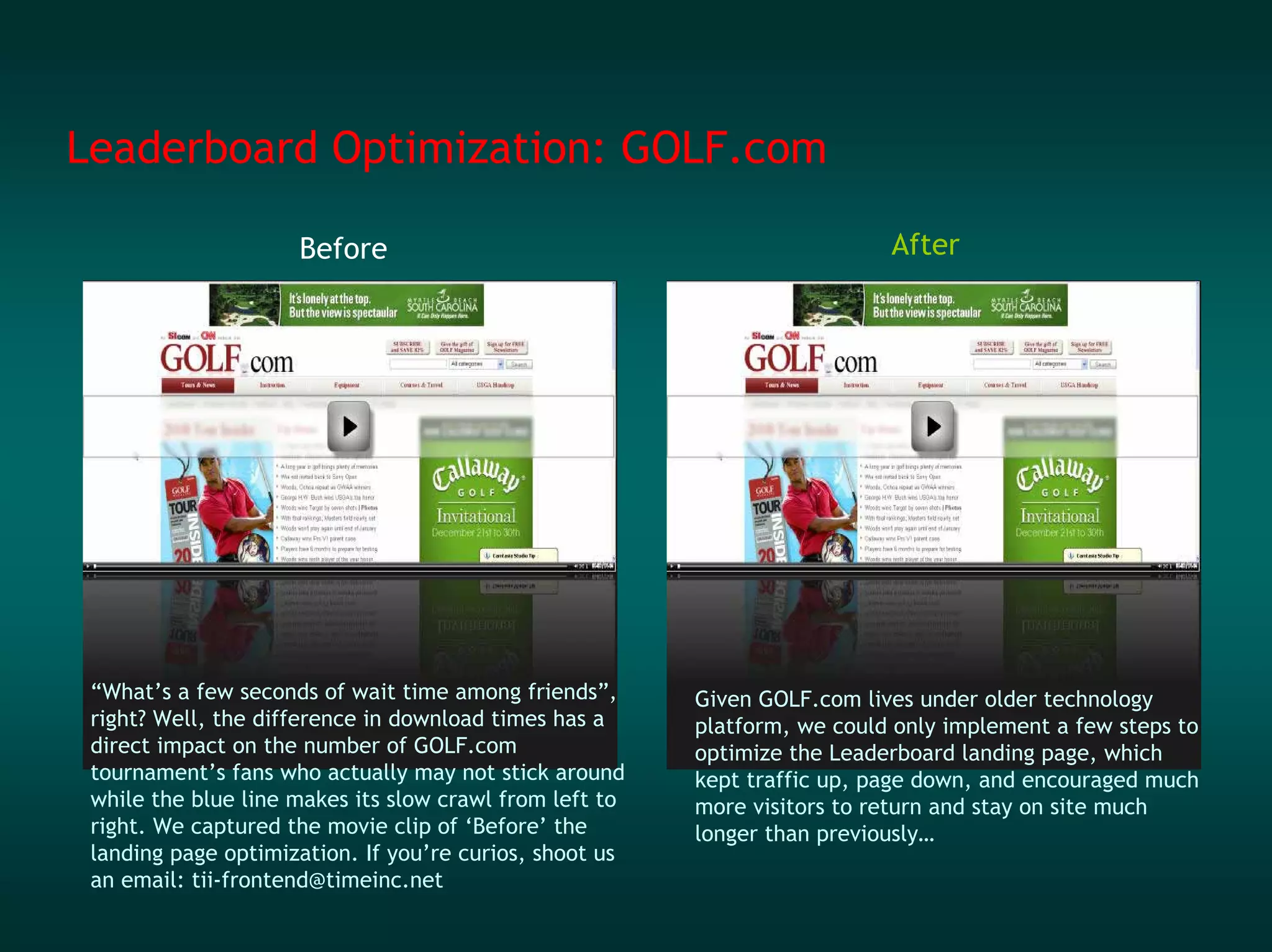
 “What’s a few seconds of wait time among friends”,      Given GOLF.com lives under older technology
 right? Well, the difference in download times has a     platform, we could only implement a few steps to
 direct impact on the number of GOLF.com                 optimize the Leaderboard landing page, which
 tournament’s fans who actually may not stick around     kept traffic up, page down, and encouraged much
 while the blue line makes its slow crawl from left to   more visitors to return and stay on site much
 right. We captured the movie clip of ‘Before’ the       longer than previously…
 landing page optimization. If you’re curios, shoot us
 an email: tii-frontend@timeinc.net
Why Maximize Performance

 A few, small improvements to the overall page weight can deliver
 substantial improvements to your visitor retention rate, conversion
 rate and PageRank, moving us up on the results page generated by a
 user query.

 And, since most SE users rarely look beyond the first or second page
 of search results delivered by any search engine, getting the site
 listed higher in the results page is a guarantee of increased site
 traffic.

 And, that gets us to the bottom line
Benefits of Maximizing Performance

• Better User Experience     • Improved Visitor Retention Rate
• Conversion Rate            • Increased Visibility
• PageRank                   • Increased Positive Responses
• Search Engine Placement    • Increased Brand Awareness
• Reduced Development Cost   • Increased Traffic
• Reduced Maintenance Cost   • Improved Ad Sales
• Lower Bandwidth Charges    • Increased Revenues
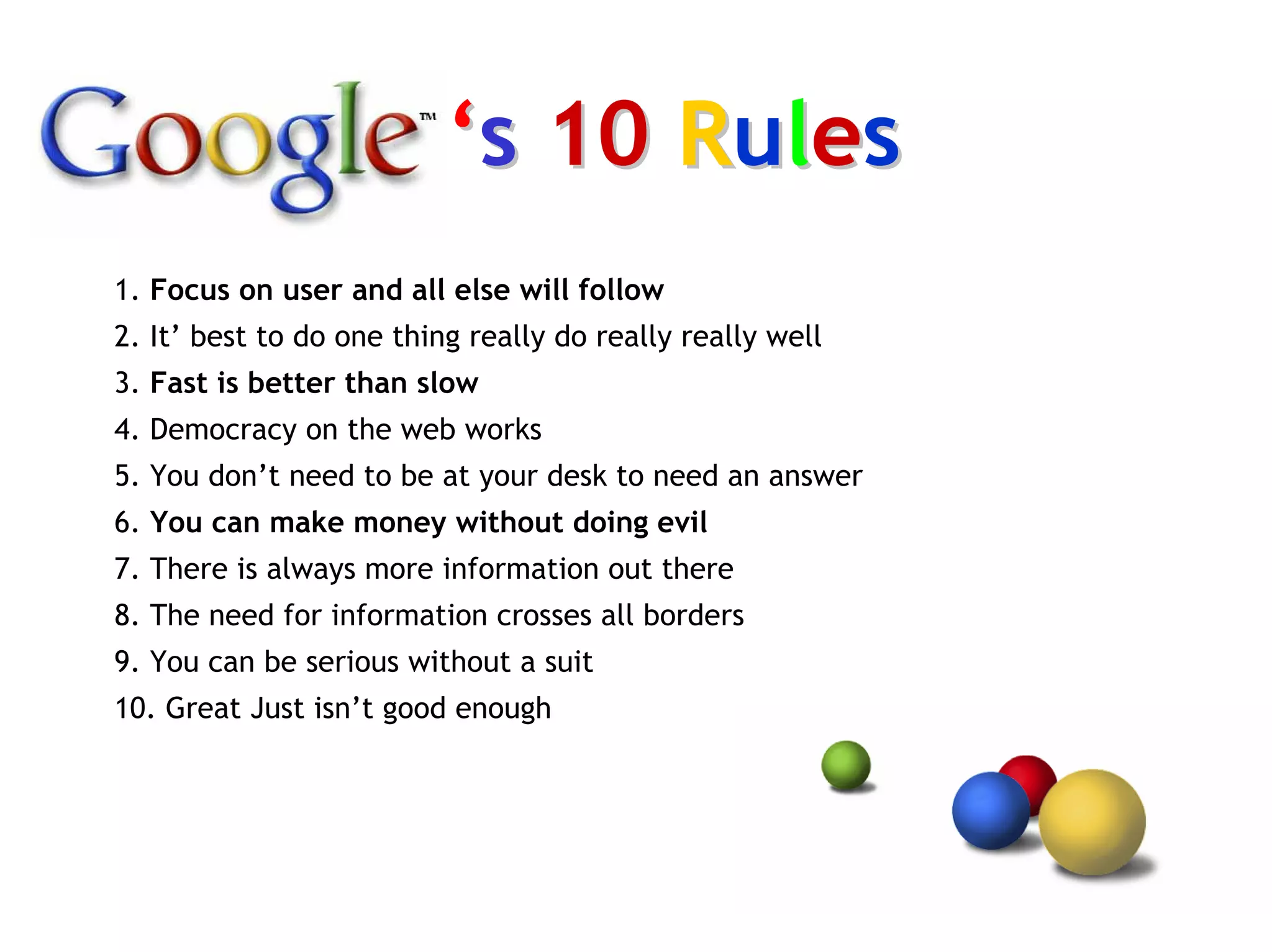
‘s 10 Rules
1. Focus on user and all else will follow
2. It’ best to do one thing really do really really well
3. Fast is better than slow
4. Democracy on the web works
5. You don’t need to be at your desk to need an answer
6. You can make money without doing evil
7. There is always more information out there
8. The need for information crosses all borders
9. You can be serious without a suit
10. Great Just isn’t good enough
We picked 3 for a better online performance

 1. Focus on user and all else will follow


 3. Fast is better than slow


 6. You can make money without doing evil
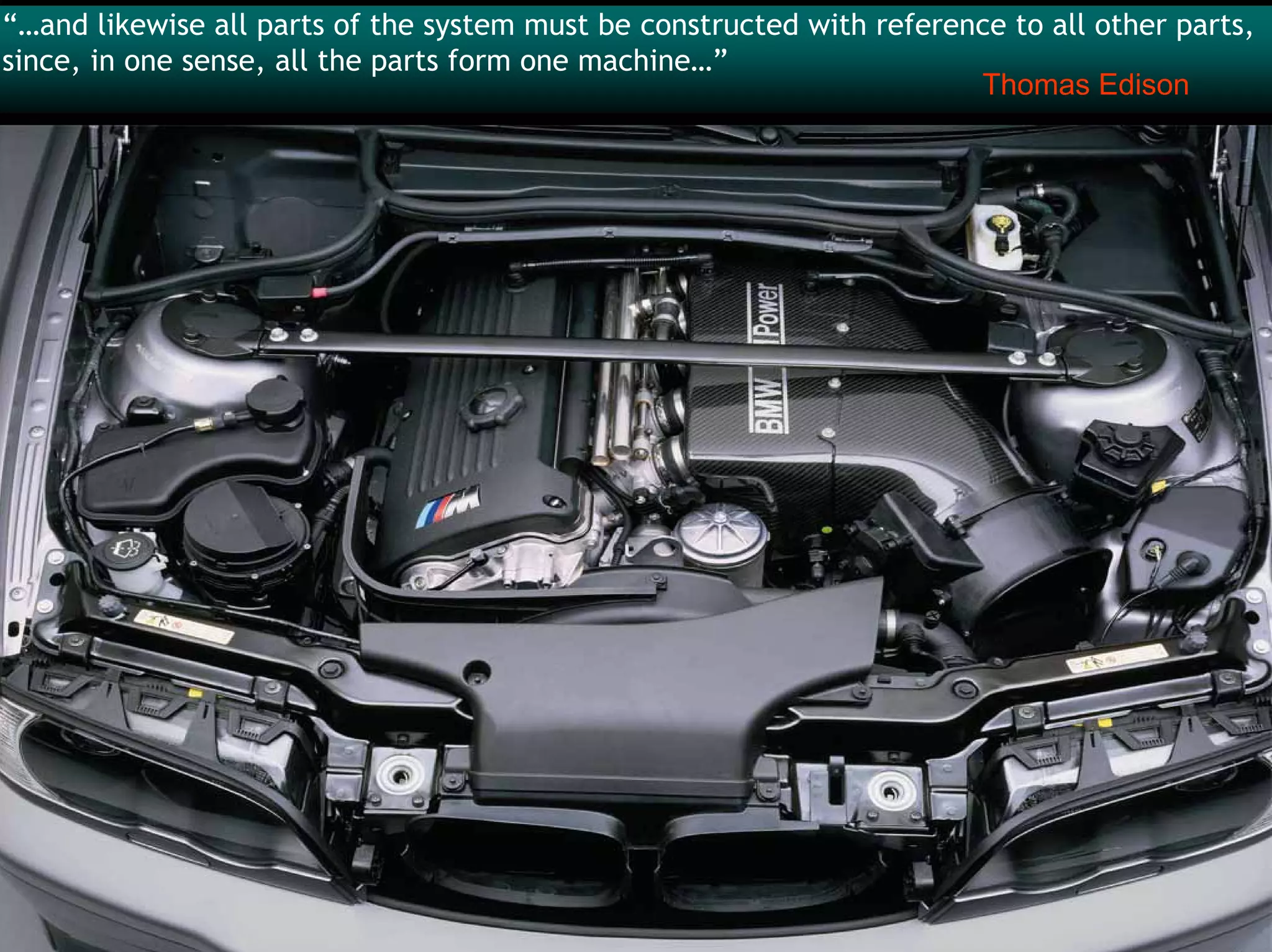
“…and likewise all parts of the system must be constructed with reference to all other parts,
since, in one sense, all the parts form one machine…”
                                                                       Thomas Edison

High Performance Websites

  • 1.
    High Performance Websites AllaGringaus Daniel Mendelsohn Aaron Grogg Time Inc. Interactive Front-end Web Development Team. Lunch & Learn. 02.12.2008
  • 2.
    In the blinkof an eye… You only have one chance to make a first impression. "In the blink of an eye" your site (blog or website) is judged. With so many sites and blogs to choose from, a site that loads at a snail's pace or is hard to navigate will send frustrated potential visitors on to their next destination. Good design, effective usability and speedy site performance are three very important considerations for building and keeping an audience. They add to your credibility and help build your audience’s trust, which is the only way to achieve user loyalty.
  • 3.
    How much informationis out there? How large is the Web? Tens of billions of documents? Hundreds? 10KB/doc => 100s of Terabytes Email, personal files, databases, broadcast media, archives Estimated 5 Exabyte/year (growing at 30%) 800MB/Year/Person – 90% in magnetic media Web is just a tiny starting point Google is working on how to organize all this information
  • 4.
    Innovation in wirelessproducts is accelerating Apple iPhone, 3 Skype Phone, Amazon Kindle, Google ‘GPhone’… 91% of mobile users keep phone within 1 met reach 24x7 15-20% of mobiles have GPS, 50% within 5 years Watch for new generation of Internet leaders to capitalize on growing access to fast Internet access on mobiles
  • 6.
  • 7.
    Broadband Statistics In hightraffic site, if pages are optimized for lower weight, the company can save a lot of money on bandwidth charges. And why should For example, 100,000 pages of 150Kb weight will I care? need twice the bandwidth as the same number of pages at 75Kb. So, if the ISP, charges by the amount of bandwidth we use, that’s how reducing page weight can save the company big time on monthly bandwidth charges.
  • 8.
    Impatience Index Thereare still a large number of outdated computers and slower speed connection than advanced reliable computers and fast connection. Connection Speed 20kb Page Weight 40kb Page Weight 100kb Page Weight 128 kbps (DSL) 1 second 2 seconds 6 seconds 256 kbps (DSL) < 1 second 1 second 3 seconds Time to Download a Page Percent of users who wait for download 10 seconds download 84% 15 seconds download 51% 20 seconds download 26% 30 seconds download 5% Poor website performance can be costly in many ways: downtime, slow response times, increased bailout rates ($$$$$!!!). Page weight has a direct correlation to the download times of your landing page and every other page within your site.
  • 9.
    Benefits of MaximizingPerformance • Better User Experience • Improved Visitor Retention Rate • Conversion Rate • Increased Visibility • PageRank • Increased Positive Responses • Search Engine Placement • Increased Brand Awareness • Reduced Development Cost • Increased Traffic • Reduced Maintenance Cost • Improved Ad Sales • Lower Bandwidth Charges • Increased Revenues
  • 10.
    How the webworks in 5 minutes, hold on tight...
  • 11.
  • 12.
  • 13.
    DNS HTML
  • 14.
  • 15.
    DNS HTML CSS
  • 16.
  • 17.
    DNS HTML CSS JS
  • 18.
  • 19.
    DNS HTML CSS JS IMAGES
  • 20.
  • 21.
    DNS HTML IMAGES CSS JS IMAGES JS JS DNS IMAGES
  • 22.
    Optimization Strategies ReduceLatency Time HTTP Requests Server-Side Optimization (Expired Headers, E-tags) Reduce Download Time K-Size of page objects (HTML, JS, CSS, Images) Improve Page Rendering Load order Code execution UI and Design Elements Page Architecture (Hidden Content, Image-based headers Less Images-involved Design, more use of CSS
  • 23.
    Optimization Strategies Latency time is reduced by making as few Reduce Latency Time requests for objects as possible: HTTP Requests For code, this means consolidating JavaScript Server-Side Optimization and CSS files into global, site, and page- (Expired Header, E-tags) specific libraries. For design, it means combining graphics, and Reduce Download Time using less of them. K-Size of page objects (HTML, JS, CSS, Images) On the server, putting cache controls on objects can greatly improve the user’s return Improve Page Rendering experience. Load order Code execution UI and Design Elements Page Architecture (Hidden Content, Image- based headers Less Images-involved Design, more use of CSS
  • 24.
    Optimization Strategies HTML redirect HTML
  • 25.
    Optimization Strategies the slash of DOOM http://www.ew.com/ew/tv http://www.ew.com/ew/tv/
  • 26.
    Optimization Strategies Effective Caching Expires Cache Controls Etags
  • 27.
    Optimization Strategies HTTP Response Headers Server: Apache Last-Modified: Thu, 18 Jan 2007 12:35:23 GMT Accept-Ranges: bytes Content-Length: 627 Content-Type: application/x-javascript Date: Tue, 12 Feb 2008 14:42:13 GMT Connection: keep-alive Etag: "9cd9a-273-45af698b" Cache-Control: max-age=315360000 Expires: Thu, 12 Feb 2009 20:00:00 GMT
  • 28.
    Optimization Strategies Reduce Latency Time HTTP Requests Download time is reduced by making every Server-Side Optimization byte count in every object sent down the (Expired Header, E-tags) pipe. For code, this means using as few characters Reduce Download Time as possible. K-Size of page objects For design, it means ensuring images are as (HTML,JS, CSS, Images) compressed as they possibly can be, and using less of them. Improve Page Rendering Optimizations such as GZip can also be made Load order on the server side to improve download time. Code execution UI and Design Elements Page Architecture (Hidden Content, Image- based headers Less Images-involved Design, more use of CSS
  • 29.
    Optimization Strategies HTML, CSS,JS, XML, JSON, TXT Reduce white-space Remove comments Minify / Obfuscate
  • 30.
    Optimize images Use Sprites Replace with CSS
  • 31.
    Optimization Strategies GZip on servers Compress: HTML, CSS, JS, XML,JSON, TXT Don’t compress: JPEG, GIF, SWF, PDF Server-side compression can be made to improve download times. This effective technique requires additional work and project management but undoubtedly impacts your bottom line (see Benefits of Maximizing Performance)
  • 32.
    Optimization Strategies Reduce Latency Time HTTP Requests Server-Side Optimization (Expired Header, E-tags) Reduce Download Time K-Size of page objects Page rendering can be improved by the (HTML,JS, CSS, Images) semantic and valid use of XHTML and other web standards. Improve Page Rendering Design can impact rendering by using CSS Load order styles as opposed to art. Code execution Technologies such as JavaScript and Flash can be optimized to control when objects are UI and Design Elements downloaded, affording the best progressive load experience. Page Architecture (Hidden Content, Image- based headers Less Images-involved Design, more use of CSS
  • 33.
    Optimization Strategies HTML Aside from ads, external CSS / JS mostly good Move JS/CSS from page CSS JS to external files Link CSS, do not @import Internal code cannot be cached
  • 34.
    Optimization Strategies CSS HTML CSS goes at the top Browser won’t render until all CSS is downloaded
  • 35.
    Optimization Strategies HTML JS JS can go at the bottom JS downloads disable parallel downloads Browser stops all processing until JS is downloaded Allows content to download before JS files Issue with ads
  • 36.
    Optimization Strategies Reduce Latency Time HTTP Requests Server-Side Optimization (Expired Header, E-tags) Reduce Download Time K-Size of page objects (HTML,JS, CSS, Images) Improve Page Rendering Load order Code execution Anything styled using code shows up first in UI and Design Elements the load order, allowing the user to get a feel for the page faster. Page Architecture Hidden Content (SEO) Reducing art assets saves on “latency time”, No image-based headers which could grow exponentially in bad network conditions, even if “cached.” More use of CSS
  • 37.
    Hidden content (tabs,slideshows) Download only when needed or post-load Be mindful of SEO Image-less headers: use text, not images (SEO-friendly pages) Reduce image-heavy designs Use CSS when possible: Fonts, Borders, Backgrounds
  • 38.
  • 39.
    The number ofassets on page and latency impact This chart shows the average latency time when averaged across the page’s assets.
  • 40.
  • 41.
  • 42.
    Leaderboard Optimization: GOLF.com Before After “What’s a few seconds of wait time among friends”, Given GOLF.com lives under older technology right? Well, the difference in download times has a platform, we could only implement a few steps to direct impact on the number of GOLF.com optimize the Leaderboard landing page, which tournament’s fans who actually may not stick around kept traffic up, page down, and encouraged much while the blue line makes its slow crawl from left to more visitors to return and stay on site much right. We captured the movie clip of ‘Before’ the longer than previously… landing page optimization. If you’re curios, shoot us an email: tii-frontend@timeinc.net
  • 43.
    Why Maximize Performance A few, small improvements to the overall page weight can deliver substantial improvements to your visitor retention rate, conversion rate and PageRank, moving us up on the results page generated by a user query. And, since most SE users rarely look beyond the first or second page of search results delivered by any search engine, getting the site listed higher in the results page is a guarantee of increased site traffic. And, that gets us to the bottom line
  • 44.
    Benefits of MaximizingPerformance • Better User Experience • Improved Visitor Retention Rate • Conversion Rate • Increased Visibility • PageRank • Increased Positive Responses • Search Engine Placement • Increased Brand Awareness • Reduced Development Cost • Increased Traffic • Reduced Maintenance Cost • Improved Ad Sales • Lower Bandwidth Charges • Increased Revenues
  • 45.
    ‘s 10 Rules 1.Focus on user and all else will follow 2. It’ best to do one thing really do really really well 3. Fast is better than slow 4. Democracy on the web works 5. You don’t need to be at your desk to need an answer 6. You can make money without doing evil 7. There is always more information out there 8. The need for information crosses all borders 9. You can be serious without a suit 10. Great Just isn’t good enough
  • 46.
    We picked 3for a better online performance 1. Focus on user and all else will follow 3. Fast is better than slow 6. You can make money without doing evil
  • 47.
    “…and likewise allparts of the system must be constructed with reference to all other parts, since, in one sense, all the parts form one machine…” Thomas Edison