







HI THIS IS URGENT PLZ FIX ASAP:
Critical Vulnerabilities
and Bug Bounty Programs
Kymberlee Price
Senior Director of Researcher Operations
Bugcrowd
@Kym_Possible
• Senior Director of a Red Team
• PSIRT Case Manager
• Data Analyst
• Internet Crime Investigator
• Behavioral Psychologist
@kym_possible
whoami?
• Intro
• Red
• Blue
• tl;dr
• Questions
Agenda
• Determining if a bug bounty program is
appropriate for your company
• Selling you a bug bounty program
• Recruiting you to be a bounty hunter
What this talk isn’t
C:intro
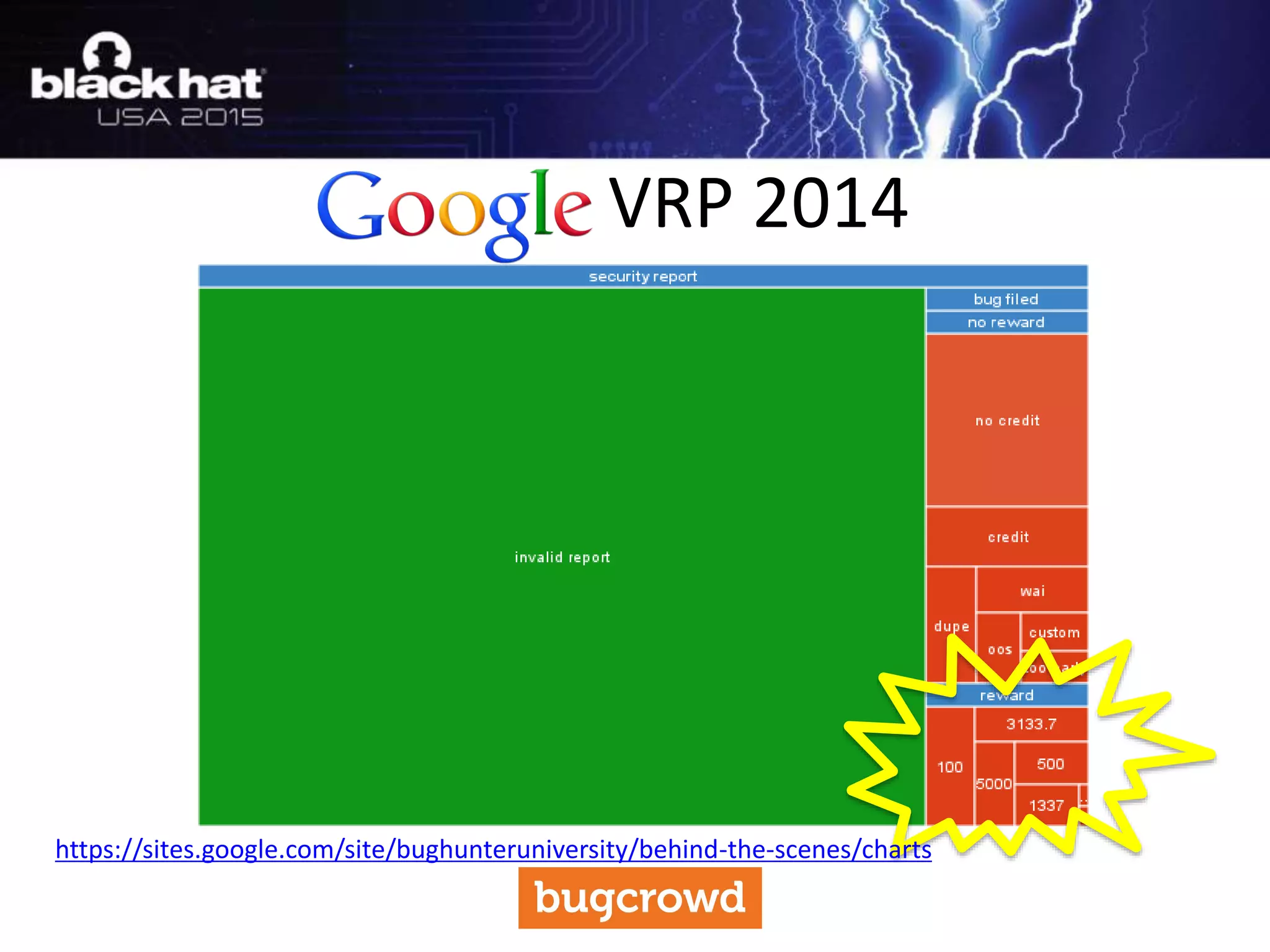
VRP 2014
https://sites.google.com/site/bughunteruniversity/behind-the-scenes/charts
VRP 2014
https://sites.google.com/site/bughunteruniversity/behind-the-scenes/charts
VRP 2014
https://sites.google.com/site/bughunteruniversity/behind-the-scenes/charts
PayoutsBugs found per active researcher
VRP 2014
https://sites.google.com/site/bughunteruniversity/behind-the-scenes/charts
2014
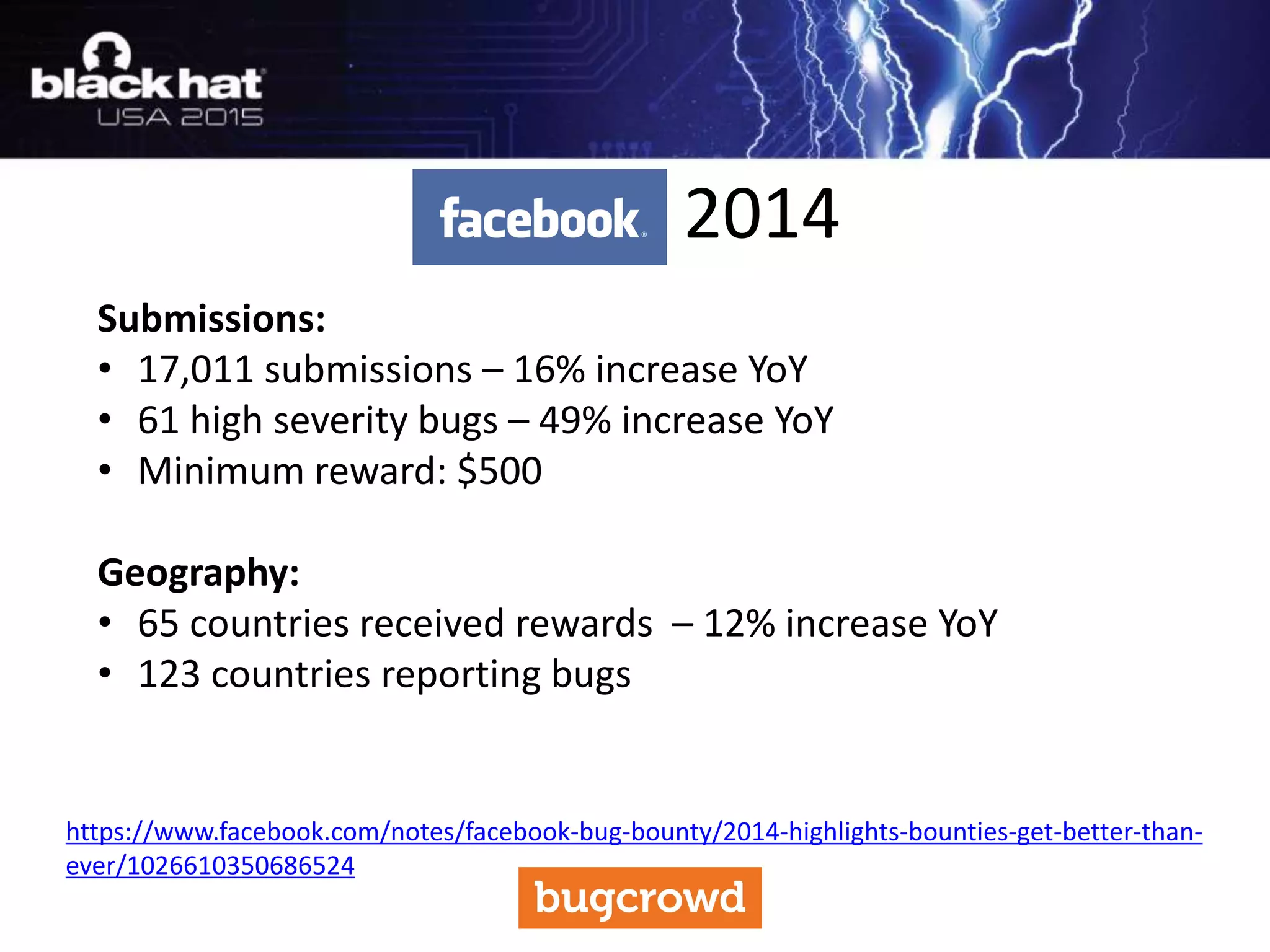
Submissions:
• 17,011 submissions – 16% increase YoY
• 61 high severity bugs – 49% increase YoY
• Minimum reward: $500
Geography:
• 65 countries received rewards – 12% increase YoY
• 123 countries reporting bugs
https://www.facebook.com/notes/facebook-bug-bounty/2014-highlights-bounties-get-better-than-
ever/1026610350686524
2014
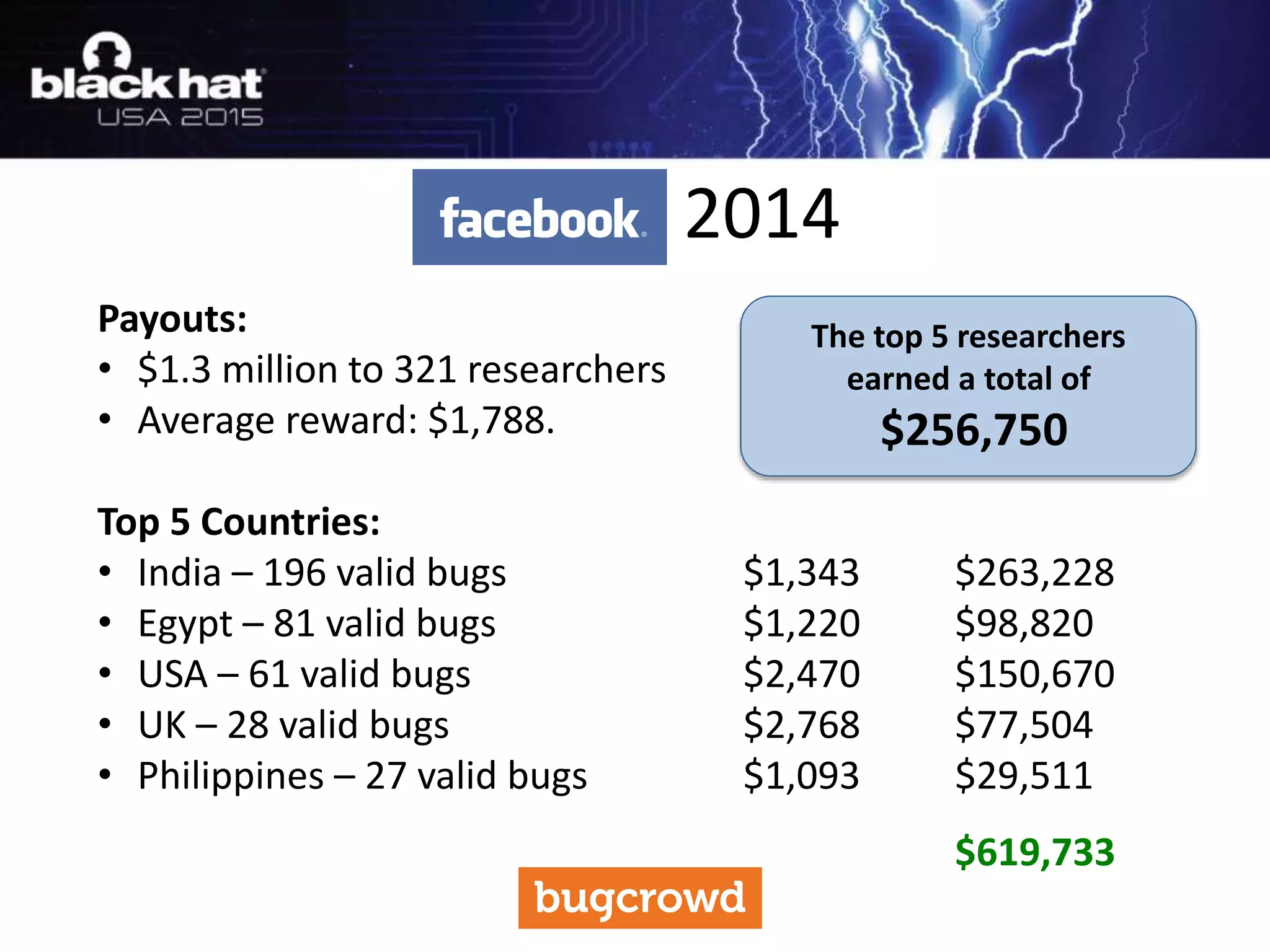
Payouts:
• $1.3 million to 321 researchers
• Average reward: $1,788.
Top 5 Countries:
• India – 196 valid bugs
• Egypt – 81 valid bugs
• USA – 61 valid bugs
• UK – 28 valid bugs
• Philippines – 27 valid bugs
$1,343
$1,220
$2,470
$2,768
$1,093
$263,228
$98,820
$150,670
$77,504
$29,511
$619,733
The top 5 researchers
earned a total of
$256,750
2014
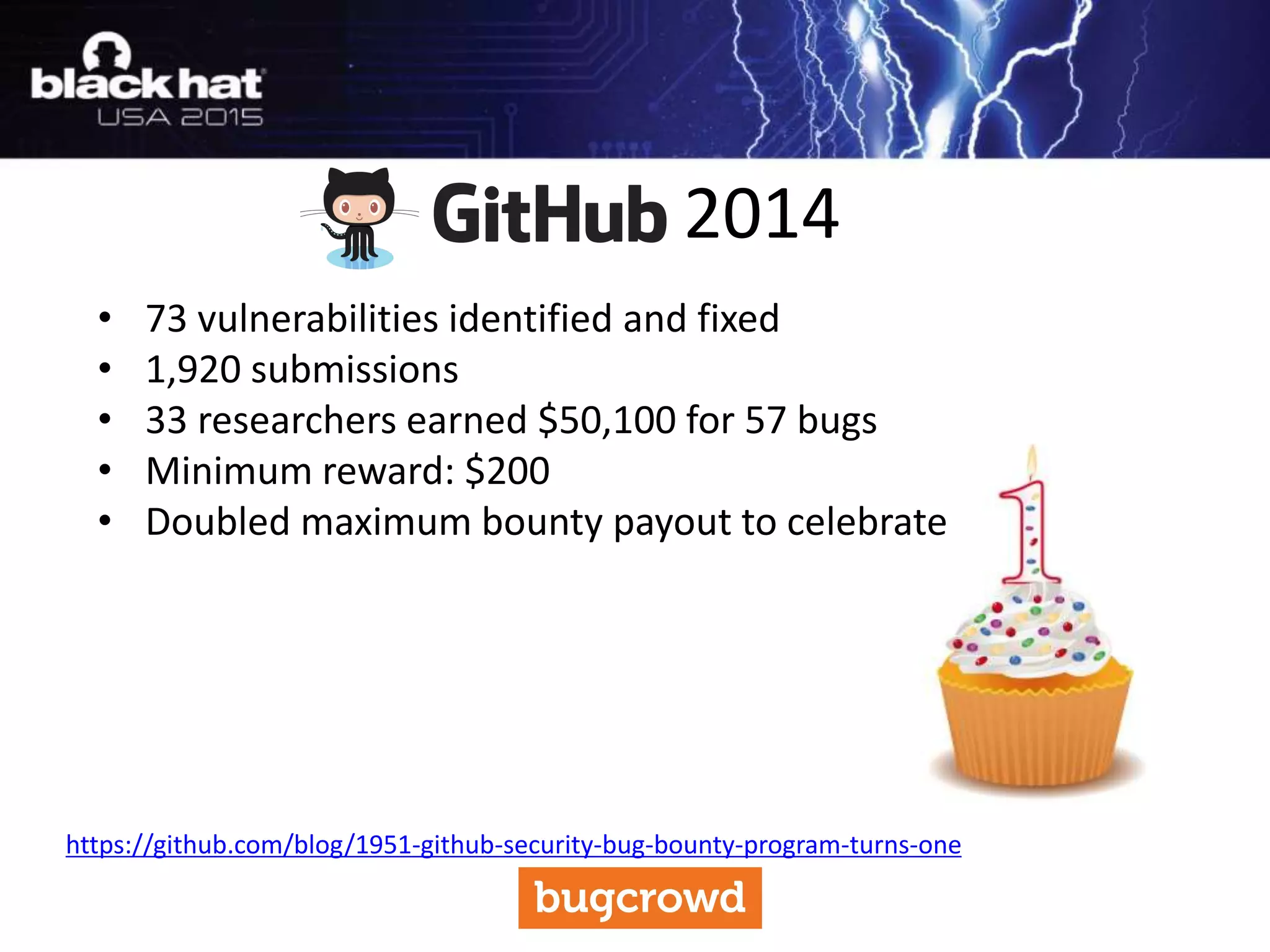
• 73 vulnerabilities identified and fixed
• 1,920 submissions
• 33 researchers earned $50,100 for 57 bugs
• Minimum reward: $200
• Doubled maximum bounty payout to celebrate
https://github.com/blog/1951-github-security-bug-bounty-program-turns-one
2014
https://github.com/blog/1951-github-security-bug-bounty-program-turns-one
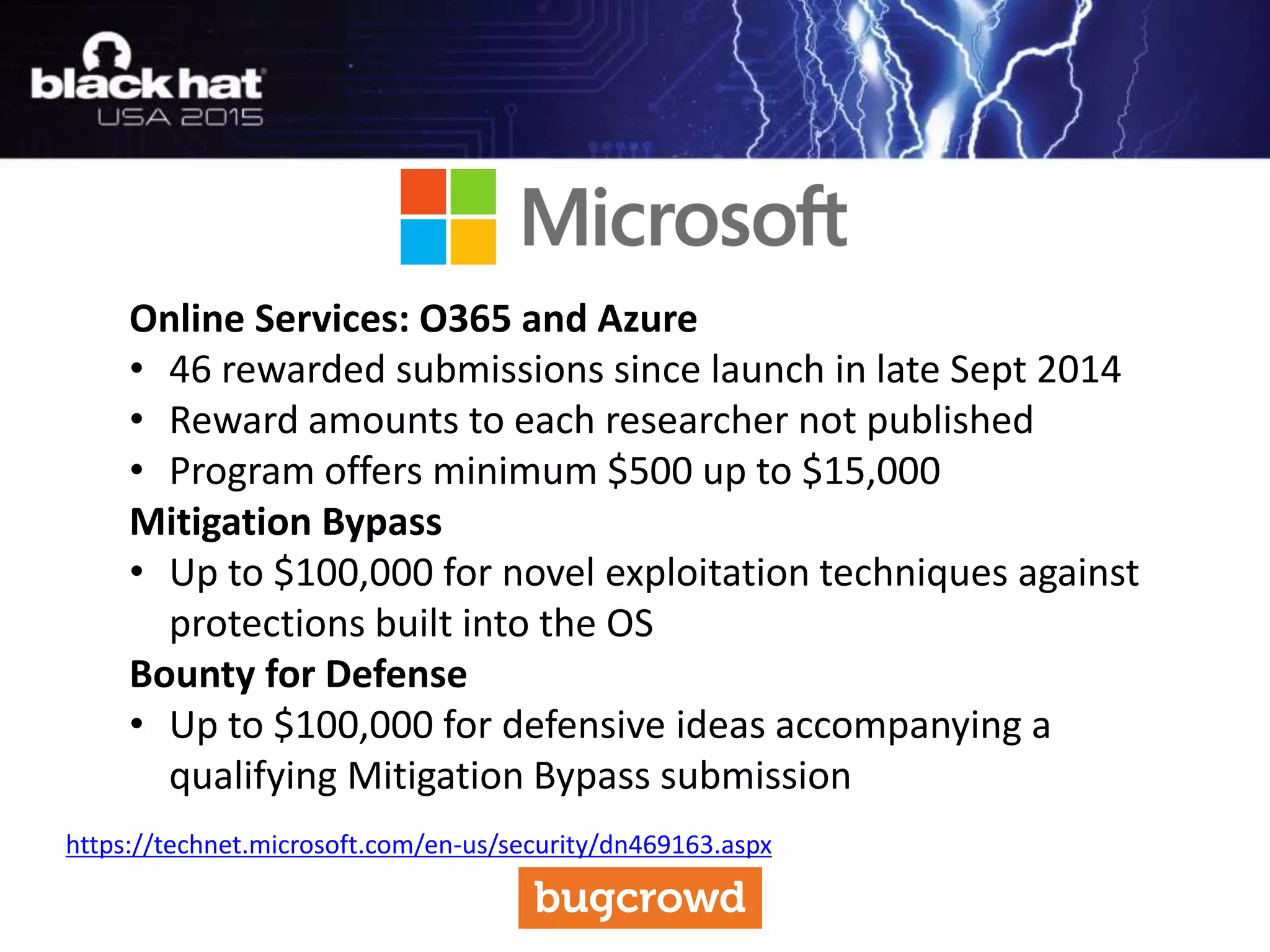
Online Services: O365 and Azure
• 46 rewarded submissions since launch in late Sept 2014
• Reward amounts to each researcher not published
• Program offers minimum $500 up to $15,000
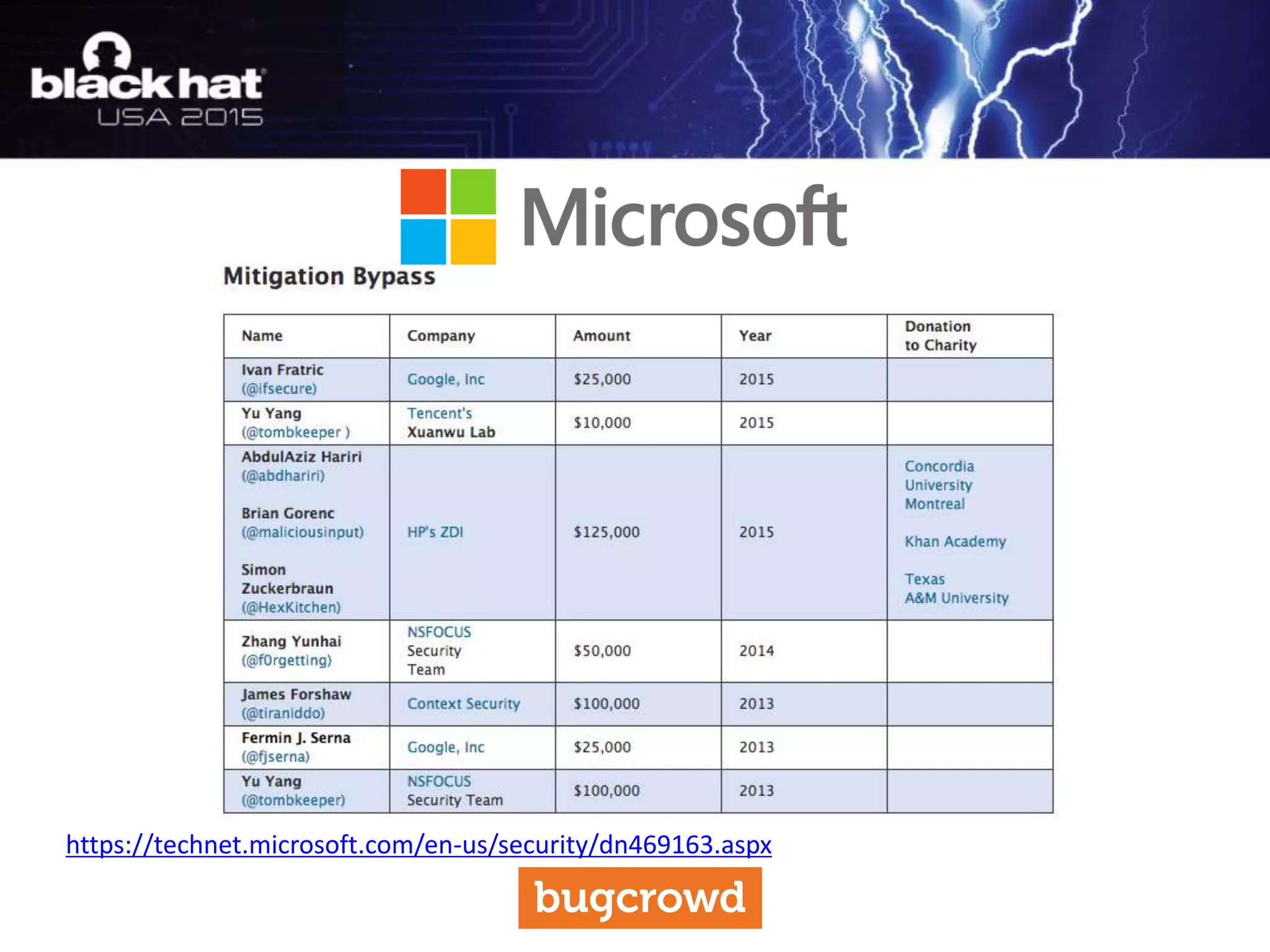
Mitigation Bypass
• Up to $100,000 for novel exploitation techniques against
protections built into the OS
Bounty for Defense
• Up to $100,000 for defensive ideas accompanying a
qualifying Mitigation Bypass submission
https://technet.microsoft.com/en-us/security/dn469163.aspx
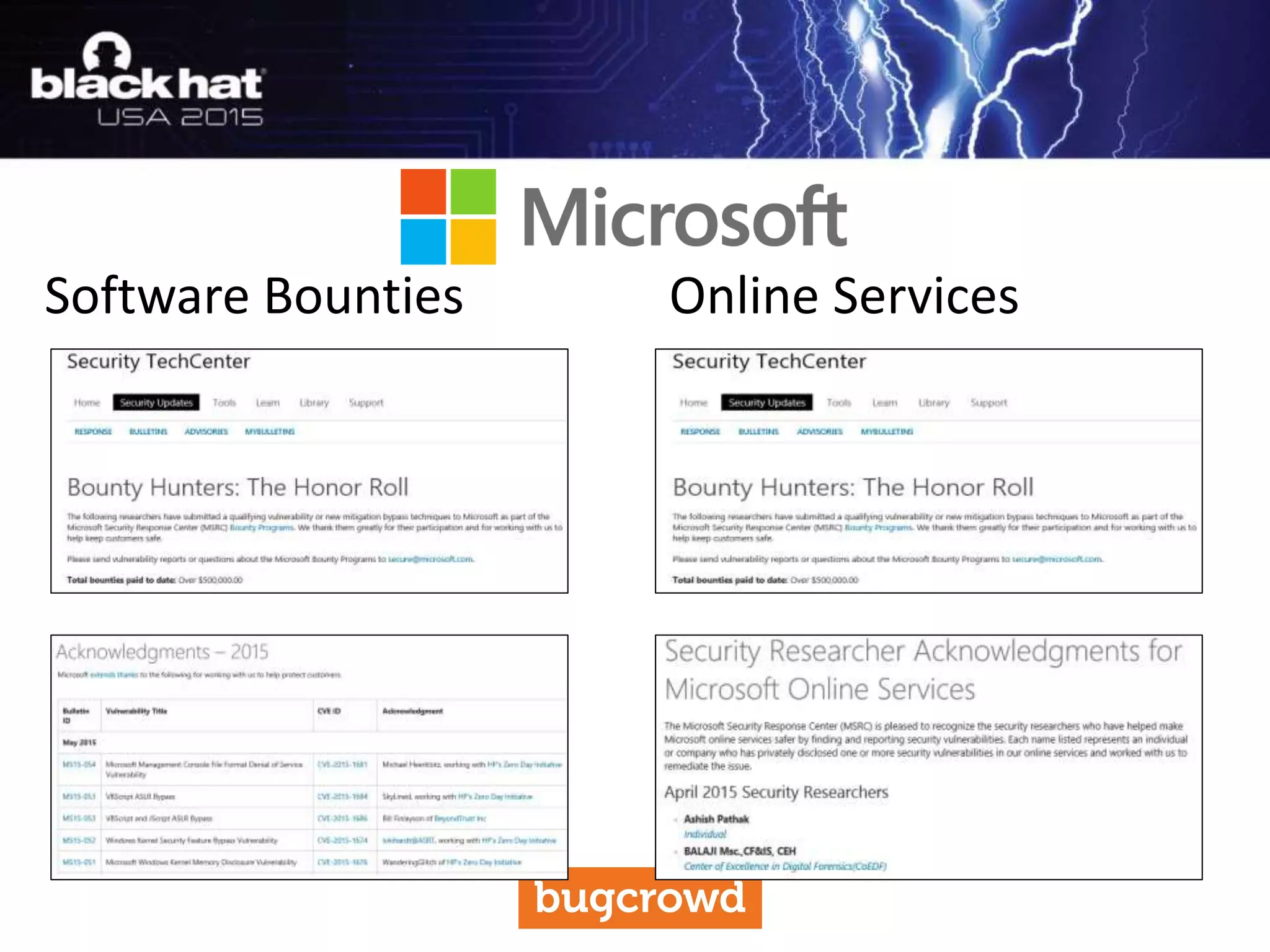
Software Bounties Online Services
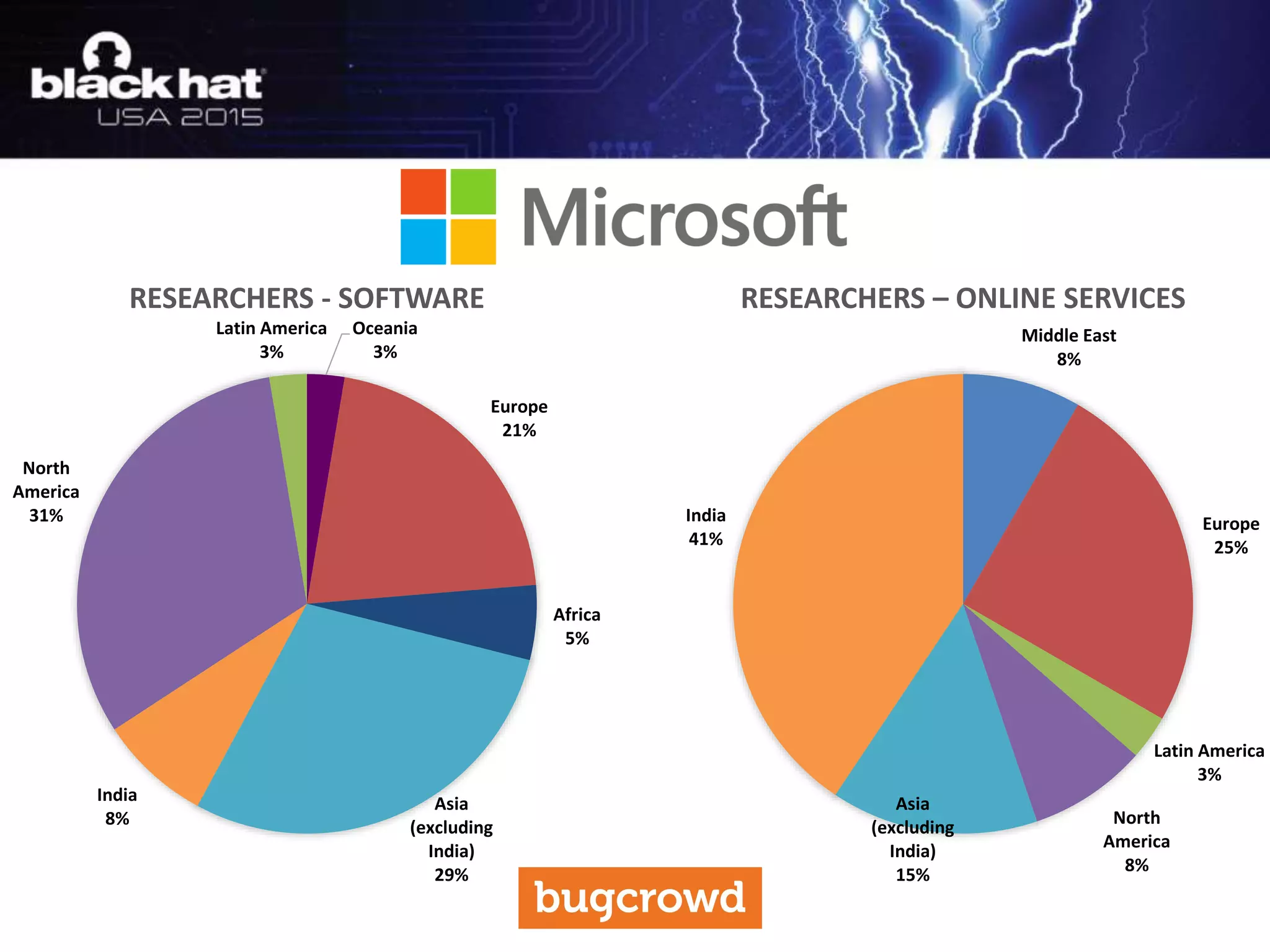
Middle East
8%
Europe
25%
Latin America
3%
North
America
8%
Asia
(excluding
India)
15%
India
41%
RESEARCHERS – ONLINE SERVICES
Oceania
3%
Europe
21%
Africa
5%
Asia
(excluding
India)
29%
India
8%
North
America
31%
Latin America
3%
RESEARCHERS - SOFTWARE
https://technet.microsoft.com/en-us/security/dn469163.aspx
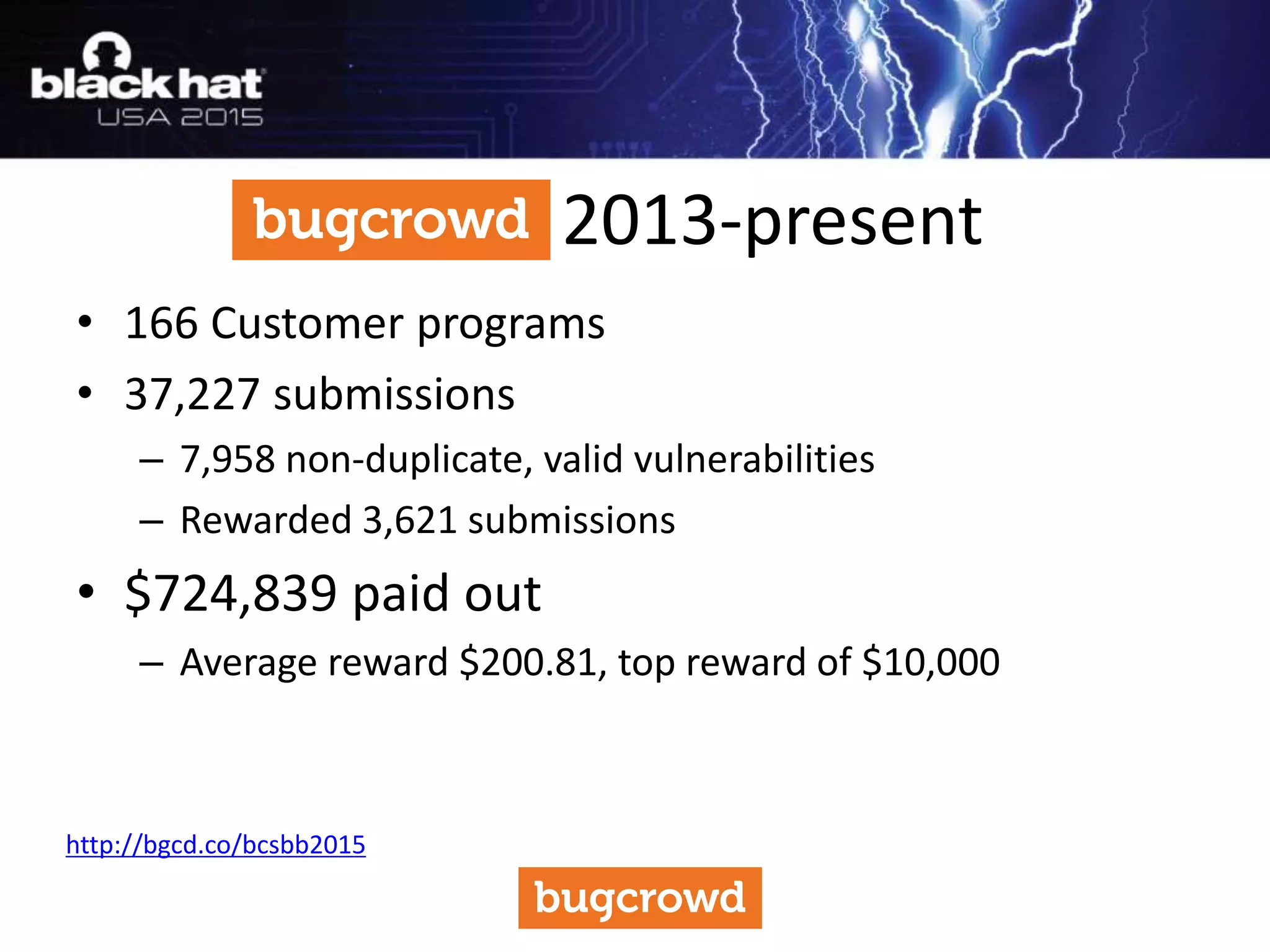
• 166 Customer programs
• 37,227 submissions
– 7,958 non-duplicate, valid vulnerabilities
– Rewarded 3,621 submissions
• $724,839 paid out
– Average reward $200.81, top reward of $10,000
2013-present
http://bgcd.co/bcsbb2015
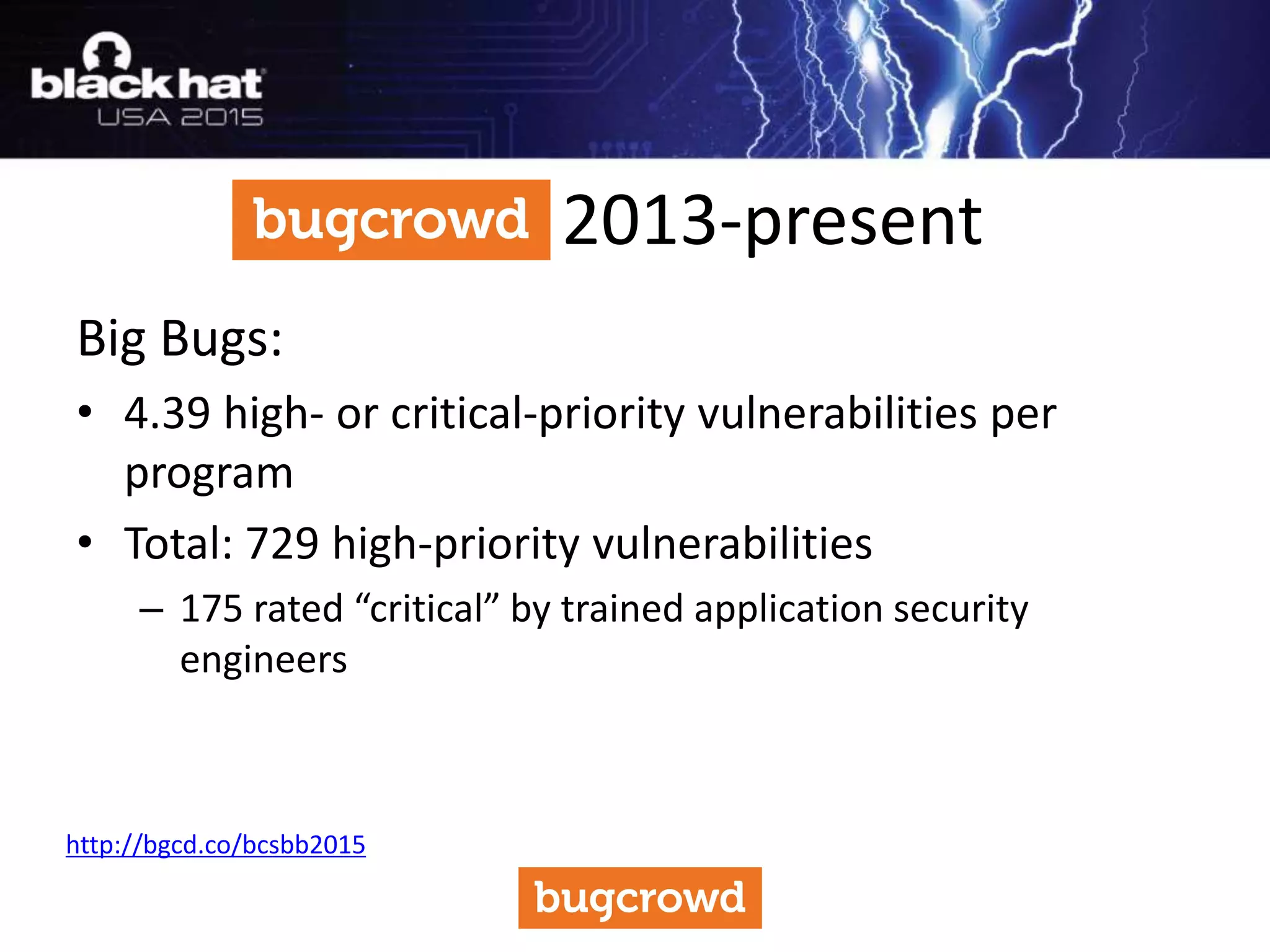
Big Bugs:
• 4.39 high- or critical-priority vulnerabilities per
program
• Total: 729 high-priority vulnerabilities
– 175 rated “critical” by trained application security
engineers
2013-present
http://bgcd.co/bcsbb2015
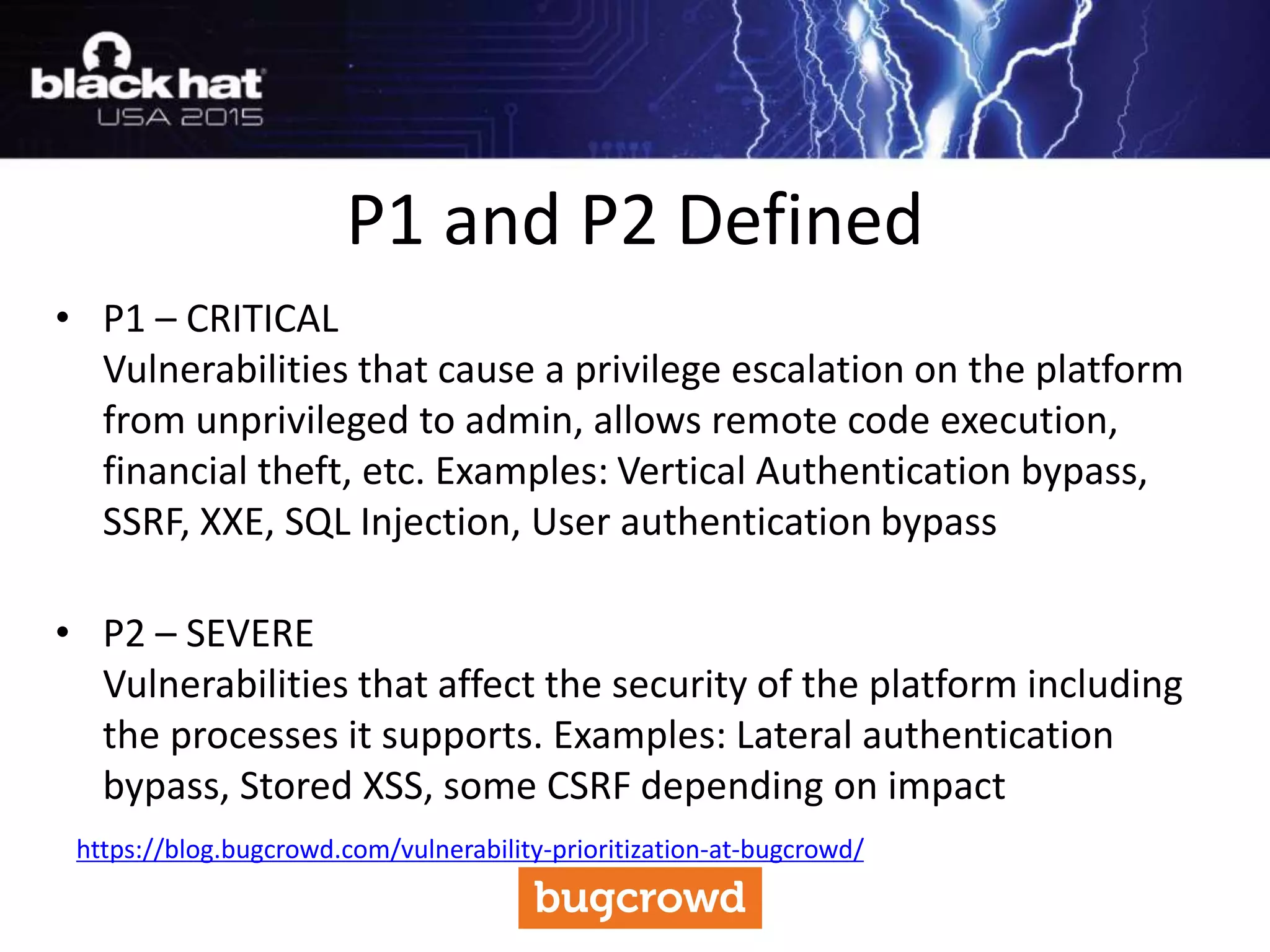
• P1 – CRITICAL
Vulnerabilities that cause a privilege escalation on the platform
from unprivileged to admin, allows remote code execution,
financial theft, etc. Examples: Vertical Authentication bypass,
SSRF, XXE, SQL Injection, User authentication bypass
• P2 – SEVERE
Vulnerabilities that affect the security of the platform including
the processes it supports. Examples: Lateral authentication
bypass, Stored XSS, some CSRF depending on impact
P1 and P2 Defined
https://blog.bugcrowd.com/vulnerability-prioritization-at-bugcrowd/
• Professional Pen Testers and consultants
• Former developers, QA engineers, and IT Admins that have
shifted focus into application security
• University students that have self taught security skills
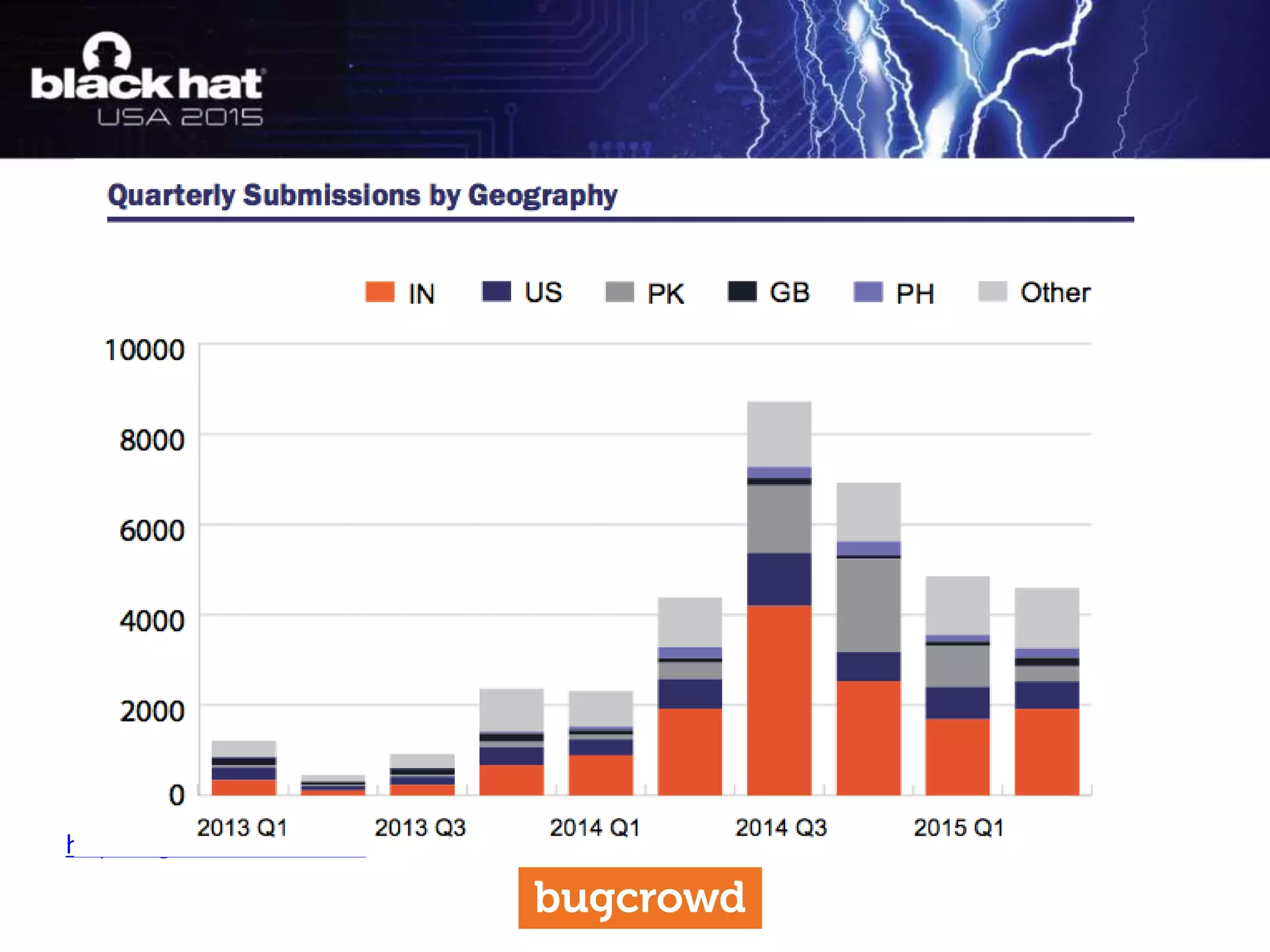
• Bugcrowd has over 18,000 researchers signed up in 147
countries worldwide
Who finds these bugs?
http://bgcd.co/bcsbb2015
C:red
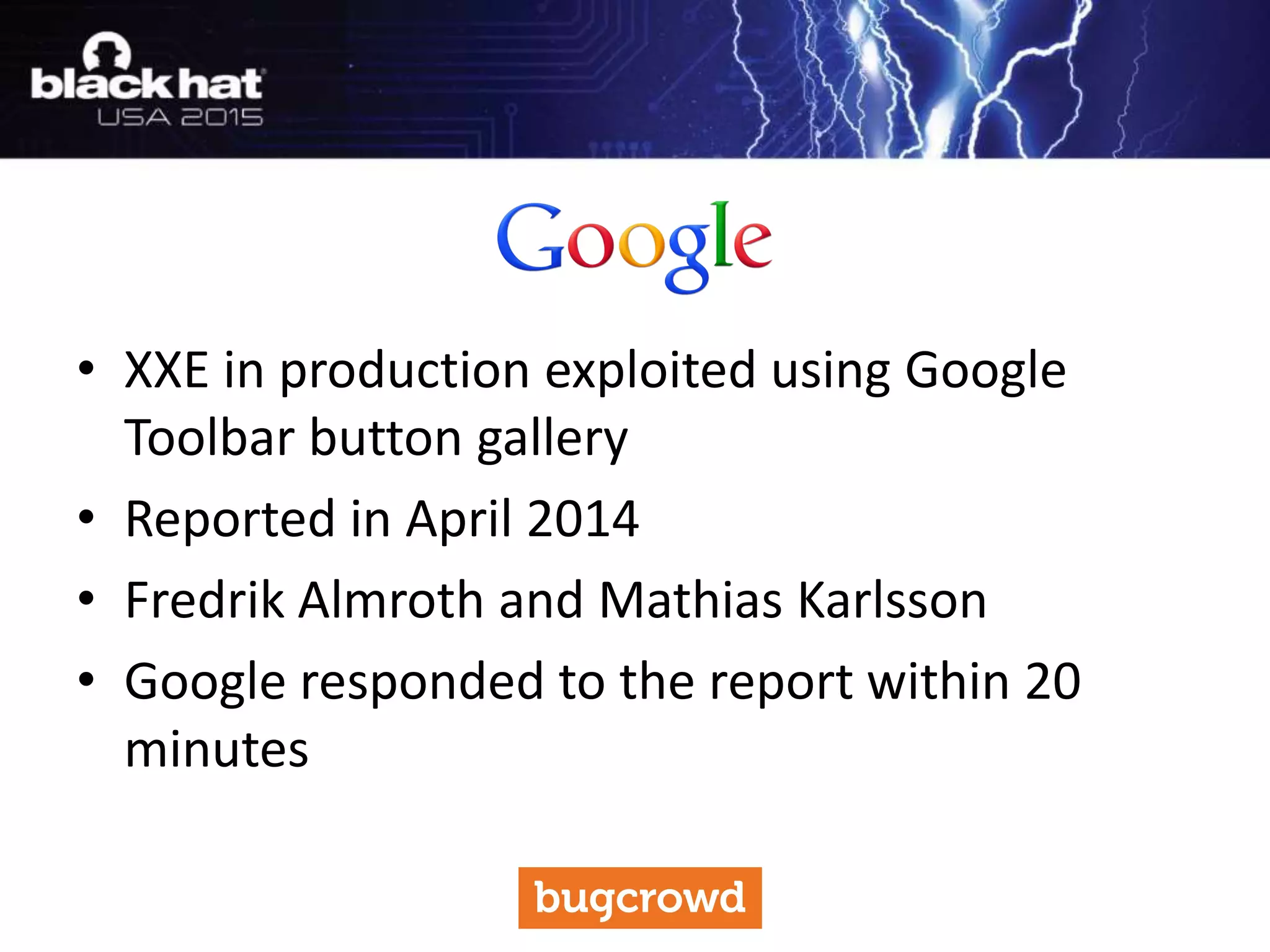
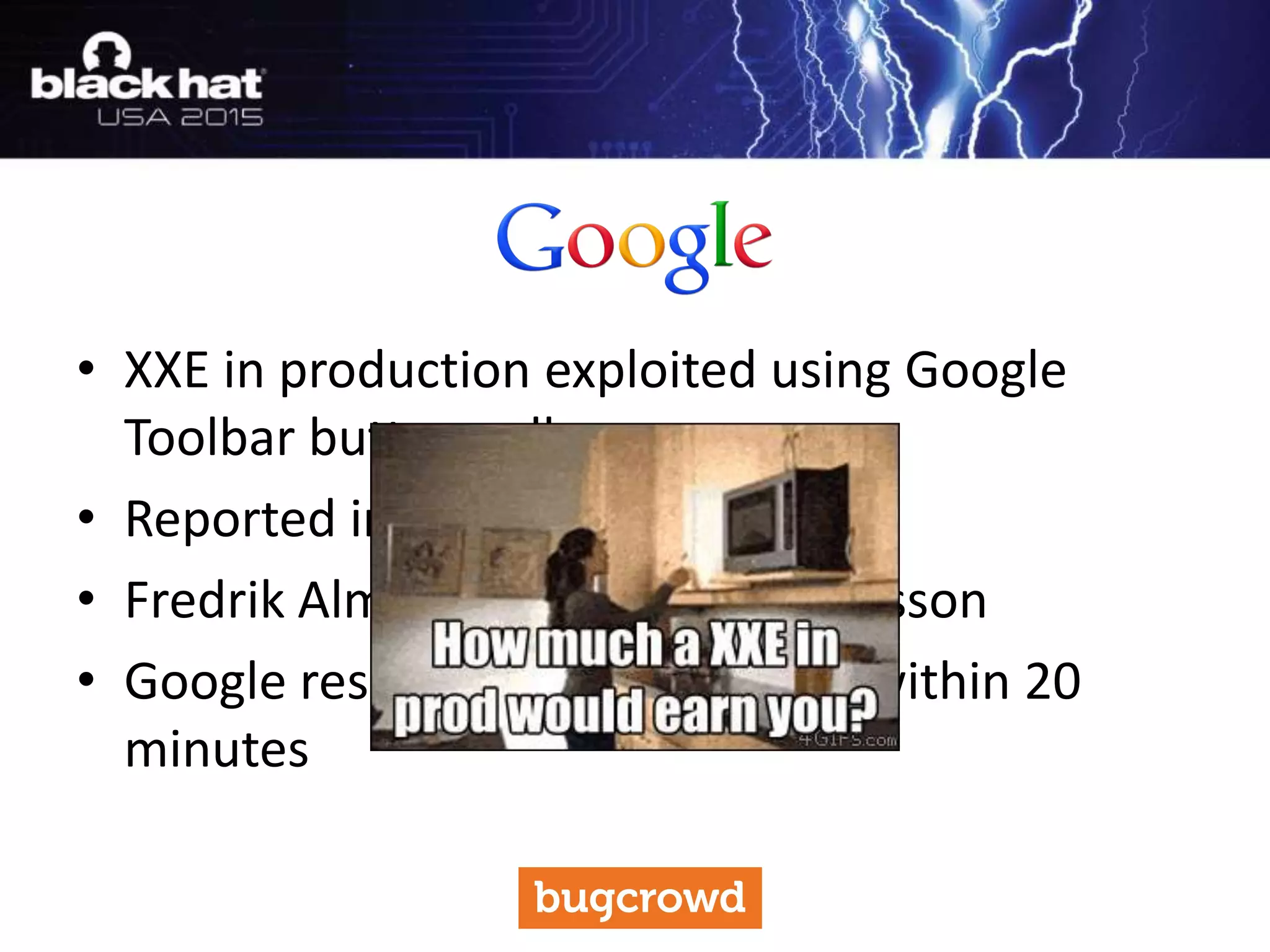
• XXE in production exploited using Google
Toolbar button gallery
• Reported in April 2014
• Fredrik Almroth and Mathias Karlsson
• Google responded to the report within 20
minutes
• XXE in production exploited using Google
Toolbar button gallery
• Reported in April 2014
• Fredrik Almroth and Mathias Karlsson
• Google responded to the report within 20
minutes
• Reginaldo Silva reported an XML external entity vulnerability
within a PHP page that would have allowed a hacker to
change Facebook's use of Gmail as an OpenID provider to a
hacker-controlled URL, before servicing requests with
malicious XML code.
• http://www.ubercomp.com/posts/2014-01-
16_facebook_remote_code_execution
• Laxman Muthiyah identified a way for a malicious user to
delete any photo album owned by a user, page, or group on
Facebook. He found this vulnerability when he tried to delete
one of his own photo albums using the graph explorer access
token.
• http://www.7xter.com/2015/02/how-i-hacked-your-facebook-
photos.html
• Cross-domain Information Disclosure
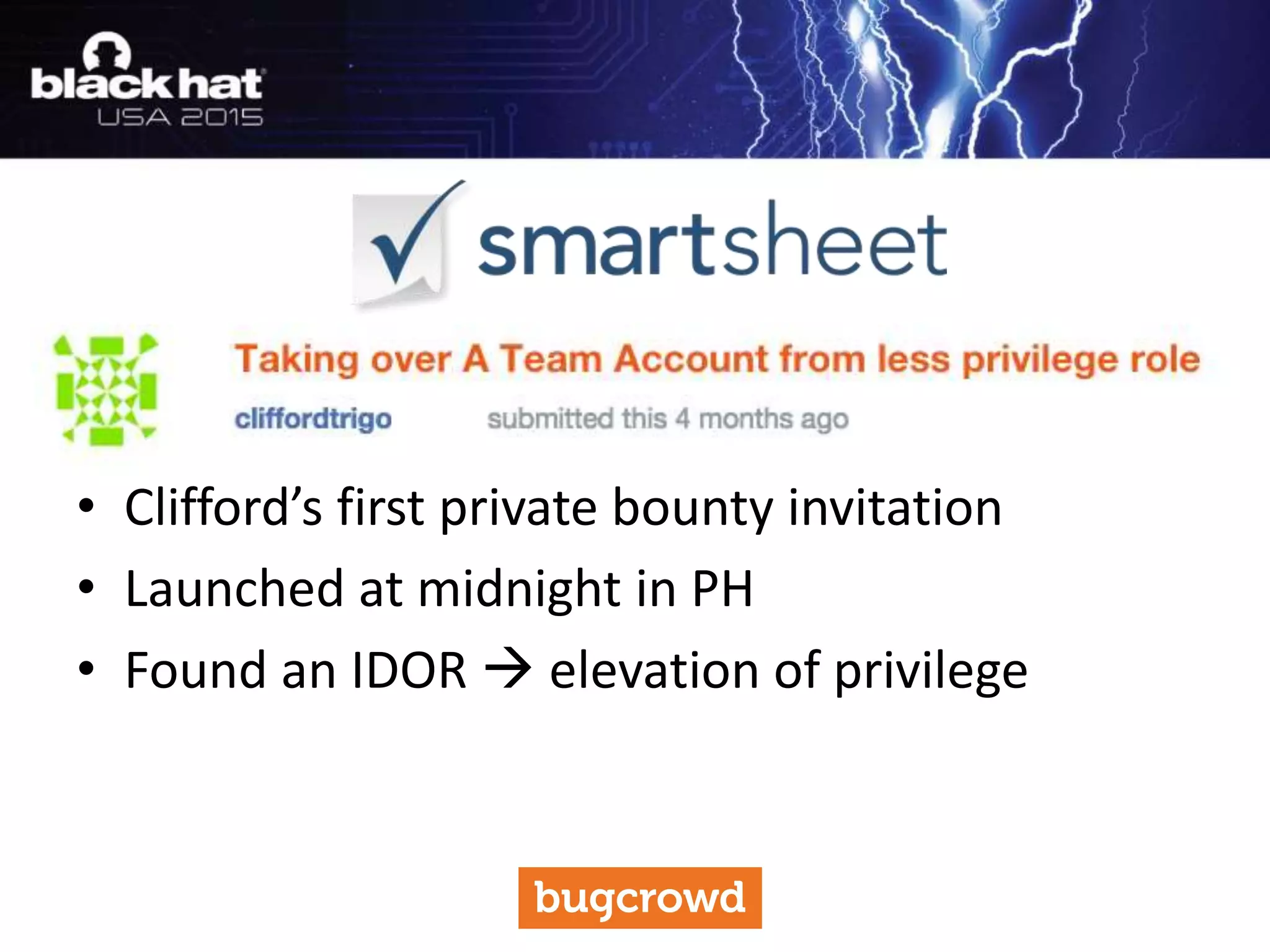
• Clifford’s first private bounty invitation
• Launched at midnight in PH
• Found an IDOR  elevation of privilege
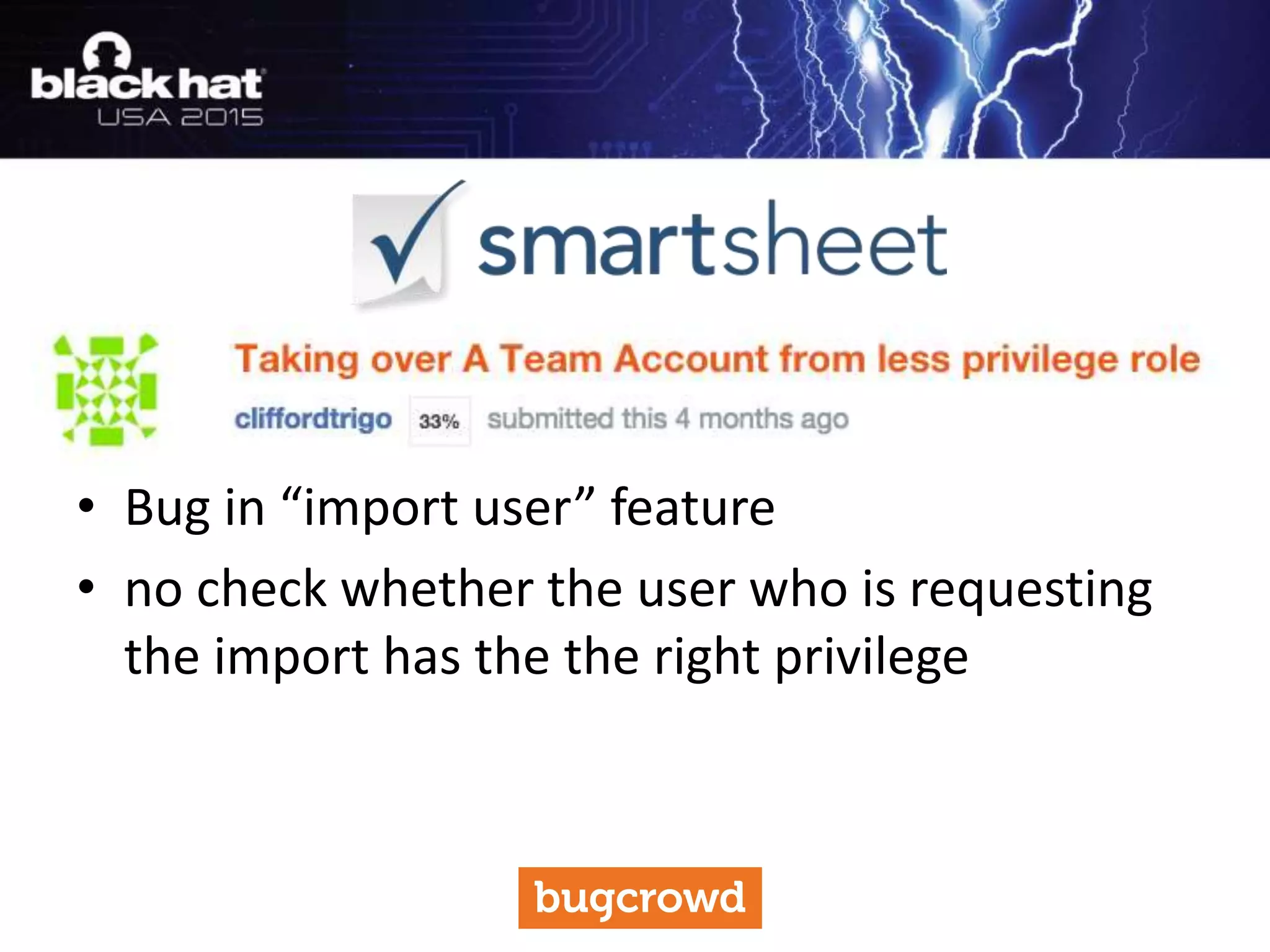
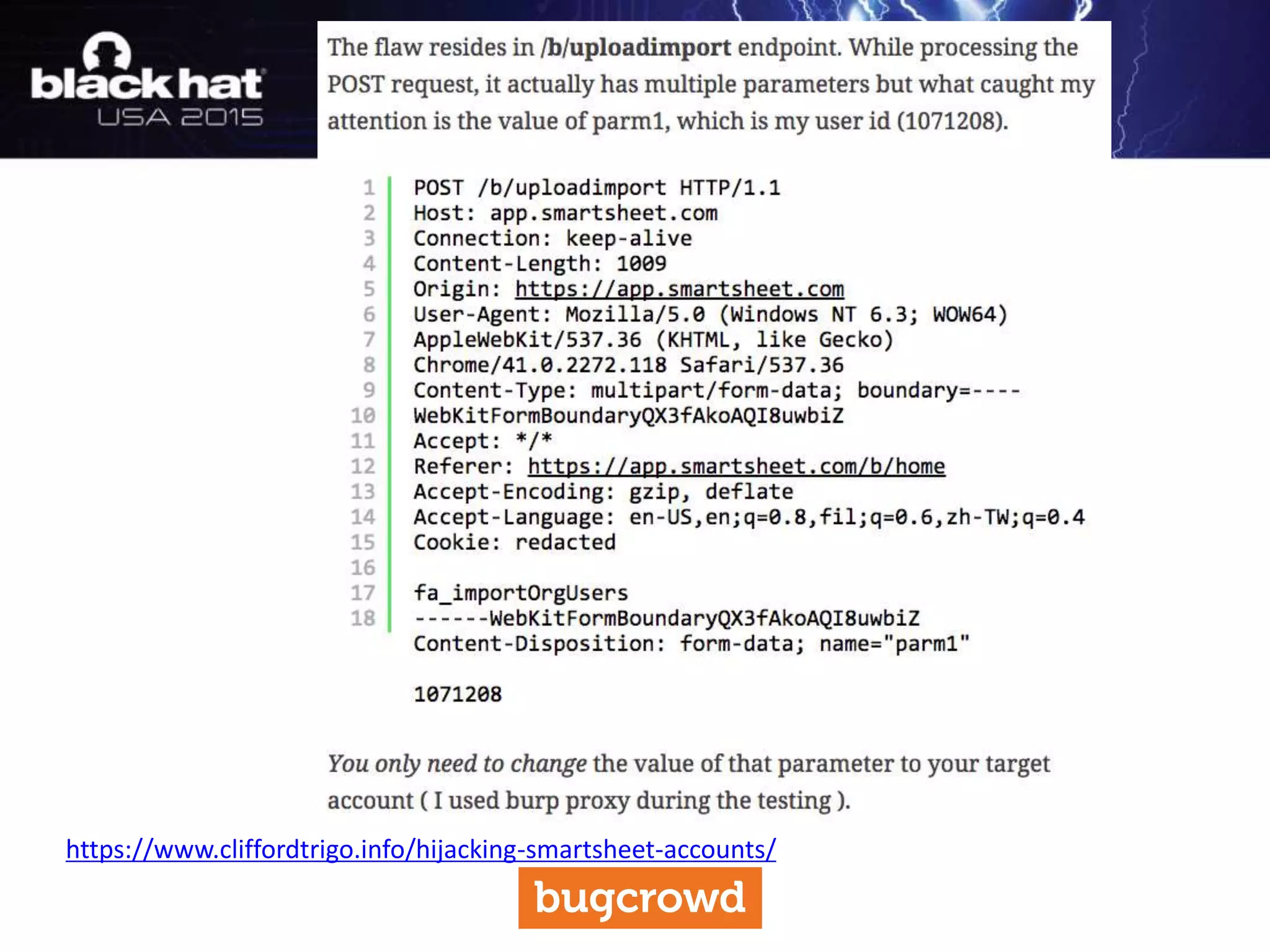
• Bug in “import user” feature
• no check whether the user who is requesting
the import has the the right privilege
https://www.cliffordtrigo.info/hijacking-smartsheet-accounts/
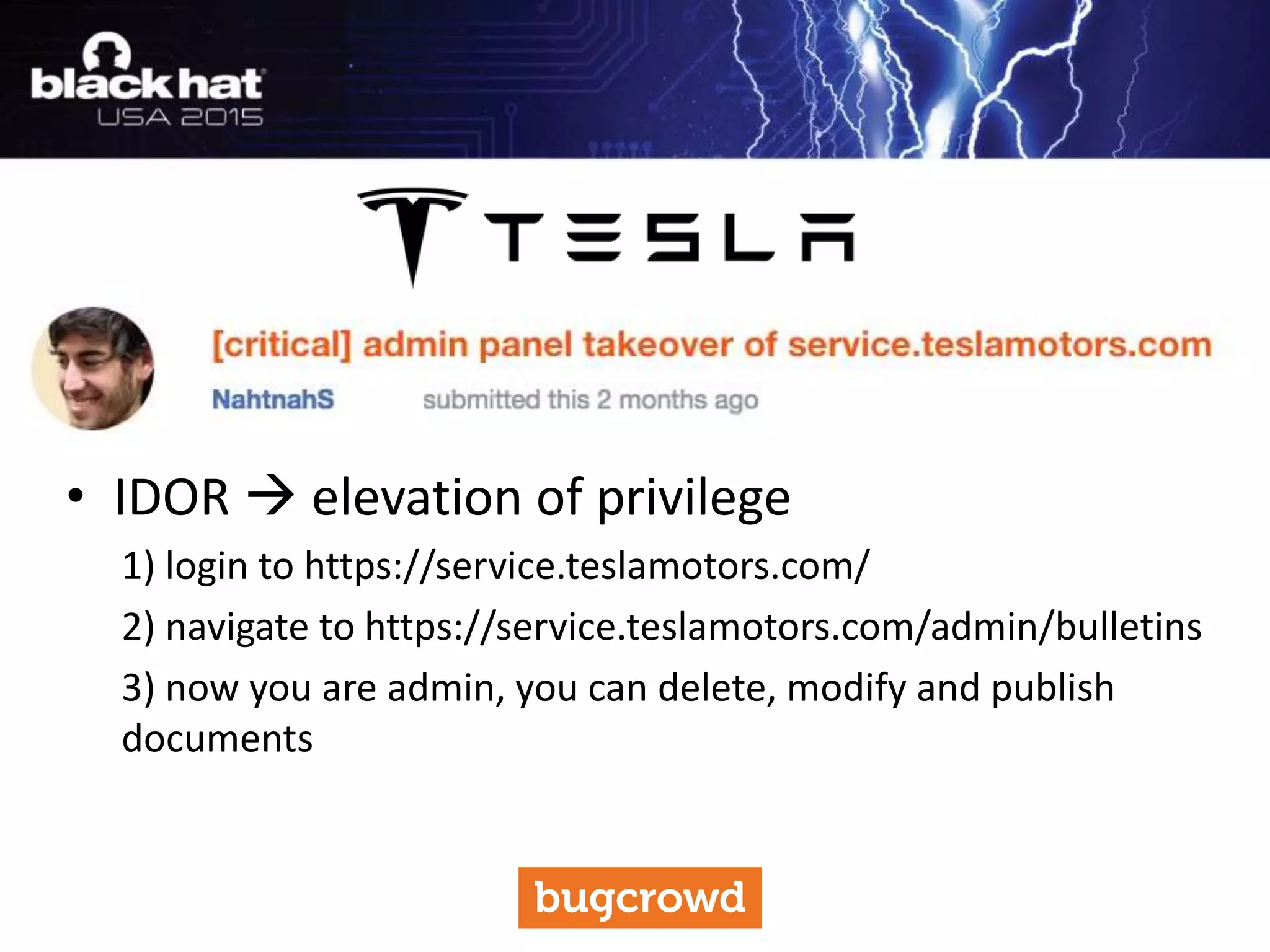
• IDOR  elevation of privilege
1) login to https://service.teslamotors.com/
2) navigate to https://service.teslamotors.com/admin/bulletins
3) now you are admin, you can delete, modify and publish
documents
http://nbsriharsha.blogspot.in/2015/07/a-style-of-bypassing-authentication.html
C:blue
• Submission framework & expectations
• Eloquence of written communication
• Clear in and out of scope documentation
Rapid triage & prioritization
(get to the P1’s faster)
• Guidance and training
– Google: Bughunter University
– Facebook: Bounty Hunter’s Guide
– Bugcrowd: Bugcrowd Forum
• Clear in and out of scope documentation
• Direct Performance Feedback
How to reduce noise
• Guidance and training
– Google: Bughunter University
– Facebook: Bounty Hunter’s Guide
– Bugcrowd: Bugcrowd Forum
• Clear in and out of scope documentation
• Direct Performance Feedback
How to reduce noise
• Clear the queue daily
• Communicate your priorities
• Dealing with Duplicates
Rapid triage & prioritization
• Defined vulnerability taxonomy
Rapid triage & prioritization
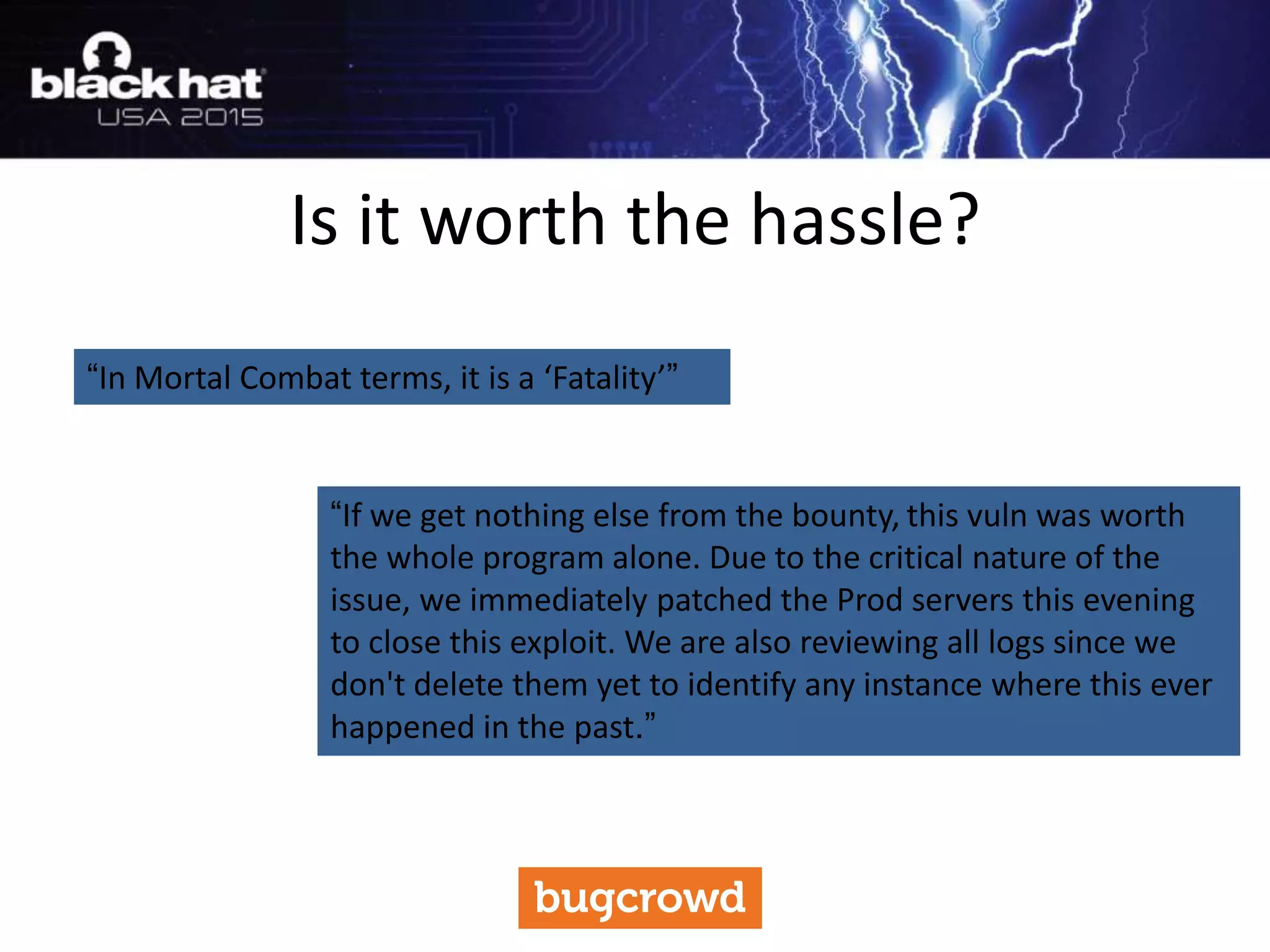
Is it worth the hassle?
“In Mortal Combat terms, it is a ‘Fatality’”
“If we get nothing else from the bounty, this vuln was worth
the whole program alone. Due to the critical nature of the
issue, we immediately patched the Prod servers this evening
to close this exploit. We are also reviewing all logs since we
don't delete them yet to identify any instance where this ever
happened in the past.”
• Publish and stick to your program SLA
• Stop rewarding bad behavior
• Don’t create bad behavior
– Reward consistently
– Reward fairly
– Fix quickly
– Again with the documentation
How to reduce noise
C:tl;dr
• Bug bounties successfully generate high
severity vulnerability disclosures, delivering
real value that improves application security
for companies of all sizes.
• Crowdsourcing engages skilled researchers
around the world that you may not have
heard of.
conclusions
• Write strong scope documentation
• Clear submission expectations
• Provide feedback
• Stay consistently engaged
• Reward good behavior
call to action
HI THIS IS URGENT PLZ FIX ASAP:
Critical Vulnerabilities
and Bug Bounty Programs
Kymberlee Price
Senior Director of Researcher Operations
Bugcrowd
@Kym_Possible

HI THIS IS URGENT PLZ FIX ASAP: Critical Vunlerabilities and Bug Bounty Programs

  • 1.
    HI THIS ISURGENT PLZ FIX ASAP: Critical Vulnerabilities and Bug Bounty Programs Kymberlee Price Senior Director of Researcher Operations Bugcrowd @Kym_Possible
  • 2.
    • Senior Directorof a Red Team • PSIRT Case Manager • Data Analyst • Internet Crime Investigator • Behavioral Psychologist @kym_possible whoami?
  • 3.
    • Intro • Red •Blue • tl;dr • Questions Agenda
  • 4.
    • Determining ifa bug bounty program is appropriate for your company • Selling you a bug bounty program • Recruiting you to be a bounty hunter What this talk isn’t
  • 5.
  • 7.
  • 8.
  • 9.
  • 10.
  • 12.
    2014 Submissions: • 17,011 submissions– 16% increase YoY • 61 high severity bugs – 49% increase YoY • Minimum reward: $500 Geography: • 65 countries received rewards – 12% increase YoY • 123 countries reporting bugs https://www.facebook.com/notes/facebook-bug-bounty/2014-highlights-bounties-get-better-than- ever/1026610350686524
  • 13.
    2014 Payouts: • $1.3 millionto 321 researchers • Average reward: $1,788. Top 5 Countries: • India – 196 valid bugs • Egypt – 81 valid bugs • USA – 61 valid bugs • UK – 28 valid bugs • Philippines – 27 valid bugs $1,343 $1,220 $2,470 $2,768 $1,093 $263,228 $98,820 $150,670 $77,504 $29,511 $619,733 The top 5 researchers earned a total of $256,750
  • 15.
    2014 • 73 vulnerabilitiesidentified and fixed • 1,920 submissions • 33 researchers earned $50,100 for 57 bugs • Minimum reward: $200 • Doubled maximum bounty payout to celebrate https://github.com/blog/1951-github-security-bug-bounty-program-turns-one
  • 16.
  • 18.
    Online Services: O365and Azure • 46 rewarded submissions since launch in late Sept 2014 • Reward amounts to each researcher not published • Program offers minimum $500 up to $15,000 Mitigation Bypass • Up to $100,000 for novel exploitation techniques against protections built into the OS Bounty for Defense • Up to $100,000 for defensive ideas accompanying a qualifying Mitigation Bypass submission https://technet.microsoft.com/en-us/security/dn469163.aspx
  • 19.
  • 20.
    Middle East 8% Europe 25% Latin America 3% North America 8% Asia (excluding India) 15% India 41% RESEARCHERS– ONLINE SERVICES Oceania 3% Europe 21% Africa 5% Asia (excluding India) 29% India 8% North America 31% Latin America 3% RESEARCHERS - SOFTWARE
  • 21.
  • 23.
    • 166 Customerprograms • 37,227 submissions – 7,958 non-duplicate, valid vulnerabilities – Rewarded 3,621 submissions • $724,839 paid out – Average reward $200.81, top reward of $10,000 2013-present http://bgcd.co/bcsbb2015
  • 24.
    Big Bugs: • 4.39high- or critical-priority vulnerabilities per program • Total: 729 high-priority vulnerabilities – 175 rated “critical” by trained application security engineers 2013-present http://bgcd.co/bcsbb2015
  • 25.
    • P1 –CRITICAL Vulnerabilities that cause a privilege escalation on the platform from unprivileged to admin, allows remote code execution, financial theft, etc. Examples: Vertical Authentication bypass, SSRF, XXE, SQL Injection, User authentication bypass • P2 – SEVERE Vulnerabilities that affect the security of the platform including the processes it supports. Examples: Lateral authentication bypass, Stored XSS, some CSRF depending on impact P1 and P2 Defined https://blog.bugcrowd.com/vulnerability-prioritization-at-bugcrowd/
  • 26.
    • Professional PenTesters and consultants • Former developers, QA engineers, and IT Admins that have shifted focus into application security • University students that have self taught security skills • Bugcrowd has over 18,000 researchers signed up in 147 countries worldwide Who finds these bugs? http://bgcd.co/bcsbb2015
  • 27.
  • 28.
    • XXE inproduction exploited using Google Toolbar button gallery • Reported in April 2014 • Fredrik Almroth and Mathias Karlsson • Google responded to the report within 20 minutes
  • 29.
    • XXE inproduction exploited using Google Toolbar button gallery • Reported in April 2014 • Fredrik Almroth and Mathias Karlsson • Google responded to the report within 20 minutes
  • 30.
    • Reginaldo Silvareported an XML external entity vulnerability within a PHP page that would have allowed a hacker to change Facebook's use of Gmail as an OpenID provider to a hacker-controlled URL, before servicing requests with malicious XML code. • http://www.ubercomp.com/posts/2014-01- 16_facebook_remote_code_execution
  • 31.
    • Laxman Muthiyahidentified a way for a malicious user to delete any photo album owned by a user, page, or group on Facebook. He found this vulnerability when he tried to delete one of his own photo albums using the graph explorer access token. • http://www.7xter.com/2015/02/how-i-hacked-your-facebook- photos.html
  • 32.
  • 34.
    • Clifford’s firstprivate bounty invitation • Launched at midnight in PH • Found an IDOR  elevation of privilege
  • 35.
    • Bug in“import user” feature • no check whether the user who is requesting the import has the the right privilege
  • 36.
  • 37.
    • IDOR elevation of privilege 1) login to https://service.teslamotors.com/ 2) navigate to https://service.teslamotors.com/admin/bulletins 3) now you are admin, you can delete, modify and publish documents
  • 38.
  • 39.
  • 40.
    • Submission framework& expectations • Eloquence of written communication • Clear in and out of scope documentation Rapid triage & prioritization (get to the P1’s faster)
  • 42.
    • Guidance andtraining – Google: Bughunter University – Facebook: Bounty Hunter’s Guide – Bugcrowd: Bugcrowd Forum • Clear in and out of scope documentation • Direct Performance Feedback How to reduce noise
  • 43.
    • Guidance andtraining – Google: Bughunter University – Facebook: Bounty Hunter’s Guide – Bugcrowd: Bugcrowd Forum • Clear in and out of scope documentation • Direct Performance Feedback How to reduce noise
  • 44.
    • Clear thequeue daily • Communicate your priorities • Dealing with Duplicates Rapid triage & prioritization
  • 45.
    • Defined vulnerabilitytaxonomy Rapid triage & prioritization
  • 46.
    Is it worththe hassle? “In Mortal Combat terms, it is a ‘Fatality’” “If we get nothing else from the bounty, this vuln was worth the whole program alone. Due to the critical nature of the issue, we immediately patched the Prod servers this evening to close this exploit. We are also reviewing all logs since we don't delete them yet to identify any instance where this ever happened in the past.”
  • 47.
    • Publish andstick to your program SLA • Stop rewarding bad behavior • Don’t create bad behavior – Reward consistently – Reward fairly – Fix quickly – Again with the documentation How to reduce noise
  • 48.
  • 49.
    • Bug bountiessuccessfully generate high severity vulnerability disclosures, delivering real value that improves application security for companies of all sizes. • Crowdsourcing engages skilled researchers around the world that you may not have heard of. conclusions
  • 50.
    • Write strongscope documentation • Clear submission expectations • Provide feedback • Stay consistently engaged • Reward good behavior call to action
  • 51.
    HI THIS ISURGENT PLZ FIX ASAP: Critical Vulnerabilities and Bug Bounty Programs Kymberlee Price Senior Director of Researcher Operations Bugcrowd @Kym_Possible

Editor's Notes

  • #2 No More Free Bugs led to Bug Bounties, but some people believe that bug bounty hunters are low quality script kiddies and the most talented researchers aren't participating. The emergence of bug bounty programs is increasing the volume of vulnerability submissions, but how many of those can be found by running an automated scanning tool? Are any really critical bugs being found in the sea of clickjacking and weak password policy reports? How do you separate the signal from the noise, and more importantly, how do you shift the balance of bug reports to greater signal/less noise overall? In this presentation we will discuss several highly critical vulnerabilities that have been uncovered through a variety of bug bounty programs and their impact on the customers. With participation from researchers and vendors, attendees will not only see some sweet vulnerabilities broken down, but also why wading through another submission from @CluelessSec might be worth it.
  • #5 I am more than happy to talk to you about any or all of these things, but not during the next 50 minutes. We are hosting a AMA lounge at Defcon where I’ll gladly answer any questions you have on starting a bounty program.
  • #7 DOES NOT INCLUDE THE PATCH REWARD PROGRAM OR CHROME REWARD PROGRAM. ANDROID REWARD PROGRAM STARTED IN 2015. In scope: google.com, youtube.com, blogger.com. Also google-developed apps & extensions in the google play, iTunes, or Chrome web stores.
  • #8 Google is one of the companies with a public bug bounty program that publishes statistics on their program. There aren’t raw numbers of vulnerability reports, but I think it is fair to say from this heatmap that rewardable submissions were less than 20% of the total. That big green block is noise. But down there on the lower right are the submissions that make the VRP program worthwhile.
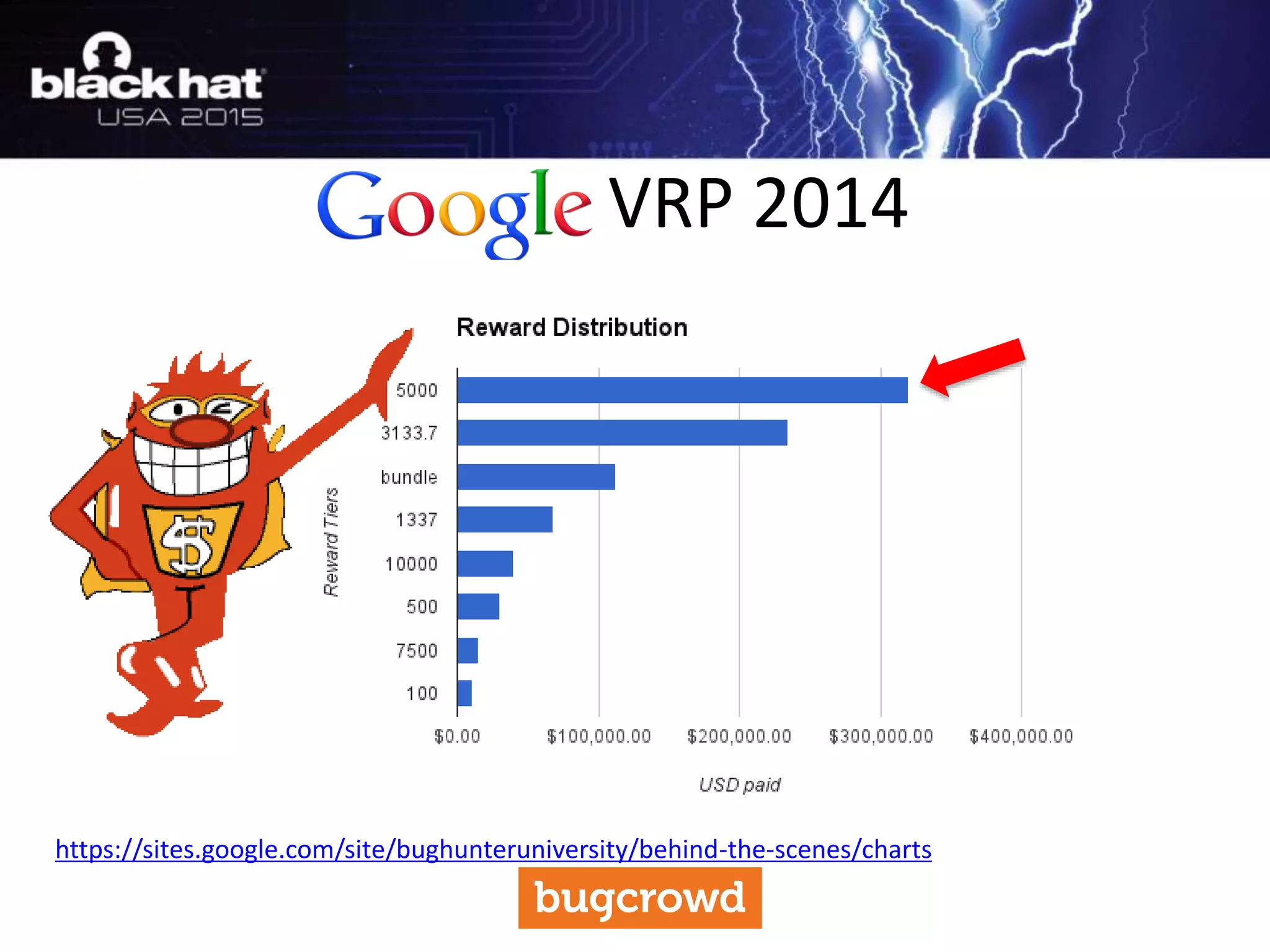
  • #9 The vast majority of reward money is sent to finders of high risk issues, delivering clear value to product security. These researchers clearly hit big money. 300000/5000=60 200000/3133.7=64
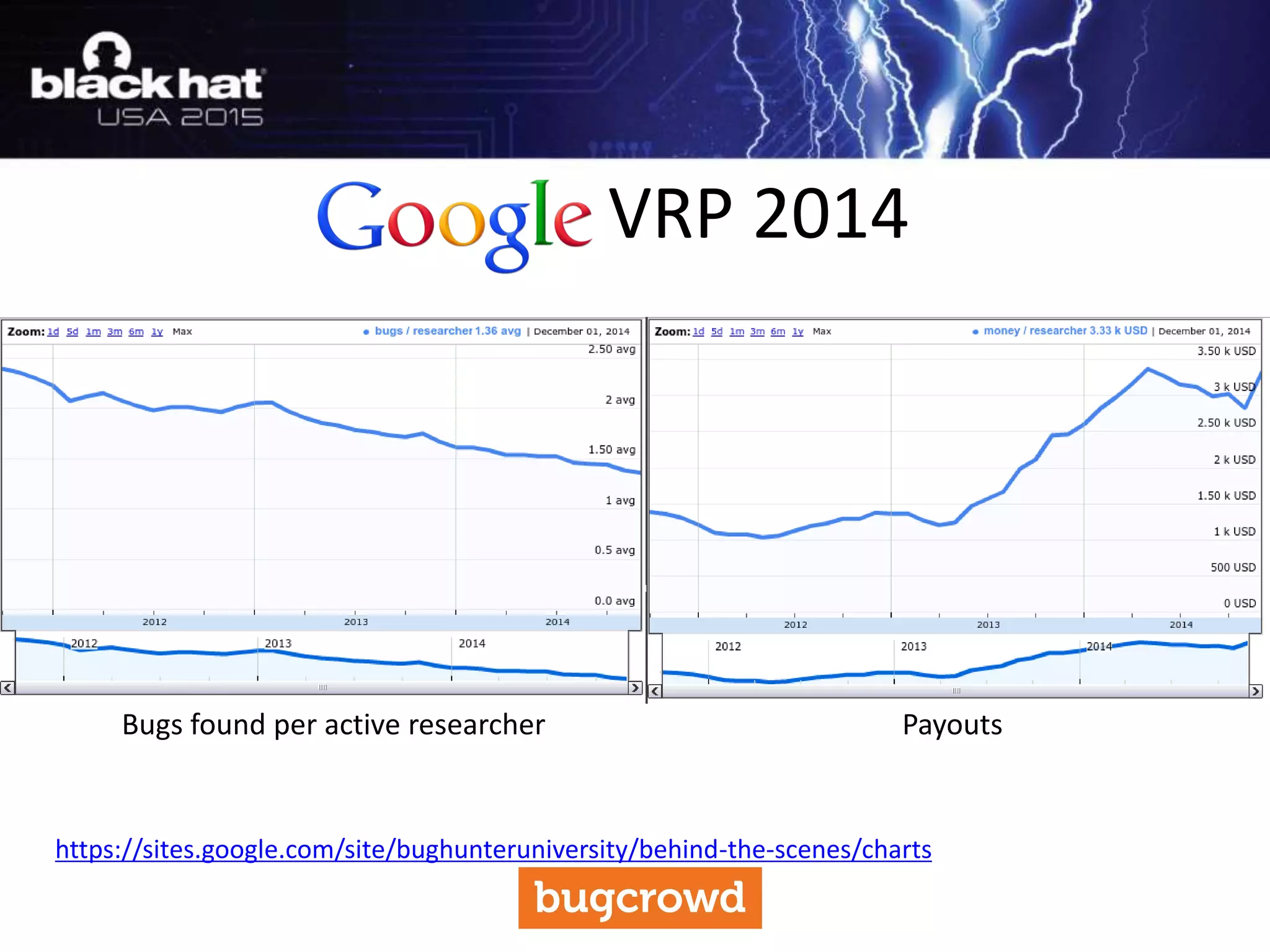
  • #10 https://sites.google.com/site/bughunteruniversity/behind-the-scenes/charts Over time, the volume of valid bugs reported decreased. “Based on interviews, surveys and this graph, we conclude that finding bugs in Google products is becoming harder over time, forcing frequent researchers to search for more complex vulnerabilities.” SUCCESS
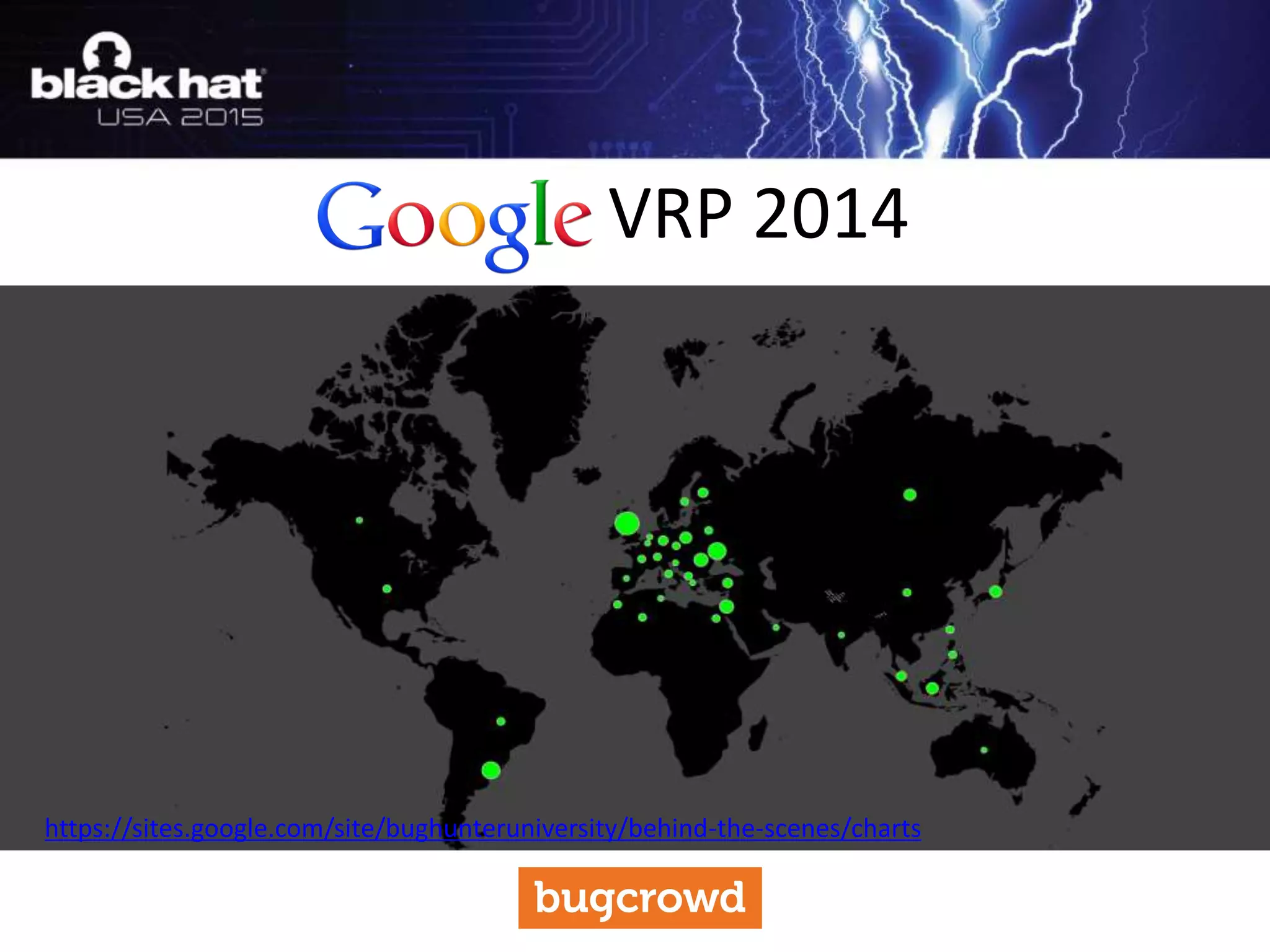
  • #11 This map shows countries where they send rewards, and size represents the average severity of the vulnerabilities. Europe is clearly submitting the most bugs, but what is interesting is that Asia and even Africa submit more valid reports than researchers based in America. Even with their significant payouts, US based researchers aren’t finding and submitting vulnerabilities on the scale that other regions are.
  • #12 https://www.facebook.com/notes/facebook-bug-bounty/2014-highlights-bounties-get-better-than-ever/1026610350686524
  • #13 https://www.facebook.com/notes/facebook-bug-bounty/2014-highlights-bounties-get-better-than-ever/1026610350686524
  • #14 The average reward may have been $1,788, but the top 5 researchers took home a quarter of a million dollars. So what are the top countries these bugs come from? If you are looking for volume, no country even comes close to beating India. Good job y’all, this is pretty impressive. This means that Facebook sent over a quarter of a million dollars to India in 2014, to pay researchers for helping to secure their product. But it isn’t all about volume, right? This whole talk is about impact. So lets look at average bug value. [click through average bug payouts and sum] Now we see that the UK comes out on top when it comes to average payout per bug. [click to show sum of top 5 countries] All told, submissions from these 5 countries account for 48% of Facebook’s total 2014 payout.
  • #15 https://github.com/blog/1951-github-security-bug-bounty-program-turns-one
  • #16 https://github.com/blog/1951-github-security-bug-bounty-program-turns-one 3.8% of submissions fixed
  • #17 https://github.com/blog/1951-github-security-bug-bounty-program-turns-one Like Google, submissions are diminishing over time. While they didn’t publish statistics on payouts from 2014, they have announced increased rewards up to $10,000 in January 2015
  • #18 https://technet.microsoft.com/en-us/security/dn469163.aspx Microsoft hasn’t published data on the volume of submissions, just a hall of fame for valid paid bugs.
  • #19 https://technet.microsoft.com/en-us/security/dn469163.aspx Microsoft hasn’t published data on the volume of submissions, just a hall of fame for valid paid bugs. Online Services Bug Bounty Start Date: 23 September 2014 Microsoft Azure services additions: 22 April 2015 Timeframe: Ongoing The Online Services Bug Bounty program gives individuals across the globe the opportunity to submit vulnerability reports on eligible Online Services (O365 and Microsoft Azure) provided by Microsoft. Being ahead of the game by identifying the exploit techniques in our widely used services helps make our customer’s environment more secure. Qualified submissions are eligible for payment from a minimum of $500 USD up to $15,000 USD.
  • #20 Different rewards for different behaviors – honor roll means the researcher received a cash reward in all cases Software: Acknowledgements are advisory credits for the disclosure. Online Services: Acknowledgement for disclosure of a valid issue that did not receive a bounty
  • #21 Where their researchers come from varies widely based on technology focus
  • #22 These researchers applied their technical and creative skills to think like an attacker, but act like a defender. Their contributions to Microsoft product security are nontrivial.
  • #23 Turns out I have a lot of data on a lot of customer bounty programs.
  • #24 STATE OF BUG BOUNTY REPORT DATA January 1 2013 to June 30 2015
  • #25 SOBB data
  • #26 So what do we mean by “high priority”? Over half the bug bounty programs we reviewed had one or more of these vulnerabilities reported
  • #29 Fredrik read through the API specifications, and crafted his own button containing fishy XML entities. The plan was to conduct an XXE attack as he noticed the title and description fields were printed out when searching for the buttons. The root cause of XXE vulnerabilities are naive XML parsers that blindly interpret the DTD of the user supplied XML documents. By doing so, you risk having your parser doing a bunch of nasty things. Some issues include: local file access, SSRF and remote file includes, Denial of Service and possible remote code execution. If you want to know how to patch these issues, check out the OWASP page on how to secure XML parsers in various languages and platforms.
  • #30 Fredrik read through the API specifications, and crafted his own button containing fishy XML entities. The plan was to conduct an XXE attack as he noticed the title and description fields were printed out when searching for the buttons. The root cause of XXE vulnerabilities are naive XML parsers that blindly interpret the DTD of the user supplied XML documents. By doing so, you risk having your parser doing a bunch of nasty things. Some issues include: local file access, SSRF and remote file includes, Denial of Service and possible remote code execution. If you want to know how to patch these issues, check out the OWASP page on how to secure XML parsers in various languages and platforms.
  • #31 Brazilian web security researcher Reginaldo Silva earned $33,500 for giving the social network a heads-up about an XML external entity vulnerability within a PHP page hosted on its servers that handled OpenID authentication. The flaw disclosed Facebook's etc/passwd. If the flaw were to be left unresolved, malicious crackers who came across the vulnerability could have abused it to change Facebook's use of Gmail as an OpenID provider to a hacker-controlled URL, before servicing requests with malicious XML code. http://www.ubercomp.com/posts/2014-01-16_facebook_remote_code_execution
  • #32 Laxman Muthiyah found a way for a malicious user to delete any photo album on Facebook. He found this vulnerability when he tried to delete one of his own photo albums using the graph explorer access token. http://www.7xter.com/2015/02/how-i-hacked-your-facebook-photos.html
  • #33 Simple is an online bank
  • #34 Peter confirmed this affected several configurations, but not every possible supported configuration – enough to demonstrate the persistence of the issue and that it was not an edge case
  • #35 Smartsheet is an online collaboration and business productivity software application with web and mobile apps. They have 65,000 customers with 6 million users, including Google, Cisco, Uber, Toyota, and Facebook. Clifford found a way to take over any user account without any user interaction
  • #36 Four user roles: Licensed user, system admin, group admin, resource viewer. Follow user import process until you hit the import button – then fire up intercept proxy and change the value of parm1 to victim target account. Verification email is sent to the imported attacker controlled email.
  • #37 Clifford received permission to disclose this issue from Smartsheet and has written up how he found the vulnerability and its impact on his blog,
  • #39 Malicious user could redirect the purchases of customers in an online shopping portal http://nbsriharsha.blogspot.in/2015/07/a-style-of-bypassing-authentication.html
  • #41 Whether you have vulnerabilities submitted through a secure webform or encrypted email, collect the right information. Tell researchers in your program brief what information you require in a submission for maximum reward. If a researcher isn’t providing it automatically, give feedback. Maybe you want CVSS, maybe you want to know the STRIDE model and if authentication is required, whatever helps you sift through bugs, ask for it. How well is the vulnerability submission written? Did they spellcheck? Does it follow industry standards and APA format? Just kidding. You’re looking for a vulnerability to fix. Give researchers a secure way to provide you with video of their POC in case English is a second language. You want the vulnerability, not a dissertation. Scope documentation is going to help you keep researchers focused on the vulns you care most about, and give you a fast way to reject out of scope bugs as out of scope. What do you do with vulnerability reports that aren’t explicitly in scope, but aren’t explicitly out of scope either? If you’re going to implement a code change as a result of the report, we recommend validating and rewarding them, and updating your brief to either include or exclude them moving forward.
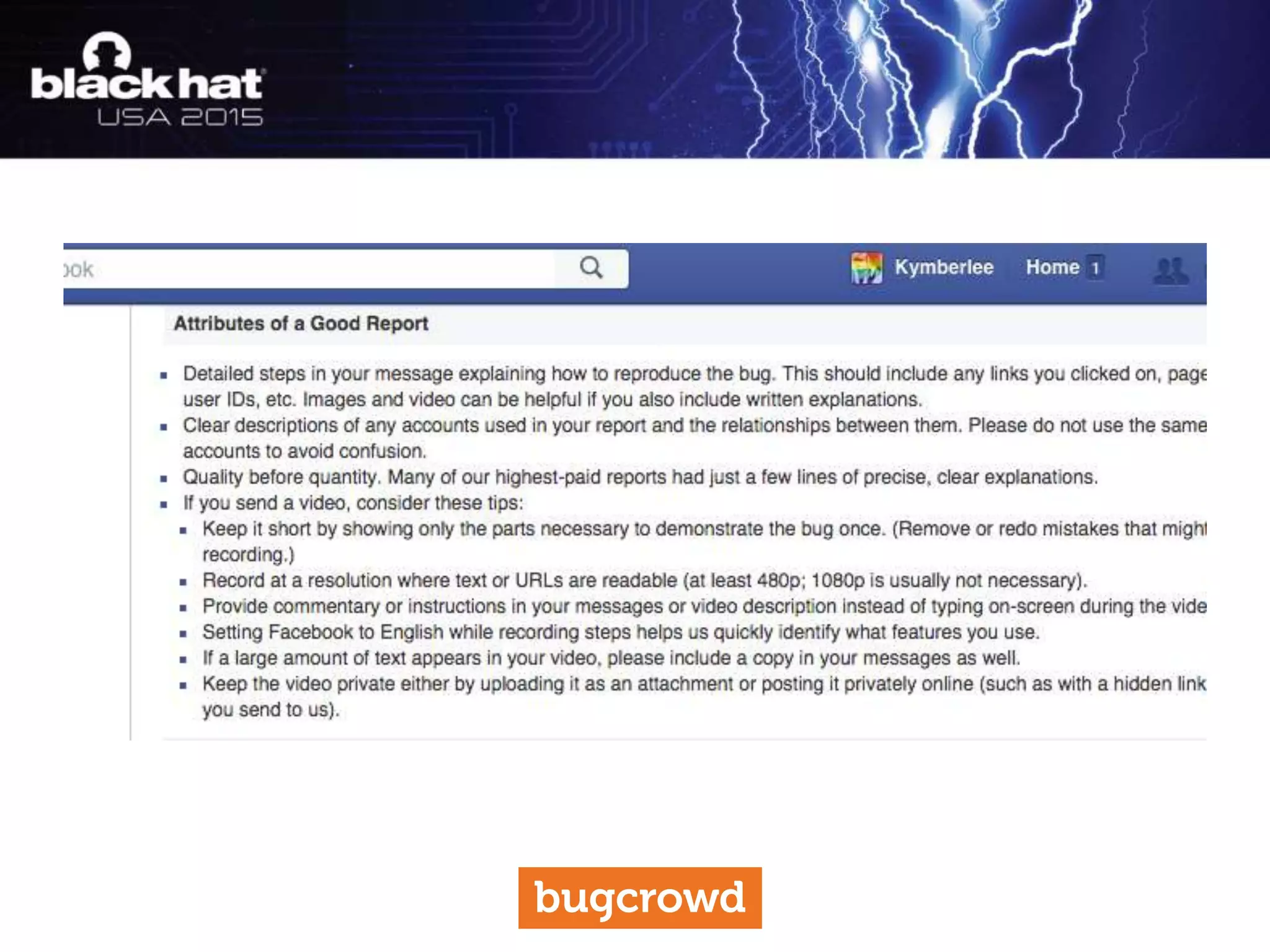
  • #42 Example of how Facebook sets expectations in submissions
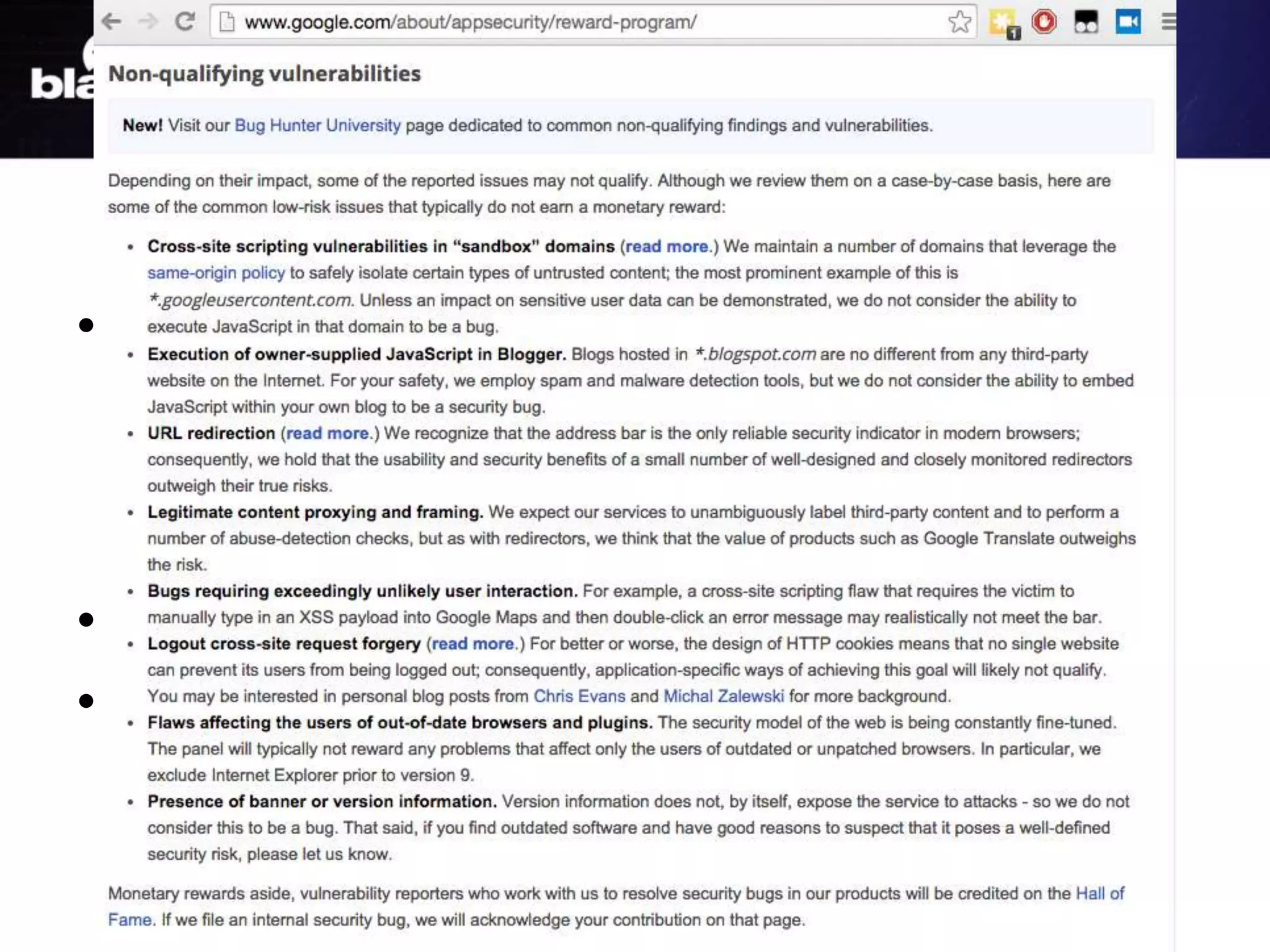
  • #43 Example of Google scope documentation
  • #44 Example of Google scope documentation
  • #45 Don’t batch responses to your new submissions once a week – allowing yourself to get 5 days behind means that if you wake up sick on your triage day and don’t go to work, your program is now over 1 business week in response time, and you’re getting further behind in the vulnerability queue… which may have a P1 in it that you need to jump on. Keep your queue manageable by clearing it daily. Publicly define how you prioritize and minimum rewards for each priority – this will cut down on debate with the researcher later. Duplicates at the P1 and P2 level are uncommon, because these issues are fixed rapidly due to their severity. But I’m going to say this anyway: fix quickly. Don’t expect that because you’ve paid a reward for a bug, you’ve got all the time you want to eventually get around to patching it. Every time a duplicate is reported it costs your bounty program both in operational effort and researcher experience. At lower severity levels duplicates are common because fixes may not be prioritized as highly as other development work, and you’ll end up having to justify to the second (and maybe third and fourth) researcher that they weren’t first, and tell them when it was reported before… Also, if the same bug is being found by your crowd once a week, you know its easily found by the bad guys too. So fix as soon as is practical and save yourself the headache.
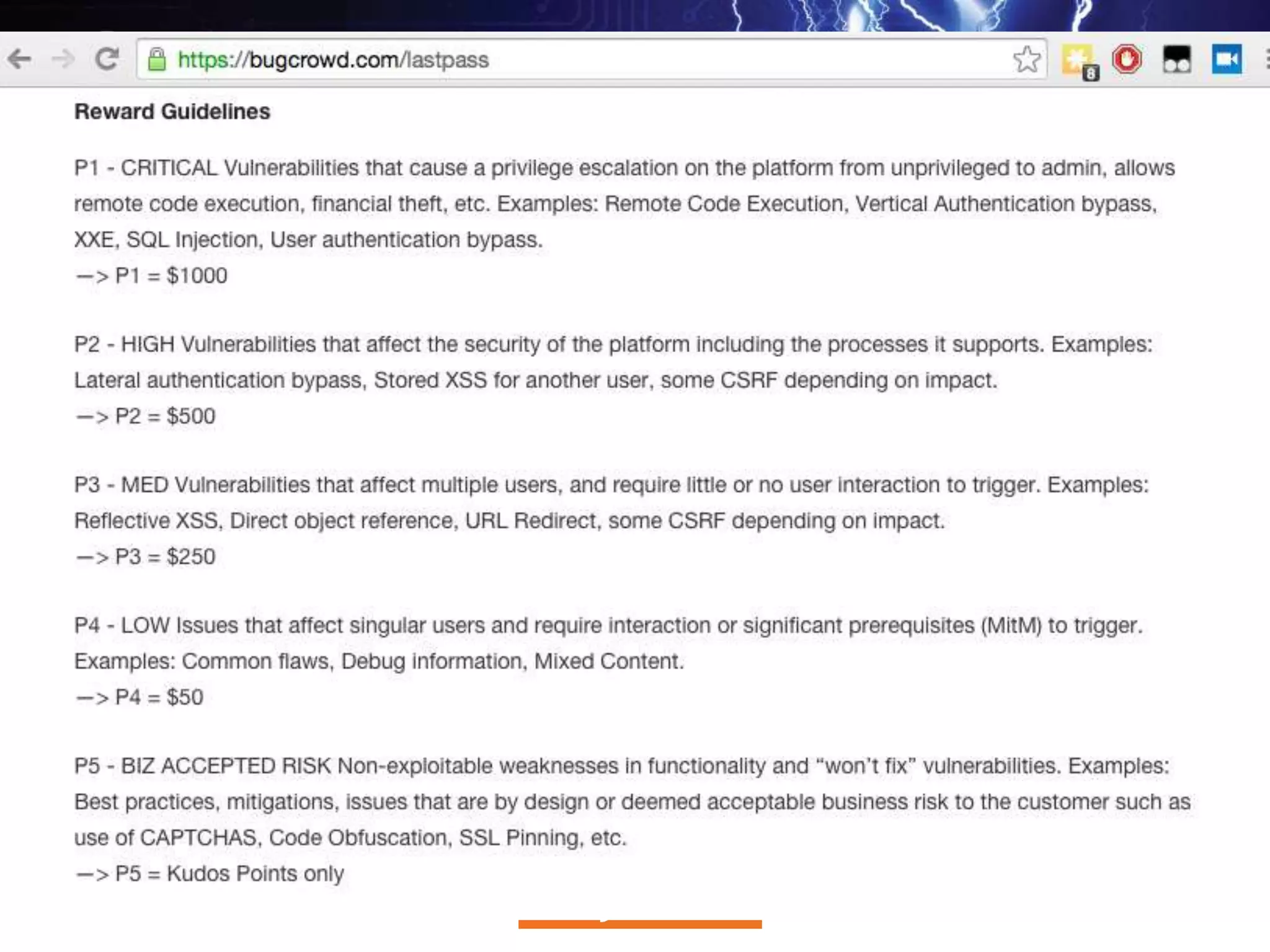
  • #46 Example of communicating priorities, this is LastPass
  • #47 These customers definitely think so. They weren’t really comfortable being attributed, but these are actual quotes.
  • #48 Example of bad behavior: awarding hall of fame because you’re tired of arguing