Ricquavious Moore
HONOLULU, HAWAII
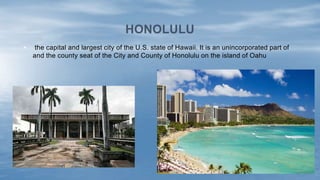
• the capital and largest city of the U.S. state of Hawaii. It is an unincorporated part of
and the county seat of the City and County of Honolulu on the island of Oahu
HONOLULU
HONOLULU
• The city is the main gateway to Hawaii and a major portal into the United States. The
city is also a major hub for international business, military defense, as well as
famously being host to a diverse variety of east-west and Pacific culture, cuisine, and
traditions.
Honolulu is a major financial
center of the islands and of the
Pacific Ocean. The population
of the city of Honolulu was
337,256 as of the 2010 census,
while the Honolulu CCD was
390,738 and the population of
the consolidated city and county
was 953,207.
Honolulu
• Honolulu means "sheltered harbor” or
"calm port". The old name is said to
be Kou, a district roughly
encompassing the area from Nuuanu
Avenue to Alakea Street and from
Hotel Street to Queen Street which is
the heart of the present downtown
district.[14] The city has been the
capital of the Hawaiian Islands since
1845 and gained historical recognition
following the attack on Pearl Harbor
by Japan near the city on December
7, 1941.
HONOLULU
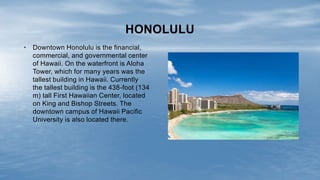
• Downtown Honolulu is the financial,
commercial, and governmental center
of Hawaii. On the waterfront is Aloha
Tower, which for many years was the
tallest building in Hawaii. Currently
the tallest building is the 438-foot (134
m) tall First Hawaiian Center, located
on King and Bishop Streets. The
downtown campus of Hawaii Pacific
University is also located there.
HONOLULU
• Annual average rainfall is 17.05 in (433 mm),
which mainly occurs during the winter months
of October through early April, with very little
rainfall during the summer; similar to
California's mediterranean climates. However,
both seasons experience a similar number of
rainy days. Light showers occur in summer
while heavier rain falls during winter. Honolulu
has an average of 278 sunny days and 90
rainy days per year.
• Although the city is situated in the tropics,
hurricanes are quite rare. The last recorded
hurricane that hit the area was Category 4
Hurricane Iniki in 1992. Tornadoes are also
uncommon and usually strike once every 15
years. Waterspouts off the coast are also
uncommon, hitting about once every five
years.[32]
HONOLULU
• The population of Honolulu was
390,738 according to the 2010 U.S.
Census. Of those, 192,781 (49.3%)
were male and 197,957 (50.7%) were
female. The median age for males
was 40.0 and 43.0 for females; the
overall median age was 41.3.
Approximately 84.7% of the total
population was 16 years and over;
82.6% were 18 years and over, 78.8%
were 21 years and over, 21.4% were
62 years and over, and 17.8% were
65 years and over.[11]
HONOLULU
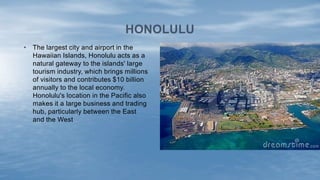
• The largest city and airport in the
Hawaiian Islands, Honolulu acts as a
natural gateway to the islands' large
tourism industry, which brings millions
of visitors and contributes $10 billion
annually to the local economy.
Honolulu's location in the Pacific also
makes it a large business and trading
hub, particularly between the East
and the West
HONOLULU
• Currently the tallest building is the 438-
foot (134 m) tall First Hawaiian Center,
located on King and Bishop Streets.
The downtown campus of Hawaii
Pacific University is also located there.
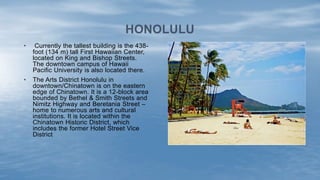
• The Arts District Honolulu in
downtown/Chinatown is on the eastern
edge of Chinatown. It is a 12-block area
bounded by Bethel & Smith Streets and
Nimitz Highway and Beretania Street –
home to numerous arts and cultural
institutions. It is located within the
Chinatown Historic District, which
includes the former Hotel Street Vice
District
HONOLULU

Hh ric

  • 1.
  • 2.
    • the capitaland largest city of the U.S. state of Hawaii. It is an unincorporated part of and the county seat of the City and County of Honolulu on the island of Oahu HONOLULU
  • 3.
    HONOLULU • The cityis the main gateway to Hawaii and a major portal into the United States. The city is also a major hub for international business, military defense, as well as famously being host to a diverse variety of east-west and Pacific culture, cuisine, and traditions.
  • 4.
    Honolulu is amajor financial center of the islands and of the Pacific Ocean. The population of the city of Honolulu was 337,256 as of the 2010 census, while the Honolulu CCD was 390,738 and the population of the consolidated city and county was 953,207. Honolulu
  • 5.
    • Honolulu means"sheltered harbor” or "calm port". The old name is said to be Kou, a district roughly encompassing the area from Nuuanu Avenue to Alakea Street and from Hotel Street to Queen Street which is the heart of the present downtown district.[14] The city has been the capital of the Hawaiian Islands since 1845 and gained historical recognition following the attack on Pearl Harbor by Japan near the city on December 7, 1941. HONOLULU
  • 6.
    • Downtown Honoluluis the financial, commercial, and governmental center of Hawaii. On the waterfront is Aloha Tower, which for many years was the tallest building in Hawaii. Currently the tallest building is the 438-foot (134 m) tall First Hawaiian Center, located on King and Bishop Streets. The downtown campus of Hawaii Pacific University is also located there. HONOLULU
  • 7.
    • Annual averagerainfall is 17.05 in (433 mm), which mainly occurs during the winter months of October through early April, with very little rainfall during the summer; similar to California's mediterranean climates. However, both seasons experience a similar number of rainy days. Light showers occur in summer while heavier rain falls during winter. Honolulu has an average of 278 sunny days and 90 rainy days per year. • Although the city is situated in the tropics, hurricanes are quite rare. The last recorded hurricane that hit the area was Category 4 Hurricane Iniki in 1992. Tornadoes are also uncommon and usually strike once every 15 years. Waterspouts off the coast are also uncommon, hitting about once every five years.[32] HONOLULU
  • 8.
    • The populationof Honolulu was 390,738 according to the 2010 U.S. Census. Of those, 192,781 (49.3%) were male and 197,957 (50.7%) were female. The median age for males was 40.0 and 43.0 for females; the overall median age was 41.3. Approximately 84.7% of the total population was 16 years and over; 82.6% were 18 years and over, 78.8% were 21 years and over, 21.4% were 62 years and over, and 17.8% were 65 years and over.[11] HONOLULU
  • 9.
    • The largestcity and airport in the Hawaiian Islands, Honolulu acts as a natural gateway to the islands' large tourism industry, which brings millions of visitors and contributes $10 billion annually to the local economy. Honolulu's location in the Pacific also makes it a large business and trading hub, particularly between the East and the West HONOLULU
  • 10.
    • Currently thetallest building is the 438- foot (134 m) tall First Hawaiian Center, located on King and Bishop Streets. The downtown campus of Hawaii Pacific University is also located there. • The Arts District Honolulu in downtown/Chinatown is on the eastern edge of Chinatown. It is a 12-block area bounded by Bethel & Smith Streets and Nimitz Highway and Beretania Street – home to numerous arts and cultural institutions. It is located within the Chinatown Historic District, which includes the former Hotel Street Vice District HONOLULU