JOURNAL CLUB
HIGH FLOW NASAL CANULA THERAPY AS A PRIMARY
MODE OF RESPIRATORY SUPPORT IN PICU
OBJECTIVES
• To assess efficacy and safety of high flow nasal cannula therapy as a
primary mode of treatment for children with respiratory distress
TITLE AND ABSTRACT
• To assess efficacy and safety of high flow nasal cannula therapy as a
primary mode of treatment for children with respiratory distress
• Children with respiratory distress were treated with HFNC, after
assessing respiratory clinical score, COMFORT score, saturation to
FiO2 ratio
• Children who succeed on HFNC show a favourable clinical response
within first few hours
METHODS
• STUDY DESIGN
CROSS SECTIONAL STUDY
• Study place and period
Urban tertiary hospital of Western India from Jan 2018 to Dec 2018
• Participants and inclusion criteria
Consecutive patients with respiratory distress necessitating admission to
PICU, in age group 1 month to 16 years
• Exclusion criteria
Children requiring immediate invasive ventilation, contraindications to
HFNC, altered sensorium, apnea, catecholamine resistant shock
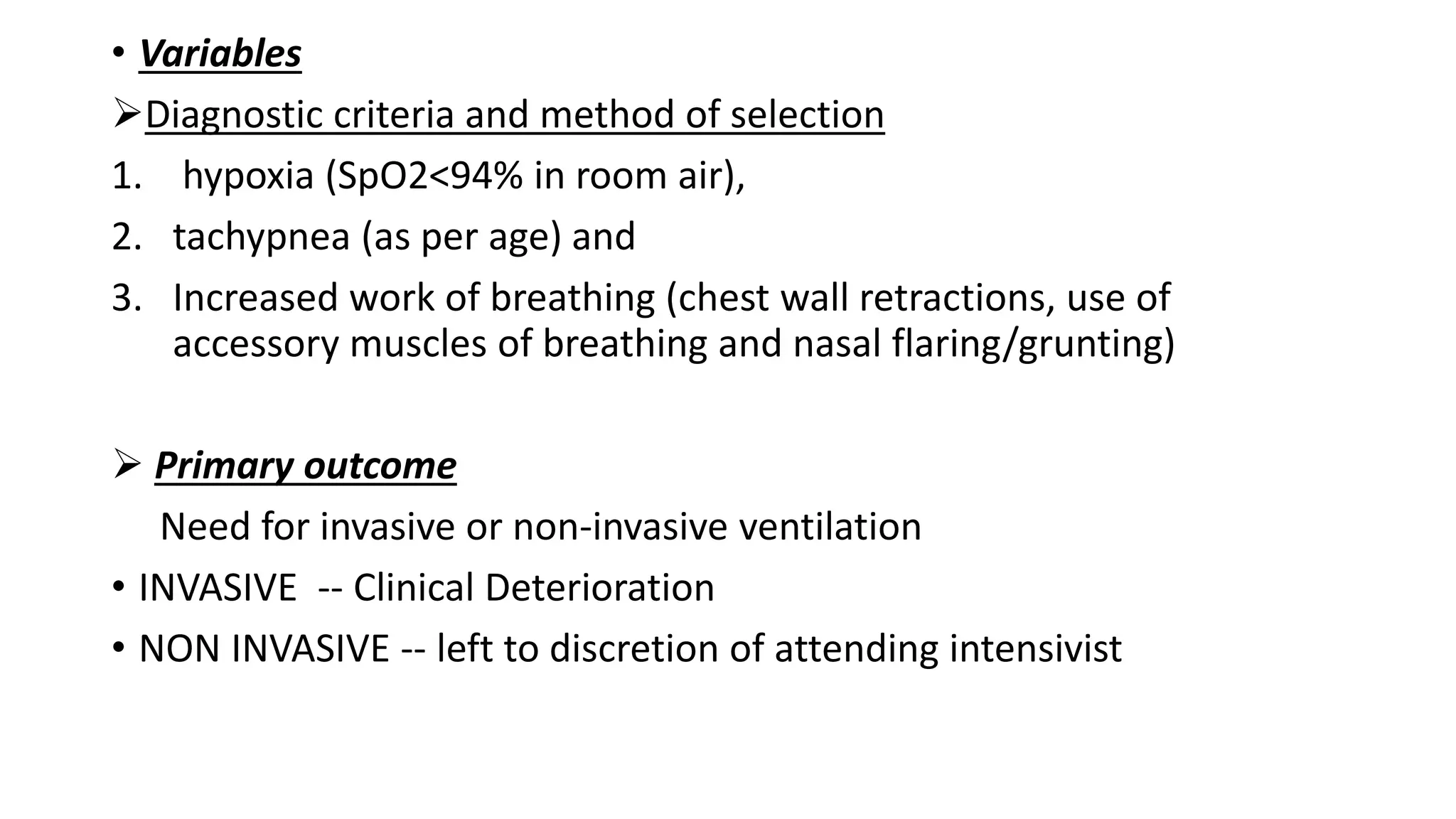
• Variables
Diagnostic criteria and method of selection
1. hypoxia (SpO2<94% in room air),
2. tachypnea (as per age) and
3. Increased work of breathing (chest wall retractions, use of
accessory muscles of breathing and nasal flaring/grunting)
 Primary outcome
Need for invasive or non-invasive ventilation
• INVASIVE -- Clinical Deterioration
• NON INVASIVE -- left to discretion of attending intensivist
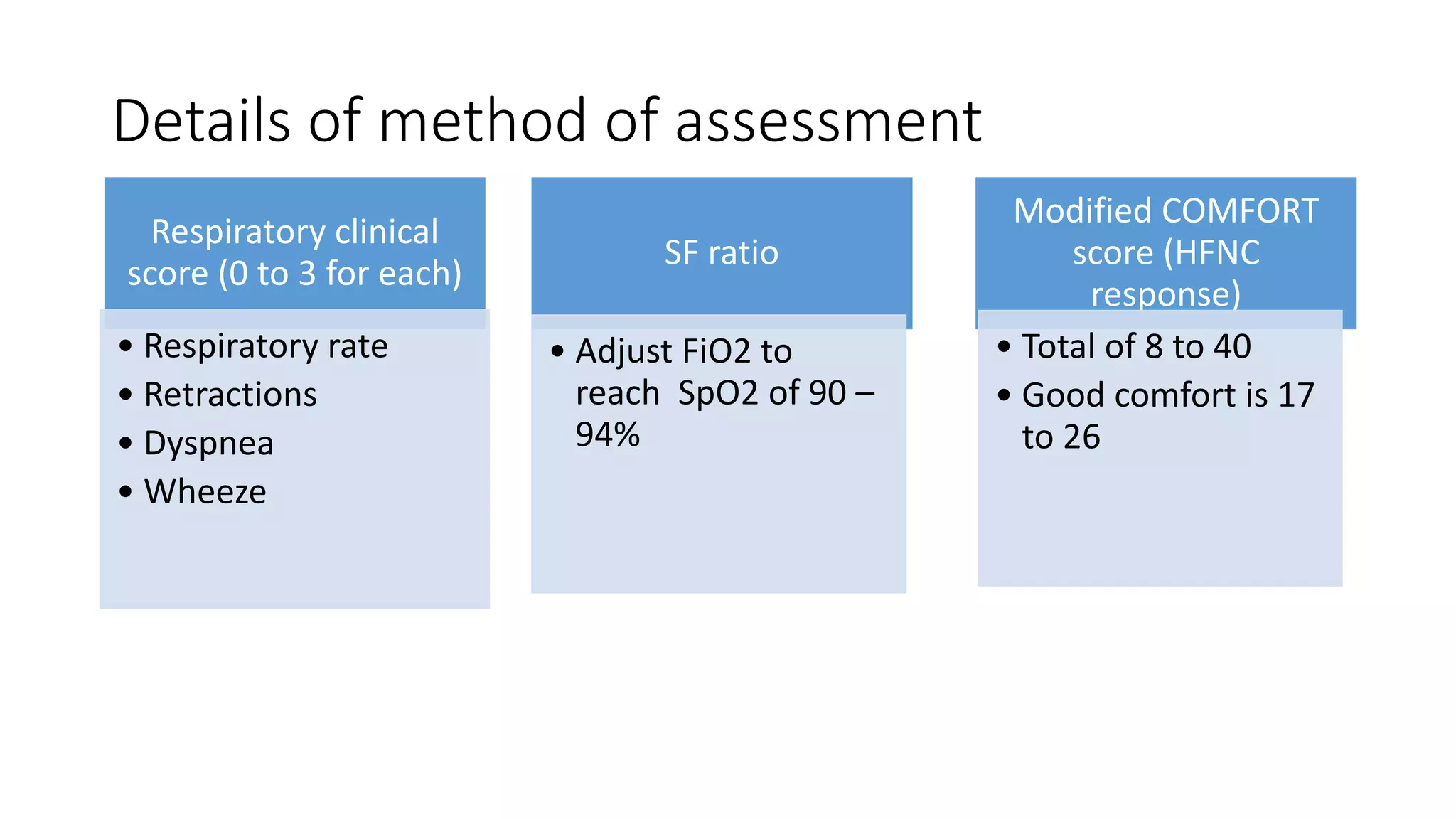
Details of method of assessment
Respiratory clinical
score (0 to 3 for each)
• Respiratory rate
• Retractions
• Dyspnea
• Wheeze
SF ratio
• Adjust FiO2 to
reach SpO2 of 90 –
94%
Modified COMFORT
score (HFNC
response)
• Total of 8 to 40
• Good comfort is 17
to 26
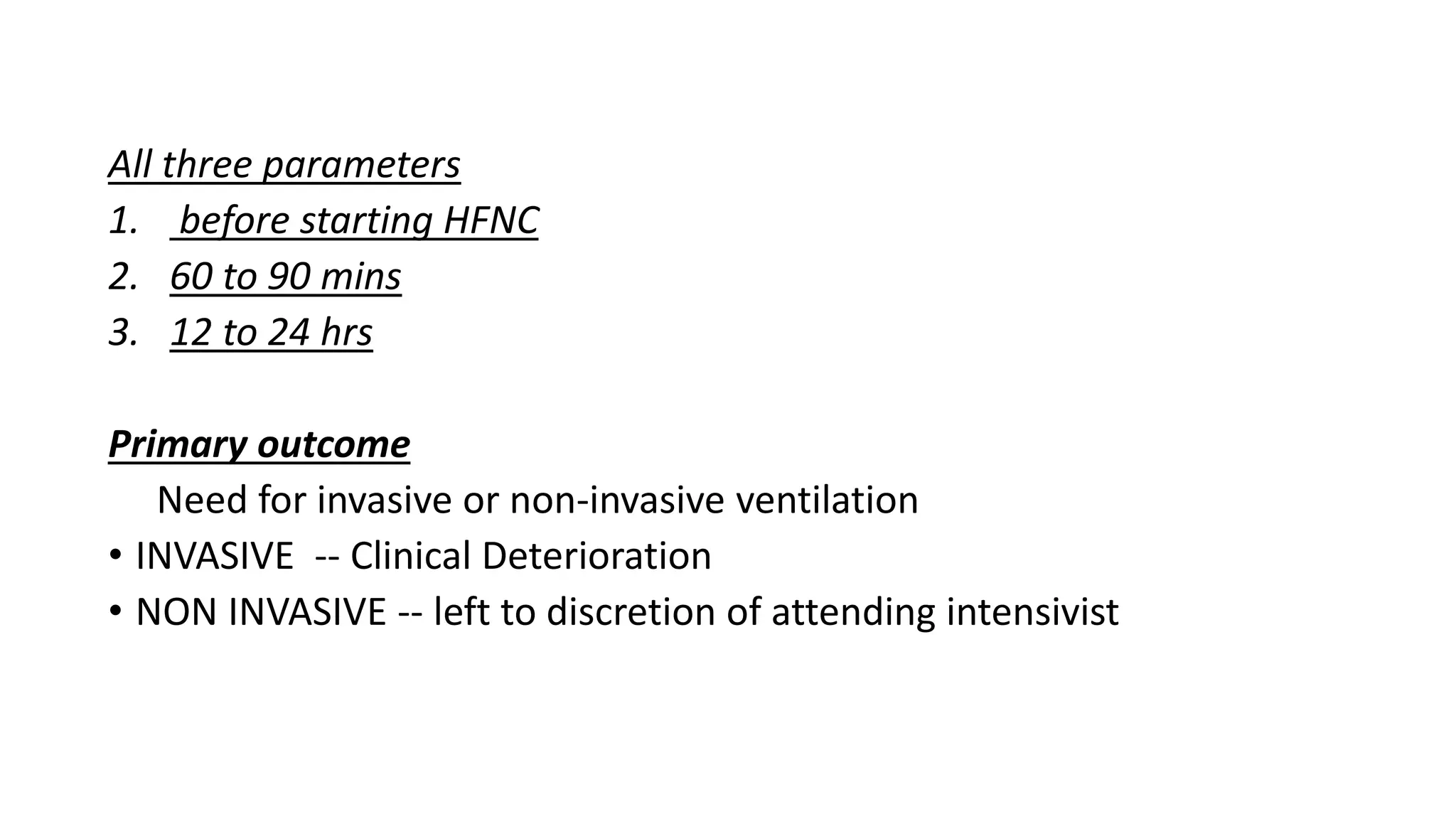
All three parameters
1. before starting HFNC
2. 60 to 90 mins
3. 12 to 24 hrs
Primary outcome
Need for invasive or non-invasive ventilation
• INVASIVE -- Clinical Deterioration
• NON INVASIVE -- left to discretion of attending intensivist
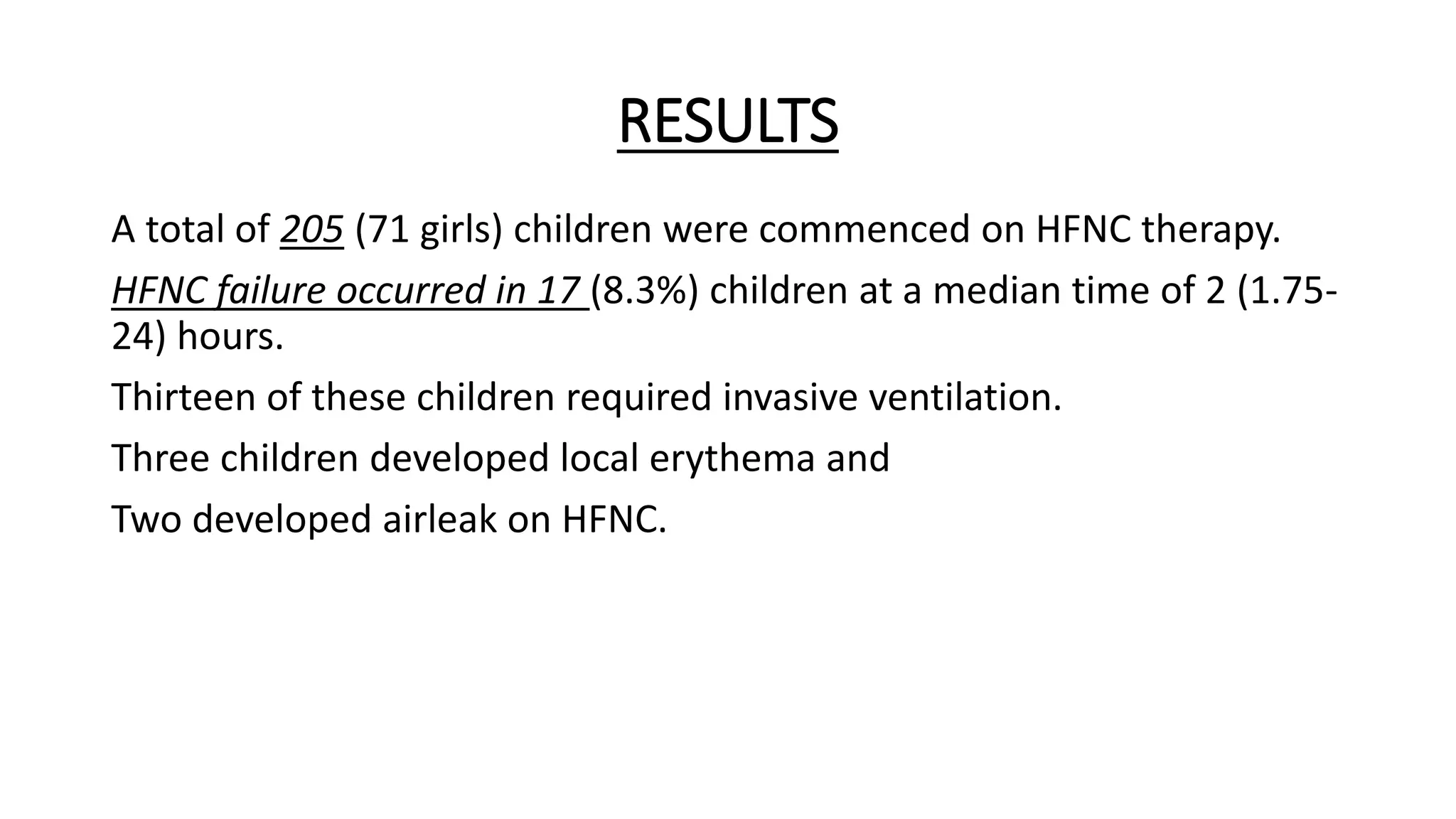
RESULTS
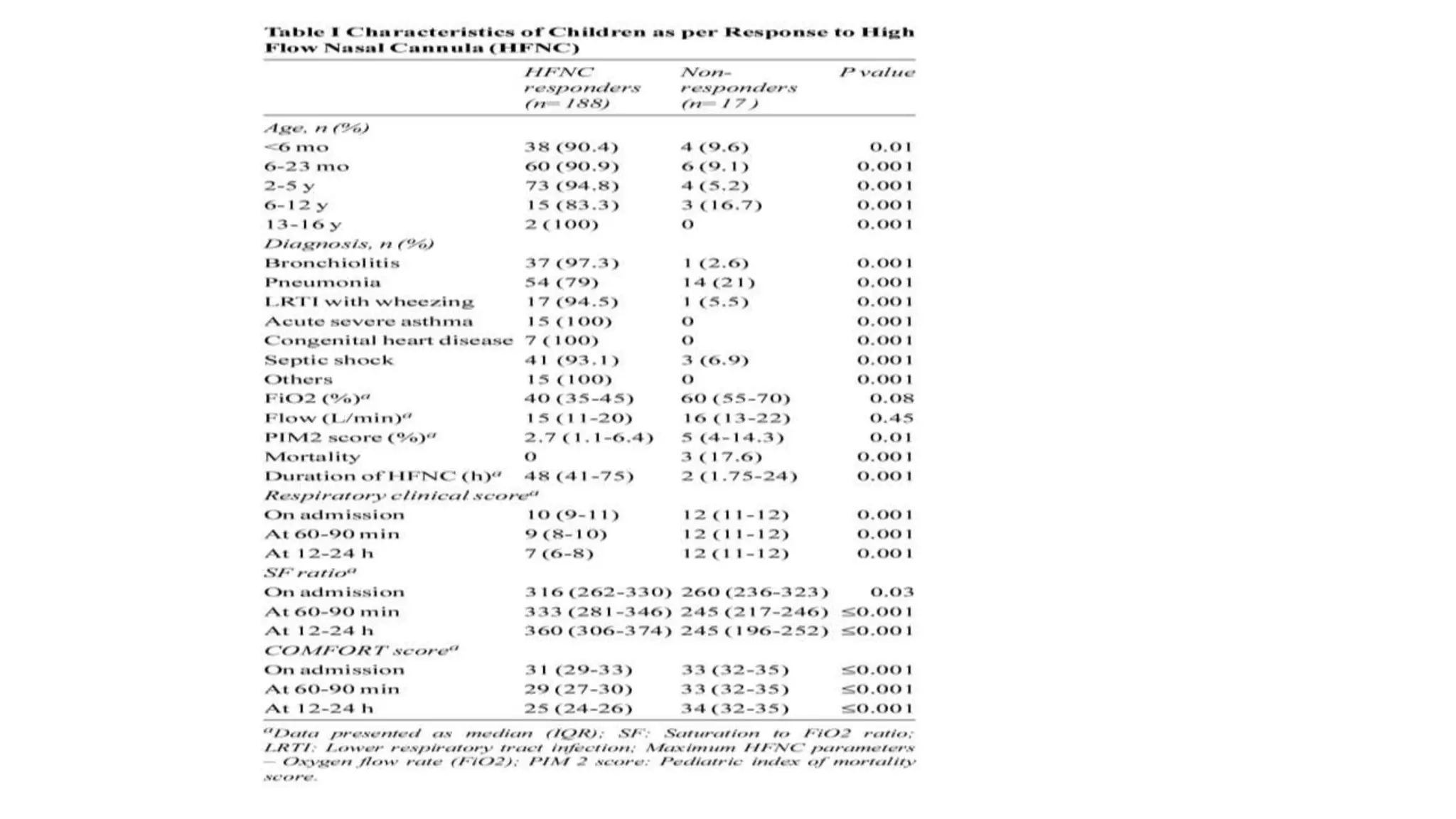
A total of 205 (71 girls) children were commenced on HFNC therapy.
HFNC failure occurred in 17 (8.3%) children at a median time of 2 (1.75-
24) hours.
Thirteen of these children required invasive ventilation.
Three children developed local erythema and
Two developed airleak on HFNC.
DISCUSSION
KEY RESULTS
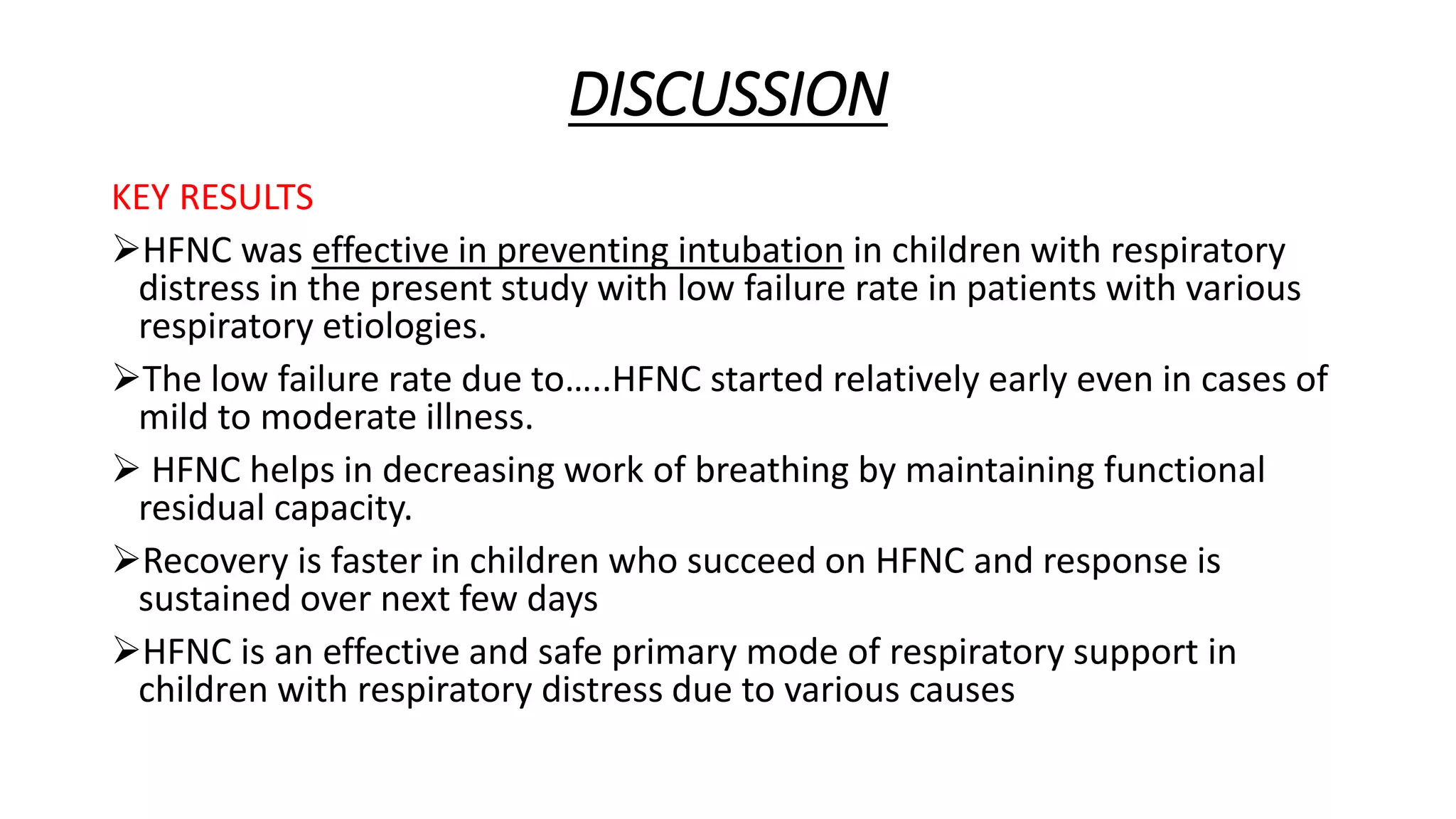
HFNC was effective in preventing intubation in children with respiratory
distress in the present study with low failure rate in patients with various
respiratory etiologies.
The low failure rate due to…..HFNC started relatively early even in cases of
mild to moderate illness.
 HFNC helps in decreasing work of breathing by maintaining functional
residual capacity.
Recovery is faster in children who succeed on HFNC and response is
sustained over next few days
HFNC is an effective and safe primary mode of respiratory support in
children with respiratory distress due to various causes
CRITICAL APPRAISAL
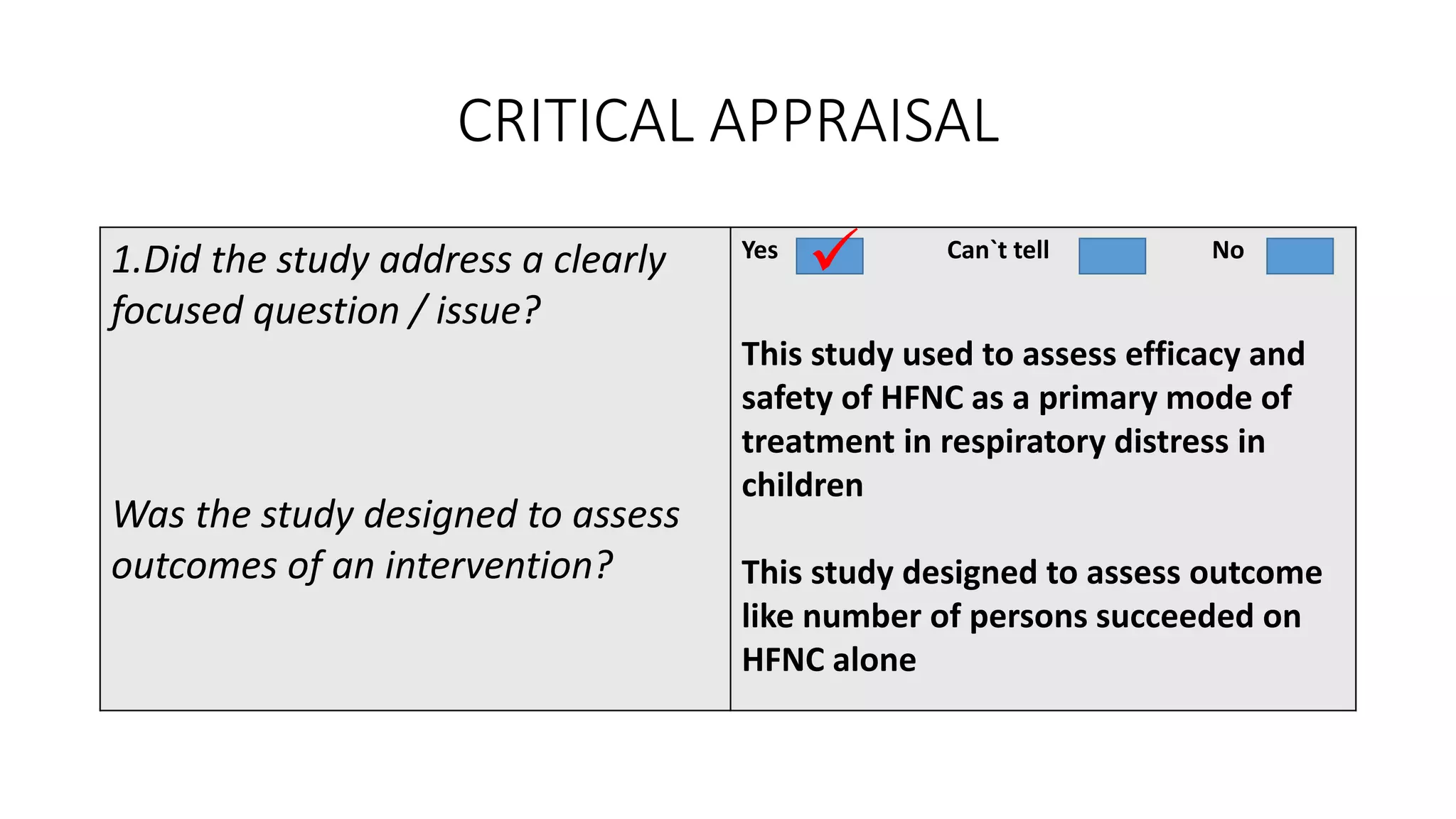
1.Did the study address a clearly
focused question / issue?
Was the study designed to assess
outcomes of an intervention?
Yes Can`t tell No
This study used to assess efficacy and
safety of HFNC as a primary mode of
treatment in respiratory distress in
children
This study designed to assess outcome
like number of persons succeeded on
HFNC alone

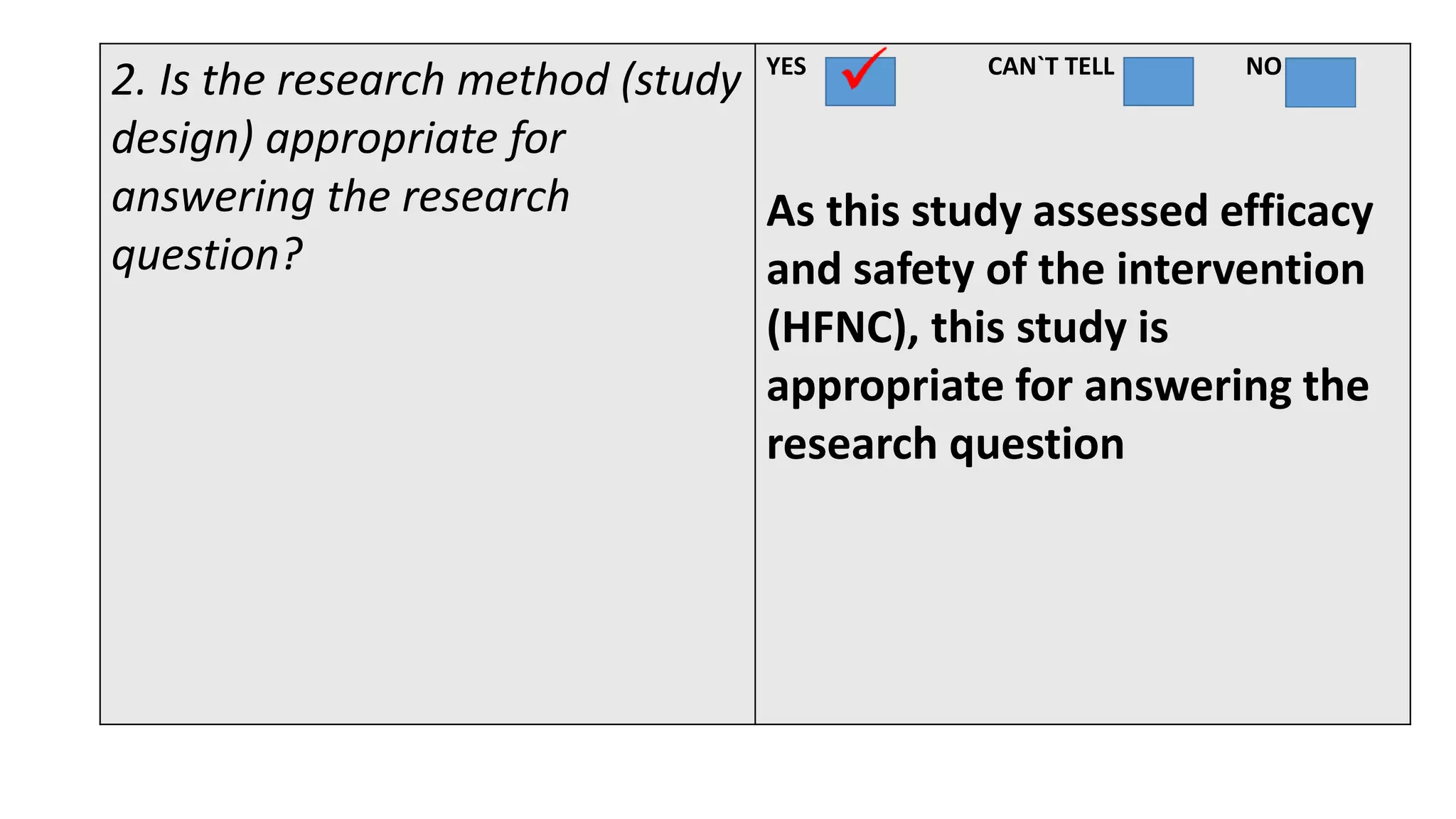
2. Is the research method (study
design) appropriate for
answering the research
question?
YES CAN`T TELL NO
As this study assessed efficacy
and safety of the intervention
(HFNC), this study is
appropriate for answering the
research question
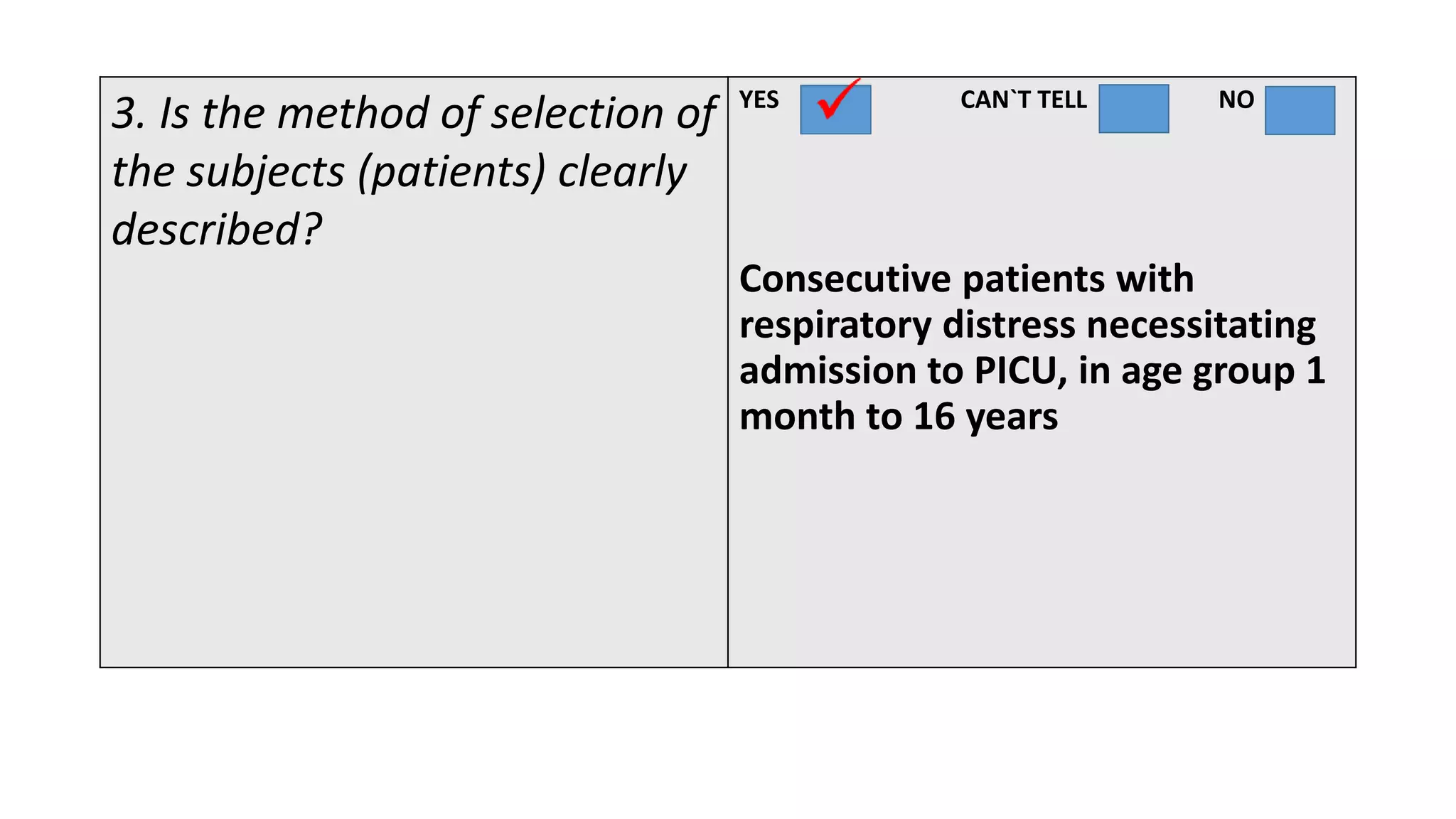
3. Is the method of selection of
the subjects (patients) clearly
described?
YES CAN`T TELL NO
Consecutive patients with
respiratory distress necessitating
admission to PICU, in age group 1
month to 16 years
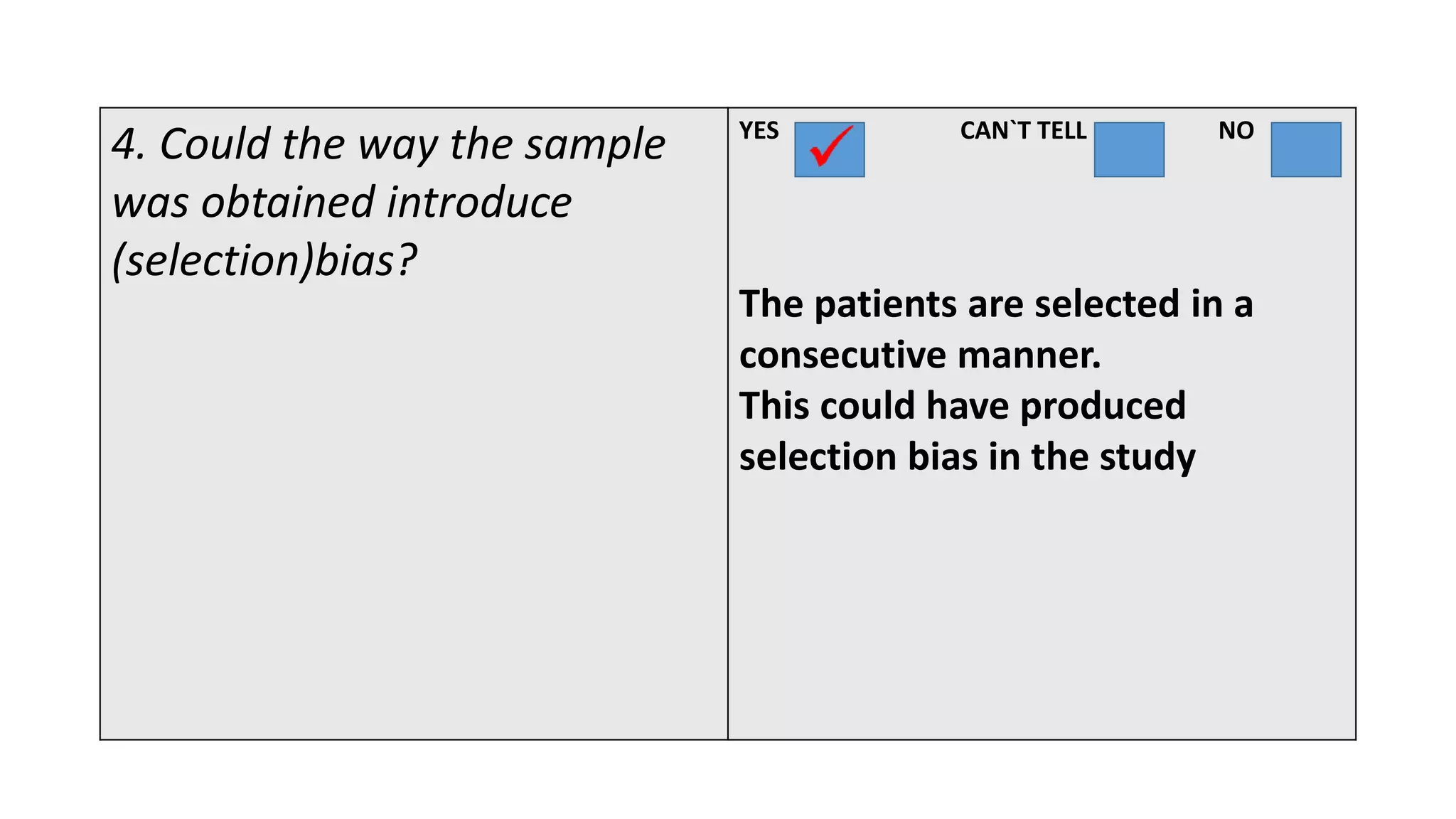
4. Could the way the sample
was obtained introduce
(selection)bias?
YES CAN`T TELL NO
The patients are selected in a
consecutive manner.
This could have produced
selection bias in the study
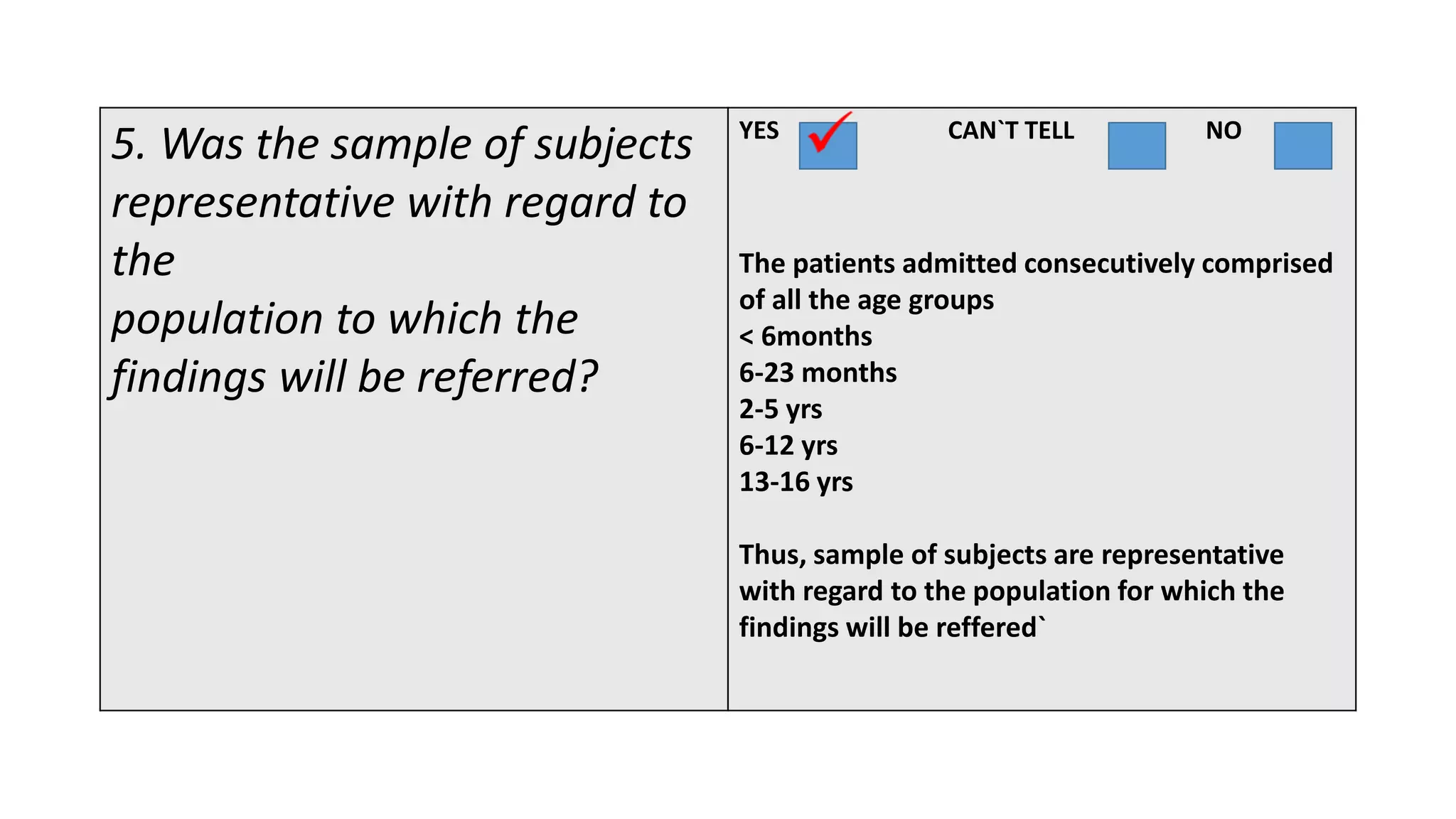
5. Was the sample of subjects
representative with regard to
the
population to which the
findings will be referred?
YES CAN`T TELL NO
The patients admitted consecutively comprised
of all the age groups
< 6months
6-23 months
2-5 yrs
6-12 yrs
13-16 yrs
Thus, sample of subjects are representative
with regard to the population for which the
findings will be reffered`
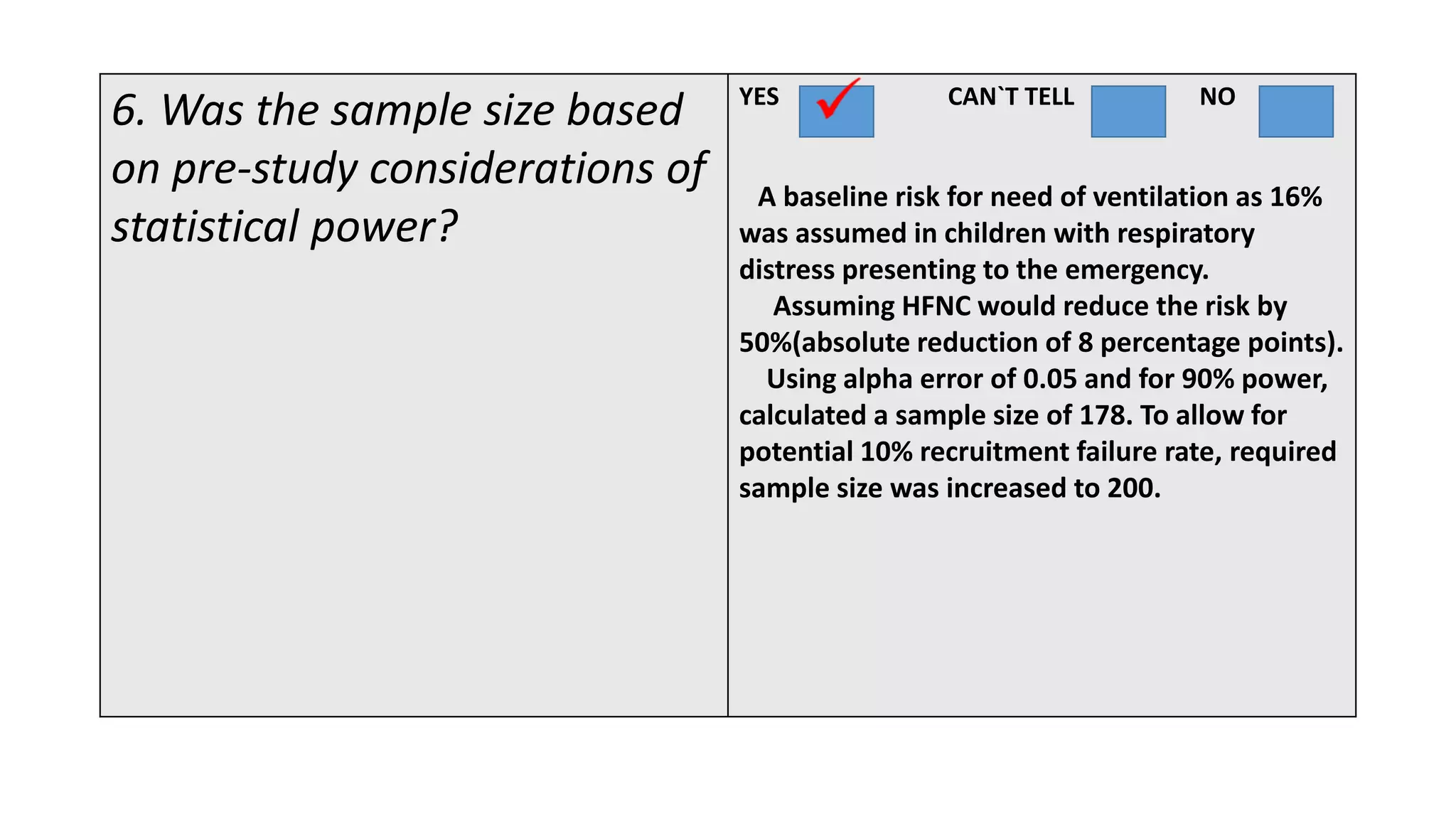
6. Was the sample size based
on pre-study considerations of
statistical power?
YES CAN`T TELL NO
A baseline risk for need of ventilation as 16%
was assumed in children with respiratory
distress presenting to the emergency.
Assuming HFNC would reduce the risk by
50%(absolute reduction of 8 percentage points).
Using alpha error of 0.05 and for 90% power,
calculated a sample size of 178. To allow for
potential 10% recruitment failure rate, required
sample size was increased to 200.
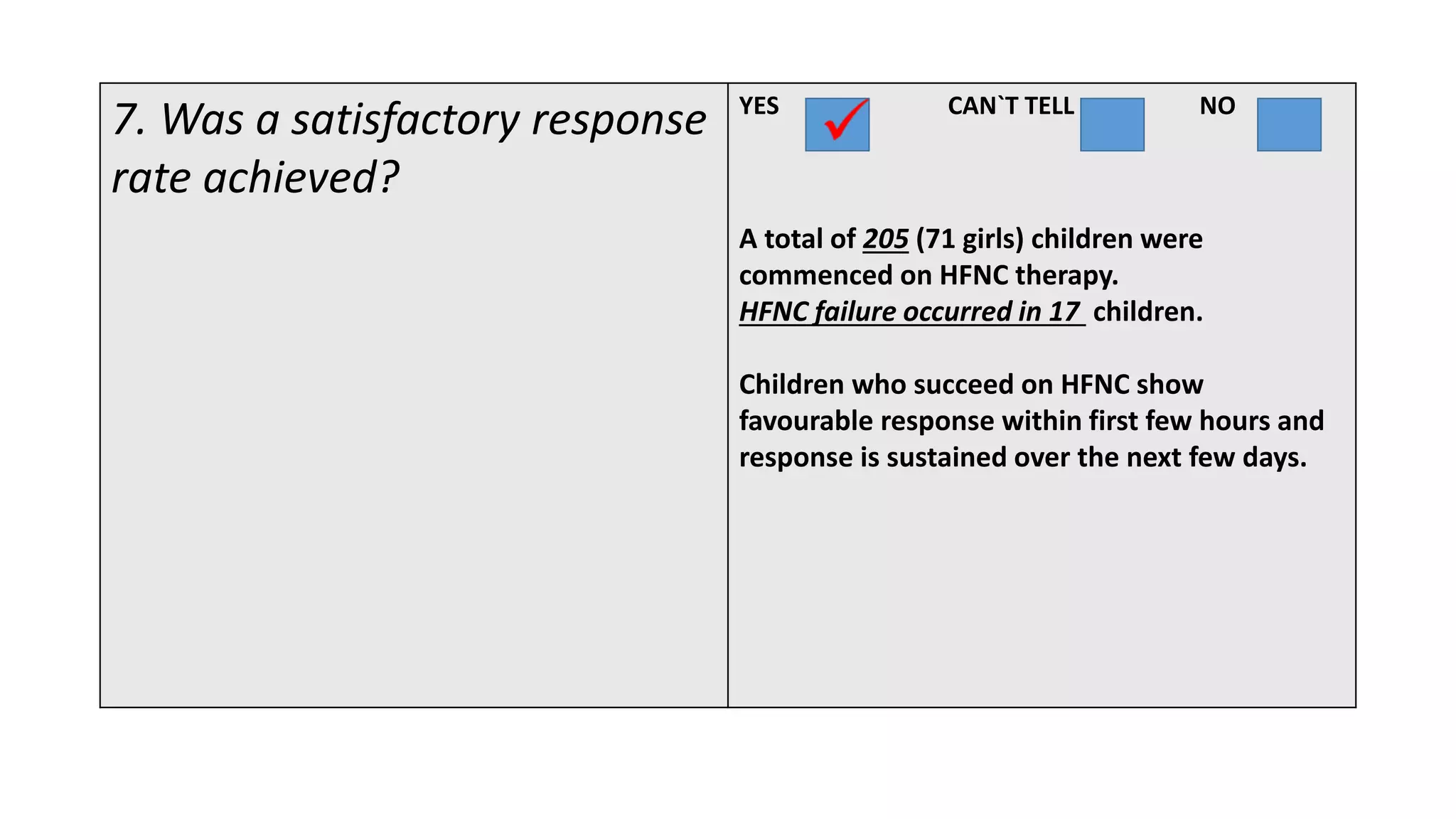
7. Was a satisfactory response
rate achieved?
YES CAN`T TELL NO
A total of 205 (71 girls) children were
commenced on HFNC therapy.
HFNC failure occurred in 17 children.
Children who succeed on HFNC show
favourable response within first few hours and
response is sustained over the next few days.
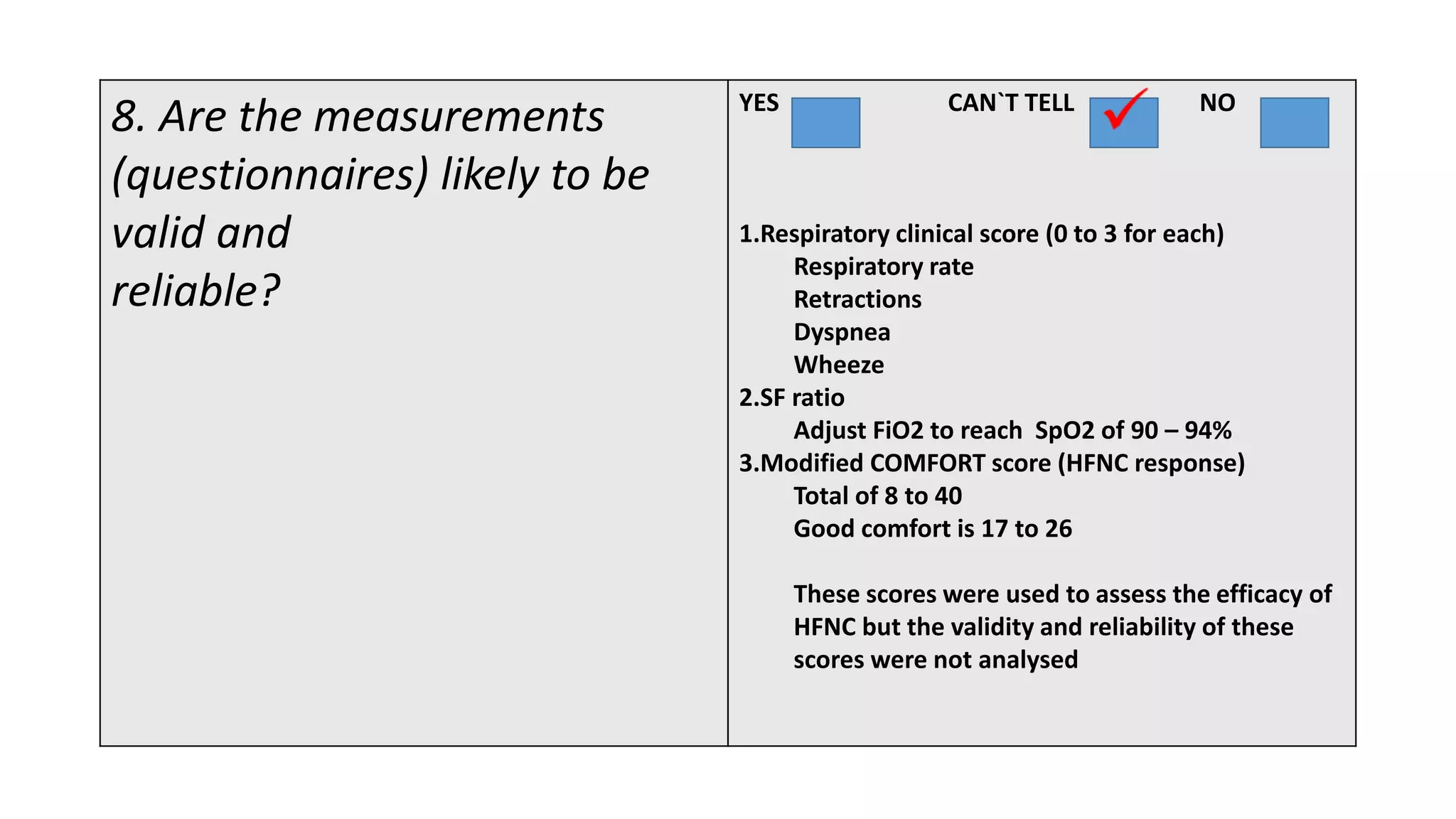
8. Are the measurements
(questionnaires) likely to be
valid and
reliable?
YES CAN`T TELL NO
1.Respiratory clinical score (0 to 3 for each)
Respiratory rate
Retractions
Dyspnea
Wheeze
2.SF ratio
Adjust FiO2 to reach SpO2 of 90 – 94%
3.Modified COMFORT score (HFNC response)
Total of 8 to 40
Good comfort is 17 to 26
These scores were used to assess the efficacy of
HFNC but the validity and reliability of these
scores were not analysed
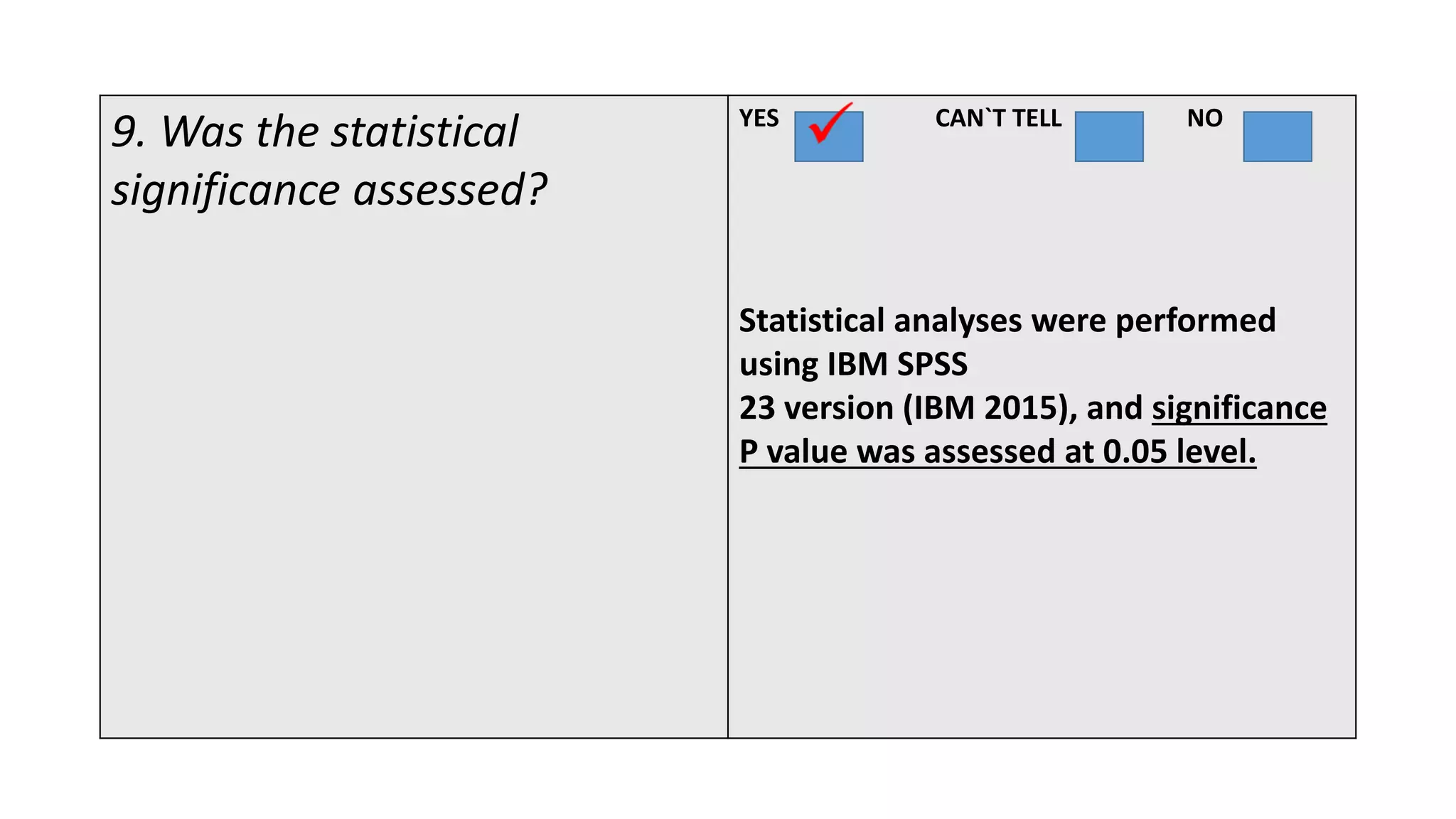
9. Was the statistical
significance assessed?
YES CAN`T TELL NO
Statistical analyses were performed
using IBM SPSS
23 version (IBM 2015), and significance
P value was assessed at 0.05 level.
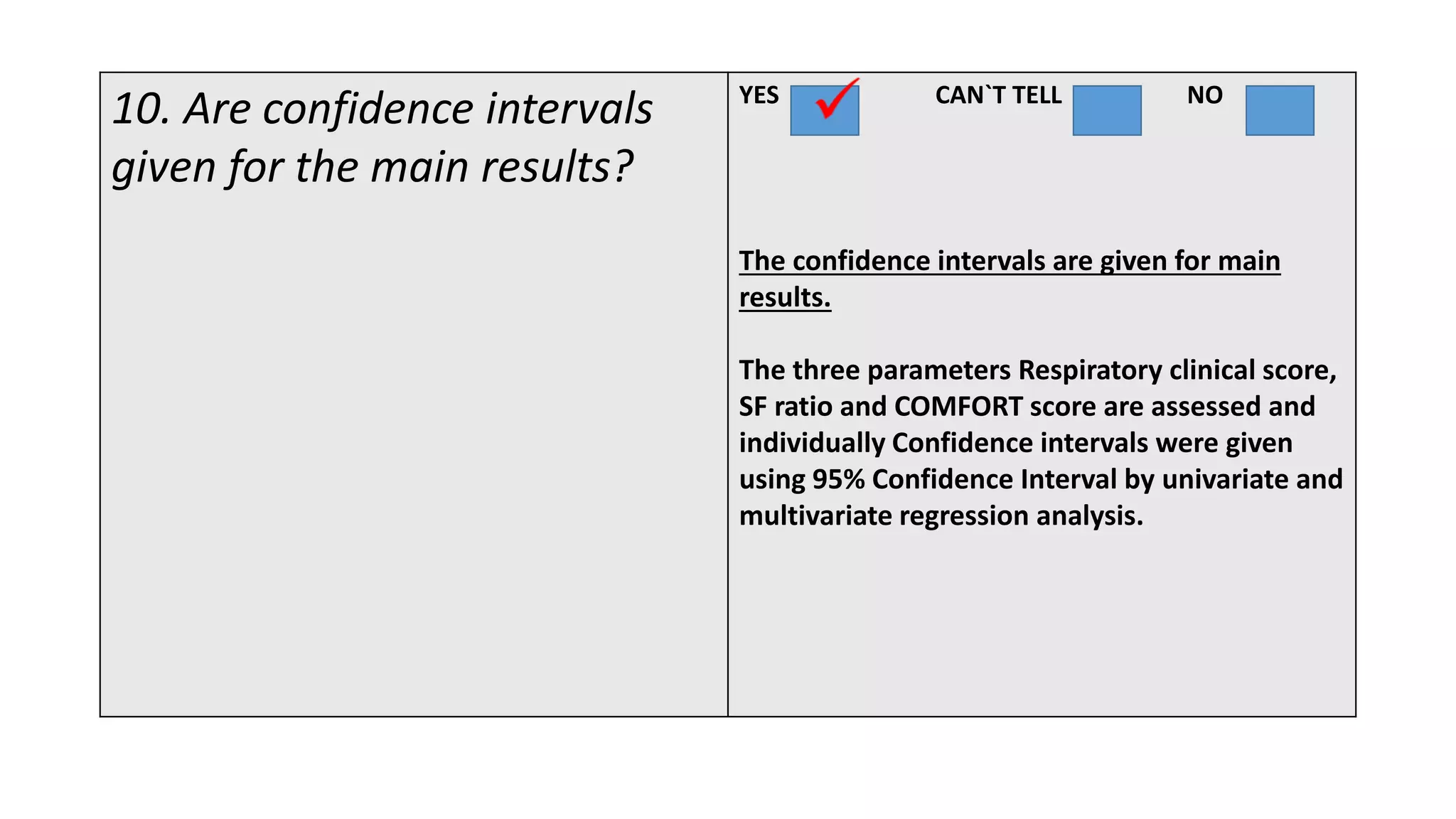
10. Are confidence intervals
given for the main results?
YES CAN`T TELL NO
The confidence intervals are given for main
results.
The three parameters Respiratory clinical score,
SF ratio and COMFORT score are assessed and
individually Confidence intervals were given
using 95% Confidence Interval by univariate and
multivariate regression analysis.
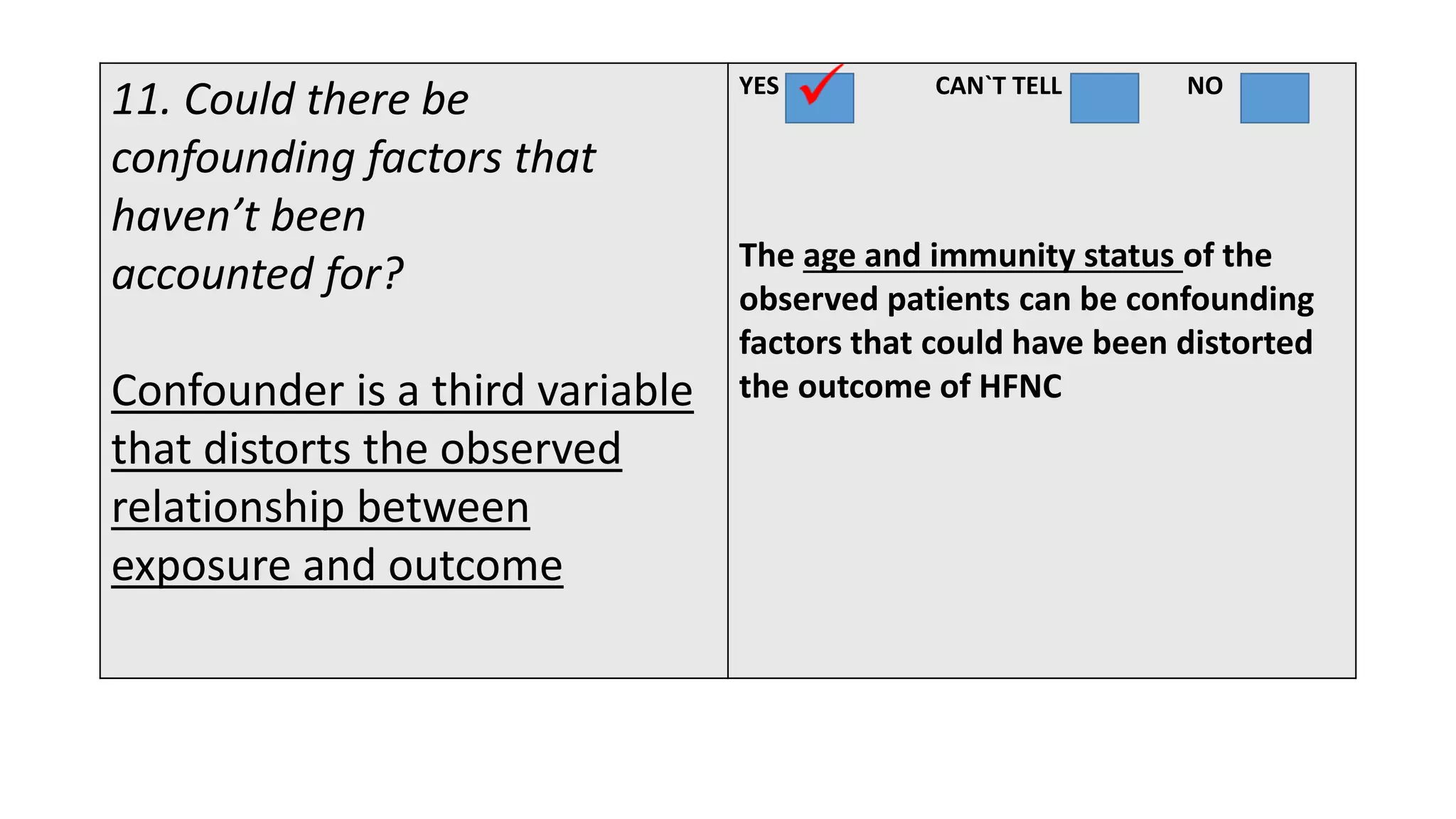
11. Could there be
confounding factors that
haven’t been
accounted for?
Confounder is a third variable
that distorts the observed
relationship between
exposure and outcome
YES CAN`T TELL NO
The age and immunity status of the
observed patients can be confounding
factors that could have been distorted
the outcome of HFNC
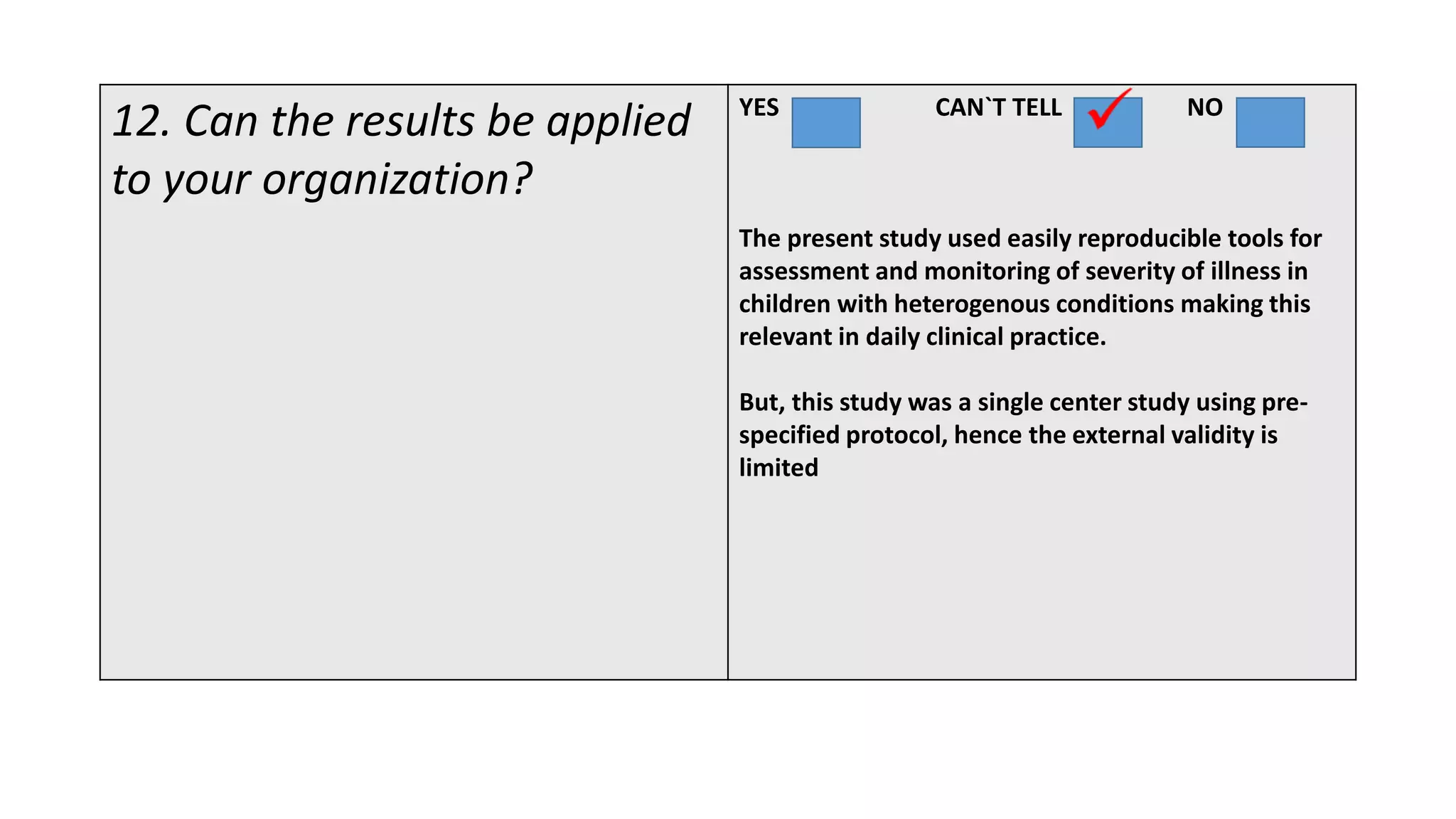
12. Can the results be applied
to your organization?
YES CAN`T TELL NO
The present study used easily reproducible tools for
assessment and monitoring of severity of illness in
children with heterogenous conditions making this
relevant in daily clinical practice.
But, this study was a single center study using pre-
specified protocol, hence the external validity is
limited
APPRAISAL SUMMARY
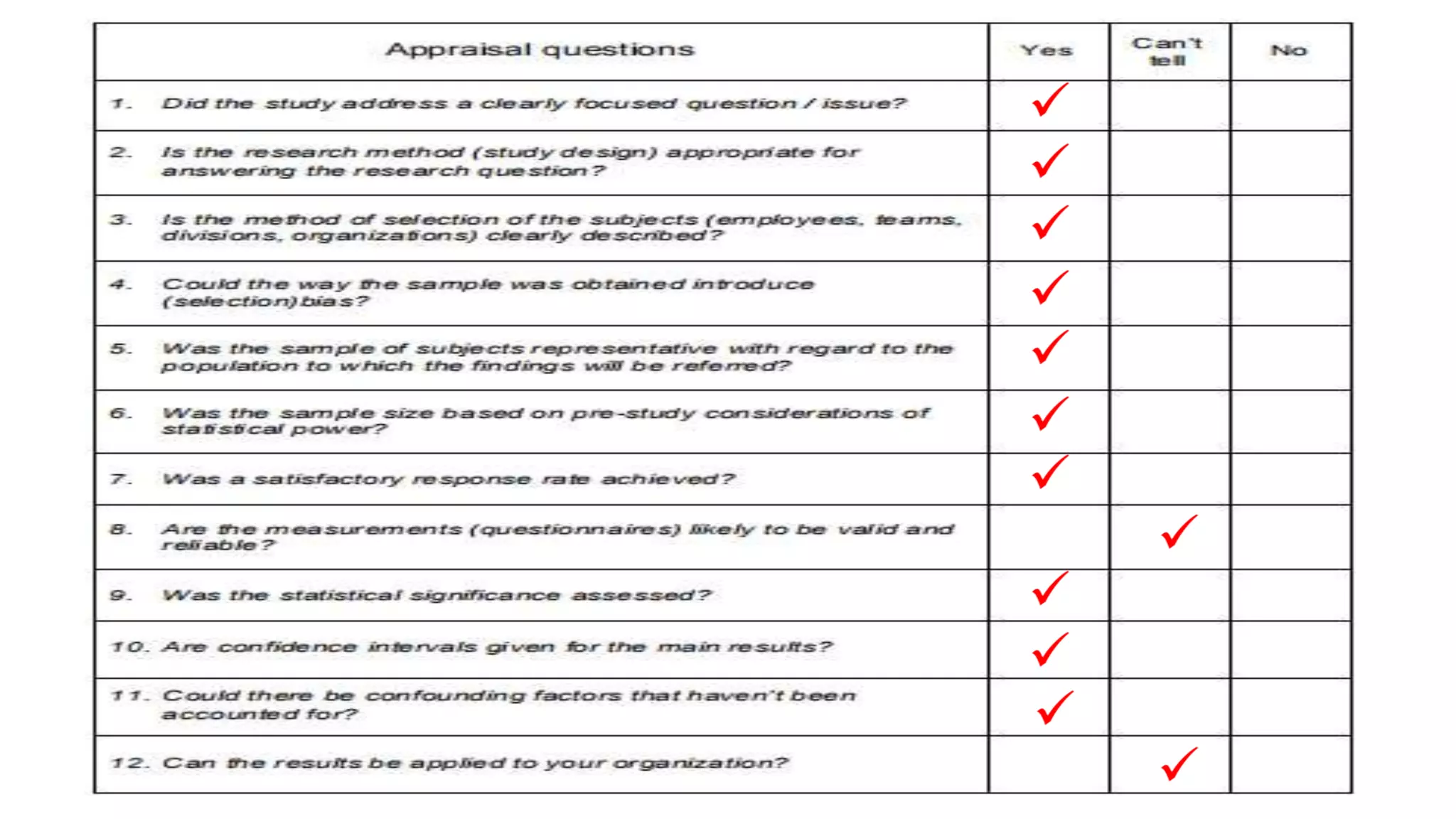
• SINCE THE STUDY ANSWERED MOST OF THE APPRAISAL QUESTION AS
YES, SO IT IS CONSIDERED VALID
• The selection bias in the study could have been avoided by effective
sampling methods
• Inspite of this study is relevant in daily clinical practice, this is a single
centre study, hence limiting its external validity.
hfnc final.pptx

hfnc final.pptx

  • 1.
    JOURNAL CLUB HIGH FLOWNASAL CANULA THERAPY AS A PRIMARY MODE OF RESPIRATORY SUPPORT IN PICU
  • 2.
    OBJECTIVES • To assessefficacy and safety of high flow nasal cannula therapy as a primary mode of treatment for children with respiratory distress
  • 3.
    TITLE AND ABSTRACT •To assess efficacy and safety of high flow nasal cannula therapy as a primary mode of treatment for children with respiratory distress • Children with respiratory distress were treated with HFNC, after assessing respiratory clinical score, COMFORT score, saturation to FiO2 ratio • Children who succeed on HFNC show a favourable clinical response within first few hours
  • 4.
    METHODS • STUDY DESIGN CROSSSECTIONAL STUDY • Study place and period Urban tertiary hospital of Western India from Jan 2018 to Dec 2018 • Participants and inclusion criteria Consecutive patients with respiratory distress necessitating admission to PICU, in age group 1 month to 16 years • Exclusion criteria Children requiring immediate invasive ventilation, contraindications to HFNC, altered sensorium, apnea, catecholamine resistant shock
  • 5.
    • Variables Diagnostic criteriaand method of selection 1. hypoxia (SpO2<94% in room air), 2. tachypnea (as per age) and 3. Increased work of breathing (chest wall retractions, use of accessory muscles of breathing and nasal flaring/grunting)  Primary outcome Need for invasive or non-invasive ventilation • INVASIVE -- Clinical Deterioration • NON INVASIVE -- left to discretion of attending intensivist
  • 6.
    Details of methodof assessment Respiratory clinical score (0 to 3 for each) • Respiratory rate • Retractions • Dyspnea • Wheeze SF ratio • Adjust FiO2 to reach SpO2 of 90 – 94% Modified COMFORT score (HFNC response) • Total of 8 to 40 • Good comfort is 17 to 26
  • 7.
    All three parameters 1.before starting HFNC 2. 60 to 90 mins 3. 12 to 24 hrs Primary outcome Need for invasive or non-invasive ventilation • INVASIVE -- Clinical Deterioration • NON INVASIVE -- left to discretion of attending intensivist
  • 8.
    RESULTS A total of205 (71 girls) children were commenced on HFNC therapy. HFNC failure occurred in 17 (8.3%) children at a median time of 2 (1.75- 24) hours. Thirteen of these children required invasive ventilation. Three children developed local erythema and Two developed airleak on HFNC.
  • 10.
    DISCUSSION KEY RESULTS HFNC waseffective in preventing intubation in children with respiratory distress in the present study with low failure rate in patients with various respiratory etiologies. The low failure rate due to…..HFNC started relatively early even in cases of mild to moderate illness.  HFNC helps in decreasing work of breathing by maintaining functional residual capacity. Recovery is faster in children who succeed on HFNC and response is sustained over next few days HFNC is an effective and safe primary mode of respiratory support in children with respiratory distress due to various causes
  • 11.
    CRITICAL APPRAISAL 1.Did thestudy address a clearly focused question / issue? Was the study designed to assess outcomes of an intervention? Yes Can`t tell No This study used to assess efficacy and safety of HFNC as a primary mode of treatment in respiratory distress in children This study designed to assess outcome like number of persons succeeded on HFNC alone 
  • 12.
    2. Is theresearch method (study design) appropriate for answering the research question? YES CAN`T TELL NO As this study assessed efficacy and safety of the intervention (HFNC), this study is appropriate for answering the research question
  • 13.
    3. Is themethod of selection of the subjects (patients) clearly described? YES CAN`T TELL NO Consecutive patients with respiratory distress necessitating admission to PICU, in age group 1 month to 16 years
  • 14.
    4. Could theway the sample was obtained introduce (selection)bias? YES CAN`T TELL NO The patients are selected in a consecutive manner. This could have produced selection bias in the study
  • 15.
    5. Was thesample of subjects representative with regard to the population to which the findings will be referred? YES CAN`T TELL NO The patients admitted consecutively comprised of all the age groups < 6months 6-23 months 2-5 yrs 6-12 yrs 13-16 yrs Thus, sample of subjects are representative with regard to the population for which the findings will be reffered`
  • 16.
    6. Was thesample size based on pre-study considerations of statistical power? YES CAN`T TELL NO A baseline risk for need of ventilation as 16% was assumed in children with respiratory distress presenting to the emergency. Assuming HFNC would reduce the risk by 50%(absolute reduction of 8 percentage points). Using alpha error of 0.05 and for 90% power, calculated a sample size of 178. To allow for potential 10% recruitment failure rate, required sample size was increased to 200.
  • 17.
    7. Was asatisfactory response rate achieved? YES CAN`T TELL NO A total of 205 (71 girls) children were commenced on HFNC therapy. HFNC failure occurred in 17 children. Children who succeed on HFNC show favourable response within first few hours and response is sustained over the next few days.
  • 18.
    8. Are themeasurements (questionnaires) likely to be valid and reliable? YES CAN`T TELL NO 1.Respiratory clinical score (0 to 3 for each) Respiratory rate Retractions Dyspnea Wheeze 2.SF ratio Adjust FiO2 to reach SpO2 of 90 – 94% 3.Modified COMFORT score (HFNC response) Total of 8 to 40 Good comfort is 17 to 26 These scores were used to assess the efficacy of HFNC but the validity and reliability of these scores were not analysed
  • 19.
    9. Was thestatistical significance assessed? YES CAN`T TELL NO Statistical analyses were performed using IBM SPSS 23 version (IBM 2015), and significance P value was assessed at 0.05 level.
  • 20.
    10. Are confidenceintervals given for the main results? YES CAN`T TELL NO The confidence intervals are given for main results. The three parameters Respiratory clinical score, SF ratio and COMFORT score are assessed and individually Confidence intervals were given using 95% Confidence Interval by univariate and multivariate regression analysis.
  • 21.
    11. Could therebe confounding factors that haven’t been accounted for? Confounder is a third variable that distorts the observed relationship between exposure and outcome YES CAN`T TELL NO The age and immunity status of the observed patients can be confounding factors that could have been distorted the outcome of HFNC
  • 22.
    12. Can theresults be applied to your organization? YES CAN`T TELL NO The present study used easily reproducible tools for assessment and monitoring of severity of illness in children with heterogenous conditions making this relevant in daily clinical practice. But, this study was a single center study using pre- specified protocol, hence the external validity is limited
  • 24.
    APPRAISAL SUMMARY • SINCETHE STUDY ANSWERED MOST OF THE APPRAISAL QUESTION AS YES, SO IT IS CONSIDERED VALID • The selection bias in the study could have been avoided by effective sampling methods • Inspite of this study is relevant in daily clinical practice, this is a single centre study, hence limiting its external validity.