HEXADECIMAL SYSTEM The hexadecimal system, sometimes abridged like hex, is the system of positional numeration of base 16, using therefore 16 symbols. His current use is very linked to the computer science and sciences of the computation, since the computers are in the habit of using the byte or octet as basic unit of memory (report); and, due to the fact that a byte represents 28 possible values, and this can be represented like:  2 8  = 2 4  . 2 4  = 16 . 16 = 1 . 16 2  + 0 . 16 1  + 0 . 16 0
That, according to the general theorem of the positional numeration, is equivalent to the number in base 16 10016, two hexadecimal digits correspond (fit) exactly, allow to represent the same line of points, to a byte. At first provided that the usual system of numeration is of decimal base and, for this reason, only he(she) arranges of ten digits, the convention was adopted of using the first six letters of the Latin alphabet to replace the digits that we lack. The set of symbols would be, therefore, the following one: S  = {0,1,2,3,4,5,6,7,8,9,A,B,C,D,E,F}
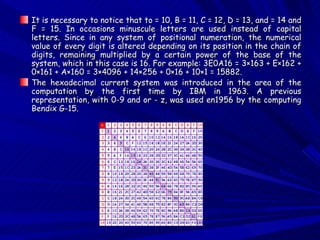
It is necessary to notice that to = 10, B = 11, C = 12, D = 13, and = 14 and F = 15. In occasions minuscule letters are used instead of capital letters. Since in any system of positional numeration, the numerical value of every digit is altered depending on its position in the chain of digits, remaining multiplied by a certain power of the base of the system, which in this case is 16. For example: 3E0A16 = 3×163 + E×162 + 0×161 + A×160 = 3×4096 + 14×256 + 0×16 + 10×1 = 15882. The hexadecimal current system was introduced in the area of the computation by the first time by IBM in 1963. A previous representation, with 0-9 and or - z, was used en1956 by the computing Bendix G-15.

Hexadecimal System[1]

  • 1.
    HEXADECIMAL SYSTEM Thehexadecimal system, sometimes abridged like hex, is the system of positional numeration of base 16, using therefore 16 symbols. His current use is very linked to the computer science and sciences of the computation, since the computers are in the habit of using the byte or octet as basic unit of memory (report); and, due to the fact that a byte represents 28 possible values, and this can be represented like: 2 8 = 2 4 . 2 4 = 16 . 16 = 1 . 16 2 + 0 . 16 1 + 0 . 16 0
  • 2.
    That, according tothe general theorem of the positional numeration, is equivalent to the number in base 16 10016, two hexadecimal digits correspond (fit) exactly, allow to represent the same line of points, to a byte. At first provided that the usual system of numeration is of decimal base and, for this reason, only he(she) arranges of ten digits, the convention was adopted of using the first six letters of the Latin alphabet to replace the digits that we lack. The set of symbols would be, therefore, the following one: S  = {0,1,2,3,4,5,6,7,8,9,A,B,C,D,E,F}
  • 3.
    It is necessaryto notice that to = 10, B = 11, C = 12, D = 13, and = 14 and F = 15. In occasions minuscule letters are used instead of capital letters. Since in any system of positional numeration, the numerical value of every digit is altered depending on its position in the chain of digits, remaining multiplied by a certain power of the base of the system, which in this case is 16. For example: 3E0A16 = 3×163 + E×162 + 0×161 + A×160 = 3×4096 + 14×256 + 0×16 + 10×1 = 15882. The hexadecimal current system was introduced in the area of the computation by the first time by IBM in 1963. A previous representation, with 0-9 and or - z, was used en1956 by the computing Bendix G-15.