Machine Learning of Epidemic
Processes in Networks
Francisco Rodrigues
Institute of Mathematics and Computer Science
University of São Paulo
francisco@icmc.usp.br
Workshop on Modelling of Infectious Diseases Dynamics
Outline
1. Complex Networks
2. Epidemic processes in networks
3. The influence of network structure
4. Prediction of epidemic processes
5. Challenges and future research
Complex Networks
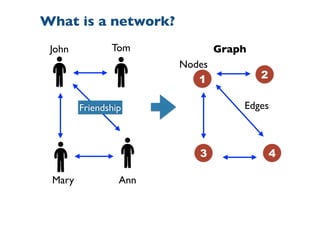
What is a network?
John Tom
Mary Ann
1 2
3 4
Graph
Nodes
EdgesFriendship
Social Network
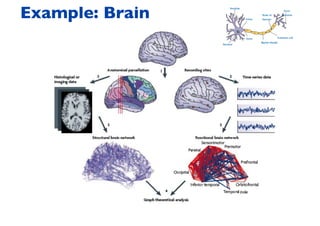
Example: Brain
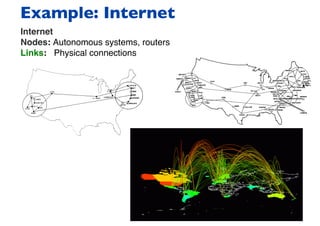
Example: Internet
Internet
Nodes: Autonomous systems, routers

Links: Physical connections
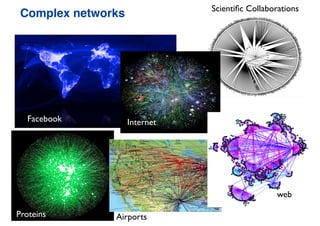
Complex networks
Facebook
Scientific Collaborations
Proteins
Internet
Airports
web
Network Science is a well stablished area.
To describe the network topology,
we need networks measures.
x = [x1, x2,…]
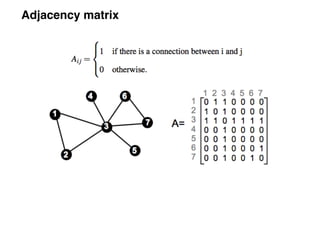
Adjacency matrix
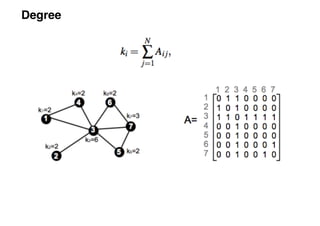
Degree
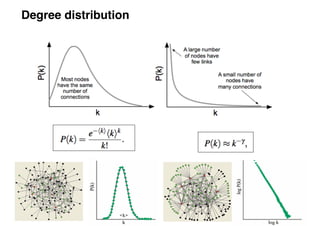
Degree distribution
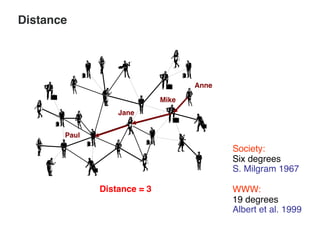
Paul
Anne
Society:
Six degrees
S. Milgram 1967
WWW:
19 degrees
Albert et al. 1999
Distance = 3
Distance
Mike
Jane
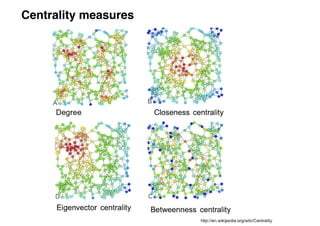
Centrality measures
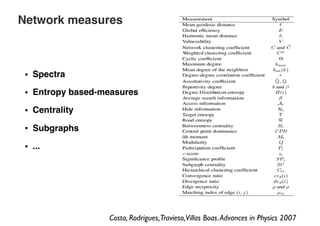
• Spectra
• Entropy based-measures
• Centrality
• Subgraphs
• ...
Costa, Rodrigues,Travieso,Villas Boas.Advances in Physics 2007
Network measures
Structure Dynamics Applications
Complex Networks
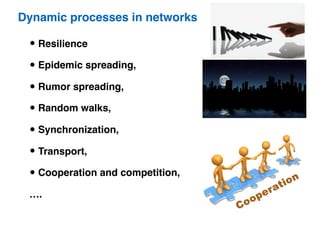
• Resilience
• Epidemic spreading,
• Rumor spreading,
• Random walks,
• Synchronization,
• Transport,
• Cooperation and competition,
….
Dynamic processes in networks
Epidemic Spreading
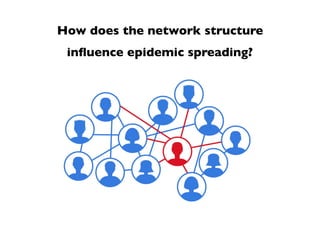
How does the network structure
influence epidemic spreading?
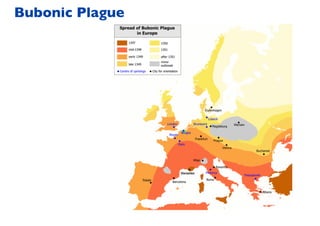
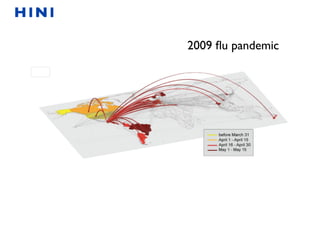
Bubonic Plague
H1N1
2009 flu pandemic
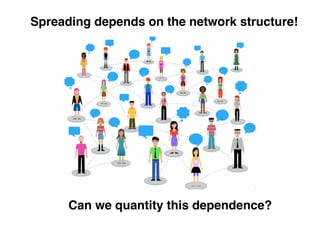
Spreading depends on the network structure!
Can we quantity this dependence?
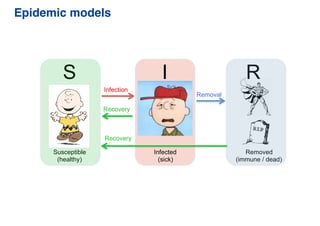
Susceptible
(healthy)
Infected
(sick)
Removed
(immune / dead)
S I R
Infection
Recovery
Recovery
Removal
Epidemic models
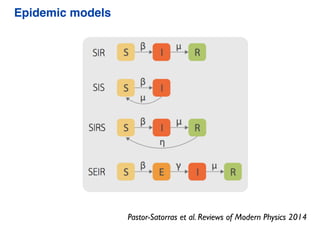
Pastor-Satorras et al. Reviews of Modern Physics 2014
Epidemic models
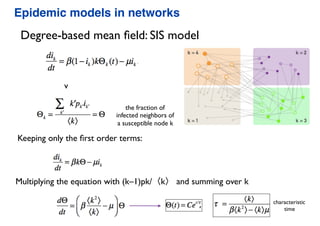
Degree-based mean field: SIS model
v
Keeping only the first order terms:
Multiplying the equation with (k–1)pk/〈k〉 and summing over k
characteristic
time
the fraction of
infected neighbors of
a susceptible node k
Epidemic models in networks
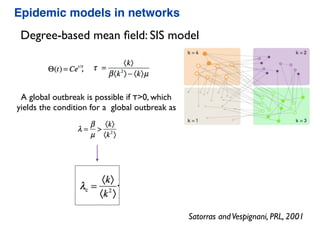
Degree-based mean field: SIS model
A global outbreak is possible if τ>0, which
yields the condition for a global outbreak as
Satorras andVespignani, PRL, 2001
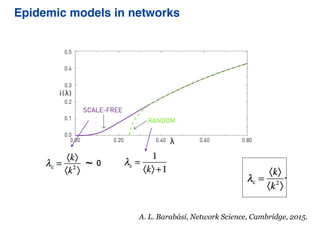
Epidemic models in networks
A. L. Barabási, Network Science, Cambridge, 2015.
0~
Epidemic models in networks
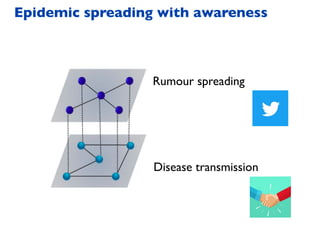
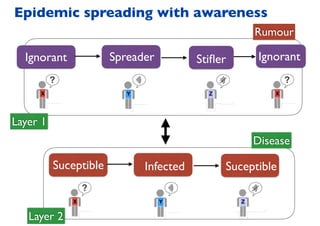
Epidemic spreading with awareness
Rumour spreading
Disease transmission
Disease awareness
Epidemic spreading with awareness
Ignorant Spreader Stifler Ignorant
Suceptible Infected Suceptible
Layer 1
Layer 2
Rumour
Disease
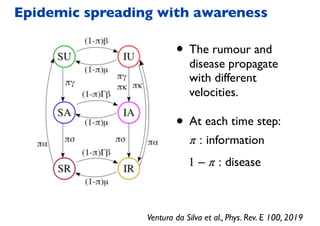
Epidemic spreading with awareness
Ventura da Silva et al., Phys. Rev. E 100, 2019
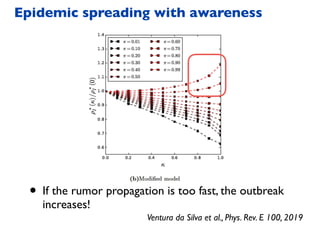
• The rumour and
disease propagate
with different
velocities.
• At each time step:
π : information
1 − π : disease
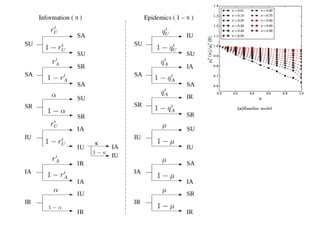
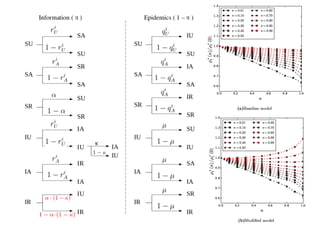
Epidemic spreading with awareness
• If the rumor propagation is too fast, the outbreak
increases!
Ventura da Silva et al., Phys. Rev. E 100, 2019
Epidemic spreading with awareness
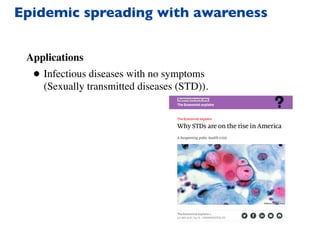
Applications
• Infectious diseases with no symptoms
(Sexually transmitted diseases (STD)).
Spreading depends on the network structure!
Arruda, Rodrigues and Moreno, Physics Reports, 2018
Epidemic spreading depends
on the network structure.
Can we predict this dynamical
processes?
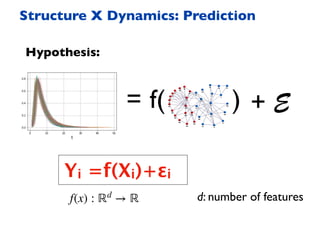
= f( ) + E
Hypothesis:
Yi =f(Xi)+εi
f(x) : ℝd
→ ℝ d: number of features
Structure X Dynamics: Prediction
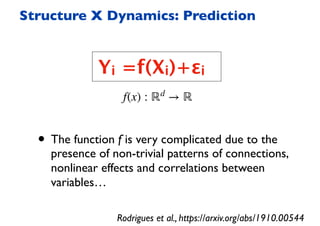
Yi =f(Xi)+εi
• The function f is very complicated due to the
presence of non-trivial patterns of connections,
nonlinear effects and correlations between
variables…
f(x) : ℝd
→ ℝ
Structure X Dynamics: Prediction
Rodrigues et al., https://arxiv.org/abs/1910.00544
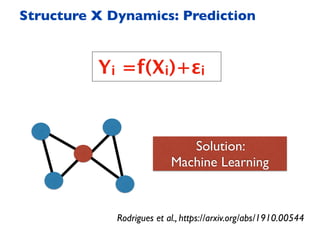
Yi =f(Xi)+εi
Solution:
Machine Learning
Structure X Dynamics: Prediction
Rodrigues et al., https://arxiv.org/abs/1910.00544
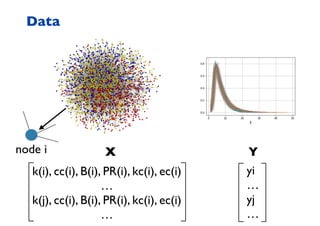
Data
X Y
k(i), cc(i), B(i), PR(i), kc(i), ec(i)
…
k(j), cc(i), B(i), PR(i), kc(i), ec(i)
…
node i
yi
…
yj
…
Dynamical processes
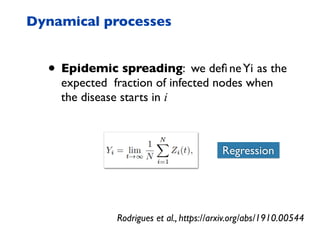
• Epidemic spreading: we defi neYi as the
expected fraction of infected nodes when
the disease starts in i
Regression
Rodrigues et al., https://arxiv.org/abs/1910.00544
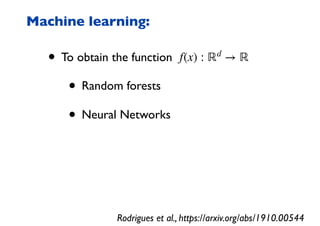
Machine learning:
• To obtain the function
• Random forests
• Neural Networks
f(x) : ℝd
→ ℝ
Rodrigues et al., https://arxiv.org/abs/1910.00544
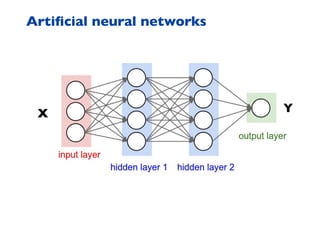
Artificial neural networks
X Y
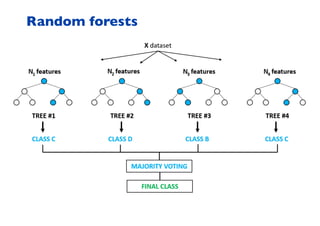
Random forests
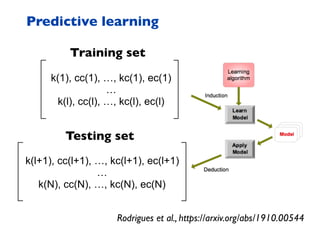
Predictive learning
Training set
k(1), cc(1), …, kc(1), ec(1)
…
k(l), cc(l), …, kc(l), ec(l)
k(l+1), cc(l+1), …, kc(l+1), ec(l+1)
…
k(N), cc(N), …, kc(N), ec(N)
Testing set
Rodrigues et al., https://arxiv.org/abs/1910.00544
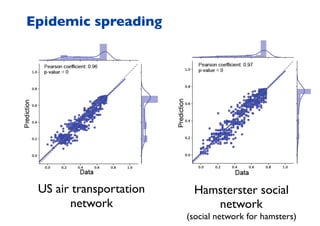
Epidemic spreading
US air transportation
network
Hamsterster social
network
(social network for hamsters)
Identification of influential spreaders
CHICAGO O'HARE INTERNATIONALAIRPORT
Can we identify the most
“important” nodes from the network
structure?
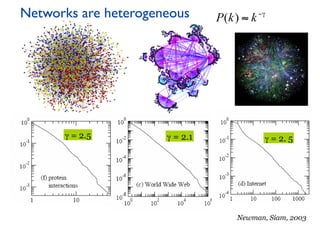
γ = 2.5 γ = 2.1 γ = 2. 5
Newman, Siam, 2003
Networks are heterogeneous
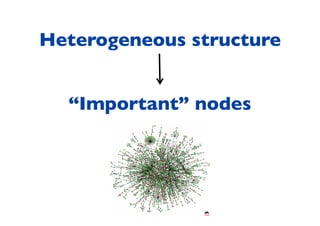
Heterogeneous structure
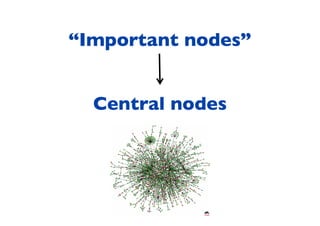
“Important” nodes
“Important nodes”
Central nodes
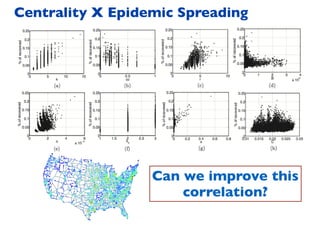
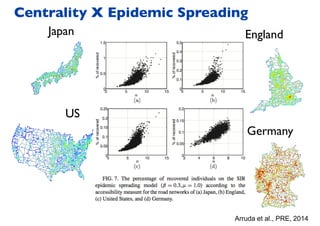
Centrality X Epidemic Spreading
Can we improve this
correlation?
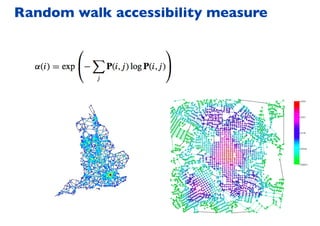
Random walk accessibility measure
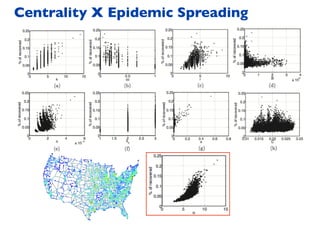
Centrality X Epidemic Spreading
Japan England
US
Germany
Arruda et al., PRE, 2014
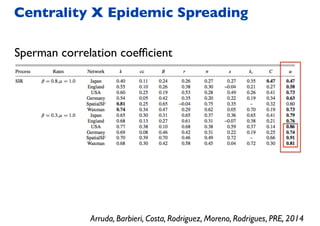
Sperman correlation coefficient
Centrality X Epidemic Spreading
Arruda, Barbieri, Costa, Rodriguez, Moreno, Rodrigues, PRE, 2014
What measure is the most suitable
to predict epidemic spreading?
Degree, betweenness centrality, closeness
centrality, PageRank, …?
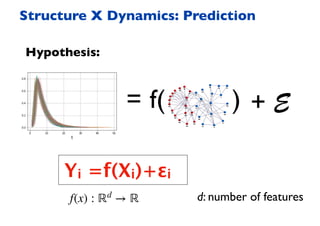
= f( ) + E
Hypothesis:
Yi =f(Xi)+εi
f(x) : ℝd
→ ℝ d: number of features
Structure X Dynamics: Prediction
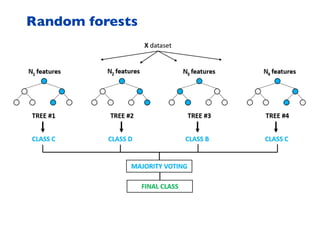
Random forests
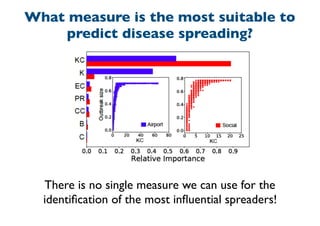
There is no single measure we can use for the
identification of the most influential spreaders!
What measure is the most suitable to
predict disease spreading?
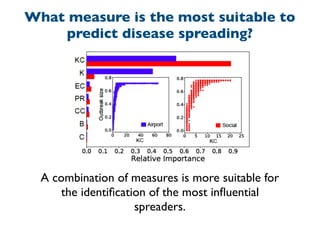
A combination of measures is more suitable for
the identification of the most influential
spreaders.
What measure is the most suitable to
predict disease spreading?
Machine learning is a very
useful tool to predict
dynamical processes from
the network structure.
Challenges
• How to predict disease propagation
from the networks structure.
• The modeling of temporal interactions
and multilayer organization.
• Host heterogeneities.
• Methods for control: quarantine,
vaccination.
• Identification of influential spreaders.
Thank you!
https://sites.icmc.usp.br/francisco
francisco@icmc.usp.br

Machine Learning of Epidemic Processes in Networks