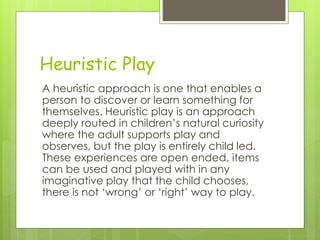
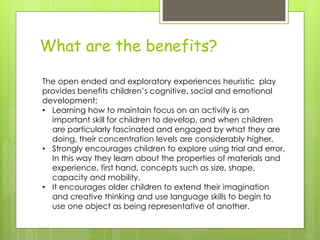
Heuristic play is an approach to play that is child-led and allows children to discover things for themselves through open-ended exploration. It was developed by Elinor Goldschmeid over 30 years ago. Heuristic play provides cognitive, social, and emotional benefits to children such as increased concentration, learning through trial and error, using their imagination, and making independent decisions.



![U3.1 lesson1[lo1,lo2,lo3]](https://cdn.slidesharecdn.com/ss_thumbnails/u3-160429093724-thumbnail.jpg?width=640&height=640&fit=bounds)

![U1.1 lesson2[lo2]](https://cdn.slidesharecdn.com/ss_thumbnails/u1-151028190936-lva1-app6891-thumbnail.jpg?width=640&height=640&fit=bounds)


![U2.2 lesson1[lo1]](https://cdn.slidesharecdn.com/ss_thumbnails/u2-160107132930-thumbnail.jpg?width=640&height=640&fit=bounds)
![U1.4 lesson3[lo3] copy](https://cdn.slidesharecdn.com/ss_thumbnails/u1-151115201251-lva1-app6892-thumbnail.jpg?width=640&height=640&fit=bounds)


![U1.1 lesson1[lo1]](https://cdn.slidesharecdn.com/ss_thumbnails/u1-151028183338-lva1-app6891-thumbnail.jpg?width=640&height=640&fit=bounds)
![U1.5 lesson5[lo6]](https://cdn.slidesharecdn.com/ss_thumbnails/u1-150924185608-lva1-app6891-thumbnail.jpg?width=640&height=640&fit=bounds)
![U1.5 lesson2[lo2,lo3]](https://cdn.slidesharecdn.com/ss_thumbnails/u1-150917093644-lva1-app6891-thumbnail.jpg?width=640&height=640&fit=bounds)

![U1.3 lesson4[lo6]](https://cdn.slidesharecdn.com/ss_thumbnails/u1-150904125355-lva1-app6892-thumbnail.jpg?width=640&height=640&fit=bounds)
![U1.2 lesson3[lo3]](https://cdn.slidesharecdn.com/ss_thumbnails/u1-150904123442-lva1-app6892-thumbnail.jpg?width=640&height=640&fit=bounds)
![U1.3 lesson2[lo2,lo3,lo4]](https://cdn.slidesharecdn.com/ss_thumbnails/u1-150904124808-lva1-app6891-thumbnail.jpg?width=640&height=640&fit=bounds)
![U1.4 lesson2[lo2]](https://cdn.slidesharecdn.com/ss_thumbnails/u1-151115201017-lva1-app6891-thumbnail.jpg?width=640&height=640&fit=bounds)
![U1.5 lesson3[lo4,lo8]](https://cdn.slidesharecdn.com/ss_thumbnails/u1-150917095042-lva1-app6891-thumbnail.jpg?width=640&height=640&fit=bounds)

![U1.3 lesson1[lo1]](https://cdn.slidesharecdn.com/ss_thumbnails/u1-150904124606-lva1-app6891-thumbnail.jpg?width=640&height=640&fit=bounds)


