Herniated Disc Surgery
Anatomy
A herniated disc most often occurs in the lumbar region (low back). This is because the 
lumbar spine carries most of the body's weight. Sometimes the herniation can press on 
a nerve, causing pain that spreads or radiates to other parts of the body.
Definition
Very few people with herniated or bulging discs need surgery. However, if you have tried 
conservative treatments  without relief, your doctor may recommend herniated disc surgery. Surgery 
may be necessary if you are experiencing:
          Muscle weakness or numbness, loss of sensation 
          Problems walking or standing
          Difficulty controlling your bowels or bladder
Many times, only the portion of the disc that is bulging or herniated is removed. In rare cases, it is 
necessary to remove the entire disc. If the entire disc is removed, the bones (vertebrae) on either side 
of the damaged disc may need to be permanently joined or fused together to provide stability for 
your spine.
Micro Discectomy
Why It's Done 
A Microdiscectomy is a surgical procedure that is done to take the pressure off the 
nerves or spinal cord by removing part or all of the herniated disc. Your physician 
might advise Microdiscectomy if: 
Nerve weakness has progressed to the point you have difficulty walking or standing
After six weeks of non­surgical treatment, such as physical therapy, your symptoms 
are not improving
A fragment of a disc becomes lodged in the spinal cord and is compressing a nerve 
The pain radiating into your arms, chest, legs or buttocks is no longer manageable
How Microdiscectomy Surgery Is Performed
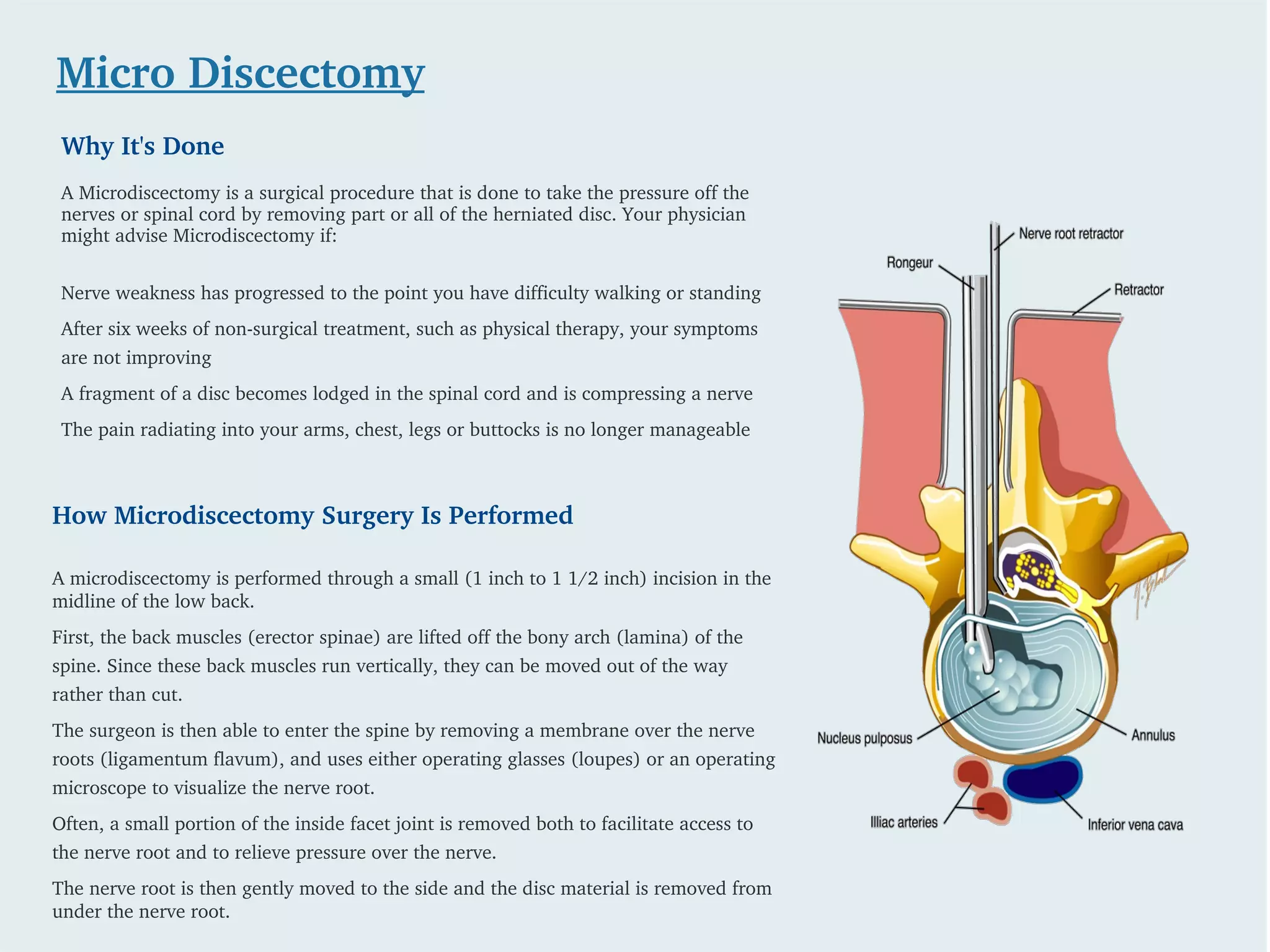
A microdiscectomy is performed through a small (1 inch to 1 1/2 inch) incision in the 
midline of the low back.
First, the back muscles (erector spinae) are lifted off the bony arch (lamina) of the 
spine. Since these back muscles run vertically, they can be moved out of the way 
rather than cut.
The surgeon is then able to enter the spine by removing a membrane over the nerve 
roots (ligamentum flavum), and uses either operating glasses (loupes) or an operating 
microscope to visualize the nerve root.
Often, a small portion of the inside facet joint is removed both to facilitate access to 
the nerve root and to relieve pressure over the nerve.
The nerve root is then gently moved to the side and the disc material is removed from 
under the nerve root.
Risks
MicroDiscectomy is considered to be a safe operation. Just like any surgery, there is a risk of complications occurring. Possible 
complications include the following:
•Bleeding 
•Infection
•Spinal fluid leaking
•Damage to nerves or blood vessels around and in the spine 
•Damage to the protective layer of tissues that surround the spine
Results
Discectomy helps to relieve the symptoms of a herniated disc in most people who have clear indications of nerve compression, such as 
pain that radiates from the back into the arms or legs. This surgery may not provide permanent relief however, because it does not 
solve the underlying problem that initially caused the disc to herniate. Your doctor may make some recommendations that will help 
you avoid injuring your spine again, such as a routine program of low­impact exercise or weight reduction. It may also be recom­ 
mended that you avoid activities that require repetitive or extensive lifting, twisting or bending.
Percutaneous Discectomy
An advanced form of percutaneous discectomy developed to date uses a plasma tech­ nology to 
remove  tissue  from  the  center  of  the  disc.  During  the  procedure,  an  instrument  is  introduced 
through a needle and placed into the center of the disc where a series of channels are created to 
remove tissue from the nucleus. 
Tissue removal from the nucleus acts to decompress the disc and relieve the pressure exerted by 
the  disc  on  the  nearby  nerve  root.  As  pressure  is  relieved,  pain  is  reduced,  consistent  with  the 
clinical  results  of  earlier  percutaneous  discectomy  procedures.  There  is  little  tissue  trauma  and 
recovery times may be improved in many patients.
Laminotomy and Laminectomy
Each back bone or vertebra has two laminae. These laminae are arch­shaped and are located closer to the internal 
body than the outside of the body. Other parts of the vertebra are located near the laminae: the facet joint and the 
spinal process.
The laminae are made of bone and they rarely cause problems. However, surgery on them can be helpful in other 
conditions. Spinal conditions may cause severe pain if the spinal cord or nearby nerves are compressed. Operations 
performed on the laminae can help to make the spinal column wider, which relieves the pressure and pain. Surgery 
on the laminae is also used to help treat spinal deformities.
What is the Difference Between Laminectomy and Laminotomy?
Sometimes even doctors and nurses interchange these two words, but there is a distinction. In a laminectomy, the 
lamina is completely removed. Only a portion of the lamina is removed in a laminotomy.
Reasons for a laminectomy or laminotomy
The main reason for either of these procedures is to remove the pressure from the nerves near the spinal cord or 
from the spinal corditself. Even though a portion of the vertebra is removed, the spinal cord remains protected 
inside the spinal column which consists of hard backbones, even when a laminectomy or laminotomy is performed. 
be permanent.

Herniated disc surgery