
HEPATOPROTECTIVE AGENTS
Subodh Chataut
Mpharm
Kathmandu University
INTRODUCTION:
The liver performs no. of important function ,
• bile production
• excretion of bilirubin , cholesterol, hormones & drugs
• metabolism of fats, protein & carbohydrates
• enzyme activation
• storage of glycogen, vitamins & minerals
• synthesis of plasma protein such as albumin, globulin & clotting factors
• blood detoxification and purification.
Liver toxicity
The main causes of liver damage are-
 Alcohol (ethanol) induced hepatotoxicity
 Chemicals like CCL4, phosphorous, alfatoxins, chlorinated hydrocarbones, etc
 Drugs like DILI (Drug Induced Liver Injuries)
 Autoimmune disorders
 Infections like viral hepatitis
Classifications
These are classified into two types-
1)Hepatotropic Agents : These generally support or promote the healing process of
liver.
2) Hepatoprotective Agents : These generally prevent various types of liver affections
prophilactically.
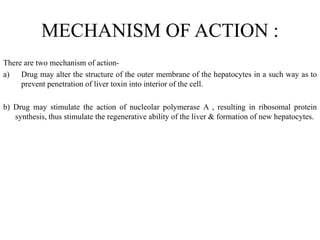
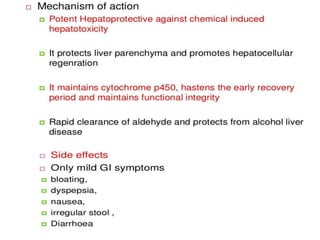
MECHANISM OF ACTION :
There are two mechanism of action-
a) Drug may alter the structure of the outer membrane of the hepatocytes in a such way as to
prevent penetration of liver toxin into interior of the cell.
b) Drug may stimulate the action of nucleolar polymerase A , resulting in ribosomal protein
synthesis, thus stimulate the regenerative ability of the liver & formation of new hepatocytes.
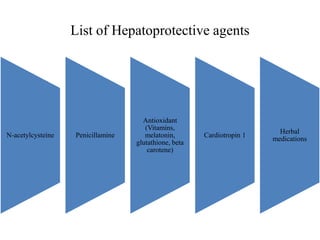
List of Hepatoprotective agents
N-acetylcysteine Penicillamine
Antioxidant
(Vitamins,
melatonin,
glutathione, beta
carotene)
Cardiotropin 1
Herbal
medications
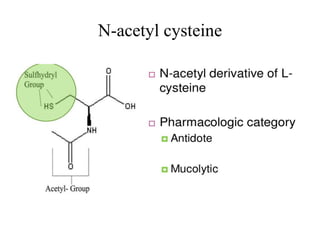
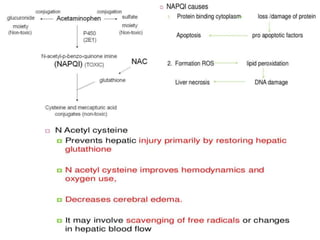
N-acetyl cysteine
Penicillamine
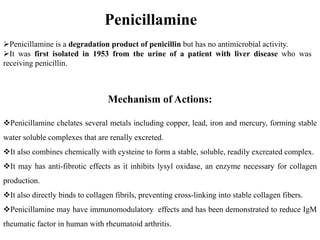
Penicillamine is a degradation product of penicillin but has no antimicrobial activity.
It was first isolated in 1953 from the urine of a patient with liver disease who was
receiving penicillin.
Mechanism of Actions:
Penicillamine chelates several metals including copper, lead, iron and mercury, forming stable
water soluble complexes that are renally excreted.
It also combines chemically with cysteine to form a stable, soluble, readily excreated complex.
It may has anti-fibrotic effects as it inhibits lysyl oxidase, an enzyme necessary for collagen
production.
It also directly binds to collagen fibrils, preventing cross-linking into stable collagen fibers.
Penicillamine may have immunomodulatory effects and has been demonstrated to reduce IgM
rheumatic factor in human with rheumatoid arthritis.
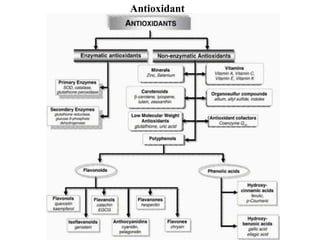
Antioxidant
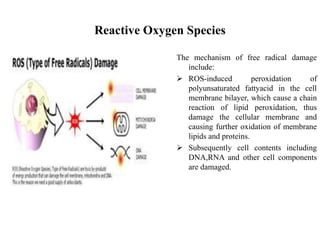
Reactive Oxygen Species
The mechanism of free radical damage
include:
 ROS-induced peroxidation of
polyunsaturated fattyacid in the cell
membrane bilayer, which cause a chain
reaction of lipid peroxidation, thus
damage the cellular membrane and
causing further oxidation of membrane
lipids and proteins.
 Subsequently cell contents including
DNA,RNA and other cell components
are damaged.
Antioxidants
 Prevents the transfer of electron from O2 to organic molecules.
 Stabilizes free radicals.
 Terminates free radical reactions.
Cardiotrophin-I
 Phase I study in healthy volunteer completed.
 Orphan drug status granted for solid organ transplantation and acute liver failure by FDA.
 Cardiotrophin-I (CT-I) belongs to the IL-6 family of cytokines.
 CT-1 receptor activation induce cell survival through signal transduction mechanism
mediated by Stat3 (Signal transducer and activator of transcription), MAPK (mitogen-
activated protein kinase), PI3K (phosphatidylinositol 3-kinases).
 CT-1 is induced in context of cell damage in several tissues.
1. Strong anti-apoptic effects on hepatocytes.
2. Reduce the cellular damage cause by ischemia/reperfusion.
3. Decrease oxidative damage.
4. Potent anti-inflammatory agent
 It has been granted for its use in hepatic regeneration.
Herbal Medications
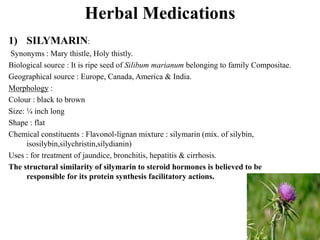
1) SILYMARIN:
Synonyms : Mary thistle, Holy thistly.
Biological source : It is ripe seed of Silibum marianum belonging to family Compositae.
Geographical source : Europe, Canada, America & India.
Morphology :
Colour : black to brown
Size: ¼ inch long
Shape : flat
Chemical constituents : Flavonol-lignan mixture : silymarin (mix. of silybin,
isosilybin,silychristin,silydianin)
Uses : for treatment of jaundice, bronchitis, hepatitis & cirrhosis.
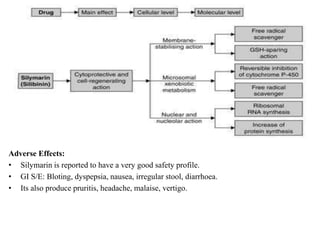
The structural similarity of silymarin to steroid hormones is believed to be
responsible for its protein synthesis facilitatory actions.
Mechanism of action
Adverse Effects:
• Silymarin is reported to have a very good safety profile.
• GI S/E: Bloting, dyspepsia, nausea, irregular stool, diarrhoea.
• Its also produce pruritis, headache, malaise, vertigo.
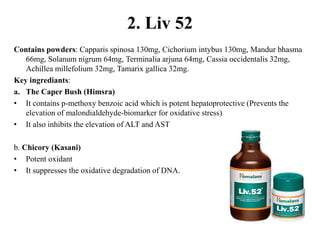
2. Liv 52
Contains powders: Capparis spinosa 130mg, Cichorium intybus 130mg, Mandur bhasma
66mg, Solanum nigrum 64mg, Terminalia arjuna 64mg, Cassia occidentalis 32mg,
Achillea millefolium 32mg, Tamarix gallica 32mg.
Key ingrediants:
a. The Caper Bush (Himsra)
• It contains p-methoxy benzoic acid which is potent hepatoprotective (Prevents the
elevation of malondialdehyde-biomarker for oxidative stress)
• It also inhibits the elevation of ALT and AST
b. Chicory (Kasani)
• Potent oxidant
• It suppresses the oxidative degradation of DNA.
Future Directions
 Hepatotoxicity will remain clinical and controlling significance.
 With increasing the incidence of hepatotoxicity the need for new, potent and
efficacious Hepatoprotective agent arises.
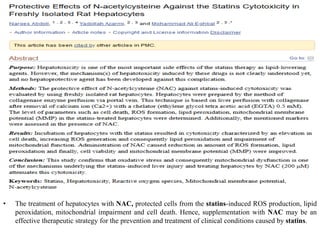
• The treatment of hepatocytes with NAC, protected cells from the statins-induced ROS production, lipid
peroxidation, mitochondrial impairment and cell death. Hence, supplementation with NAC may be an
effective therapeutic strategy for the prevention and treatment of clinical conditions caused by statins.
References
Hepatoprotective agents

Hepatoprotective agents

  • 1.
  • 2.
    INTRODUCTION: The liver performsno. of important function , • bile production • excretion of bilirubin , cholesterol, hormones & drugs • metabolism of fats, protein & carbohydrates • enzyme activation • storage of glycogen, vitamins & minerals • synthesis of plasma protein such as albumin, globulin & clotting factors • blood detoxification and purification.
  • 3.
    Liver toxicity The maincauses of liver damage are-  Alcohol (ethanol) induced hepatotoxicity  Chemicals like CCL4, phosphorous, alfatoxins, chlorinated hydrocarbones, etc  Drugs like DILI (Drug Induced Liver Injuries)  Autoimmune disorders  Infections like viral hepatitis
  • 5.
    Classifications These are classifiedinto two types- 1)Hepatotropic Agents : These generally support or promote the healing process of liver. 2) Hepatoprotective Agents : These generally prevent various types of liver affections prophilactically.
  • 6.
    MECHANISM OF ACTION: There are two mechanism of action- a) Drug may alter the structure of the outer membrane of the hepatocytes in a such way as to prevent penetration of liver toxin into interior of the cell. b) Drug may stimulate the action of nucleolar polymerase A , resulting in ribosomal protein synthesis, thus stimulate the regenerative ability of the liver & formation of new hepatocytes.
  • 7.
    List of Hepatoprotectiveagents N-acetylcysteine Penicillamine Antioxidant (Vitamins, melatonin, glutathione, beta carotene) Cardiotropin 1 Herbal medications
  • 8.
  • 10.
    Penicillamine Penicillamine is adegradation product of penicillin but has no antimicrobial activity. It was first isolated in 1953 from the urine of a patient with liver disease who was receiving penicillin. Mechanism of Actions: Penicillamine chelates several metals including copper, lead, iron and mercury, forming stable water soluble complexes that are renally excreted. It also combines chemically with cysteine to form a stable, soluble, readily excreated complex. It may has anti-fibrotic effects as it inhibits lysyl oxidase, an enzyme necessary for collagen production. It also directly binds to collagen fibrils, preventing cross-linking into stable collagen fibers. Penicillamine may have immunomodulatory effects and has been demonstrated to reduce IgM rheumatic factor in human with rheumatoid arthritis.
  • 11.
  • 12.
    Reactive Oxygen Species Themechanism of free radical damage include:  ROS-induced peroxidation of polyunsaturated fattyacid in the cell membrane bilayer, which cause a chain reaction of lipid peroxidation, thus damage the cellular membrane and causing further oxidation of membrane lipids and proteins.  Subsequently cell contents including DNA,RNA and other cell components are damaged.
  • 13.
    Antioxidants  Prevents thetransfer of electron from O2 to organic molecules.  Stabilizes free radicals.  Terminates free radical reactions.
  • 14.
    Cardiotrophin-I  Phase Istudy in healthy volunteer completed.  Orphan drug status granted for solid organ transplantation and acute liver failure by FDA.  Cardiotrophin-I (CT-I) belongs to the IL-6 family of cytokines.  CT-1 receptor activation induce cell survival through signal transduction mechanism mediated by Stat3 (Signal transducer and activator of transcription), MAPK (mitogen- activated protein kinase), PI3K (phosphatidylinositol 3-kinases).  CT-1 is induced in context of cell damage in several tissues. 1. Strong anti-apoptic effects on hepatocytes. 2. Reduce the cellular damage cause by ischemia/reperfusion. 3. Decrease oxidative damage. 4. Potent anti-inflammatory agent  It has been granted for its use in hepatic regeneration.
  • 15.
    Herbal Medications 1) SILYMARIN: Synonyms: Mary thistle, Holy thistly. Biological source : It is ripe seed of Silibum marianum belonging to family Compositae. Geographical source : Europe, Canada, America & India. Morphology : Colour : black to brown Size: ¼ inch long Shape : flat Chemical constituents : Flavonol-lignan mixture : silymarin (mix. of silybin, isosilybin,silychristin,silydianin) Uses : for treatment of jaundice, bronchitis, hepatitis & cirrhosis. The structural similarity of silymarin to steroid hormones is believed to be responsible for its protein synthesis facilitatory actions.
  • 16.
  • 17.
    Adverse Effects: • Silymarinis reported to have a very good safety profile. • GI S/E: Bloting, dyspepsia, nausea, irregular stool, diarrhoea. • Its also produce pruritis, headache, malaise, vertigo.
  • 18.
    2. Liv 52 Containspowders: Capparis spinosa 130mg, Cichorium intybus 130mg, Mandur bhasma 66mg, Solanum nigrum 64mg, Terminalia arjuna 64mg, Cassia occidentalis 32mg, Achillea millefolium 32mg, Tamarix gallica 32mg. Key ingrediants: a. The Caper Bush (Himsra) • It contains p-methoxy benzoic acid which is potent hepatoprotective (Prevents the elevation of malondialdehyde-biomarker for oxidative stress) • It also inhibits the elevation of ALT and AST b. Chicory (Kasani) • Potent oxidant • It suppresses the oxidative degradation of DNA.
  • 20.
    Future Directions  Hepatotoxicitywill remain clinical and controlling significance.  With increasing the incidence of hepatotoxicity the need for new, potent and efficacious Hepatoprotective agent arises.
  • 22.
    • The treatmentof hepatocytes with NAC, protected cells from the statins-induced ROS production, lipid peroxidation, mitochondrial impairment and cell death. Hence, supplementation with NAC may be an effective therapeutic strategy for the prevention and treatment of clinical conditions caused by statins.
  • 23.