WELCOME
HEPATITIS C DRUGS - EVIDENCE TO
DEMONSTRATE EFFECTIVENESS & VALUE
July 7th, 2014
ABOUT CMTP AND ICER
The Center for Medical Technology Policy (CMTP) has extensive experience convening stakeholder groups to
discuss value, and evidence and methodological standards. CMTP’s work on such standards is conducted under the
umbrella of the Green Park Collaborative-USA (GPC-USA), a neutral forum to support dialogue and consensus
among stakeholders on methodological standards for clinical research, focusing on “real-world” effectiveness and
value, and emphasizing evidence expectations of payers, informed by the views of patients and clinicians. Visit us
online at: http://www.cmtpnet.org/
The Institute for Clinical and Economic Review (ICER) is an independent non-profit health care research
organization dedicated to improving the interpretation and application of evidence in the health care system. ICER
directs two core programs: the California Technology Assessment Forum (CTAF), and the New England Comparative
Effectiveness Public Advisory Council (CEPAC). For more information about ICER, please visit ICER’s
website, www.icer-review.org.
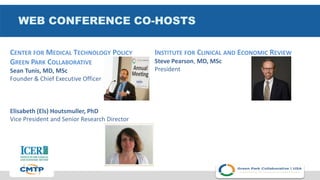
WEB CONFERENCE CO-HOSTS
CENTER FOR MEDICAL TECHNOLOGY POLICY
GREEN PARK COLLABORATIVE
Sean Tunis, MD, MSc
Founder & Chief Executive Officer
Elisabeth (Els) Houtsmuller, PhD
Vice President and Senior Research Director
INSTITUTE FOR CLINICAL AND ECONOMIC REVIEW
Steve Pearson, MD, MSc
President
HEPATITIS C DRUGS
• New treatment options for hepatitis C appear to have significant
advantages in terms of safety, effectiveness, and patient burden
• Evidence needs for decision-making by patients, clinicians, and payers
HEPATITIS C DRUGS: GPC FOCUS
• GPC Purpose: provide multi-stakeholder forum to support dialogue and
consensus on methodological standards for generating evidence of
effectiveness and value
• Forward-looking: maximize relevance, quality and efficiency of future
research to inform key decision makers (patients, clinicians, and payers)
• Intent of webinar is NOT to debate critical issues of current coverage
policies, evidence requirements for breakthrough drugs or accelerated
approval, or pricing of medications
WEB CONFERENCE AGENDA
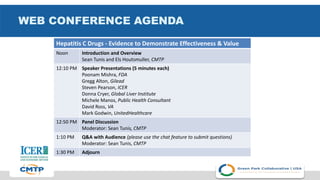
Hepatitis C Drugs - Evidence to Demonstrate Effectiveness & Value
Noon Introduction and Overview
Sean Tunis and Els Houtsmuller, CMTP
12:10 PM Speaker Presentations (5 minutes each)
Poonam Mishra, FDA
Gregg Alton, Gilead
Steven Pearson, ICER
Donna Cryer, Global Liver Institute
Michele Manos, Public Health Consultant
David Ross, VA
Mark Godwin, UnitedHealthcare
12:50 PM Panel Discussion
Moderator: Sean Tunis, CMTP
1:10 PM Q&A with Audience (please use the chat feature to submit questions)
Moderator: Sean Tunis, CMTP
1:30 PM Adjourn
WEB CONFERENCE AGENDA CONT’D
• Speakers will focus on what types of additional evidence would be most
helpful to inform decisions by patients, payers and providers
• We welcome suggestions from speakers on potential strategies and
approaches that would enable the production of new evidence most
efficiently
SPEAKERS
Poonam Mishra, MD
Medical Officer, Division of Antiviral Products
U.S. Food and Drug Administration
Gregg Alton, JD
Executive Vice President
Corporate and Medical Affairs
Gilead
Steven Pearson, MD, MSc
President
Institute for Clinical and Economic Review
Donna Cryer, JD
President & CEO
Global Liver Institute
Michele Manos, PhD, MPH, DVM
Public Health Consultant (former
Director of the Kaiser Permanente Viral Hepatitis
Registry)
David Ross, MD, PhD, MBI
Director
HIV, HCV, and Public Health Pathogens Programs
Office of Public Health/Clinical Public Health
U.S. Department of Veterans Affairs
Mark Godwin, PharmD
Manager of Clinical Pharmacy
UnitedHealthcare
BACKGROUND
• Chronic hepatitis C affects estimated 130-150 million worldwide; 3.2 million in US.
• Associated with serious liver problems; leading cause of liver cancer and liver
transplantation.
• In recent years, hepatitis C has surpassed HIV/AIDS as a cause of death.
• Treatment: up to 48 weeks of therapy; serious side effects, risk of drug-drug
interactions, and burdensome dosing requirements.
BACKGROUND
• Sovaldi (sofosbuvir) approved through breakthrough drug pathway
• must be intended to treat a serious condition, and
• must have preliminary clinical evidence that the drug may demonstrate substantial
improvement on a clinically significant endpoint over available therapies.
• Approval based on high rates of viral clearance and relatively low risks of side effects
• Shorter treatment duration, for some patients without interferon
• Additional all-oral Hepatitis C medications expected to receive approval through
breakthrough pathway later this year
SPEAKER PRESENTATIONS
Poonam Mishra, MD U.S. Food and Drug Administration
Gregg Alton, JD Gilead
Steve Pearson, MD, MSc ICER
Donna Cryer, JD Global Liver Institute
Michele Manos, PhD, MPH, DVM Public Health Consultant
David Ross, MD, PhD, MBI U.S. Department of Veterans Affairs
Mark Godwin, PharmD UnitedHealthcare
Hepatitis C Drugs – Evidence to
Demonstrate Safety and Efficacy
Poonam Mishra, MD
Medical Officer
Division of Antiviral Products
U.S. Food and Drug Administration
CMTP/ICER Web Conference
July 7, 2014
Disclaimer
The views expressed in this presentation are
those of the speaker and not necessarily official
policy of the Food and Drug and Administration
13
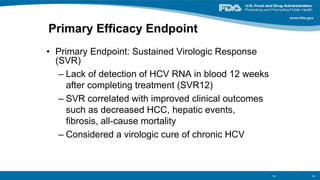
Primary Efficacy Endpoint
• Primary Endpoint: Sustained Virologic Response
(SVR)
– Lack of detection of HCV RNA in blood 12 weeks
after completing treatment (SVR12)
– SVR correlated with improved clinical outcomes
such as decreased HCC, hepatic events,
fibrosis, all-cause mortality
– Considered a virologic cure of chronic HCV
14 14
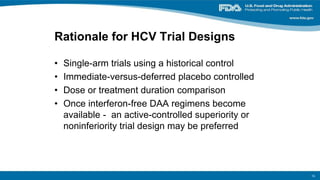
Rationale for HCV Trial Designs
• Single-arm trials using a historical control
• Immediate-versus-deferred placebo controlled
• Dose or treatment duration comparison
• Once interferon-free DAA regimens become
available - an active-controlled superiority or
noninferiority trial design may be preferred
15
Specific Populations
• Evaluation of DAA HCV regimens in patient
populations with unmet medical need, such as:
– Pre- and post- liver transplant subjects
– Subjects with decompensated cirrhosis
– Subjects with bleeding disorders
– Subjects using intravenous drugs
– Subjects on opioid maintenance therapy
– Subjects with renal insufficiency
– HCV/HIV-1 co-infected subjects
16
Post-Approval
• Optimizing regimen/duration for “harder-to-treat”
subgroups identified in Phase 3 trials
• Tailoring an optimal regimen based on patient
characteristics to identify patients who can be
effectively treated with shorter regimen
• Data on populations underrepresented in Phase
3 trials
• “Real-world” effectiveness and safety data
17
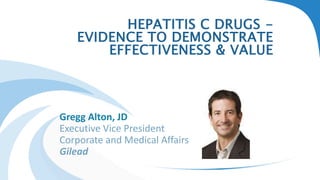
HEPATITIS C DRUGS -
EVIDENCE TO DEMONSTRATE
EFFECTIVENESS & VALUE
Gregg Alton, JD
Executive Vice President
Corporate and Medical Affairs
Gilead
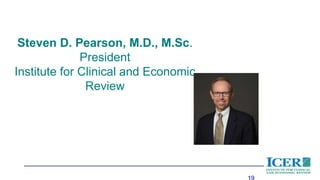
Steven D. Pearson, M.D., M.Sc.
President
Institute for Clinical and Economic
Review
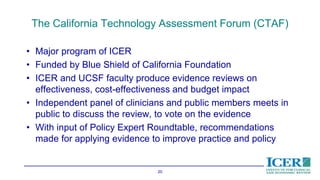
The California Technology Assessment Forum (CTAF)
• Major program of ICER
• Funded by Blue Shield of California Foundation
• ICER and UCSF faculty produce evidence reviews on
effectiveness, cost-effectiveness and budget impact
• Independent panel of clinicians and public members meets in
public to discuss the review, to vote on the evidence
• With input of Policy Expert Roundtable, recommendations
made for applying evidence to improve practice and policy
20
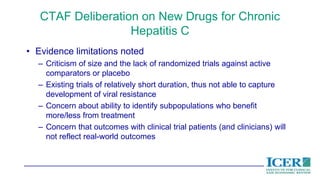
CTAF Deliberation on New Drugs for Chronic
Hepatitis C
• Evidence limitations noted
– Criticism of size and the lack of randomized trials against active
comparators or placebo
– Existing trials of relatively short duration, thus not able to capture
development of viral resistance
– Concern about ability to identify subpopulations who benefit
more/less from treatment
– Concern that outcomes with clinical trial patients (and clinicians) will
not reflect real-world outcomes
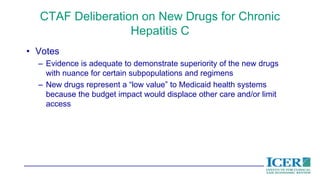
CTAF Deliberation on New Drugs for Chronic
Hepatitis C
• Votes
– Evidence is adequate to demonstrate superiority of the new drugs
with nuance for certain subpopulations and regimens
– New drugs represent a “low value” to Medicaid health systems
because the budget impact would displace other care and/or limit
access
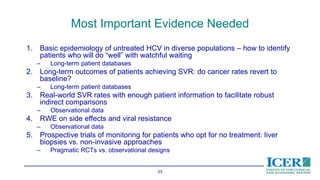
Most Important Evidence Needed
1. Basic epidemiology of untreated HCV in diverse populations – how to identify
patients who will do “well” with watchful waiting
– Long-term patient databases
2. Long-term outcomes of patients achieving SVR: do cancer rates revert to
baseline?
– Long-term patient databases
3. Real-world SVR rates with enough patient information to facilitate robust
indirect comparisons
– Observational data
4. RWE on side effects and viral resistance
– Observational data
5. Prospective trials of monitoring for patients who opt for no treatment: liver
biopsies vs. non-invasive approaches
– Pragmatic RCTs vs. observational designs
23
© 2013 Global Liver Institute
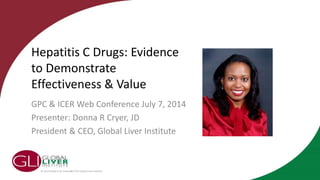
Hepatitis C Drugs: Evidence
to Demonstrate
Effectiveness & Value
© 2013 Global Liver Institute
GPC & ICER Web Conference July 7, 2014
Presenter: Donna R Cryer, JD
President & CEO, Global Liver Institute
© 2013 Global Liver Institute
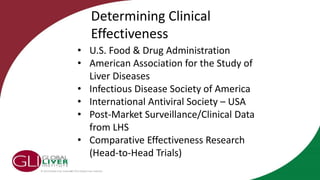
Determining Clinical
Effectiveness
© 2013 Global Liver Institute
• U.S. Food & Drug Administration
• American Association for the Study of
Liver Diseases
• Infectious Disease Society of America
• International Antiviral Society – USA
• Post-Market Surveillance/Clinical Data
from LHS
• Comparative Effectiveness Research
(Head-to-Head Trials)
© 2013 Global Liver Institute
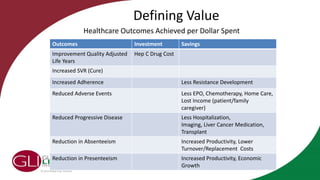
Defining Value
Healthcare Outcomes Achieved per Dollar Spent
Outcomes Investment Savings
Improvement Quality Adjusted
Life Years
Hep C Drug Cost
Increased SVR (Cure)
Increased Adherence Less Resistance Development
Reduced Adverse Events Less EPO, Chemotherapy, Home Care,
Lost Income (patient/family
caregiver)
Reduced Progressive Disease Less Hospitalization,
Imaging, Liver Cancer Medication,
Transplant
Reduction in Absenteeism Increased Productivity, Lower
Turnover/Replacement Costs
Reduction in Presenteeism Increased Productivity, Economic
Growth
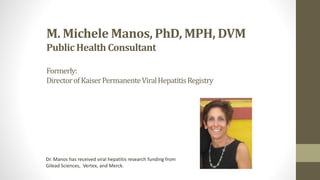
M. Michele Manos, PhD, MPH, DVM
Public Health Consultant
Formerly:
DirectorofKaiserPermanenteViralHepatitisRegistry
Dr. Manos has received viral hepatitis research funding from
Gilead Sciences, Vertex, and Merck.
Selecting the “right” HCV drug regimens:
things we need to know
What are the real-world attributes of specific drug regimens?
Things are not what they seem in clinical trials. Large population based studies
in non-academic settings are crucial.
(E.g. crude SVR rates are about 50% with TVR and BOC)
Data from baby boomers (now age 50-70) are essential, as that group should
be the (urgent) main target.
• SVR rates
• by age, disease, race, Rx history, host and viral genetics
• Side effects (prevalence, severity, cost, d/c rate)
• which side effects are attributable to IFN versus RBV?
• Duration of treatment (flexibility, effectiveness)
• Long term relapse rates
• in the absence of immune stimulation (IFN), do we risk suppression
rather than cure?
Selecting the “right” HCV drug regimens:
(more difficult)thingswe need to know
Can we quantitate the long term benefits of treatment?
Again, this should be assessed in community-based settings.
• How do they vary by patient characteristics?
• Does everyone benefit?
• Does impact “drop off” at some age or disease state?
Who needs treatment, and when?
• Factors considered: disease status, additional risk factors, age
• Is there an “ideal” time to treat? A breakpoint in natural history?
• Is there a subset of patients who will never progress, and thus
less requirement for therapy?
• Is there an upper age limit for treatment?
Selecting the “right” HCV drug regimens:
an extremely large challenge
As is often the case, we must determine how to best distribute
limited resources.
And at this time, we have limited information upon which to base
those decisions.
Population health perspectives and decisions are distinct from
clinical choices about treating individual patients.
However, if we don’t act soon, the huge majority of patients will
simply age out of the window for intervention.
Many will die of liver disease.
Hepatitis C Drugs - Evidence to Demonstrate
Effectiveness and Value
David Ross, M.D., Ph.D., M.B.I.
Director, HIV, HCV, and Public Health Pathogens Programs
Office of Public Health/Clinical Public Health
U.S. Department of Veterans Affairs
VETERANS HEALTH ADMINISTRATION
Disclaimer
The views expressed are those of the author, and do not necessarily
represent the policy or opinion of the US Department of Veterans
Affairs, the Veterans Health Administration, or the US Government.
32
VETERANS HEALTH ADMINISTRATION
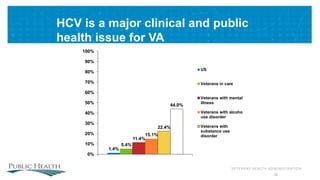
HCV is a major clinical and public
health issue for VA
1.4%
5.4%
11.4%
15.1%
22.4%
44.0%
0%
10%
20%
30%
40%
50%
60%
70%
80%
90%
100%
PrevalenceofHCVantibodies
US
Veterans in care
Veterans with mental
illness
Veterans with alcoho
use disorder
Veterans with
substance use
disorder
.
33
VETERANS HEALTH ADMINISTRATION
Current VA approach to DAAs
• Cost is not a factor in treatment decision-making
• New DAAs added to VA National Formulary (Mar 2014)
• Updated VA HCV treatment guidelines (Apr 2014)
• Monitoring of drug uptake and outcomes (ongoing)
• Treatment of comorbidities
• Provider education (ongoing)
• Data feedback (ongoing)
34
VETERANS HEALTH ADMINISTRATION
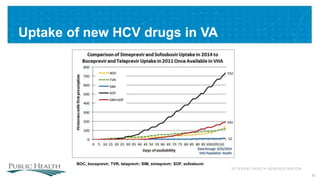
Uptake of new HCV drugs in VA
35
BOC, boceprevir; TVR, telaprevir; SIM, simeprevir; SOF, sofosbuvir
VETERANS HEALTH ADMINISTRATION
Questions of interest to VA
• Access
– How do we improve access to HCV treatment for Veterans with
geographic barriers?
– How do we redesign care to increase capacity?
• Quality
– What is the real-world effectiveness of DAAs?
– What is comparative effectiveness of different DAAs
– What factors (patient, provider, system) predict adherence?
36
VETERANS HEALTH ADMINISTRATION
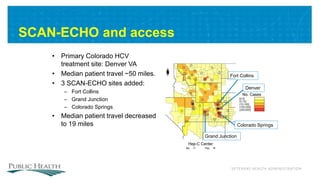
SCAN-ECHO and access
• Primary Colorado HCV
treatment site: Denver VA
• Median patient travel ~50 miles.
• 3 SCAN-ECHO sites added:
– Fort Collins
– Grand Junction
– Colorado Springs
• Median patient travel decreased
to 19 miles
Grand Junction
Fort Collins
Denver
Colorado Springs
VETERANS HEALTH ADMINISTRATION
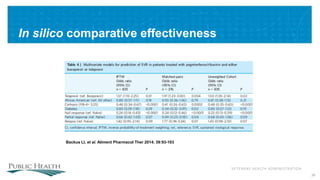
In silico comparative effectiveness
38
Backus LI, et al. Aliment Pharmacol Ther 2014; 39:93-103
VETERANS HEALTH ADMINISTRATION
Other questions
• Hepatitis C-specific lessons
– Can patients with traditional barriers to treatment (IDU, EtOH use) be treated successfully?
– Does SVR achieved through DAAs carry the same clinical benefit as SVR achieved through PEG-Riba?
– What is the utility (e.g., in terms of net QALY changes) for treatment of different populations?
– Any prevention benefits (decreased transmission, post-exposure prophylaxis)/
• General lessons learned
– Public health: Can interventions to increase access be extrapolated to other therapeutic areas with large
caseloads without sacrificing quality?
– Drug development/regulators: What are the pro’s/con’s of this drug development model for other therapeutic
areas (e.g., Abx)?
– Payors: Better mechanisms to anticipate/project costs of expensive new agents? Does traditional cost-
effectiveness modeling apply well with large populations?
VETERANS HEALTH ADMINISTRATION
Questions?
• David.Ross4@va.gov
• publichealth@va.gov
• www.hepatitis.va.gov
HEPATITIS C DRUGS -
EVIDENCE TO DEMONSTRATE
EFFECTIVENESS & VALUE
Mark Godwin, PharmD
Manager of Clinical Pharmacy
UnitedHealthcare
• Long-term SVR12 durability data
• Comparative studies designed to identify the most effective direct
acting agent (DAA) combinations based on patient characteristics,
disease staging and regardless of manufacturer sponsor
• Include both comparative clinical outcomes, intermediate and long-term,
as well as comparative cost outcomes
• Additional data on specific subtypes of hepatitis C and subpopulations
of interest
HEPATITIS C DRUGS - EVIDENCE TO
DEMONSTRATE EFFECTIVENESS & VALUE
RECOMMENDATIONS FOR FUTURE RESEARCH EFFORTS:
Studies designed to determine when to initiate treatment
• Long term data and outcomes for patients achieving SVR12/SVR24 based on fibrosis score at
time of treatment initiation (e.g. long-term liver-related complications, all-cause mortality, etc.
when comparing patients who achieve SVR when therapy is initiated at F1 vs. F2 vs. F3 vs. F4)
• Research must highlight degree of fibrosis at time of treatment initiation so stakeholders can
determine when it would be best, and most cost-effective, to initiate treatment
Pharmacoeconomic studies designed to demonstrate the true value of DAA treatment regimens
• Should include both pharmacy costs as well as medical cost savings
• Post marketing studies or a registry database to track long-term medical cost savings
• Must consider the all-in costs of treatment including comparative cost-effectiveness of each drug
and drug combination, as well as those respective costs in relation to medical costs and medical
cost savings
PANEL DISCUSSION
Moderator: Sean Tunis, CMTP
GENERAL DISCUSSION AND
QUESTIONS FROM THE AUDIENCE
Please use the chat feature to type and submit your questions.
The webinar facilitator will share your question with the
audience, and ask the speakers to respond.
We will do our best to respond to everyone, but our time may
be limited.
THANK YOU FOR
PARTICIPATING!
For more information about this web conference or
CMTP’s Green Park Collaborative, please email
Els Houtsmuller: els.houtsmuller@cmtpnet.org
Visit us online at http://www.cmtpnet.org
Follow us on Twitter @CMTP_Baltimore

Hepatitis C Drugs - Evidence to Demonstrate Effectiveness & Value

  • 1.
    WELCOME HEPATITIS C DRUGS- EVIDENCE TO DEMONSTRATE EFFECTIVENESS & VALUE July 7th, 2014
  • 2.
    ABOUT CMTP ANDICER The Center for Medical Technology Policy (CMTP) has extensive experience convening stakeholder groups to discuss value, and evidence and methodological standards. CMTP’s work on such standards is conducted under the umbrella of the Green Park Collaborative-USA (GPC-USA), a neutral forum to support dialogue and consensus among stakeholders on methodological standards for clinical research, focusing on “real-world” effectiveness and value, and emphasizing evidence expectations of payers, informed by the views of patients and clinicians. Visit us online at: http://www.cmtpnet.org/ The Institute for Clinical and Economic Review (ICER) is an independent non-profit health care research organization dedicated to improving the interpretation and application of evidence in the health care system. ICER directs two core programs: the California Technology Assessment Forum (CTAF), and the New England Comparative Effectiveness Public Advisory Council (CEPAC). For more information about ICER, please visit ICER’s website, www.icer-review.org.
  • 3.
    WEB CONFERENCE CO-HOSTS CENTERFOR MEDICAL TECHNOLOGY POLICY GREEN PARK COLLABORATIVE Sean Tunis, MD, MSc Founder & Chief Executive Officer Elisabeth (Els) Houtsmuller, PhD Vice President and Senior Research Director INSTITUTE FOR CLINICAL AND ECONOMIC REVIEW Steve Pearson, MD, MSc President
  • 4.
    HEPATITIS C DRUGS •New treatment options for hepatitis C appear to have significant advantages in terms of safety, effectiveness, and patient burden • Evidence needs for decision-making by patients, clinicians, and payers
  • 5.
    HEPATITIS C DRUGS:GPC FOCUS • GPC Purpose: provide multi-stakeholder forum to support dialogue and consensus on methodological standards for generating evidence of effectiveness and value • Forward-looking: maximize relevance, quality and efficiency of future research to inform key decision makers (patients, clinicians, and payers) • Intent of webinar is NOT to debate critical issues of current coverage policies, evidence requirements for breakthrough drugs or accelerated approval, or pricing of medications
  • 6.
    WEB CONFERENCE AGENDA HepatitisC Drugs - Evidence to Demonstrate Effectiveness & Value Noon Introduction and Overview Sean Tunis and Els Houtsmuller, CMTP 12:10 PM Speaker Presentations (5 minutes each) Poonam Mishra, FDA Gregg Alton, Gilead Steven Pearson, ICER Donna Cryer, Global Liver Institute Michele Manos, Public Health Consultant David Ross, VA Mark Godwin, UnitedHealthcare 12:50 PM Panel Discussion Moderator: Sean Tunis, CMTP 1:10 PM Q&A with Audience (please use the chat feature to submit questions) Moderator: Sean Tunis, CMTP 1:30 PM Adjourn
  • 7.
    WEB CONFERENCE AGENDACONT’D • Speakers will focus on what types of additional evidence would be most helpful to inform decisions by patients, payers and providers • We welcome suggestions from speakers on potential strategies and approaches that would enable the production of new evidence most efficiently
  • 8.
    SPEAKERS Poonam Mishra, MD MedicalOfficer, Division of Antiviral Products U.S. Food and Drug Administration Gregg Alton, JD Executive Vice President Corporate and Medical Affairs Gilead Steven Pearson, MD, MSc President Institute for Clinical and Economic Review Donna Cryer, JD President & CEO Global Liver Institute Michele Manos, PhD, MPH, DVM Public Health Consultant (former Director of the Kaiser Permanente Viral Hepatitis Registry) David Ross, MD, PhD, MBI Director HIV, HCV, and Public Health Pathogens Programs Office of Public Health/Clinical Public Health U.S. Department of Veterans Affairs Mark Godwin, PharmD Manager of Clinical Pharmacy UnitedHealthcare
  • 9.
    BACKGROUND • Chronic hepatitisC affects estimated 130-150 million worldwide; 3.2 million in US. • Associated with serious liver problems; leading cause of liver cancer and liver transplantation. • In recent years, hepatitis C has surpassed HIV/AIDS as a cause of death. • Treatment: up to 48 weeks of therapy; serious side effects, risk of drug-drug interactions, and burdensome dosing requirements.
  • 10.
    BACKGROUND • Sovaldi (sofosbuvir)approved through breakthrough drug pathway • must be intended to treat a serious condition, and • must have preliminary clinical evidence that the drug may demonstrate substantial improvement on a clinically significant endpoint over available therapies. • Approval based on high rates of viral clearance and relatively low risks of side effects • Shorter treatment duration, for some patients without interferon • Additional all-oral Hepatitis C medications expected to receive approval through breakthrough pathway later this year
  • 11.
    SPEAKER PRESENTATIONS Poonam Mishra,MD U.S. Food and Drug Administration Gregg Alton, JD Gilead Steve Pearson, MD, MSc ICER Donna Cryer, JD Global Liver Institute Michele Manos, PhD, MPH, DVM Public Health Consultant David Ross, MD, PhD, MBI U.S. Department of Veterans Affairs Mark Godwin, PharmD UnitedHealthcare
  • 12.
    Hepatitis C Drugs– Evidence to Demonstrate Safety and Efficacy Poonam Mishra, MD Medical Officer Division of Antiviral Products U.S. Food and Drug Administration CMTP/ICER Web Conference July 7, 2014
  • 13.
    Disclaimer The views expressedin this presentation are those of the speaker and not necessarily official policy of the Food and Drug and Administration 13
  • 14.
    Primary Efficacy Endpoint •Primary Endpoint: Sustained Virologic Response (SVR) – Lack of detection of HCV RNA in blood 12 weeks after completing treatment (SVR12) – SVR correlated with improved clinical outcomes such as decreased HCC, hepatic events, fibrosis, all-cause mortality – Considered a virologic cure of chronic HCV 14 14
  • 15.
    Rationale for HCVTrial Designs • Single-arm trials using a historical control • Immediate-versus-deferred placebo controlled • Dose or treatment duration comparison • Once interferon-free DAA regimens become available - an active-controlled superiority or noninferiority trial design may be preferred 15
  • 16.
    Specific Populations • Evaluationof DAA HCV regimens in patient populations with unmet medical need, such as: – Pre- and post- liver transplant subjects – Subjects with decompensated cirrhosis – Subjects with bleeding disorders – Subjects using intravenous drugs – Subjects on opioid maintenance therapy – Subjects with renal insufficiency – HCV/HIV-1 co-infected subjects 16
  • 17.
    Post-Approval • Optimizing regimen/durationfor “harder-to-treat” subgroups identified in Phase 3 trials • Tailoring an optimal regimen based on patient characteristics to identify patients who can be effectively treated with shorter regimen • Data on populations underrepresented in Phase 3 trials • “Real-world” effectiveness and safety data 17
  • 18.
    HEPATITIS C DRUGS- EVIDENCE TO DEMONSTRATE EFFECTIVENESS & VALUE Gregg Alton, JD Executive Vice President Corporate and Medical Affairs Gilead
  • 19.
    Steven D. Pearson,M.D., M.Sc. President Institute for Clinical and Economic Review
  • 20.
    The California TechnologyAssessment Forum (CTAF) • Major program of ICER • Funded by Blue Shield of California Foundation • ICER and UCSF faculty produce evidence reviews on effectiveness, cost-effectiveness and budget impact • Independent panel of clinicians and public members meets in public to discuss the review, to vote on the evidence • With input of Policy Expert Roundtable, recommendations made for applying evidence to improve practice and policy 20
  • 21.
    CTAF Deliberation onNew Drugs for Chronic Hepatitis C • Evidence limitations noted – Criticism of size and the lack of randomized trials against active comparators or placebo – Existing trials of relatively short duration, thus not able to capture development of viral resistance – Concern about ability to identify subpopulations who benefit more/less from treatment – Concern that outcomes with clinical trial patients (and clinicians) will not reflect real-world outcomes
  • 22.
    CTAF Deliberation onNew Drugs for Chronic Hepatitis C • Votes – Evidence is adequate to demonstrate superiority of the new drugs with nuance for certain subpopulations and regimens – New drugs represent a “low value” to Medicaid health systems because the budget impact would displace other care and/or limit access
  • 23.
    Most Important EvidenceNeeded 1. Basic epidemiology of untreated HCV in diverse populations – how to identify patients who will do “well” with watchful waiting – Long-term patient databases 2. Long-term outcomes of patients achieving SVR: do cancer rates revert to baseline? – Long-term patient databases 3. Real-world SVR rates with enough patient information to facilitate robust indirect comparisons – Observational data 4. RWE on side effects and viral resistance – Observational data 5. Prospective trials of monitoring for patients who opt for no treatment: liver biopsies vs. non-invasive approaches – Pragmatic RCTs vs. observational designs 23
  • 24.
    © 2013 GlobalLiver Institute Hepatitis C Drugs: Evidence to Demonstrate Effectiveness & Value © 2013 Global Liver Institute GPC & ICER Web Conference July 7, 2014 Presenter: Donna R Cryer, JD President & CEO, Global Liver Institute
  • 25.
    © 2013 GlobalLiver Institute Determining Clinical Effectiveness © 2013 Global Liver Institute • U.S. Food & Drug Administration • American Association for the Study of Liver Diseases • Infectious Disease Society of America • International Antiviral Society – USA • Post-Market Surveillance/Clinical Data from LHS • Comparative Effectiveness Research (Head-to-Head Trials)
  • 26.
    © 2013 GlobalLiver Institute Defining Value Healthcare Outcomes Achieved per Dollar Spent Outcomes Investment Savings Improvement Quality Adjusted Life Years Hep C Drug Cost Increased SVR (Cure) Increased Adherence Less Resistance Development Reduced Adverse Events Less EPO, Chemotherapy, Home Care, Lost Income (patient/family caregiver) Reduced Progressive Disease Less Hospitalization, Imaging, Liver Cancer Medication, Transplant Reduction in Absenteeism Increased Productivity, Lower Turnover/Replacement Costs Reduction in Presenteeism Increased Productivity, Economic Growth
  • 27.
    M. Michele Manos,PhD, MPH, DVM Public Health Consultant Formerly: DirectorofKaiserPermanenteViralHepatitisRegistry Dr. Manos has received viral hepatitis research funding from Gilead Sciences, Vertex, and Merck.
  • 28.
    Selecting the “right”HCV drug regimens: things we need to know What are the real-world attributes of specific drug regimens? Things are not what they seem in clinical trials. Large population based studies in non-academic settings are crucial. (E.g. crude SVR rates are about 50% with TVR and BOC) Data from baby boomers (now age 50-70) are essential, as that group should be the (urgent) main target. • SVR rates • by age, disease, race, Rx history, host and viral genetics • Side effects (prevalence, severity, cost, d/c rate) • which side effects are attributable to IFN versus RBV? • Duration of treatment (flexibility, effectiveness) • Long term relapse rates • in the absence of immune stimulation (IFN), do we risk suppression rather than cure?
  • 29.
    Selecting the “right”HCV drug regimens: (more difficult)thingswe need to know Can we quantitate the long term benefits of treatment? Again, this should be assessed in community-based settings. • How do they vary by patient characteristics? • Does everyone benefit? • Does impact “drop off” at some age or disease state? Who needs treatment, and when? • Factors considered: disease status, additional risk factors, age • Is there an “ideal” time to treat? A breakpoint in natural history? • Is there a subset of patients who will never progress, and thus less requirement for therapy? • Is there an upper age limit for treatment?
  • 30.
    Selecting the “right”HCV drug regimens: an extremely large challenge As is often the case, we must determine how to best distribute limited resources. And at this time, we have limited information upon which to base those decisions. Population health perspectives and decisions are distinct from clinical choices about treating individual patients. However, if we don’t act soon, the huge majority of patients will simply age out of the window for intervention. Many will die of liver disease.
  • 31.
    Hepatitis C Drugs- Evidence to Demonstrate Effectiveness and Value David Ross, M.D., Ph.D., M.B.I. Director, HIV, HCV, and Public Health Pathogens Programs Office of Public Health/Clinical Public Health U.S. Department of Veterans Affairs
  • 32.
    VETERANS HEALTH ADMINISTRATION Disclaimer Theviews expressed are those of the author, and do not necessarily represent the policy or opinion of the US Department of Veterans Affairs, the Veterans Health Administration, or the US Government. 32
  • 33.
    VETERANS HEALTH ADMINISTRATION HCVis a major clinical and public health issue for VA 1.4% 5.4% 11.4% 15.1% 22.4% 44.0% 0% 10% 20% 30% 40% 50% 60% 70% 80% 90% 100% PrevalenceofHCVantibodies US Veterans in care Veterans with mental illness Veterans with alcoho use disorder Veterans with substance use disorder . 33
  • 34.
    VETERANS HEALTH ADMINISTRATION CurrentVA approach to DAAs • Cost is not a factor in treatment decision-making • New DAAs added to VA National Formulary (Mar 2014) • Updated VA HCV treatment guidelines (Apr 2014) • Monitoring of drug uptake and outcomes (ongoing) • Treatment of comorbidities • Provider education (ongoing) • Data feedback (ongoing) 34
  • 35.
    VETERANS HEALTH ADMINISTRATION Uptakeof new HCV drugs in VA 35 BOC, boceprevir; TVR, telaprevir; SIM, simeprevir; SOF, sofosbuvir
  • 36.
    VETERANS HEALTH ADMINISTRATION Questionsof interest to VA • Access – How do we improve access to HCV treatment for Veterans with geographic barriers? – How do we redesign care to increase capacity? • Quality – What is the real-world effectiveness of DAAs? – What is comparative effectiveness of different DAAs – What factors (patient, provider, system) predict adherence? 36
  • 37.
    VETERANS HEALTH ADMINISTRATION SCAN-ECHOand access • Primary Colorado HCV treatment site: Denver VA • Median patient travel ~50 miles. • 3 SCAN-ECHO sites added: – Fort Collins – Grand Junction – Colorado Springs • Median patient travel decreased to 19 miles Grand Junction Fort Collins Denver Colorado Springs
  • 38.
    VETERANS HEALTH ADMINISTRATION Insilico comparative effectiveness 38 Backus LI, et al. Aliment Pharmacol Ther 2014; 39:93-103
  • 39.
    VETERANS HEALTH ADMINISTRATION Otherquestions • Hepatitis C-specific lessons – Can patients with traditional barriers to treatment (IDU, EtOH use) be treated successfully? – Does SVR achieved through DAAs carry the same clinical benefit as SVR achieved through PEG-Riba? – What is the utility (e.g., in terms of net QALY changes) for treatment of different populations? – Any prevention benefits (decreased transmission, post-exposure prophylaxis)/ • General lessons learned – Public health: Can interventions to increase access be extrapolated to other therapeutic areas with large caseloads without sacrificing quality? – Drug development/regulators: What are the pro’s/con’s of this drug development model for other therapeutic areas (e.g., Abx)? – Payors: Better mechanisms to anticipate/project costs of expensive new agents? Does traditional cost- effectiveness modeling apply well with large populations?
  • 40.
    VETERANS HEALTH ADMINISTRATION Questions? •David.Ross4@va.gov • publichealth@va.gov • www.hepatitis.va.gov
  • 41.
    HEPATITIS C DRUGS- EVIDENCE TO DEMONSTRATE EFFECTIVENESS & VALUE Mark Godwin, PharmD Manager of Clinical Pharmacy UnitedHealthcare
  • 42.
    • Long-term SVR12durability data • Comparative studies designed to identify the most effective direct acting agent (DAA) combinations based on patient characteristics, disease staging and regardless of manufacturer sponsor • Include both comparative clinical outcomes, intermediate and long-term, as well as comparative cost outcomes • Additional data on specific subtypes of hepatitis C and subpopulations of interest HEPATITIS C DRUGS - EVIDENCE TO DEMONSTRATE EFFECTIVENESS & VALUE
  • 43.
    RECOMMENDATIONS FOR FUTURERESEARCH EFFORTS: Studies designed to determine when to initiate treatment • Long term data and outcomes for patients achieving SVR12/SVR24 based on fibrosis score at time of treatment initiation (e.g. long-term liver-related complications, all-cause mortality, etc. when comparing patients who achieve SVR when therapy is initiated at F1 vs. F2 vs. F3 vs. F4) • Research must highlight degree of fibrosis at time of treatment initiation so stakeholders can determine when it would be best, and most cost-effective, to initiate treatment Pharmacoeconomic studies designed to demonstrate the true value of DAA treatment regimens • Should include both pharmacy costs as well as medical cost savings • Post marketing studies or a registry database to track long-term medical cost savings • Must consider the all-in costs of treatment including comparative cost-effectiveness of each drug and drug combination, as well as those respective costs in relation to medical costs and medical cost savings
  • 44.
  • 45.
    GENERAL DISCUSSION AND QUESTIONSFROM THE AUDIENCE Please use the chat feature to type and submit your questions. The webinar facilitator will share your question with the audience, and ask the speakers to respond. We will do our best to respond to everyone, but our time may be limited.
  • 46.
    THANK YOU FOR PARTICIPATING! Formore information about this web conference or CMTP’s Green Park Collaborative, please email Els Houtsmuller: els.houtsmuller@cmtpnet.org Visit us online at http://www.cmtpnet.org Follow us on Twitter @CMTP_Baltimore