Canada’s Orphan Drug Regulatory
Framework & panCanadian Access to Rare
Disease Drugs
Update and Opportunities
Durhane Wong-Rieger, PhD
President & CEO
Nov 11, 2014
Why Life-cycle Approach for Orphan Drugs?
What is known about the potential/actual benefits and harms
associated with an orphan drug may be highly uncertain at time of
regulatory application and will change over time.
 Orphan drugs treat rare, severe, life-threatening, debilitating
conditions that have few or no effective treatments
 Compelling benefits > risks
 Market approval may be granted despite uncertainty due to:
 Small, short clinical trials (e.g., Phase II, non-RCTs, cross-over)
 Limited outcome measures, surrogate, biomarkers,
nonvalidated PROs
 Need for continuous regulator oversight beginning at early
development stage with medical plausibility and encompassing
a greater ability to define post-approval information gathering.
2
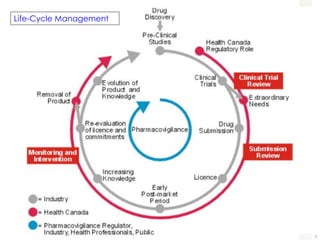
Life-Cycle Management
3
Traditional HTA Limits Orphan Drug Access
• HTA OFTEN same as for common drugs
• RCTs = small samples, short timeframes, surrogate markers
• High $ development, small population = High $/patient
• Cost-utility: $/QALY below theoretical $50k threshold
• Small # = Low budget impact
• HTA recommends “no” to most drugs for rare disorders
• Private drugs plans usually cover (but some do not)
• Public drug plans usually adopt HTA recommendations
• HTA limits access in some European countries
• Half of all orphan drugs evaluated have been rejected
by one or more HTA bodies in the UK.
• Where Cost-Effectiveness NOT norm, reimbursement
varies; best = 80% to 100% funding
4
Balancing Public Good, Innovation,
Effectiveness, Risk & Access
1) Available health care resources should be used in a way that
improves the health of populations
2) Patient needs exceed limited healthcare budgets
3) System incentives should encourage innovations for improving
health care
4) New technologies lack evidence of effectiveness and safety
required by traditional assessment models
5) Lack of evidence of effectiveness ≠ evidence of lack of
effectiveness
6) Prior to real-world use, clinical trials findings are best guide to
optimal use and funding decisions
7) Collecting data on real-world use can reduce uncertainty and
increase the probability of making a ‘good’ funding decision
(30 Sep 2014): Health Ministers’ Press
Release: Orphan drugs for rare diseases
 Orphan drugs are used to treat life-threatening, chronic
and seriously debilitating rare diseases
 … And are very costly
 Growth rates for orphan drug market expected to double
overall prescription drug market by 2018
 Establish a working group led by Alberta, British Columbia
and Ontario on how to manage the cost of rare disease
drug therapies with evidence-based approaches.
CORD Response to Health Ministers’
Orphan Drugs Announcement
 Need for bold decisive action, NOT timid steps covering old ground
 Federal government has introduced “state-of-the art” Orphan
Drug Regulatory Framework based on international best practices
 PT Health Ministers position not much different than 2006 NPS
 Working Group should build on current practices: managed
entry/exit criteria, coverage with evidence building, and risk-sharing
 Ontario Drugs for Rare Diseases
 Cancer Care Ontario Evidence Building Programs
 Personalized (targeted) therapies
 Re-focus: Saving lives and reducing disabilities rather than just short-
term costs
 Goal: provide access as soon as possible to reduce deaths and
disabillities
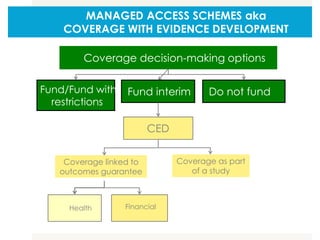
MANAGED ACCESS SCHEMES aka
COVERAGE WITH EVIDENCE DEVELOPMENT
AED
Coverage as part
of a study
Health Financial
CED
Fund/Fund with
restrictions
Do not fundFund interim
Coverage decision-making options
Coverage linked to
outcomes guarantee
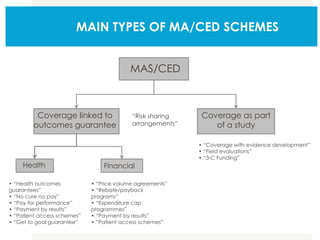
MAIN TYPES OF MA/CED SCHEMES
Coverage as part
of a study
Health Financial
MAS/CED
Coverage linked to
outcomes guarantee
• “Coverage with evidence development”
• “Field evaluations”
• “3-C Funding”
• “Health outcomes
guarantees”
• “No cure no pay”
• “Pay for performance”
• “Payment by results”
• “Patient access schemes”
• “Get to goal guarantee”
• “Price volume agreements”
• “Rebate/payback
programs”
• “Expenditure cap
programmes”
• “Payment by results”
• “Patient access schemes”
“Risk sharing
arrangements”
OUTCOMES GUARANTEE –
HEALTH OUTCOMES
Four main types:
1. Payer funds technology for defined period; manufacturer
refunds cost of drug in patients who do not achieve pre-
defined clinical outcome
2. Payer purchases technology at reduced price for first
treatment cycle; payer purchases technology at regular price
for subsequent cycles in patients who achieve pre-defined
clinical outcome
3. Payer purchases technology at full price for a specified period
of time; manufacturer agrees to lower price by amount
needed to maintain pre-defined level of cost-effectiveness
4. Manufacturer initially provides technology at no cost; payers
agree to pay for the technology in patients who achieve pre-
defined clinical outcome and continue to receive the
technology
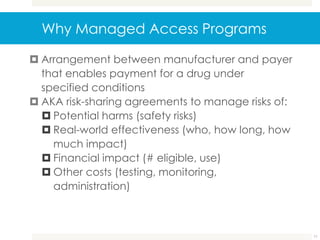
Why Managed Access Programs
 Arrangement between manufacturer and payer
that enables payment for a drug under
specified conditions
 AKA risk-sharing agreements to manage risks of:
 Potential harms (safety risks)
 Real-world effectiveness (who, how long, how
much impact)
 Financial impact (# eligible, use)
 Other costs (testing, monitoring,
administration)
11
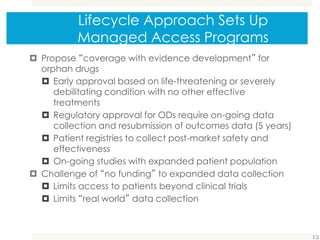
Lifecycle Approach Sets Up
Managed Access Programs
 Propose “coverage with evidence development” for
orphan drugs
 Early approval based on life-threatening or severely
debilitating condition with no other effective
treatments
 Regulatory approval for ODs require on-going data
collection and resubmission of outcomes data (5 years)
 Patient registries to collect post-market safety and
effectiveness
 On-going studies with expanded patient population
 Challenge of “no funding” to expanded data collection
 Limits access to patients beyond clinical trials
 Limits “real world” data collection
12
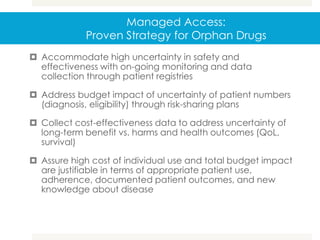
Managed Access:
Proven Strategy for Orphan Drugs
 Accommodate high uncertainty in safety and
effectiveness with on-going monitoring and data
collection through patient registries
 Address budget impact of uncertainty of patient numbers
(diagnosis, eligibility) through risk-sharing plans
 Collect cost-effectiveness data to address uncertainty of
long-term benefit vs. harms and health outcomes (QoL,
survival)
 Assure high cost of individual use and total budget impact
are justifiable in terms of appropriate patient use,
adherence, documented patient outcomes, and new
knowledge about disease
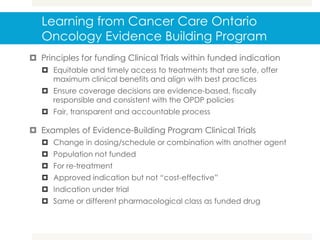
Learning from Cancer Care Ontario
Oncology Evidence Building Program
 Principles for funding Clinical Trials within funded indication
 Equitable and timely access to treatments that are safe, offer
maximum clinical benefits and align with best practices
 Ensure coverage decisions are evidence-based, fiscally
responsible and consistent with the OPDP policies
 Fair, transparent and accountable process
 Examples of Evidence-Building Program Clinical Trials
 Change in dosing/schedule or combination with another agent
 Population not funded
 For re-treatment
 Approved indication but not “cost-effective”
 Indication under trial
 Same or different pharmacological class as funded drug
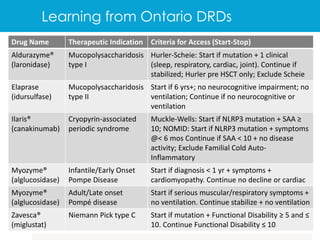
Learning from Ontario DRDs
Drug Name Therapeutic Indication Criteria for Access (Start-Stop)
Aldurazyme®
(laronidase)
Mucopolysaccharidosis
type I
Hurler-Scheie: Start if mutation + 1 clinical
(sleep, respiratory, cardiac, joint). Continue if
stabilized; Hurler pre HSCT only; Exclude Scheie
Elaprase
(idursulfase)
Mucopolysaccharidosis
type II
Start if 6 yrs+; no neurocognitive impairment; no
ventilation; Continue if no neurocognitive or
ventilation
Ilaris®
(canakinumab)
Cryopyrin-associated
periodic syndrome
Muckle-Wells: Start if NLRP3 mutation + SAA ≥
10; NOMID: Start if NLRP3 mutation + symptoms
@< 6 mos Continue if SAA < 10 + no disease
activity; Exclude Familial Cold Auto-
Inflammatory
Myozyme®
(alglucosidase)
Infantile/Early Onset
Pompe Disease
Start if diagnosis < 1 yr + symptoms +
cardiomyopathy. Continue no decline or cardiac
Myozyme®
(alglucosidase)
Adult/Late onset
Pompé disease
Start if serious muscular/respiratory symptoms +
no ventilation. Continue stabilize + no ventilation
Zavesca®
(miglustat)
Niemann Pick type C Start if mutation + Functional Disability ≥ 5 and ≤
10. Continue Functional Disability ≤ 10
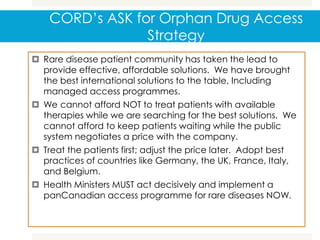
CORD’s ASK for Orphan Drug Access
Strategy
 Rare disease patient community has taken the lead to
provide effective, affordable solutions. We have brought
the best international solutions to the table, Including
managed access programmes.
 We cannot afford NOT to treat patients with available
therapies while we are searching for the best solutions. We
cannot afford to keep patients waiting while the public
system negotiates a price with the company.
 Treat the patients first; adjust the price later. Adopt best
practices of countries like Germany, the UK, France, Italy,
and Belgium.
 Health Ministers MUST act decisively and implement a
panCanadian access programme for rare diseases NOW.
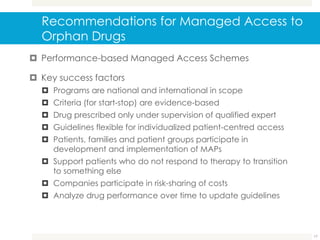
Recommendations for Managed Access to
Orphan Drugs
 Performance-based Managed Access Schemes
 Key success factors
 Programs are national and international in scope
 Criteria (for start-stop) are evidence-based
 Drug prescribed only under supervision of qualified expert
 Guidelines flexible for individualized patient-centred access
 Patients, families and patient groups participate in
development and implementation of MAPs
 Support patients who do not respond to therapy to transition
to something else
 Companies participate in risk-sharing of costs
 Analyze drug performance over time to update guidelines
17
Thank You!
18
Durhane Wong-Rieger, PhD
President
Canadian Organization for Rare Disorders
www.raredisorders.ca
416-969-7435
durhane@sympatico.ca

Canada’s Orphan Drug Regulatory Framework & panCanadian Access to Rare Disease Drugs

  • 1.
    Canada’s Orphan DrugRegulatory Framework & panCanadian Access to Rare Disease Drugs Update and Opportunities Durhane Wong-Rieger, PhD President & CEO Nov 11, 2014
  • 2.
    Why Life-cycle Approachfor Orphan Drugs? What is known about the potential/actual benefits and harms associated with an orphan drug may be highly uncertain at time of regulatory application and will change over time.  Orphan drugs treat rare, severe, life-threatening, debilitating conditions that have few or no effective treatments  Compelling benefits > risks  Market approval may be granted despite uncertainty due to:  Small, short clinical trials (e.g., Phase II, non-RCTs, cross-over)  Limited outcome measures, surrogate, biomarkers, nonvalidated PROs  Need for continuous regulator oversight beginning at early development stage with medical plausibility and encompassing a greater ability to define post-approval information gathering. 2
  • 3.
  • 4.
    Traditional HTA LimitsOrphan Drug Access • HTA OFTEN same as for common drugs • RCTs = small samples, short timeframes, surrogate markers • High $ development, small population = High $/patient • Cost-utility: $/QALY below theoretical $50k threshold • Small # = Low budget impact • HTA recommends “no” to most drugs for rare disorders • Private drugs plans usually cover (but some do not) • Public drug plans usually adopt HTA recommendations • HTA limits access in some European countries • Half of all orphan drugs evaluated have been rejected by one or more HTA bodies in the UK. • Where Cost-Effectiveness NOT norm, reimbursement varies; best = 80% to 100% funding 4
  • 5.
    Balancing Public Good,Innovation, Effectiveness, Risk & Access 1) Available health care resources should be used in a way that improves the health of populations 2) Patient needs exceed limited healthcare budgets 3) System incentives should encourage innovations for improving health care 4) New technologies lack evidence of effectiveness and safety required by traditional assessment models 5) Lack of evidence of effectiveness ≠ evidence of lack of effectiveness 6) Prior to real-world use, clinical trials findings are best guide to optimal use and funding decisions 7) Collecting data on real-world use can reduce uncertainty and increase the probability of making a ‘good’ funding decision
  • 6.
    (30 Sep 2014):Health Ministers’ Press Release: Orphan drugs for rare diseases  Orphan drugs are used to treat life-threatening, chronic and seriously debilitating rare diseases  … And are very costly  Growth rates for orphan drug market expected to double overall prescription drug market by 2018  Establish a working group led by Alberta, British Columbia and Ontario on how to manage the cost of rare disease drug therapies with evidence-based approaches.
  • 7.
    CORD Response toHealth Ministers’ Orphan Drugs Announcement  Need for bold decisive action, NOT timid steps covering old ground  Federal government has introduced “state-of-the art” Orphan Drug Regulatory Framework based on international best practices  PT Health Ministers position not much different than 2006 NPS  Working Group should build on current practices: managed entry/exit criteria, coverage with evidence building, and risk-sharing  Ontario Drugs for Rare Diseases  Cancer Care Ontario Evidence Building Programs  Personalized (targeted) therapies  Re-focus: Saving lives and reducing disabilities rather than just short- term costs  Goal: provide access as soon as possible to reduce deaths and disabillities
  • 8.
    MANAGED ACCESS SCHEMESaka COVERAGE WITH EVIDENCE DEVELOPMENT AED Coverage as part of a study Health Financial CED Fund/Fund with restrictions Do not fundFund interim Coverage decision-making options Coverage linked to outcomes guarantee
  • 9.
    MAIN TYPES OFMA/CED SCHEMES Coverage as part of a study Health Financial MAS/CED Coverage linked to outcomes guarantee • “Coverage with evidence development” • “Field evaluations” • “3-C Funding” • “Health outcomes guarantees” • “No cure no pay” • “Pay for performance” • “Payment by results” • “Patient access schemes” • “Get to goal guarantee” • “Price volume agreements” • “Rebate/payback programs” • “Expenditure cap programmes” • “Payment by results” • “Patient access schemes” “Risk sharing arrangements”
  • 10.
    OUTCOMES GUARANTEE – HEALTHOUTCOMES Four main types: 1. Payer funds technology for defined period; manufacturer refunds cost of drug in patients who do not achieve pre- defined clinical outcome 2. Payer purchases technology at reduced price for first treatment cycle; payer purchases technology at regular price for subsequent cycles in patients who achieve pre-defined clinical outcome 3. Payer purchases technology at full price for a specified period of time; manufacturer agrees to lower price by amount needed to maintain pre-defined level of cost-effectiveness 4. Manufacturer initially provides technology at no cost; payers agree to pay for the technology in patients who achieve pre- defined clinical outcome and continue to receive the technology
  • 11.
    Why Managed AccessPrograms  Arrangement between manufacturer and payer that enables payment for a drug under specified conditions  AKA risk-sharing agreements to manage risks of:  Potential harms (safety risks)  Real-world effectiveness (who, how long, how much impact)  Financial impact (# eligible, use)  Other costs (testing, monitoring, administration) 11
  • 12.
    Lifecycle Approach SetsUp Managed Access Programs  Propose “coverage with evidence development” for orphan drugs  Early approval based on life-threatening or severely debilitating condition with no other effective treatments  Regulatory approval for ODs require on-going data collection and resubmission of outcomes data (5 years)  Patient registries to collect post-market safety and effectiveness  On-going studies with expanded patient population  Challenge of “no funding” to expanded data collection  Limits access to patients beyond clinical trials  Limits “real world” data collection 12
  • 13.
    Managed Access: Proven Strategyfor Orphan Drugs  Accommodate high uncertainty in safety and effectiveness with on-going monitoring and data collection through patient registries  Address budget impact of uncertainty of patient numbers (diagnosis, eligibility) through risk-sharing plans  Collect cost-effectiveness data to address uncertainty of long-term benefit vs. harms and health outcomes (QoL, survival)  Assure high cost of individual use and total budget impact are justifiable in terms of appropriate patient use, adherence, documented patient outcomes, and new knowledge about disease
  • 14.
    Learning from CancerCare Ontario Oncology Evidence Building Program  Principles for funding Clinical Trials within funded indication  Equitable and timely access to treatments that are safe, offer maximum clinical benefits and align with best practices  Ensure coverage decisions are evidence-based, fiscally responsible and consistent with the OPDP policies  Fair, transparent and accountable process  Examples of Evidence-Building Program Clinical Trials  Change in dosing/schedule or combination with another agent  Population not funded  For re-treatment  Approved indication but not “cost-effective”  Indication under trial  Same or different pharmacological class as funded drug
  • 15.
    Learning from OntarioDRDs Drug Name Therapeutic Indication Criteria for Access (Start-Stop) Aldurazyme® (laronidase) Mucopolysaccharidosis type I Hurler-Scheie: Start if mutation + 1 clinical (sleep, respiratory, cardiac, joint). Continue if stabilized; Hurler pre HSCT only; Exclude Scheie Elaprase (idursulfase) Mucopolysaccharidosis type II Start if 6 yrs+; no neurocognitive impairment; no ventilation; Continue if no neurocognitive or ventilation Ilaris® (canakinumab) Cryopyrin-associated periodic syndrome Muckle-Wells: Start if NLRP3 mutation + SAA ≥ 10; NOMID: Start if NLRP3 mutation + symptoms @< 6 mos Continue if SAA < 10 + no disease activity; Exclude Familial Cold Auto- Inflammatory Myozyme® (alglucosidase) Infantile/Early Onset Pompe Disease Start if diagnosis < 1 yr + symptoms + cardiomyopathy. Continue no decline or cardiac Myozyme® (alglucosidase) Adult/Late onset Pompé disease Start if serious muscular/respiratory symptoms + no ventilation. Continue stabilize + no ventilation Zavesca® (miglustat) Niemann Pick type C Start if mutation + Functional Disability ≥ 5 and ≤ 10. Continue Functional Disability ≤ 10
  • 16.
    CORD’s ASK forOrphan Drug Access Strategy  Rare disease patient community has taken the lead to provide effective, affordable solutions. We have brought the best international solutions to the table, Including managed access programmes.  We cannot afford NOT to treat patients with available therapies while we are searching for the best solutions. We cannot afford to keep patients waiting while the public system negotiates a price with the company.  Treat the patients first; adjust the price later. Adopt best practices of countries like Germany, the UK, France, Italy, and Belgium.  Health Ministers MUST act decisively and implement a panCanadian access programme for rare diseases NOW.
  • 17.
    Recommendations for ManagedAccess to Orphan Drugs  Performance-based Managed Access Schemes  Key success factors  Programs are national and international in scope  Criteria (for start-stop) are evidence-based  Drug prescribed only under supervision of qualified expert  Guidelines flexible for individualized patient-centred access  Patients, families and patient groups participate in development and implementation of MAPs  Support patients who do not respond to therapy to transition to something else  Companies participate in risk-sharing of costs  Analyze drug performance over time to update guidelines 17
  • 18.
    Thank You! 18 Durhane Wong-Rieger,PhD President Canadian Organization for Rare Disorders www.raredisorders.ca 416-969-7435 durhane@sympatico.ca