Hepatic microsome
• The cytochrome P450 system is a group of enzymes
that control the concentrations of many
endogenous substances and drugs. These enzymes
are mainly found in the liver (hepatic microsomal
enzymes) and gut
• Cytochrome P450 system is comprised of about 40-
50 isoenzymes. Each isoenzyme is derived from the
expression of an individual gene. Originally the
system was identified as a pigment in hepatic
microsomes.
• . When examined, the pigment had a characteristic
spectrophotometric profile with an associated peak
at 450nm (hence the term cytochrome P450
system) .The main effect of the cytochrome P450
enzymes is to catalyse oxidation, which generally
makes the substrate more water-soluble and so
more readily excreted by the kidney.
• There are many isoenzymes in the cytochrome
P450 system, only a few appear to be responsible
for the metabolism of commonly used drugs (CYP
1A2, CYP 2C9, CYP 2C19, CYP 2D6, CYP 3A3, CYP
3A4)
The metabolism of drugs that are inactivated by the
cytochrome P450 enzymes can be altered by
substances which either induce these enzymes and
therefore increase degradation, or substances that
inhibit these enzymes and therefore are associated
with increased levels of the drug
CYP enzymes have been identified in all domains of
life - animals, plants, fungi, protists, bacteria,
archaea, and even in viruses
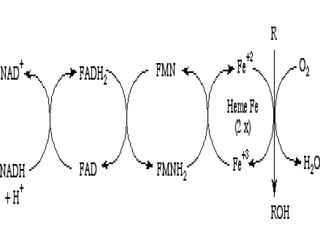
• The most common reaction catalyzed by
cytochromes P450 is a monooxygenase reaction,
e.g., insertion of one atom of oxygen into the
aliphatic position of an organic substrate (RH) while
the other oxygen atom is reduced to water:
RH + O2 + NADPH + H+ → ROH + H2O + NADP.
+Human CYPs are primarily membrane-associated
proteins located either in the inner membrane of
mitochondria or in the endoplasmic reticulum of
cells. CYPs metabolize thousands of endogenous
and exogenous chemicals.
Hepatic  microsome

Hepatic microsome

  • 1.
    Hepatic microsome • Thecytochrome P450 system is a group of enzymes that control the concentrations of many endogenous substances and drugs. These enzymes are mainly found in the liver (hepatic microsomal enzymes) and gut • Cytochrome P450 system is comprised of about 40- 50 isoenzymes. Each isoenzyme is derived from the expression of an individual gene. Originally the system was identified as a pigment in hepatic microsomes.
  • 2.
    • . Whenexamined, the pigment had a characteristic spectrophotometric profile with an associated peak at 450nm (hence the term cytochrome P450 system) .The main effect of the cytochrome P450 enzymes is to catalyse oxidation, which generally makes the substrate more water-soluble and so more readily excreted by the kidney. • There are many isoenzymes in the cytochrome P450 system, only a few appear to be responsible for the metabolism of commonly used drugs (CYP 1A2, CYP 2C9, CYP 2C19, CYP 2D6, CYP 3A3, CYP 3A4)
  • 3.
    The metabolism ofdrugs that are inactivated by the cytochrome P450 enzymes can be altered by substances which either induce these enzymes and therefore increase degradation, or substances that inhibit these enzymes and therefore are associated with increased levels of the drug CYP enzymes have been identified in all domains of life - animals, plants, fungi, protists, bacteria, archaea, and even in viruses
  • 4.
    • The mostcommon reaction catalyzed by cytochromes P450 is a monooxygenase reaction, e.g., insertion of one atom of oxygen into the aliphatic position of an organic substrate (RH) while the other oxygen atom is reduced to water: RH + O2 + NADPH + H+ → ROH + H2O + NADP. +Human CYPs are primarily membrane-associated proteins located either in the inner membrane of mitochondria or in the endoplasmic reticulum of cells. CYPs metabolize thousands of endogenous and exogenous chemicals.