HEPATIC ENCEPHALOPATHY
IJATUYI OLUWATOMISIN
OUTLINE
• Introduction
• Epidemiology
• Pathogenesis
• Clinical features
• Management
• Conclusion
• References
INTRODUCTION
• Hepatic encephalopathy a.k.a portosystemic encephalopathy (PSE) is
a chronic neuropsychiatric syndrome that is often secondary to
cirrhosis.
• Acute hepatic encephalopathy can occur in acute hepatic failure .
• It can also arise in portal hypertensive patients due to spontaneous
‘shunting’, or in those with surgical or TIPS shunts.
• It is sometimes the cardinal presentation in acute liver failure
EPIDEMIOLOGY
• The exact incidence is unknown.
• M:F is thesame
• It can occur in individuals of any age who have acute or chronic liver
disease
• 24 % - 53% of patients with a portosystemic shunt develop HE
• It is most often associated with cirrhosis-70%
PATHOGENESIS
• The portal blood bypasses the liver via collaterals, and ‘toxic’ metabolites pass directly to
the brain to produce encephalopathy.
• Ammonia-induced alteration of brain neurotransmitter balance, especially at the
astrocyte–neurone interface, is considered to be the leading pathophysiological
mechanism.
• Other implicated substances are free fatty acids and mercaptans; accumulation of false
neurotransmitters (octopamine) or activation of the γ-aminobutyric acid (GABA)
inhibitory neurotransmitter system may also be responsible.
• Increased blood levels of aromatic amino acids (tyrosine and phenylalanine) and reduced
branched-chain amino acids (valine, leucine and isoleucine) also occur.
PRECIPITANTS
• High dietary protein
• GI hemorrhage
• Constipation
• Infection (SBP)
• Fluid & electrolyte derangement
• Drugs
• Portosystemic shunts
• Surgery
• Hepatocellular carcinoma
CLINICAL FEATURES
• The patient becomes increasingly drowsy and comatose.
• Chronically, there is a disorder of personality, mood and intellect, with a reversal of
normal sleep rhythm.
• The patient is irritable, confused and disorientated, and has slow, slurred speech.
• Nausea, vomiting and weakness.
• There is hyper-reflexia and increased tone.
• Coma occurs as the encephalopathy becomes more marked.
• Convulsions are very rare, but if they do occur, other causes must be considered.
• Signs include:
• fetor hepaticus
• asterixis
• constructional apraxia
• decreased mental function
MANAGEMENT
• Diagnosis is clinical!
• History
• Examination
• Investigations
• EEG shows diffuse decrease in the frequency of the normal α-waves (8–13 Hz)
to 1.5–3 Hz and eventual development of delta waves. These changes occur
before coma supervenes.
• Visual evoked responses also detect subclinical encephalopathy.
• Arterial blood ammonia
TREATMENT
• Identify and remove the possible precipitating cause.
• Give purgation and enemas
• Maintain nutrition, if necessary via a fine-bore nasogastric tube, and do not restrict
protein for more than 48 h.
• Give antibiotics. Rifaximin,Metronidazole .Neomycin should be avoided.
• Stop or reduce diuretic therapy.
• Give intravenous fluids as necessary
• Treat infection.
• Increase protein in the diet to the limit of tolerance as encephalopathy improves.
Grading of Hepatic Encephalopathy (West Haven
Criteria)
Grade Neurological Manifestations
0 No alteration in consciousness, intellectual function,
personality or behaviour
1 Trivial lack of awareness, euphoria or anxiety; short attention
span, cognitive defects
2 Lethargy or apathy, disorientation for time, personality
change, inappropriate behaviour
3 Somnolence to semi-stupor, confusion; responds to noxious
stimuli, gross disorientation, bizarre behaviour
4 Coma, no response to noxious stimuli
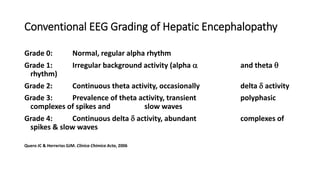
Conventional EEG Grading of Hepatic Encephalopathy
Grade 0: Normal, regular alpha rhythm
Grade 1: Irregular background activity (alpha  and theta 
rhythm)
Grade 2: Continuous theta activity, occasionally delta  activity
Grade 3: Prevalence of theta activity, transient polyphasic
complexes of spikes and slow waves
Grade 4: Continuous delta  activity, abundant complexes of
spikes & slow waves
Quero JC & Herrerias GJM. Clinica Chimica Acta, 2006
DIFFERENTIALS
• Intracranial hemorrhage
• Drug or alcohol intoxication
• Delirium tremens/alcohol withdrawal
• Psychiatric disorders
• Hypoglycemia
• Neurological Wilson’s disease
• Post-ictal state
PROGNOSIS
• Acute encephalopathy in acute hepatic failure has a very poor prognosis
associated with that of the disease itself.
• In cirrhosis, chronic HE adversely affects prognosis but the course is very
variable.
• Very rarely with chronic portosystemic shunting, an organic syndrome with
cerebellar signs or choreoathetosis develops, as well as myelopathy leading
to a spastic paraparesis due to demyelination. These patients require
referral to a liver transplant centre.
CONCLUSION
REFERENCES
THANK YOU FOR LISTENING
QUESTIONS?
HEPATIC ENCEPHALOPATHY

HEPATIC ENCEPHALOPATHY

  • 1.
  • 2.
    OUTLINE • Introduction • Epidemiology •Pathogenesis • Clinical features • Management • Conclusion • References
  • 3.
    INTRODUCTION • Hepatic encephalopathya.k.a portosystemic encephalopathy (PSE) is a chronic neuropsychiatric syndrome that is often secondary to cirrhosis. • Acute hepatic encephalopathy can occur in acute hepatic failure . • It can also arise in portal hypertensive patients due to spontaneous ‘shunting’, or in those with surgical or TIPS shunts. • It is sometimes the cardinal presentation in acute liver failure
  • 4.
    EPIDEMIOLOGY • The exactincidence is unknown. • M:F is thesame • It can occur in individuals of any age who have acute or chronic liver disease • 24 % - 53% of patients with a portosystemic shunt develop HE • It is most often associated with cirrhosis-70%
  • 5.
    PATHOGENESIS • The portalblood bypasses the liver via collaterals, and ‘toxic’ metabolites pass directly to the brain to produce encephalopathy. • Ammonia-induced alteration of brain neurotransmitter balance, especially at the astrocyte–neurone interface, is considered to be the leading pathophysiological mechanism. • Other implicated substances are free fatty acids and mercaptans; accumulation of false neurotransmitters (octopamine) or activation of the γ-aminobutyric acid (GABA) inhibitory neurotransmitter system may also be responsible. • Increased blood levels of aromatic amino acids (tyrosine and phenylalanine) and reduced branched-chain amino acids (valine, leucine and isoleucine) also occur.
  • 6.
    PRECIPITANTS • High dietaryprotein • GI hemorrhage • Constipation • Infection (SBP) • Fluid & electrolyte derangement • Drugs • Portosystemic shunts • Surgery • Hepatocellular carcinoma
  • 7.
    CLINICAL FEATURES • Thepatient becomes increasingly drowsy and comatose. • Chronically, there is a disorder of personality, mood and intellect, with a reversal of normal sleep rhythm. • The patient is irritable, confused and disorientated, and has slow, slurred speech. • Nausea, vomiting and weakness. • There is hyper-reflexia and increased tone. • Coma occurs as the encephalopathy becomes more marked. • Convulsions are very rare, but if they do occur, other causes must be considered.
  • 8.
    • Signs include: •fetor hepaticus • asterixis • constructional apraxia • decreased mental function
  • 9.
    MANAGEMENT • Diagnosis isclinical! • History • Examination • Investigations • EEG shows diffuse decrease in the frequency of the normal α-waves (8–13 Hz) to 1.5–3 Hz and eventual development of delta waves. These changes occur before coma supervenes. • Visual evoked responses also detect subclinical encephalopathy. • Arterial blood ammonia
  • 10.
    TREATMENT • Identify andremove the possible precipitating cause. • Give purgation and enemas • Maintain nutrition, if necessary via a fine-bore nasogastric tube, and do not restrict protein for more than 48 h. • Give antibiotics. Rifaximin,Metronidazole .Neomycin should be avoided. • Stop or reduce diuretic therapy. • Give intravenous fluids as necessary • Treat infection. • Increase protein in the diet to the limit of tolerance as encephalopathy improves.
  • 11.
    Grading of HepaticEncephalopathy (West Haven Criteria) Grade Neurological Manifestations 0 No alteration in consciousness, intellectual function, personality or behaviour 1 Trivial lack of awareness, euphoria or anxiety; short attention span, cognitive defects 2 Lethargy or apathy, disorientation for time, personality change, inappropriate behaviour 3 Somnolence to semi-stupor, confusion; responds to noxious stimuli, gross disorientation, bizarre behaviour 4 Coma, no response to noxious stimuli
  • 12.
    Conventional EEG Gradingof Hepatic Encephalopathy Grade 0: Normal, regular alpha rhythm Grade 1: Irregular background activity (alpha  and theta  rhythm) Grade 2: Continuous theta activity, occasionally delta  activity Grade 3: Prevalence of theta activity, transient polyphasic complexes of spikes and slow waves Grade 4: Continuous delta  activity, abundant complexes of spikes & slow waves Quero JC & Herrerias GJM. Clinica Chimica Acta, 2006
  • 13.
    DIFFERENTIALS • Intracranial hemorrhage •Drug or alcohol intoxication • Delirium tremens/alcohol withdrawal • Psychiatric disorders • Hypoglycemia • Neurological Wilson’s disease • Post-ictal state
  • 14.
    PROGNOSIS • Acute encephalopathyin acute hepatic failure has a very poor prognosis associated with that of the disease itself. • In cirrhosis, chronic HE adversely affects prognosis but the course is very variable. • Very rarely with chronic portosystemic shunting, an organic syndrome with cerebellar signs or choreoathetosis develops, as well as myelopathy leading to a spastic paraparesis due to demyelination. These patients require referral to a liver transplant centre.
  • 15.
  • 16.
  • 17.
    THANK YOU FORLISTENING
  • 18.