How to Get Funded! Hints and Tips on How to Write a Good Application and Maximise Your Chance of Being Successful
Me and what I do! Dr Henriette Bruun, Principal School Research Facilitator Funding opportunities Feedback on applications Feedback on response to referee reports Research initiatives UCL
My background MA, PhD 3 years as lecturer 7 years working for a funder More than thousand applications Thousands of referee reports Funding recommendations on a couple of hundred applications Funding Committee meetings
How to find out about your options? Your university Postdoctoral Research Fellowship Research Assistant European Research Council  Starting Grants
What makes a good application? Five key criteria The applicant(s) Research question/idea Preliminary research and project details Presentation/grantsmanship Funder, including funder’s expectations, and scheme
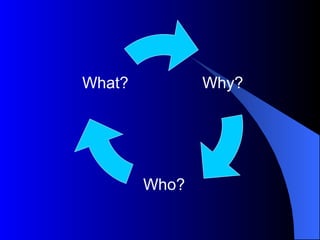
Applying for a grant What do you want to do? Why do you want to do it? Who are interested?
Why? Who? What?
What to include in the Case for Support
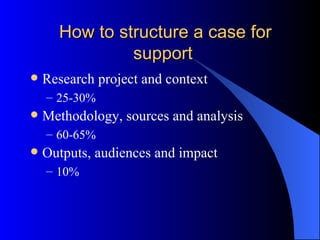
How to structure a case for support Research project and context 25-30% Methodology, sources and analysis 60-65% Outputs, audiences and impact 10%
Research project and context What is the project about Research questions(s) Aims and objectives Existing scholarship/field of inquiry Why your project is important
Methodology, sources and analysis Justify case studies/comparisons to be made Explain choice of sources and analysis Data collection and ethics Highlight specialist skills Technical stuff, including ‘legacy’ Copyright, IP Management Timetable with milestones
Dissemination: Outputs, audiences and impact What are the outputs How and where will your research findings be disseminated Who are interested and why What will the impact of your research and its findings be
The application form Complete sections and take it seriously Reverse chronological order (CV, e.g. qualifications, appointments, publications) Attachments Format – font, font size, margins
Technical Appendix? Project management of technical aspects Data development methods Infrastructural support Data preservation and sustainability Access Copyright and intellectual property issues Additional relevant information allowed such as Gantt charts, or additional text where character limits on the form do not allow the inclusion of sufficient information?
Presentation/grantsmanship Why should your application be funded? Convince peer reviewers and funding committee Positive and confident statements Writing ‘I’ is fine No typos
Presentation/grantsmanship Keep your audiences in mind Peer reviewers Panel members Funder Read information and follow guidelines Be kind No jargon Get feedback
Referee reports Use right to reply Engage with referee comments Do not be defensive Do not be aggressive if criticism is unfair/the referees have not understood what you want to do One more chance to convince the panel why your application should be funded  Your reply may influence the funding decision
Common assessment criteria Quality of applicant and track record Importance of project, dissemination and impact Skills required to carry out the project Appropriate institution Fit to funder and scheme Quality of application/grantsmanship Value for money
Positions and jobs Junior Research Fellowships Offered by institutions Eligibility criteria vary Benefits vary Research assistants/research fellows THE, jobs.ac.uk, institutional websites
Dr Henriette Bruun Extension: 24840 Email: h.bruun@ucl.ac.uk

Henriette Bruun How to Session at InterFace 2011

  • 1.
    How to GetFunded! Hints and Tips on How to Write a Good Application and Maximise Your Chance of Being Successful
  • 2.
    Me and whatI do! Dr Henriette Bruun, Principal School Research Facilitator Funding opportunities Feedback on applications Feedback on response to referee reports Research initiatives UCL
  • 3.
    My background MA,PhD 3 years as lecturer 7 years working for a funder More than thousand applications Thousands of referee reports Funding recommendations on a couple of hundred applications Funding Committee meetings
  • 4.
    How to findout about your options? Your university Postdoctoral Research Fellowship Research Assistant European Research Council Starting Grants
  • 5.
    What makes agood application? Five key criteria The applicant(s) Research question/idea Preliminary research and project details Presentation/grantsmanship Funder, including funder’s expectations, and scheme
  • 6.
    Applying for agrant What do you want to do? Why do you want to do it? Who are interested?
  • 7.
  • 8.
    What to includein the Case for Support
  • 9.
    How to structurea case for support Research project and context 25-30% Methodology, sources and analysis 60-65% Outputs, audiences and impact 10%
  • 10.
    Research project andcontext What is the project about Research questions(s) Aims and objectives Existing scholarship/field of inquiry Why your project is important
  • 11.
    Methodology, sources andanalysis Justify case studies/comparisons to be made Explain choice of sources and analysis Data collection and ethics Highlight specialist skills Technical stuff, including ‘legacy’ Copyright, IP Management Timetable with milestones
  • 12.
    Dissemination: Outputs, audiencesand impact What are the outputs How and where will your research findings be disseminated Who are interested and why What will the impact of your research and its findings be
  • 13.
    The application formComplete sections and take it seriously Reverse chronological order (CV, e.g. qualifications, appointments, publications) Attachments Format – font, font size, margins
  • 14.
    Technical Appendix? Projectmanagement of technical aspects Data development methods Infrastructural support Data preservation and sustainability Access Copyright and intellectual property issues Additional relevant information allowed such as Gantt charts, or additional text where character limits on the form do not allow the inclusion of sufficient information?
  • 15.
    Presentation/grantsmanship Why shouldyour application be funded? Convince peer reviewers and funding committee Positive and confident statements Writing ‘I’ is fine No typos
  • 16.
    Presentation/grantsmanship Keep youraudiences in mind Peer reviewers Panel members Funder Read information and follow guidelines Be kind No jargon Get feedback
  • 17.
    Referee reports Useright to reply Engage with referee comments Do not be defensive Do not be aggressive if criticism is unfair/the referees have not understood what you want to do One more chance to convince the panel why your application should be funded Your reply may influence the funding decision
  • 18.
    Common assessment criteriaQuality of applicant and track record Importance of project, dissemination and impact Skills required to carry out the project Appropriate institution Fit to funder and scheme Quality of application/grantsmanship Value for money
  • 19.
    Positions and jobsJunior Research Fellowships Offered by institutions Eligibility criteria vary Benefits vary Research assistants/research fellows THE, jobs.ac.uk, institutional websites
  • 20.
    Dr Henriette BruunExtension: 24840 Email: h.bruun@ucl.ac.uk