Research and the REF
 What is the REF and why is it
      important to me and my
                   institutiton?
Why research?

Research supports teaching
Research supports work with industry
Research differentiates HE from FE
Research adds to student experience
Research attracts income
Research develops reputation
Support

Good research:
links with scholarly activity;
Links with industry;
Adds depth to your teaching;
Keeps you better focussed;
Keeps you in better contact.
Income

Research attracts income:
Through applying for research grants;
From Hefce as apportioned by the REF;
By making links with industry that they are
 prepared to fund.
Income and reputation

Attract students;
Attract partners from industry or other
 institutions;
Attract international links and students
What is the REF?

The REF will:
• inform the selective allocation of research
  funding to HEIs on the basis of excellence

 • provide benchmarking information and
  reputational yardsticks

 • provide accountability for public investment in
  research and demonstrate its benefits.
What are UoAs?

Units of assessment assess quality of
 research in a specific range of subject
 disciplines:
UoA 36 covers Communication, Cultural
 and Media Studies, Library and
 Information Management
This includes journalism, which is
 specifically mentioned in the more detailed
 description.
Timetable
 2010 Appoint panels
 2011 Publish assessment criteria
 2013 (July 31): end of assessment period
 2013 (Oct 31): Census date for eligible staff
 2013 (Nov 29): Closing date for submissions
 2013 (Dec 31): Closing date for outcomes
 2014 Panels assess. Outcomes published in
  December
REF Submission
A submission will include:
Research outputs (worth 65%)
 Assessed in terms of their ‘rigour, originality and significance’, with
   reference to international research quality standards.


Impact (worth 20%)
 The sub-panels will assess social and economic impacts arising
   from research in terms of their ‘reach and significance’.


Environment (Worth 15%)
 The sub-panels will assess the research environment in terms of its
  ‘sustainability, vitality and influence’.
Research outputs


A submission will include the work of each
 researcher. Each researcher will normally
 be expected to submit four pieces of
 research.
This will be examined by the panels to
 indicate excellence.
Hefce definition of research

…original
 investigation
 undertaken in order to
 gain knowledge and
 understanding.
Research outputs

Panels will treat all research on an equal
 footing measuring excellence in research
 across the spectrum of applied research,
 practice-based and basic/strategic
 research, wherever that research is
 conducted.
The panel is measuring the research, not
 the place where the research was
 disseminated.
Practice-based research

Practice based research is welcomed;
Practice-based research needs to be
 research as defined by HEFCs;
Scholarly activity is not research
Impact

The REF will measure the impact of
 research on the wider community.
Impact will involve case studies (at least
 two but maybe more in larger institutions)
Impact studies can go back up to 12
 years, involve the work in the university
 and cannot be transferred with the
 researcher.
Environment

This measures the sustainability, vitality
 and influence of the unit of assessment
 including:
Post graduate student success rate;
Support for research;
Research development;
Research income;
External influence.
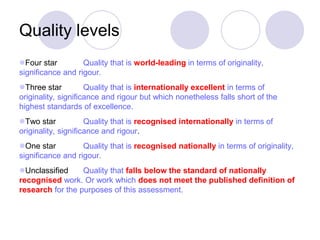
Quality levels
Four star         Quality that is world-leading in terms of originality,
significance and rigour.
Three star          Quality that is internationally excellent in terms of
originality, significance and rigour but which nonetheless falls short of the
highest standards of excellence.
Two star            Quality that is recognised internationally in terms of
originality, significance and rigour.
One star          Quality that is recognised nationally in terms of originality,
significance and rigour.
Unclassified     Quality that falls below the standard of nationally
recognised work. Or work which does not meet the published definition of
research for the purposes of this assessment.

Ref 2014 for aje

  • 1.
    Research and theREF What is the REF and why is it important to me and my institutiton?
  • 2.
    Why research? Research supportsteaching Research supports work with industry Research differentiates HE from FE Research adds to student experience Research attracts income Research develops reputation
  • 3.
    Support Good research: links withscholarly activity; Links with industry; Adds depth to your teaching; Keeps you better focussed; Keeps you in better contact.
  • 4.
    Income Research attracts income: Throughapplying for research grants; From Hefce as apportioned by the REF; By making links with industry that they are prepared to fund.
  • 5.
    Income and reputation Attractstudents; Attract partners from industry or other institutions; Attract international links and students
  • 6.
    What is theREF? The REF will: • inform the selective allocation of research funding to HEIs on the basis of excellence  • provide benchmarking information and reputational yardsticks  • provide accountability for public investment in research and demonstrate its benefits.
  • 7.
    What are UoAs? Unitsof assessment assess quality of research in a specific range of subject disciplines: UoA 36 covers Communication, Cultural and Media Studies, Library and Information Management This includes journalism, which is specifically mentioned in the more detailed description.
  • 8.
    Timetable  2010 Appointpanels  2011 Publish assessment criteria  2013 (July 31): end of assessment period  2013 (Oct 31): Census date for eligible staff  2013 (Nov 29): Closing date for submissions  2013 (Dec 31): Closing date for outcomes  2014 Panels assess. Outcomes published in December
  • 9.
    REF Submission A submissionwill include: Research outputs (worth 65%)  Assessed in terms of their ‘rigour, originality and significance’, with reference to international research quality standards. Impact (worth 20%)  The sub-panels will assess social and economic impacts arising from research in terms of their ‘reach and significance’. Environment (Worth 15%)  The sub-panels will assess the research environment in terms of its ‘sustainability, vitality and influence’.
  • 10.
    Research outputs A submissionwill include the work of each researcher. Each researcher will normally be expected to submit four pieces of research. This will be examined by the panels to indicate excellence.
  • 11.
    Hefce definition ofresearch …original investigation undertaken in order to gain knowledge and understanding.
  • 12.
    Research outputs Panels willtreat all research on an equal footing measuring excellence in research across the spectrum of applied research, practice-based and basic/strategic research, wherever that research is conducted. The panel is measuring the research, not the place where the research was disseminated.
  • 13.
    Practice-based research Practice basedresearch is welcomed; Practice-based research needs to be research as defined by HEFCs; Scholarly activity is not research
  • 14.
    Impact The REF willmeasure the impact of research on the wider community. Impact will involve case studies (at least two but maybe more in larger institutions) Impact studies can go back up to 12 years, involve the work in the university and cannot be transferred with the researcher.
  • 15.
    Environment This measures thesustainability, vitality and influence of the unit of assessment including: Post graduate student success rate; Support for research; Research development; Research income; External influence.
  • 16.
    Quality levels Four star Quality that is world-leading in terms of originality, significance and rigour. Three star Quality that is internationally excellent in terms of originality, significance and rigour but which nonetheless falls short of the highest standards of excellence. Two star Quality that is recognised internationally in terms of originality, significance and rigour. One star Quality that is recognised nationally in terms of originality, significance and rigour. Unclassified Quality that falls below the standard of nationally recognised work. Or work which does not meet the published definition of research for the purposes of this assessment.