P2P Communication
Framework on Android
      Platform
      By Liu Tianwei
Outline
• Introduction
• Motivation + Proposed Solutions.
• Recap of work done
• Design Decision and Limitation
• Implementation result and performance
• Demo
• Limitation and Future Work
Introduction
Problem

• Need for better mobile network
  infrastructure.
• Traditional Mobile Network are not
  designed to scale fast and cheaply.

Motivation

• Provide an alternatives to traditional mobile
  network infrastructure.
• Lower the infrastructure cost for each
  additional devices added to the network.
Propose Solution

• A P2P communication framework on
  mobile platform.
• Open Source to allow developers to easily
  integrate with their existing source code.
Recap of work done

• Server Implementation
• Literature Reviews
• Geoscribe Webservice implementation
Design Decisions and
     Limitations
• Platform
• Hardware Choices and Limitation
• Network Design
• AutoConnection
Platform

• Open Source
• Large Developer Community
• Comprehensive Java Apis.
Network Design
Designed Considered:

• Centralized Index
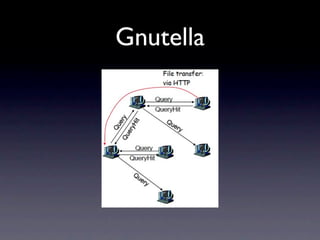
• Gnutella (Query Flooding)
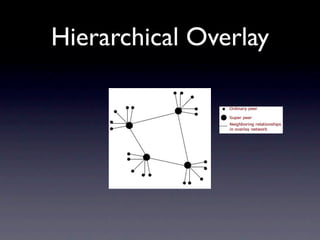
• Hierarchical Overlay
• Distributed Hash Table
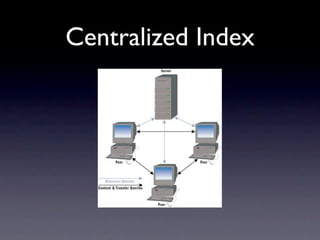
Centralized Index
Gnutella
Hierarchical Overlay
Distributed Hash Table

 • A distributed database over large number
   of peers that supported query&update
   operations.
 • Information stored in database in the
   form of key value pairs.
 • Peers query database with key
Network Design
Modified Gnutella network.


 • Easy to implement.
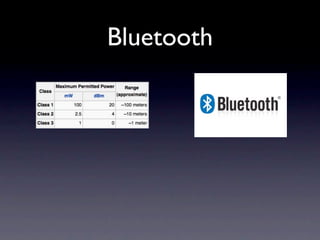
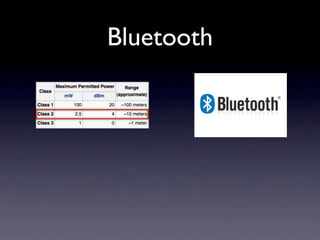
 • Bluetooth hardware limitations.
 • Server-less implementation.
Hardware Choices and
     Limitations
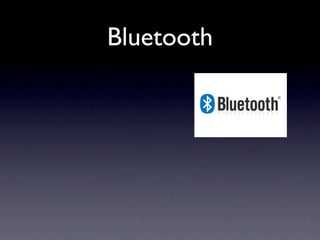
Androids Offers:
•  Bluetooth
• Wireless - Fidelity
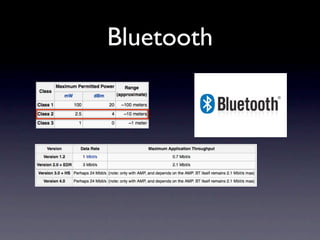
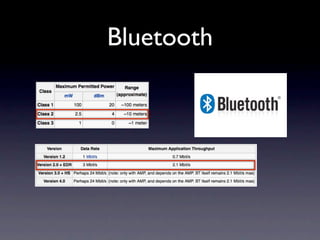
Bluetooth
Bluetooth
Bluetooth
Bluetooth
Bluetooth
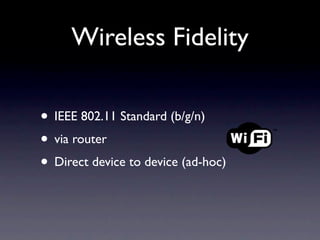
Wireless Fidelity

• IEEE 802.11 Standard (b/g/n)
• via router
• Direct device to device (ad-hoc)
Hardware Choices and
     Limitations
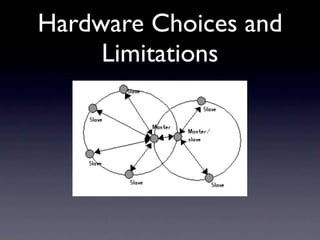
Focused on Bluetooth

 • Bluetooth has well defined apis
 • Wi-Fi ad-hoc mode not supported on
   android.
 • rooting is required for Wi-Fi ad-hoc.
Hardware Choices and
     Limitations
Hardware Choices and
     Limitations
AutoConnection

• Experimental feature to overcome in-ability
  to stay always discoverable.
• Centralized Geo-location indexing server.
• Maintain Bluetooth scatter-net topology.
Implementation Result
  and Performance

• Framework Overview
• Key Features
• Performance Metrics
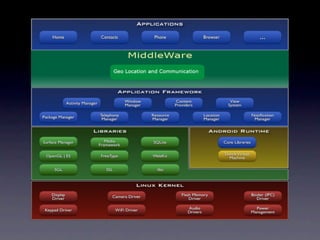
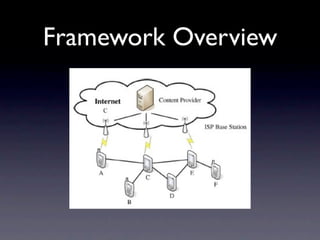
Framework Overview
Framework Overview
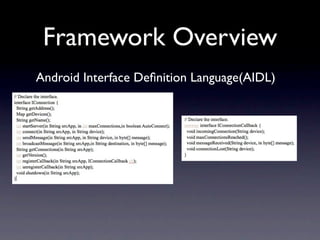
Android Interface Definition Language(AIDL)
Framework Overview
Use Cases:
• Ad-hoc gaming network
• Instant Messaging Application
• File Sharing
• Video Sharing
• Internet sharing
• Geo-location Triangulations, etcs
Key Features
• Open-Source
• No Rooting Required
• Packet Routing
• No need for Centralized Index Server
• Flow Control / Traffic Policing
• Auto Connections
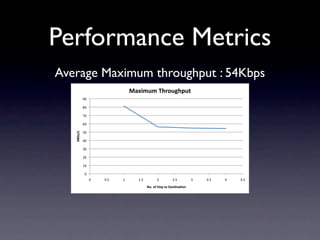
Performance Metrics
Average Maximum throughput : 54Kbps
                                     324#565'789)6:8-6$'
              +!"

              *!"

              )!"

              (!"

              '!"
   !"#$%&%'


              &!"

              %!"

              $!"

              #!"

               !"
                    !"   !,'"   #"     #,'"         $"       $,'"        %"   %,'"   &"   &,'"
                                              ()*')+',)-'$)'./%0120)1'
Demo
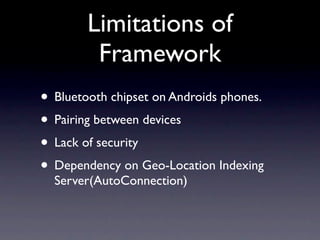
Limitations of
         Framework
• Bluetooth chipset on Androids phones.
• Pairing between devices
• Lack of security
• Dependency on Geo-Location Indexing
  Server(AutoConnection)
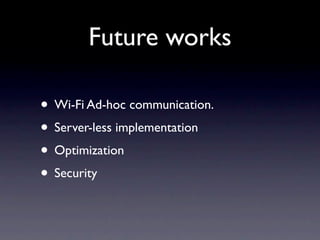
Future works

• Wi-Fi Ad-hoc communication.
• Server-less implementation
• Optimization
• Security
Q&A

heng+hong

Editor's Notes

  • #2 \n
  • #3 \n
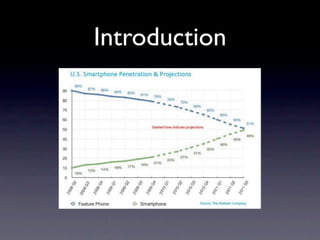
  • #4 In a recent report by Nielsen, smartphone penetration rate in US is predicted to reach over 50% reaching over 95 millions units in the 2011(Nielsen 2011). A smartphone, is defined here as a mobile phone “that offers more advanced computing ability and connectivity than a contemporary feature phone”(Nusca 2009)\n
  • #5 \n
  • #6 \n
  • #7 \n
  • #8 \n
  • #9 \n
  • #10 \n
  • #11 \n
  • #12 \n
  • #13 \n
  • #14 \n
  • #15 \n
  • #16 \n
  • #17 \n
  • #18 \n
  • #19 \n
  • #20 \n
  • #21 \n
  • #22 \n
  • #23 \n
  • #24 \n
  • #25 \n
  • #26 \n
  • #27 \n
  • #28 \n
  • #29 A open source peer to peer framework which allow for inter-connectivity between devices.\n
  • #30 \n
  • #31 \n
  • #32 \n
  • #33 According to the experimental measurements obtained from the transferring of multiple Image files of 350 - 380 kbytes, we observed that the throughput rate stabilizes at around 54Kbits/s for nodes that are more than 1 mores away from the original node.\n
  • #34 \n
  • #35 \n
  • #36 \n
  • #37 \n