ASSIGNMENT :
HEMP & SUNHEMP
SUBMITTED TO:
DR.GHULAM MUHAYUDIN
SUBMITTED BY:
MUHAMMAD SAMEER
ROLL NO:
FA19C1BA 320
SEMESTER:
6TH (PBG)
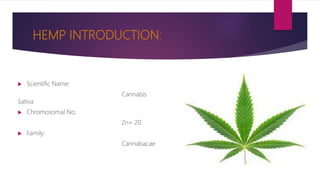
HEMP INTRODUCTION:
 Scientific Name:
Cannabis
Sativa
 Chromosomal No:
2n= 20
 Family:
Cannabacae
History & Origin:
 Hemp originated in Central Asia.
 Hemp cultivation for fibre was recorded in China as early as
2800 BCE.
 It was practiced in the Mediterranean countries of Europe early in
the Christian era, spreading throughout the rest of Europe during
the Middle Ages.
 It was planted in Chile in the 1500s and a century later in North
America.
CULTIVATION:
 Hemp is grown in temperate zones as an annual cultivated from seed and can
reach a height of up to 5 metres (16 feet).
 Crops grow best in sandy loam with good drainage and require average monthly
rainfall of at least 65 mm (2.5 inches) throughout the growing season.
 Crops cultivated for fibre are densely sowed and produce plants averaging 2–3
metres (6–10 feet) tall with almost no branching.
 Plants grown for oilseed are planted farther apart and are shorter and many-
branched.
 In fibre production, maximum yield and quality are obtained by harvesting soon
after the plants reach maturity, indicated by the full blossoms and freely shedding
pollen of the male plants
MORPHOLOGY:
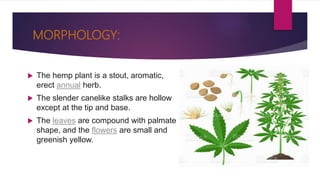
 The hemp plant is a stout, aromatic,
erect annual herb.
 The slender canelike stalks are hollow
except at the tip and base.
 The leaves are compound with palmate
shape, and the flowers are small and
greenish yellow.
MORPHOLOGY:
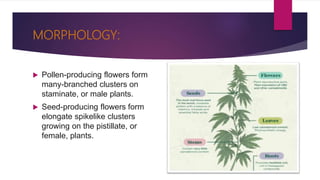
 Pollen-producing flowers form
many-branched clusters on
staminate, or male plants.
 Seed-producing flowers form
elongate spikelike clusters
growing on the pistillate, or
female, plants.
HARVESTING:
 In fibre production, maximum yield and quality are obtained by harvesting
soon after the plants reach maturity, indicated by the full blossoms and
freely shedding pollen of the male plants.
 Although sometimes pulled up by hand, plants are more often cut off
about 2.5 cm (1 inch) above the ground.
FIBER EXTRACTION:
 Fibres are obtained by subjecting the stalks to a series of operations—
including retting, drying, and crushing—and a shaking process that
completes separation from the woody portion, releasing the long, fairly
straight fibre, or line.
 The fibre strands, usually longer than 1.8 metres (5.8 feet), are made of
individual cylindrical cells with an irregular surface..
FIBER STRUCTURE:
 The fibre, longer and less flexible than flax, is usually yellowish, greenish,
or a dark brown or gray and, because it is not easily bleached to
sufficiently light shades, is rarely dyed. It is strong and durable and is
used for cordage.
 The fibre strands, usually longer than 1.8 metres (5.8 feet), are made of
individual cylindrical cells with an irregular surface.
USES OF HEMP:
 It is strong and durable and is used for cordage—e.g., twine, yarn,
rope, cable, and string—and for artificial sponges and such coarse
fabrics as sacking (burlap) and canvas.
 Some specially processed hemp has a whitish colour and attractive
lustre and is used to make fabric similar to linen for clothing.
Hemp textiles can be used to make shoes.
 Hemp fibre is used to make bioplastics that are recyclable and
biodegradable, depending on the formulation.
USES:
 The edible seeds contain about 30 percent oil and are a source
of protein, fibre, and magnesium.
 Shelled hemp seeds, sometimes called hemp hearts, are sold as a
health food and may be eaten raw; they are commonly sprinkled on salads
or blended with fruit smoothies.
 Hemp seed milk is used as an alternative to dairy milk in drinks and
recipes. The oil obtained from hemp seed can be used to make paints,
varnishes, soaps, and edible oil with a low smoke point.
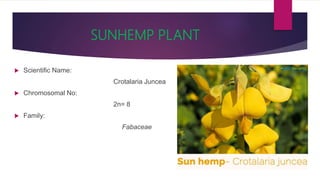
SUNHEMP PLANT
 Scientific Name:
Crotalaria Juncea
 Chromosomal No:
2n= 8
 Family:
Fabaceae
HISTORY & ORIGIN:
 Crotalaria juncea originated from India and has been cultivated there since the
earlier times of agriculture. It was first reported in Sanskrit literature in 400 BCE
(Sarkar et al., 2015).
 Sunn hemp is now widely cultivated in many tropical and subtropical areas in the
world, such as India, Bangladesh, Brazil, and even in cold temperate steppes
(Cook et al., 2005).
 In its main area of cultivation in India, sunn hemp is found from 17°N to 30°N and
grows at altitudes between sea level and 1500 m, where average annual
temperature ranges between 15-27.5°C.
 In Brazil, it grows from the Amazon belt to 22.5°S where the average annual
temperature range is 18-27°C.
CULTIVATION:
 Crotalaria juncea is propagated by seeds under moist and frost-free conditions,
sowing periods varying upon location and final use of sunn hemp.
 As a green manure, sunn hemp is mainly grown during the rainy season. Sunn hemp
should be preferably sown in a well-prepared, fertilized, weeded, seedbed to a depth
of 2-3 cm.
 Seeds can be broadcast or sown in rows. They germinate within 3 days under
favourable conditions. Sunn hemp is a fast growing species that suppresses weeds
by shading them out once sufficient height is reached .
 When grown for fibre, sunn hemp should be sown at higher seed rate in order to
promote erect growth, stem elongation and high quality fibre.
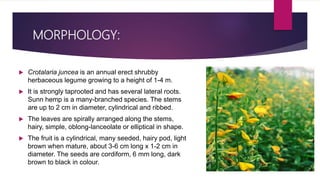
MORPHOLOGY:
 Crotalaria juncea is an annual erect shrubby
herbaceous legume growing to a height of 1-4 m.
 It is strongly taprooted and has several lateral roots.
Sunn hemp is a many-branched species. The stems
are up to 2 cm in diameter, cylindrical and ribbed.
 The leaves are spirally arranged along the stems,
hairy, simple, oblong-lanceolate or elliptical in shape.
 The fruit is a cylindrical, many seeded, hairy pod, light
brown when mature, about 3-6 cm long x 1-2 cm in
diameter. The seeds are cordiform, 6 mm long, dark
brown to black in colour.
HARVESTING & FIBER EXTRACTION:
 For grain purpose, harvesting is carried out 150 days after sowing. (From
mid-October to early November).
 When crop is raised for green manure purpose, 45-60 days after sowing
buried crop in soil.
 The main portion of the stem is left to dry on the ground during 1 to 6
days, depending on places, so that it shed its leaves and becomes ready
for retting.
 In some areas, stems are left up to 15 days on the ground and retting
occurs naturally thanks to morning dew
FIBER STRUCTURE:
 Sunn fibre is lustrous, with a whitish, gray, or yellow
colour.
 The fibre strands, about 1 to 1.5 metres (3.3 to 5 feet)
long, are composed of individual fibre cells,
cylindrically shaped and with striated surface
markings.
 Sunn fibre is almost as strong as hemp and more
durable than jute.
 It increases in strength when wet and is fairly resistant
to mildew.
USES OF SUNHEMP:
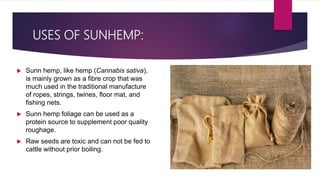
 Sunn hemp, like hemp (Cannabis sativa),
is mainly grown as a fibre crop that was
much used in the traditional manufacture
of ropes, strings, twines, floor mat, and
fishing nets.
 Sunn hemp foliage can be used as a
protein source to supplement poor quality
roughage.
 Raw seeds are toxic and can not be fed to
cattle without prior boiling.

HEMP & SUNHEMP Cultivation

  • 1.
    ASSIGNMENT : HEMP &SUNHEMP SUBMITTED TO: DR.GHULAM MUHAYUDIN SUBMITTED BY: MUHAMMAD SAMEER ROLL NO: FA19C1BA 320 SEMESTER: 6TH (PBG)
  • 2.
    HEMP INTRODUCTION:  ScientificName: Cannabis Sativa  Chromosomal No: 2n= 20  Family: Cannabacae
  • 3.
    History & Origin: Hemp originated in Central Asia.  Hemp cultivation for fibre was recorded in China as early as 2800 BCE.  It was practiced in the Mediterranean countries of Europe early in the Christian era, spreading throughout the rest of Europe during the Middle Ages.  It was planted in Chile in the 1500s and a century later in North America.
  • 4.
    CULTIVATION:  Hemp isgrown in temperate zones as an annual cultivated from seed and can reach a height of up to 5 metres (16 feet).  Crops grow best in sandy loam with good drainage and require average monthly rainfall of at least 65 mm (2.5 inches) throughout the growing season.  Crops cultivated for fibre are densely sowed and produce plants averaging 2–3 metres (6–10 feet) tall with almost no branching.  Plants grown for oilseed are planted farther apart and are shorter and many- branched.  In fibre production, maximum yield and quality are obtained by harvesting soon after the plants reach maturity, indicated by the full blossoms and freely shedding pollen of the male plants
  • 5.
    MORPHOLOGY:  The hempplant is a stout, aromatic, erect annual herb.  The slender canelike stalks are hollow except at the tip and base.  The leaves are compound with palmate shape, and the flowers are small and greenish yellow.
  • 6.
    MORPHOLOGY:  Pollen-producing flowersform many-branched clusters on staminate, or male plants.  Seed-producing flowers form elongate spikelike clusters growing on the pistillate, or female, plants.
  • 7.
    HARVESTING:  In fibreproduction, maximum yield and quality are obtained by harvesting soon after the plants reach maturity, indicated by the full blossoms and freely shedding pollen of the male plants.  Although sometimes pulled up by hand, plants are more often cut off about 2.5 cm (1 inch) above the ground.
  • 8.
    FIBER EXTRACTION:  Fibresare obtained by subjecting the stalks to a series of operations— including retting, drying, and crushing—and a shaking process that completes separation from the woody portion, releasing the long, fairly straight fibre, or line.  The fibre strands, usually longer than 1.8 metres (5.8 feet), are made of individual cylindrical cells with an irregular surface..
  • 9.
    FIBER STRUCTURE:  Thefibre, longer and less flexible than flax, is usually yellowish, greenish, or a dark brown or gray and, because it is not easily bleached to sufficiently light shades, is rarely dyed. It is strong and durable and is used for cordage.  The fibre strands, usually longer than 1.8 metres (5.8 feet), are made of individual cylindrical cells with an irregular surface.
  • 10.
    USES OF HEMP: It is strong and durable and is used for cordage—e.g., twine, yarn, rope, cable, and string—and for artificial sponges and such coarse fabrics as sacking (burlap) and canvas.  Some specially processed hemp has a whitish colour and attractive lustre and is used to make fabric similar to linen for clothing. Hemp textiles can be used to make shoes.  Hemp fibre is used to make bioplastics that are recyclable and biodegradable, depending on the formulation.
  • 11.
    USES:  The edibleseeds contain about 30 percent oil and are a source of protein, fibre, and magnesium.  Shelled hemp seeds, sometimes called hemp hearts, are sold as a health food and may be eaten raw; they are commonly sprinkled on salads or blended with fruit smoothies.  Hemp seed milk is used as an alternative to dairy milk in drinks and recipes. The oil obtained from hemp seed can be used to make paints, varnishes, soaps, and edible oil with a low smoke point.
  • 12.
    SUNHEMP PLANT  ScientificName: Crotalaria Juncea  Chromosomal No: 2n= 8  Family: Fabaceae
  • 13.
    HISTORY & ORIGIN: Crotalaria juncea originated from India and has been cultivated there since the earlier times of agriculture. It was first reported in Sanskrit literature in 400 BCE (Sarkar et al., 2015).  Sunn hemp is now widely cultivated in many tropical and subtropical areas in the world, such as India, Bangladesh, Brazil, and even in cold temperate steppes (Cook et al., 2005).  In its main area of cultivation in India, sunn hemp is found from 17°N to 30°N and grows at altitudes between sea level and 1500 m, where average annual temperature ranges between 15-27.5°C.  In Brazil, it grows from the Amazon belt to 22.5°S where the average annual temperature range is 18-27°C.
  • 14.
    CULTIVATION:  Crotalaria junceais propagated by seeds under moist and frost-free conditions, sowing periods varying upon location and final use of sunn hemp.  As a green manure, sunn hemp is mainly grown during the rainy season. Sunn hemp should be preferably sown in a well-prepared, fertilized, weeded, seedbed to a depth of 2-3 cm.  Seeds can be broadcast or sown in rows. They germinate within 3 days under favourable conditions. Sunn hemp is a fast growing species that suppresses weeds by shading them out once sufficient height is reached .  When grown for fibre, sunn hemp should be sown at higher seed rate in order to promote erect growth, stem elongation and high quality fibre.
  • 15.
    MORPHOLOGY:  Crotalaria junceais an annual erect shrubby herbaceous legume growing to a height of 1-4 m.  It is strongly taprooted and has several lateral roots. Sunn hemp is a many-branched species. The stems are up to 2 cm in diameter, cylindrical and ribbed.  The leaves are spirally arranged along the stems, hairy, simple, oblong-lanceolate or elliptical in shape.  The fruit is a cylindrical, many seeded, hairy pod, light brown when mature, about 3-6 cm long x 1-2 cm in diameter. The seeds are cordiform, 6 mm long, dark brown to black in colour.
  • 16.
    HARVESTING & FIBEREXTRACTION:  For grain purpose, harvesting is carried out 150 days after sowing. (From mid-October to early November).  When crop is raised for green manure purpose, 45-60 days after sowing buried crop in soil.  The main portion of the stem is left to dry on the ground during 1 to 6 days, depending on places, so that it shed its leaves and becomes ready for retting.  In some areas, stems are left up to 15 days on the ground and retting occurs naturally thanks to morning dew
  • 17.
    FIBER STRUCTURE:  Sunnfibre is lustrous, with a whitish, gray, or yellow colour.  The fibre strands, about 1 to 1.5 metres (3.3 to 5 feet) long, are composed of individual fibre cells, cylindrically shaped and with striated surface markings.  Sunn fibre is almost as strong as hemp and more durable than jute.  It increases in strength when wet and is fairly resistant to mildew.
  • 18.
    USES OF SUNHEMP: Sunn hemp, like hemp (Cannabis sativa), is mainly grown as a fibre crop that was much used in the traditional manufacture of ropes, strings, twines, floor mat, and fishing nets.  Sunn hemp foliage can be used as a protein source to supplement poor quality roughage.  Raw seeds are toxic and can not be fed to cattle without prior boiling.