HAEMOPHILIA
PRESENTATION BY : ASHISH RAJPUT
BAMS 4th Yr., Student
Desh Bhagat Ayurvedic
College & Hospital
Mandi Govindgarh.
WHAT IS HAEMOPHILIA ?
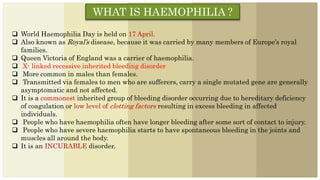
 World Haemophilia Day is held on 17 April.
 Also known as Royal’s disease, because it was carried by many members of Europe’s royal
families.
 Queen Victoria of England was a carrier of haemophilia.
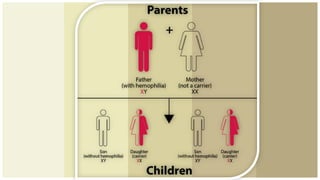
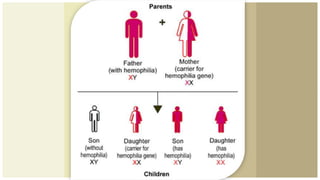
 X- linked recessive inherited bleeding disorder
 More common in males than females.
 Transmitted via females to men who are sufferers, carry a single mutated gene are generally
asymptomatic and not affected.
 It is a commonest inherited group of bleeding disorder occurring due to hereditary deficiency
of coagulation or low level of clotting factors resulting in excess bleeding in affected
individuals.
 People who have haemophilia often have longer bleeding after some sort of contact to injury.
 People who have severe haemophilia starts to have spontaneous bleeding in the joints and
muscles all around the body.
 It is an INCURABLE disorder.
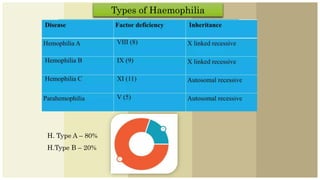
Types of Haemophilia
H. Type A – 80%
H.Type B – 20%
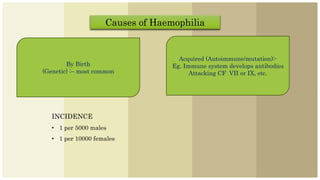
Causes of Haemophilia
By Birth
(Genetic) :– most common
Acquired (Autoimmune/mutation):-
Eg. Immune system develops antibodies
Attacking CF VII or IX, etc.
INCIDENCE
• 1 per 5000 males
• 1 per 10000 females
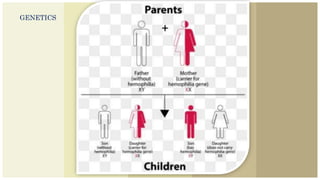
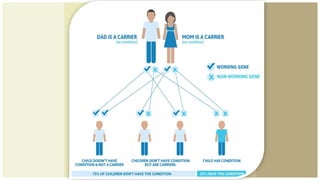
GENETICS
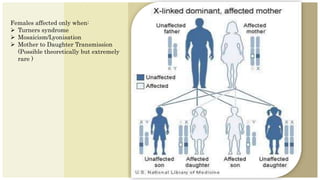
Females affected only when:
 Turners syndrome
 Mosaicism/Lyonisation
 Mother to Daughter Transmission
(Possible theoretically but extremely
rare )
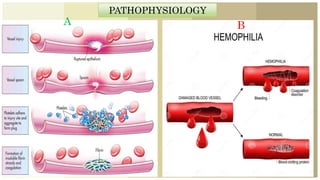
PATHOPHYSIOLOGY
A B
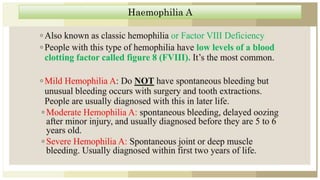
Haemophilia A
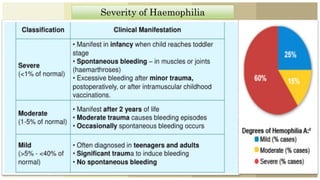
Severity of Haemophilia
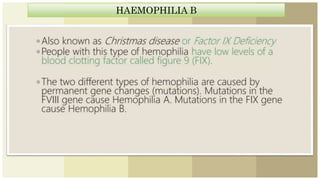
HAEMOPHILIA B
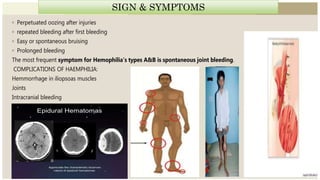
SIGN & SYMPTOMS
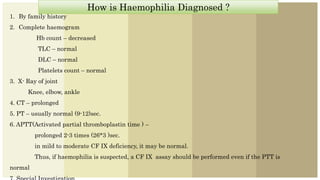
How is Haemophilia Diagnosed ?
1. By family history
2. Complete haemogram
Hb count – decreased
TLC – normal
DLC – normal
Platelets count – normal
3. X- Ray of joint
Knee, elbow, ankle
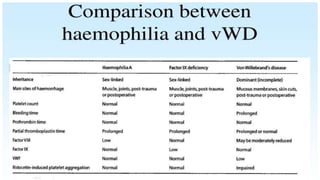
4. CT – prolonged
5. PT – usually normal (9-12)sec.
6. APTT(Activated partial thromboplastin time ) –
prolonged 2-3 times (26*3 )sec.
in mild to moderate CF IX deficiency, it may be normal.
Thus, if haemophilia is suspected, a CF IX assay should be performed even if the PTT is
normal
Management Options
Management Options
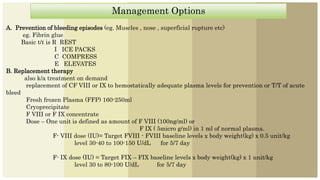
A. Prevention of bleeding episodes (eg. Muscles , nose , superficial rupture etc)
eg. Fibrin glue
Basic t/t is R REST
I ICE PACKS
C COMPRESS
E ELEVATES
B. Replacement therapy
also k/a treatment on demand
replacement of CF VIII or IX to hemostatically adequate plasma levels for prevention or T/T of acute
bleed
Fresh frozen Plasma (FFP) 160-250ml
Cryoprecipitate
F VIII or F IX concentrate
Dose – One unit is defined as amount of F VIII (100ng/ml) or
F IX ( 5micro g/ml) in 1 ml of normal plasma.
F- VIII dose (IU)= Target FVIII - FVIII baseline levels x body weight(kg) x 0.5 unit/kg
level 30-40 to 100-150 U/dL for 5/7 day
F- IX dose (IU) = Target FIX – FIX baseline levels x body weight(kg) x 1 unit/kg
level 30 to 80-100 U/dL for 5/7 day
Management Options
Management Options
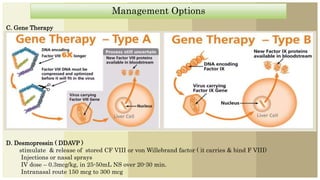
C. Gene Therapy
D. Desmopressin ( DDAVP )
stimulate & release of stored CF VIII or von Willebrand factor ( it carries & bind F VIII)
Injections or nasal sprays
IV dose – 0.3mcg/kg, in 25-50mL NS over 20-30 min.
Intranasal route 150 mcg to 300 mcg
Management Options
Management Options
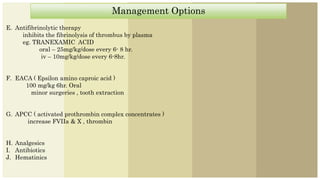
E. Antifibrinolytic therapy
inhibits the fibrinolysis of thrombus by plasma
eg. TRANEXAMIC ACID
oral – 25mg/kg/dose every 6- 8 hr.
iv – 10mg/kg/dose every 6-8hr.
F. EACA ( Epsilon amino caproic acid )
100 mg/kg 6hr. Oral
minor surgeries , tooth extraction
G. APCC ( activated prothrombin complex concentrates )
increase FVIIa & X , thrombin
H. Analgesics
I. Antibiotics
J. Hematinics
Prevention
• Aviod IM injections (apply 5min. Pressure)
• Avoid contact sports
• Orthopedic care – traction ,splinting ,reconstructive surgery
• Prophylactic immunisation
• Proper checkups & Councelling
• Avoid NSAIDS
Raise awareness about haemophilia & other bleeding
disorders & to promote advocacy & support for people.
World Haemophilia Day : Bleeding disorders

World Haemophilia Day : Bleeding disorders

  • 3.
    HAEMOPHILIA PRESENTATION BY :ASHISH RAJPUT BAMS 4th Yr., Student Desh Bhagat Ayurvedic College & Hospital Mandi Govindgarh.
  • 4.
    WHAT IS HAEMOPHILIA?  World Haemophilia Day is held on 17 April.  Also known as Royal’s disease, because it was carried by many members of Europe’s royal families.  Queen Victoria of England was a carrier of haemophilia.  X- linked recessive inherited bleeding disorder  More common in males than females.  Transmitted via females to men who are sufferers, carry a single mutated gene are generally asymptomatic and not affected.  It is a commonest inherited group of bleeding disorder occurring due to hereditary deficiency of coagulation or low level of clotting factors resulting in excess bleeding in affected individuals.  People who have haemophilia often have longer bleeding after some sort of contact to injury.  People who have severe haemophilia starts to have spontaneous bleeding in the joints and muscles all around the body.  It is an INCURABLE disorder.
  • 5.
    Types of Haemophilia H.Type A – 80% H.Type B – 20%
  • 6.
    Causes of Haemophilia ByBirth (Genetic) :– most common Acquired (Autoimmune/mutation):- Eg. Immune system develops antibodies Attacking CF VII or IX, etc. INCIDENCE • 1 per 5000 males • 1 per 10000 females
  • 7.
  • 11.
    Females affected onlywhen:  Turners syndrome  Mosaicism/Lyonisation  Mother to Daughter Transmission (Possible theoretically but extremely rare )
  • 12.
  • 13.
  • 14.
  • 16.
  • 17.
  • 18.
    How is HaemophiliaDiagnosed ? 1. By family history 2. Complete haemogram Hb count – decreased TLC – normal DLC – normal Platelets count – normal 3. X- Ray of joint Knee, elbow, ankle 4. CT – prolonged 5. PT – usually normal (9-12)sec. 6. APTT(Activated partial thromboplastin time ) – prolonged 2-3 times (26*3 )sec. in mild to moderate CF IX deficiency, it may be normal. Thus, if haemophilia is suspected, a CF IX assay should be performed even if the PTT is normal
  • 20.
    Management Options Management Options A.Prevention of bleeding episodes (eg. Muscles , nose , superficial rupture etc) eg. Fibrin glue Basic t/t is R REST I ICE PACKS C COMPRESS E ELEVATES B. Replacement therapy also k/a treatment on demand replacement of CF VIII or IX to hemostatically adequate plasma levels for prevention or T/T of acute bleed Fresh frozen Plasma (FFP) 160-250ml Cryoprecipitate F VIII or F IX concentrate Dose – One unit is defined as amount of F VIII (100ng/ml) or F IX ( 5micro g/ml) in 1 ml of normal plasma. F- VIII dose (IU)= Target FVIII - FVIII baseline levels x body weight(kg) x 0.5 unit/kg level 30-40 to 100-150 U/dL for 5/7 day F- IX dose (IU) = Target FIX – FIX baseline levels x body weight(kg) x 1 unit/kg level 30 to 80-100 U/dL for 5/7 day
  • 21.
    Management Options Management Options C.Gene Therapy D. Desmopressin ( DDAVP ) stimulate & release of stored CF VIII or von Willebrand factor ( it carries & bind F VIII) Injections or nasal sprays IV dose – 0.3mcg/kg, in 25-50mL NS over 20-30 min. Intranasal route 150 mcg to 300 mcg
  • 22.
    Management Options Management Options E.Antifibrinolytic therapy inhibits the fibrinolysis of thrombus by plasma eg. TRANEXAMIC ACID oral – 25mg/kg/dose every 6- 8 hr. iv – 10mg/kg/dose every 6-8hr. F. EACA ( Epsilon amino caproic acid ) 100 mg/kg 6hr. Oral minor surgeries , tooth extraction G. APCC ( activated prothrombin complex concentrates ) increase FVIIa & X , thrombin H. Analgesics I. Antibiotics J. Hematinics
  • 23.
    Prevention • Aviod IMinjections (apply 5min. Pressure) • Avoid contact sports • Orthopedic care – traction ,splinting ,reconstructive surgery • Prophylactic immunisation • Proper checkups & Councelling • Avoid NSAIDS
  • 24.
    Raise awareness abouthaemophilia & other bleeding disorders & to promote advocacy & support for people.